Bloomberg

Khamenei Slams Iran Protests as Forces Target Universities

(Bloomberg) —  

Sign up for our Middle East newsletter and follow us @middleeast for news on the region.

Iran’s Supreme Leader said protests currently gripping the country were “planned riots” designed by the US and Israel, voicing solidarity with his security forces a day after they besieged scores of students on a university campus in Tehran.

In his first comments addressing the protests, Ayatollah Ali Khamenei said the death of Mahsa Amini, a 22-year-old woman who fell into a coma while being detained by “morality police” for allegedly flouting strict Islamic dress codes, was “heart-wrenching” but the response of protesters was “not normal” and the security forces had been “wronged.”

Amini’s death on Sept. 16 triggered an outpouring of anger that has grown into broad nationwide protests against the Islamic Republic at a time of record inflation and as negotiations to revive the 2015 nuclear deal founder. The state’s harsh response to the protests has drawn criticism from the international community, including the European Union, which is mediating between Tehran and Washington in the nuclear talks. 

Security forces have cracked down heavily on dissent, using tear gas, paint guns, shotguns, Tasers and water cannon against demonstrators, many of whom are young women and men, leading calls for an end to laws that are seen to heavily curtail civil liberties and human rights. 

The Oslo-based Iran Human Rights said on Sunday that 133 people have been killed by security forces so far, including 41 in the southeast province of Sistan-Baluchestan during an attack on Friday prayers on Sept. 30. Iran’s government hasn’t given a death toll for the unrest since Sept. 24, when it said 41 people had been killed.

University Protests

The latest major standoff between protesters, militias and police, started on Sunday afternoon when a large number of students held sit-ins and protests outside the computer engineering faculty of the Sharif University of Technology in Tehran, according to an account published by the Islamic Association of Students of Sharif University, on Twitter and Telegram. 

The association said more than 30 students were arrested and Oct. 2 would go down as a “bloody day” for the university.

University campuses were a critical driver of the 1979 revolution and students formed a core part of opposition groups that toppled the Shah of Iran. The Islamic Republic has always heavily controlled and suppressed political activity at universities.

The protests at Sharif were part of broad demonstrations across university campuses on Sunday, including in Kerman and Esfahan. Unconfirmed reports on social media show demonstrations continuing on some campuses on Monday morning, in support of the Sharif students.

Mobile phone footage shared on social media shows plainclothes Islamic militias — known as Basij — and armed police attacking students with clubs and firing tear gas, with gunfire heard in some clips. The association said police fired paintball guns and shotgun pellets at the students.

Video circulated widely on Twitter late on Sunday showed a large group of student protesters being chased through the university’s underground parking, running to find cover from security forces mounted on motorbikes and firing guns into the air. None of the video can be verified by Bloomberg.

According to the student association, the students had gone into the parking lot after a number of professors attending the rally reached an agreement with police to allow them safe passage to their dormitories. The students instead found themselves being chased by security forces who were waiting for them inside the parking lot. 

The Islamic Association of Students of Sharif University has called for a strike by students and teachers and for the suspension of all teaching in solidarity with the protesters. The state-run Islamic Republic News Agency said classes will be taught online until further notice. 

Why a Woman’s Death in Iran Has Ignited New Protests: QuickTake

More stories like this are available on bloomberg.com

©2022 Bloomberg L.P.

EU Aims for Russia Sanctions Deal Today, Including Oil Price Cap

(Bloomberg) — The European Union is aiming for a preliminary deal as soon as Monday on a new sanctions package meant to punish Russia for escalating its war in Ukraine and illegally annexing four occupied territories there.

“I am hopeful in a couple of hours we can have a unanimous agreement on the sanctions package,” Polish ambassador to the EU, Andrzej Sados, told reporters. “We are very close to it and there is determination to clinch a deal ASAP.”

Sados said the deal would likely include political backing for imposing a price cap on Russian oil, with the exact level of the cap to be unanimously approved at a later stage.

Member states are eager to reach an agreement before EU leaders meet in Prague on Oct. 7, said people familiar with the matter, who asked not to be identified because the discussions are private. 

Hungary has been an obstacle in the discussions, according to the people. A group of countries including Greece, Cyprus and Malta, which have large shipping industries, has also expressed concern that they would be affected by curbs on transporting Russian oil. Sanctions decisions in the EU require unanimity, giving each country an effective veto.

Chemicals, Aviation

The broader sanctions package would also target a range of individuals and entities, including senior Russian ministry officials and people involved in staging the recent, widely condemned referendums. It would also restrict access to aviation items, electronic components and specific chemical substances to deprive Russia’s military from important technologies. 

Read more: EU Aims to Exempt Maritime Pilot Services From Russia Oil Ban

Some nations are upset that the latest draft of the sanctions appears to have weakened several of the proposed measures, including the removal of a Russian diamond mining company from the penalty list, one of the people said.

The sanctions would add a ban on shipping Russian oil, but carve out an exemption for oil priced at or under a level set by a coalition of the Group of Seven and other countries, according to a draft of the proposal seen by Bloomberg. 

To allow for an oil price cap, the bloc will have to change its current legislation. In June, EU nations agreed to a full ban on insurance and financial services for seaborne oil, while shipping was spared from the restrictions. Most of those prohibitions are due to kick in Dec. 5 alongside a ban on EU purchases of Russian crude.

The G-7, which endorsed a cap earlier this month, has said it wants an agreement in place before that date.

More stories like this are available on bloomberg.com

©2022 Bloomberg L.P.

Prosus Cancels $4.7 Billion Acquisition of India’s BillDesk

(Bloomberg) — Prosus NV has canceled a $4.7 billion deal to buy Indian payments firm BillDesk after a collapse in valuations for major tech startups. 

The deal, set to be the largest acquisition by Prosus, was canceled after “certain conditions precedent” weren’t met by the end of September, Prosus said in a statement on Monday. The company didn’t elaborate on the conditions. 

“When Prosus struck the deal prices for technology companies were very different,” said FNB portfolio manager Wayne McCurrie by phone. “With it falling through, it means they won’t be buying an overvalued asset and can conserve cash.”

BillDesk will pursue all options to keep the deal alive, two people familiar with the matter said, who asked not to be named discussing sensitive information. 

Representatives for BillDesk didn’t immediately respond to a request for comment. A spokesperson for Prosus declined to comment beyond the company statement. 

Prosus has invested close to $6 billion in Indian technology companies since 2005. The BillDesk deal would help increase the scale its other businesses, including payments, that are dwarfed by the value of its stake in Chinese game-maker Tencent. 

The BillDesk deal had already received approval by the Competition Commission of India in September. A second and final regulatory clearance from with India’s financial regulator the Reserve Bank of India, was needed for the deal to be completed. An application with the central bank was submitted, one of the people said.

Read More: Prosus Strikes Deal to Buy India’s BillDesk for $4.7 Billion

BillDesk, founded by three consultants from Arthur Andersen LLP more than two decades ago, benefited from a surge in growth in digital payments as Indians adopted smartphones and Internet access became ubiquitous. The founders stood to collect $500 million each from the deal, Bloomberg News reported when it was announced. 

Since the deal was announced in August last year, technology firms and stocks worldwide has experienced significant sell-off and devaluations, following an increase in regulatory pressures, inflation and a concern that the global economy will tip into recession.

The Dutch ecommerce investor has since been selling off stakes in its holdings in Chinese Internet giants Tencent Holdings Ltd. and JD.com Inc. to help fund a share buyback.

“Many valuations have declined since the deal was announced, and Prosus’ broad scale and financial firepower mean it can afford to wait,” said Bloomberg Intelligence analyst John Davies. “In June, it announced a move to a more conservative investment strategy alongside its Tencent selldown,” he pointed out. 

Read More: Indian Trio Reap $500 Million Each Selling Payments Startup

Prosus said its full-year operating loss narrowed to $859 million in the year through March from more than $1 billion, though core headline earnings per shares for the period — Prosus’s preferred measure of analyzing its finances — declined. 

Prosus shares were down 0.8% at 11:39 a.m. in Amsterdam trading on Monday. The stock has declined about 27% this year.

(Updates with additional market comments, background)

More stories like this are available on bloomberg.com

©2022 Bloomberg L.P.

Deliveroo Opens Brick-and-Mortar Grocery Shop in Central London

(Bloomberg) —

Deliveroo Plc is opening its first physical grocery outlet in the UK on central London’s New Oxford Street in an expansion of its rapid delivery service.

Customers will be able to purchase items by ordering through digital kiosks in the store, ordering ahead via the Deliveroo app for in-store collection or for delivery nearby from Monday, according to a statement. The new effort from the London-based food delivery company builds on its partnership with grocery chain Wm Morrison Supermarkets Plc. 

Read more: Deliveroo, Morrison Test London Dark Store for Fast Delivery 

Traditional retail stores have been shrinking or shutting down, hit by online shopping and the pandemic. Despite the collapse, online-focused firms have been entering the market. Amazon.com Inc., the largest shareholder in Deliveroo, now runs a number of cashier-less convenience stores throughout London.

With shoppers now also cutting back on online-shopping, Deliveroo has been turning to new avenues for revenue. In its latest financial report, Deliveroo said its loss widened less than expected thanks to sales from its new ad platform. 

For more than a year, Deliveroo has been rolling out its Hop service offering rapid delivery of groceries from micro-fulfillment centers. There are now 16 such sites across the UK, France, Italy, Hong Kong and the UAE, a company representative said. 

More stories like this are available on bloomberg.com

©2022 Bloomberg L.P.

Tesla Slumps as Deliveries Disappoint Due to Logistic Snarls

(Bloomberg) — Tesla Inc. shares dropped in early trading after the carmaker blamed a disappointing deliveries report on shipment issues that increased the number of vehicles that were on their way to customers as the quarter came to a close.

The maker of Model 3 sedans and Model Y crossovers handed over 343,830 vehicles to customers in the last three months, short of the almost 358,000 total that analysts expected. The stock traded down as much as 6.5% to $248 before the start of regular trading Monday.

Tesla has for years delivered big batches of vehicles toward the end of each quarter, a practice Chief Executive Officer Elon Musk has said he’s trying to move away from by localizing production in all major regions. While the carmaker opened its first European factory in Germany in March, record shipping costs are bedeviling the auto industry along with shortages of materials and components including semiconductors.

“As our production volumes continue to grow, it is becoming increasingly challenging to secure vehicle transportation capacity and at a reasonable cost during these peak logistics weeks,” Tesla said in a statement Sunday. “In Q3, we began transitioning to a more even regional mix of vehicle builds each week, which led to an increase in cars in transit at the end of the quarter.”

Quarterly deliveries are among the most closely watched indicators for Tesla, as they underpin the carmaker’s financial results. Legacy automakers and new entrants alike are bringing more EVs to market to take on Tesla, which has led the charge for battery-powered cars since the Model S sedan debuted a decade ago.

“Naysayers on the Tesla story will point to the shortfall in 3Q as a demand issue,” Jeffrey Osborne, an analyst at Cowen & Co. with the equivalent of a holding rating on the shares, wrote in a report. “Monthly registrations and 4Q results will need to be monitored to better assess the situation.”

Tesla had said that its delivery count is conservative and that final numbers could vary by 0.5% or more. The company produced 365,923 vehicles for the quarter.


Tesla doesn’t break out sales by geography, but the US and China are its largest markets. The Model 3 and Model Y accounted for almost 95% of last quarter’s deliveries. The company also makes the Model S and X at its factory in Fremont, California.

The delivery figures came on the heels of Tesla’s AI Day event, held after the close on Sept. 30. Musk showed off a prototype humanoid that walked and raised its hands just over a year after a human dressed as robot danced on stage during a similar showcase of the company’s artificial intelligence efforts in August 2021.

“One of the main purposes of hosting AI day 2 was to attract talent,” Ben Kallo, a Baird analyst who rates Tesla the equivalent of a buy, said in a note. “This is a critical piece of advancing its initiatives as the shortage of laborers in the market continues, specifically for highly trained engineers.”

Read more: Tesla Shows Latest Robot Prototype With Opposable Thumbs

(Updates with analyst’s comment in the fourth paragraph.)

More stories like this are available on bloomberg.com

©2022 Bloomberg L.P.

Temasek’s 65 Equity Partners Pours $80 Million Into ShopBack

(Bloomberg) — ShopBack, an online shopping rewards app backed by Singapore’s Temasek Holdings Pte, raised $80 million from the state investment giant’s late stage fund as it works toward going public.

Temasek’s 65 Equity Partners Holdings Pte will join the Singapore-based startup’s extended Series F round, ShopBack said in a statement on Monday. The round brings the total capital raised by ShopBack to more than $310 million.

The funding round values the company at close to $1 billion, according to a person with knowledge of the matter. The startup is preparing for a stock exchange listing though has made no decisions on the timing, co-founder Henry Chan said in an interview. 

“We’re very focused on being listing-ready,” said Chan, who is also the company’s chief executive officer. “That way we can decide to act on macro winds as they turn in the coming months or years.”

The Singapore stock exchange is a “viable” primary or secondary listing venue for ShopBack, Chan said, adding that the company is also considering other possibilities including Hong Kong, Australia and New York. “We’re still very early in our public-readiness journey and we have not nailed down an exact listing venue,” he said.

ShopBack, whose investors include SoftBank Ventures Asia and Rakuten Capital, offers cashback and other rewards for brands and retailers including Dyson, Lululemon and Foodpanda. It’s adding users as e-commerce gains popularity in the Asia-Pacific region.

The new injection from 65 Equity Partners brings the total raised for this round to about $160 million, slightly more than the target of about $150 million that Bloomberg News reported in February.

Founded in 2014 by Chan and Joel Leong, the platform has expanded to 10 markets across Southeast Asia, Australia, South Korea and Taiwan, according to its website. A representative of 65 Equity Partners will get a ShopBack board seat, joining investors including East Ventures’ Willson Cuaca and Asia Partners’ Nicholas Nash.

The company raised $75 million in a funding round from investors including Temasek, Rakuten and East Ventures in 2020, and bought fintech startup Hoolah late last year to add “buy now, pay later” services.

Following the acquisition of Hoolah, ShopBack appointed Hamish Moline, former chief commercial officer of Australian fintech company Zip Co., as its managing director for financial services.

(Updates with comments from CEO starting in third paragraph)

More stories like this are available on bloomberg.com

©2022 Bloomberg L.P.

Europe’s Factory Slump Heightens Recession Risk as Asia Mixed

(Bloomberg) — The manufacturing industry deteriorated further across Europe last month because of the impact of the war in Ukraine, while factories in Asia painted a mixed picture.

The purchasing managers index for the 19-nation euro zone, a gauge of private-sector activity, fell to 48.4 from 49.6 in August. That’s slightly worse than S&P Global’s initial reading and marks the third consecutive month below the 50 threshold that separates expansion from contraction.

Readings for the euro area’s four biggest economies were also below this key level, highlighting the increasingly gloomy outlook for the region hardest hit by the conflict on its eastern border. A recession in the bloc is looking increasingly likely amid heightened threats of power restrictions.

“The ugly combination of a manufacturing sector in recession and rising inflationary pressures will add further to concerns about the outlook for the euro zone economy,” Chris Williamson, an economist at S&P Global, said on Monday. “Worse looks set to come, with orders slumping at a significantly steeper rate than production is being cut.”

In Asia, factories displayed a split track of recovery in September, with manufacturing powerhouses in the north turning weak and key supply chain hubs in the south showing resilience amid China’s growth slowdown.  

Gauges for much of Southeast Asia showed improvement, with Indonesia at 53.7, matching its January reading for the best this year. Thailand’s reading was a record high in data back to 2016, and the Philippines also edged up in September. Malaysia was a rare weakening in Southeast Asia, slipping to 49.1 after 50.3 in August.

North Asia revealed more of the pain in September PMIs. Taiwan and Japan eased from the prior month, with Taiwan’s PMI slumping to 42.2, its worst since the pandemic-era low in May 2020, according to S&P Global. South Korea’s PMI is set to be reported Tuesday.

The factory figures are one piece of an increasingly downbeat outlook for the global economy, with a wave of interest-rate hikes yet to defeat rampant inflation and growth concerns on the rise. China’s economic slowdown is starting to weigh more heavily on trade-reliant neighbors, and supply-chain backups have persisted worldwide.

Slumping demand for technology and semiconductors is hammering exports from Asia’s northeast manufacturing powerhouses including South Korea, Taiwan and Japan, and weighing on sentiment among producers. 

Confidence among Japan’s large manufacturers unexpectedly worsened for three straight quarters following the yen’s rapid depreciation and worsening global economic outlook. An index of sentiment among the country’s biggest manufacturers declined to 8 in September from 9, according to the Bank of Japan’s quarterly Tankan report released Monday.

Companies are not expecting improvement “anytime soon,” as business confidence for the year ahead hit its second-lowest level on record, Annabel Fiddes, economics associate director at S&P Global Market Intelligence, said in a release. “This was driven be fears that global economic conditions will weaken further, and demand across key markets across Asia, Europe and the US will continue to decline in the months ahead.”

China’s official manufacturing purchasing managers index rose last month to 50.1 — barely into expansion territory — from 49.4 in August, according to a statement from the National Bureau of Statistics on Friday.

While China’s PMIs are showing nascent signs of bottoming, economists are warning that the brunt of the hit for Asia exporters is still to come. Factories in Taiwan saw the quickest drop in output and sales since May 2020 and inventories slumped at the fastest rate in over a decade.

US data and a global reading for manufacturing PMIs are due later on Monday.

More stories like this are available on bloomberg.com

©2022 Bloomberg L.P.

Ian Latest: Death Toll Climbs as Biden Plans Florida Visit

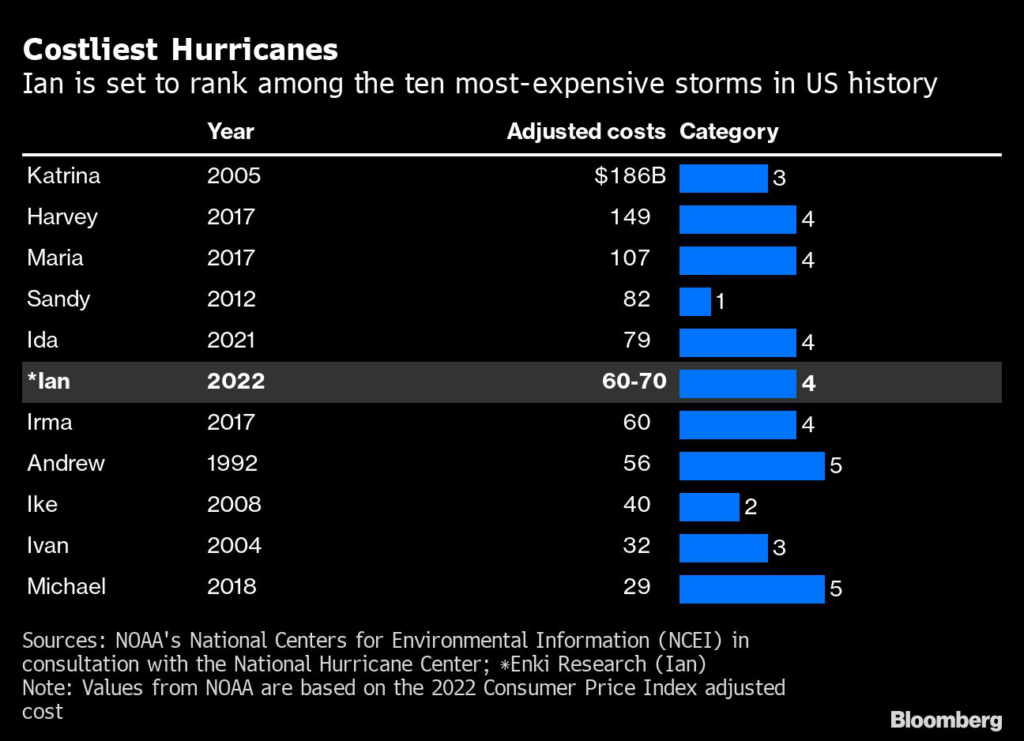
(Bloomberg) — The death toll from Hurricane Ian rose further as Joe Biden plans to visit Florida on Wednesday to survey the catastrophic damage left behind by one of the strongest storms to make landfall in the United States. 

Ahead of his trip to the state, the president will go to Puerto Rico on Monday, which was hit earlier in September by Hurricane Fiona, the White House said. Biden, who has pledged to commit the full strength of the federal government to recovery efforts, said on Saturday that Florida’s hurricane damage is “likely to rank among the worst” in US history. Power and communications operators reported a significant return of services on Sunday. 

At least 68 people have been confirmed dead: 61 in Florida, four in North Carolina and three in Cuba, the Associated Press reported. 

Ian, which had weakened to a post-tropical cyclone, “fully dissipated overnight” Saturday, the National Weather Service reported. “Widespread showers and storms” will continue in the mid-Atlantic and central Appalachians, reaching southern New Jersey. 


Death Toll From Ian Rises to At least 68 (4:44 a.m NY time)

At least 68 people have been confirmed dead: 61 in Florida, four in North Carolina and three in Cuba, the Associated Press reported. Deanne Criswell, administrator of the Federal Emergency Management Agency, told the news wire that the federal government was ready to help in a “huge way,” focusing first on victims in Florida, which took the brunt of one of the strongest storms to make landfall in the United States.

More than 640,000 in Florida Still Without Power (11:34 p.m.)

More than 640,000 customers in Florida are still without power, according to PowerOutage.us. Electricity has been restored to more than 1.8 million user accounts across the state, figures from the Florida Division of Emergency Management showed on Sunday.

Governor Ron DeSantis visited the cities of North Port and Arcadia over the weekend, where flooding hasn’t subsided, according to local media reports.

Lee County Reports 42 Deaths Amid Rising Florida Toll (6:32 p.m.)

The death toll in Florida is rising, though the numbers remained uncertain and incomplete amid ongoing searches through masses of wreckage.   

In Lee County, on the state’s southwest coast, Sheriff Carmine Marceno said on Sunday that 42 people had died there.

“We have buildings, multiple-floor buildings that have been washed out, OK? It is incomprehensible what we’re looking at,” Marceno said. “Those numbers could go up. I don’t know. I pray and hope that they don’t.”

On Saturday night, the Florida Medical Examiners Commission released a count of 44 dead across the state, including 30 in Lee County. The commission had not updated the toll on Sunday. 

Florida Cell Service Returning With Gaps in Hard-Hit Areas (3:51 p.m.)

Cell-service has been restored across most of Florida, though the hardest-hit counties are still experiencing significant zones without signal, according to a report from the Federal Communications Commission Sunday. 

The report listed the top counties by percentage with cell sites still not operational: DeSoto 38.5%; Hardee 33.3%; Charlotte 20.2%; and Lee 19.5%.

Governor Ron DeSantis announced Saturday that Elon Musks’s SpaceX will deploy 120 units of its Starlink satellites to southwest Florida to provide Internet service for those affected.

More Than 820,000 in Florida Remain Without Power (1:12 p.m.)

About 822,000 customers remain without power in Florida, according to PowerOutage.US. That’s a recovery from the peak of 2.7 million customers without power after Hurricane Ian made landfall in southwest Florida on Wednesday. 

In North Carolina, where the storm hit on Friday, there are close to 21,000 customers without power.

‘Old Florida’ Flattened by Hurricane, Rubio Says (12:21 p.m.)

Some of Florida’s oldest and most popular beach destinations devastated by Hurricane Ian will never look the same, Senator Marco Rubio said on Sunday.

Fort Myers Beach, a seaside tourist town, “no longer exists,” Rubio said on ABC’s “This Week.” Sanibel Island, another barrier island along Florida’s southwest coast, has also been ravaged, he said. 

“This is a character-altering event,” he said. 

FEMA Head Warns of Post-Storm Hazards (9:50 a.m.)

People working to clean up after Hurricane Ian need to “stay vigilant right now” because of the potential danger amid debris, downed power lines and other hazards, warned Deanne Criswell, administrator of the Federal Emergency Management Agency. 

“We see so many more injuries and sometimes more fatalities after the storm, because there are so many dangers out there,” Criswell said on “Fox News Sunday.” “Standing water brings with it all kinds of hazards…We want to make sure that people are being extra cautious.”

Biden to Visit Puerto Rico, Florida (10:39 p.m.)

President Joe Biden will travel to Puerto Rico on Monday and Florida on Wednesday to survey the damage there after vowing to commit the full strength of the federal government to recovery efforts in the wake of two devastating hurricanes.

The president will be accompanied by the first lady, the White House said.

Ian Expected to End by Sunday Morning (5:12 p.m.)

Storm Ian is expected to dissipate on Sunday morning, the National Weather Service said in an update. By 5 p.m., the storm had slowed over Virginia, moving east-northeast at about 6 miles an hour with maximum sustained winds near 25 miles per hour, the service reported.

Central Florida will continue to experience “major to record” river flooding through next week. Areas of Maryland and West Virginia may also experience several inches of rain into Sunday morning, with the potential of some flooding.

Four Die in North Carolina (4:06 p.m.)

Four storm-related deaths were reported in North Carolina: one drowning, two in vehicle accidents and one poisoned by carbon monoxide from a generator, Governor Roy Cooper’s office reported. 

Power was restored to about half the 418,000 customers who had lost electricity on Friday night, his office said in a press release Saturday.

No Deaths in South Carolina, Governor Says (3:09 p.m.)

South Carolina suffered no deaths despite being hit by winds as high as 92 miles an hour from Hurricane Ian on Friday, Governor Henry McMaster said in a press briefing Saturday. Unlike Florida, there has been relatively little flooding, and most electricity has already been restored, he said.

“We know that we have much cleaning up and rebuilding to do,” McMaster said. “There’s some heartbreak, there’s work to be done. But all in all it’s a good story.”

Florida Governor Says Flooding Did Most Damage (2:47 p.m. NY)

Florida suffered more damage from flooding caused by Hurricane Ian than strong winds, Governor Ron DeSantis said Saturday.

“When you’ve got a torrent of water coming in, there’s really nothing you can do about that, so that’ll require a lot of flood claims being filed,” DeSantis said at a news briefing in Fort Myers. 

DeSantis added that nearly 55% of power has been restored to those affected by power outages. Power has been restored to 1.5 million customers serviced by Florida Power & Light, with another 650,000 customers still without power, said FPL president and chief executive officer Eric Silagy. 

Biden Briefed on Damage, Restoration of Power and Water (2:26 p.m.)

President Joe Biden was briefed by advisers including Chief of Staff Ron Klain on the damage from the storm, focusing on power and water restoration in Florida and damage in South Carolina, White House Press Secretary Karine Jean-Pierre said in a tweet.

Ian Weakens as It Moves North (12:15 a.m.)

Post-tropical cyclone Ian continued to weaken midday Saturday as it moved north through North Carolina and toward Virginia, according to a National Weather Service update at 11 a.m. 

Maximum sustained winds slowed to to 25 mph (40 kph), the service reported. Another 1-3 inches or rain was expected to fall across the central Appalachians and mid-Atlantic, “with local heavier amounts possible.” 

Across central Florida, “major to record river flooding” is expected over the next week.

Biden Calls Storm Damage ‘Among Worst’ Ever in US (10:41 a.m.)

President Biden said the damage from storm Ian “is likely to rank among the worst” in US history. 

Few Florida Homes Covered for Flooding (9:12 a.m.)

A majority of Florida homeowners caught in the hurricane’s path now face rebuilding without the benefit of flood insurance — and some might not even realize they’re uncovered.

Only 18% of all Florida homes — of which there more than 10 million, per census data — have flood insurance, according to the Insurance Information Institute. And some property owners harbor the misconception that policies protecting against damage from wind and rain will also apply to losses brought on by rising water.

Officials in Florida County Delayed Evacuation, NYT Says (3:53 a.m.)

Emergency officials in Lee County, Florida, only issued a mandatory evacuation order for the areas likely to be hit the most by Hurricane Ian on Tuesday, giving residents less time to evacuate, the New York Times reported.

While much of the areas set to be affected had told their residents to flee on Monday, Lee County officials opted to wait to see how forecasts for the hurricane evolved overnight. At least 16 storm-related deaths have been identified in Lee County, the highest toll anywhere in the state, the newspaper said.

Biden Declares Emergency in North Carolina (1:51 a.m.)

US President Joe Biden has declared an emergency in the state of North Carolina in the wake of Hurricane Ian, and ordered federal assistance to supplement response efforts, according to a statement released by the White House. 

Cuba Requests US Aid After Devastation, WSJ Says (7:38 p.m.)

Cuba’s government is seeking emergency assistance from the US in the aftermath of Ian’s devastation, the Wall Street Journal reported, citing email communications.

No exact amount was requested and the US is trying to determine if Cuba will supplement its request, the newspaper said. Havana is making the rare request as it contends with an economic crisis and while its longtime supporter Russia struggles with the war in Ukraine.   

More stories like this are available on bloomberg.com

©2022 Bloomberg L.P.

Is Web3 Really Going That Great?

  • Listen to Bloomberg Crypto on the iHeartRadio App
  • Listen to Bloomberg Crypto on Apple Podcasts
  • Listen to Bloomberg Crypto on Spotify  

(Bloomberg) — Perhaps you’ve heard of Molly White. The software engineer and crypto skeptic has been profiled in the Washington Post, Fast Company, and the Boston Globe. 

She has more than 80,000 followers on her personal Twitter account, and more than 100,000 on an account called “web3 is going just great.” It is, as you might guess, a chronicle of all the ways that web3 is not going so well.

Molly White joins this episode to talk through her skepticism of digital assets.

Follow us on Twitter @crypto, and subscribe to the Bloomberg Crypto Newsletter at https://bloom.bg/cryptonewsletter

More stories like this are available on bloomberg.com

©2022 Bloomberg L.P.

Porsche Shares Drop Below IPO Price Within Days of Making Debut

(Bloomberg) — Porsche AG stock traded below the price it debuted at last week, succumbing to the market pressures Volkswagen AG defied by going ahead with Europe’s biggest initial public offering in more than a decade.

The sports-car maker’s shares traded down as much as 1.8% to €81 on Monday, roughly in line with the drop in the blue chip Euro Stoxx 50 Index. Porsche debuted at €82.50 — the high end of the range VW sought — on Sept. 29 in Europe’s biggest IPO since miner Glencore Plc raised almost $10 billion in 2011.

Porsche’s listing reaped roughly €9.4 billion ($9.2 billion) in proceeds for VW, which went ahead with the IPO amid Europe’s energy squeeze and concerns that global central banks will have to continue raising rates to tame inflation. Oliver Blume, chief executive officer of both VW and Porsche, has said the maker of the 911 will win over investors by showing resiliency as it has in recent crises, including the pandemic and subsequent semiconductor shortage.

“We have shown during the last years a very strong and robust financial profile,” Blume told Bloomberg Television last week outside the Frankfurt Stock Exchange. “Investors like to invest in stable businesses.”

More stories like this are available on bloomberg.com

©2022 Bloomberg L.P.

Close Bitnami banner
Bitnami