Bloomberg

Stocks Fall, US Futures Wobble on Economic Jitters: Markets Wrap

(Bloomberg) — Global stocks fell to a two-year low, while US index futures struggled for direction, amid concern hawkish policies by global central banks will spark a recession and earnings contraction. The pound rose as the UK withdrew a plan to abolish the top income-tax rate.

December contracts on the S&P 500 Index were little changed while similar futures on the Nasdaq 100 slid 0.5%. European stocks declined as the region’s energy crisis escalated. Oil jumped on signals the OPEC+ alliance may opt for a production cut. Credit Suisse Group AG’s shares hit record low as traders continued to speculate about its future. A Brazil-linked exchange-traded fund rallied in Paris after the nation’s presidential race went into a run-off.

Global markets are in jitters over the impact of monetary tightening on the economy after central banks including the Federal Reserve reiterated their resolve to contain runaway inflation. US stocks posted their third straight quarter of losses for the first time since 2009 since the Federal Reserve delivered a third jumbo hike last month. Traders now await US jobs data later this week to gauge the path of the economy and Fed policy.

“The Fed is actively trying to tighten financial conditions and weaker equity markets is one way you get there,” said Colin Asher, a senior economist Mizuho Bank Ltd. in London. “Because inflation is so high central banks will be wary of declaring victory just yet.”


The pound and shares of Credit Suisse were in focus in European trading. The British currency rallied after UK Chancellor of Exchequer Kwasi Kwarteng withdrew a proposal to abolish the top 45% tax rate. 

Investors also waited to see how Brazil-linked assets move after the country’s presidential election headed to a run-off vote on Oct. 30. An early indication came from the Lyxor MSCI Brazil ETF in Paris, which jumped the most since July 7. 

Credit Suisse fell 9% in Zurich even after Chief Executive Officer Ulrich Koerner asserted the bank has a strong capital base. Speculation about the company’s future and its requirement for fresh capital continued to mount.

Global inflation fears were further stoked as West Texas Intermediate oil surged above $83 a barrel on indications that the OPEC+ alliance is considering slashing production by more than 1 million barrels a day when it meets this week. 

Equities made small gains in Japan and dropped in Hong Kong and Australia. Trading in Asia was muted with a week-long closure of Chinese markets for Golden Week, and holidays in South Korea and Sydney. 

Investors now await the jobs data this week for further clues about the Fed’s rate-hike trajectory. Upcoming inflation and GDP readings will also provide details on whether price pressures are easing meaningfully. Rate decisions in Australia and New Zealand are also expected, with these economies considered bellwethers for developed market peers. 

Key events this week:

  • US construction spending, ISM Manufacturing, light vehicle sales, Monday
  • Fed’s Raphael Bostic, John Williams speak at events, Monday
  • Euro-area and EU finance ministers meet, Monday
  • Eurozone PPI, Tuesday
  • US factory orders, durable goods, Tuesday
  • Fed’s John Williams, Lorie Logan, Loretta Mester, Mary Daly speak at events, Tuesday
  • Eurozone services PMIs, Wednesday
  • OPEC+ meeting begins, Wednesday
  • Fed’s Raphael Bostic speaks, Wednesday
  • Eurozone retail sales, Thursday
  • US initial jobless claims, Thursday
  • Fed’s Charles Evans, Lisa Cook, Loretta Mester speak at events, Thursday
  • US unemployment, wholesale inventories, nonfarm payrolls, Friday
  • BOE Deputy Governor Dave Ramsden speaks at event, Friday
  • Fed’s John Williams speaks at event, Friday

Key market moves:

Stocks

  • The Stoxx Europe 600 fell 1.3% as of 9:41 a.m. London time
  • Futures on the S&P 500 were little changed
  • Futures on the Nasdaq 100 fell 0.5%
  • Futures on the Dow Jones Industrial Average rose 0.2%
  • The MSCI Asia Pacific Index fell 0.3%
  • The MSCI Emerging Markets Index fell 0.8%

Currencies

  • The Bloomberg Dollar Spot Index fell 0.2%
  • The euro rose 0.2% to $0.9821
  • The Japanese yen fell 0.2% to 145.01 per dollar
  • The offshore yuan rose 0.1% to 7.1341 per dollar
  • The British pound rose 0.6% to $1.1237

Cryptocurrencies

  • Bitcoin fell 0.2% to $19,203.51
  • Ether fell 0.9% to $1,291.77

Bonds

  • The yield on 10-year Treasuries declined four basis points to 3.79%
  • Germany’s 10-year yield advanced one basis point to 2.12%
  • Britain’s 10-year yield declined four basis points to 4.06%

Commodities

  • Brent crude rose 4.3% to $88.77 a barrel
  • Spot gold rose 0.2% to $1,664.68 an ounce

More stories like this are available on bloomberg.com

©2022 Bloomberg L.P.

How Record Power Outages Are Hobbling Services in South Africa

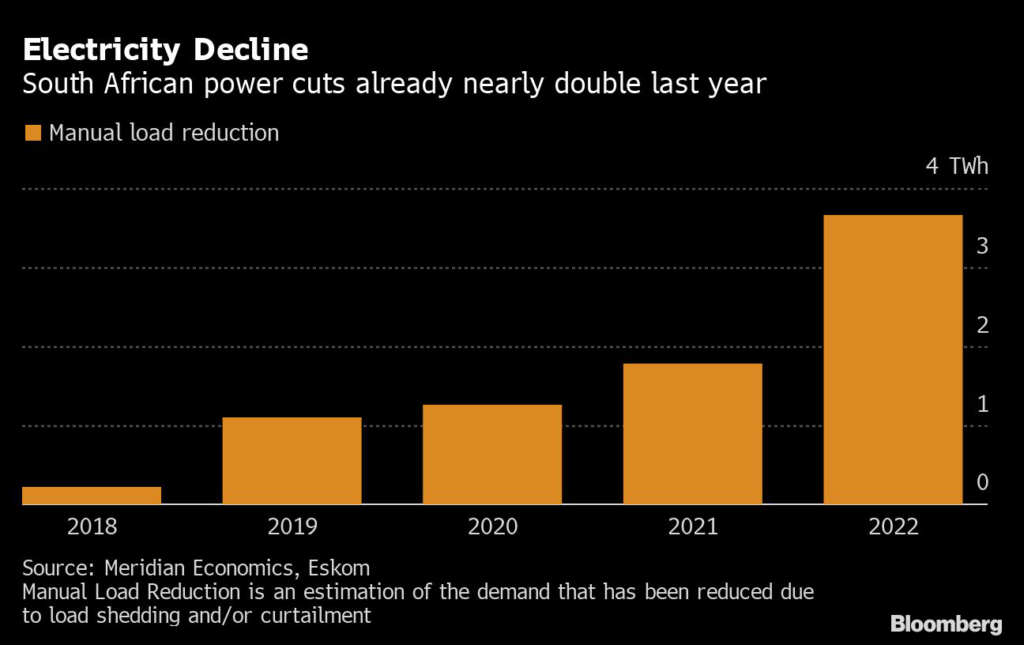
(Bloomberg) — South Africa, which has been experiencing energy shortages since 2008, is in the throes of its worst power cuts on record as breakdowns at state-owned utility Eskom Holdings SOC Ltd.’s plants reach unprecedented levels. 

The blackouts have caused disruptions countrywide, illustrating the challenges Europe could face as it confronts acute power shortages of its own. 

Here’s how some key services have been affected:

Healthcare 

Most hospitals have backup electricity, but generators don’t always kick in immediately and sometimes malfunction, placing patients at risk. Among the most vulnerable are those in intensive care and babies in incubators. State facilities have burnt through their budgets because they’ve had to run their generators for longer than anticipated and they intend to ask the National Treasury for additional funding, according to Health Minister Joe Phaahla. 

Water and Sanitation

Municipal and provincial authorities and water utilities have urged consumers to cut back on their water usage, because the lack of electricity means pump stations can’t always operate at full capacity. Generators have been fitted at most wastewater and sewage-treatment plants, though the risk of spills is high if they malfunction. 

Mobile Telecommunications

Mobile-phone companies have invested a fortune in batteries and generators for their towers, but the backup electricity they provide isn’t always sufficient to last through extended blackouts. Stop-start outages also mean batteries can’t fully recharge and shorten their lifespans. As a result, mobile phones’ signals aren’t always reliable. 

Crime Prevention

The blackouts make it easier for criminals to operate undetected, and harder and more dangerous for the police to apprehend them. Insurance companies have reported an increase in claims for car and home break-ins. Private security companies have warned that battery backups on alarm systems can be rendered useless as a result of the unreliable power supply and urged clients to check them regularly. Thieves have also taken advantage of the outages to steal the copper cabling used to transmit electricity, leaving some homes and business without supply for weeks on end.   

More stories like this are available on bloomberg.com

©2022 Bloomberg L.P.

Morgan Stanley Says Likely Fed Pivot Won’t End Earnings Pain

(Bloomberg) — Michael J. Wilson, one of Wall Street’s biggest equity bears, says a Federal Reserve pivot to dovishness is becoming likely amid falling money supply, but such a move won’t allay concerns about earnings. 

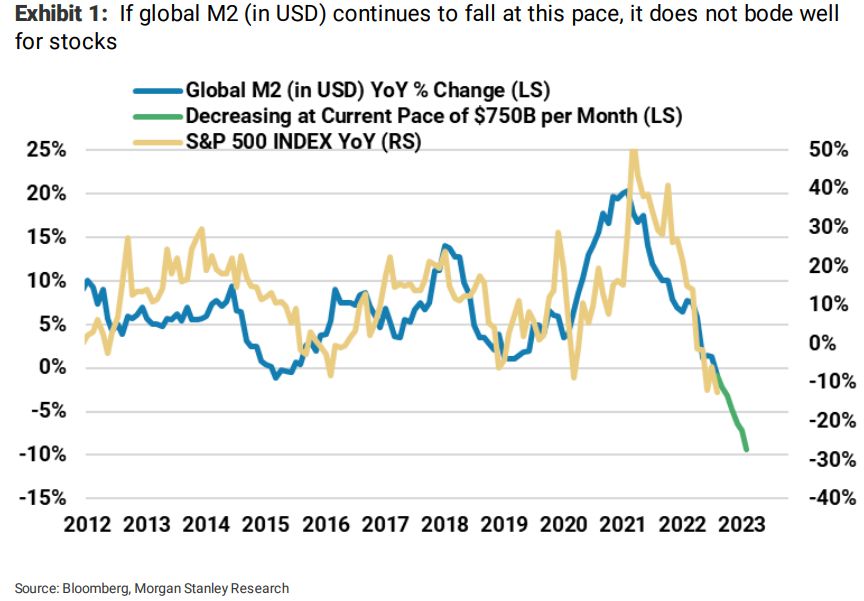
“We find M2 growth in what we call the ‘danger zone’ -– the area where financial/economic accidents tend to occur,” Wilson, Morgan Stanley’s chief US equity strategist, wrote in a note on Sunday, referring to the Fed’s broadest measure for money supply. 

While “a Fed pivot is likely at some point,” the timing is uncertain and it won’t change the trajectory of earnings estimates, he added.

Wilson, who predicted this year’s equities selloff, wrote that the year-on-year rate of change in money supply in dollars for the US, China, the Eurozone and Japan has turned negative for the first time since March 2015, a period that immediately preceded a global manufacturing recession. Such tightness is unsustainable “and the problem can be fixed by the Fed, if it so chooses,” he wrote.

The strategist said last week that US equities are in the “final stages” of a bear market and could stage a rally in the near term going into the earnings season before selling off again. 

Wilson has said that he sees an eventual low for the S&P 500 coming later this year, or early next, at the 3,000 to 3,400 point level. That implies a drop of as much as 16% from Friday’s close.

Goldman Sees More Selling in US Stocks by Households in 2023

(Updates to add more context and definition of M2 in second paragraph.)

More stories like this are available on bloomberg.com

©2022 Bloomberg L.P.

Manhattan’s EV-Charging Sites Now Outnumber Gas Stations 10 to 1

(Bloomberg) — Charging an electric car in Manhattan takes a little work — but it’s already much easier than finding a gas station.

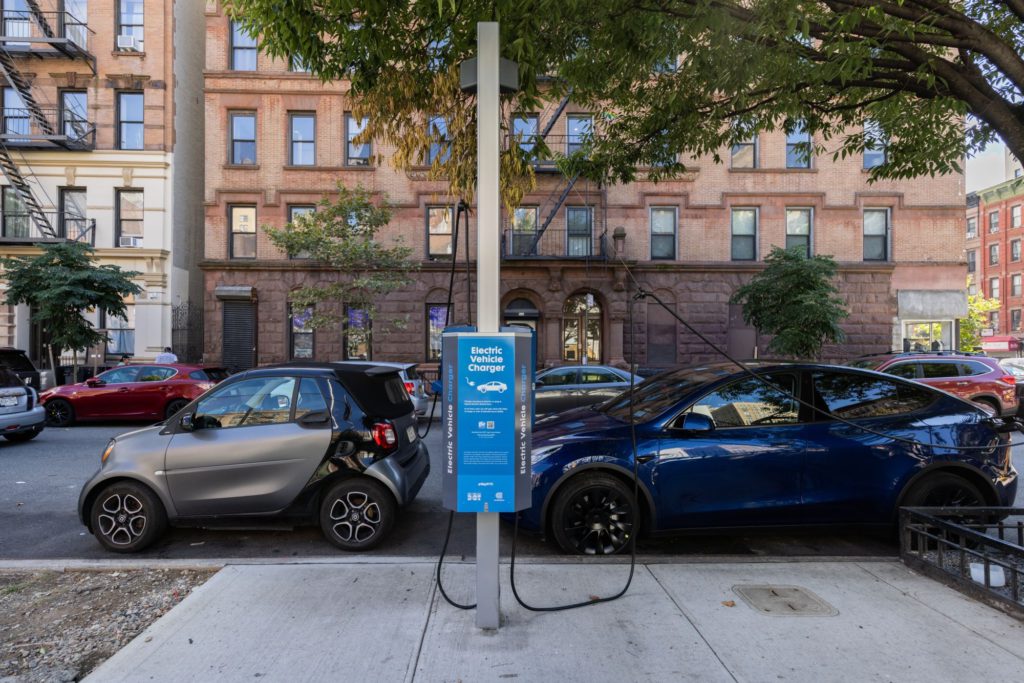
The borough has about 320 publicly accessible charging locations, according to data from the US Department of Energy, compared with just 29 remaining gas stations, according to the New York State Department of Agriculture and Markets. In other words, Manhattan’s EV-charging sites now outnumber its gas stations more than 10 to one. Gas stations still dominate citywide — 697 across all five boroughs, versus about 520 charging sites — but there, too, the chargers are catching up. 

“I don’t think you need to go far up the electric-vehicle adoption curve to see gas-station deforestation,” says Pasquale Romano, chief executive officer of ChargePoint Holdings Inc., the country’s largest EV-charging company. “It’s a question of when.”

The most immediate reason for Manhattan’s gas-station scarcity has nothing to do with EVs. Land on the island is simply too valuable to waste on a business that’s minimally profitable and needs a convenience store or car wash to survive. One by one, the borough’s gas stations have been bulldozed to make way for condos and offices — a dynamic that’s been playing out for years in compact, pricey San Francisco, which now has 92 gas stations, according to the California Energy Commission, versus 139 EV charging sites. 

But as New York City officials push to deploy more EV chargers across all five boroughs, Manhattan’s numbers will only grow more lopsided. And the location of those chargers illustrates a fundamental change that electric cars will bring: Future drivers can expect to do the bulk of their refueling at home or at work, not at a station on the corner. 

Most of Manhattan’s public chargers exist in a broad arc from the Upper East Side and Upper West Side down through Midtown, although there are plenty farther south as well. Unlike the borough’s gas stations, most of which can be found north of Central Park, there are few EV chargers above 110th Street. 

A significant number of Manhattan’s public charging stations sit in parking garages, usually with several chargers at each site. Many sites have Tesla Inc. chargers that are designed strictly for that company’s cars (although other EVs can use Tesla’s lower-powered “destination” chargers with an adapter). All but a handful of the borough’s public chargers are “level 2” devices that take several hours to top off a car battery, rather than speedier “DC fast” chargers.

Read: Uber, Lyft Drivers Stymied by New York City’s EV-Charging Divide

New York officials are eager for more curbside options — a city website extolling the benefits of curbside charging lists just 35 such locations in all five boroughs — but for now locating a charger can take a little planning. Depending on the garage, chargers are either self-serve or valet, and some will give monthly customers priority access, while others are first-come, first-serve. Prices vary depending on the garage: Some offer a flat rate such as $20 for a charge, in addition to the garage’s regular parking fee. Others levy an hourly charging fee — $3 an hour, for example, or whatever fee is assessed by charger operators such as Blink Charging Co. — in addition to the garage’s regular parking price. Still others only charge for the parking and give away the electricity as a perk. A recent, weekday survey of six garages found most of the charging spots filled, and one broken charger.

Sherry Boschert of Lebanon, New Hampshire, used the PlugShare app to find a refueling spot for her Tesla on a recent visit to the Upper West Side. She chose a valet garage on West 75th Street, a block from her hotel. All Boschert, 66, had to do was hand over the key fob and pay the regular parking fee — the electricity came free. 

“Once you’re off of gasoline and you don’t have to go to those stinky, dirty, crowded gasoline stations, you don’t want to go back,” says Boschert, an author and longtime EV advocate. “And it costs a lot less.”

New York drivers haven’t exactly rushed to ditch gasoline. Fully electric cars and plug-in hybrids account for 8.9% of new passenger vehicles in the city this year, according to research firm Atlas Public Policy. That’s up from 6.6% last year but still well behind Los Angeles, where 13.8% of new cars this year run on electricity. It’s an issue for New York City officials, whose plans for fighting climate change call for having 400,000 EVs on city streets by 2030 and 1.6 million by 2050, up from 24,000 now. 

Even if Manhattan’s gas stations have been done in primarily by real estate prices, ChargePoint’s Romano says electric cars will put more pressure on gas station owners, particularly those dependent on selling fast food and car washes. Eventually, “range anxiety” — the fear of an EV running out of charge on the road — will be more applicable to owners of gas-powered vehicles.

“If no one’s visiting for gas, that means no one’s going to the convenience store,” Romano says. “It starts to slide, and it doesn’t take much to flip that business upside down.” 

More stories like this are available on bloomberg.com

©2022 Bloomberg L.P.

Stocks Struggle on Higher Oil, Pound Erases Losses: Markets Wrap

(Bloomberg) — Stocks in Asia struggled to gain traction and US equity futures fluctuated, as negative sentiment persisted amid fears that major central banks will keep hiking rates until inflation is tamed, raising the risk of a recession.

Inflation fears were further stoked as oil surged to trade near $82 a barrel on indications that the OPEC+ alliance is considering slashing production by more than 1 million barrels a day when it meets this week. Commodity currencies gained.

The pound rebounded on a BBC report that the UK government may reverse its tax-cut policy. It had earlier fell, while European stock contracts lost 2% amid thin volumes, with the UK’s economic turmoil and challenges facing Credit Suisse Group weighing on sentiment. 

Equities made small gains in Japan and dropped in Hong Kong and Australia. Trading in Asia was muted with a week-long closure of Chinese markets for Golden Week, and holidays in South Korea and Sydney. Treasuries rallied.


The week’s cautious start comes after US stocks posted their third straight quarter of losses for the first time since 2009. Risk assets have been in a tailspin since the Federal Reserve delivered a third jumbo hike last month and officials repeatedly warned of more pain to come. 

“Risk off seen from multiple forces heading into the new month or quarter as corporate earnings misses continue to raise the threat of an ugly earnings season ahead,” a group of Saxo Capital Markets analysts wrote in a note.

Confidence among Japan’s large manufacturers unexpectedly worsened for three straight quarters following the yen’s rapid depreciation and deterioration in the global economic outlook, adding another headwind for local equities. The yen weakened past 145 per dollar, nearing the level where Japanese authorities intervened last month to support the currency.

Shorter Treasury yields fell more than longer ones in a so-called bull-steepening, with the yield on two-year note at around 4.2% and the 10-year at about 3.8%. The dollar swung between gains and losses versus major currencies.

“Last week’s developments reinforced our expectation that we will see further tightening in financial conditions, but also illustrated the short-term two-way volatility, which will likely accompany it,” Citigroup Inc. Global Head of Currency Analysis Ebrahim Rahbari wrote in a note to clients. With the three main forces at play — rising real rates, volatility and the US dollar — “we therefore remain very bearish regarding the outlook for global risk assets,” he wrote.

The pound was earlier the worst performer among Group-of-10 currencies. Chancellor of the Exchequer Kwasi Kwarteng is expected to make a statement in the next hour, reversing the proposed scrapping of the 45% rate of income tax, the BBC reported.

Brazil-linked global assets will be in focus on Monday as the country’s presidential election is headed to a run-off vote on Oct. 30. 

Read More: UK Pension Strategy That Gilt Market Relied On Becomes Big Risk

Investors are now awaiting jobs data this week for further clues about the Fed’s rate-hike trajectory. Upcoming inflation and GDP readings will also provide details on whether price pressures are easing meaningfully. Rate decisions in Australia and New Zealand are also expected, with these economies considered bellwethers for developed market peers. 

Geopolitical tensions also continue to simmer as Russian forces faced a new operational defeat — this time in a strategic eastern Ukrainian town — to cast further doubt on the “forever” annexation of four occupied regions by President Vladimir Putin that he vowed was irreversible. President Joe Biden declared that a massive leak from the Nord Stream gas pipeline system in the Baltic Sea was an intentional act. 

Key events this week:

  • Eurozone manufacturing PMIs, Monday
  • US construction spending, ISM Manufacturing, light vehicle sales, Monday
  • Fed’s Raphael Bostic, John Williams speak at events, Monday
  • Euro-area and EU finance ministers meet, Monday
  • Eurozone PPI, Tuesday
  • US factory orders, durable goods, Tuesday
  • Fed’s John Williams, Lorie Logan, Loretta Mester, Mary Daly speak at events, Tuesday
  • Eurozone services PMIs, Wednesday
  • OPEC+ meeting begins, Wednesday
  • Fed’s Raphael Bostic speaks, Wednesday
  • Eurozone retail sales, Thursday
  • US initial jobless claims, Thursday
  • Fed’s Charles Evans, Lisa Cook, Loretta Mester speak at events, Thursday
  • US unemployment, wholesale inventories, nonfarm payrolls, Friday
  • BOE Deputy Governor Dave Ramsden speaks at event, Friday
  • Fed’s John Williams speaks at event, Friday

Key market moves:

Stocks

  • S&P 500 futures added 0.2% as of 6:56 a.m. London time. S&P 500 Index fell 1.5% on Friday
  • Nasdaq 100 futures dropped 0.1%. Nasdaq 100 Index slid 1.7% on Friday
  • Japan’s Topix index climbed 0.6%
  • Hong Kong’s Hang Seng Index was down 0.9%
  • S&P/ASX 200 Index slid 0.3%
  • Euro Stoxx 50 futures tumbled 1.5%

Currencies 

  • The Bloomberg Dollar Spot Index was down 0.3%
  • The euro climbed 0.3% to 0.9830 per dollar
  • The British pound gained 0.8% to 1.1268 per dollar
  • The Japanese yen slid 0.1% to 144.76 per dollar
  • The offshore yuan rose 0.1% to 7.1372 per dollar

Cryptocurrencies

  • Bitcoin increased 0.2% to $19,270
  • Ether was down 0.5% to $1,296

Bonds

  • The yield on 10-year Treasuries decreased six basis points to 3.77%

Commodities

  • West Texas Intermediate rose 2.9% to $81.80 a barrel
  • Gold climbed 0.4% to $1,667.21 per ounce

More stories like this are available on bloomberg.com

©2022 Bloomberg L.P.

Sony Betting Big on Next VR Headset With Increased Production Plan

(Bloomberg) — Sony Group Corp. plans to make 2 million units of the PlayStation VR2 headset by March next year, people familiar with the matter said, setting an ambitious outlook that defies the global economic malaise.

Mass production of the virtual reality goggles began in September and hasn’t yet faced supply chain constraints, said the people, who asked not to be identified discussing private information. The production figure could be adjusted depending on the device’s sales momentum once it’s released early next year.

Shares in Sony rose 2.4% in Tokyo on Monday, in the stock’s biggest jump in six weeks.

VR goggles remain a largely unproven category several years into the wide availability of commercial offerings from the likes of HTC Corp. and Oculus, now a part of Meta Platforms Inc. Sony’s roadmap for the PSVR2 anticipates much greater popularity than the company’s preceding PlayStation VR goggles for the PlayStation 4 — which took eight months to reach a million sales. Meta’s Quest 2, the most popular VR headset today, shipped 2.8 million units in its first quarter of availability, according to IDC figures.

Sony has yet to give an official price or release date for the PSVR2. Its current plan to start selling the headset in early 2023 will coincide with expected relief of the supply chain bottlenecks that have hampered availability of the PlayStation 5 console since its launch in late 2020, the people said. That would give the company sufficient inventory of both headsets and consoles for a big marketing push. Users will need a PS5 console to use the VR headset.

A spokesperson for Sony Interactive Entertainment declined to comment.

“A key to success is the quality of the games Sony will be able to develop,” said Tokyo-based analyst Serkan Toto of Kantan Games. “The other critical point will be the price: spec-wise, the PSVR2 is a beast, and some users already expect it to cost as much as a PS5 itself.”

Game developers remain skeptical about the VR segment because of its relative lack of market penetration, especially on Sony’s home turf of Japan. Meta’s Quest 2 is estimated by IDC to have shipped 17 million units to date and is lauded as the high water mark for the sector, but pales in comparison to other products in the console, mobile and PC gaming arenas.

The economic slowdown and increased materials costs following Russia’s invasion of Ukraine have also hit the VR sector. Meta raised the Quest 2’s price in August in response to the rising cost of production.

“The increasing cost of living is making many consumers wary of spending on non-essential items,” said IDC vice president of data and analytics Francisco Jeronimo. “If the economic crisis deepens, Sony may need to cut production.”

Sony’s suppliers and partners are uncertain about how long the Japanese company will maintain its high-paced production schedule after launch.

Sony plans to boost the PSVR2’s launch with new titles designed for VR from its popular in-house franchises, such as Horizon, and has said there are more than 20 titles in development for the device from internal and third-party game developers.

(Updates with analyst comment in seventh paragraph)

More stories like this are available on bloomberg.com

©2022 Bloomberg L.P.

Premier Kishida Wants Japan to Take Advantage of Weak Yen

(Bloomberg) — Japanese Prime Minister Fumio Kishida said he would strengthen the economy in a way that makes the most of the weak yen, including encouraging the building of chip and battery factories as well as pushing farm exports.

“I will press ahead with strengthening an economic structure that capitalizes on the weak yen,” he said Monday at the opening of a new session of parliament. “While drawing out the maximum benefits of the weak yen, I will proceed with policies that return them to the people.”

Kishida is trying to ease the blow from a currency that has lost about 20% of its value this year against the dollar. The prime minister has ordered his cabinet to compile an economic package by the end of the month with an unspecified value, as higher commodity prices and a rapid weakening of the yen add to headwinds for small companies and consumers. 

The speech came as Kishida, who has been in office for about a year, faces a struggle to restore voter trust in his government. His cabinet’s support rate has fallen to record lows amid widespread unease over links that have emerged between his ruling Liberal Democratic Party and the South Korean-based Unification Church. 

But Kishida’s party does have some breathing space, with polls showing the support rate for leading opposition groups mired in single digits. After guiding the LDP to victory in an upper house election in July, Kishida may not need to face another national vote for three years. Any challenge to his leadership, and key policies such as his New Capitalism plan for a more equal society, is likely to come from within the LDP. 

Japan’s Kishida Orders Stimulus as Analysts Warn of Overspending

On measures to tackle electricity price rises, Kishida said he would put together “unprecedented, bold measures” to directly reduce the impact on households and businesses. 

Kishida said he’d aim for 5 trillion yen ($34.5 billion) in consumption by inbound tourists, with the return of visa-free travel and individual travel from Oct. 11. The moves would end most of the border restrictions introduced to try to slow the spread of Covid-19.

The yen weakened past 145 per dollar in Monday trading, setting the stage for Japanese authorities to potentially intervene to prop it up for a second time this year. The Ministry of Finance spent 2.84 trillion yen in September to try to boost the currency. 

Other comments:

  • Will put together comprehensive economic measures this month to protect livelihoods from price rises
  • Will shift toward an economy that can withstand crises, including by focusing on stable energy supply and food security
  • Will deal with nuclear power issue head-on
  • Will press ahead with joint development and mass production of next-generation semiconductors with US, as well as “beyond 5G” research and development
  • Will seek to bolster public-private investment in semiconductors in Japan, it is said 10 trillion yen is needed over next 10 years


(Updates with comments from speech in ninth paragraph)

More stories like this are available on bloomberg.com

©2022 Bloomberg L.P.

Ian Latest: Biden to Visit Florida Wednesday as Death Toll Rises

(Bloomberg) — Joe Biden will visit Florida on Wednesday to survey the damage left behind by Hurricane Ian, with the official death toll set to rise as search operations continue.  

Ahead of his trip to the state, the president will go to Puerto Rico on Monday, which was hit earlier in September by Hurricane Fiona, the White House said. Biden, who has pledged to commit the full strength of the federal government to recovery efforts, said on Saturday that Florida’s hurricane damage is “likely to rank among the worst” in US history. Power and communications operators reported a significant return of services on Sunday. 

The death toll in Florida, officially near 50, was uncertain and shifting. In hard-hit Lee County, home to Fort Myers, Sheriff Carmine Marceno said on Sunday there were 42 confirmed deaths in his county alone. On Saturday night, the Florida Medical Examiners Commission reported 30 deaths in Lee County and 44 statewide.  

Four deaths have been reported in North Carolina and three in Cuba. 

Ian, which had weakened to a post-tropical cyclone, “fully dissipated overnight” Saturday, the National Weather Service reported. “Widespread showers and storms” will continue in the mid-Atlantic and central Appalachians, reaching southern New Jersey. 

More than 640,000 in Florida Still Without Power (11:34 p.m.)

More than 640,000 customers in Florida are still without power, according to PowerOutage.us. Electricity has been restored to more than 1.8 million user accounts across the state, figures from the Florida Division of Emergency Management showed on Sunday.

Governor Ron DeSantis visited the cities of North Port and Arcadia over the weekend, where flooding hasn’t subsided, according to local media reports.

Lee County Reports 42 Deaths Amid Rising Florida Toll (6:32 p.m.)

The death toll in Florida is rising, though the numbers remained uncertain and incomplete amid ongoing searches through masses of wreckage.   

In Lee County, on the state’s southwest coast, Sheriff Carmine Marceno said on Sunday that 42 people had died there.

“We have buildings, multiple-floor buildings that have been washed out, OK? It is incomprehensible what we’re looking at,” Marceno said. “Those numbers could go up. I don’t know. I pray and hope that they don’t.”

On Saturday night, the Florida Medical Examiners Commission released a count of 44 dead across the state, including 30 in Lee County. The commission had not updated the toll on Sunday. 

Florida Cell Service Returning With Gaps in Hard-Hit Areas (3:51 p.m.)

Cell-service has been restored across most of Florida, though the hardest-hit counties are still experiencing significant zones without signal, according to a report from the Federal Communications Commission Sunday. 

The report listed the top counties by percentage with cell sites still not operational: DeSoto 38.5%; Hardee 33.3%; Charlotte 20.2%; and Lee 19.5%.

Governor Ron DeSantis announced Saturday that Elon Musks’s SpaceX will deploy 120 units of its Starlink satellites to southwest Florida to provide Internet service for those affected.

More Than 820,000 in Florida Remain Without Power (1:12 p.m.)

About 822,000 customers remain without power in Florida, according to PowerOutage.US. That’s a recovery from the peak of 2.7 million customers without power after Hurricane Ian made landfall in southwest Florida on Wednesday. 

In North Carolina, where the storm hit on Friday, there are close to 21,000 customers without power.

‘Old Florida’ Flattened by Hurricane, Rubio Says (12:21 p.m.)

Some of Florida’s oldest and most popular beach destinations devastated by Hurricane Ian will never look the same, Senator Marco Rubio said on Sunday.

Fort Myers Beach, a seaside tourist town, “no longer exists,” Rubio said on ABC’s “This Week.” Sanibel Island, another barrier island along Florida’s southwest coast, has also been ravaged, he said. 

“This is a character-altering event,” he said. 

FEMA Head Warns of Post-Storm Hazards (9:50 a.m.)

People working to clean up after Hurricane Ian need to “stay vigilant right now” because of the potential danger amid debris, downed power lines and other hazards, warned Deanne Criswell, administrator of the Federal Emergency Management Agency. 

“We see so many more injuries and sometimes more fatalities after the storm, because there are so many dangers out there,” Criswell said on “Fox News Sunday.” “Standing water brings with it all kinds of hazards…We want to make sure that people are being extra cautious.”

Biden to Visit Puerto Rico, Florida (10:39 p.m.)

President Joe Biden will travel to Puerto Rico on Monday and Florida on Wednesday to survey the damage there after vowing to commit the full strength of the federal government to recovery efforts in the wake of two devastating hurricanes.

The president will be accompanied by the first lady, the White House said.

Ian Expected to End by Sunday Morning (5:12 p.m.)

Storm Ian is expected to dissipate on Sunday morning, the National Weather Service said in an update. By 5 p.m., the storm had slowed over Virginia, moving east-northeast at about 6 miles an hour with maximum sustained winds near 25 miles per hour, the service reported.

Central Florida will continue to experience “major to record” river flooding through next week. Areas of Maryland and West Virginia may also experience several inches of rain into Sunday morning, with the potential of some flooding.

Four Die in North Carolina (4:06 p.m.)

Four storm-related deaths were reported in North Carolina: one drowning, two in vehicle accidents and one poisoned by carbon monoxide from a generator, Governor Roy Cooper’s office reported. 

Power was restored to about half the 418,000 customers who had lost electricity on Friday night, his office said in a press release Saturday.

No Deaths in South Carolina, Governor Says (3:09 p.m.)

South Carolina suffered no deaths despite being hit by winds as high as 92 miles an hour from Hurricane Ian on Friday, Governor Henry McMaster said in a press briefing Saturday. Unlike Florida, there has been relatively little flooding, and most electricity has already been restored, he said.

“We know that we have much cleaning up and rebuilding to do,” McMaster said. “There’s some heartbreak, there’s work to be done. But all in all it’s a good story.”

Florida Governor Says Flooding Did Most Damage (2:47 p.m. NY)

Florida suffered more damage from flooding caused by Hurricane Ian than strong winds, Governor Ron DeSantis said Saturday.

“When you’ve got a torrent of water coming in, there’s really nothing you can do about that, so that’ll require a lot of flood claims being filed,” DeSantis said at a news briefing in Fort Myers. 

DeSantis added that nearly 55% of power has been restored to those affected by power outages. Power has been restored to 1.5 million customers serviced by Florida Power & Light, with another 650,000 customers still without power, said FPL president and chief executive officer Eric Silagy. 

Biden Briefed on Damage, Restoration of Power and Water (2:26 p.m.)

President Joe Biden was briefed by advisers including Chief of Staff Ron Klain on the damage from the storm, focusing on power and water restoration in Florida and damage in South Carolina, White House Press Secretary Karine Jean-Pierre said in a tweet.

Ian Weakens as It Moves North (12:15 a.m.)

Post-tropical cyclone Ian continued to weaken midday Saturday as it moved north through North Carolina and toward Virginia, according to a National Weather Service update at 11 a.m. 

Maximum sustained winds slowed to to 25 mph (40 kph), the service reported. Another 1-3 inches or rain was expected to fall across the central Appalachians and mid-Atlantic, “with local heavier amounts possible.” 

Across central Florida, “major to record river flooding” is expected over the next week.

Biden Calls Storm Damage ‘Among Worst’ Ever in US (10:41 a.m.)

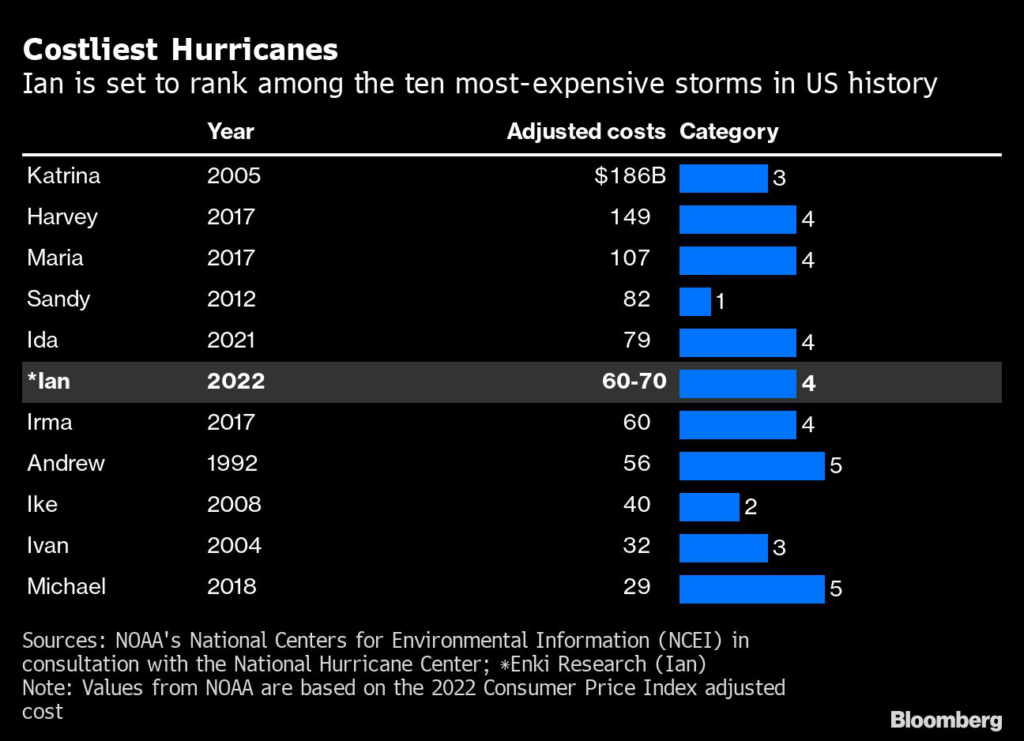
President Biden said the damage from storm Ian “is likely to rank among the worst” in US history. 

Few Florida Homes Covered for Flooding (9:12 a.m.)

A majority of Florida homeowners caught in the hurricane’s path now face rebuilding without the benefit of flood insurance — and some might not even realize they’re uncovered.

Only 18% of all Florida homes — of which there more than 10 million, per census data — have flood insurance, according to the Insurance Information Institute. And some property owners harbor the misconception that policies protecting against damage from wind and rain will also apply to losses brought on by rising water.

Officials in Florida County Delayed Evacuation, NYT Says (3:53 a.m.)

Emergency officials in Lee County, Florida, only issued a mandatory evacuation order for the areas likely to be hit the most by Hurricane Ian on Tuesday, giving residents less time to evacuate, the New York Times reported.

While much of the areas set to be affected had told their residents to flee on Monday, Lee County officials opted to wait to see how forecasts for the hurricane evolved overnight. At least 16 storm-related deaths have been identified in Lee County, the highest toll anywhere in the state, the newspaper said.

Biden Declares Emergency in North Carolina (1:51 a.m.)

US President Joe Biden has declared an emergency in the state of North Carolina in the wake of Hurricane Ian, and ordered federal assistance to supplement response efforts, according to a statement released by the White House. 

Cuba Requests US Aid After Devastation, WSJ Says (7:38 p.m.)

Cuba’s government is seeking emergency assistance from the US in the aftermath of Ian’s devastation, the Wall Street Journal reported, citing email communications.

No exact amount was requested and the US is trying to determine if Cuba will supplement its request, the newspaper said. Havana is making the rare request as it contends with an economic crisis and while its longtime supporter Russia struggles with the war in Ukraine.   

More stories like this are available on bloomberg.com

©2022 Bloomberg L.P.

Ian Latest: Biden to Visit Florida Wednesday as Death Toll Rises

(Bloomberg) — Joe Biden will visit Florida on Wednesday to survey the damage left behind by Hurricane Ian, with the official death toll set to rise as search operations continue.  

Ahead of his trip to the state, the president will go to Puerto Rico on Monday, which was hit earlier in September by Hurricane Fiona, the White House said. Biden, who has pledged to commit the full strength of the federal government to recovery efforts, said on Saturday that Florida’s hurricane damage is “likely to rank among the worst” in US history. Power and communications operators reported a significant return of services on Sunday. 

The death toll in Florida, officially near 50, was uncertain and shifting. In hard-hit Lee County, home to Fort Myers, Sheriff Carmine Marceno said on Sunday there were 42 confirmed deaths in his county alone. On Saturday night, the Florida Medical Examiners Commission reported 30 deaths in Lee County and 44 statewide.  

Four deaths have been reported in North Carolina and three in Cuba. 

Ian, which had weakened to a post-tropical cyclone, “fully dissipated overnight” Saturday, the National Weather Service reported. “Widespread showers and storms” will continue in the mid-Atlantic and central Appalachians, reaching southern New Jersey. 

More than 640,000 in Florida Still Without Power (11:34 p.m.)

More than 640,000 customers in Florida are still without power, according to PowerOutage.us. Electricity has been restored to more than 1.8 million user accounts across the state, figures from the Florida Division of Emergency Management showed on Sunday.

Governor Ron DeSantis visited the cities of North Port and Arcadia over the weekend, where flooding hasn’t subsided, according to local media reports.

Lee County Reports 42 Deaths Amid Rising Florida Toll (6:32 p.m.)

The death toll in Florida is rising, though the numbers remained uncertain and incomplete amid ongoing searches through masses of wreckage.   

In Lee County, on the state’s southwest coast, Sheriff Carmine Marceno said on Sunday that 42 people had died there.

“We have buildings, multiple-floor buildings that have been washed out, OK? It is incomprehensible what we’re looking at,” Marceno said. “Those numbers could go up. I don’t know. I pray and hope that they don’t.”

On Saturday night, the Florida Medical Examiners Commission released a count of 44 dead across the state, including 30 in Lee County. The commission had not updated the toll on Sunday. 

Florida Cell Service Returning With Gaps in Hard-Hit Areas (3:51 p.m.)

Cell-service has been restored across most of Florida, though the hardest-hit counties are still experiencing significant zones without signal, according to a report from the Federal Communications Commission Sunday. 

The report listed the top counties by percentage with cell sites still not operational: DeSoto 38.5%; Hardee 33.3%; Charlotte 20.2%; and Lee 19.5%.

Governor Ron DeSantis announced Saturday that Elon Musks’s SpaceX will deploy 120 units of its Starlink satellites to southwest Florida to provide Internet service for those affected.

More Than 820,000 in Florida Remain Without Power (1:12 p.m.)

About 822,000 customers remain without power in Florida, according to PowerOutage.US. That’s a recovery from the peak of 2.7 million customers without power after Hurricane Ian made landfall in southwest Florida on Wednesday. 

In North Carolina, where the storm hit on Friday, there are close to 21,000 customers without power.

‘Old Florida’ Flattened by Hurricane, Rubio Says (12:21 p.m.)

Some of Florida’s oldest and most popular beach destinations devastated by Hurricane Ian will never look the same, Senator Marco Rubio said on Sunday.

Fort Myers Beach, a seaside tourist town, “no longer exists,” Rubio said on ABC’s “This Week.” Sanibel Island, another barrier island along Florida’s southwest coast, has also been ravaged, he said. 

“This is a character-altering event,” he said. 

FEMA Head Warns of Post-Storm Hazards (9:50 a.m.)

People working to clean up after Hurricane Ian need to “stay vigilant right now” because of the potential danger amid debris, downed power lines and other hazards, warned Deanne Criswell, administrator of the Federal Emergency Management Agency. 

“We see so many more injuries and sometimes more fatalities after the storm, because there are so many dangers out there,” Criswell said on “Fox News Sunday.” “Standing water brings with it all kinds of hazards…We want to make sure that people are being extra cautious.”

Biden to Visit Puerto Rico, Florida (10:39 p.m.)

President Joe Biden will travel to Puerto Rico on Monday and Florida on Wednesday to survey the damage there after vowing to commit the full strength of the federal government to recovery efforts in the wake of two devastating hurricanes.

The president will be accompanied by the first lady, the White House said.

Ian Expected to End by Sunday Morning (5:12 p.m.)

Storm Ian is expected to dissipate on Sunday morning, the National Weather Service said in an update. By 5 p.m., the storm had slowed over Virginia, moving east-northeast at about 6 miles an hour with maximum sustained winds near 25 miles per hour, the service reported.

Central Florida will continue to experience “major to record” river flooding through next week. Areas of Maryland and West Virginia may also experience several inches of rain into Sunday morning, with the potential of some flooding.

Four Die in North Carolina (4:06 p.m.)

Four storm-related deaths were reported in North Carolina: one drowning, two in vehicle accidents and one poisoned by carbon monoxide from a generator, Governor Roy Cooper’s office reported. 

Power was restored to about half the 418,000 customers who had lost electricity on Friday night, his office said in a press release Saturday.

No Deaths in South Carolina, Governor Says (3:09 p.m.)

South Carolina suffered no deaths despite being hit by winds as high as 92 miles an hour from Hurricane Ian on Friday, Governor Henry McMaster said in a press briefing Saturday. Unlike Florida, there has been relatively little flooding, and most electricity has already been restored, he said.

“We know that we have much cleaning up and rebuilding to do,” McMaster said. “There’s some heartbreak, there’s work to be done. But all in all it’s a good story.”

Florida Governor Says Flooding Did Most Damage (2:47 p.m. NY)

Florida suffered more damage from flooding caused by Hurricane Ian than strong winds, Governor Ron DeSantis said Saturday.

“When you’ve got a torrent of water coming in, there’s really nothing you can do about that, so that’ll require a lot of flood claims being filed,” DeSantis said at a news briefing in Fort Myers. 

DeSantis added that nearly 55% of power has been restored to those affected by power outages. Power has been restored to 1.5 million customers serviced by Florida Power & Light, with another 650,000 customers still without power, said FPL president and chief executive officer Eric Silagy. 

Biden Briefed on Damage, Restoration of Power and Water (2:26 p.m.)

President Joe Biden was briefed by advisers including Chief of Staff Ron Klain on the damage from the storm, focusing on power and water restoration in Florida and damage in South Carolina, White House Press Secretary Karine Jean-Pierre said in a tweet.

Ian Weakens as It Moves North (12:15 a.m.)

Post-tropical cyclone Ian continued to weaken midday Saturday as it moved north through North Carolina and toward Virginia, according to a National Weather Service update at 11 a.m. 

Maximum sustained winds slowed to to 25 mph (40 kph), the service reported. Another 1-3 inches or rain was expected to fall across the central Appalachians and mid-Atlantic, “with local heavier amounts possible.” 

Across central Florida, “major to record river flooding” is expected over the next week.

Biden Calls Storm Damage ‘Among Worst’ Ever in US (10:41 a.m.)

President Biden said the damage from storm Ian “is likely to rank among the worst” in US history. 

Few Florida Homes Covered for Flooding (9:12 a.m.)

A majority of Florida homeowners caught in the hurricane’s path now face rebuilding without the benefit of flood insurance — and some might not even realize they’re uncovered.

Only 18% of all Florida homes — of which there more than 10 million, per census data — have flood insurance, according to the Insurance Information Institute. And some property owners harbor the misconception that policies protecting against damage from wind and rain will also apply to losses brought on by rising water.

Officials in Florida County Delayed Evacuation, NYT Says (3:53 a.m.)

Emergency officials in Lee County, Florida, only issued a mandatory evacuation order for the areas likely to be hit the most by Hurricane Ian on Tuesday, giving residents less time to evacuate, the New York Times reported.

While much of the areas set to be affected had told their residents to flee on Monday, Lee County officials opted to wait to see how forecasts for the hurricane evolved overnight. At least 16 storm-related deaths have been identified in Lee County, the highest toll anywhere in the state, the newspaper said.

Biden Declares Emergency in North Carolina (1:51 a.m.)

US President Joe Biden has declared an emergency in the state of North Carolina in the wake of Hurricane Ian, and ordered federal assistance to supplement response efforts, according to a statement released by the White House. 

Cuba Requests US Aid After Devastation, WSJ Says (7:38 p.m.)

Cuba’s government is seeking emergency assistance from the US in the aftermath of Ian’s devastation, the Wall Street Journal reported, citing email communications.

No exact amount was requested and the US is trying to determine if Cuba will supplement its request, the newspaper said. Havana is making the rare request as it contends with an economic crisis and while its longtime supporter Russia struggles with the war in Ukraine.   

More stories like this are available on bloomberg.com

©2022 Bloomberg L.P.

Swiss Dropout Worth $14 Billion Moves Startup Away From Porn

(Bloomberg) — A college dropout from Switzerland has amassed a $14 billion fortune to become one of the country’s richest people by creating a rising star in electronic payments.

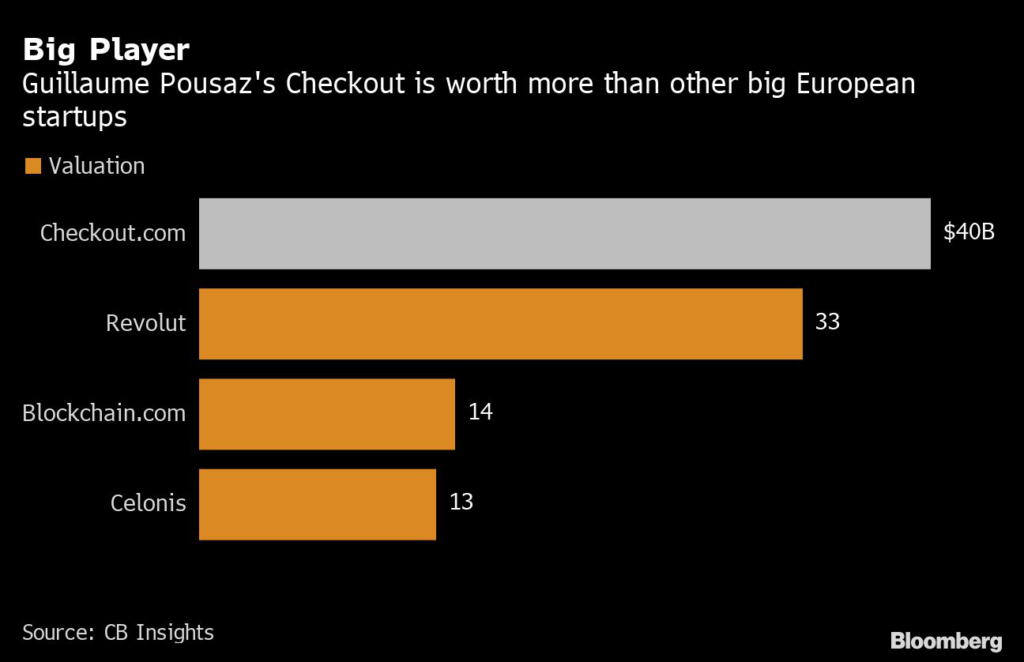
Guillaume Pousaz is the founder and chief executive officer of Checkout.com, which this year raised funding at a valuation of $40 billion, making it worth more than British telecoms giant Vodafone Group Plc. But in its formative years, his company also got business from clientele Pousaz doesn’t like to talk about: porn and gambling websites. 

His path to create one of Europe’s most valuable startups circles the globe — from the U.S., where he pursued a passion for surfing and got his first taste of the payments industry, to Singapore, where he founded Checkout’s predecessor while still in his 20s.

The 41-year-old — who owns 60% of Checkout, filings show — now resides in Dubai with his wife and three children. In addition to running the London-based company, he operates a newly formed family office that has invested in fintech startups, positioning the entrepreneur as a rainmaker in technology throughout the region.

“In the fintech space, he’s looked upon as someone who can show people that building a company and scaling it to this size is possible,” said Gerard Grech, chief executive officer of UK industry group Tech Nation.

A snowboarder in his youth who appeared in sports magazines, Pousaz is dismissive of the ability of traditional banks to compete in the world of e-commerce and advocates for cryptocurrencies and Web3, a loose set of technologies aimed at decentralizing the internet.

Tall and lean with piercing blue eyes, Pousaz speaks with swagger about Checkout’s journey from back-room shop to part of the web’s financial plumbing. His company, which has an eye on an eventual public listing, boasts that it got help from big-ticket customers like Netflix Inc. and venture backing from prominent firms including Tiger Global, and is moving away from risky porn clients.

‘Savoir Faire’

“Investors are believing in our ability to build a very large business in what is essentially one of the largest total addressable markets,” Pousaz told Sky News in January. “We have the savoir faire” and the technology to beat traditional banks in electronic payments.

He wields his appeal to bigger businesses to take swipes at rivals like Stripe Inc. and Adyen NV. In a TechCrunch interview in 2020, he said Checkout jokes internally that it’s “the Stripe graduation program” because of a focus on blue-chip clients rather than smaller merchants, which make up much of Stripe’s customer base.

But there have been recent signs of growing pains. Checkout is eliminating about 100 people, or roughly 5% of its staff. Separately, the company fired several employees earlier this year due to harassment complaints that arose from an off-site trip to Cyprus.

Key executives are also departing. Chief Revenue Officer Nick Worswick left in July by mutual agreement, a Checkout spokesperson said. Worswick declined to comment. 

The company has also been bulking up in volatile segments as it seeks to expand. Fintech and cryptocurrency transactions accounted for more than half of Checkout’s payments volume as of January. Many crypto trading platforms have since seen transactions drop amid a broader downturn in valuations for the digital currencies.

Raised in Geneva, Pousaz initially had hopes of becoming an investment banker and began studying mathematical engineering at Ecole Polytechnique Federale de Lausanne. He dropped out of university in his final year in 2005 after his father was diagnosed with pancreatic cancer, moving to California mainly to go surfing. 

He started working for a payments-processing firm in the US in 2006 and founded a money-transfer service called NetMerchant the following year. That provided him with capital, and he bought Mauritius-based SMS Gateway in 2009, which became the basis for a venture in Singapore called Opus Payments. 

An early break came in 2011 when Opus signed a deal with Chinese e-commerce website Dealextreme, making the company profitable and allowing it to finance expansion. A year later, Opus morphed into Checkout and shifted its base to the UK after receiving an operating license. 

Checkout bagged Netflix as its first blue-chip client in 2018. While the deal was only for a slice of the streaming service’s business — typical for the payments industry — it was a key validation and put Checkout firmly in the sights of investors. Its first funding round closed the next year, valuing the company at $2 billion.

But in its early days, Checkout worked with clients that provide adults-only services including pornography and gambling, which at one point accounted for a significant amount of business, according to people familiar with the matter. 

The clients included companies like MindGeek SARL, the owner of websites like Pornhub.com, OnlyFans Ltd. and MondoCamGirls, a website that allows users to pay for live feeds of sexual content, the people said.

Pousaz has referred to Checkout’s early days as “scrappy” but has denied getting much revenue from adult sites. In a 2020 interview with Sifted, an online news site about European startups, he called rumors of a reliance on porn sites “quite annoying.” 

Exiting Porn

In a response to questions from Bloomberg, Checkout acknowledged it worked with porn and gambling sites, but the business volume wasn’t significant. 

“From our early years, adult content and gambling were immaterial contributors to Checkout’s overall processing volumes, revenue, growth and success,”  a company spokesperson said. “Checkout has since exited adult content entirely, serving no merchants in this category.”

Transparency is crucial as the company sets its sights on a potential listing. The business of moving money around the internet is complex and opaque, and regulators have struggled to keep pace. E-money companies have seen growth and suspicious activity reports surge.

Read more: Fintech Boom Masks a Shady Side of London’s Money Hub

Business in adult-only industries can also prove an uncomfortable risk for financial firms. Notably, OnlyFans said last year it would ban sexually explicit material after coming under pressure from banking and payment services, before later reversing course.

“When I first met them it was five or six guys sitting around a table in a small rented office behind Oxford Circus,” said Kevin Jenkins, a former managing director at Visa who advises financial-technology startups. “You have to admire that, but investors need to understand what that business model is in reality.”

As Checkout gains customers like Sony Corp., Pizza Hut Inc. and Grab Holdings Ltd., the company is cleaning up its client list. Its latest terms and conditions explicitly say Checkout’s services may not be used for pornography. 

In the latest funding round, Pousaz secured big-name backers including Franklin Resources Inc., Qatar Investment Authority and Tiger Global. Other key long-term investors include Insight Partners and DST Global.

With Pousaz’s wealth surging, he launched Zinal Growth — a family office named after a Swiss mountain village — and hired former Swiss Startup Group executive Guillaume Waser as managing partner. The entity has since made investments in fintech startups Ziina and Wayflyer, as well as blockchain firm Snickerdoodle Labs.

When announcing the new investment in January, Checkout said it had tripled transaction volume in its home markets for the third year in a row. Bolstered by the influx of cash, it’s expanding in the US and betting more on cryptocurrency, partnering with exchanges including Binance Holdings Ltd. 

“E-commerce volumes are down, crypto winter is upon us so Checkout needs to work hard to open up new markets and additional customer segments,” said Ophelia Brown, who was an early investor in Checkout through her fund Blossom Capital. “These challenges are not new, rather ones that are welcomed as a test.”

More stories like this are available on bloomberg.com

©2022 Bloomberg L.P.
Close Bitnami banner
Bitnami