

Bloomberg

Stocks Struggle, Oil Price Jump Saps Sentiment: Markets Wrap

(Bloomberg) — Stocks in Asia struggled to gain traction and US equity futures fluctuated as negative sentiment persisted in markets amid fear that global central banks will keep hiking rates until inflation is tamed, raising the risk of a recession. 

Equities made small gains in Japan and dropped in Hong Kong and Australia. Trading in Asia may be muted by a holiday in Sydney and South Korea on Monday and the week-long closure of Chinese markets for Golden Week. 

Oil surged to trade near $82 a barrel on indications the OPEC+ alliance is considering slashing production by more than 1 million barrels a day to revive plunging prices when it meets this week. Commodity currencies gained. Those moves increase the risk of more inflation that may prompt central banks to take further aggressive policy action.

Shorter Treasury yields fell more than longer ones in a so-called bull-steepening, with the yield on two-year note at around 4.2% and the 10-year at about 3.8%. The dollar fell slightly.

The week’s cautious start comes after US stocks posted their third straight quarter of losses for the first time since 2009. Risk assets have been in a tailspin since the Federal Reserve delivered a third jumbo hike last month and officials repeatedly warned of more pain to come. 

“Risk off seen from multiple forces heading into the new month or quarter as corporate earnings misses continue to raise the threat of an ugly earnings season ahead,” a group of Saxo Capital Markets analysts wrote in a note.

Confidence among Japan’s large manufacturers unexpectedly worsened for three straight quarters following the yen’s rapid depreciation and deterioration in the global economic outlook, adding another headwind for local equities.

Brazil-linked global assets will be in focus on Monday as the country’s presidential election is headed to a run-off vote on Oct. 30.    

Traders are also closely watching the turmoil in the UK and the developments surrounding Credit Suisse Group after its new chief sought to calm the markets following a climb in its default swaps.

Prime Minister Liz Truss put the blame for the controversial decision to remove the highest rate of UK income tax on Chancellor of the Exchequer Kwasi Kwarteng, but the government intends to follow through with the plan despite the market chaos.

The pound fell for the first time in five days and European stock contracts lost more than 2% on Monday amid thin volumes.

“Last week’s developments reinforced our expectation that we will see further tightening in financial conditions, but also illustrated the short-term two-way volatility, which will likely accompany it,” Citigroup Inc. Global Head of Currency Analysis Ebrahim Rahbari wrote in a note to clients. With the three main forces at play — rising real rates, volatility and the US dollar — “we therefore remain very bearish regarding the outlook for global risk assets,” he wrote.

Read More: UK Pension Strategy That Gilt Market Relied On Becomes Big Risk

Investors are now awaiting jobs data this week for further clues about the Fed’s rate-hike trajectory. Upcoming inflation and GDP readings will also provide details on whether price pressures are easing meaningfully. Rate decisions in Australia and New Zealand are also expected, with the antipodean markets considered bellwethers for developed market peers. 

Geopolitical tensions also continue to simmer as Russian forces faced a new operational defeat — this time in a strategic eastern Ukrainian town — to cast further doubt on the “forever” annexation of four occupied regions by President Vladimir Putin that he vowed was irreversible. President Joe Biden declared that a massive leak from the Nord Stream gas pipeline system in the Baltic Sea was an intentional act. 

Key events this week:

  • Eurozone manufacturing PMIs, Monday
  • US construction spending, ISM Manufacturing, light vehicle sales, Monday
  • Fed’s Raphael Bostic, John Williams speak at events, Monday
  • Euro-area and EU finance ministers meet, Monday
  • Eurozone PPI, Tuesday
  • US factory orders, durable goods, Tuesday
  • Fed’s John Williams, Lorie Logan, Loretta Mester, Mary Daly speak at events, Tuesday
  • Eurozone services PMIs, Wednesday
  • OPEC+ meeting begins, Wednesday
  • Fed’s Raphael Bostic speaks, Wednesday
  • Eurozone retail sales, Thursday
  • US initial jobless claims, Thursday
  • Fed’s Charles Evans, Lisa Cook, Loretta Mester speak at events, Thursday
  • US unemployment, wholesale inventories, nonfarm payrolls, Friday
  • BOE Deputy Governor Dave Ramsden speaks at event, Friday
  • Fed’s John Williams speaks at event, Friday

Key market moves:

Stocks

  • S&P 500 futures lost 0.1% as of 12:25 p.m. Tokyo time. S&P 500 Index fell 1.5% on Friday
  • Nasdaq 100 futures dropped 0.4%. Nasdaq 100 Index slid 1.7% on Friday
  • Japan’s Topix index climbed 0.3%
  • Hong Kong’s Hang Seng Index was down 1.2%
  • S&P/ASX 200 Index slid 0.1%
  • Euro Stoxx 50 futures tumbled 1.7%

Currencies 

  • The Bloomberg Dollar Spot Index was down 0.1%
  • The euro gained 0.1% to 0.9812 per dollar
  • The British pound weakened 0.4% to 1.1127 per dollar
  • The Japanese yen was little changed at 144.82 per dollar
  • The offshore yuan rose 0.1% to 7.1363 per dollar

Cryptocurrencies

  • Bitcoin fell 0.4% to $19,163
  • Ether was down 0.9% to $1,291

Bonds

  • The yield on 10-year Treasuries decreased nearly five basis points to 3.78%

Commodities

  • West Texas Intermediate rose 2.8% to $81.72 a barrel
  • Gold climbed 0.2% to $1,664.22 per ounce

More stories like this are available on bloomberg.com

©2022 Bloomberg L.P.

Tesla Deliveries Miss Estimates, Slowed by Logistic Snarls

(Bloomberg) — Tesla Inc. worldwide deliveries missed forecasts in the third quarter and the company warned of challenges in getting its cars to customers, suggesting that supply-chain snarls remain a blight.

It delivered a record 343,830 cars worldwide in the third quarter. Analysts had expected that nearly 358,000 vehicles would be shipped, based on the average of estimates compiled by Bloomberg.

“Historically, our delivery volumes have skewed towards the end of each quarter due to regional batch building of cars,” Austin, Texas-based Tesla said in a statement. “As our production volumes continue to grow, it is becoming increasingly challenging to secure vehicle transportation capacity and at a reasonable cost during these peak logistics weeks.”

Chief Executive Officer Elon Musk said on Twitter he’s aiming for “steadier” deliveries in between quarters, adding that the customer experience suffers from an end-of-quarter rush. 

Quarterly deliveries are among the most closely watched indicators for Tesla since they underpin the carmaker’s financial results. Though legacy automakers and new entrants alike are bringing more EVs to market, Tesla has led the charge for battery-powered cars since the first Model S sedans were delivered to customers a decade ago. 

Tesla had said that its delivery count is conservative and that final numbers could vary by 0.5% or more. The company produced 365,923 vehicles for the quarter. 

Tesla began shifting to a “more even regional mix” of vehicle production, leading to an increase of cars in transit during the end of the quarter. “These cars have been ordered and will be delivered to customers upon arrival at their destination,” the company said on Sunday.

The carmaker doesn’t break out sales by geography, but the U.S. and China are its largest markets and the overwhelming number of sales were of the Model 3 sedan and Y crossover. 

Tesla makes the Model S, X, 3 and Y models at its factory in Fremont, California. It makes the newer Model 3 and Y at the factory near Shanghai. Tesla recently began delivering Model Ys from its latest plants in Berlin and Austin.

The shares of some Tesla suppliers in Asia fell on Monday, although equity markets were closed in China and South Korea, both home to big electric car battery makers and EV suppliers. Panasonic Holdings Corp. in Japan dipped as much a 0.8% before recovering while Taiwan’s Cheng Uei Precision Industry Co., which makes connectors and power packs, slumped as much as 2.8%.

The delivery figures come on the heels of Tesla’s “AI Day” late Friday night, which was largely a recruiting event. Musk showed off a prototype humanoid robot walking and waving its hand, seeking to demonstrate Tesla’s advances in artificial intelligence.

Tesla Shows Latest Robot Prototype With Opposable Thumbs

(Updates with supplier reaction in penultimate paragraph.)

More stories like this are available on bloomberg.com

©2022 Bloomberg L.P.
SingTel Engages Lawyers After Major Data Theft at Australia Unit

(Bloomberg) — Singapore Telecommunications Ltd. is engaging lawyers after a major data breach at its Australian unit Optus, even though the company has yet to receive any legal notice of a class action lawsuit. 

Optus, Australia’s second-largest mobile-phone operator that’s owned by SingTel, said last month hackers had exposed records of 9.8 million current and former customers. Millions of them lost details of passports, drivers licenses or medical identity cards, the Australian government said.

Reports of potential fines and costs are “speculative at this juncture” and should not be relied upon, SingTel said in a statement to the Singapore stock exchange. Any potential class action will be “vigorously defended,” it added. 

Optus has also hired Deloitte to conduct an independent assessment of its security systems as well as the recent breach, it said in a separate statement. The agency will work with Optus, SingTel and international cyber experts, according to the statement.

The breach, which affected over one third of the Australian population, risks wiping out more than one quarter of SingTel’s annual profit. Prime Minister Anthony Albanese said Optus should pay for replacement passports, and Australia’s biggest states said Optus would pick up the tab for new driving permits.

“While our overwhelming focus remains on protecting our customers and minimizing the harm that might come from the theft of their information, we are determined to find out what went wrong,” said Kelly Bayer Rosmarin, Optus’s chief executive officer. “This review will help ensure we understand how it occurred and how we can prevent it from occurring again.”

Cyberattacks have become more common worldwide, exposing at least 11.43 billion customer records at several hundred entities in the space of more than a decade. Australian police are working with the US Federal Bureau of Investigation on the Optus hack.

More stories like this are available on bloomberg.com

©2022 Bloomberg L.P.

Google Pulls Plug on Translate App for China in Ongoing Retreat

(Bloomberg) — Google shut down its Translate app for China, ending one of the few remaining services the US giant still operates in the world’s biggest internet arena.

The service’s web page in China now shows a photo of a generic search bar that redirects to Google’s Hong Kong translation site, which isn’t accessible from the mainland. “We have discontinued Google Translate in mainland China due to low usage,” a company representative said in a statement.

Alphabet Inc.’s Google, which pulled its search engine from mainland China in 2010 because of the government’s censorship of internet content, has explored ways to retain a foothold in the market. It made its translation service available to users in the country in 2017 via a dedicated website and smartphone app. Google had also considered a separate, prototype search service for the Chinese market, but said later that project was terminated.

The translation service’s discontinuation comes as US-China tensions have ratcheted up and both countries move to protect sensitive technologies and intellectual property. It comes at a sensitive time, with a key Party Congress set to start this month. 

More stories like this are available on bloomberg.com

©2022 Bloomberg L.P.
Asia’s Factories Paint Uneven Recovery Picture in September

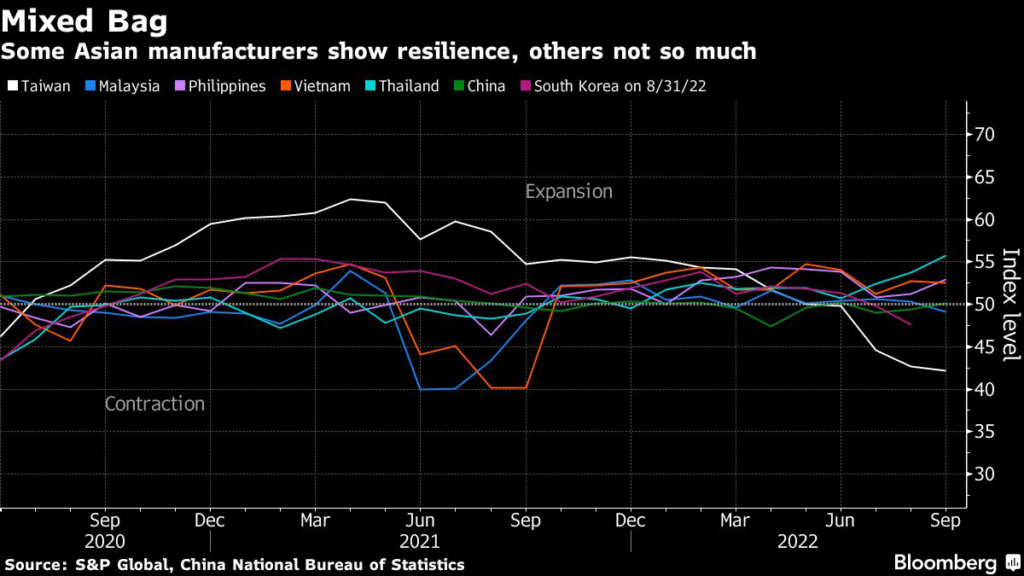
(Bloomberg) — Asia’s factories displayed a split track of recovery in September, with manufacturing powerhouses in the north turning weak and key supply chain hubs in the south showing resilience amid China’s growth slowdown.  

Purchasing managers indexes for much of Southeast Asia showed improvement, with Indonesia at 53.7 matching its January reading for the best this year. Thailand’s reading was a record high in data back to 2016, and the Philippines also edged up in September. Malaysia was a rare weakening in Southeast Asia, slipping to 49.1 after 50.3 in August.

A reading above 50 indicates expansion from the previous month, while anything below indicates contraction.

North Asia showed more of the pain in September PMIs. Taiwan and Japan eased from the prior month, with Taiwan’s PMI slumping to 42.2, its worst since the pandemic-era low in May 2020, according to S&P Global. South Korea’s PMI is set to be reported Tuesday.

The factory figures are one piece of an increasingly downbeat outlook for the global economy, with a wave of interest-rate hikes yet to defeat rampant inflation and growth concerns on the rise. China’s economic slowdown is starting to weigh more heavily on trade-reliant neighbors, and supply-chain backups have persisted worldwide.

Slumping demand for technology and semiconductors is hammering exports from Asia’s northeast manufacturing powerhouses including South Korea, Taiwan and Japan, and weighing on sentiment among producers. 

Confidence among Japan’s large manufacturers unexpectedly worsened for three straight quarters following the yen’s rapid depreciation and worsening global economic outlook. An index of sentiment among the country’s biggest manufacturers declined to 8 in September from 9, according to the Bank of Japan’s quarterly Tankan report released Monday.

Companies are not expecting improvement “anytime soon,” as business confidence for the year ahead hit its second-lowest level on record, Annabel Fiddes, economics associate director at S&P Global Market Intelligence, said in a release. “This was driven be fears that global economic conditions will weaken further, and demand across key markets across Asia, Europe and the US will continue to decline in the months ahead.”

China’s official manufacturing purchasing managers index rose last month to 50.1 — barely into expansion territory — from 49.4 in August, according to a statement from the National Bureau of Statistics on Friday.

While China’s PMIs are showing nascent signs of bottoming, economists are warning that the brunt of the hit for Asia exporters is still to come. Factories in Taiwan saw the quickest drop in output and sales since May 2020 and inventories slumped at the fastest rate in over a decade.

(Updates with details from the sixth paragraph.)

More stories like this are available on bloomberg.com

©2022 Bloomberg L.P.
Amazon Boasts 25% Increase in UK Marketplace Sellers

(Bloomberg) — The number of small and medium-sized British businesses selling over Amazon.com Inc.’s marketplace soared by more than 25% in 2021, faster than in Germany, France or Italy.

Some 85,000 smaller UK enterprises now sell on Amazon, responsible for more than 950 million product sales — or 1,750 per minute, the Seattle-based tech giant said in a statement Monday. More than 700 of those merchants have sales of more than £1 million ($1.1 million).

Facing antitrust scrutiny around the world, Amazon is positioning itself as a champion of small business and a job creator, promoting online courses aimed at sellers to use its platform more effectively. In July, Britain’s Competition and Markets Authority launched a probe into Amazon’s retail and reselling business, following EU and US investigations. The CMA cited suspected breaches of competition law and said its initial information gathering was set to end in September. 

Some smaller European countries including the Netherlands, Poland and Sweden grew their marketplaces faster than Britain, but from a lower base, Amazon said.

More stories like this are available on bloomberg.com

©2022 Bloomberg L.P.

Amazon Boasts 25% Increase in UK Marketplace Sellers

(Bloomberg) — The number of small and medium-sized British businesses selling over Amazon.com Inc.’s marketplace soared by more than 25% in 2021, faster than in Germany, France or Italy.

Some 85,000 smaller UK enterprises now sell on Amazon, responsible for more than 950 million product sales — or 1,750 per minute, the Seattle-based tech giant said in a statement Monday. More than 700 of those merchants have sales of more than £1 million ($1.1 million).

Facing antitrust scrutiny around the world, Amazon is positioning itself as a champion of small business and a job creator, promoting online courses aimed at sellers to use its platform more effectively. In July, Britain’s Competition and Markets Authority launched a probe into Amazon’s retail and reselling business, following EU and US investigations. The CMA cited suspected breaches of competition law and said its initial information gathering was set to end in September. 

Some smaller European countries including the Netherlands, Poland and Sweden grew their marketplaces faster than Britain, but from a lower base, Amazon said.

More stories like this are available on bloomberg.com

©2022 Bloomberg L.P.
India Has a $1.2 Trillion Plan to Snatch Factories From China

(Bloomberg) — In India, half of all infrastructure projects are delayed, and one in four run over their estimated budget. Prime Minister Narendra Modi believes technology is the solution to these perennial and notorious bottlenecks. 

Under a 100-trillion-rupee ($1.2 trillion) mega project called PM Gati Shakti — Hindi for strength of speed — Modi’s administration is creating a digital platform that combines 16 ministries. The portal will offer investors and companies a one-stop solution for design of projects, seamless approvals and easier estimation of costs.   

“The mission is to implement projects without time overrun and cost overrun,” Amrit Lal Meena, special secretary of logistics in the ministry of commerce and industry, said in an interview in New Delhi. “Global companies choosing India as their manufacturing center is the objective.”

Fast-tracking projects will give India an advantage, especially with China still largely closed to the outside world and companies increasingly adopting a China-plus-one policy — finding other countries to expand in or source from — to diversify their businesses and supply chains. Asia’s third-largest economy not only offers cheap labor, but also a talent pool of largely English-speaking workers, even though rickety infrastructure keeps many investors away.

READ: China’s $5 Trillion Rout Creates Historic Gap With Indian Stocks

“The only way to compete with China, apart from the fact there are political requirements of countries to move away, is to be as competitive on the cost as you can be,” said Anshuman Sinha, a partner at Kearney India who leads transport and infrastructure practices. “Gati Shakti is about making it easier to have a flow of goods and manufactured components across the length and breadth of the country.”

The key pillars of the project are identifying new production clusters that don’t exist today, and linking those sites seamlessly to the nation’s railway network, ports and airports, Sinha said. “If you peel the layers of Gati Shakti, it’s made up of identifying nodes and strengthening the logistics network connecting those nodes.”

Reducing red tape through technology is crucial for India to unclog its stalled infrastructure projects. Of the 1,300 projects Gati Shakti’s portal currently oversees, almost 40% were delayed due to issues related to land acquisition, forest and environment clearances, resulting in cost overruns, according to Meena. At least 422 projects had some issues and the portal resolved problems in some 200 of those.

Under Gati Shakti, the government, for example, will use technology to ensure that a newly constructed road isn’t dug up again to lay out phone cables or gas pipelines, according to a government agency promoting investments in India. The plan envisages modeling infrastructure projects along the lines of what Europe did after the Second World War or what China did between 1980 and 2010 to raise the nation’s “competitive index,” according to Invest India, the government agency. 

“Today’s India is committed to investing more and more to develop modern infrastructure and it is taking every step to ensure projects do not face roadblocks and get delayed,” Modi said in a speech last year inaugurating the program. “Quality infrastructure is the key to kick-start several economic activities, and create employment on a large scale. Without modern infrastructure, all-round development cannot happen in India.”

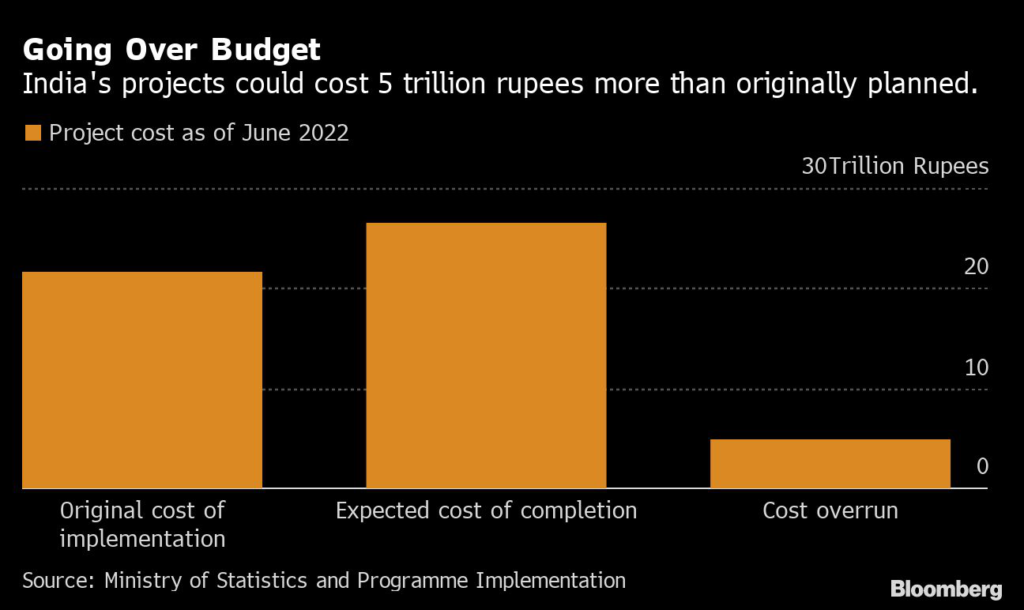
Indeed, data on the Ministry of Statistics and Programme Implementation’s website paints a picture of delayed, over-budget projects, which are hurting the nation’s economic recovery in a post-pandemic world. In May, India had a total of 1,568 projects, out of which 721 were delayed, while 423 ran over their original cost of implementation.

Since coming to power in 2014, Modi has been increasing spending on infrastructure to create new jobs and bolster an economy that was hit by an aggressive wave of Covid-19 infections. He has had some early success. 

Apple Inc. now plans to begin manufacturing the iPhone 14 in India about two months after the product’s initial release out of China, while Samsung Electronics Co. opened the world’s largest mobile phone factory in the country in 2018. Home-grown Ola Electric Mobility Pvt has pledged to build the world’s biggest electric scooter factory locally. 

The government is also using the Gati Shakti portal to spot infrastructure gaps in last- and first-mile connectivity, Meena said. 

It’s prioritizing 196 projects to plug gaps and increase port connectivity for the movement of coal, steel and food, he said. The road transport ministry is using the portal to design 11 greenfield projects under the government’s $106 billion Bharatmala plan to construct 83,677 kilometers (52,005 miles) of roads by 2022. 

“There is further focus on modern warehousing, digitization of process, skilled manpower and reduction in the logistics cost,” Meena said. “For any manufacturer, choosing India as a manufacturing destination would be a sought after decision.”

More stories like this are available on bloomberg.com

©2022 Bloomberg L.P.

India Has a $1.2 Trillion Plan to Snatch Factories From China

(Bloomberg) — In India, half of all infrastructure projects are delayed, and one in four run over their estimated budget. Prime Minister Narendra Modi believes technology is the solution to these perennial and notorious bottlenecks. 

Under a 100-trillion-rupee ($1.2 trillion) mega project called PM Gati Shakti — Hindi for strength of speed — Modi’s administration is creating a digital platform that combines 16 ministries. The portal will offer investors and companies a one-stop solution for design of projects, seamless approvals and easier estimation of costs.   

“The mission is to implement projects without time overrun and cost overrun,” Amrit Lal Meena, special secretary of logistics in the ministry of commerce and industry, said in an interview in New Delhi. “Global companies choosing India as their manufacturing center is the objective.”

Fast-tracking projects will give India an advantage, especially with China still largely closed to the outside world and companies increasingly adopting a China-plus-one policy — finding other countries to expand in or source from — to diversify their businesses and supply chains. Asia’s third-largest economy not only offers cheap labor, but also a talent pool of largely English-speaking workers, even though rickety infrastructure keeps many investors away.

READ: China’s $5 Trillion Rout Creates Historic Gap With Indian Stocks

“The only way to compete with China, apart from the fact there are political requirements of countries to move away, is to be as competitive on the cost as you can be,” said Anshuman Sinha, a partner at Kearney India who leads transport and infrastructure practices. “Gati Shakti is about making it easier to have a flow of goods and manufactured components across the length and breadth of the country.”

The key pillars of the project are identifying new production clusters that don’t exist today, and linking those sites seamlessly to the nation’s railway network, ports and airports, Sinha said. “If you peel the layers of Gati Shakti, it’s made up of identifying nodes and strengthening the logistics network connecting those nodes.”

Reducing red tape through technology is crucial for India to unclog its stalled infrastructure projects. Of the 1,300 projects Gati Shakti’s portal currently oversees, almost 40% were delayed due to issues related to land acquisition, forest and environment clearances, resulting in cost overruns, according to Meena. At least 422 projects had some issues and the portal resolved problems in some 200 of those.

Under Gati Shakti, the government, for example, will use technology to ensure that a newly constructed road isn’t dug up again to lay out phone cables or gas pipelines, according to a government agency promoting investments in India. The plan envisages modeling infrastructure projects along the lines of what Europe did after the Second World War or what China did between 1980 and 2010 to raise the nation’s “competitive index,” according to Invest India, the government agency. 

“Today’s India is committed to investing more and more to develop modern infrastructure and it is taking every step to ensure projects do not face roadblocks and get delayed,” Modi said in a speech last year inaugurating the program. “Quality infrastructure is the key to kick-start several economic activities, and create employment on a large scale. Without modern infrastructure, all-round development cannot happen in India.”

Indeed, data on the Ministry of Statistics and Programme Implementation’s website paints a picture of delayed, over-budget projects, which are hurting the nation’s economic recovery in a post-pandemic world. In May, India had a total of 1,568 projects, out of which 721 were delayed, while 423 ran over their original cost of implementation.

Since coming to power in 2014, Modi has been increasing spending on infrastructure to create new jobs and bolster an economy that was hit by an aggressive wave of Covid-19 infections. He has had some early success. 

Apple Inc. now plans to begin manufacturing the iPhone 14 in India about two months after the product’s initial release out of China, while Samsung Electronics Co. opened the world’s largest mobile phone factory in the country in 2018. Home-grown Ola Electric Mobility Pvt has pledged to build the world’s biggest electric scooter factory locally. 

The government is also using the Gati Shakti portal to spot infrastructure gaps in last- and first-mile connectivity, Meena said. 

It’s prioritizing 196 projects to plug gaps and increase port connectivity for the movement of coal, steel and food, he said. The road transport ministry is using the portal to design 11 greenfield projects under the government’s $106 billion Bharatmala plan to construct 83,677 kilometers (52,005 miles) of roads by 2022. 

“There is further focus on modern warehousing, digitization of process, skilled manpower and reduction in the logistics cost,” Meena said. “For any manufacturer, choosing India as a manufacturing destination would be a sought after decision.”

More stories like this are available on bloomberg.com

©2022 Bloomberg L.P.

Coinbase Resolves Problem That Halted Payments From US Banks

(Bloomberg) — Crypto exchange Coinbase Global Inc. said it fixed an issue that prevented the company from processing transactions with US bank accounts for more than five hours.

“We’ve fully resolved this issue and ACH transfers are now processing. We apologize for the inconvenience,” the company said on Twitter. Earlier, it said it was unable to take payments or make withdrawals involving US bank accounts.

Account holders were able to use debit card or PayPal account to make direct purchases during the outage and funds were safe,  Coinbase said.

(Updates with company statement on resolution.)

More stories like this are available on bloomberg.com

©2022 Bloomberg L.P.

Close Bitnami banner
Bitnami