Bloomberg

Coinbase Resolves Problem That Halted Payments From US Banks

(Bloomberg) — Crypto exchange Coinbase Global Inc. said it fixed an issue that prevented the company from processing transactions with US bank accounts for more than five hours.

“We’ve fully resolved this issue and ACH transfers are now processing. We apologize for the inconvenience,” the company said on Twitter. Earlier, it said it was unable to take payments or make withdrawals involving US bank accounts.

Account holders were able to use debit card or PayPal account to make direct purchases during the outage and funds were safe,  Coinbase said.

(Updates with company statement on resolution.)

More stories like this are available on bloomberg.com

©2022 Bloomberg L.P.

Bitcoiners Hunker Down for ‘Storms Ahead’ as Retail Stays Away

(Bloomberg) — Crypto investors found something to cheer about amid the recent downturn in digital tokens: the asset class held up better than just about everything else in the third quarter. Yet the hunt for a bottom continues as long-term holders cling on with expectations that there’s more pain to come — and retail investors stay on the sidelines. 

Even with the narrative going around that crypto hung tough in the July-September stretch, the mood has remained sour. While around 83,500 new digital wallets are coming online daily, that’s a low for the 2020-2022 cycle, according to data compiled by strategists at Glassnode. 

Meanwhile, wealth held by “mature coins” is at an all-time high, the researcher said, as long-time investors have refused to spend them amid the market turmoil. The group of investors who ‘hodl’ through thick and thin — meaning those who remain loyal even during tough times — has remained “steadfast,” according to Glassnode, which said that they might be hunkering down “for the storms ahead.” 

Such is the problem for Bitcoin and other cryptocurrencies now — the cohort of retail-type investors who had fueled much of last year’s huge surge in prices have been missing in action. Some market-watchers say that with hodl-investors waiting things out, the overhanging question remains whether — or when — individual investors will make a return. 

“The overall price has got to do better, and once it does, the retail investor will become excited again. We definitely don’t have that right now because we’re just stuck in a range,” said Matt Maley, chief market strategist at Miller Tabak & Co. “There’s nothing that turns off an individual investor more than something getting stuck in a sideways range.”

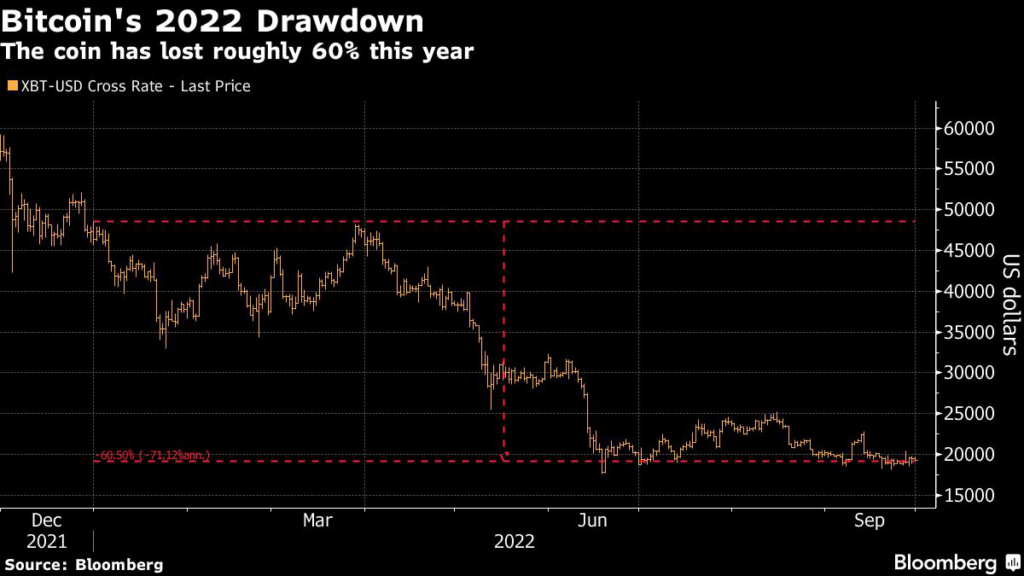
At issue is Bitcoin needing to find a bottom amid a selloff that’s brought it down 60% this year. Many analysts say that should US stocks form a floor, then the digital token could too, though there’s little consensus on when that might happen. Others argue that once the dollar starts to weaken, then Bitcoin might be able to break upwards also. 

Whatever the case, interest in crypto has waned in recent months. Google trends show the general populace has been much less interested in the tokens. And Bitcoin’s on-chain activity has been depressed the whole year, according to a note by Jaran Mellerud at researcher Arcane. 

“If it is a risk asset, as many including myself have suggested, picking a bottom in BTC is tantamount to picking a bottom in stocks,” Marc Chandler, chief market strategist at Bannockburn Global Forex, said, adding that “the crash has tempered the enthusiasm among” people he speaks with. 

With investors sitting things out until Bitcoin and other cryptocurrencies can start to rebound, ETF flows have remained muted too. The money flowing out of crypto-related funds in the third quarter has slowed down and some analysts argue the bulk of investors fleeing happened in the second quarter. Now they’re just waiting things out. 

There are plenty who say that price recoveries could still be a ways off. That’s the view of Ashley Oerth, senior investment strategy analyst at Invesco, who says that cryptocurrencies tend to be valued not by their own characteristics but by the prevailing macro environment. 

“‘Next summer’ for crypto is probably when we see peak hawkishness from central banks and a start to easing policy,” Oerth said. “To the extent that you’re a believer in crypto’s long-term potential, now may be a buying opportunity — if you can stomach the volatility.”

More stories like this are available on bloomberg.com

©2022 Bloomberg L.P.

Coinbase Fixing Problem That Halted Payments From US Banks

(Bloomberg) — Crypto exchange Coinbase Global Inc. is fixing an issue that prevented the company from processing transactions with US bank accounts.

“We are currently unable to take payments or make withdrawals involving US bank accounts. Our team is aware of this issue and is working on getting everything back to normal as soon as possible,” it said in a statement.

More than an hour later, the company said the issue has been identified and a fix is being implemented.

Account holders can still use a debit card or PayPal account to make direct purchases, it added.

(Updates with latest statement from company.)

More stories like this are available on bloomberg.com

©2022 Bloomberg L.P.

Stellantis’s Tavares Sees Microchip Shortage Lasting to End-2023

(Bloomberg) —

Stellantis NV’s chief executive believes a microchip shortage could remain “very complicated” until late 2023, according to an interview with Le Parisien published on Sunday.

Carlos Tavares expects the situation to loosen after that, in part because the market for consumer electronics is declining. The carmaker’s CEO also thinks the tens of billions of euros invested in Europe and the US to foster local microchip industries will boost supply in the long term.

“When these investments materialize, there will be microchips, even in overabundance,” Tavares said in the interview. “But we’ll need to wait at least three years.”

Car manufacturers are facing a shortage of microchips, after the dedicated industry shifted its focus to consumer electronics during the pandemic. At the time, carmakers had lowered their microchip orders, with potential customers unable to go to dealerships, Renault SA’s Chief Executive Officer Luca de Meo said in the same interview with Le Parisien.

“Now I struggle to find the basic microchip that raises or lowers the window,” de Meo said. “Without it, I can’t produce the car.”

More stories like this are available on bloomberg.com

©2022 Bloomberg L.P.

JD.com Tycoon Settles Rape Suit Hours Before US Trial Begins

(Bloomberg) — Billionaire JD.com founder Richard Liu has reached a settlement with Liu Jingyao, the Minnesota student who accused him of rape in 2018, bringing to a close a civil suit less than 48 hours before a trial was set to begin. 

“The incident between Ms. Jingyao Liu and Mr. Richard Liu in Minnesota in 2018 resulted in a misunderstanding that has consumed substantial public attention and brought profound suffering to the parties and their families,” the parties said in a joint statement. “Today, the parties agreed to set aside their differences, and settle their legal dispute in order to avoid further pain and suffering caused by the lawsuit.”

Details of the settlement weren’t released. Liu Jingyao had been seeking at least $50,000 in damages, plus additional punitive damages in the lawsuit. While in criminal trials prosecutors are required to persuade a jury the defendant is guilty beyond a reasonable doubt, the standard is lower in civil suits, where the jury must only be convinced by a preponderance of evidence of the defendant’s liability.

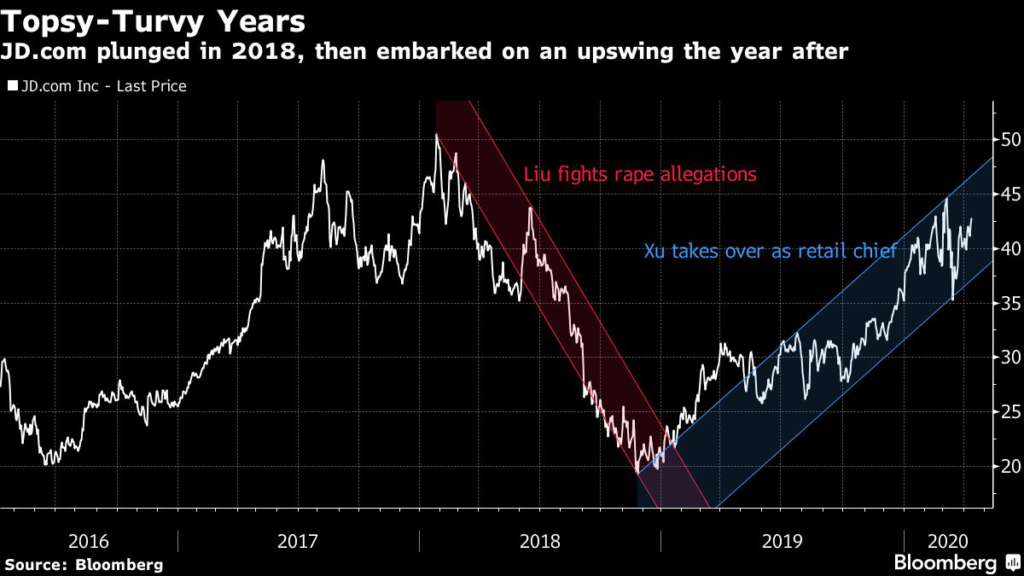
Richard Liu, whose Chinese name is Liu Qiangdong, is one of China’s most powerful businessmen, and the company he founded in 1998 has grown to be one of its biggest e-commerce platforms. News of the alleged assault wiped $10 billion off the value of the company, but Liu remains among the 150 richest people in the world, according to the Bloomberg Billionaire Index, with a net worth of $12.2 billion.


The civil suit drew international attention, in part because China’s domestic legal system makes it hard for women to seek recourse for sexual misconduct by men. The nation’s courts give little weight to testimony in general, making it difficult for women whose cases depend on witness statements and credibility.

Liu, then a student at the University of Minnesota, filed a police report in 2018 saying that the tech executive had groped her in a car after dinner in a Minneapolis restaurant and later raped her. After prosecutors declined to press charges, saying they lacked sufficient evidence, Liu filed a civil suit.

Richard Liu, who had been expected to testify in the trial, has consistently denied Liu Jingyao’s accusations and insisted that their encounter was consensual. 

The settlement was hotly debated on the Chinese social media platform Weibo, where a hashtag of the news was viewed 86 million times as of early Sunday afternoon local time. Many comments disparaged Jingyao Liu and implied she pursued legal actions for money, an unsubstantiated accusation that’s dogged Jingyao Liu since she first pursued legal action.

Some of her supporters have also been attacked on social media, said Liang Xiaowen, an activist and lawyer based in New York. “There have been students who were pressured by staff at their university to delete posts that express support for Jingyao Liu,” she said. “Many people have experienced intimidation through supporting Jingyao Liu. So this result is important to them.”


In the three months after his arrest, JD.com lost more than $10 billion of market value — almost a third of its capitalization at the time. In China, JD.com is a combination of e-commerce and delivery, with similarities to Amazon.com Inc. and Federal Express Corp. It also has operations in Thailand and Indonesia.

The company paid a special cash dividend in May of 63 cents per ordinary share and $1.26 per American depository share for a payout of $2 billion, of which more than $200 million went to Richard Liu.

On Sept. 16, Richard Liu relinquished 45% of his equity interests in two JD.com affiliates to Qin Miao, the vice president of JD Group, to boost the administration efficiency, according to filings with the Hong Kong stock exchange. 

The transfer followed Richard Liu’s decision to step down as chief executive officer of JD.com in April. He was replaced by the company’s president, Xu Lei. Richard Liu also resigned from the Chinese People’s Political Consultative Conference, citing “personal reasons.”

(Updates with local reaction and activist comment)

More stories like this are available on bloomberg.com

©2022 Bloomberg L.P.

The Stocks to Buy and Sell During the UK’s Market Rout

(Bloomberg) —

The stock market has been roiled by Britain’s stubborn inflation and an interest rate crisis deepened by tax cuts from Liz Truss’s new government. Now, investors are seeking places to hide.

Worries about the mortgage market have crushed real estate and construction firms, while also taking down retailers. On the flip side, investors see pockets of safety in the biggest exporters such as pharma giant GSK Plc, oil company Shell Plc, cigarette maker British American Tobacco Plc, as well as financial companies that can ride volatility, like London Stock Exchange Group Plc.

Others simply flag the discounts on offer in London. “If you look at the average UK stock it’s becoming embarrassing how cheap they are getting,” said Peter Toogood, chief investment officer at Embark Group Ltd.

Indeed, take the FTSE All-Shares Index, it trades at 8.4 times forward earnings. That’s far cheaper than 13.3 times for a global stocks gauge, the MSCI All-Country World Index.

The FTSE Local Index of businesses that generate at least 70% of sales domestically is down 12% since the budget through yesterday’s close. The FTSE 100, meanwhile, has fallen just 3.7%. And with the UK’s fiscal and monetary policymakers apparently moving in different directions, more volatility is expected.

“There’s a lot of chaos — a lot of difficult times ahead,” Embark’s Toogood told Bloomberg TV on Friday. 

Here’s a look at some of the most-impacted sectors.

Banks

Lenders such as Barclays Plc, Lloyds Banking Group Plc and NatWest Group Plc have slumped following the bond yield spike over the past week. That’s slightly counterintuitive, as they make more money from lending when rates rise. The problem is, surging mortgage rates will hurt demand for loans, and even spur some defaults. Mortgage rates close to 6% could “trigger asset quality problems,” Morgan Stanley analyst Alvaro Serrano wrote in a note.

Homebuilders

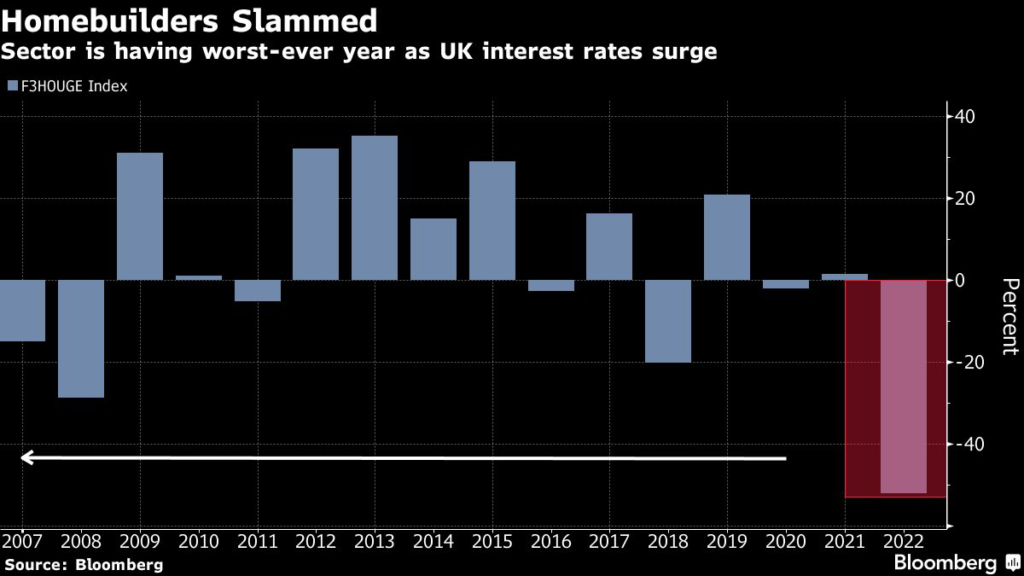
A FTSE index tracking companies like Persimmon Plc and Taylor Wimpey Plc has fallen by 14% since Kwarteng announced his mini-budget on Sept. 23. That’s extended a year-to-date slump to more than 50%, knocking about £22 billion ($24.5 billion) in market value off the sector. 

That’s left some homebuilders trading at 30% discounts to the amount they originally paid for the land that they own, according to Shane Carberry, an analyst at Goodbody Stockbrokers. He questioned whether house prices will fall by that much in reality, and added that homebuilders’ balance sheets are much stronger than they were during the financial crisis.

Read More: Homebuilders Drop 50% This Year as Crisis Worsens With Truss

Exchanges

London Stock Exchange Group Plc and other exchanges benefit from rising rates via higher interest income as well as higher trading, clearing and settlement volumes, Deutsche Bank analyst Benjamin Goy said in a note.

A bigger beneficiary, however, might be TP ICAP Group Plc, the storied interdealer broker whose biggest market is bonds and which earns a big chunk of its revenue in dollars. “Conditions have not been this good for this company for years,” Canaccord Genuity analysts Justin Bates and Portia Patel wrote in a note as they kept a buy rating on the stock. 

Read More: London’s European Stock Market Crown Under Threat From Paris

Retail 

UK retailers are facing a “mortgage time bomb,” with rising interest rates set to have twice the impact on consumer finances as the recent surge in utility bills, according to Deutsche Bank. A “significant” increase in the cost of servicing home loans will reduce disposable incomes by about 5% in 2023, Matt Garland wrote in a note Thursday, adding to pressure on consumers already struggling to contend with soaring inflation.

The prediction added to investor jitters on the day that bellwether Next Plc issued its second profit warning this year and Sweden’s Hennes & Mauritz AB, which is prominent on the UK high street, reported an 86% slump in third-quarter earnings. 

Technology

With a weaker pound and cheaper valuations for tech stocks following a recent selloff in growth assets, foreign capital’s appetite for UK tech is only increasing. Tech occupies less than 2% of FTSE All-Share Index, and the weight is set to decrease further, as analysts said companies including Darktrace Plc, Kape Technologies Plc and The Sage Group Plc could also draw takeover interest.

The UK tech sector has already seen a flurry of takeover attempts from foreign buyers in recent months. Open Text Corp.’s offer for Micro Focus International Plc nearly doubled the software company’s share price in one day, while Aveva Group Plc’s shares also benefitted from a premium in Schneider Electric SE’s offer.

Risk Arbitrage

On the theme of M&A, some investors may be using “risk arbitrage” to shield themselves from UK turbulence. Risk arbitrage is a strategy that bets on the successful closing of an acquisition, where the difference between the offer price and the stock price reflects the risk of deal completion.

In addition to its positive correlation to interest rates, the strategy has a very low correlation to the overall market as investors are taking deal risk, not market risk. The strategy is therefore seen as helpful in dampening the volatility of an overall portfolio.

Healthcare

UK pharmaceutical businesses are relatively insulated from recent economic woes, as investors expect their “defensive qualities” to shield earnings. People will always need treatments and drugs.

Big pharma can also benefit from sterling’s weakness, as much of its sales are in US dollars. While the two British pharma giants GSK Plc and AstraZeneca Plc have outperformed significantly in the past 12 months — AstraZeneca shares are up 15% year-to-date — they might have further to go still.

In a Sept. 29 note, analysts at Oddo BHF tagged both firms as top picks in the sector, saying recent profit-taking after their strong 2022 “represents an opportunity,” and flagged next year will be rich in catalysts, including a data readout from a large AstraZeneca lung cancer treatment study, due in early 2023.

In terms of sector performance, much may depend on the direction of the pound. Homebuilders, domestic banks and real estate companies tend to outperform when the pound strengthens, while health care, staple goods and telecommunications underperform, according to an analysis from Goldman Sachs Inc. The latter sectors — which generate large sales abroad — could benefit if sterling weakens further.

More stories like this are available on bloomberg.com

©2022 Bloomberg L.P.

JD.com Tycoon Settles Rape Lawsuit Hours Before US Trial Begins

(Bloomberg) — Billionaire JD.com founder Richard Liu has reached a settlement with Liu Jingyao, the Minnesota student who accused him of rape in 2018, bringing to a close a civil suit less than 48 hours before a trial was set to begin. 

“The incident between Ms. Jingyao Liu and Mr. Richard Liu in Minnesota in 2018 resulted in a misunderstanding that has consumed substantial public attention and brought profound suffering to the parties and their families,” the parties said in a joint statement. “Today, the parties agreed to set aside their differences, and settle their legal dispute in order to avoid further pain and suffering caused by the lawsuit.”

Details of the settlement weren’t released. Liu Jingyao had been seeking at least $50,000 in damages, plus additional punitive damages in the lawsuit. While in criminal trials prosecutors are required to persuade a jury the defendant is guilty beyond a reasonable doubt, the standard is lower in civil suits, where the jury must only be convinced by a preponderance of evidence of the defendant’s liability.

Richard Liu, whose Chinese name is Liu Qiangdong, is one of China’s most powerful businessmen, and the company he founded in 1998 has grown to be one of its biggest e-commerce platforms. News of the alleged assault wiped $10 billion off the value of the company, but Liu remains among the 150 richest people in the world, according to the Bloomberg Billionaire Index, with a net worth of $12.2 billion.


The civil suit drew international attention, in part because China’s domestic legal system makes it hard for women to seek recourse for sexual misconduct by men. The nation’s courts give little weight to testimony in general, making it difficult for women whose cases depend on witness statements and credibility.

Liu, then a student at the University of Minnesota, filed a police report in 2018 saying that the tech executive had groped her in a car after dinner in a Minneapolis restaurant and later raped her. After prosecutors declined to press charges, saying they lacked sufficient evicende, Liu filed a civil suit.

Richard Liu, who had been expected to testify in the trial, has consistently denied Liu Jingyao’s accusations and insisted that their encounter was consensual. Liu Jingyao has also been attacked by some on Chinese social media, accusing her of trying to blackmail him.

Interest in the trial in China was high. Richard Liu was spotted with his pregnant wife in a Target store last week, according to photos posted on Weibo, the Chinese social media platform. The post garnered 890 million views and spurred about 30,000 discussions.


In the three months after his arrest, JD.com lost more than $10 billion of market value — almost a third of its capitalization at the time. In China, JD.com is a combination of e-commerce and delivery, with similarities to Amazon.com Inc. and Federal Express Corp. It also has operations in Thailand and Indonesia.

The company paid a special cash dividend in May of 63 cents per ordinary share and $1.26 per American depository share for a payout of $2 billion, of which more than $200 million went to Richard Liu.

On Sept. 16, Richard Liu relinquished 45% of his equity interests in two JD.com affiliates to Qin Miao, the vice president of JD Group, to boost the administration efficiency, according to filings with the Hong Kong stock exchange. 

The transfer followed Richard Liu’s decision to step down as chief executive officer of JD.com in April. He was replaced by the company’s president, Xu Lei. Richard Liu also resigned from the Chinese People’s Political Consultative Conference, citing “personal reason.”

The case is Liu v. Liu, 27-cv-19-5911, District Court, 4th Judicial District, County of Hennepin.

More stories like this are available on bloomberg.com

©2022 Bloomberg L.P.

The Best Places to Visit in Japan Before Swarms of Tourists Arrive

(Bloomberg) — After almost three years of Covid-induced border closures, Japan is finally opening up to vaccinated tourists from most countries, with no need for quarantine, PCR tests or visas. And with the weaker yen making hotels, restaurants and shopping more affordable, demand is sure to be high.

Airlines are ramping up flights and businesses are getting to receive visitors from Oct. 11. Even so, it will probably be a while before crowds return, especially with China restricting travel.

With that in mind, here’s are some of the top spots to visit in Japan while the country is still relatively empty, as curated by Bloomberg Tokyo’s newsroom:

Ghibli Park

For fans of Hayao Miyazaki’s animated films, it doesn’t get much better than this. Ghibli Park, an ode to the characters and scenery featured in the movies, opens to the public Nov. 1 in Aichi prefecture, roughly three hours by train from Tokyo.

Featuring buildings and landscapes featured in My Neighbor Totoro and Laputa: Castle in the Sky, the park is much bigger in scale than Tokyo’s more modest (but popular) Ghibli Museum. Most of the new attraction will be green space in a 194-hectare (479 acres) park that hosted the 2005 Aichi Expo.  

But don’t expect a Cat Bus roller-coaster or thrill-seeking rides. Instead, the studio encourages visitors to “take a stroll, feel the wind, and discover the wonders” of the world of Ghibli.

Tickets (reservations required) will cost 1,000 to 2,500 yen ($7-$17) for adults, or 500 yen to 1,250 yen for children, to access any one of the three parts of the park. Two more areas will be added later, including “Mononoke Village.”  

Ancient Kyoto

No list of Japan’s travel spots would be complete without mention of Japan’s ancient capital and home to centuries-old temples and shrines, art and exquisite cuisine. 

A beloved tourist destination for Japanese and overseas visitors alike, the city of 1.5 million has had a love-hate relationship with its popularity, as its narrow streets and limited public transportation were under strain from heavy tourist traffic pre-Covid. And even if it does get crowded, there are enough off-the-beaten track options to explore, such as the National Museum of Modern Art.

Read more: Once Overcrowded Kyoto Now Longs for Foreign Tourists in Japan

A recent visit to the 1,200-year-old Kiyomizudera Temple overlooking the city saw only a handful of visitors, on a weekday. There’s new stuff too; Mario fans can visit the former Nintendo Co. headquarters that’s been transformed to a hotel that’s just opened this year complete with a library, bar and spa. (More on Mario below.)

Tokyo’s Fish Market

Many returning tourists won’t want to miss out on sushi. 

The ramshackle alleys of Tsukiji are no longer home to the world’s biggest fish market, but if you travel a bit further, you’ll find crowd favorites Daiwa Sushi and Sushi Dai at the Toyosu Fish Market at Shijomae station.

Many people in Tokyo will tell you they know the world’s best sushi restaurant. Ours is Iwasa Sushi, at the new market, where photos of Quentin Tarantino and other celebrities grace the walls. Here, the sushi chefs will lay out a bamboo leaf on the counter and plop down pieces of fatty toro and botan ebi faster than you can wolf it down. Follow the local practice and have a beer or sake with your sushi. For breakfast.

A Hiker’s Dream

For hikers, Japan offers excellent terrain across its mountainous archipelago. 

If you’re looking to explore further out of Tokyo, consider Aomori, the northernmost prefecture of Japan’s main island of Honshu. Use JR East Pass to travel up north. Fall is a perfect season to hike in the country, and Aomori’s Mount Hakkoda boasts beautiful fall leaves changing colors during the season. Hikers can opt for a route that ends with a soak at Sukayu Onsen, a famous hot spring by the base of the mountain known for its Senninburo, or “bath of thousand bathers.”

The Michinoku coastal trail runs for over 1,000 kilometers along the Pacific coast of Japan’s Tohuku region. Hikers are rewarded with dramatic scenery of sheer cliffs plunging into the ocean, wonderful sea views and rugged, challenging terrain. Plus the area has incredible seafood.

Iconic Isetan

One of Tokyo’s iconic department stores, Isetan in central Tokyo has gotten a facelift since borders were closed at the start of the pandemic. 

Originally founded in 1886 as a kimono and clothing store, Isetan has expanded its sprawling cosmetics retail area, which now takes up two floors. That should make it easier to look around and find popular Japanese beauty and spa products, which were a massive draw for Chinese and other Asian tourists pre-Covid. 

The Hermès boutique on the first floor also recently expanded but be prepared to wait — lines were already seen there on a recent weekday. 

Eclectic Kyushu

Kyushu, southernmost of Japan’s four big islands, is one of Japan’s best-kept secrets. From top-notch cuisine in the biggest city of Fukuoka to the hot springs of Beppu, it’s an increasingly popular destination for travelers, both international and domestic.

Nagasaki, the Kyushu port city that’s home to Japan’s biggest Christian population, is home to numerous churches. A melting pot, thanks to centuries of trade with the Netherlands, Portugal and China, the city is home to eclectic cuisine and fresh seafood. A short boat ride will take visitors to Gunkanjima, a concrete island that was once home to former coal-mining facility that looks like a battleship.

The new Nishi Kyushu Shinkansen, or western Kyushu bullet train, that began service in September should make traveling to Nagasaki much quicker and easier. 

Super Nintendo World

Explore the world of Mario in real life. The world’s first theme park based on Nintendo’s hugely popular video-game franchise opened in March 2021 inside Universal Studios Japan. Zip over to Osaka from Tokyo on the Shinkansen bullet train before transferring to local lines and you’re there in about 3 hours.

The entrance to Super Nintendo World is a green warp pipe tunnel that leads to Peach’s castle and the Mushroom Kingdom. From the moment you exit the tunnel, it’s a game world, complete with spinning gold coins, question mark boxes and Piranha plants.

Mario Kart and Yoshi’s Adventure are the main rides. There are also a number of Key Challenge mini games. Once you win three, you get access inside Bowser Jr.’s lair to try and retrieve a stolen golden mushroom. When you’ve run out of fuel, head to Kinopio’s Cafe for food made by Chef Toad.

The price of admission includes park entrance and use of all attractions including Super Nintendo World. Tickets cost 8,400 yen for those 12 and up, 7,600 yen for seniors over 65, and 5,400 yen for young children. Express Passes and VIP wristbands are also available, helping cut down wait times for an additional fee. The park is open every day of the year.

More stories like this are available on bloomberg.com

©2022 Bloomberg L.P.

World Economy Roiled by Simultaneous Shocks Echoing 2007 Anxiety

(Bloomberg) — Sign up for the New Economy Daily newsletter, follow us @economics and subscribe to our podcast.

The world economy is showing signs of a rapid downshift as it contends with a series of shocks — some of them self-inflicted by policymakers — increasing the likelihood of another global recession and the danger of major financial disruptions.

“We’re living through a period of elevated risk,” former US Treasury Secretary Lawrence Summers told “Wall Street Week” with David Westin on Bloomberg Television, for whom he is a paid contributor. “In the same way that people became anxious in August of 2007, I think this is a moment when there should be increased anxiety.”

At the heart of the strain: The fallout from the most aggressive hiking of interest rates since the 1980s. Having failed to foresee the surge in inflation to multi-decade highs, the Federal Reserve and most peers are now lifting rates at speed in a bid to restore price stability and their own credibility. 

Evidence of the impact — and of the blow to consumers’ purchasing power from soaring prices — is mounting quickly. In the past several days, Nike Inc. reported a surging stockpile of unsold product, FedEx Corp. shocked with a warning on delivery volumes and key chipmaker South Korea saw the first drop in semiconductor output in four years as demand retreats. Apple Inc. is backing off plans to boost output of its new iPhones, Bloomberg reported.

The turn is coming even before the full thrust of monetary tightening is felt. The Fed and many counterparts are pledging to keep going with steep rate hikes as they attempt to rebuild credibility. Quantitative tightening programs, where central banks remove liquidity by shrinking bond portfolios, are also just getting going.

Inflation data showcase the need for, as Fed Vice Chair Lael Brainard put it Friday, “avoiding pulling back prematurely” on tightening. She spoke shortly after the Fed’s preferred measure of prices jumped more than forecast. Earlier, data showed euro-zone inflation has punched into double-digits.

Layered on top of continuing reverberations from the Russian invasion of Ukraine, the spreading economic gloom is sowing fear in financial markets, creating its own worrying dynamic. A rapidly appreciating dollar, supercharged by the Fed, may help cool US inflation, but it drives it up elsewhere by weakening other currencies — pressuring authorities to restrain their own economies.

“The global economy is in the eye of a new storm,” Reserve Bank of India Governor Shaktikanta Das said Friday after lifting rates again.

Prospects for a second global recession so soon after the 2020 downturn triggered by the pandemic were hardly apparent a year ago. But Europe’s Russian-induced energy crisis, and China’s deepening property slump and continued Covid-Zero approach weren’t part of the consensus outlook.

Not all is dark, with US job-market resilience a notable feature. But the plans by Facebook parent Meta Platforms Inc. for the first reduction in headcount ever illustrate how that may still change.

And Britain’s experience in recent days showcases how investors are in a mood to punish policymakers pursuing approaches deemed unsustainable. The Bank of England was forced to intervene in its bond market after the new UK government announced $45 billion of unfunded tax cuts.

What Bloomberg Economics Says…

“Forecasts of a soft landing for the global economy assume something close to perfect policy execution. The events of the last week demonstrate the reality can be very different.”

“The opportunity for further fumbles — after the UK’s fiscal fail and market meltdown — is high. And the cost, if they occur, higher.”

–Tom Orlik, chief economist. 

“Markets are concerned about fiscal policies becoming even looser despite inflation, or the dollar, getting excessively strong,” said Cui Li, head of macro research at CCB International Securities Ltd. 

Nike’s troubles showed how the dollar’s appreciation is causing issues not just for developing nations that issued debt in the US currency — Sri Lanka, Pakistan and Argentina are among those turning to the IMF for help — but also for American multinational companies.

The athletics-wear giant on Thursday downgraded its outlook, citing foreign-exchange effects and higher freight costs, which are a symptom of supply-chain delays and port congestion. That’s besides the need to embrace price markdowns given unsold stock. North American inventories climbed 65% in the three months through August.

Housing markets are also turning, walloped by surging mortgage rates. The US in the past week saw the first decline in home prices in a decade.

“The question is how low growth will go, and for how long it will stay down,” said S&P Global Chief Economist Paul Gruenwald.

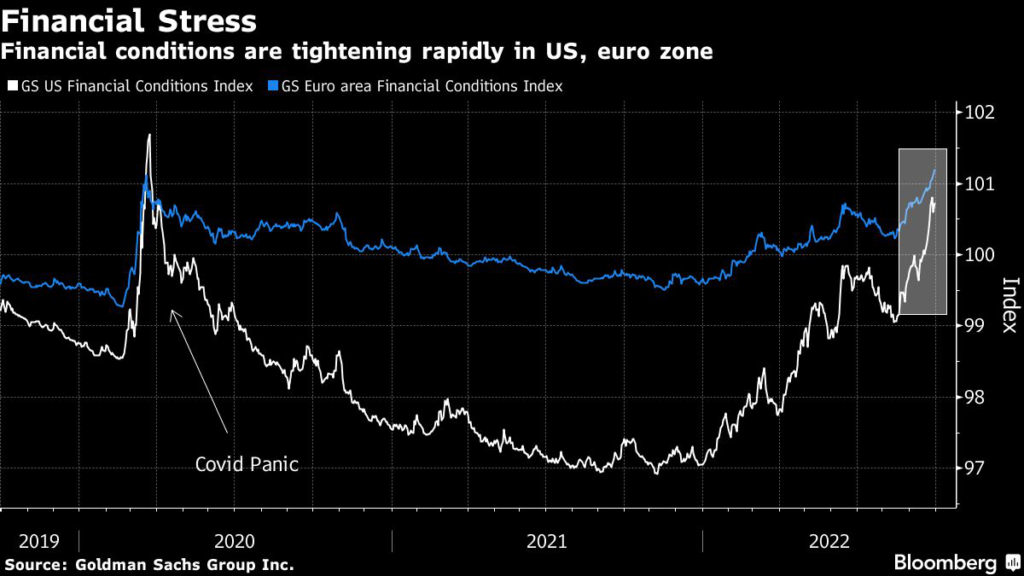
Perhaps the biggest X-factor is the potential for financial turmoil as the dollar, which has appreciated almost 14% this year as measured by the Bloomberg Dollar Spot Index, exerts pressure across markets.

Combine that with rapid increases in borrowing costs, and it spells the potential for trouble. Summers, the ex-Treasury chief, said  “You can never be certain about what the consequences of that will be.”

That has echoes of the summer of 2007, when the impact of the collapsing US housing market first began showing up in the financial system, with the closure of a number of funds and sudden liquidity shortfalls among banks. Things eventually morphed the following year into the worst financial crisis since the Great Depression.

Rising anxiety across global markets can be seen in the Bank of America Merrill Lynch GFSI Market Risk indicator, a measure of future price swings implied by options trading on equities, interest rates, currencies and commodities.

The gauge has jumped to the highest since March 2020, when markets were in full-blown pandemic panic.

Given the need to address inflation, diminished fiscal space in the wake of record spending on the pandemic, and varying priorities across major economies, the potential for joint action to address challenges may be in question.

“The incoherent macro policies within countries and absence of policy coordination across countries are both problematic,” said Cui Li at CCB.

It all makes for a potentially tension-filled gathering of global finance chiefs next week for the annual International Monetary Fund and World Bank Oct. 10-16 in Washington.

More stories like this are available on bloomberg.com

©2022 Bloomberg L.P.

West Africa’s Fifth Coup in Two Years Tests Regional Bloc

(Bloomberg) —

West Africa’s fifth successful coup in just over two years is testing a regional bloc that’s running out of ideas to maintain political stability in the face of threats by jihadists.

The Economic Community of West African States, which aims to create a trading bloc and promote democracy, is negotiating a return to civilian rule in three member states including Burkina Faso, where the latest coup occurred this week. The country’s now-ousted leadership had agreed for elections to be held by July 2024 to restore democracy.

“Ecowas finds this new coup unfortunate at a time when progress had been made, through diplomatic and Ecowas efforts, to ensure a methodical return to democracy,” the 15-nation bloc said Friday in a statement calling for the deadline of July 2024 to be maintained.

The African Union echoed that call in a separate statement.

Burkina Faso, Africa’s fourth-biggest gold producer, has been under military rule since Jan. 24 when mutinous soldiers forced then-President Roch Marc Christian Kabore to resign. The regional bloc had initially hoped for a quick return to civilian rule after a succession of putsches suspended constitutional order. Mali and Guinea, the world’s top bauxite producer, have also succumbed to coups since August 2020. 

Meanwhile, Niger President Mohamed Bazoum and his Guinea-Bissau counterpart, Umaro Sissoco Embalo, have both survived military attempts to topple their governments in the past 18 months. It’s gotten so bad that Embalo, who currently holds the one-year rotating presidency of Ecowas, floated the idea of creating an anti-putsch force to deter coup plotters. 

In Mali and Burkina Faso, those originally seizing power from civilian governments did so on the grounds that national security was under threat by jihadists who’ve destabilized the wider region. But power grabs could also make the region more vulnerable to Islamist attacks by creating vacuums or jeopardizing military cooperation. 

Mali and Burkina Faso have now faced second coups with control moving between military leaders.

In the latter, the same junta, known by its French acronym MPSR, remains in power after replacing Paul-Henri Sandaogo Damiba over his inability to stem jihadist violence, a junta spokesman said Friday on the state broadcaster, Radio Television du Burkina. Still, the new leadership ditched the democratic transition plan, suspended the constitution, and dissolved the cabinet and parliament. It also closed all borders and imposed a curfew.

Captain’s Word

Damiba, a 41-year-old colonel, had himself seized power in January, toppling Kabore over failure to quash Islamist violence. His replacement, Ibrahim Traore, a 34-year old captain, was named new MPSR President.

Ecowas’ attempts to restore civilian rule in the region have so far been met with little success. The bloc imposed strict economic and trade sanctions on Mali for six months, but took a softer stance in Burkina Faso and Guinea, conceding to longer-than-demanded transitions. In Guinea-Bissau, it deployed soldiers to protect Embalo in a rare military intervention.

In his first interview Saturday, Burkina Faso’s new junta leader sought to reassure the bloc that civilian rule could be restored even faster than agreed with the ousted regime.

“We don’t need two years,” Traore told Voice of America. “Ecowas shouldn’t worry about its timeline. We’re not here to hold on to power.”  

(Updates with quote from new junta leader in last paragraph)

More stories like this are available on bloomberg.com

©2022 Bloomberg L.P.
Close Bitnami banner
Bitnami