
Bloomberg

Swift Bankman-Fried Indictment Points to ‘Avalanche of Evidence’

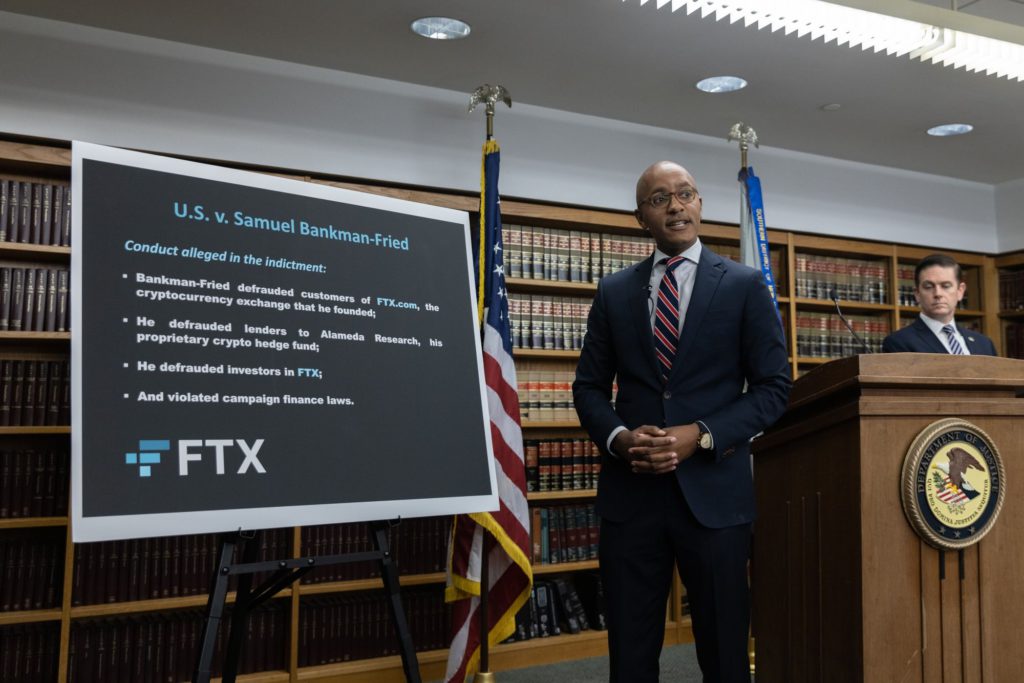
(Bloomberg) — Federal prosecutors moved at warp speed to charge FTX founder Sam Bankman-Fried, defying expectations that a criminal case over the cryptocurrency exchange’s collapse would take months or even years to build.

The eight-count indictment against Bankman-Fried unsealed Tuesday came barely a month after FTX filed for bankruptcy protection on Nov. 11. By comparison, Enron Corp. Chief Executive Officer Jeffrey Skilling, who was ultimately convicted of fraud and other counts, wasn’t charged until more than two years after that company’s 2001 collapse. 

Gene Rossi, a former federal prosecutor, said such a swift indictment suggests federal investigators quickly accumulated a substantial amount of evidence through grand jury subpoenas and witness testimony.

“To indict someone of his stature so early tells me they had an avalanche of evidence,” Rossi said. “To indict this early, when they didn’t have to, tells me that they have incredibly powerful evidence.”

Misappropriated Billions

The charges against Bankman-Fried include wire fraud, conspiracy to commit securities fraud and several other counts for allegedly misappropriating billions of dollars in FTX customers funds for personal use and risky bets by sister trading house Alameda Research. Manhattan US Attorney Damian Williams on Tuesday called the case “one of the biggest financial frauds in American history.”

Complex fraud cases usually take far longer to investigate as prosecutors and federal agents sift through documents, interview witnesses and present evidence to grand juries. 

But FTX’s bankruptcy-appointed Chief Executive Officer John J. Ray III, who also oversaw Enron’s liquidation, testified before Congress on Tuesday that he believed the fraud at the cryptocurrency exchange wasn’t particularly complex.

“The FTX Group’s collapse appears to stem from the absolute concentration of control in the hands of a very small group of grossly inexperienced and unsophisticated individuals,” Ray testified. He called the alleged misuse of FTX customer funds by Bankman-Fried’s inner circle straightforward embezzlement.

Sam Buell, a Duke University law professor and former lead prosecutor for the Justice Department’s Enron Task Force, said the 14-page indictment against Bankman-Fried “quite bare bones relative to what you would normally expect in a major fraud prosecution.” Buell said the lack of detail could suggest prosecutors felt pressure to act quickly.

Marc Litt, a former federal prosecutor in Manhattan, agreed. He likened the speed with which prosecutors acted to the December 2008 indictment of Bernard Madoff, who was charged days after a lawyer for the investment manager’s sons told the US Securities and Exchange Commission about the fraud at their father’s brokerage firm. 

Litt said prosecutors likely felt they had to move swiftly in both cases. 

Rossi said the government was probably “gravely concerned” that Bankman-Fried would try to flee to a jurisdiction where he could not be extradited. Bankman-Fried, who ran FTX from the Bahamas, was arrested there Monday evening. 

At a Tuesday arraignment in a Bahamian court, Bankman-Fried’s lawyer said his client planned to fight extradition to the US. Legal experts said such a fight could delay the case for months or even years, potentially negating the swiftness of the indictment.

Williams declined to address the extradition process on Tuesday.

The US attorney has previously stressed the need to speed up high-profile, white-collar cases. Williams told Bloomberg in June that his goal is to bring such cases while the facts that gave rise to them are still relatively fresh in people’s minds.

At that time, he cited the office’s April charges against Archegos Capital Management’s Bill Hwang, which came about a year after his family office imploded. Hwang has pleaded not guilty and is scheduled to go on trial next year.

“We have been managing these investigations with the goal toward charging them as quickly as possible,” Williams said in June.

–With assistance from Greg Farrell.

More stories like this are available on bloomberg.com

©2022 Bloomberg L.P.
Charter to Spend $5.5 Billion on High-Speed Internet Upgrade

(Bloomberg) — Charter Communications Inc., the second-largest US cable TV provider, will spend $5.5 billion on its network to bring higher-speed broadband connections to customers.

The overhaul is expected to cost about $100 per home passed and be completed by the end of 2024, the company’s new chief executive officer, Chris Winfrey, said at an investor event on Tuesday. 

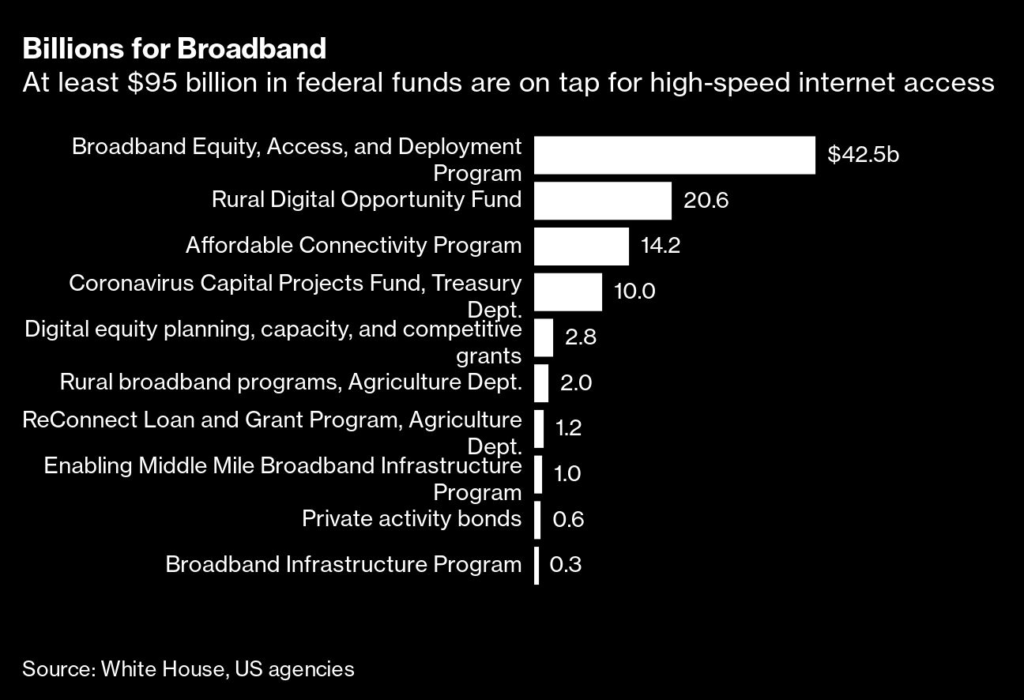
Cable, phone and satellite companies are vying for some of the $100 billion in federal funds aimed at expanding broadband service to poorer and more rural parts of the country. As past internet building booms have shown, one of the biggest risks to any venture is the high costs involved.

Charter and Comcast Corp., the largest US cable provider, have opted to take a different path than their telecom rivals. Instead of replacing their coaxial wires with higher-capacity fiber, the two companies have opted for a technology called DOCSIS 4.0 that uses amplifiers to allow existing cable systems to give customers multigigabit speeds.

Last month, Comcast said it would spend about $200 per home passed to upgrade its systems using amplifiers. That number compares with about $1,000 per home for laying new fiber optic cable lines. Neither amount includes the cost of connecting all the way to a home.

More stories like this are available on bloomberg.com

©2022 Bloomberg L.P.
Bankman-Fried Fraud Used ‘Dirty Money’ in DC, US Prosecutor Says

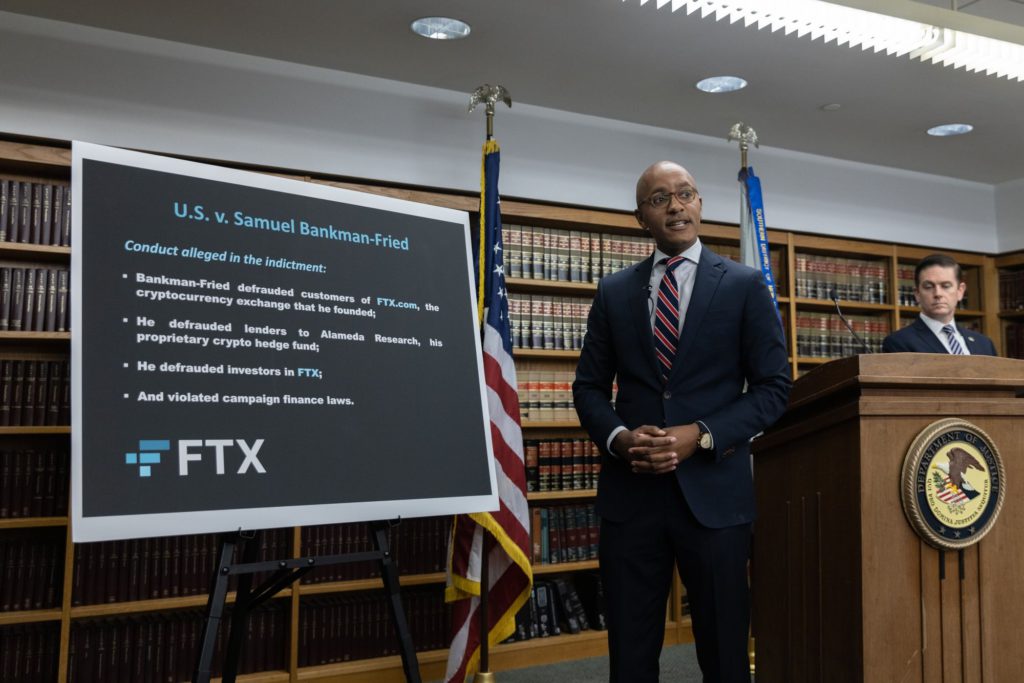
(Bloomberg) — FTX cryptocurrency exchange founder Sam Bankman-Fried is responsible for “one of the biggest financial frauds in American history” and the investigation of the alleged scheme is “very much ongoing,” Manhattan US Attorney Damian Williams said Tuesday. 

Bankman-Fried was charged with eight criminal counts, including conspiracy and wire fraud, earlier in the day, for allegedly misusing billions of dollars in customer funds to prop up his Alameda Research crypto fund. Bankman-Fried was arrested Monday in the Bahamas, where he was living.

While the 30-year-old Bankman-Fried may not fit the typical profile of someone who cheats investors, “you can commit fraud in shorts and t-shirts in the sun —that’s possible too,” Williams said during a press conference in New York. The alleged scheme involved “dirty money” that was “used in service of Bankman-Fried’s desire to buy bipartisan influence and impact the direction of public policy in Washington,” the federal prosecutor said. 

“While this is our first public announcement it will not be our last,” Williams said.

Prosecutors claim Bankman-Fried used tens of millions of dollars of the proceeds for illegal contributions to political campaigns. 

“He preyed on his customers, the victims of this case, abusing the trust placed in not only his company but himself as the lead of that company,” FBI New York Assistant Director in Charge Michael Driscoll said. “I want to be clear: this case is about fraud. Fraud is fraud.”

If convicted, Bankman-Fried could face as long as 20 years in prison for each of the wire fraud and money-laundering charges, and five years on each of the commodity and securities fraud charges and campaign-finance fraud, the US Department of Justice said in a statement. White-collar defendants, if convicted, rarely serve statutory maximum sentences.

The US Securities and Exchange Commission and the Commodity Futures Trading Commission sued Bankman-Fried separately on Tuesday for his alleged role in the collapse of FTX.

Since the inception of FTX in 2019, Bankman-Fried “began secretly and improperly diverting customer funds to his crypto hedge fund Alameda research,” SEC Enforcement Director Gubir Grewal said at the press conference. “Bankman-Fried’s house of cards began to crumble as crypto prices plummeted in 2022.”

The collapse shows that trading on a non-compliant trading platform poses risks for investors and doesn’t offer protections against fraud, Grewal said. “It’s imperative that non-compliant platforms come into compliance” with US regulators, he said.

“The runway is getting shorter for them to come in and to register with us, and for those who do not, the enforcement division stands ready to take action,” Grewal said.

Read More: Bankman-Fried Balks at Extradition as US Sketches Case for Fraud

–With assistance from Bob Van Voris.

(Updates with maximum sentences for alleged crimes.)

More stories like this are available on bloomberg.com

©2022 Bloomberg L.P.
China’s Economy Likely Worsened Before Abrupt Covid Policy Shift

(Bloomberg) — China’s key indicators this week will likely show the economy worsened in November, putting it in a vulnerable position as Beijing’s sudden pivot away from Covid Zero brings more disruption to growth. 

Economists surveyed by Bloomberg News predict a bigger contraction in retail sales than in October, a slowdown in factory output and investment, and an increase in unemployment. The data are scheduled to be released by the National Bureau of Statistics on Thursday.

Covid infections are spreading rapidly, including in the capital Beijing, and will likely surge further in the coming weeks and months after China abandoned stringent testing and quarantine rules that helped keep cases and deaths under control for most of the pandemic. 

Policymakers are shifting their focus away from Covid Zero toward boosting growth next year, suggesting more fiscal and monetary action may be on the cards. The central bank will have an opportunity to add stimulus this week when it holds its monthly liquidity operation, but economists don’t expect a cut in interest rates yet. 

To better gauge China’s economic performance, here’s a guide of what to watch out for in Thursday’s data:

Weak Consumption 

November saw a surge in Covid cases and strict rules including lockdowns in several cities to bring infections under control. Retail businesses reliant on face-to-face interaction, like restaurants and hotels, likely suffered the most. 

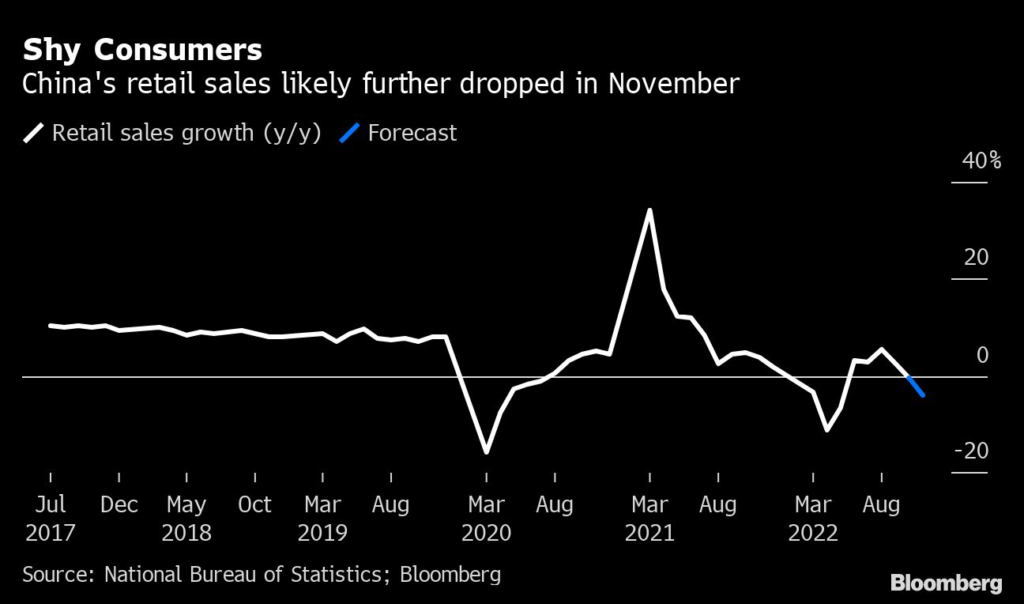
Economists surveyed by Bloomberg predict retail sales declined 4% in November from a year earlier — the biggest drop since the Shanghai outbreak in the second quarter and worse than October’s fall of 0.5%.   

Car sales, a key component of retail sales and a rare bright spot in recent months, took a major hit in November, plunging 9.5% from a year earlier, according to China’s Passenger Car Association.

The annual Singles’ Day shopping festival that takes place each November failed to boost retail sales. Alibaba Group Holding Ltd. didn’t disclose full sales results from its e-commerce platform for the first time, after forecasts showed an unprecedented decline.

Factory Slide 

Manufacturing hubs like Guangzhou and Zhengzhou enforced snap lockdowns in November, disrupting business activity and supply chains. 

Hon Hai Precision Industry Co., known as Foxconn, reported a 11.4% drop in sales last month after shipments were affected by an outbreak at its iPhone assembly complex in Zhengzhou, where lockdowns, a worker exodus and violent protests snarled operations.

Factory output likely grew 3.5% in November from a year earlier, according to economists surveyed by Bloomberg, down from 5% growth in October. 

On top of the Covid disruptions, global demand for exports has plummeted, curbing manufacturing output in China. Exports from China contracted almost 9% in November, the biggest decline since February 2020. 

Investment Slowdown

With most other growth engines sputtering, China’s investment in property, manufacturing and infrastructure has become a bigger driver for the economy.

Infrastructure investment likely continued to grow strongly in November as the government ramped up support for projects. Property investment probably remained weak amid an ongoing slump in the real estate market, even though authorities have recently outlined several rescue measures for the industry. 

Economists predict fixed asset investment likely expanded 5.6% in the first 11 months of the year compared with the same period last year, down from 5.8% in the January-October period.

Unemployment Climbs 

Jobs figures remain a key focus as businesses in China have been forced to shed workers, freeze hiring or even close their doors — temporarily or permanently. 

The surveyed unemployment rate likely climbed to 5.6% after staying unchanged at 5.5% for two months. It’s also above ceiling of under 5.5% the government set for all of 2022.

Whatever the headline figure may be, further details about the jobless rates for the most vulnerable groups — including young people and migrant workers — will shed more light on the true extent of unemployment pain. 

The surveyed jobless rate for those aged 16-24 hit a record high of 19.9% in July and remains elevated at 17.9%.

Policy Loans

The People’s Bank of China will have another opportunity to ramp up support for the economy on Thursday after it earlier cut the amount of cash banks must hold in reserve, injecting liquidity into the market. 

Four of the seven economists surveyed by Bloomberg expect the central bank to fully roll over 500 billion yuan ($71.7 billion) worth of maturing one-year policy loans, known as the medium-term lending facility. Another two predict a slight net withdrawal of 100 billion yuan, and one sees a net injection of 300 billion yuan.

The PBOC may want to maintain ample liquidity, analysts say, after the Covid Zero pivot spurred a rapid sell-off in government bonds and roiled the credit market.

More significant easing, though, is likely off the table. The PBOC will refrain from lowering the rate on MLF loans, and instead keep it steady at 2.75%, according to all 14 economists surveyed.

The cut to the reserve requirement ratio for banks, though, has led to higher expectations for a reduction in the five-year loan prime rate — a reference for mortgage rates. That could be trimmed later this month, even in the absence of a policy rate cut.

–With assistance from Tomoko Sato and Wenjin Lv.

More stories like this are available on bloomberg.com

©2022 Bloomberg L.P.
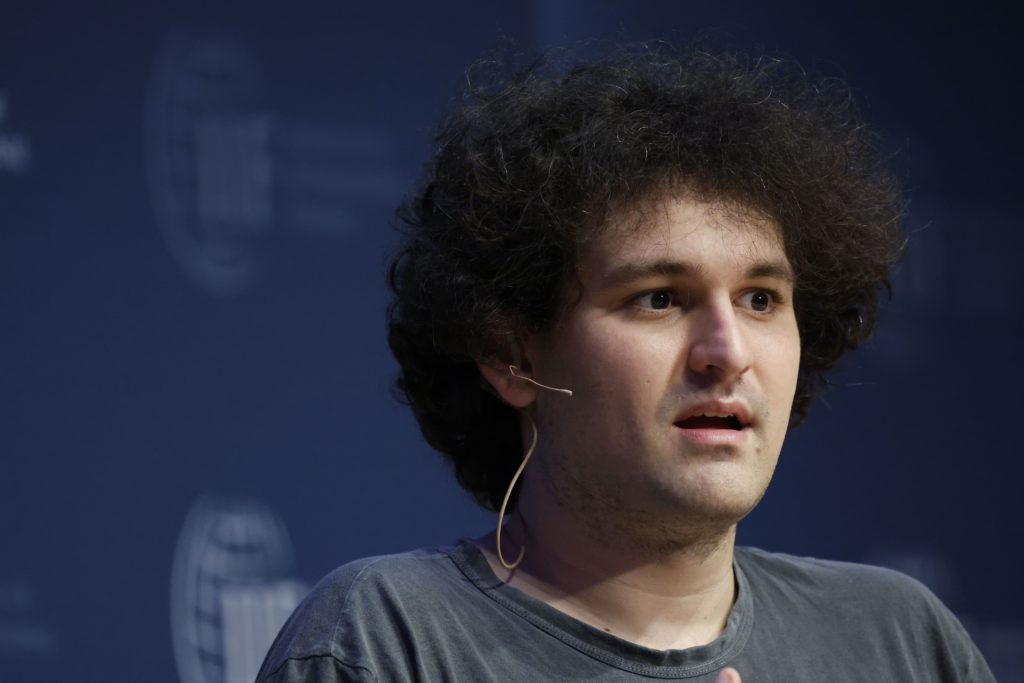
Sam Bankman-Fried’s Stanford Professor Parents Tangled in FTX Probes

(Bloomberg) — FTX founder Sam Bankman-Fried was known to blur the lines between personal and professional, most famously by shacking up in a luxury Bahamas penthouse with nine colleagues.

But as regulators and lawmakers take aim at the disgraced crypto mogul, they’re widening their scope beyond his band of twenty- and thirty-somethings — “grossly inexperienced and unsophisticated individuals,” in the words of FTX’s new chief executive — and probing the role played by two people who, based on their bona fides, also should have known better: his parents.

Stanford University law professors Joseph Bankman and Barbara Fried featured briefly in congressional testimony Tuesday, as well as in civil suits against their son from the Commodity Futures Trading Commission and Securities and Exchange Commission.

They weren’t mentioned by name, or accused of wrongdoing. But their mere reference — on the same day they accompanied their son to his first appearance in Bahamas court since his arrest on Monday — signals how potentially far-reaching the government’s investigation may go into a crypto collapse that has left some 1 million customers in limbo. 

Bankman-Fried faces eight criminal counts, including conspiracy and wire fraud, for allegedly misappropriating billions of dollars in customers’ funds to pay expenses and debts of his hedge fund, Alameda Research.  

“Bankman-Fried, his parents, and other FTX and Alameda employees used FTX customer funds for a variety of personal expenditures, including luxury real estate purchases, private jets, documented and undocumented personal loans, and personal political donations,” the CFTC said in its complaint.

The SEC added that the property purchases totaled “tens of millions of dollars.”

Received Payments

Neither the CFTC nor the SEC elaborated on the parents’ role, if any. FTX’s newly appointed CEO, restructuring expert John J. Ray III, confirmed at a House Financial Services Committee hearing on Tuesday that “the family did receive payments.”

Risa B. Heller, a spokesperson for Bankman and Fried, didn’t have an immediate response when reached by email.

Bankman-Fried said at the New York Times DealBook Summit last month that his parents “bore no responsibility” for what happened at FTX and a house for his parents in the Bahamas “was not intended to be their long-term property” and was for the company. 

Still, even in FTX’s heyday, some red flags emerged around how invested Bankman and Fried were in their son’s business.

They got involved with the company’s personnel, entertaining them and making sure key staffers were content at FTX, according to a person familiar with the matter. Fried, the mother, was viewed as the more authoritative parent, while Bankman was more mild-mannered.  

Classes Canceled

The FTX scandal has already had repercussions for the professors. 

Neither Bankman nor Fried will teach at the law school next year, the Stanford Daily reported last week. Bankman canceled a class he was supposed to lead, while Fried isn’t listed as an instructor for the courses in her catalog next year, the publication reported. 

Fried told the Daily the change was part of a “long-planned” retirement and has “nothing to do with anything else going on.”

Stanford Law School didn’t immediately respond to a request for comment.

Fried was one of the founders of Mind the Gap, a super political action committee that works to bolster Democratic political candidates. She has since stepped down from her leadership role following the collapse of FTX.

Bankman-Fried, a major political donor, was also charged Tuesday with conspiracy to defraud the US and campaign finance laws.

Her academic work has included musings on personal accountability. She wrote in 2013, in an article titled “Beyond Blame,” that society should question the idea of blame and free will for individuals.

“We have gotten nothing from our 40-year blame fest except the guilty pleasure of reproaching others for acts that, but for the grace of God, or luck, or social or biological forces, we might well have committed ourselves,” she wrote.

–With assistance from Joel Rosenblatt.

More stories like this are available on bloomberg.com

©2022 Bloomberg L.P.
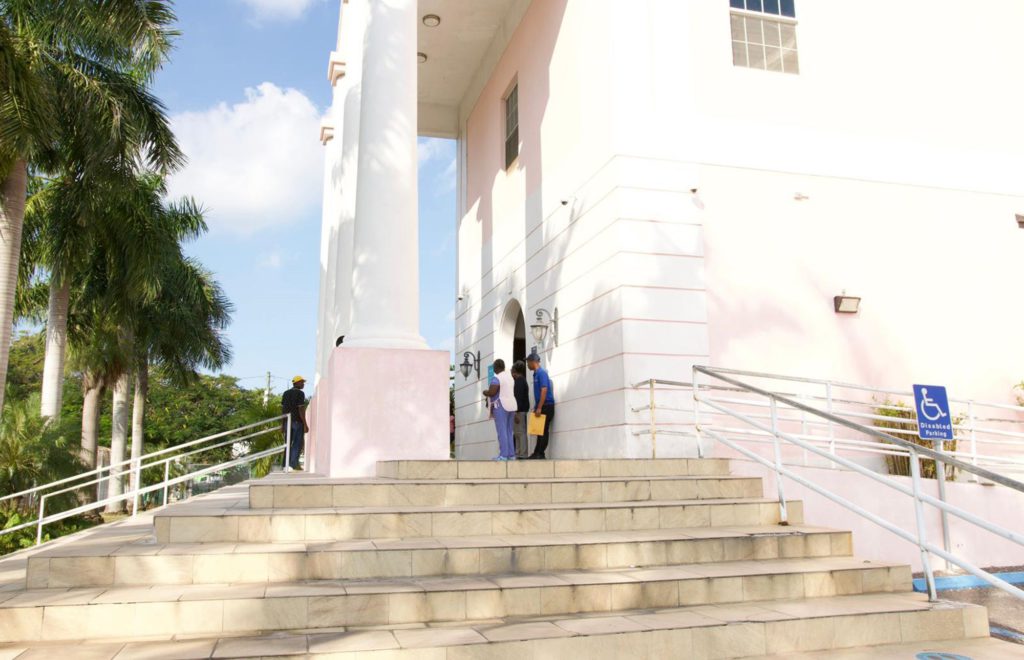
Bankman-Fried Lawyer Suggests $250,000 Bail, Ankle Bracelet

(Bloomberg) — An attorney for FTX Co-founder Sam Bankman-Fried proposed that his client pay $250,000 cash bail and wear an ankle bracelet to be allowed to leave his Bahamas jail cell. 

The pitch was made on Tuesday during Bankman-Fried’s first court appearance since being arrested in the Bahamas. His US passport was confiscated when he was detained at his luxury penthouse Monday evening. 

Dressed in a blue suit and white shirt for the arraignment proceedings, Bankman-Fried at times appeared shaky and fidgety. His parents were present in the courtroom as their 30-year-old son was frequently referred to as a “fugitive.”

Earlier on Tuesday, federal prosecutors in Manhattan revealed that they had charged Bankman-Fried with eight criminal counts, including conspiracy and wire fraud, for allegedly misusing billions of dollars in customers’ funds before last month’s spectacular collapse of his cryptocurrency empire.

During the Bahamas hearing, Bankman-Fried’s lawyer Jerome Roberts said that his client planned to fight extradition to the US to face the charges.

“Mr. Bankman-Fried is reviewing the charges with his legal team and considering all of his legal options,” Mark Cohen, another attorney for Bankman fried said in a statement.

In addition to criminal charges, Bankman-Fried also faces a series of civil allegations from US regulators. The Securities and Exchange Commission said Tuesday that he carried out a multi-year scheme to defraud investors and commingled customer funds. 

The Commodity Futures Trading Commission claimed Bankman-Fried and other FTX executives took hundreds of millions of dollars in loans from the trading firm Alameda Research, which Bankman-Fried also founded, to buy real estate and make donations to politicians. 

(Updates with details from Bahamas court appearance throughout)

More stories like this are available on bloomberg.com

©2022 Bloomberg L.P.
Tech Fuels Rally in Fed-Sensitive Shares With Downshift in Sight

(Bloomberg) — Tech stocks — which are among the most-sensitive groups to Federal Reserve’s policy moves — are beating the broader market Tuesday after a weaker-than-estimated consumer price index raised hopes officials will ease their tightening stance. 

Facebook parent Meta Platforms Inc. soared 4.5%, while a gauge of megacap firms including Alphabet Inc. and Netflix Inc. jumped as much as 5.2%. Chipmakers, which are some of the biggest losers this year, also enjoyed a powerful rally. These moves were part of a concerted effort that took the Nasdaq 100 up almost 4% earlier in the day. Rising Fed rates and inflation make the value of future profits in tech less appealing. 

“A soft CPI print inherently means a dovish Fed,” said Gareth Ryan, managing director at IUR Capital, said in an email. “The riskiest parts of the stock market are the most sensitive to changes in the rate environment.”

The CPI print validates the Fed’s projected half-point rate increase on Wednesday — after four straight 75 basis-point hikes — and sets the tone for future decisions.

Read: Fed Doves’ Case for Rate Pause Bolstered by Inflation Slowdown

The Cboe Volatility Index dropped to 23, while putting Wall Street’s chief fear gauge below this year’s average of 25.8. A measure of expected swings in the VIX fell below 90. 

To Greg Bassuk, chief executive officer at asset management firm AXS Investments, November’s CPI print should help ease looming recession concerns over the Fed’s aggressive policy to curb inflation, but he expects volatility to pick up in the coming weeks and months as investors assess Fed policy.

Although his more experienced clients are snapping up shares of tech and so-called growth stocks in the short-run including Tuesday and possibly over the next week, he’s still advising caution for long-term investors. He suggests having exposure toward defensive cyclical and value companies that can hold up better in elevated inflationary environments.

“While this is a breath of fresh air, this is still a single data point,” Bassuk said. “Investors need to strap on their seat belts because we expect more volatility until there is a greater consistency with inflation data as we move into 2023.”

Over the next few months, he’s waiting to see a pattern emerge where inflation data, corporate earnings and geopolitical developments all point to a single trajectory that shows a balance of a healthy growing economy, including one where prices can be contained.

“This is definitely a welcome surprise for investors,” Bassuk said. “There’s no question this data will take pressure off the Fed, but what the inflation figures show in the coming months in terms of the trajectory of prices is crucial for how investors will position themselves.”

Investors are turning less negative on equity risk, according to Bank of America Corp.’s latest fund manager survey. The bank’s FMS Financial Market Stability Risks Indicator eased from 8.5 to 5.6 — a “turning point for risk aversion,” strategists led by Michael Hartnett wrote in a note dated Dec. 12.

A record net 90% of fund managers think that global inflation will be lower within the next 12 months, with investors expecting US CPI inflation to be 4.2% in the next 12 months, according to BofA.

More stories like this are available on bloomberg.com

©2022 Bloomberg L.P.
FTX’s US Customers May Have Best Chance to Get Their Money Back

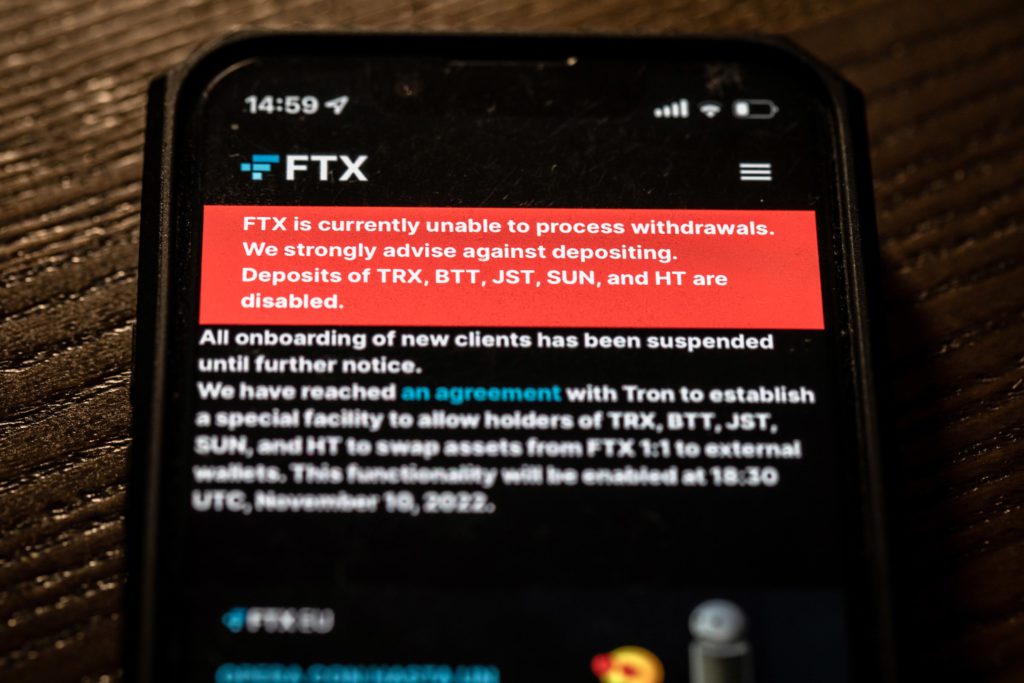
(Bloomberg) — FTX’s US-based account holders are more likely than customers elsewhere in the world to get access to their assets on the bankrupt crypto platform, according to the man in charge of tracking down that money.

John J. Ray III, who’s in charge of FTX’s restructuring, told a panel of US lawmakers that he’s optimistic they’ll be able to recover and return funds to FTX.US customers sooner and more fully than those on the FTX.com platform, which is largely for international users.

“There’s a general truth to the statement that the US exchange will suffer less,” Ray told the House Financial Services Committee Tuesday.

Ray said he didn’t agree with FTX’s former chief executive officer Sam Bankman-Fried that the US platform is completely solvent and that customer accounts could be unfrozen at any time. Bankman-Fried, who was arrested Monday night and faces a series of criminal charges for wire fraud and conspiracy, was also scheduled before he was taken into custody to also appear at Tuesday’s hearing. 

Ray, who said that so far they’ve recovered more than $1 billion in assets, set it was “premature” to say that US customers will receive all the assets they had on the platform prior to the bankruptcy filing last month.

US customers had less exposure to losses because FTX executives pulled more money from FTX.com, rather than FTX.US to lend to Alameda Research, the hedge fund largely controlled by Bankman-Fried. Ray said there are about 2.7 million user accounts on the American platform and 7.6 million on the international platform, though noted the actual number of individuals involved in likely lower because some users had multiple accounts.

US users weren’t supposed to trade on the FTX.com platform, but Ray said a small number of people — a couple hundred — had accounts on the platform.

Ray didn’t give a timeline for when customers would have access to their accounts, but said its a process that would take months. The next step will be assigning losses to user accounts, he said.

“It’s a mining exercise at this point. At the end of the day, we’re not going to be able to recover all the losses here,” Ray said. “Money was spent that we’ll never get back.” 

More stories like this are available on bloomberg.com

©2022 Bloomberg L.P.
Apple to Allow Outside App Stores in Overhaul Spurred by EU Laws

(Bloomberg) — Apple Inc. is preparing to allow alternative app stores on its iPhones and iPads, part of a sweeping overhaul aimed at complying with strict European Union requirements coming in 2024.

Software engineering and services employees are engaged in a major push to open up key elements of Apple’s platforms, according to people familiar with the efforts. As part of the changes, customers could ultimately download third-party software to their iPhones and iPads without using the company’s App Store, sidestepping Apple’s restrictions and the up-to-30% commission it imposes on payments.

The moves — a reversal of long-held policies — are a response to EU laws aimed at leveling the playing field for third-party developers and improving the digital lives of consumers. For years, regulators and software makers have complained that Apple and Google, which run the two biggest mobile app stores, wield too much power as gatekeepers.

If similar laws are passed in additional countries, Apple’s project could lay the groundwork for other regions, according to the people, who asked not to be identified because the work is private. But the company’s changes are designed initially to just go into effect in Europe.

Even so, the news bolstered shares of companies that offer dating services and other apps. Match Group Inc. jumped as much as 10% and Bumble Inc. was up as much as 8.6% — a sign investors think the companies could get a break from Apple’s commissions. Spotify Technology SA, the audio streaming service, climbed as much as 9.7%. Apple’s shares, meanwhile, were little changed.

A spokesman for the Cupertino, California-based company declined to comment on the upcoming changes.

The main new European law, dubbed the Digital Markets Act, takes effect in the coming months, but companies aren’t required to comply with all of the rules until 2024. Government officials in the US and other countries have pushed for similar laws but haven’t gotten as far as the EU yet. 

The act requires technology companies to allow the installation of third-party apps and let users more easily change default settings. The rules demand that messaging services work together and that outside developers get equal access to core features within apps and services.

The laws apply to technology companies with market valuations of at least €75 billion ($80 billion) and a minimum of 45 million monthly users within the EU.

The changes underway within Apple are being led by Andreas Wendker, a longtime software engineering vice president who reports to Craig Federighi, the company’s top software executive. Jeff Robbin — Apple’s top engineering manager for its services, who reports to head of services Eddy Cue — is also involved. 

Apple is applying a significant amount of resources to the companywide endeavor. It hasn’t been a popular initiative within Apple, considering that the company has spent years decrying the need for “sideloading” — the process of installing software without using the official App Store. In lobbying against the new European laws, Apple has argued that sideloading could put unsafe apps on consumers’ devices and undermine privacy.

Some engineers working on the plan also see it as distraction from typical day-to-day development of future features, according to the people. The company is aiming for the changes to be ready as part of an update to next year’s iOS 17, which would be in line with requirements.

Epic Games Inc., maker of the hit game Fortnite, waged a legal battle with Apple over the App Store fees. After Epic sought to sidestep the commission with Fortnite, Apple removed the game from its store. In the ensuing fight, Epic accused Apple of using monopolistic practices, but a US court found that the iPhone maker didn’t violate federal antitrust laws. 

To help protect against unsafe apps, Apple is discussing the idea of mandating certain security requirements even if software is distributed outside its store. Such apps also may need to be verified by Apple — a process that could carry a fee. Within the App Store, Apple takes a 15% to 30% cut of revenue. 

Apple hasn’t made a final decision on whether to comply with a component of the Digital Markets Act that allows developers to install third-party payment systems within their apps. That would let users sign up for subscriptions to a travel app, for example, or buy in-app content from a game maker — without involving Apple.

As part of an agreement with the Japanese government, the company already allows some media and cloud apps to point users to the web to complete transactions. But the Digital Markets Act likely wants Apple and other technology giants to go further.

Apple also is working to open more of its private application programming interfaces, or APIs, to third-party apps. Those are the underlying frameworks that allow apps and features to interact with Apple’s hardware and core system functions.

Currently, third-party web browsers, including ones like Chrome from Alphabet Inc.’s Google, are required to use WebKit, Apple’s Safari browsing engine. Under the plan to meet the new law, Apple is considering removing that mandate.

Apple is also working to open up other features to third-party apps, including more camera technologies and its near-field communications chip — at least in a limited fashion. Currently, only the company’s Wallet app and Apple Pay service can use the NFC chip to enable mobile wallet functionality. Apple has faced pressure to let third-party financial apps have the same capability.

The company hasn’t, however, made a decision on how it may open iMessage and its Messages app to third-party services — another requirement of the Digital Markets Act. Engineers believe that such a change could hurt end-to-end encryption and other privacy features offered by iMessage. The company also isn’t currently considering integrating RCS, or rich communication services, a messaging protocol that Google and others are pushing Apple to adopt.

Apple is discussing further opening up its Find My network to accessories, like Tile, that compete with the AirTag. The Find My network allows AirTags to provide their location to its owner by using surrounding Apple devices as signals. While Apple has offered third parties that functionality since 2021, Tile and others have said the company gives its own accessory an advantage.

The EU, which includes France, Germany, Italy and Spain among a total of 27 countries, has threatened fines of as much as 20% of a company’s annual global revenue if they repeatedly violate the law. Apple generated nearly $400 billion in worldwide revenue in fiscal 2022, which would put such a fine in the $80 billion range.

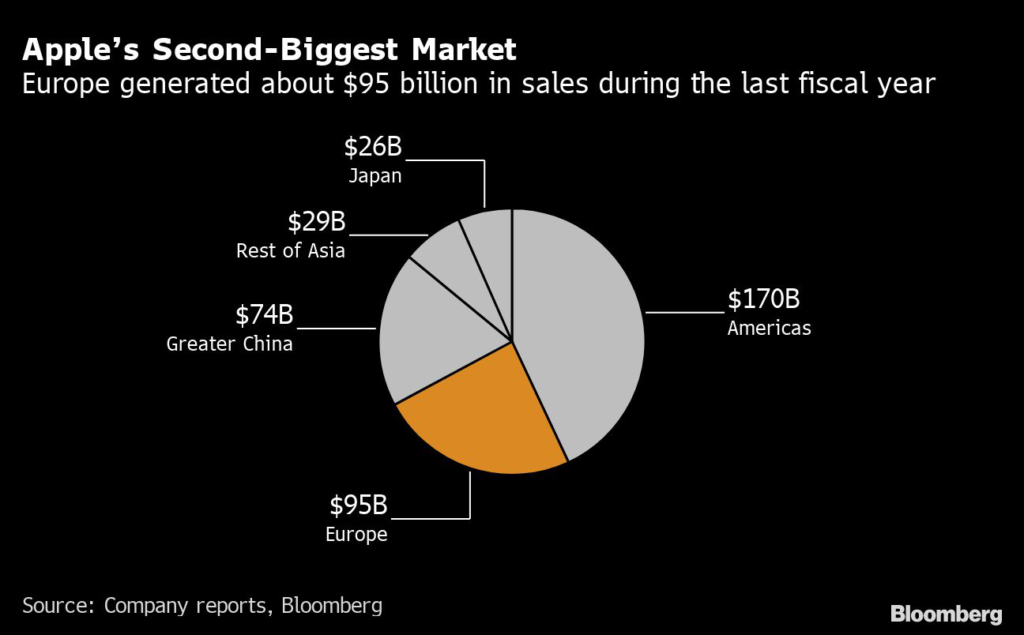
Apple generated about $95 billion in revenue from Europe, which includes the EU and the UK, during fiscal 2022. That revenue base will likely take a hit when it makes the changes, which are poised to make the App Store less lucrative.

Overall, though, Apple should be able to absorb the financial impact. The App Store makes up 6% of total revenue, and Europe’s contribution to that is likely less than 2%, according to Bloomberg Intelligence analysts Anurag Rana and Andrew Girard. 

It wouldn’t be the first time Apple had to make major changes to abide by local laws. The company is also planning to use a USB-C connector on the next iPhones in 2023 instead of Lightning, also to meet an EU regulation. In China, the company has made numerous compromises. That’s included using a local provider to host iCloud data and shifting AirDrop settings in a way that made it harder for protesters to share information.

(Updates with Epic Games lawsuit in 13th paragraph.)

More stories like this are available on bloomberg.com

©2022 Bloomberg L.P.
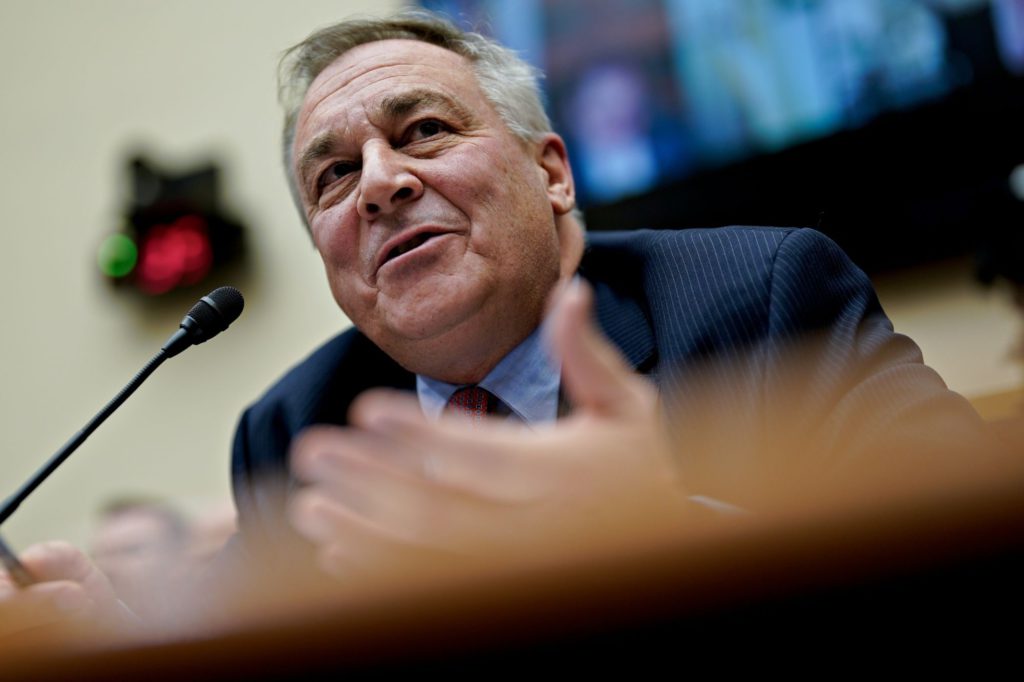
FTX’s John Ray Speaks at US House Hearing: Key Takeaways

(Bloomberg) — Here are the key takeaways from the House committee hearing on Tuesday into FTX’s collapse. Click here for our TOPLive blog.

  • John Ray III, the current CEO of FTX, said funds of all customers of FTX.com, FTX.US and of Alameda were comingled. While the US exchange’s customers are likely to fare better, he said the exact magnitude of the financial hole bankrupt companies have is still unclear. He doesn’t yet know how much money customers may get back or when, but it’s a matter of months, not weeks.
  • Ray repeatedly told lawmakers that he is more hopeful about recouping assets tied to FTX.US accounts than those for international accounts on FTX.com. He said that US customers will possibly have a “greater” and “sooner” recovery than international account customers, though there is still more work to do for before that can happen.
  • Ray said he has secured about $1 billion in funds, but may not have found all of the coins owned by FTX-related businesses. He said it’s possible the companies’ founders have hidden some funds on thumb drives somewhere. He also accused Bankman-Fried and Gary Wang of transferring hundreds of million in funds to the Bahamian authorities, which he said have been uncooperative.
  • The biggest barrier to his investigation is a complete lack of record-keeping, Ray said. He said FTX didn’t conduct daily reconciliations, top executives had access to all accounts, and Alameda had unlimited access to FTX-related funds.
  • The hearing showed a partisan divide: There are clear factions forming among partisan lines in the wake of the FTX collapse. Republicans generally say that SBF was a bad actor in a space that is otherwise exploring new and beneficial technologies. Democrats are much more skeptical, saying that FTX is an example of the potential for fraud and unsavory schemes.
  • William Timmons, a Republican from South Carolina who is a former prosecutor, questioned why Bankman-Fried was arrested within hours of testifying at the hearing. Bankman-Fried was arrested in the Bahamas late Monday, within hours of his scheduled testimony before the committee. Federal prosecutors have charged him with eight criminal counts, including conspiracy and wire fraud in what US Attorney Damian Williams called “one of the biggest financial frauds in American history.” The Securities and Exchange Commission and the Commodity Futures Trading Commission have filed separate suits against the FTX founder. Extradition efforts are ongoing, prosecutors said.


–With assistance from Steven T. Dennis and Madlin Mekelburg.

More stories like this are available on bloomberg.com

©2022 Bloomberg L.P.

Close Bitnami banner
Bitnami
