Bloomberg

Tesla Shows Latest Robot Prototype With Opposable Thumbs

(Bloomberg) — Elon Musk showed off a prototype humanoid robot walking and waving its hand, seeking to demonstrate Tesla Inc.’s advances in artificial intelligence.

At the electric automaker’s AI Day late Friday, Musk also showed a video of the robot picking up boxes and moving through a rendered office building to water plants. 

“The robot can actually do a lot more than we just showed you,” said Musk. “We just didn’t want it to fall on its face.”

A second robot — the latest iteration of what Tesla calls Optimus — also appeared on stage. Musk said that while Optimus wasn’t quite ready to walk, it has opposable thumbs and can perform tasks.

“Our goal is to make a useful humanoid robot as quickly as possible,” said Musk. “Optimus is designed to be an extremely capable robot made in very high volume, probably ultimately millions of units, and is expected to cost much less than a car.” 

The event, held at a Tesla facility in Palo Alto, California, featured several engineers giving highly technical presentations about how the robot perceives its environment. The technology that Tesla has developed for its vehicles, including cameras, is now being used for the robot.

Musk, who was tweeting during his employees’ presentations, said near the end of the three-hour event that he was “excited to see what Optimus will become.” Musk added Tesla plans to test the robot at its factory in Fremont, California, where the videos of it operating were filmed. 

But he admitted the robot is “not strictly speaking in line with” Tesla’s goal of accelerating the adoption of sustainable energy. “I’m not sure where it ends up,” he said. Musk also said Tesla is “probably not barking up the right tree on on all the technical solutions,” and reminded the audience the company is “open to evolving” those solutions it has already arrived at.

Beyond the robot, Tesla used the event to expand on the progress it has made developing its automated driving software, and the “Dojo” supercomputer that the company uses to train its in-house artificial intelligence. Musk said Tesla may some day allow other companies to pay to use Dojo to train their own neural networks.

Read more: Tesla AI Day Offers a Glimpse of Just How Sentient Its Bots Are

(Updates with Musk’s comments from seventh paragraph)

More stories like this are available on bloomberg.com

©2022 Bloomberg L.P.

Tesla Shows Latest Optimus Robot Prototype With Opposable Thumbs

(Bloomberg) — Elon Musk showed off a prototype humanoid robot walking and waving its hand, seeking to demonstrate Tesla Inc.’s advances in artificial intelligence.

At the electric automaker’s AI Day late Friday, Musk also showed a video of the robot picking up boxes and moving through a rendered office building to water plants. 

“The robot can actually do a lot more than we just showed you,” said Musk. “We just didn’t want it to fall on its face.”

A second robot — the latest iteration of what Tesla calls Optimus — also appeared on stage. Musk said that while Optimus wasn’t quite ready to walk, it has opposable thumbs and can perform tasks.

“Our goal is to make a useful humanoid robot as quickly as possible,” said Musk. “Optimus is designed to be an extremely capable robot made in very high volume, probably ultimately millions of units, and is expected to cost much less than a car.” 

The event, held at a Tesla facility in Palo Alto, California, featured several engineers giving highly technical presentations about how the robot perceives its environment. The technology that Tesla has developed for its vehicles, including cameras, is now being used for the robot.

Read more: Tesla AI Day Offers a Glimpse of Just How Sentient Its Bots Are

More stories like this are available on bloomberg.com

©2022 Bloomberg L.P.

South Korea Posts Longest Run of Trade Deficits Since 1997

(Bloomberg) — South Korea recorded its longest string of trade deficits since the Asian financial crisis in 1997 as elevated energy and commodity prices resulted in imports continuing to outpace exports.

The deficit was $3.77 billion in September, the sixth straight monthly shortfall, according to data released Saturday by the trade ministry. Imports climbed 18.6% from a year earlier, while exports advanced 2.8%.

Export-dependent nations are seeing persistent trade shortfalls this year as Russia’s war on Ukraine leads to higher energy and commodity prices and exacerbates inflationary pressures. Korea’s deficit hit a record in August and its weakening currency further increases troubles for manufacturers.

Korea produces key items such as chips, cars, displays and smartphones, and its shipments help paint a picture of demand at a time when concerns are mounting about a global recession.

Inflation remains elevated worldwide, prompting central banks to tighten policy rates irrespective of the economic costs. Korean chipmakers in August slashed production for the first time in more than four years to brace for a deterioration in demand.

Resilient export growth has been a major factor bolstering the confidence of Bank of Korea board members to keep raising rates. Governor Rhee Chang-yong is keeping the door open for another hike at an Oct. 12 meeting.

The September trade data showed:

  • Daily average shipments that rule out calendar differences increased 0.4%, according to separate customs office data
  • Exports to China fell 6.5% and those to the European Union were down 0.7%. Shipments to the U.S. gained 16%, while those to Japan increased 2.5%
  • Total semiconductor shipments decreased 5.7% in September from a year earlier
  • Total automobile shipments advanced 34.7%, while exports of rechargeable batteries rose 30.4%

(Updates with trade performance)

More stories like this are available on bloomberg.com

©2022 Bloomberg L.P.

Crypto’s Hold on Formula 1 Sponsoring Gets Tested in Singapore

(Bloomberg) — At Formula One’s Miami Grand Prix in May, the dizzying displays of crypto companies sponsoring the sport were inescapable, with Crypto.com’s blue branding covering every imaginable surface along the race track. 

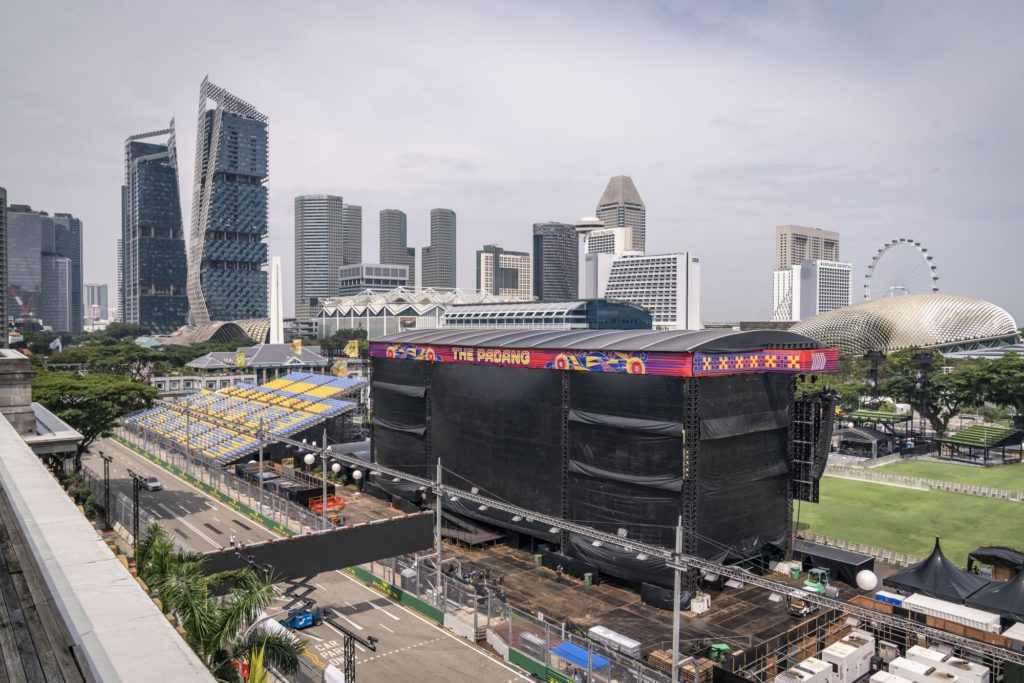
When Singapore hosts the most popular motor sport this weekend, the visibility of digital assets will be far more subdued. The Monetary Authority of Singapore will let teams show their crypto sponsors’ logos only on cars and uniforms at the Singapore Grand Prix, but no advertising will be permitted around the track or in the local area. 

The shift underscores the changing mood around crypto, both from a regulatory and a financial standpoint. Jurisdictions in Singapore, the UK and France have intensified scrutiny this year after digital asset prices soured, billion-dollar projects collapsed and major market players went bankrupt. As a result, F1’s newest throng of advertisers are finding ways to make their mark without moving too boldly.

The rout in cryptocurrencies in recent months, which has wiped out around $2 trillion in value since November, has left crypto brands more cash-strapped but still keen to maintain what they’ve already invested to keep a foothold on the world stage. 

Jeremy Walls, a senior executive for the Miami venue who helped close the deal with Crypto.com, said that current market dynamics may make crypto companies “be a little more thorough and thoughtful” about the deals they sign going forward.

“I’m still seeing people doing crypto partnerships now, it’s just maybe not the pace that it once was,” Walls said.

Partnering with an F1 team has turned into a status symbol for crypto companies, a flashy multi-million-dollar accessory that signals affluence and success at a time when market prices reflect the opposite. Around 80% of F1 teams have at least one crypto partner, in addition to Formula One Group itself, which has its own $100 million-deal with Crypto.com.

Zak Brown, head of McLaren Racing, said that F1 teams “don’t want to get left behind” when a new sponsor or trend emerges. McLaren signed a five-year deal worth hundreds of millions of dollars with crypto exchange OKX in May and will debut a special crypto-themed car for the circuits in Singapore and Japan in compliance with the stricter advertising guidance.

New Tobacco

Rob Bloom, chief marketing officer at Aston Martin Lagonda Global Holdings Plc’s F1 team, said the need to alter sponsor branding to suit different locations is par for the course in the sport. Certain locations require bans on alcohol or tobacco marketing, for example, where companies like Philip Morris International Inc. historically showed the shape or colored branding of their cigarettes without actually displaying a logo.

Aside from emblazoned logos across drivers’ uniforms and cars, F1 teams are also getting into crypto themselves. Several now offer fan tokens —- team-specific cryptoassets that can be earned, traded and used to pay for experiences or rewards -— and nonfungible tokens assigned to individual car parts.

What makes F1 a promising proposition for sponsors is the sport’s global and loyal audience. Next year’s competition is expected to reach a record of 24 races in 21 countries, held over the course of nine months. Fans are also typically wealthier thanks to the sport’s high cost of entry, where tickets start at hundreds of dollars and TV channels pay high fees for exclusive broadcasting rights.

Whether crypto firms will be able to keep up the pace of dealmaking in sports remains unclear, with waning demand for digital assets now taking its toll. Crypto.com and Bybit were among several major companies to lay off staff earlier this year, while the likes of FTX opt to value their F1 partnerships on an annual basis, according to Avi Dabir, the exchange’s vice president for business development.

Since signing with Mercedes, Dabir said FTX had seen a “noticeable” increase in new customers, as well as more interest from existing clients who want to take advantage of access to F1 races. 

F1 is no stranger to volatility. McLaren driver Daniel Ricciardo, currently signed as a brand ambassador for OKX, is expected to leave his team at the end of this season, his third switch in five years. Brown said next year’s marketing imagery with the exchange may have to transition to feature a new driver as a result, or focus more closely on the car itself.

McLaren also had a previous crypto partner in Turkish exchange Bitci.com, which at the time was the first to run a fan token for an F1 team. The deal was quietly wound up in February after less than a year, Bloomberg reported at the time, along with two other Bitci.com deals with European football clubs after it failed to make payments to certain partners.

“That was one that we jumped into pretty quickly,” Brown said in an interview. “You need to do your homework to understand” a crypto deal. As a result, the subsequent partnership with OKX was scrutinized by a 15-person external advisory board, he said.

Due diligence has become even more important this year amid a spate of major crypto collapses, in addition to rising regulation. McLaren is now exploring a new fan token with OKX, which it hopes to launch in 2023 after taking its time to ensure “really robust” development, the team’s director of licensing, e-commerce, e-sports and gaming, Lindsey Eckhouse said.

Despite racing team sponsorships typically being more expensive than other sports, Crypto.com Chief Marketing Officer Steven Kalifowitz said its F1 deals were among the first that the exchange made.

“I was really looking for ways to meet a global audience and meet them quickly,” Kalifowitz said. F1 really delivers on that in a way I don’t think really any other sport does.”

  • Read: Can Other Sports Replicate F1’s Netflix Success?

But with crypto stuck hovering around yearly lows and the general economic environment signaling a potential turn for the worse, the future of F1’s multi-year deals hang in the balance. It’s typical in the sport for partners to come and go, if a sponsor suddenly can’t meet the millions of dollars required to stay in the race, said Ted Dobrzynski, president of F1 sponsorship agency VIAGP.

“They’re going to have to regroup and the market will balance itself next season,” he said, predicting that at least two crypto brands could scrap their deals due to market instability. “When the cars are presented to the world in February next year, you’ll see who disappeared.”

More stories like this are available on bloomberg.com

©2022 Bloomberg L.P.

Activision’s Compliance Chief Steps Down Ahead of Microsoft Deal

(Bloomberg) — Activision Blizzard Inc.’s chief compliance officer, who drew scrutiny over her response to sexual assault allegations last year, is stepping down as the video game publisher seeks to close its sale to Microsoft Corp.

Frances Townsend, who also serves as executive vice president of corporate affairs, leaves two years after taking her role. After Friday, she will become an adviser to the board and to the chief executive officer, Bobby Kotick.

“Fran did a truly exceptional job—actually four jobs—with continuously increasing responsibilities and the most exemplary work ethic,” Kotick wrote in an email shared with Bloomberg News. “Fran also has done an extraordinary job enhancing the strong governance and compliance programs we have throughout the Company.”

Jen Brewer, the senior vice president of ethics and compliance, and Luci Altman, the senior vice president of corporate governance, will fill Townsend’s role. Brewer has been with the company for over a decade. The Wall Street Journal reported the move earlier Friday.

Townsend previously held positions as a counter-terrorism adviser to President George W. Bush’s White House and as a general council for MacAndrews & Forbes. Shortly after taking the job at Activision, Townsend said she would focus on customer safety and the security of their personally identifying information. She also said she would look into loot boxes, a mechanic for obtaining in-game cosmetics that is sometimes likened to gambling.

In July 2021, shortly after a California state agency complaint alleged endemic sexism at Activision Blizzard, Townsend’s response to the claims were roundly criticized. She described them in an internal letter as “factually incorrect, old, and out of context.” Over 2,000 current and former employees of the company signed a letter calling Activision Blizzard leaders’ response to the discrimination suit “abhorrent and insulting.” 

Kotick ultimately took responsibility for the incident, saying Townsend shouldn’t be blamed. The company has since shifted to a more conciliatory tone, but she later stepped down from her role as the women’s network sponsor at Activision Blizzard King.

(Updates with more on 2021 incident in final paragraph.)

More stories like this are available on bloomberg.com

©2022 Bloomberg L.P.

Ian Latest: Weaker Storm Brings Rain, Flash Floods to Carolinas

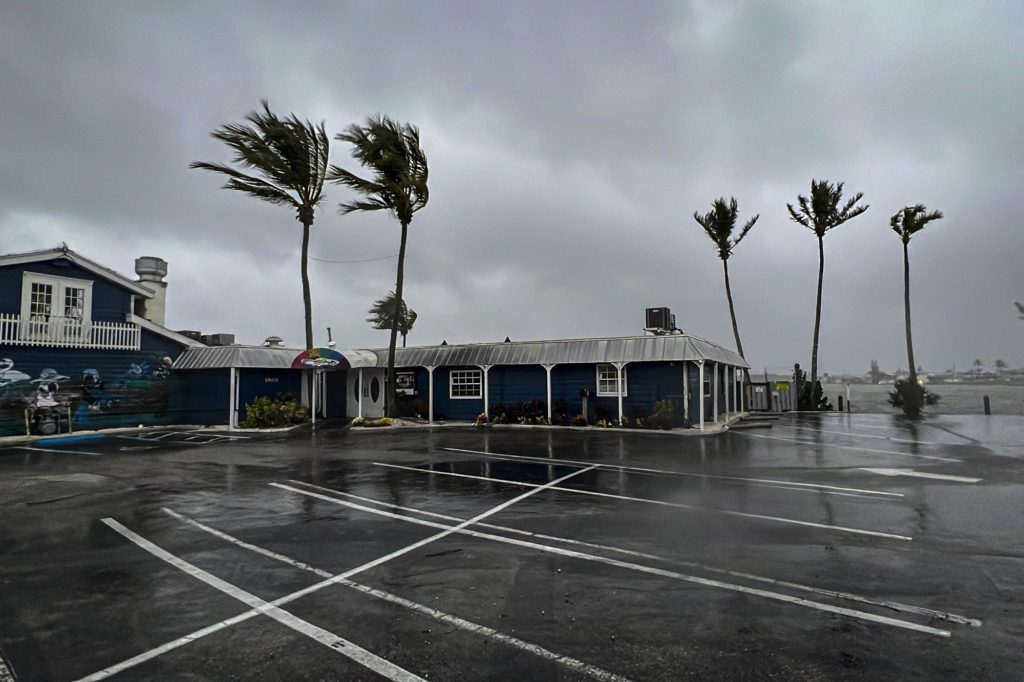
(Bloomberg) — Ian lost its hurricane status after pummeling South Carolina with violent winds and a deadly storm surge, knocking out power to tens of thousands in the US Southeast.

The storm came ashore as a Category 1 hurricane just after 2 p.m. local time near Georgetown, South Carolina, with 85-mile (137-kilometer) per-hour winds, according to the National Hurricane Center. Wind speeds weakened to about 60 miles per hour as of 8 p.m., even as Ian brings heavy rain, flash floods and high winds to both South and North Carolina. More than 392,000 customers are without power in the Carolinas and Virginia.

Florida, meanwhile, continues to reel under the storm’s impact. Almost 1.8 million homes and businesses remain without power, and Lee County, the hardest-hit area, has no running water. Homes, bridges and other infrastructure are in ruin, with damage estimates ranging from $68 billion to $100 billion. Florida Governor Ron DeSantis said it will take years to recover.

Florida officials have confirmed one death from Ian, while 20 more remain unconfirmed, according to Kevin Guthrie, director of the state’s division of emergency management. Authorities have warned the death toll may climb. Three people were killed in Cuba, according to the Associated Press.


Cuba Requests US Aid After Devastation, WSJ Says (7:38 p.m.)

Cuba’s government is seeking emergency assistance from the US in the aftermath of Ian’s devastation, the Wall Street Journal reported, citing email communications

No exact amount was requested and the US is trying to determine if Cuba will supplement its request, the newspaper said. Havana is making the rare request as it contends with an economic crisis and while its longtime supporter Russia struggles with the war in Ukraine.   

Perdue Cancels Shift at South Carolina Poultry Plant (7 p.m.)

Poultry producer Perdue Farms canceled a shift Friday at a South Carolina plant and shut a Georgia distribution center as Hurricane Ian made a second landfall. 

Some production will be delayed until next week at the chicken plant in Dillon, South Carolina, with no loss in volume expected, according to Perdue spokeswoman Diana Souder. The Carolinas account for about 17% of American chicken production.

Biggest Florida Utility Restores Power to 1.2 Million (7 p.m.)

Florida Power & Light Co., the state’s biggest utility, said it had restored power to 1.2 million homes and businesses as of 6 p.m. local time Friday. Still, another 850,000 customers lack power two days after Ian made landfall in the state.

Some parts of the NextEra Energy Inc. utility’s service territory still remains inaccessible due to high water or other damage, said Eric Silagy, FPL’s chief executive officer.

“There are bridges that we cannot safely go across or no longer exist,” he said in a press conference late Friday. “So we are going to have to get equipment over to those areas using either boats or barges or wait in the high flood water areas for the water to recede.”

South Carolina Oyster Suppliers Face Weeks of Delays (6:28 p.m.)

The South Carolina Department of Health and Environmental Control said Friday it’s closing all shellfish harvesting beds across the state due to disruptions caused by Ian, leading to weeks of possible delays.

That means suppliers to local restaurants and distributors won’t be able to collect oysters until they get the all-clear from the state. The start of the 2022-2023 wild shellfish harvest season, which had been scheduled for Oct. 1, has been delayed.

Coastal Fuel Markets Close in Parts of South Carolina (5:24 p.m.)

With Ian lashing South Carolina, coastal fuel markets in Savannah, Charleston and elsewhere have shut down, preventing fuel trucks from loading and making deliveries, according to fuel distributor Mansfield Energy. That could limit fuel supplies in the region in the coming hours and even days.

In Tampa, meanwhile, fuel terminals have re-opened, though lines are as long as 5-6 hours, Mansfield said in a note to customers. Hospitals, senior care centers and grocery stores are among the vital businesses in need of diesel to power their generators.

Florida Farmers Face Widespread Crop Destruction (4:24 p.m.)

Florida’s farmers and ranchers are facing “widespread destruction” of their crops from Hurricane Ian, according to the state’s farm bureau.

The region’s farmers are still assessing damage, but it has become clear that, in areas of Florida’s citrus belt, “there has been significant fruit dropped from the trees,” the Florida Farm Bureau said by email. “Fall vegetables once rooted are now lost.”

Livestock and dairy farms have been “devastated,” the bureau said, and families in the region are facing weeks of rebuilding while still without power.

Kinder Morgan Fuel Terminal Remains Shut After Ian (3:19 p.m.)

Kinder Morgan Inc.’s fuel terminal in Orlando remains shut, but will have limited truck loading capacity by Friday evening and additional racks back online on Saturday, according to spokeswoman Melissa Ruiz. The company plans to restart its Central Florida Pipeline system, which moves fuel from Tampa to Orlando, on Saturday. 

Fuel terminals at Port Manatee, Port Sutton and Tampa are undergoing assessments and service could ramp up by late Friday or Saturday, Ruiz said. Kinder Morgan has shut its terminals in Charleston, South Carolina.

Hospitals, senior living facilities, fire stations and grocery stores are among those waiting for diesel fuel deliveries to power generators, said Eliot Vancil, president of Fuel Logic. Businesses typically keep one to two days of supply on hand, so when generators are running, it is “critical to get to them daily,” Vancil told Bloomberg.

At Its Peak, Ian Left a Quarter of Florida in the Dark (2:35 p.m.)

Rarely does a hurricane trigger widespread power failures the way Ian has. At its peak, the storm bearing 150-mile-an-hour winds had knocked out power to 2.7 million homes and businesses across Florida, leaving 24% of the state in the dark, according to an analysis of power outage reports from the Florida Public Service Commission dating back five years. 

For comparison, Hurricane Michael knocked out power to 4% in 2018. Other recent storms including Eta, Elsa, Fred and Isaias in 2020 and 2021 affected less than 1%. 

Some Florida Customers Face Extended Power Outages (2:07 p.m.)

Some customers may be in the dark for more than a month because Ian’s damage means parts of the grid will have to be rebuilt from the ground up, according to Lee County Electric Cooperative, which serves Florida’s hardest-hit country. 

The cooperative’s customers include some residents and businesses in counties that encompass Fort Myers and Sanibel Island — communities devastated by the Category-4 hurricane.

“While they rebuild homes and businesses, we will rebuild the infrastructure so that it is ready when they are able to receive power,” said Karen Ryan, a spokeswoman for the cooperative.

Ian Hit Florida at Key Time for Fruit, Vegetable Planting (12:59 p.m.)

Ian has hit a leading producer of fruits and vegetables in the US for the cooler fall and winter months, disrupting planting at a time when food inflation already is soaring.

Though the toll on Florida’s agriculture is still uncertain, many in the industry are facing power outages, widespread flooding and the inability to access fields, groves and packinghouses, said Christina Morton, director of communications for the state’s Fruit and Vegetable Association.

More stories like this are available on bloomberg.com

©2022 Bloomberg L.P.

Intel’s Self-Driving Technology Mobileye Unit Files for IPO

(Bloomberg) — Intel Corp. has filed for an initial public offering of its self-driving technology business, Mobileye Global Inc., braving the worst market for new US listings since the financial crisis more than a decade ago. 

The company didn’t disclose terms of the planned share sale in its filing Friday with the US Securities and Exchange Commission. Mobileye will continue to be controlled by Intel after the IPO, according to the filing.

Intel expects the IPO to value Mobileye at as much as $30 billion, less than originally hoped, Bloomberg News reported this month.

If the listing goes ahead this year, it would be one of the biggest US offerings of 2022. Currently, only two companies have raised $1 billion or more on New York exchanges since Jan. 1, compared with 45 in 2021. This year, the US share of IPOs has shrunk to less then a seventh of the global total from half in 2021.

Mobileye would also be following in the tracks of Porsche AG’s market-defying IPO in Frankfurt this week. That €9.4 billion ($9.2 billion) listing is the world’s second biggest this year and the largest since stock markets began their volatility- and inflation-driven downward spiral in January.

Intel Chief Executive Officer Pat Gelsinger is trying to capitalize on Jerusalem-based Mobileye, acquired in 2017 for $15 billion, with a partial spinoff of its shares. Mobileye makes chips for cameras and drive-assistance features, and is seen as a prized asset as the car industry races toward fully automated vehicles.

EyeQ Shipments

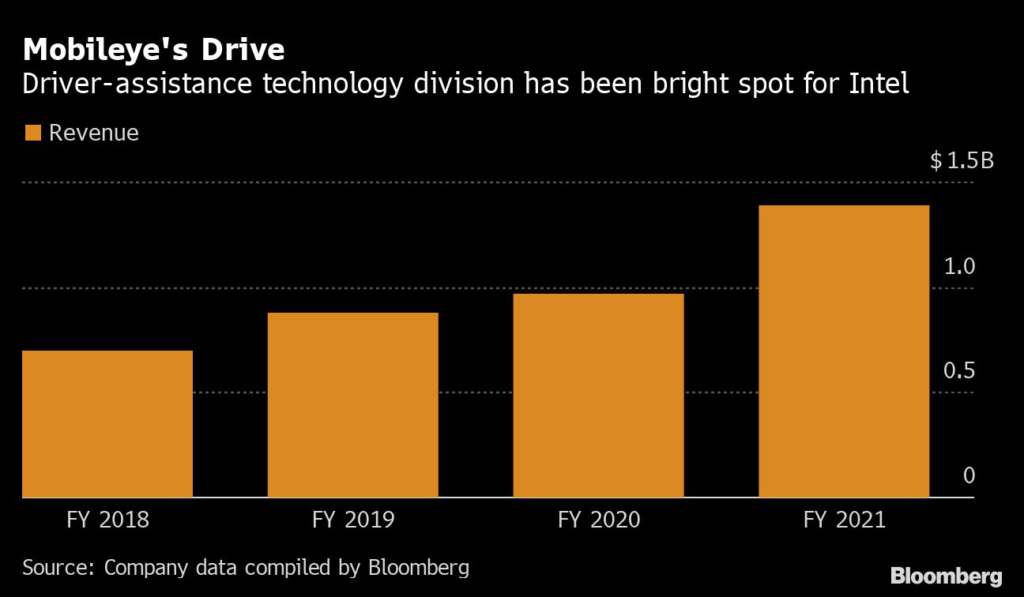
Now with about 3,100 employees, Mobileye has collected data from 8.6 billion miles on the road from eight testing sites globally, according to its filing. the company says its technology leads in the race to shift the automotive industry away from human drivers. It’s shipped 117 million units of its EyeQ product.

Mobileye has been a particularly bright spot for Intel and has consistently grown faster than its parent. As of July, it had $774 million of cash and cash equivalents. In the 12 months ended Dec. 25, it had a net loss of $75 million on revenue of $1.39 billion.

The company said it plans to use proceeds from the IPO to pay down debt and for working capital and general corporate purposes.

McCaskill, Huntsman

Mobileye said in its filing that its board will include Gelsinger as chairman, and also former US Senator Claire McCaskill, a Missouri Democrat, and Jon Huntsman, the former Republican governor of Utah as well as ambassador to China who is now on Ford Motor Co.’s board.

In its filing, Mobileye noted that it acquired mobility and transportation business Moovit from Intel this year. Moovit, another Israeli-based business, had been acquired by Intel for $900 million in 2020.

A successful Mobileye listing could break the ice for an array of startups that have been waiting for the year’s market tumult to ease before moving ahead with IPOs.

More specifically, it could clear a growing logjam of chip-related assets waiting to come to market. SoftBank Group Corp. also is trying to sell shares of semiconductor designer Arm Ltd. by early next year. Ampere Computing LLC, a startup making processors for data centers, is planning an IPO as well.

The Mobileye offering is being led by Goldman Sachs Group Inc. and Morgan Stanley. Mobileye plans for its shares to trade on Nasdaq under the symbol MBLY.

(Updates with Mobileye’s revenue in eighth paragraph)

More stories like this are available on bloomberg.com

©2022 Bloomberg L.P.

Burkina Faso Junta Removes Leader in Second Coup This Year

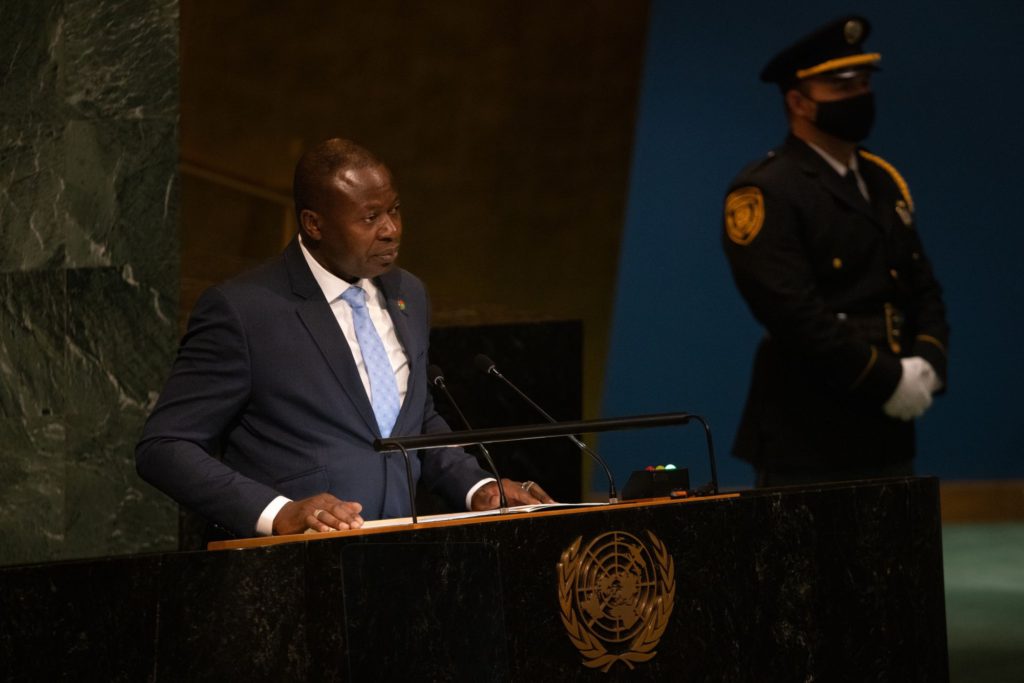
(Bloomberg) — Burkina Faso’s ruling junta replaced its leader in a counter-coup and nullified a transition plan which sought to restore democratic order in the West African nation in mid-2024.

The junta known as the Patriotic Movement for Salvation and Restoration will hold on to power in the West African nation after replacing Paul-Henri Sandaogo Damiba over his inability to stem jihadist violence. Ibrahim Traore, a military captain, was named as the new president in a statement read on the state broadcaster, Radio Television du Burkina.

“We have lost faith in” Damiba, a junta spokesman said on the broadcast late Friday. “Instead of retaking territory, we have lost ground to the armed terrorist groups,” he said.

Damiba, who himself took power in a January coup, faced growing discontent over spreading jihadist violence and a recent crackdown on civic freedoms, including restricting protests. The announcement comes after gunfire and heavy explosions were heard near the presidential palace and key army bases earlier in the day.

The junta announced Friday it was closing all borders, suspending the constitution, and dissolving the cabinet and parliament. It also invalidated a democratic transition plan, which the Economic Community of West African States had demanded after the January coup. The 15-nation bloc has sought to mediate a succession of putsches in the last couple of years. 

Coup Contagion

The Ecowas bloc temporarily imposed strict economic and trade sanctions on Mali, but took a softer stance in Burkina Faso and Guinea after soldiers ousted democratically elected leaders there. Within the region, the presidents of Niger and Guinea-Bissau survived recent attempts to overthrow their governments.

Burkina Faso is Africa’s fourth-largest gold producer, where companies including Endeavour Mining Plc and Iamgold Corp. own mines. Production of the metal plunged in the first half of this year as militants stepped up attacks on gold operations.

(Recasts story)

More stories like this are available on bloomberg.com

©2022 Bloomberg L.P.
Crypto ETF Outflows Drop 97% as ‘Get-Me-Out’ Rush Eases

(Bloomberg) — The money flowing out of crypto-related funds in the third quarter has slowed down, a sign that many bearish investors may have already piled out of the risky asset class.

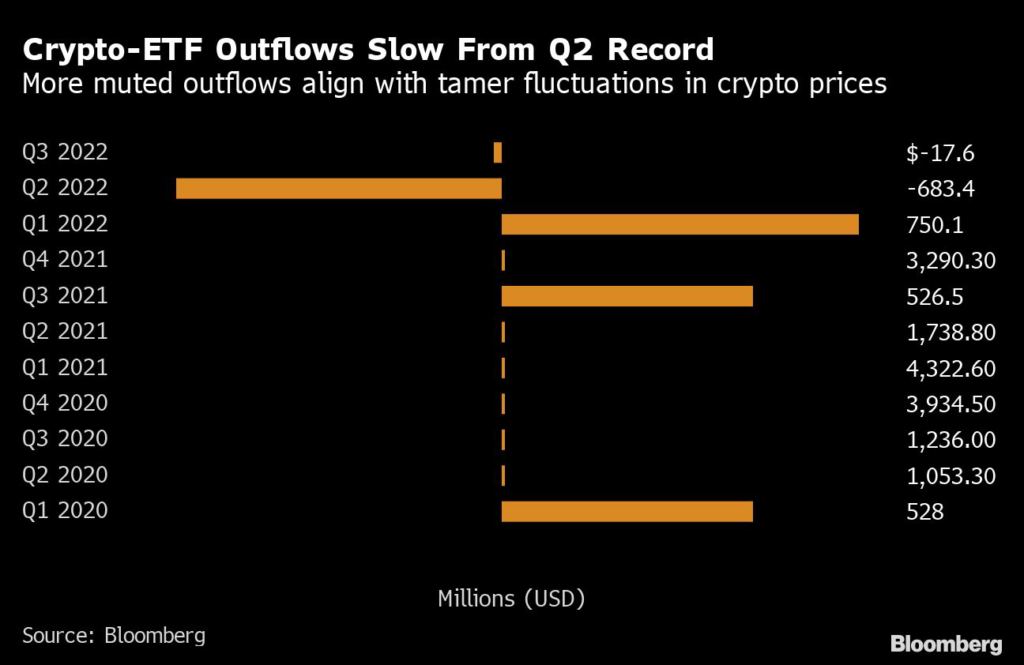
Investors pulled out $17.6 million from crypto exchange-traded funds in the three months ending Sept. 30, according to data compiled by Bloomberg Intelligence. That figure, as of Friday morning, is far below the record $683.4 million withdrawn from such funds in the second quarter. The outflows mainly took place in the past two months. In July, investors poured upwards of $200 million into crypto ETFs.

Record outflows in the second quarter tracked plunging cryptocurrency prices. Bitcoin, the world’s largest digital asset based on market value, fell nearly 60% during the second quarter of this year and posted a record low of $17,785 on June 18. Bitcoin rose 3.7% in the third quarter.

The more muted crypto-linked ETF outflows in the third quarter aligned with narrower fluctuations in prices. Bitcoin was trading above $19,400 on Friday, close to its price at the beginning of the quarter.

“I wonder if the second quarter was the ‘get me out’ part of these funds,” said Todd Sohn, ETF strategist at Strategas Securities. The third quarter saw “some laggards,” and investors who are just “keeping the faith mentality,” and waiting for crypto to rebound, he added.  

Global markets have sunk in the past few months as central banks around the world raise interest rates to curb soaring inflation. Risk assets like cryptocurrencies have been especially hard hit as recessionary fears rise. 

“Everything’s more correlated right now,” said Stephane Ouellette, chief executive officer of FRNT Financial Inc., a crypto brokerage firm.  “The people who are buying the ETF are in the same position as the people who are in Bitcoin,” he said. “Everyone’s panicking, so they’re acting the same.”

But investors who pool their money in funds tend to be different than holders of tokens, Sohn said. Those who put their money in crypto ETFs may do so to hedge the risks associated with buying digital tokens directly, he added. 

The Securities and Exchange Commission has repeatedly blocked the creation of a physically backed US Bitcoin ETF, despite other countries offering such options. As a result, US investors generally look to trusts or derivatives-backed crypto ETFs. 

Earlier this month, the Hashdex Bitcoin Futures ETF (ticker DEFI), a futures-backed product, launched and could pave the way for a US Bitcoin exchange-traded fund.

(Updates with third-quarter results.)

More stories like this are available on bloomberg.com

©2022 Bloomberg L.P.
Crypto Notable Quarterly Performer With Bitcoin Edging Higher

(Bloomberg) — Bitcoin registered a bit of a victory this quarter, even if the scale may not seem much for an asset class where outsized gains were until recently the order of the day. 

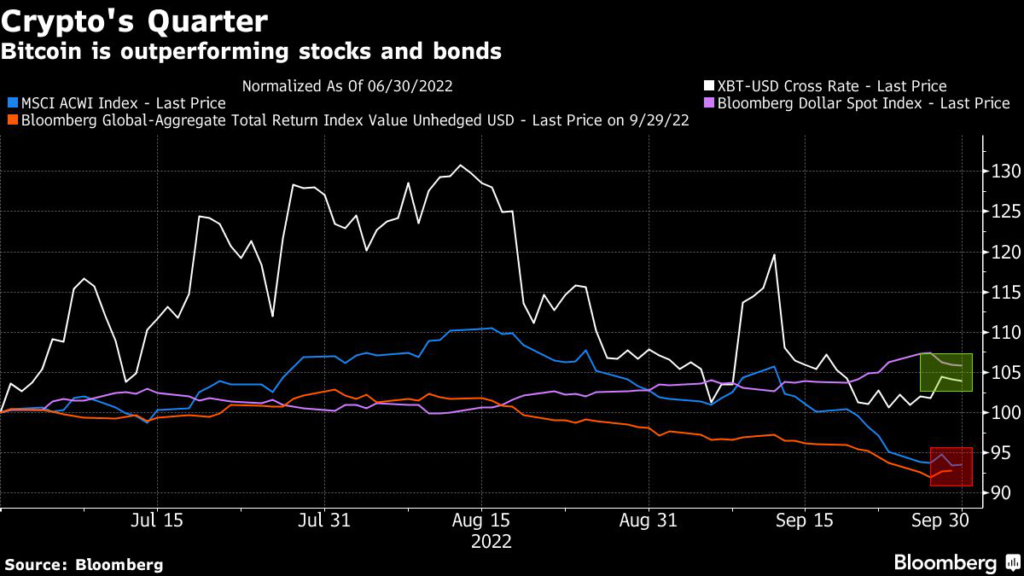
The biggest cryptocurrency rose 3.7%, recently trading about $19,392, compared to declines of about 7% for MSCI’s all-country stock index and Bloomberg’s total-return global bond index. It’s a further sign crypto prices may have stabilized following dramatic declines at the start of the year. By contrast, stocks are currently around 2022 lows. 

“It appears Wall Street believes crypto is close to the bottom and will become an attractive diversification strategy once the peak in Treasury yields is in place,” said Edward Moya, senior market analyst at Oanda Corp. “Despite all the doom and gloom on Wall Street, calls for another crypto crash have been somewhat quiet.” 

The gain might not be much, but it stands out in a sea of red, especially after an almost 60% drop in the second quarter. Asset classes across the board have been hit by a combination of rapid Federal Reserve interest rate hikes, stubbornly high inflation and heightened geopolitical tensions. The only major exception is the US dollar, with the Bloomberg Dollar Spot Index up about 6% since June 30.

Furthermore, Ethereum’s much-watched upgrade went smoothly, helping remove uncertainty, put a floor under prices and attract interest from institutional traders, said Darius Sit, co-founder of Singapore-based crypto investment fund QCP Capital. Ether rose 32% in the quarter, after an almost 70% drop in the three months ended June 30.

“The Ethereum merge was a strong Q3 2022 narrative,” Sit said. “Although we saw a post-merge dip in prices, the success of this watershed event bodes well for the space.”

Bitcoin is now also heading toward a historically more favorable time of the year. In the fourth quarter, it’s recorded gains two-thirds of the time with a median advance of 33%, pricing data back to 2010 shows. 

“While prices are depressed, the crypto ecosystem is actually thriving,” said Cici Lu, chief executive officer of Venn Link Partners Pte. “Developers are focusing on building the technologies.”

More stories like this are available on bloomberg.com

©2022 Bloomberg L.P.
Close Bitnami banner
Bitnami