Bloomberg

US Stocks Waver as Inflation Concerns Persist: Markets Wrap

(Bloomberg) — US stocks fluctuated as a slew of Federal Reserve officials rehashed their higher-rates-for-longer message. 

The S&P 500 had climbed as much as 0.9%, after Fed Vice Chair Lael Brainard acknowledged the need to monitor the impact rising borrowing costs could have on global-market stability. It pared gains as investors contend with continued strength in personal consumption expenditure, one of the Fed’s preferred inflation gauges. US Treasury yields slid, with the benchmark 10-year rate around 3.73%. 

Fed officials, all week, have been drilling in the message that they’ll continue to be aggressive to combat inflation. Friday’s comments came with some nuance. While Richmond Fed’s Thomas Barkin said key pressures stoking price growth are showing some signs of easing, San Francisco’s Fed Mary Daly said incoming data will determine how much the Fed will raise interest rates by. Investors now seem to be getting comfortable that tighter financial conditions will slow growth, said Dennis DeBusschere, founder of 22V Research.

US long-term inflation expectations also continued to ease in September, which helped lift consumer sentiment from the previous month despite growing economic uncertainty.

“The Fed is the only game in town,” said Brian Levitt, Invesco’s global market strategist. “Brainard’s comments provide hope. The Fed wants to slow growth, but not crush it.”

A bruising session on Wall Street Thursday had already taken the S&P 500 down 2% to the lowest in almost two years and sent the Nasdaq 100 tumbling almost 4%. The S&P 500 is headed for its third straight quarter of losses for the first time since 2009 and the Nasdaq 100 for the first time in 20 years. 

“By no means do I think we get a soft landing, but too much Fed-based negativity is priced in, and the data could start tilting toward lower inflation than the market — and Fed — have been fixated on,” wrote Peter Tchir, head of macro strategy at Academy Securities. “I continue to believe the ultimate lows will be in a true “risk-off” scenario, where bonds rally while stocks fall. But I think for now, both can limp into month-end and get some strength.”

Fears of global recession are still mounting as the threat of higher rates saps growth. The case of the UK shows how faultlines between government and central bank policy on tackling inflation can erupt into a crisis. Hopes evaporated that the British government would succumb to pressure to back down from tax cuts that brought the pound to the edge of dollar parity.

Traders are now gauging the next pressure points that will further erode gains won by the Bank of England’s billions in bond-market buying in the past two days.

Read more: UK Treasury Hasn’t Sought to Speed Up Budget Watchdog’s Forecast 

Geopolitical tensions also continued to simmer as Vladimir Putin vowed his annexation of four occupied regions in Ukraine is irreversible. 

Key events this week:

  • Euro zone CPI, unemployment, Friday
  • University of Michigan consumer sentiment, Friday
  • Fed’s John Williams to speak, Friday

Some of the main moves in markets:

Stocks

  • The S&P 500 was little changed as of 11:55 a.m. New York time
  • The Nasdaq 100 rose 0.1%
  • The Dow Jones Industrial Average fell 0.3%
  • The Stoxx Europe 600 rose 1.3%
  • The MSCI World index fell 1.4%

Currencies

  • The Bloomberg Dollar Spot Index rose 0.1%
  • The euro fell 0.3% to $0.9789
  • The British pound rose 0.1% to $1.1131
  • The Japanese yen fell 0.2% to 144.70 per dollar

Cryptocurrencies

  • Bitcoin rose 1.4% to $19,783.43
  • Ether rose 1% to $1,351.2

Bonds

  • The yield on 10-year Treasuries declined six basis points to 3.73%
  • Germany’s 10-year yield declined seven basis points to 2.11%
  • Britain’s 10-year yield declined four basis points to 4.10%

Commodities

  • West Texas Intermediate crude fell 0.2% to $81.08 a barrel
  • Gold futures rose 0.8% to $1,681.80 an ounce

More stories like this are available on bloomberg.com

©2022 Bloomberg L.P.

Ian Latest: Life-Threatening Storm Surge to Hit South Carolina

(Bloomberg) — Ian, a hurricane once more, is swirling over the Atlantic and barreling toward South Carolina, threatening to carve a new path of destruction when it roars ashore near the historic city of Charleston.

The storm is forecast to make landfall as a Category 1 hurricane, driving a surge of water up to 7 feet (2.1 meters) ashore and dropping up to 8 inches (20 centimeters) of rain, according to the National Hurricane Center. “Life-threatening storm surge and damaging winds” are arriving soon, the center said. 

Florida, meanwhile, continues to reel under the storm’s impact. More than 1.9 million homes and businesses remain without power, and Lee County, the hardest-hit area, has no running water. Homes, bridges and other infrastructure are in ruin, with damage estimates ranging from $65 billion to $100 billion. Florida Governor Ron DeSantis said it will take years to recover. 

Florida officials have confirmed one death from Ian, while 20 more remain unconfirmed, according to Kevin Guthrie, director of the state’s division of emergency management. Authorities have warned the death toll may climb. Three people were killed in Cuba, according to the Associated Press.


Ian to Make Landfall Around 3 p.m., AccuWeather Says (11:02 a.m.)

Ian will probably make landfall near the mouth of the Santee River about 60 miles northeast of Charleston around 3 p.m., said Paul Walker, a meteorologist with the commercial forecaster AccuWeather Inc. 

The hurricane’s top winds were holding steady at 85 miles per hour, the National Hurricane Center said in an 11 a.m. advisory. The storm was about 60 miles southeast of Charleston.

North Carolina’s Outer Banks could get high winds and storm surge could cut off roads, Walker said. Wilmington may also take some damage, he said. 

None of Ian’s impacts Friday and through the weekend will rival what it did to Florida. “The biggest thing about Ian is that it has done most of its damage,” Walker said.

Tampa Ports Set to Reopen as Trucks Move Fuel (10:04 a.m.)

The port of Tampa Bay is expected to resume vessel operations later on Friday after Hurricane Ian forced its closure, according to spokesperson Lisa Wolf-Chason. 

The land side of the port opened on Thursday morning and trucks are moving fuel out of terminals. The waterways are being assessed by the Coast Guard, Wolf-Chason said.

Florida’s Lee County Has No Running Water After Ian (9:58 a.m.)

Lee County, the hardest-hit area in Florida, has no running water due to a water main break, DeSantis said during a press conference. An “extraordinary amount of water has been staged” to supply residents there, he said.

Rescuers have gone to more than 3,000 homes and are continuing to conduct searches, DeSantis said. Fuel supply is flowing to the state, though some gas stations remain without power, he said. Power has been restored to 117 healthcare facilities. 

Florida Power Outages Drop Below 2 Million (9:24 a.m.)

Power outages in Florida have dipped below 2 million homes and businesses for the first time since Hurricane Ian barreled across the state. Just over 1.9 million customers were without service at 9 a.m. local time, according to PowerOutage.us, which tracks utility outages.

At peak, around 2.6 million homes and businesses were without electricity in the wake of the storm. Officials have warned many of the outages could be prolonged because of extensive damage to the grid from Ian.

Most of the outages remain concentrated in southwest Florida, where Ian land landfall with 150 mile per hour winds. Roughly 85% of homes in Lee and Charlotte counties remain without electricity.

Ian Strengthens to Become Strong Category 1 Storm (7:45 a.m.)

Ian’s top winds are now gusting at 85 miles per hour, making it a strong Category 1 hurricane. Shortly before dawn, it was about 145 miles southeast of Charleston, South Carolina. 

The hurricane will hit a large part of the state’s coast with a wall of water 3 feet (0.9 meters) high, with the surge reaching as much as 7 feet in the area around flood-prone Charleston. Some areas will get as much as 12 inches (30 centimeters) of rain. About half of all hurricane deaths are from flooding. 

Storm Surge, Flooding Rains Forecast (5 a.m. NY)

Ian is expected to bring life-threatening storm surge and hurricane conditions along the Carolina coast by the afternoon, the National Hurricane Center said in an update just before 5 a.m. Flooding rains are likely across the Carolinas and southern Virginia.

The storm was located about 145 miles south-southeast of Charleston in South Carolina, and 225 miles south-southwest of Cape Fear in North Carolina. Maximum sustained winds were 85 miles per hour, with higher gusts, and hurricane-force winds extend outward up to 70 miles from the center. The storm is moving north-northeast at 9 mph.

“On the forecast track, the center of Ian will approach and reach the coast of South Carolina today, and then move farther inland across eastern South Carolina and central North Carolina tonight and Saturday.”

While little change in strength is expected before it reaches the coast later today, Ian should see a “rapid” weakening after landfall.

Biden Declares Emergency for South Carolina (2 a.m. NY)

Biden declared an emergency exists in South Carolina, authorizing the Federal Emergency Management Agency to provide equipment and resources to the state now in the storm’s crosshairs.


More stories like this are available on bloomberg.com

©2022 Bloomberg L.P.

Ten Things Elon Musk’s Texts Reveal About the Twitter Deal

(Bloomberg) — A new trove of text messages between Elon Musk and Twitter Inc. executives, close friends, potential investors and Silicon Valley bros sheds light on how a $44 billion deal by the world’s richest person to buy the social media company came about — and ended up in court. 

The texts show who wanted to be part of the buyout and reveal the inner circle’s musings on who should run the company if Musk did come to own it. They were disclosed as part of Twitter’s lawsuit to make Musk follow through on his $54.20-per-share offer, which is slated to go to trial in Delaware Chancery Court next month.

Read court filing here 


Among the many texts, Musk discloses that he “has a minor case of Covid” in late March, is usually “up until ~3 am” and no longer has a personal assistant.

Here are 10 glimpses behind the scenes. 

1. Jack Dorsey, Twitter’s former chief executive officer, worked to get Musk to join the board shortly after activist investors starting agitating for change at the company in 2020. 

“I tried my hardest to get you on our board, and the board said no,” Dorsey wrote. “That’s about the time I decided I need to work to leave, as hard as it was for me.” 

Dorsey is “jack jack” on Elon’s phone. 

Read More: Dorsey Tried to Add Musk to Twitter’s Board Well Before Deal

2. Musk’s relations with Twitter CEO Parag Agrawal went from friendly to frosty within a week. On April 5, Agrawal tweeted that Musk was being appointed to Twitter’s board — and got Musk’s approval for the language of the tweet. 

But by April 9, the tone had shifted dramatically. Agrawal upbraided Musk over his tweets disparaging the company. 

“You are free to tweet ‘is Twitter dying’ or anything else about Twitter — but it’s my responsibility to tell you that it’s not helping me make Twitter better in the current context. I’d like to provide your perspective on the level of internal distraction right now and how it [sic] hurting our ability to do work.”

“What did you get done this week?” Musk snapped back.

“I’m not joining the board. This is a waste of time,” he texted 40 seconds later.

“Will make an offer to take Twitter private,” he texted 15 seconds after that. 

3. A few minutes later, Musk texted with Chair Bret Taylor about fixing Twitter. The texts suggest he already knew about Twitter’s bot problem, which he would later cite as a reason to abandon the deal.

“This is hard to do as a public company, as purging fake users will make the numbers look terrible, so restructuring should be done as a private company,” Musk wrote. “This is Jack’s opinion too.”

Read More: Twitter Calls Musk Counterclaims ‘Made-for-Litigation Tale’ 

4. On April 20, Musk texted Oracle Corp.’s Larry Ellison. 

“Any interest in participating in the Twitter deal?” he asked. Ellison said yes. Musk asked how much. 

“A billion … or whatever you recommend,” Ellison replied. Musk recommended $2 billion. On April 24 Ellison said, “Since you think I should come in for at least $2B … I’m in for $2B.” 

5. Several of Musk’s friends had ideas on whom Musk should hire. Investor Bill Lee suggested Bill Gurley of Benchmark Capital. Jason Calacanis noted that “Twitter CEO is my dream job.” 

6. Joe Rogan was a fan of the deal. “I REALLY hope you get Twitter,” the outsize podcaster texted. “If you do, we should throw a hell of a party.”

Read More: Musk Sought ‘Trump’ Word Search to Prove Twitter Fake Accounts

7. Steve Jurvetson suggested Musk hire Emil Michael, the former chief business officer of Uber Technologies Inc., and texted Michael’s LinkedIn account over. 

“I don’t have a LinkedIn account,” Musk responded. 

8. Gayle King of CBS asked Musk in April for an interview, saying buying Twitter was what the kids call a “gangsta move” and suggesting that Oprah Winfrey might want to join the board. King said she’d like a Twitter edit button. 

“Twitter edit button is coming,” Musk responded. 

9. Musk warned Calacanis against offering investment in the deal to “randos.” 

It “makes it seem like I’m desperate,” he said. 

Calacanis said he only wanted to be supportive: “You know I’m ride or die brother.” 

Read More: Twitter Gets Win Over Musk With Fast-Tracked October Trial

10. In March, Sam Bankman-Fried, the crypto billionaire, tried to get in touch with Musk through an associate to discuss joining in a deal for Twitter. Musk appeared uninterested — and unaware of Bankman-Fried’s wealth, asking, “Does he have huge amounts of money?” 

Eventually he warmed to the idea, “so long as I don’t have to have a laborious blockchain debate.” 

It’s unclear if they met.

The case is Twitter v. Musk, 22-0613, Delaware Chancery Court (Wilmington).

More stories like this are available on bloomberg.com

©2022 Bloomberg L.P.

EU Plots More Gas Steps as Security in Spotlight: Energy Update

(Bloomberg) — European Union energy ministers backed an initial package of measures to tame the gas crisis, and the bloc pledged to come forward with more next week as the crisis only intensifies.

Ministers signed off on a deal to curb power demand and grab profits from energy companies to redistribute to struggling consumers. But amid clamor for more action and criticism the commission has been too slow to act, Energy Commissioner Kadri Simson promised to do more.

The gnarly issue of a cap on wholesale gas prices is set to come back on the table again — even as it’s not clear consensus can be achieved. The commission insists that any price cap has to be accompanied by stricter demand cuts, and not all member states are ready for that. Proposals for an alternative gas benchmark and common gas purchases are also likely to get another hearing.

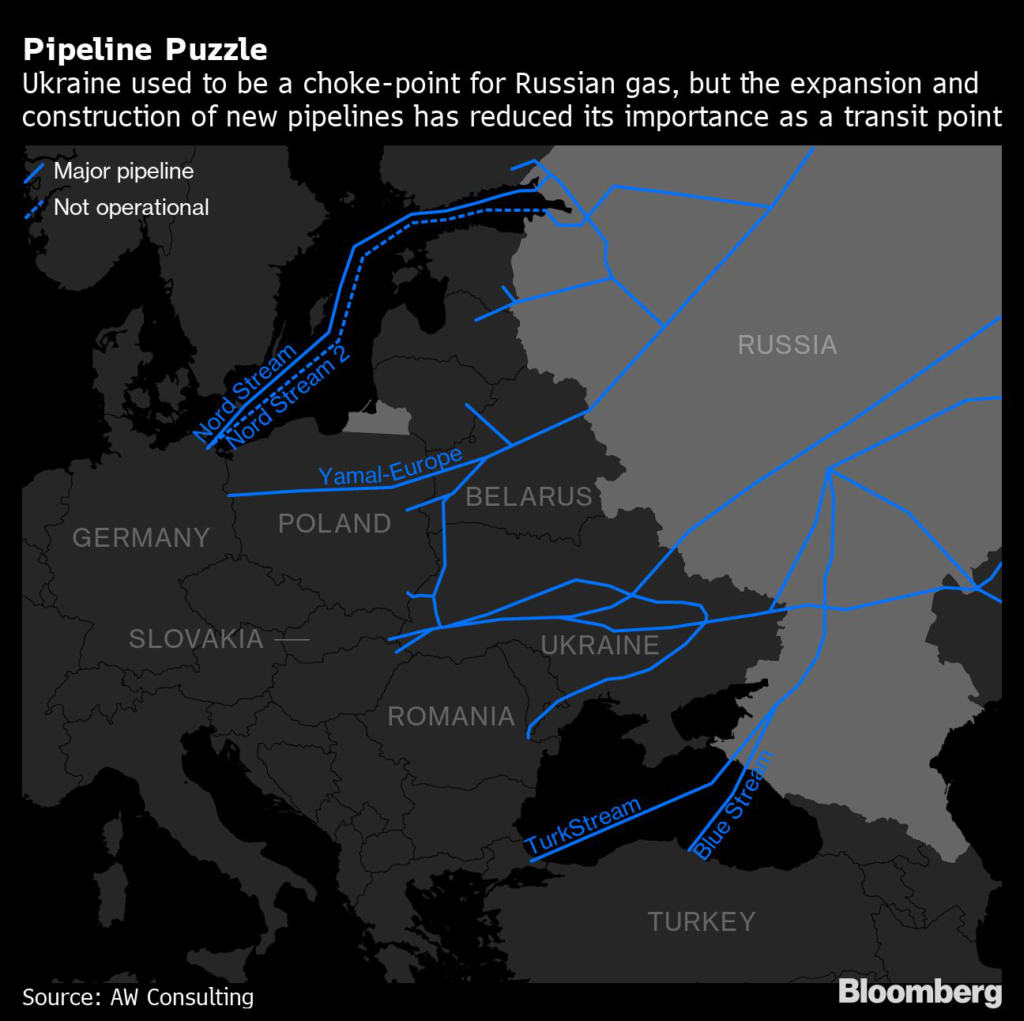
Overshadowing the meeting in Brussels was the sabotage earlier this week of the Nord Stream pipelines, which has thrown the focus onto security and prompted a rush to bolster defenses. The bloc will look at a stress test of its energy infrastructure in response. 

Key Developments:

  • Habeck signals Russia to blame for Nord Stream destruction; Putin blames “Anglo-Saxons”
  • Ministers agree initial package of measures
  • Italy sends navy to protect pipelines
  • Norway’s armed forces bolster security
  • Gas flows via Ukraine stable; prices fall 7%
  • Satellites capture first images of pipeline leaks
  • Draghi warns against distorting market
  • France mulls shielding businesses from costs

Read this: How Would You Manage Europe’s Energy Crisis?

ConocoPhillips Spots Drones; Ups Security (3:50 p.m.)

ConocoPhillips Skandinavia AS said it has raised the security level and emergency preparedness around its offshore and onshore facilities, and has spotted drones in the area.

The company is cooperating with authorities, it said.

TotalEnergies SE said late Thursday it had spotted an aerial drone close to an oil field in the Danish North Sea, following similar reports from Norway. 

EU Sees Stress Test on Infrastructure (3 p.m.)

Energy Commissioner Kadri Simson said she’d work with her home affairs counterpart to propose a stress test on European energy infrastructure as a response to the Nord Stream blasts.

“I will work with my colleague Commissioner Ylva Johansson to propose to the member states a stress test of the physical protection of critical energy infrastructure,” she said. “

“Given the possible serious possible impact of an incident on the internal market and across borders, an EU-wide approach is needed and we will work with member states to define the test scope and timing to reinforce the resilience of the EU energy system to threats.”

Ministers Demand More Action (2:45 p.m.)

Czech Energy Minister Jozef Sikela, whose country holds the rotating presidency, called on the commission to press ahead at pace with more measures to stem the crisis.

Sikela has heard “serious concerns” from member states about the lack of urgency.

“We have to act now,” he told reporters. 

Common gas purchases, work on a parallel benchmark gas index, and measures to cut the link between gas and power prices should be considered. 

Habeck Points Finger at Russia (2:20 p.m.)

German Economy Minister Robert Habeck indicated that Russia is to blame for the Nord Stream explosions, in the clearest statement yet from a European leader.

“There’s an investigation ongoing and we should wait for the result but that Russia is saying it wasn’t us is like saying I’m not the thief,” he said. “I don’t know who has done the explosions but saying it wasn’t us is not an answer I would trust.”

The Kremlin has denied responsibility.

Habeck Underlines the Challenge (2:15 p.m.)

Habeck underlined the challenge facing ministers as they contemplate measures such as gas price caps: “We need to find a way to reduce prices without risking supply.”

For now, there’s no agreement on any kind of gas price cap. But several member states are still pushing.

“I’m optimistic we’ll find better solution than what is currently on the table,” he told reporters. 

‘Progress’ on Oil Price Cap (1:15 p.m.)

There’s been progress in discussions on the oil price cap, according to Poland’s ambassador to the EU, Andrzej Sados.

A new draft on the broader sanctions package will be circulated in coming days for discussion on Monday, he told reporters in Brussels.

Poland is one of the key backers of the plan in the bloc.

How Big Is the Nord Stream Leak? (1 p.m.)

Whichever way you look at it, the amount of natural gas bubbling up in the Baltic Sea from Russia’s ruptured Nord Stream pipelines is massive. 

The underwater pipes, damaged by what European and US leaders say was sabotage, contained 778 million cubic meters of gas, based on data compiled by the Danish Energy Agency. That would be enough to meet three days’ supply for Germany, Europe’s biggest user of the fuel. It’s also the same as two-and-a-half days of production from Norway, currently the continent’s top gas supplier.  

What Happened to the Caps? (11:45 p.m.)

As the EU moves forward with its first package of measures, it’s becoming increasingly clear that some of its most radical ideas are running into stark divisions within the bloc, as well as market realities.

Some key member states have all but dropped an idea of putting a price cap on gas from Russia. That was meant to cut Moscow’s revenues as well as helping European prices. The idea was also floated of a wider cap that would also cover gas from Algeria and Norway.

The problem is any such measure would endanger supply, at a time when the bloc is desperate for alternative sources of gas. And capping LNG is probably not an option in a vastly competitive global market.

Another idea is a cap on the wholesale gas price, as backed by 15 nations. That’s looking hard to execute as it would require an overhaul of the market.

That leaves the option of capping the price of gas just for power production in order to sever the link between gas and power and alleviate the burden on bills. It’s the narrowest, most modest version of a price cap, though it still comes at a big fiscal cost.

EU Ministers Back Package (11:06 a.m.) 

Ministers reached an agreement on an initial energy intervention package, setting a goal to reduce power consumption and agreeing to tap windfall profits of companies and redirect them to customers and businesses.

It includes a binding target for each member state to lower its electricity use by 5% during peak hours during the heating season. It also allows governments to slap levies on fossil-fuel companies and power producers with cheaper inputs, a move the bloc estimates could raise 140 billion euros ($138 billion).

Habeck Says Allies Should Avoid ‘Exploitation’ (10 a.m.)

German Economy Minister Robert Habeck suggested that countries stepping into supply gas to the EU, which include Norway and the US, shouldn’t exploit the skyrocketing prices at Europe’s expense.

“I call on the EU to work for a different negotiation position with those states which are supplying gas,” he told reporters. “Because in this situation, we are in a partnership, and partnership cannot mean exploitation.”

Italy Sends Navy to Protect Pipelines (9:20 a.m.)

Italy is reinforcing protection of strategic trans-Mediterranean pipelines, the Navy said.

Two ships of the Italian Navy, equipped with remote-controlled submarines, are in charge of monitoring key areas in the Mediterranean Sea, specifically around the infrastructures transporting energy from Maghreb countries to Italy, according to a statement.

EU Focuses on Three Steps for Now (9:15 a.m.)

Ministers are likely to sign off on a package based around three main measures — the easiest ones on which to achieve consensus. A gas cap is not part of the package as it’s proved too controversial, at least for now. The main measures to be approved today are:

  • A mandatory power demand reduction target at peak hours
  • A profit-grab on power producers with cheaper input costs — for example those using nuclear, renewables
  • A levy on excess profits of fossil-fuel producers. The funds would be redistributed to help struggling consumers

German Finance Chief Says Putin’s ‘Energy War’ Will Fail (9:10 a.m.)

German Finance Minister Christian Lindner said the government is protecting Europe’s biggest economy from the fallout of the energy crisis with an “all-in strategy” and warned Russian President Vladimir Putin that his “energy war” will fail.

Putin’s “goal is clear,” Lindner said in a speech to the lower house of parliament in Berlin ahead of a vote approving the government’s temporary cut in sales tax on gas purchases to 7% from 19%. “Our prosperity should be shaken, our economic structure hit so that in the end our social cohesion erodes, also with the aim of bringing the solidarity that this country has for Ukraine to an end,” Lindner added. “We’re sending out a clear signal that he will fail.”

Sweden Taking Steps to Secure Infrastructure (9:20 a.m.)

Swedish Energy Minister Khashayar Farmanbar said authorities are taking steps to secure energy infrastructure after the Nord Stream blasts, which he said were probably perpetrated by a state actor. 

Norway Can’t Avert Sabotage (9 a.m.)

Norway’s security service lacks tools to prevent sabotage against the country’s energy facilities while such risks have increased, public broadcaster NRK reported, citing the agency’s Deputy Chief Hedvig Moe.

Frustration at Slow Pace (8:30 a.m.)

Some member states expressed frustration that more hasn’t been done to reach an agreement sooner to bring down gas prices. 

The European Commission set out earlier this week the risks of implementing a gas price cap on its own without additional measures.

Not Safe Enough Yet to Assess Pipeline Damage (8:25 a.m.)

US Defense Secretary Lloyd Austin said he spoke with his Danish counterpart, who said it will still be several days before it’s safe enough to assess the damaged pipelines.

“There is a lot of speculation but quite frankly, until a complete investigation is done, no one will be able to determine for certain what happened,” Austin told reporters in Hawaii.

EU to Focus on Three Steps (8:20 a.m.)

Ministers will focus on three measures that were the easiest to secure consensus around: a reduction of electricity demand, a cap on profits from energy producers with cheap input costs, and a tax on excess profits from fossil fuel companies. A cap on gas prices is not on the table. 

Czech Energy Minister Jozef Sikela said more needs to be done, and now. 

“This is just the first part in the puzzle. We must not stop here,” Sikela said. “We are in an energy war with Russia. The winter is coming and we have to act now.”


Europe’s Biggest Reactor Reaches Full Capacity (8 a.m.)

Europe’s newest nuclear reactor now has the biggest output too, bringing some relief to the region’s strained electricity market. 

Finland’s Olkiluoto-3, which sits on a peninsula by the Baltic Sea, reached full power for the first time last night, its operator Teollisuuden Voima Oyj said.

Germany Warns of Gas Shortage Threat This Winter (7:30 a.m.)

German Economy Minister Robert Habeck said the government’s move to put a lid on gas prices won’t hinder efforts to cut consumption, but he reiterated an appeal for all consumers to use less fuel to avert a shortage this winter.

“We’re still in this emergency situation and if we don’t save, if households don’t reduce usage, then the threat remains that we’ll have too little gas this winter,” Habeck said in an interview with Deutschlandfunk radio. 

The EU must also come up with a “unanimous response” to help bring down prices for gas imported into Europe, he added, accusing some countries, even allies, of “making out like bandits.”


More stories like this are available on bloomberg.com

©2022 Bloomberg L.P.

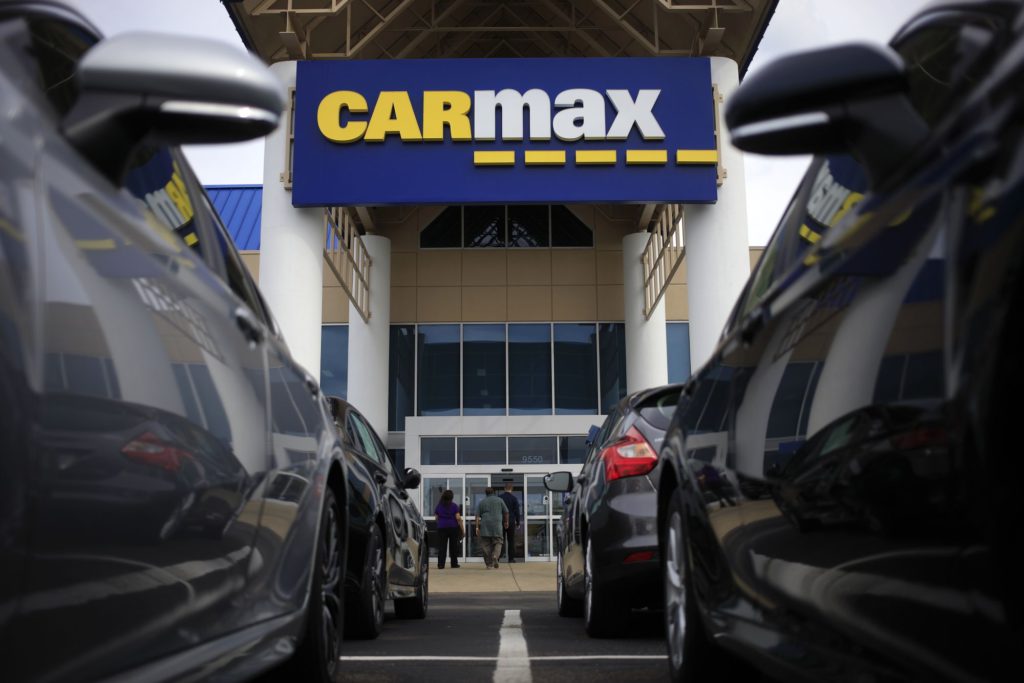
CarMax’s Huge Earnings Miss Points to Trouble Ahead for New-Car Market

(Bloomberg) — New-car sales are expected to rise in the just-ending third quarter, but a deteriorating market for used vehicles  — which sent CarMax Inc. shares tumbling Thursday — suggests trouble ahead for automakers.

The resale market often indicates where new-car demand is headed — and CarMax said vehicle sales dropped in the three months ended Aug. 31. Both consumers and wholesalers — they all buy from CarMax — pulled back, the company said. 

“This is a correction period because prices were so high for the last year,” said Chris Frey, senior manager for economic and industry insights at Cox Automotive. “There aren’t as many buyers at auction than there have been.”

Dallas-area dealer Dane Minor is used to finding ready buyers for his used cars at wholesale auctions. With a semiconductor shortage limiting new-vehicle production, prices for pre-owned models soared and vehicles sometimes sold for more than new cars. But the market has begun to weaken, and some models are selling below asking price. 

“Six months ago if you took a nice car to the auction, it was like piranha,” said Minor, the managing partner of Freeman Toyota in suburban Dallas. “Now we’re seeing softness in the market.”

CarMax made it clear consumers were hit by a triple whammy: Inflation is making cars less affordable, rising interest rates make them tougher to finance and consumer confidence is ebbing.

Prices Rise

Prices rose for the vehicles that CarMax sold in the quarter, but that came at the expense of volume. Total vehicle sales fell 10% from a year ago — with retail down 6.4% and wholesale down 15%.

Shares of the Richmond, Virginia-based car retailer rose 0.5% on Friday to $65.49 as of 9:48 a.m. in New York after plunging 25% on Thursday, the worst single day for the stock in more than 22 years.  

No longer assured of getting what they paid for trade-ins at auction, some dealers are redirecting inventory toward their own used-car lots to see if they have better luck getting full price from retail buyers. CarMax, for example, shifted some inventory from wholesale to retail to meet shopper demand for lower-priced vehicles.

Average used-vehicle prices spiked in early May to a record $28,375, but they have slipped since then and averaged $28,205 in July, according to data from Cox. The average listing price is up 11% from year ago, Cox said.

Manufacturers are starting to get more of the semiconductors they need to complete vehicles and are slowly boosting production. But supplies are still lean, and automakers are selling everything they can build. As a result, analysts say sales in September — and the third quarter — probably rose.

Quarterly Estimates

J.D. Power estimates US new-vehicle sales will reach 1.12 million units in September, a 12% increase from a year ago. Power also forecasts that seasonally adjusted annual sales for the month rose to 13.6 million units, up 1.5 million units from 2021. Sales for the quarter probably inched up 0.2% to 3.37 million vehicles but are likely down 13% during the first nine months, Power said. 

New-car prices rose 6.3% in September to record average of more than $45,000, a slowdown from the 10% rate that has prevailed for the year to date. Modest increases in production are helping to tame new-vehicle inflation, said Thomas King, president of the data and analytics division at J.D. Power. 

“Overall, this points to some deterioration in per unit pricing and profitability in the coming quarters,” King said.

Cox Automotive predicts September sales will be up 7.7%. Most automakers have more inventory now than they did a year ago, according to Cox. General Motors Co. and Tesla Inc. will likely be big winners in the quarter, while Japanese automakers, especially Honda Motor Co. and Nissan Motor Co., struggled the most with supply-chain issues. 

Interest Rates

With new-car inventory rising, consumers don’t need to go to the used-vehicle market and overpay, Frey said.

Interest rates are also starting to take their toll. For lower-income buyers and consumers in the middle tiers of credit, higher financing costs are starting to bite, said Jim Hardick, a managing partner with Moritz Dealerships, which sell the Chevrolet, Chrysler, Jeep and Kia brands in Fort Worth, Texas. 

Shoppers with lower credit scores could be paying interest rates of 8% to 12%, Hardick said. “You couple that with inflation, and it has taken some people out of the market,” he said. 

New car prices don’t yet reflect the downward pressure of rising interest rates and higher production. There is still plenty of pent-up demand due to the yearlong production shortage, according to Cox senior economist Charlie Chesbrough.

But there are signs they will.

“The recent changes in the economic outlook from rising interest rates is beginning to chip away at demand,” Chesbrough said in Cox’s recent report. “The waiting line for new vehicles is likely getting much shorter.”

(Updates with Friday market opening shares in eighth paragraph.)

More stories like this are available on bloomberg.com

©2022 Bloomberg L.P.

EV Startup Arrival in Talks on Funds to Unlock US Market

(Bloomberg) — Electric-vehicle startup Arrival SA surged after it said it’s in talks to raise capital to build and sell its products in the US. 

The company, which is primarily UK-based, also said it’s a step closer to operating so-called microfactories to produce battery-powered vans. The shares pared an early gain of as much as 17% on Friday to trade up 7.9% to 85 cents as of 9:42 a.m. in New York. 

Arrival said it reached a key milestone Thursday with a first production verification vehicle completed at its Bicester facility. Denis Sverdlov, founder and chief executive officer, says the step proves that the microfactory concept — which uses autonomous robots instead of a production line — works.

The next step for Arrival is the US, where President Joe Biden’s Inflation Reduction Act offers massive rebates on electric vans. To cash in on an expected surge of demand, Sverdlov says Arrival plans to build multiple microfactories in the US. However, it needs to raise capital for that — Sverdlov estimates the cost of a plant at $50 million, with a further $50 million needed for working capital.

Arrival declined to comment on how much capital it was seeking. It has multiple avenues, including loans under the US government’s Advanced Technology Vehicles Manufacturing Loan Program, strategic partnerships, and licensing its intellectual property, said Avinash Rugoobur, Arrival’s president.

Read more: EV Startup Out to Beat Google Gets Stuck at the Starting Line

Sverdlov said he wasn’t concerned about interest dropping off due to recent economic uncertainty across the world. Demand is many times more than supply, with few to no competitors in the large van space, he said. 

Arrival has an order from United Parcel Service Inc. to supply 10,000 vans, and Rugoobur said the company will begin road tests with UPS in London shortly. 

The company, which listed via a reverse merger with a special purpose acquisition company, has seen its shares plunge about 88% this year. 

The stock is trading near an all-time low, yet Sverdlov says he doesn’t regret taking the company public. 

“I will not say we regret this because we raised $1.4 billion from the public markets,” he said. “Raising that through the private markets at that time was almost impossible.” 

(Updates with shares in second paragraph.)

More stories like this are available on bloomberg.com

©2022 Bloomberg L.P.
Americans Are Planning Fall Travel Despite Higher Costs Ahead

(Bloomberg) — Financial worries may have bumped the pandemic as a top concern for travelers, but close to two-thirds of Americans still plan to hop on at least one overnight leisure trip in the upcoming three months—which include the holiday season. Of those travelers, nearly half are planning to visit friends and relatives. 

“Despite the challenges facing our industry, the outlook for fall looks stable,” said Erin Francis-Cummings, chief executive officer of Destination Analysts, in a live streamed presentation of the latest quarterly State of the American Traveler report released on Tuesday. The pre-holiday report and survey spans data collected from July through most of September.

A whopping 80% of US travelers confirm that they are excited about future trips, according to the report, with nearly a third saying they will take more leisure vacations in the next 12 months, compared to a year earlier. 

That’s not to say that inflation hasn’t affected plans for some; due to high prices, more than 30% had to cancel an upcoming trip. Some 45% hadn’t traveled in the past month. The frustration of traveling over the summer has persuaded at least 31% of American travelers to reconsider their fall travel plans.

Financial confidence has also taken a hit; only 27% say their financial situation is stronger than in the prior year, compared to 41% who had felt stronger financially in 2021, compared to 2020.

Still, US travel optimism is running high, despite chaotic, expensive, and frustrating service over the summer. That’s just as well because the upcoming holiday season isn’t looking smoother. It’s predicted to be the costliest, busiest yet, according to the latest Holiday Travel Outlook report from Hopper Inc., the Goldman Sachs Inc.-backed booking and fintech startup. 

Hopper’s findings align: More than half of American travelers plan to get around for one or both of this year’s major holidays; 70% plan to stay inside the US while 25% plan to head overseas.

Destinations popular with US tourists, such as Japan, have been announcing a lessening of restrictions; Canada is dropping Covid entry requirements this weekend. 

Related: Where You Can Travel Now Without a Covid Vaccine or Test

Nonetheless, the creeping cost of airfare, together with global financial uncertainty, may keep more Americans home, perhaps on road trips. Hopper predicts that air tickets will cost 41% more than last year for international fare and and 43% more for domestic tickets, or 25% and 22% higher, respectively, than pre-pandemic prices in 2019. 

Baby boomers, ready to spend $4,285, are the segment most inclined to spend on leisure travel in the next 12 months, closely followed by millennials and Gen-Xers; members of Gen-Z were the most price conscious. And luxury travelers predictably led the pack. Boomers are currently driving 77% of all tour bookings, according to survey results from JourneyWoman.

As for the luxury segment, a travel panel presented on Sept. 27 by Robb Report said that unconventional modes of traveling are grabbing more attention and dollars. To wit, Space Perspective, which offers individuals the experience of floating at the edge of space in an eight-seat capsule for $125,000 per person, is currently sold out until the end of 2024. 

Culinary travel also ranks high among US luxury travelers, who tend to be more eco-conscious and are likelier to support minority-owned businesses when traveling, Francis-Cummings said. Some 61% of this segment indicated that they’d be interested in using the metaverse to gain travel inspiration.

“I would encourage a more open look at who luxury travelers are,” Francis-Cummings adds during a follow-up interview. “Many of those prioritizing luxury travel experiences have not yet hit a $100,000 household income yet, but are still choosing to spend their discretionary income on luxury experiences in travel.”

More stories like this are available on bloomberg.com

©2022 Bloomberg L.P.

Hertz’s Electrified Fleet Could Be the Auto Industry’s Safety Net

(Bloomberg) — It wasn’t that long ago that sales to rental fleets were seen as a sign of failure. With the dawn of the electric-vehicle age, that’s changing.

In the past, automakers typically took aging or unpopular models, stripped them of many creature comforts and sold them to the likes of Hertz and Avis at discounted prices. It was a way to keep production lines moving until a freshened version of the car got to market. 

Electric vehicles are hot sellers right now, so cutting big deals with Hertz and other fleet buyers isn’t the desperate move that it once was, but it sure is an insurance policy. Both Tesla and General Motors are both cranking up production of EVs over the next several years. If middle market consumers don’t make the switch, both companies and Polestar—the all-electric automaker controlled by Volvo and its Chinese owner Zhejiang Geely Holding Group—will have already secured fleet deals to boost sales and keep building economies of scale.

That insurance plan might be needed. Right now, electric vehicles are 5% of sales in the US. That’s about double what it was last year, but no one in the industry is sure how quickly sales will keep growing. The buyers today are the early adopters, many of whom are passionate about climate change or technology, or just having the newest and coolest car on the block.

The average electric vehicle in the US sells for about $67,000, which is about $20,000 more than average ICE models, which are themselves at record levels. As automakers introduce cheaper EVs — like GM’s Chevrolet Equinox that will start at $30,000 next year and the Chevy Silverado and Ford Lightning pickup that will offer $40,000 versions — that could change. But at the moment even the Kia EV6 starts north of $41,000.  EVs are out of reach for most consumers.

Until those sticker prices come down, we’ll see more fleet deals. Hertz alone has already agreed to buy 175,000 EVs from GM over the next five years, along with 100,000 from Tesla and 65,000 from Polestar. If GM sells the same number to Hertz in each year, that rental deal alone would be 3.5% of the 1 million EVs that the company hopes to sell in 2025. 

Automakers will probably sell even more EVs to fleets. Fedex said it will buy as many as 20,000 electric delivery vans from GM’s BrightDrop unit in the next several years. Similarly, Ford said in August that it’s sold 8,300 of its E-transit electric vans. Startup Rivian Automotive plans to sell 100,000 electric vans to Amazon. 

Avis has made little noise about renting out EVs, but consumers can find a Tesla to rent on its website. Other carmakers will likely sell more of their electrified production to the rental trio of Hertz, Avis and the industry’s giant, Enterprise Rent-a-Car. 

Avis and Enterprise should take note if they haven’t already. On the company’s most recent earnings call, Hertz Chief Executive Officer Steve Scherr said that its EVs command an extra $30 to $35 a day at the counter and the company has lower fueling and maintenance costs. He said the resale values are also stronger than they are for many internal combustion models.

When GM and Hertz announced their agreement, GM North America President Steve Carlisle said that car buyers are twice as likely to consider an electric vehicle once they have driven one. Renting them out can prime the market.

And if consumers balk at plugging in, these deals will serve as a safety hatch in case automakers are building more electric models than American drivers want.

More stories like this are available on bloomberg.com

©2022 Bloomberg L.P.
Airbnb Hosts Try New Feature to Get Guests Traveling Again: Pickleball

(Bloomberg) — Addison Seale manages a luxury Airbnb Inc. listing near Joshua Tree National Park in southern California, a short-term rental market that boomed during the pandemic as people fled cramped cities in search of outdoor space. The house is sleek—a single story, three-bedroom concrete home with a deck, hot tub, small above-ground pool and a striking view of the desert. But to set the home apart from the 1,200 other rentals in the area, Seale, 25, and her fiancé decided against an in-ground pool, and chose a pickleball court instead.

“Compared to putting in a pool it was extremely cheap because it’s a concrete slab they had to finish and put the lines on,” she said. “We really just wanted something we could use and make us stand out.”

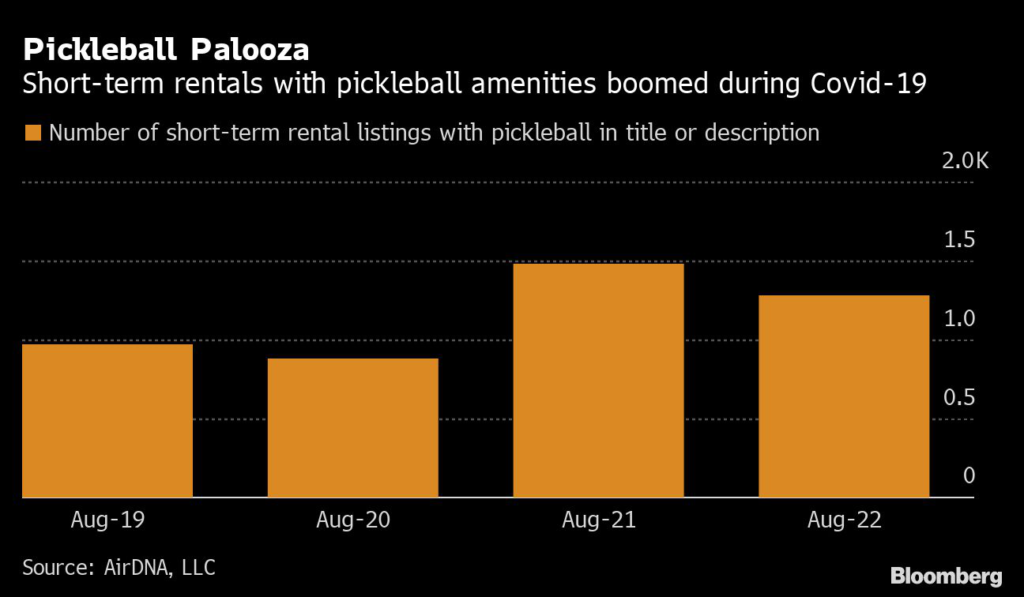
Seale’s property is one of almost 1,300 short-term rentals across Airbnb and Expedia Group Inc.’s Vrbo that mention pickleball in their listing title or description, according to industry data provider AirDNA. The number of citations has increased 32% from 2019.  

While the number of residences boasting pickleball courts is still small compared with the more than 8 million listings combined for Airbnb and Vrbo, having homes that will entice guests helps the companies compete with hotels. After two years of Covid lockdowns, the travel companies have been enjoying a boom in demand, with revenue in the second quarter topping analysts’ expectations. But shares of Airbnb and Expedia are down about 37% and 48%, respectively, this year as analysts expect travel to taper off toward the end of  2022 amid high inflation and an uncertain economic outlook. Property listings that mention pickleball are down about 200 this year, likely a reflection of softer demand for popular sites near mountain and lake getaways, AirDNA said.

Pickleball—played with a plastic, hollow-ball and wide paddle—resembles a cross between tennis, badminton and ping-pong. Players can compete as singles or as doubles on a court or even a driveway marked with chalk. All that’s needed is a lightweight and inexpensive net and paddles, making the game easily accessible to most people. The popularity of the sport exploded recently, growing 39% over the last two years to  4.8 million players, according to a study from the Sports & Fitness Industry Association, a global trade group for sports and fitness brands. Players in the 18-34 age range make up almost 29% of total players, but among serious pickleball enthusiasts, those who play eight times or more a year, almost a third are 65 or older.

Read about how LeBron James is buying a stake in a new pro pickleball team

Advertising pickleball perks can help short-term rental hosts get noticed amid a flood of new properties that have cropped up since the pandemic. Demand for homes has swelled as people take advantage of flexible work options. More guests are looking for stays of a month or more, and many are bringing their whole families in search of a space to combine work and leisure. The top amenities people are looking for include home offices, fast Wi-Fi, backyards and pet-friendly homes, according to Airbnb.

The San Francisco-based company said it doesn’t track searches for pickleball, but does note that travelers say amenities are a top priority for a great trip, especially when guests are booking for longer stays. On a blog post for hosts, Airbnb advises: “Thoughtfully outfitting your space and adding popular amenities to your listing will help you stand out from the crowd.” One host on the site suggested that other hosts “write your listing to invite people who value and enjoy the same things you do.”

That’s what Mike and Barbara Burch did. The Sedona, Arizona, residents converted a guest house on their property into an Airbnb listing and installed a pickleball court in September 2020 after playing at their church’s gym before the pandemic. It’s been a draw for reservations, and the couple, who describe themselves as “very active seniors,” finds new playing partners when their guests pick up the paddles.

“I have many people who will say, ‘I saw you had a pickleball court and that’s what bought me to your site,’” Barbara Burch said. “We’ve taught a lot of people that have no physical ability at all.”

Pickleball players in the US are concentrated on the coasts, with more than 1 million from Florida to Washington, D.C., and more than 750,000 players on the West Coast, according to the Sports & Fitness Industry Association report. But tournaments happen all across the country, including one in Sacramento, California, at the end of September that offers a $40,000 prize. That means travelers could be looking for a pickleball-friendly place to stay while competing, or to stay in shape while on vacation. Saint George, Utah, has the most pickleball-related rental listings in the US, with more than 100, followed by the Florida cities of St. Petersburg, Panama City Beach and Naples, according to AirDNA.

Like Lake Tahoe, and Joshua Tree, Arizona saw a boom in the popularity of short-term rentals during the pandemic, along with a hot housing market. The number of short-term listings in Phoenix increased 46% as of August compared with last year, according to AirDNA. While many people flocked to the sunny, dry destinations as an ideal place to weather the pandemic and work from home, not everyone wants to just lounge by the pool after a day of video calls or while on a family trip.

“If you go to a place like Arizona you’re gonna lay at the pool,” said Sarah Bradford, a former vacation rental manager and self-described pickleball fanatic. “A family is tired of playing at the pool after an hour. You need activities; you’re on vacation.”

More stories like this are available on bloomberg.com

©2022 Bloomberg L.P.
People Struggling to Get Pregnant Are Turning to Fintechs to Pay for Fertility Treatments

(Bloomberg) — Victoria Borges and her husband Caio only found out they were carriers of cystic fibrosis after their first son Lucas was diagnosed with the disease at three weeks old. So when the Atlanta-based couple decided to have another child a few years later, they hoped to use in-vitro fertilization to avoid passing on the genetic condition.

But at around $40,000– and not covered by insurance– the cost was far too high for them to be paid out of pocket. The Borges borrowed most of the funds from Future Family, a buy-now-pay-later startup that provides financing for fertility services. They are paying back the loan in 60 monthly installments at a fixed interest rate of 7.99%.  

“We started the process in November and it wasn’t until May that we had a plan to pay for it,” Victoria, 36, said. “We are not wealthy by any means, so it’s been a huge stressor.”

Future Family is part of a crop of startups in the US and Europe – a list that includes Gaia Family, Sunfish and Carrot Fertility – that aim to make fertility treatments more affordable by providing access to credit or working with employers to include these services as health benefits. 

The way these companies make money varies based on their model, including charging borrowers interest, taking a portion of what gets paid to the treatment provider, or charging fees to employers.

  • Read more: American Women Are at a Breaking Point

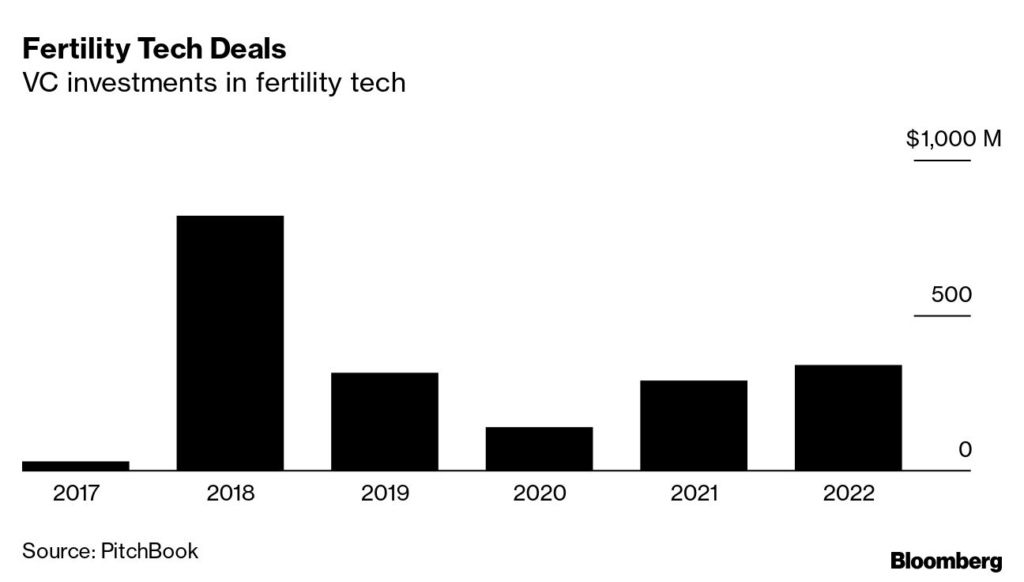
This budding area of fintech has garnered more attention from venture investors, and forms part of the broader fertility technology sector, which has attracted $1.9 billion in funding from VCs since 2017, according to data provider Pitchbook.

“We were quite intrigued by all of the different socioeconomic shifts that were happening in the world, and were noticing particularly people having children later in life, and women having more economic power,” said Sasha Astafyeva, a partner at London-based tech investor Atomico, and Gaia backer.

The global fertility services market is expected to expand 16% to $47.2 billion this year, and reach $80 billion in 2026, according to a recent report by ResearchAndMarkets.com. Rising infertility is driven in part by lifestyle changes, including women waiting longer to have children, and expected to boost the demand for treatment. But high prices could put a dent in the market’s growth, the report found, with the average cost of one IVF cycle reaching around $12,000.

In the US and UK these services are– for the most part– not covered by medical insurance, or hard to qualify for if offered by the public health system, leaving many facing the prospects of steep or unaffordable medical bills.  

By 2021, 36% of large companies — with 500 workers or more — covered IVF for employees according to survey data from workforce consultant Mercer. This is up from just under a quarter in 2015. 

“This group of fintechs are filling a gap,” said Sarah Kocianski, an independent fintech strategy consultant. “Nobody needs more digital general practice services, but there is an opportunity for something more specific.”

Financing fertility treatments is not new, but consumers have traditionally opted for more generic and expensive forms of borrowing. Nearly 29% of US consumers who have undergone fertility treatments have paid for the services using credit cards, the most common source of financing, followed by savings, according to a study conducted for Bloomberg by personal finance fintech Credit Karma. In the UK the most common payment source were savings, used by 34% of respondents, followed by credit cards. 

“For some patients, financing or insurance packages are their only hope of starting a family, but it is essential that what’s offered by insurance or other funding providers is safe and financially manageable,” said Clare Ettinghausen, the director for strategy and corporate affairs at the Human Fertilization & Embryology Authority, a UK government body with oversight over fertility treatments. 

The average interest rate for the financing was around 15%, according to the Credit Karma study, which surveyed 2,017 adult consumers in the US and the UK to gauge how fertility treatments were being funded.

While the vast majority of respondents said the cost of the treatment was worth it for them, there have been instances of lenders charging rates as high as 36%, said Colleen McCreary, Credit Karma’s consumer financial advocate. “This worries me,” McCreary said. “If consumers are willing to go to great lengths to grow their family — and I don’t blame them — they could find themselves taking on debt at a premium, which could have long term consequences on their finances.”

No matter the source of funding, over two-thirds of respondents said the cost of the treatments had long-term effects on their finances, the Credit Karma survey also found. 

Hit On All Sides

“You are getting hit on all sides of the spectrum, financially, physically and mentally,” said Marquita Wright, a 38-year-old sales manager in New Orleans, Louisiana who paid for intrauterine insemination treatments using credit cards. Wright and her husband ended up paying around $6,294 in credit card bills for the treatment, excluding interest.

“At the time it was the only option if we wanted to have kids,” said Wright. “We said the third time would be our last time because it would get too expensive.”

The couple are now parents to twin toddlers. But not everyone who borrows money or taps into savings is as lucky.  

Saira Rahman, a senior executive at fintech firm Fundrise, has been trying to get pregnant for eight years. She’s tried IVF in multiple US states, had six miscarriages and several failed transfers. Rahman is thankful that she’s been able to pay the roughly $100,000 she has spent over the years through savings, although she imagines what it would be like, being in debt for something that hasn’t worked. 

“If you don’t get pregnant you still have to pay the loan,” Rahman said. “You have a monthly reminder of your infertility. It’s worse than getting a period every month.”

Some fintech companies have taken this into consideration. London-based Gaia blends insurance and lending by using data to forecast how many rounds of IVF a couple will need. Customers will initially be charged a premium usually ranging between 20-30% of the cost of the treatment. If the treatment isn’t successful within the number of rounds estimated by the company, customers do not have to pay back the loan. If the treatment does lead to a baby, they can pay back the full amount in interest-free installments for as many as 5 years.

“Everyone should have the best chance of starting a family regardless of their financial situation,” said Nader AlSalim, Gaia’s chief executive officer and founder. 

San Francisco-based Future Family recently launched a product that is interest free which allows borrowers to pay back the loan in 12 months. Until now its interest rates have ranged from around 6% to 18%. 

As with other areas in consumer credit, concerns have emerged that rising interest rates and the subsequent cost of living crisis may make it harder for consumers to pay back their fertility loans. Providers are confident their customers — people seeking to grow families — are reliable and less likely to default on their loans.

“It’s consumers that are doing something responsible in their life,” said Claire Tomkins, Future Family’s chief executive. “I don’t expect that we would suddenly see crazy losses, but we may see higher rates.”

While several companies started by offering IVF financing, many are expanding to offer financing for a broader set of family-building or reproductive-care services, as they hope to fill a wider gap in the market. 

Future Family offers egg freezing plans, a treatment that Gaia is also planning to cover in the future, according to its CEO. 

Gülnaz Can​, a 38-year-old marketing executive based in London, has endometriosis, which doctors have told her causes high levels of infertility. While freezing her eggs will make it more likely that she might one day become a mother, the treatment for her would not be covered by the British National Healthcare System. 

She is paying with money from her divorce settlement.

“I would 100% borrow if I didn’t have the savings,” Can said. “I can’t tell you how much freedom it gave me even to have four eggs somewhere in the bank.”

Can, who is originally from Turkey, thought about getting treatment there where the service is cheaper. But local rules mean she would have only been able to access her eggs if married, she said. So instead she is spending £2,900 per treatment cycle in the UK. Medication is charged on top of treatment cost and amounted to £1,800 for her latest round, Can added.

Menlo Park, California-based Carrot, which enables employers to offer fertility health care and family-forming benefits to their staff, also covers adoption and surrogacy. Its customers include Box, Snap Inc, and Peloton.

“There are lots of differences in access to fertility care across 120 countries,” said Carrot founder and Chief Executive Tammy Sun. “One thing is very similar, not everything is accessible to everyone.” 

  • Read more: Walmart to Offer IVF, Other Fertility Benefits to US Workers

More stories like this are available on bloomberg.com

©2022 Bloomberg L.P.

Close Bitnami banner
Bitnami