Bloomberg

Africa’s Largest Phone Firm MTN Seeks Clarity on Telkom Deal

(Bloomberg) — MTN Group Ltd., which is talks to buy Telkom SA SOC Ltd., is questioning a proposal from another telecoms company that’s asked Telkom to acquire it.

Rain Group Holdings Pty Ltd. has offered to sell itself to Telkom in return for newly issued shares, the company said in a statement on Friday.

MTN, which is still formalizing its own offer for Telkom, said separately that it’s waiting for a detailed response from the partly state-owned operator. The deal to combine MTN and Telkom would result in the country’s biggest mobile-phone operator by number of subscribers.

“A further announcement will be released by MTN, setting out its position with regards to the future of the transaction,” MTN said.

Telkom shares fell 3.5% as of 12:58 p.m. in Johannesburg, valuing the company at 22.9 billion rand ($1.3 billion). MTN, which has dropped 12% since its July 15 offer for Telkom, was little changed. 

“Rain’s attempt to crash the South African telecom M&A party with its approach to Telkom for a merger makes MTN’s approach to Telkom for an-all share deal even more complicated,” said Bloomberg analyst John Davies. “It extends the uncertainty for Telkom and MTN and complicates any upcoming spectrum auction,” he said. 

MTN is flush with cash — after a multi year asset-disposal program — and is looking to strengthen its position in its core African markets. A combination with Telkom would close the gap with rival Vodacom Group Ltd., South Africa’s market leader controlled by the UK’s Vodafone Group Plc. A recent spectrum auction made the continent’s most-industrialized economy even more attractive to operators.  


More stories like this are available on bloomberg.com

©2022 Bloomberg L.P.

Tencent Loses Crown in World’s Biggest Stock Wipeout

(Bloomberg) — Tencent Holdings Ltd. has lost its title as China’s biggest company to liquor giant Kweichow Moutai Co., the latest sign of how far regulatory risk and dimming growth prospects has set back the country’s technology industry.

Shares of the online gaming company have tumbled 64% in Hong Kong since a January 2021 peak, wiping $623 billion off its market value. That’s more than any other firm globally, driven by concerns about Tencent’s outlook after Beijing’s yearlong regulatory crackdown. As of the Hong Kong close on Friday, the company was valued at about $5.4 billion less than Moutai.

The fall of Tencent  — which in early 2021 was on the verge of becoming Asia’s second-trillion-dollar firm — reflects the many risks facing the sector. Beijing’s overhaul of gaming companies coupled with the nation’s slowing economic growth remain the biggest hurdles for a recovery.

“There are no positive catalysts for Tencent in the second half, since its earnings will continue to be under pressure from the weak macro environment,” said Kenny Wen, head of investment research at KGI Asia Ltd. “And even when that improves in China, we are in an era of monetary tightening, so it will be hard to climb back to where it was when central banks were easing.” 

Moutai, on the other hand, sells the potent baijiu liquor drunk at banquets and other special occasions, and Beijing has pledged policy support for consumer-driven sectors. 

For Tencent, there are challenges on all sides. A slow drip for new gaming approvals as well as limits on playing time for minors has continued to affect its bottom line. Beijng’s strict Covid Zero policy and sporadic lockdowns have damped economic growth and hit advertising revenues. A broader selloff driven by fears of aggressive Federal Reserve tightening is also weighing on shares.

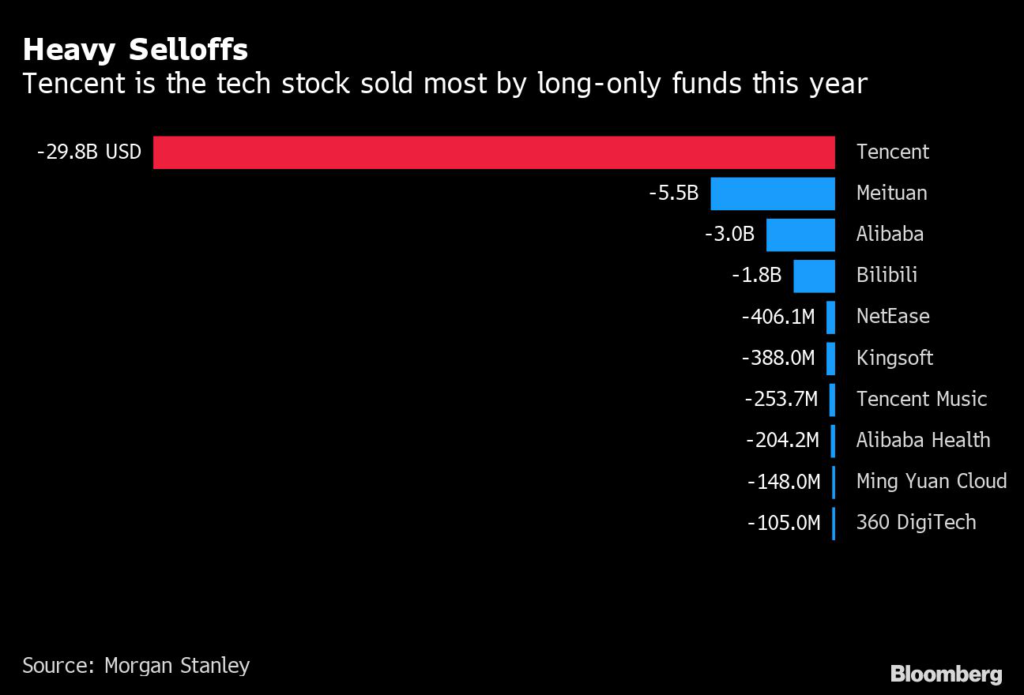
Those challenges haven’t gone unnoticed among active long-only funds, according to Morgan Stanley. The brokerage said that investors have net sold about $30 billion worth of the company’s shares this year through Sept. 20, the most of any firm in its cohort, with the pace having accelerated recently. Tencent’s controlling holders are selling too.

Last month, the brokerage also lowered its earnings estimates, saying slower gaming growth and “limited visibility” on an advertising recovery could weigh on top-line growth in the third quarter, according to a note by analysts including Gary Yu.

While the story is predominantly one of Tencent’s slide, Moutai’s stock has maintained some resiliency this year. The stock has slid 8.7% in 2022, outperforming the broader CSI 300 Index by 14 percentage points. The company is on track to beat its 2022 sales growth targets and could be a beneficiary of any consumer discretionary rebound should China ease its Covid-19 restrictions.

Investors are now divided on the outlook for Tencent. According to Jian Shi Cortesi, investment director at GAM Investment Management, the stock is “cheaply valued” and policy risks have already peaked. But others are not convinced by that argument, citing that prospects for future profitability look limited. 

“When an industry needs to rely on cutting cost to maintain margins, it means they are in the late period of their mature phase. Tencent is a typical example,” said Sun Jianbo, president at China Vision Capital. “None of its monetization methods have proved to be meaningful revenue drivers. I’m not considering buying even now that the valuation looks cheap.” 


Tech Chart of the Day

Oil major Exxon Mobil Corp. overtook social media giant Meta Platforms Inc. in market value for the first time since early 2017. While Exxon and other energy producers have outperformed this year amid a surge in commodities prices, tech stocks have been battered as soaring inflation prompted the Federal Reserve to enact a series of aggressive interest-rate hikes. 

Top Tech Stories

  • Apple Inc., which is trying to reduce its dependence on China, has already started producing some iPhone 14 models in India, in an earlier than usual move for new models. And Apple’s largest supplier, Foxconn Technology Group, recently agreed to a $300 million expansion of its production facilities in Vietnam.
    • One of Apple’s most senior executives is leaving after he turned up in a viral video on TikTok making an off-color joke that he fondles “big-breasted women” for a living.
  • Micron Technology Inc., the largest US maker of memory chips, is slashing production to cope with a steep plunge in demand, the latest sign of how the semiconductor industry’s boom times have quickly turned into a crisis.
    • Micron and Kioxia Holdings Corp., two of the world’s top memory-chip makers, are slashing production to cope with a steep plunge in demand.
    • Japan will subsidize Micron’s push to produce its new advanced chips in Hiroshima, as the tech sector braces for a collapse in demand.
  • Meta Platforms Chief Executive Officer Mark Zuckerberg outlined sweeping plans to reorganize teams and reduce headcount for the first time ever, calling an end to an era of rapid growth at the social media giant.
  • Japanese investor SoftBank Group Corp. has sold its entire stake in Sinch AB following a share price collapse of more than 90% in the Swedish cloud-based platform provider. 
  • Cineworld Group Plc revised down its outlook for admissions for the next two years, as the world’s second-largest cinema chain embarks on bankruptcy proceedings in the US.

More stories like this are available on bloomberg.com

©2022 Bloomberg L.P.

EU Backs Gas Plan as Focus Turns to Security: Energy Update

(Bloomberg) — European Union energy ministers backed an initial package of measures to tame the gas crisis, including a power-demand reduction goal and a profit grab from energy companies.

There’s some frustration in Brussels that more hasn’t been done, however, as the challenges facing policymakers keep growing.

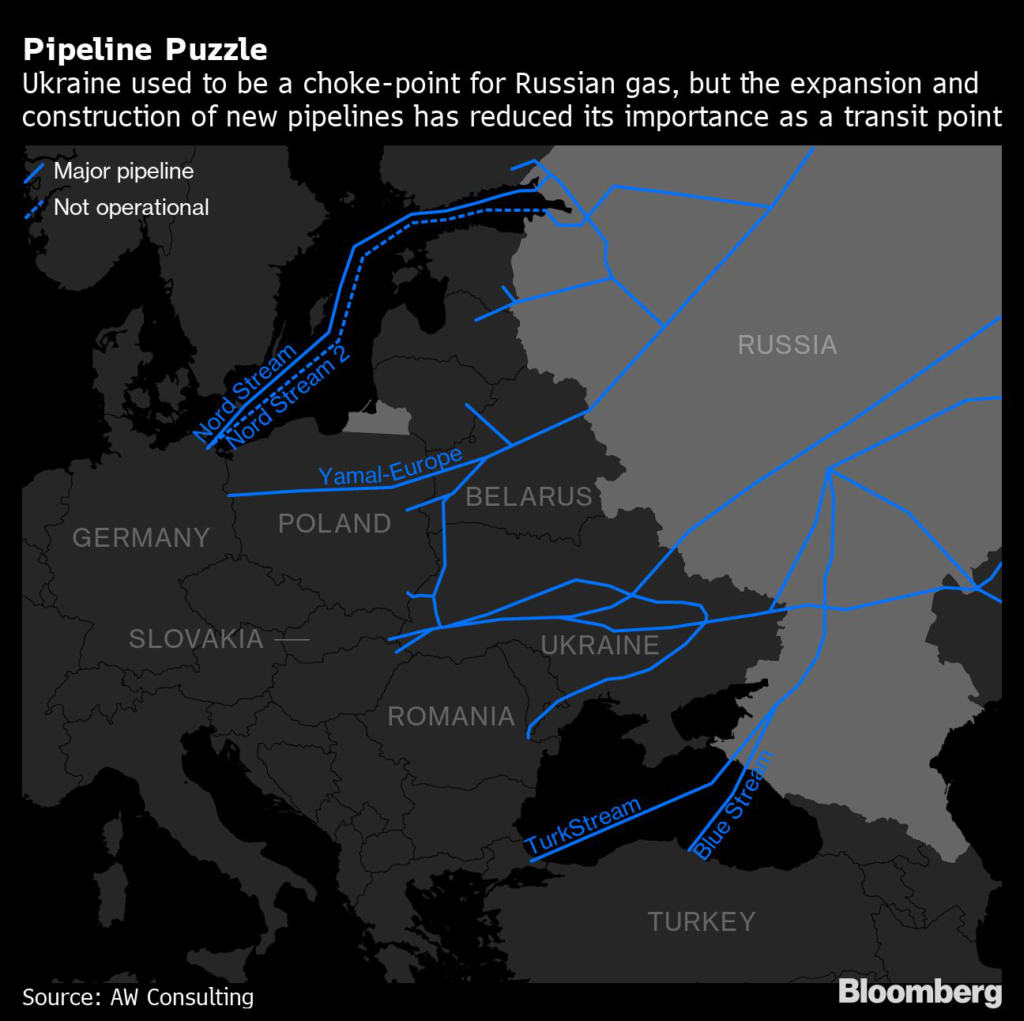
Overshadowing the meeting is the threat to the security of energy infrastructure after the suspected sabotage of the Nord Stream pipelines. Countries are moving to step up security, even as they admit their ability to prevent attacks is limited. 

Key Developments:

  • Habeck says Germany must save more gas
  • TotalEnergies spots drone flying near North Sea field
  • Italy sends navy to protect pipelines
  • Gas flows via Ukraine stable; prices flat
  • Satellites capture first images of pipeline leaks
  • NATO chief will speak at 6 p.m. Brussels time
  • Germany tells allied gas suppliers not to exploit situation
  • Draghi warns against distorting market

Read this: How Would You Manage Europe’s Energy Crisis?

What Happened to the Caps? (12:45 p.m.)

As the EU moves forward with its first package of measures, it’s becoming increasingly clear that some of its most radical ideas are running into stark divisions within the bloc, as well as market realities.

Some key member states have all but dropped an idea of putting a price cap on gas from Russia. That was meant to cut Moscow’s revenues as well as helping European prices. The idea was also floated of a wider cap that would also cover gas from Algeria and Norway.

The problem is any such measure would endanger supply, at a time when the bloc is desperate for alternative sources of gas. And capping LNG is probably not an option in a vastly competitive global market.

Another idea is a cap on the wholesale gas price, as backed by 15 nations. That’s looking hard to execute as it would require an overhaul of the market.

That leaves the option of capping the price of gas just for power production in order to sever the link between gas and power and alleviate the burden on bills. It’s the narrowest, most modest version of a price cap, though it still comes at a big fiscal cost.

EU Ministers Back Package (11:06 a.m.) 

Ministers reached an agreement on an initial energy intervention package, setting a goal to reduce power consumption and agreeing to tap windfall profits of companies and redirect them to customers and businesses.

It includes a binding target for each member state to lower its electricity use by 5% during peak hours during the heating season. It also allows governments to slap levies on fossil-fuel companies and power producers with cheaper inputs, a move the bloc estimates could raise 140 billion euros ($138 billion).

Habeck Says Allies Should Avoid ‘Exploitation’ (10 a.m.)

German Economy Minister Robert Habeck suggested that countries stepping into supply gas to the EU, which include Norway and the US, shouldn’t exploit the skyrocketing prices at Europe’s expense.

“I call on the EU to work for a different negotiation position with those states which are supplying gas,” he told reporters. “Because in this situation, we are in a partnership, and partnership cannot mean exploitation.”

Italy Sends Navy to Protect Pipelines (9:20 a.m.)

Italy is reinforcing protection of strategic trans-Mediterranean pipelines, the Navy said.

Two ships of the Italian Navy, equipped with remote-controlled submarines, are in charge of monitoring key areas in the Mediterranean Sea, specifically around the infrastructures transporting energy from Maghreb countries to Italy, according to a statement.

EU Focuses on Three Steps for Now (9:15 a.m.)

Ministers are likely to sign off on a package based around three main measures — the easiest ones on which to achieve consensus. A gas cap is not part of the package as it’s proved too controversial, at least for now. The main measures to be approved today are:

  • A mandatory power demand reduction target at peak hours
  • A profit-grab on power producers with cheaper input costs — for example those using nuclear, renewables
  • A levy on excess profits of fossil-fuel producers. The funds would be redistributed to help struggling consumers

German Finance Chief Says Putin’s ‘Energy War’ Will Fail (9:10 a.m.)

German Finance Minister Christian Lindner said the government is protecting Europe’s biggest economy from the fallout of the energy crisis with an “all-in strategy” and warned Russian President Vladimir Putin that his “energy war” will fail.

Putin’s “goal is clear,” Lindner said in a speech to the lower house of parliament in Berlin ahead of a vote approving the government’s temporary cut in sales tax on gas purchases to 7% from 19%. “Our prosperity should be shaken, our economic structure hit so that in the end our social cohesion erodes, also with the aim of bringing the solidarity that this country has for Ukraine to an end,” Lindner added. “We’re sending out a clear signal that he will fail.”

Sweden Taking Steps to Secure Infrastructure (9:20 a.m.)

Swedish Energy Minister Khashayar Farmanbar said authorities are taking steps to secure energy infrastructure after the Nord Stream blasts, which he said were probably perpetrated by a state actor. 

Norway Can’t Avert Sabotage (9 a.m.)

Norway’s security service lacks tools to prevent sabotage against the country’s energy facilities while such risks have increased, public broadcaster NRK reported, citing the agency’s Deputy Chief Hedvig Moe.

Frustration at Slow Pace (8:30 a.m.)

Some member states expressed frustration that more hasn’t been done to reach an agreement sooner to bring down gas prices. 

The European Commission set out earlier this week the risks of implementing a gas price cap on its own without additional measures.

Not Safe Enough Yet to Assess Pipeline Damage (8:25 a.m.)

US Defense Secretary Lloyd Austin said he spoke with his Danish counterpart, who said it will still be several days before it’s safe enough to assess the damaged pipelines.

“There is a lot of speculation but quite frankly, until a complete investigation is done, no one will be able to determine for certain what happened,” Austin told reporters in Hawaii.

EU to Focus on Three Steps (8:20 a.m.)

Ministers will focus on three measures that were the easiest to secure consensus around: a reduction of electricity demand, a cap on profits from energy producers with cheap input costs, and a tax on excess profits from fossil fuel companies. A cap on gas prices is not on the table. 

Czech Energy Minister Jozef Sikela said more needs to be done, and now. 

“This is just the first part in the puzzle. We must not stop here,” Sikela said. “We are in an energy war with Russia. The winter is coming and we have to act now.”


Europe’s Biggest Reactor Reaches Full Capacity (8 a.m.)

Europe’s newest nuclear reactor now has the biggest output too, bringing some relief to the region’s strained electricity market. 

Finland’s Olkiluoto-3, which sits on a peninsula by the Baltic Sea, reached full power for the first time last night, its operator Teollisuuden Voima Oyj said.

Germany Warns of Gas Shortage Threat This Winter (7:30 a.m.)

German Economy Minister Robert Habeck said the government’s move to put a lid on gas prices won’t hinder efforts to cut consumption, but he reiterated an appeal for all consumers to use less fuel to avert a shortage this winter.

“We’re still in this emergency situation and if we don’t save, if households don’t reduce usage, then the threat remains that we’ll have too little gas this winter,” Habeck said in an interview with Deutschlandfunk radio. 

The EU must also come up with a “unanimous response” to help bring down prices for gas imported into Europe, he added, accusing some countries, even allies, of “making out like bandits.”


More stories like this are available on bloomberg.com

©2022 Bloomberg L.P.

Ian Latest: Biden Declares Emergency for South Carolina

(Bloomberg) — Ian, now a hurricane again, is threatening to carve a new path of destruction through South Carolina Friday when it roars ashore north of Charleston.

The storm will drive a surge of water into the city of 3 to 6 feet (1.8 meters) and drop up to 8 inches (20 centimeters) of rain, according to Mike Doll, a meteorologist at commercial-forecaster AccuWeather Inc.

Power outages will reach far inland as Ian’s winds shake trees and power lines throughout the region. The storm is likely to create an even higher flooding surge further up the coast, with as much as 10 feet of water being pushed on shore in places, Doll said. Around Myrtle Beach, the surge could be also be 3 to 6 feet. 

The damage in South Carolina, and the flooding rains inland, will be severe but won’t rival the devastation across Florida, where it may take weeks or months to assess the true cost, Doll said.

“This is going to be among the most devastating hurricanes we have seen in the US,” he said. “Is it as bad as Katrina? Probably not, but the coastline in southwest Florida is going to be forever altered from this.” 

President Joe Biden has said early indications suggest that there could be a significant death toll. “We’re hearing early reports of what may be substantial loss of life,” Biden said on Thursday.

Storm Surge, Flooding Rains Forecast (5 a.m. NY)

Ian is expected to bring life-threatening storm surge and hurricane conditions along the Carolina coast by the afternoon, the National Hurricane Center said in an update just before 5 a.m. Flooding rains are likely across the Carolinas and southern Virginia.

The storm was located about 145 miles south-southeast of Charleston in South Carolina, and 225 miles south-southwest of Cape Fear in North Carolina. Maximum sustained winds were 85 miles per hour, with higher gusts, and hurricane-force winds extend outward up to 70 miles from the center. The storm is moving north-northeast at 9 mph.

“On the forecast track, the center of Ian will approach and reach the coast of South Carolina today, and then move farther inland across eastern South Carolina and central North Carolina tonight and Saturday.”

While little change in strength is expected before it reaches the coast later today, Ian should see a “rapid” weakening after landfall.

Biden Declares Emergency for South Carolina (2 a.m. NY)

Biden declared an emergency exists in South Carolina, authorizing the Federal Emergency Management Agency to provide equipment and resources to the state now in the storm’s crosshairs.

Orlando Airport, Disney World to Reopen Friday (11 p.m. NY)

Orlando International Airport will resume passenger flights at noon Friday and the Walt Disney World Resort will restart theme park operations in a phased approach starting Friday as the threatening winds and rain move north.

Florida Sees Remaining Ports Reopening by Saturday (8 p.m. NY)

Ports in Florida that are still shut will reopen by Saturday, and the state is trucking in food, water, ice, blankets, tarp and pet supplies to help people devastated by the storm, Governor Ron DeSantis said at a press conference Thursday evening. 

“They will bounce back, but we have to make sure we pave the way for them,” DeSantis said of the people impacted by the hurricane in Southwest Florida.

DeSantis said he anticipates deaths from the storm, but wouldn’t say how many fatalities the state had been able to confirm yet. Trucks are delivering gasoline to fueling stations in the state and utility workers are restoring power to many, but in areas including Fort Myers Beach, Sanibel Island and Pine Island the damage is severe enough that blackouts will remain lengthy, he said. The state had more than 2 million customers without power, according to PowerOutage.us.

Ian’s Winds Reach Hurricane Strength Again (5 p.m. NY)

Ian’s wind have strengthened to 75 mph, making it a Category 1 hurricane on the five-step, Saffir-Simpson scale, the National Hurricane Center said in an advisory. 

The hurricane’s top winds will likely strengthen to 80 mph overnight, however it will still be a Category 1 storm, the hurricane center said. 

“Hurricane-force winds are expected across the coasts of South Carolina and southeastern North Carolina beginning early Friday, where a hurricane warning is in effect,” Eric Blake, a forecaster at the center, wrote in his outlook. “Hurricane conditions are possible tonight along the coasts of northeastern Florida, Georgia, and North Carolina where a hurricane watch is in effect.”

Cattle Ranches ‘Are Kind of Wrecked’ (4:42 p.m. NY)

Hurricane Ian swept through about 40% of Florida’s beef cattle country, leaving ranches “kind of wrecked,” Jim Handley, executive vice president of the Florida Cattlemen’s Association said by phone from Kissimmee. The key for animals now is for water on pastures to recede so they can resume feeding before hunger becomes critical. “It hammered us pretty good,” Handley said.

Utility With Major Outages Had Pole Woes in 2021 (4:26 p.m. NY)

Lee County Electric Cooperative said that 92% of its customers are without power as of Thursday afternoon after Ian swept through the region. One compounding issue may have been the condition of its utility poles.

When the cooperative filed a report to regulators on its storm-hardening efforts earlier this year, it disclosed that 5,904 distribution poles — or 19% of inspected poles on its network — failed inspections last year. The vast majority failed due to rot, decay or other damage. The utility said it repaired or replaced nearly 750 poles in 2021.

Storm Knocked Out 11% of Florida’s Wireless Networks (3:27 p.m. NY)

Storm damage and power outages knocked out more than 1,500 cell sites, leaving about 11% of Florida’s wireless networks out of service in the wake of Hurricane Ian, according to a status update from the Federal Communications Commission.

The scope of the mobile phone service disruptions span the entire state from the Keys, where Monroe County to Bradford County in northern Florida. So far, most of the severe damage was in western and southern Florida, including Lee and Hendry counties, where about 66% of cell sites are reported to be out of service.

The damage to communication systems also includes disruption to cable and phone company services such as TV, phone and internet. About half a million landline subscribers in the hurricane disaster area are without service, according to the FCC update.

Fertilizer Firm Sees No Chemical Leaks (3:10 p.m. NY)

Fertilizer maker Mosaic Co. found no releases of toxic fertilizer byproduct in the wake of Ian’s landfall, spokesman Bill Barksdale said Thursday by email. The company will continue to inspect sites in the coming days to confirm its initial assessment, he said.

Florida is home to much of America’s production of phosphate fertilizer and Ian’s path came close to Tampa, close to where Mosaic Co. has the bulk of its phosphate facilities. 

Iconic Causeway Damaged from ‘Biblical’ Surge (2:51 p.m. NY) 

Sanibel Island off Florida’s Gulf coast was hit with a “biblical storm surge” from Hurricane Ian, which destroyed homes and caused a collapse of the sole road linking the island to mainland, according to Florida Governor Ron DeSantis.

The hurricane caused extensive damage to the Sanibel Causeway, an iconic trio of two-lane bridges spanning San Carlos Bay to connect the island of Sanibel to the mainland. The storm left the link unusable to vehicle traffic. The governor said there are air and boat operations to rescue those who are still stranded on the island, which is home to about 6,000 people.

Sanibel Island, a 25-mile drive from Fort Myers, is a popular tourist destination with many people visiting during the winter months.

Utility Uses Drones to Assess Damage (2:38 p.m. NY)

Florida’s largest utility said it will provide estimates for when power will be restored within 24 hours of assessing damage, though it will take longer for hard-hit areas, especially where Ian made landfall. Florida Power & Light has 21,000 people in the field working to assess damage and restore power.

“In areas impassable due to floodwater or debris, we will use a fleet of drones to assess damage,” company representative Bryan Garner said at an afternoon news briefing. 

Florida Gas Stations Wait for Power to Return (2:15 p.m. NY)

Florida gas stations that were in Ian’s path are closed while others outside the cone of destruction may face disruption as suppliers wait for the power to return and roads to clear.

Close to 11% of Florida’s gas stations were without fuel Thursday, said Patrick De Haan, head of petroleum analysis at GasBuddy. All of the stations between Fort Meyers and Naples were closed, Ned Bowman, executive director of the Florida Fuel Marketers Association, said in an interview. The state has about 7,400 retail stations, he said.

Fuel racks in Jacksonville were still closed, while flooded terminals in Orlando were waiting for deliveries from other parts of the state. Fuel bottlenecks could complicate efforts to rebuild from what is likely to amount to tens of billions of dollars in damages. Across Florida’s southwest, residents were still trapped in their homes with limited electricity and mobile phone coverage.

Duke Energy Prepares for Outages in Carolinas (1:58 p.m. NY)

Duke Energy Corp. said it’s readying crews to respond to potential power outages across the Carolinas as Ian approaches the region.

“The storm is expected to bring with it strong winds and heavy rains that could lead to localized flooding,” the company said in a statement.

High water and flooding is possible on Duke Energy lakes, said the company, which is lowering levels by moving water through its river systems, creating more storage for rainfall and runoff.

President Biden Hears of ‘Substantial’ Loss of Life (1:17 p.m. NY)

President Joe Biden said at a Federal Emergency Management Agency briefing that he’s getting early indications of a significant death toll from Hurricane Ian.

 “We’re hearing early reports of what may be substantial loss of life,” Biden said at the agency’s headquarters in Washington, D.C.

Since 1980, tropical cyclones have killed an average of 156 people a year in the US, according to the National Centers for Environmental Information. In the time frame they were the deadliest weather events killing a total of 6,708 people.

Orange Juice Soars to 5-Year High (12:25 p.m. NY)

Orange juice surged to the highest since 2017 as a storm-ravaged Florida starts to assess citrus crop damage from Hurricane Ian.

“It will take another day or two to fully understand the damage the storm caused but damage is expected to be very big,” Jack Scoville, vice president of Chicago brokerage Price Futures Group, said in a note. Orange juice inventories in Florida are 41% below year-earlier levels, he said.

Ian is expected to be a massive blow to the citrus industry of Florida, which supplies nearly all of the orange juice to the country. The storm’s impact on domestic fertilizer output is also under scrutiny, since supply disruptions could hurt production of grains and other key crops.

More stories like this are available on bloomberg.com

©2022 Bloomberg L.P.

Stocks, US Equity Futures Rise as Turmoil Pauses: Markets Wrap

(Bloomberg) — European stocks rose with government bonds, signaling a potential recovery at the end of a tumultuous week in markets.

European shares added about 1%, paring the longest run of quarterly losses since 2009. US equity futures also gained following another bruising session on Wall Street that took the S&P 500 down 2% to the lowest in almost two years and sent the tech-heavy Nasdaq 100 tumbling almost 4%. Government debt markets rallied.

Fears of global recession are mounting as the threat of higher rates saps growth. The case of the UK shows how faultlines between government and central bank policy on tackling inflation can erupt into a crisis.

The dollar weakened while the pound rose as investors weighed risks emanating from the debt crisis gripping the UK. 

“Today, everything is just oversold so you are seeing a rebound,” said Esty Dwek, chief investment officer at Flowbank SA.

The UK currency has staged an almost full recovery since the government announced sweeping UK tax cuts a week ago, surging 7% from its all-time low of $1.0350 set early Monday.

“We are closer to bottoms and sentiment is so negative the downside is becoming more limited,” Dwek said. “At some point, risk assets will move higher again.”

Global equity funds garnered inflows of $7.6 billion in the week to Sept. 28, according to data compiled by EPFR Global. Bonds had $13.7 billion of outflows in the week, while $8.9 billion flowed into US stocks, the data showed.

Even so, the mood remains unsettled, with traders gauging the next pressure points that could undo gains won by the Bank of England’s billions in bond-market buying in the past two days.

Read more: The Market Pain Levels That May Spark the Next UK Policy Action

How much damage is a strong dollar causing? That’s the theme of this week’s MLIV Pulse survey. It’s brief and we don’t collect your name or any contact information. Please click here to share your views.

Key events this week:

  • Euro zone CPI, unemployment, Friday
  • US consumer income , University of Michigan consumer sentiment, Friday
  • Fed’s Lael Brainard and John Williams speak, Friday

Some of the main moves in markets:

Stocks

  • The Stoxx Europe 600 rose 0.9% as of 10:23 a.m. London time
  • Futures on the S&P 500 rose 0.7%
  • Futures on the Nasdaq 100 rose 0.6%
  • Futures on the Dow Jones Industrial Average rose 0.6%
  • The MSCI Asia Pacific Index fell 0.5%
  • The MSCI Emerging Markets Index rose 0.2%

Currencies

  • The Bloomberg Dollar Spot Index fell 0.2%
  • The euro was little changed at $0.9819
  • The Japanese yen rose 0.1% to 144.25 per dollar
  • The offshore yuan fell 0.1% to 7.1057 per dollar
  • The British pound rose 0.5% to $1.1169

Cryptocurrencies

  • Bitcoin rose 0.2% to $19,542.85
  • Ether rose 0.3% to $1,342.65

Bonds

  • The yield on 10-year Treasuries declined eight basis points to 3.71%
  • Germany’s 10-year yield declined seven basis points to 2.11%
  • Britain’s 10-year yield declined 11 basis points to 4.03%

Commodities

  • Brent crude rose 1.2% to $89.54 a barrel
  • Spot gold rose 0.6% to $1,671.07 an ounce

More stories like this are available on bloomberg.com

©2022 Bloomberg L.P.
Infowars Bankruptcy Exposes Web of Alex Jones’ Family, Friends

(Bloomberg Law) — Far-right conspiracist Alex Jones is facing heightened scrutiny as the bankruptcy of his Infowars parent company reveals a complicated web of corporate entities tied to his family and associates.

Jones’ parents and sister control companies that are now looking to be paid as creditors of the bankrupt debtor, Free Speech Systems LLC. Other companies run by his personal trainer and an Infowars contributor also have supplier contracts with Free Speech that will be probed during the Chapter 11 case.

Jones and his company now owe about $50 million in defamation judgment—and possibly more in the future—to Sandy Hook Elementary School shooting victim families for his lies that the 2012 shooting was a hoax.

Those families, as unsecured creditors, have led the call to investigate whether Free Speech, through his family and friends, has established corporate structures that allow him to protect assets that could otherwise be used to pay the defamation judgment.

A judge has ordered the bankruptcy trustee in the case to investigate the intra-family and other dealings that could hurt creditor payout. Future court rulings could wreak havoc on Jones’ quest to use bankruptcy to limit his liabilities.

The investigation “is a major inflection point in this bankruptcy case that will put the debtor on its heels and highlights that the Court is taking seriously the concerns of creditors,” said Nicholas Koffroth, a bankruptcy attorney with Fox Rothschild LLP.

Findings of fraud, dishonesty, incompetence, or gross mismanagement could result in removal of Jones’ control over the assets, a liquidation order, or dismissal of the bankruptcy case, said Donald L. Swanson, a bankruptcy attorney and shareholder at Koley Jessen.

Small businesses’ transactions and dealings with close insiders aren’t unusual. But Free Speech’s finances should be probed given the concerns over a “lack of candor” by some of its former advisers, Texas bankruptcy Judge Christopher M. Lopez said last week, while directing Subchapter V trustee Melissa Haselden to investigate the debtor.

Jones, who via a separate entity invited a probe into Free Speech’s finances before Lopez ordered the investigation, said in a statement to Bloomberg Law that claims of “side deals” with certain companies are “100% false.”

“I put Free Speech Systems into bankruptcy so that the truth of our financial situation could be known to the courts and to the people of America,” Jones said. “The establishment press and the plaintiff’s lawyers have continued to systematically lie at every point about the amount of money we have and our business practices.”

All in the Family

One of the key relationships that Haselden will look into is Free Speech’s relationship with PQPR Holdings Limited LLC, a dietary supplements procurer that’s owned by Jones’ and his parents, David Jones and Carol Jones, through affiliated corporate entities, according to court filings.

Free Speech says it owes about $54 million in purportedly secured debt to PQPR. The dietary supplements and other products PQPR buys from suppliers are then sold to Free Speech to sell on the Infowars website.

If that debt is found to be valid and secured, PQPR would be among the first in line to get paid under a bankruptcy plan—before the Sandy Hook families.

Jones’ parents could not be reached for comment.

“Just because the debtor labels the debt as secured does not mean that it is in fact,” said Melanie Cyganowski, a former bankruptcy judge now with the law firm Otterbourg PC.

MRJR Holdings LLC, a company controlled by Jones’ sister, Marleigh Jones Rivera, is also an unsecured creditor listed in the case.

Free Speech listed in court filings $84,000 in claims to Nevada-based MRJR. Before bankruptcy, Free Speech also paid roughly $240,000 to MRJR for consulting services, according to court records.

Rivera could not be reached for comment.

Selling Dietary Supplements

Anthony Gucciardi, a former contributor to Infowars, also features in the case.

Gucciardi owns a company, Austin-based Auriam Services LLC, that facilitates the credit card services Free Speech uses on its websites, Auriam attorney Lynn Butler of Husch Blackwell LLP told Bloomberg Law.

Free Speech has paid the processor a fee of at least 4% of the total amount of all credit card charges processed under the agreement, as well as reimbursement of all costs incurred, according to court records.

The trustee will investigate Free Speech’s agreement with a credit card processor, whose name has been redacted in financial disclosures. But the processor’s address uses the same PO Box of PQPR.

“Mr. Gucciardi has been in the health supplement business for years,” Butler wrote in an email. “He has brokered arrangements with companies that he understands then sold to FSS but those were part of his normal business. There is not any informal relationship with FSS or any Alex Jones-related businesses other than Auriam’s financial services contract with FSS.”

Free Speech’s ties extend to Jones’ personal trainer. Patrick Riley—who has said he trained Jones and Jones’ father and worked for Free Speech—recently began operating Blue Asension Logistics LLC to take on fulfillment logistics work for Free Speech. In August, Jones agreed to send Blue Asension $400,000 to clear sales order backlogs, Riley said.

The bankruptcy judge also charged Haselden with investigating roughly $62 million withdrawn by Free Speech’s “members,” according to disclosures. The company’s only member is Jones.

“If proven, this could bring significant monies into the bankruptcy for distribution to the non-insider creditors,” Cyganowski said.

Creditors have questioned Free Speech over reports that Jones has recently collected millions of dollars in cryptocurrency donations. Jones said in Connecticut state court recently that he’s received about $9 million worth of cryptocurrency to his personal cryptocurrency wallet through donations solicited from Infowars.

All but about $60,000 worth of that cryptocurrency has gone back into Free Speech to shore up the business, Jones said.

‘Potentially Incurable’

The court hasn’t found any wrongdoing in Free Speech’s connections or transactions. But the sheer amount of “potentially incurable conflicts of interest” makes them subject to scrutiny, said Alan Rosenberg of Markowitz Ringel Trusty & Hartog PA.

The law doesn’t prevent a debtor from engaging in business with friends or family, but it’s “unrealistic” to expect that the debtor will impartially investigate potential wrongdoing within its own familial and social circle, Rosenberg said.

“If there is a legal basis to avoid PQPR’s claim, can we really expect Alex Jones/Free Speech systems to pursue it?” Rosenberg said. “Of course not – and that is not specific to Alex Jones or Free Speech Systems. These kinds of conflicts arise in many cases.”

To contact the reporter on this story: James Nani in New York at jnani@bloombergindustry.com

To contact the editors responsible for this story: Maria Chutchian at mchutchian@bloombergindustry.com; Roger Yu at ryu@bloomberglaw.com

More stories like this are available on bloomberg.com

©2022 Bloomberg L.P.
How Did Bitcoin Fare in September?

  • Listen to Bloomberg Crypto on the iHeartRadio App
  • Listen to Bloomberg Crypto on Apple Podcasts
  • Listen to Bloomberg Crypto on Spotify  

(Bloomberg) — With apologies to TS Eliot — in finance, September is commonly held to be the cruelest month of the trading calendar. This extends to the crypto markets, too: Almost every year since 2013, Bitcoin prices struggle come September. 

Market conditions have been especially unforgiving this year. So what’s the outlook for crypto asset prices as we leave September behind?Joining this episode from Sydney is Jamie Coutts, crypto market analyst for Bloomberg Intelligence.

Follow us on Twitter @crypto, and subscribe to the Bloomberg Crypto Newsletter at https://bloom.bg/cryptonewsletter

More stories like this are available on bloomberg.com

©2022 Bloomberg L.P.
India’s RBI Delivers Half-Point Hike to Rein in Inflation

(Bloomberg) — India’s central bank delivered a hat-trick of half-point interest-rate hikes, sustaining its battle to rein in inflation while flagging “calibrated action” to shield the economy amid fears of a global recession.

The benchmark repurchase rate was raised by 50 basis points to 5.90%, Reserve Bank of India Governor Shaktikanta Das said after the six-member monetary policy committee’s 5-1 decision. The move was expected by 34 of 46 economists in a Bloomberg survey.

“If high inflation is allowed to linger, it invariably triggers second order effects,” Das said in a virtual briefing, taking the total increase this year to 1.9 percentage point. He declined to provide forward guidance but pledged to “remain alert and nimble” and data-dependent amid a global storm arising from aggressive tightening by advanced economies.

In remarks seen less hawkish compared to the August meeting when he vowed to do “whatever it takes” against inflation, the governor’s more balanced rhetoric at a time of a volatile currency markets signal that the RBI, like many of its peers in the region, intends to safeguard the economy while trying to curb prices. Das also touted India’s robust reserves to help support the rupee.

The RBI cut its economic growth outlook for the financial year ending March to 7% from 7.2% previously, while keeping its 6.7% forecast on inflation. India’s consumer prices hovered at 7%, against the central bank’s 2%-6% target band.


“RBI appears to have delivered a status quo policy,” Rahul Bajoria, an economist with Barclays Bank Plc said, referring to the bank’s past decision that involved an identical move. “We think data dependency will rise going forward, as RBI stares at a wider trade off between growth and inflation.”

The benchmark 10-year yield was up only one basis point at 7.35% after rising by as much as seven basis points, while the rupee rose 0.3% to 81.5875 per dollar. The benchmark Sensex stock index is headed for its biggest single-day rally in a month.

Bonds pared early losses because “the governor’s commentary was not very hawkish and took a balanced view on inflation,” said Naveen Singh, head of trading at ICICI Securities Primary Dealership.

Das said the inflation trajectory remains clouded with geopolitical uncertainty, but falling crude prices may offset pressures spreading from wheat to rice. The RBI now expects oil prices to average at $100 per barrel, from $105 seen earlier.

RBI will stay focused on withdrawal of accommodation, Das said. Citigroup Inc. had expected a change in stance to “neutral.”

The deterioration in India’s foreign exchange reserves is mainly due to a stronger dollar and the warchest remains robust, Das said, signaling he won’t hesitate to deploy it to cushion the rupee. He said 67% of the decline in the reserves is due to valuation impact.

“The RBI intervenes to curb exchange rate volatility,” Das said. “The adequacy of forex reserves is always kept in mind and the umbrella continues to remain strong.”

(Updates with details throughout.)

More stories like this are available on bloomberg.com

©2022 Bloomberg L.P.
SoftBank Sells Entire Stake in Troubled Cloud Firm Sinch

(Bloomberg) — Japanese investor SoftBank Group Corp has sold its entire stake in Sinch AB following a share price collapse of more than 90% in the Swedish cloud-based platform provider. 

The Swedish company has fallen 93% from a peak in September last year following a string of disappointing earnings reports. The stock is also among the most shorted in Europe.

That’s a complete reversal from 2020 when Sinch was lauded as the best performing equity in Europe as virus-related lockdowns fueled demand for its messaging services and investors cheered the company’s aggressive pace of acquisitions.

But even then there were warnings. In June of that year, a financial adviser with Soderberg & Partners said that Sinch’s “growth journey must continue, or there is a great risk that the stock will end up at the other end of the chart.” 

Softbank, which acquired a tenth of Sinch in November 2020, is selling its remaining stake of 5% to Sinch’s co-founder and interim Chief Executive Officer Johan Hedberg and Neqst D2 AB, a firm connected to the company’s Chairman Erik Froberg.  

Shares rose as much as 24% in Stockholm on Friday, the biggest gain since February last year. The fact that the stake was bought by Sinch’s largest shareholder and the firm’s co-founder could partially offset the potentially negative aspect of the Softbank sale, Morgan Stanley said in a note. 

Read More: SoftBank Buys 10.1% Stake in Sinch After Its Meteoric Surge

(Adds share price move)

More stories like this are available on bloomberg.com

©2022 Bloomberg L.P.
‘Hard Times’ as Big Memory Makers Cut Output on Supply Glut

(Bloomberg) — Micron Technology Inc. and Kioxia Holdings Corp., two of the world’s top memory chipmakers, are slashing production to cope with a steep plunge in demand.

Micron, the largest US maker of memory chips, reported downbeat earnings on Thursday and forecast quarterly sales that were nearly $2 billion below Wall Street estimates. Japan’s Kioxia, which supplies much of the world’s NAND storage for smartphones and servers, followed that on Friday by announcing that it’s reducing new production and will have its overall output 30% lower by December.

Global chipmakers had been riding high during the pandemic, when the work-from-home trend fueled demand for computers and other consumer technology. But inflation and recession fears — plus a return to the office — have put a damper on purchases. That’s left memory customers sitting on stockpiles of unused chips.

“Hard times are ahead for the industry, except for a few,” said Kazunori Ito, an analyst with Morningstar. “The deep cuts stem from weakening demand for computers and smartphones, and the wider semiconductor industry is likely to follow the trend.”

Micron’s aggressive moves to deal with the problem were enough to calm investors’ fears Thursday. The stock initially dropped more than 4% in the wake of its forecast, but soon rebounded. Closely-held Kioxia is planning an initial public offering, though hasn’t yet set a timeline.

“As we look ahead, macroeconomic uncertainty is high and visibility is low,” Micron Chief Financial Officer Mark Murphy said on a conference call after the Boise, Idaho-based company released its quarterly results.

Memory chips are unique in the semiconductor field in that they’re built to industry standards, meaning products from rival companies are interchangeable. They’re traded like commodities, with publicly available pricing.

To restore the balance between supply and demand, South Korean competitors Samsung Electronics Co. and SK Hynix Inc. are also showing signs of dialing back production. The country’s semiconductor output fell last month for the first time in more than four years and Hynix said it’s weighing big spending cuts. Samsung, the largest maker of memory chips, is scheduled to report earnings next week.

For now, Micron is in for a difficult year. It expects sales of about $4.25 billion in its fiscal first quarter, which ends in November. That compares with an average analyst estimate of $6 billion, according to data compiled by Bloomberg. Excluding certain items, profit will be about 4 cents a share, compared with a 87-cent prediction by analysts.

As part of its response to the slump, Micron will cut capital spending by 30% in its fiscal year 2023, Chief Executive Officer Sanjay Mehrotra said.

“Yes, we have a challenging market environment, but we’re responding rapidly with actions,” he said in an interview. “Fiscal 2023 is, of course, an unprecedented environment, but the long-term drivers are intact.”

Customers across various industries are cutting orders to pare their stockpiles of chips, he said, and the industry is experiencing a tough pricing environment. Micron expects conditions to improve in the second half of the fiscal year, which begins in the May quarter.

Micron and Kioxia’s memory chips store data and help process information in phones, PCs and servers, making the outlook from these companies a key indicator of demand for a large swath of the electronics industry. While they’ve benefited from the spread of computing into everything from household devices to automobiles, they remain heavily reliant on computers to fuel revenue. 

Micron’s stock had fallen 46% this year through the close, part of a rout for the semiconductor industry.

In the three months ended Sept 1, Micron’s revenue shrank about 20% to $6.64 billion, its first decline in more than two years. Net income was $1.49 billion, or $1.35 a share.

(Updates with Kioxia production cut announcement)

More stories like this are available on bloomberg.com

©2022 Bloomberg L.P.

Close Bitnami banner
Bitnami