Bloomberg

Taiwan Warns Exports to Struggle in Rest of 2022 as Demand Slows

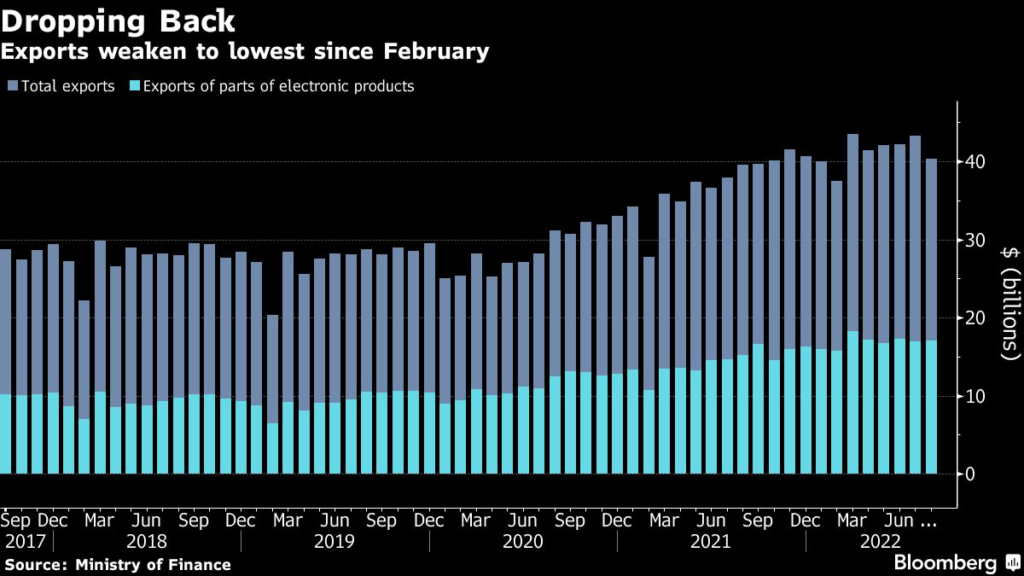
(Bloomberg) — Taiwan’s exports are expected to slow to a crawl through the end of the year, according to Finance Minister Su Jain-rong, as waning global demand piles pressure on the trade-dependent economy. 

Growth in overseas shipments might slump to single-digits in the fourth quarter of 2022, Su said in an interview in Manila on Friday. He cited global headwinds including the US Federal Reserve’s rate hikes and slowdowns in the US and Europe, which are major trading partners for Taiwan.

Taiwan had been enjoying nearly a year and a half of double-digit export growth during the pandemic, with a global computer chip shortage fueling demand for its electronics and semiconductors. Last year the economy grew at the fastest pace since rebounding in 2010 from the global financial crisis.

This year, though, Taiwan has faced several challenges. Global demand for many products has waned as inflation elsewhere skyrockets and several major economies face the prospect of a slowdown or recession. China, another important trading partner, has struggled with ongoing Covid outbreaks and lockdowns, along with a property crisis. 

August export growth slowed to just 2%, the slowest pace in more than two years, prompting Ministry of Finance chief statistician Beatrice Tsai to warn at the time that “winter is coming” earlier than expected. She also cautioned that September exports could even shrink by as much as 3% from a year earlier.

Export orders have also slowed. While orders gained 2% in August, reversing a decline in July, purchases from China and Hong Kong fell more than 25% last month. Almost 40% of Taiwan’s exports went to Hong Kong and China for the first eight months of the year, data from the finance ministry showed.

Su said Taiwan is watching China’s economic progress carefully. Sporadic lockdowns there have dented demand and confidence, becoming a major drag on growth in the world’s second-largest economy.

“We should be careful” if something happens to China’s economy, Su said, adding that Taiwan is trying to mitigate risks stemming from China by diversifying.

Taiwan has been looking to diminish its dependence on China in recent years. Taipei last year asked to join Asia-Pacific’s biggest working trade deal, though its application is still pending. 

More stories like this are available on bloomberg.com

©2022 Bloomberg L.P.

Singapore Regulator Warns Crypto Firms to Curb Their Enthusiasm

(Bloomberg) — A senior Singapore central bank official is repeatedly warning cryptocurrency firms that policymakers will clamp down hard on crypto players who fan speculation in the country.

Sopnendu Mohanty, chief fintech officer at the Monetary Authority of Singapore reminded the traders to be careful about how they lure customers. “Reduce your enthusiasm and be mindful of who you are selling to,” Mohanty said on Friday at an office opening ceremony of Cobo, a digital asset custody provider. “Singapore is not a place to speculate. We will be very, very hard on this behavior.” 

Less than 24 hours earlier, Mohanty had taken on crypto players at the Token2049 conference, calling out the many exhibitor booths set up around the site for what he saw as a lack of attention to the potential dangers of operating in the crypto space.

“Look at what the advertisements say. None of them talk about risk,” he said, singling out a booth near the stage that he felt had an overly bold slogan. “Consumer awareness is a big challenge for us now. We’ve got to repeatedly let the market know this asset class is not suitable for retail investors.”

Mohanty’s comments echo concerns voiced by MAS Managing Director Ravi Menon, who said in a speech last month that the monetary authority “regards cryptocurrencies as unsuitable for use as money and as highly hazardous for retail investors.” They also reiterate remarks Mohanty made in June about how the city-state would be hard on bad actors in the space.

“We got caught up in this narrative of cryptocurrency without getting into the purpose part of the cryptocurrency,” Mohanty said in separate remarks at the Milken Asia conference on Thursday. “If I have a cryptocurrency, what am I going to do with that? Apart from speculation. We’ve got to start thinking from that side. The currency ran ahead of the purpose it’s supposed to serve.”

Singapore Blow-Ups

A series of high-profile crypto collapses and market meltdowns this year have prompted warnings from the MAS and government officials. Some of the biggest casualties of the crypto downturn, such as hedge fund Three Arrows Capital, operated out of Singapore. Vauld, Zipmex and Hodlnaut all sought protection from creditors after being unable to meet their financial obligations.

An early proponent of crypto regulation, Singapore attempted to establish itself as a hub for global digital-asset companies long before similar pronouncements by countries like the UK. But Singapore’s authorities struggled to find a way to incorporate digital assets into its financial system in a way that protected retail investors from crypto’s wild fluctuations and bouts of intense speculation.

Still, over the course of the comments, Mohanty did strike an optimistic tone occasionally. He said Singapore wants to encourage more uses of digital assets in the country, just with no speculation or bad behavior.

“The number of intellectual property filed on blockchain is by far 10 times more than the second best,” which is artificial intelligence or AI, Mohanty said at the Milken conference. “Which means the best and brightest are focusing on this sector. And they’re going to change the future.”

More stories like this are available on bloomberg.com

©2022 Bloomberg L.P.

Micron to Get $320 Million From Japan to Make Advanced Chips

(Bloomberg) — Japan will subsidize US memory maker Micron Technology Inc.’s push to produce its new advanced chips in Hiroshima, as the tech sector braces for a collapse in demand. 

Japan’s Ministry of Economy, Trade and Industry said it would provide as much as 46.5 billion yen ($320 million) to Micron to help it mass produce cutting-edge memory chips at facilities in Hiroshima in western Japan. Micron had said its investments would hinge in part on the amount of the local government’s support. 

The Boise, Idaho-based chipmaker said it will begin producing the new chips — which will have double the memory capacity of its existing chips — in the spring of next year.

“We believe this will further strengthen the US-Japan partnership in semiconductors,” said METI chief Yasutoshi Nishimura at a regularly scheduled press briefing, where he announced the plan on Friday.

The news comes shortly after a visit by US Vice President Kamala Harris to Tokyo, where she said that Japan plays a “critical role” in building resilient supply chains for chips. The US is rallying allies in Asia to build redundancies and help it slow the technological ascent of China.

Harris Says Japan Plays ‘Critical Role’ in Chips Supply Chain

Japan relinquished the lead in semiconductor production decades ago, but it remains home to some of the world’s biggest makers of chip tools and chip materials such as silicon wafers and photomasks. 

Micron acquired the Japanese facilities in 2013 when it bought Elpida Memory, which went under after creditors refused to bankroll attempts by the then-No. 3 maker of DRAM to keep investing in an economic downturn. The US chipmaker is now one of the top three memory producers in the world, alongside South Korea’s Samsung Electronics Co. and SK Hynix Inc. 

Chipmakers including Micron are cutting back on machinery spending or reducing output as they seek a better balance of supply and demand for a plunge in demand. Japan’s Kioxia Holdings Corp. said it will cut output of new memory chips by 30% beginning next month, while Samsung and SK Hynix have also signaled a reduction in output in recent weeks.

Kioxia to Cut Output of New Memory Chips by 30% From October

Micron Braces for Massive Plunge in Demand by Slowing Production

(Updates with details about advanced chip production in third paragraph)

More stories like this are available on bloomberg.com

©2022 Bloomberg L.P.

Shinsei Shares Surge as Broker SBI Takes Step to Boost Stake

(Bloomberg) — Shares in Shinsei Bank Ltd. jumped after Japan’s largest online brokerage SBI Holdings Inc. took a key step towards raising its stake further.

A unit of SBI, which holds 48.6%, filed to obtain an approval from Japan’s financial regulator to operate as a bank holding company, according to a spokesperson for the firm. If granted, it would allow SBI to raise its stake in Shinsei Bank to more than 50%. 

Shinsei Bank shares gained as much as 12% Friday before ending the session 7% higher. Nikkei first reported the application earlier. 

A takeover fight erupted for Shinsei about a year ago when SBI launched a rare unsolicited tender offer to increase its stake to a level that would give it effective control of the lender without having to go through additional regulatory hurdles. 

In December, SBI had said it planned to acquire a majority stake in Shinsei Bank provided the tender offer for the lender concluded successfully and it can obtain regulatory approval for a bank holding company. 

SBI’s Chief Executive Officer Yoshitaka Kitao previously said the brokerage, in conjunction with the government, has the option to delist Shinsei Bank in order to pay back funds the lender owes to taxpayers. 

More stories like this are available on bloomberg.com

©2022 Bloomberg L.P.

How to Make a Butter Board: Top Chefs Break Down the TikTok Sensation

(Bloomberg) — The latest TikTok food obsession, the butter board, continues to intrigue dairy fans.

The buzz around the new party staple snack — softened butter that’s mixed with and/or topped by flavorings from salt and citrus to honey and bacon, then lavishly spread on a serving board and served with bread — was sparked Sept. 12 when cook Justine Doiron posted to her audience of 2 million on TikTok. Within a week, #butterboard had scored more than 30 million views; it now has over 115 million. 

The board was created as a simple, and less pricey, alternative to cheese and charcuterie boards, and features a potentially limitless assortment of add-ins, displayed in the most dramatic way for social media consumption.

In 2021, the attention lavished on feta cheese pasta — last year’s most searched dish on Google — increased global feta sales worldwide. At the southeastern supermarket chain Fresh Market, sales rose 45%.

It’s unclear whether the attention will be enough to move the needle on something as ubiquitous as butter. But butter boards are already more expensive to make than they would have been a year ago. The price of butter in the US is at an all-time high: 1 pound costs $4.70 on average after higher production costs and the summer’s extreme heat weighed on domestic milk supplies.

Some restaurants already have versions on the menu. One of America’s best pizza restaurants Razza, in Jersey City, New Jersey, offers a butter tasting that includes one made with sweet Hudson Valley cream, and a contrasting “bleu butter” injected with penicillium roquefort (the mold that causes blue veins to appear in cheese).

Chef-owner Dan Richer, who has been making butter boards since 2012, says the one Razza offers “is very simple and straightforward, there are no condiments like honey or figs or herbs as seen in the newly popular TikTok videos.” He does, however, make one topping exception: caviar. “Because, why not?” he said.

So who better to turn to for inspiration for butter than chefs? Doiron credits chef Oregon-based chef Joshua McFadden with inspiring her butter board.

Bloomberg Pursuits caught up with a few other top chefs to get their takes. From pesto to cornflakes, here are their best tips.

Eight Ways to Make a Butter Board

Go Italian

From Don Angie, Manhattan

“We think it might be fun to do an Italian-inspired version of a butter board using whipped lardo instead of butter,” says co-owner and chef Angie Rito. She recommends pesto modenese from Emilia-Romagna, made with the whipped cured pork fat, seasoned with garlic and rosemary. “It would be a delicious, next-level substitute for the butter, and could be served topped with grated parmigiano and flaky sea salt, along with everything from marinated vegetables and herbs, to things like anchovies, olives, or nuts,” she said.

Bacon, of Course

From Kudu Collective, London

At Kudu, the South African brioche-style bread mosbolletjies is served with melted smoked bacon butter or melted seafood butter. “Those two butters would look amazing slathered on a board and garnished with chopped bacon on one side, and fried brown shrimps on the other,” says chef-owner Patrick Williams. As an alternative, he suggests a simple butter board sprinkled with the tangy spice sumac to serve with raisin bread.

Cornflake Combo

From Retan, London 

Josh Dalloway, chef and co-founder of the supper club Retan, likes the idea of a butter-board style of presenting the fat at different stages, from just made to cultured to aged cultured, so it’s fully fermented. He also considers wrapping the aged butter in fig leaves to infuse it with flavor. But he has a faster, more unconventional ideas as well: “Cornflakes on a salted butter is a great combo,” Dalloway says. Here’s why: “The cornflakes add texture, whilst also feeding into the trickery of salty/sweet, similar to mixing salty and sweet popcorn at the cinema.”

Make It Seasonal

From Hotel Lilien, Tannersville, New York 

The new Catskills boutique hotel has jumped on the trend, offering a butter board as a limited-time, $11 special. Chef Jeff Grover says the most important thing is to start with unsalted butter, “so that you can control the salt with toppings and flaky Maldon.” He makes his butter board seasonal: His autumnal hot honey version features dried figs and pumpkin seeds. 

Mix It Up

From the NoMad, London

At the restaurants at the Covent Garden hotel, chef Ashley Abodeely uses a variety of butters, from regular to cultured cow to goat. For a butter board she recommends whipping them with another fat “to lighten the texture and ensure they are spreadable. “The cultured butter we ship with yogurt, for acidity, the goats butter with creme fraiche for body and the regular butter with mascarpone, for volume,” she says. She adds pesto for flavor and bright green color and suggests garnishing with radishes or house pickles, or even just a drizzle of olive oil. 

Think Like a Chef

From The Water House Project, London

Chef Gabriel Waterhouse things big picture flavor groups when he seasons butter at his restaurant. Currently, he’s offering both cep, or porcini, and coffee and juniper options. For home butter boards for entertaining, “I’d organize from earthy (like mushrooms, coffee, marmite, whiskey, etc) to grassy (watercress, parsley), to floral and aromatic (basil, tarragon) to sweet-spicy (preserved lemon, elderberry, port and honey).” 

DIY, with Marmite

From Pied a Terre, London

Executive chef Asimakis Chaniotis believes that the best board starts with homemade butter. His recipe: whip high quality double, or heavy, cream with an electric whisk or mixer, until the butter fat and butter milk split, then squeeze the butter fat in cheese cloth to remove the moisture. You can simply flavor the fresh butter with Maldon salt, it’s that good. Or, try a few flavors. “I love a mix—marmite, tarragon purée and smoked paprika. These different colored butters would look great on a board.” 

Consider the Board

From Valerie, Manhattan

Toppings might be all important, but chef Dan Fleming also thinks about the optimal board for service. “I like to use wooden platters that have a light lamination. This allows for a smooth smear for the vessel of your choosing,” he says. He also wants people to consider the accompaniments. He recommends an assortment of bread, from cranberry walnut to sourdough and lavash crackers. And he says, serve at least one cheese on the side. Because sometimes a butter board just isn’t enough. 

More stories like this are available on bloomberg.com

©2022 Bloomberg L.P.

Cineworld Lowers Admission Forecasts: The London Rush

(Bloomberg) — Here’s the key business news from London-listed companies this morning.

Barclays Plc: The British lender agreed to pay $361 million to resolve Securities and Exchange Commission charges that it broke US rules by not registering securities sales with the regulator.

  • The SEC said that Barclays and its unit offered and sold “an unprecedented amount of securities” due to failures in its internal controls that were supposed to track transactions in real time

Cineworld Plc: The struggling cinema operator, has lowered its short and medium-term cinema admission forecasts, blaming a slower-than-expected recovery.

  • Cineworld now sees admissions in 2023/2024 below pre-covid levels but says it will keep operating its outlets as it undergoes restructuring

Independent Living REIT: The real estate investor won’t proceed with its IPO citing current market conditions. It had originally planned to raise target gross issue proceeds of £150 million.

Milton Capital: The Special Purpose Acquisition Company plans to list on the London Stock Exchange. 

  • The SPAC intends to search for targets in the tech sector with a focus on “megatrends” including space, artificial intelligence, machine learning and blockchain technology

Outside The City

The UK economy grew in the second quarter, averting a summer recession despite the cost of living crisis. The 0.2% growth was a surprise improvement on the previous estimate of a fall of 0.1%, the Office for National Statistics said Friday.

Prime Minister Liz Truss and Chancellor of the Exchequer Kwasi Kwarteng will hold emergency talks today with the head of the OBR, The Guardian reported, before being presented with a first draft of full fiscal forecasts next week.

In Case You Missed It 

The historic program of tax cuts unleashed by Kwarteng will overwhelmingly put money in the pockets of the wealthiest White British people, according to new analysis. 

Among the slew of tax policies announced last week, Kwarteng’s decision to abolish the top 45% tax rate benefits the top 1% of earners in the country, on incomes of £150,000 ($160,000) or over. More than 90% of that group is White — while other ethnic minorities are under-represented, an analysis of publicly available data by a researcher at the University of Leeds finds.

Looking Ahead

UK manufacturing PMI data is due to be reported on Monday.

For a news fix when the day is done, sign up to The Readout with Allegra Stratton, to make sense of the day’s events.

More stories like this are available on bloomberg.com

©2022 Bloomberg L.P.

Sea’s Shopee Faces Boycott Calls in Philippines Over Brand Ambassador

(Bloomberg) — Sea Ltd.’s e-commerce business Shopee faced boycott calls from Philippine consumers after naming a staunch supporter of the country’s president, Ferdinand Marcos Jr., as its brand ambassador.

Shopee announced Thursday that Filipina actress and singer Toni Gonzaga, who hosted campaign rallies for Marcos, was its new brand ambassador. That led to calls on social media to stop using the shopping app.

The hash-tags #ByeShopee and #BoycottShopee became top trends on Twitter in the Philippines, with about 340,000 tweets about the company as of Friday morning, with some users defending the firm. The second-most popular topic involved posts calling on shoppers to switch to Lazada, a rival e-commerce platform owned by Alibaba Group Holding Ltd.

A spokesperson for Shopee was not immediately able to comment on the issue. A Philippine Daily Inquirer report quoted a Shopee representative as saying that Gonzaga was chosen for her “mass appeal,” not for her political leanings. Gonzaga said in a Philippine Star report that she’s “grateful” for the mentions and engagements.

The backlash presents a new headache for Singapore-based Sea, already beset by ballooning losses which have forced it to lay off employees and retreat from the Latin America market. Its shares traded in New York are down 76% this year.

Shopee ranked first by average monthly active users in the shopping category in Southeast Asia, Sea said in its quarterly earnings report, citing analysis from data.ai.

Marcos Jr. won 59% of votes during the May elections, but he’s opposed by a minority concerned by alleged corruption and human rights abuses during the dictatorship of his father.

More stories like this are available on bloomberg.com

©2022 Bloomberg L.P.

Stocks Slide Deepens in Volatile Race to Month-End: Markets Wrap

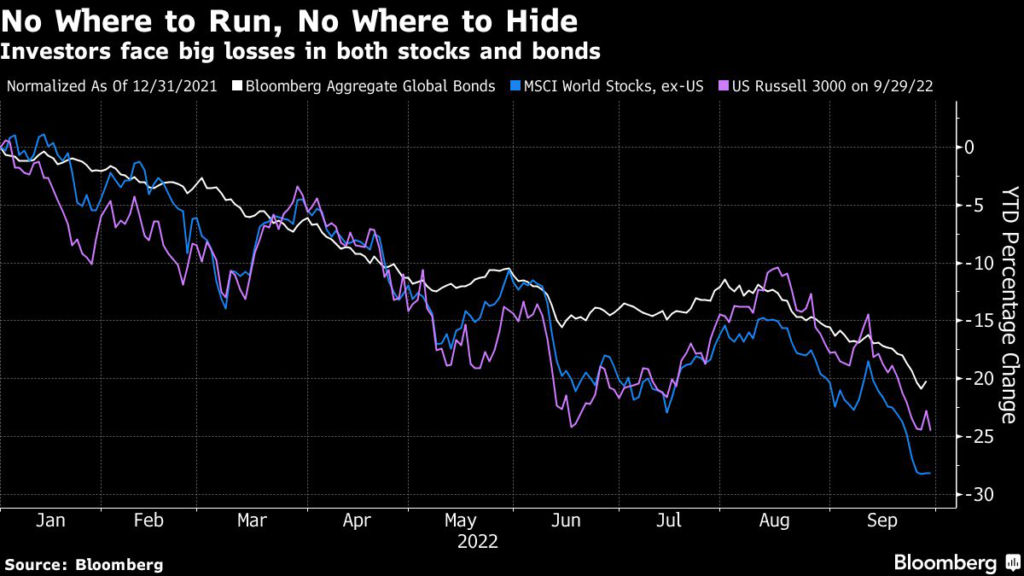
(Bloomberg) — Stocks dropped in Asia after another plunge on Wall Street as the prospect of higher interest rates and turmoil in Europe stoked fears of global recession. 

An index of the region’s equities headed for its seventh straight weekly loss and a monthly slump that would be the biggest since 2008. US futures fluctuated after the S&P 500 slid more than 2% to the lowest in almost two years. 

The dollar swung between gains and losses versus major currencies including the pound as investors weighed risks emanating from the debt crisis gripping the UK. Treasury yields were little changed after days of being whipsawed.

The Cboe Volatility Index has been well over 30 for almost all of this week, reflecting heightened worry among equity investors. Another group of Federal Reserve officials struck a hawkish tone, German inflation topped 10% and the UK government’s tax plan continued to weigh on market sentiment.

The Bank of Japan boosted its planned bond purchases at a regular operation on Friday as it sought to cap upward pressure on yields, while Prime Minister Fumio Kishida instructed his government to come up with an economic stimulus package by the end of October. 

The offshore yuan weakened and was at risk of further depreciation next week, when China goes on a one-week holiday, leaving Beijing unable to guide investor expectations with its daily reference rate.

“Our assumption is that the Chinese government will continue to fight this administratively as long as they can before they have to step in with direct intervention and have to start selling down US reserves,” Charlene Chu, senior analyst for Autonomous Research, said on Bloomberg Television.

Amid the economic pressure, China’s central government shifted to allow some cities to lower their mortgage rates for first home purchases in its latest bid to help the country’s struggling housing market.

The tech-heavy Nasdaq 100 dropped almost 4% during the session after St. Louis Fed President James Bullard said investors have now understood that they can’t escape additional rate hikes in coming months. The index was dragged down by Apple Inc., which fell after a rare analyst downgrade from Bank of America warning of weaker consumer demand for its popular devices.

How much damage is a strong dollar causing? That’s the theme of this week’s MLIV Pulse survey. It’s brief and we don’t collect your name or any contact information. Please click here to share your views.

Key events this week:

  • Euro zone CPI, unemployment, Friday
  • US consumer income , University of Michigan consumer sentiment, Friday
  • Fed’s Lael Brainard and John Williams speak, Friday

Some of the main moves in markets:

Stocks

  • S&P 500 futures added 0.1% as of 7:16 a.m. London time. The S&P 500 fell 2.1%
  • Nasdaq 100 futures gained 0.1%. The Nasdaq 100 fell 2.9%
  • Japan’s Topix index fell 1.8%
  • South Korea’s Kospi index slipped 0.8%
  • Hong Kong’s Hang Seng Index was up 0.1%
  • China’s Shanghai Composite Index fell 0.3%
  • Australia’s S&P/ASX 200 Index dropped 1.2%
  • Euro Stoxx 50 futures surged 0.2%

Currencies

  • The Bloomberg Dollar Spot Index fell 0.2%
  • The euro was up was little changed at $0.9818
  • The Japanese yen was steady at 144.49 per dollar
  • The offshore yuan was at 7.0882 per dollar

Cryptocurrencies

  • Bitcoin fell 0.3% to $19,448.03
  • Ether fell 0.5% to $1,331.46

Bonds

  • The yield on 10-year Treasuries slipped two basis points to 3.77%
  • Australia’s 10-year bond yield was steady at 3.94%

Commodities

  • West Texas Intermediate crude decreased 0.1% to $81.13 a barrel
  • Spot gold climbed 0.3% to $1,665.50 an ounce

More stories like this are available on bloomberg.com

©2022 Bloomberg L.P.

A Bad Year for Polish Stocks Investors Is Only Getting Worse

(Bloomberg) — A bad year for Polish stock investors got even worse in the third quarter as economic prospects for the country affected by the war in neighboring Ukraine deteriorated further.

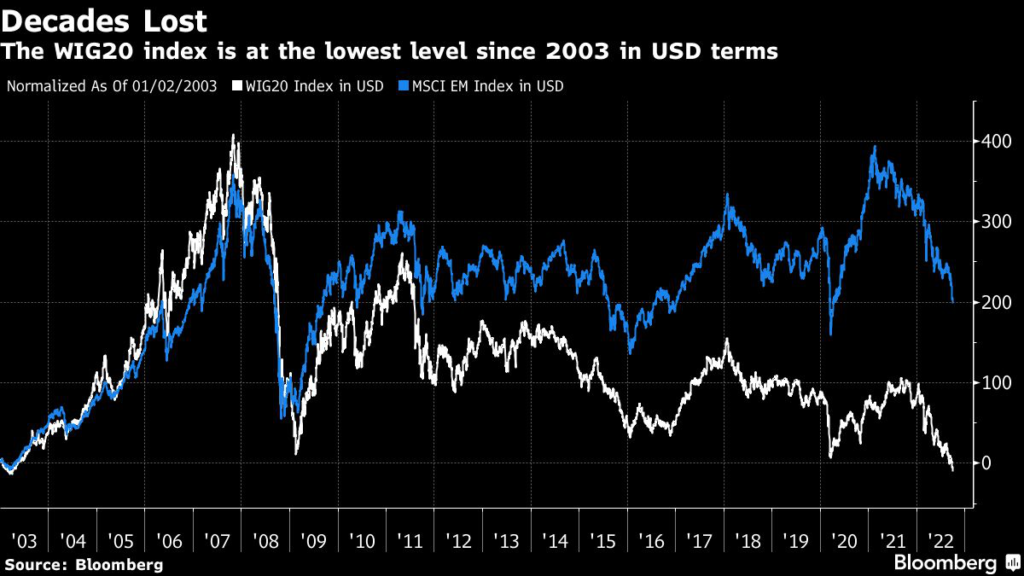
Warsaw’s WIG20 index lost 19% since the end of June, taking its year-to-date drop to 39%, the worst showing among 92 global equity gauges tracked by Bloomberg. The index slumped to the lowest level since the Covid pandemic in 2020, while in US dollar terms it’s trading at a 19-year low.

Sentiment turned against Warsaw-listed stocks after Russia’s invasion of Ukraine, which put the country on the frontier of a global conflict, and as the ensuing economic and energy crisis darkened growth prospects across the continent. Furthermore, the Polish government’s activism including mortgage payment holidays and plans for a windfall tax have spooked investors by massively jeopardizing company profits.

Even the country’s coal-linked stocks, which benefited from spiking energy prices and scarcity of the fossil fuel earlier in the year, slumped during the third quarter amid uncertainty over which companies will face taxes on their additional profit. 

Coking coal maker JSW SA lost 49% this quarter, followed by a 42% drop by leading coal-based power producer PGE SA. Lenders also continued their retreat with the WIG-Bank index declining 16% as mortgage moratoriums bite, along with legal risks from legacy Swiss-franc loans. 

“Even as valuations of Polish companies are already low, we lack any impulse that could reverse negative trends,” said Grzegorz Zawada, head of PKO Bank Polski SA’s brokerage unit. “It’s hard to expect sudden inflows from abroad, as foreign investors are still concerned about geopolitical risks and impact from inflation on Polish economy.”

Computer game producer CD Projekt SA is the only WIG20 stock to advance in the third quarter on hopes that a Netflix Inc. series may revive interest in its Cyberpunk 2077 franchise. Improved sentiment toward the industry leader has also helped other gaming stocks rise, including Huuuge Inc. and CI Games SA. 

(Updates with PKO brokerage comment in penultimate paragraph.)

More stories like this are available on bloomberg.com

©2022 Bloomberg L.P.

Peter Thiel’s Palantir Had Secret Plan to Crack UK’s NHS: ‘Buying Our Way In’

(Bloomberg) — Palantir Technologies had a secret plan to deepen its relationship with the UK’s National Health Service without public scrutiny.

The US data-analytics company aimed to buy up smaller rivals that already had an existing relationship with the NHS, according to emails and strategy documents seen by Bloomberg. This approach would hopefully allow Palantir to avoid further scrutiny in working with one of the largest depositories of health data. 

Palantir’s regional head Louis Mosley described the strategy in an email entitled “Buying our way in…!” sent in Sept. 2021, which outlined “hoovering up” small businesses serving the NHS to “take a lot of ground and take down a lot of political resistance.” 

The NHS, one of the world’s largest employers with a recent annual budget close to £190 billion ($208 billion), has become a key client for Palantir. It hired the US tech firm to help with its Covid-19 response, and currently has a £360 million contract coming up for tender — a deal Palantir is hoping to win. 

While Palantir has so far been unsuccessful in buying up NHS suppliers, the documents seen by Bloomberg show how Palantir hopes to deepen its business with a key client, both by making key hires from the NHS and via potential acquisitions. 

Palantir has consistently faced criticism in countries including the US and UK from civil liberties groups, who have been concerned by its track record for providing tools to government agencies that help enable broad surveillance of populations, for example by US Customs and Enforcement to find undocumented migrants for deportation. Lawmakers in the UK have also voiced concern over Palantir’s technology.

“Palantir exists to help the most important institutions solve their biggest challenges — and there are none more important in the UK than the NHS,” Palantir spokesman Ben Mascall said in a statement. “Palantir has already enabled the NHS to improve millions of people’s lives. We want to do more of this and we make no apology for that.”

The spokesman added that some of the language from Mosley’s email was “regrettable” and “not an accurate characterization of our relationship with the NHS.”

Palantir’s spokesman said that the firm works with some of the most respected intelligence and defense agencies in the world, and these institutions continue to trust its software’s capability to protect sensitive data. They said the company was winning NHS business on merit and that its software was world-class and the result of several billion pounds of investment. Its website states that the company “was founded on the conviction that it’s essential to preserve fundamental principles of privacy and civil liberties while using data.”

NHS England spokesman James Kell said the upcoming contract would be awarded through an “open and transparent process” with strict requirements including “ensuring data remains secure and within the NHS.” Eighty-six suppliers attended pre-market engagement events, he said. 

‘Start Scoping’

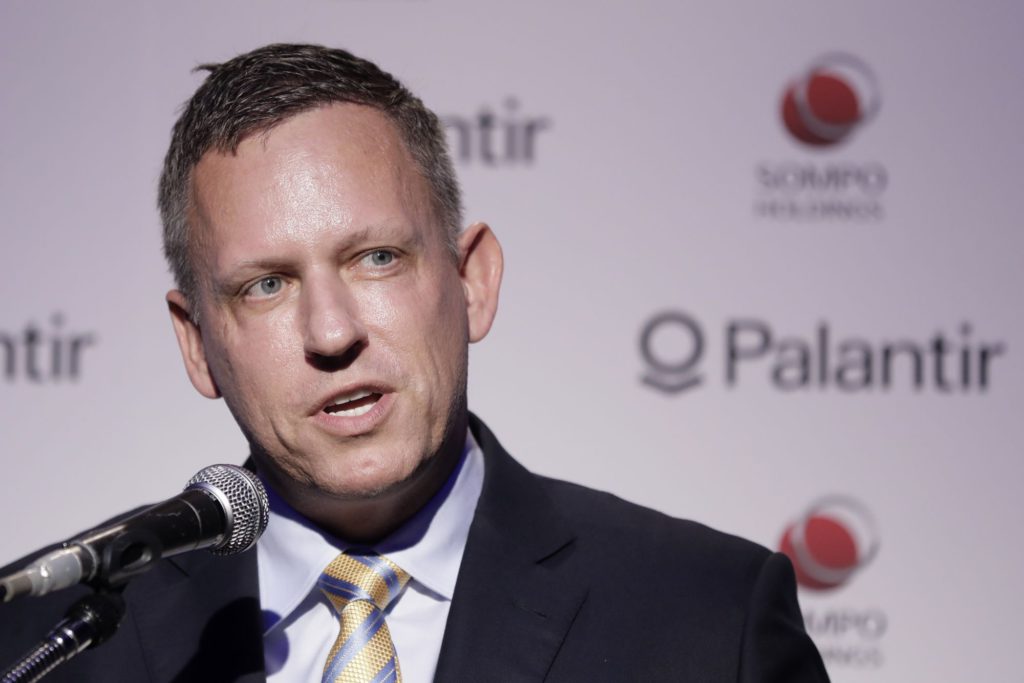
Co-founded in 2003 by Facebook Inc. board member Peter Thiel, Palantir quickly won the attention and financial backing of In-Q-Tel, the venture investing arm of the U.S. Central Intelligence Agency. The startup counted the CIA among its first customers, and cultivated an early reputation for secrecy.

Named for the all-seeing stones used in J.R.R. Tolkien’s fictional The Lord of the Rings trilogy, Palantir now counts dozens of US government agencies as customers, with a a significant number in the national security and defense space. Palantir leadership has forsworn doing business in China and other regions not aligned with US interests, elevating the importance of UK deals. However, despite predicting $1.9 billion in revenue for 2022, the firm has struggled to turn a profit. It’s share price is down about 56% so far this year.  

According to Mosley’s email to colleagues, suitable UK takeover targets were those with credible leadership, annual revenue of between £5 million and £50 million, and already selling software services to the NHS. Founders would be offered a “v. generous buyout schedule (say 10x, especially if all stock),” he wrote. 

Palantir would offer compensation to founders for their equity stake if they shifted all of their services into Palantir’s main data handling platform, Foundry, which was designed to organize data from disparate sources. 

“I doubt anybody else is likely to come along and offer them something as generous as we would (we might even be their only real exit option),” Mosley wrote.

Early in the Covid-19 pandemic, Foundry was used by the NHS to track the take-up of vaccines and, more recently, to manage the backlog of patients waiting for elective surgeries. Since 2020, Palantir secured more than £37 million in contracts with the NHS and the Department of Health and Social Care, according to public spending tracker AdviceCloud.

One of the companies Palantir sought to acquire, shortly before Mosley emailed his plan, was Beautiful Information, an NHS-private partnership that generates real-time information for hospitals to use for balancing resources with patient demand. Palantir lost out to Canadian health-tech firm VitalHub Corp, which announced it bought Beautiful Information for £1.55 million in January.

“I’m keen to start scoping more acquisition targets like [Beautiful Information],” Mosley wrote, adding that he had “a kitty,” a British term for a pot of money. 

Late in 2021, Palantir was also in advanced talks to invest more than £21 million into British data-analytics firm Sensyne, in a deal codenamed “Project Gondor” — a reference to a fictional kingdom depicted in The Lord of the Rings — in return for Sensyne using Palantir’s Foundry, according to an internal document seen by Bloomberg. 

“There is nothing unusual about a company exploring investments or acquisitions,” Palantir’s spokesman said. He said the company had been approached with “two such opportunities” in 2021. “We declined to proceed with either and have not acquired any companies that work with the NHS,” he said.

Sensyne and Beautiful Information did not respond to requests for comment. 

Palantir was also part of a group of several investors that contributed $230 million to support Babylon Holdings Ltd. going public in 2021, as part of a longer-term partnership between the two companies that saw Babylon migrate some of its data to Palantir’s Foundry platform, Bloomberg reported.

Lobby Efforts

Deals and takeovers were only part of Palantir’s approach, however, the messages seen by Bloomberg show. At the same time as the Babylon partnership, Palantir urged industry lobby group TechUK to encourage government agencies to buy commercial off-the-shelf products, such as Foundry, instead of building their own bespoke tools. 

A spokeswoman from TechUK declined to comment.

Palantir hired Global Counsel — the strategic advisory firm co-founded by Peter Mandelson, a British Lord and former leading adviser to ex-Prime Minister Tony Blair — to help lobby UK government. It also recently hired Indra Joshi and Harjeet Dhaliwal, key figures from the NHS.

“Global Counsel’s work for Palantir is a matter of public record,” a spokesperson said in an emailed statement. “The relevant declarations to statutory registers and the NHS in relation to this work have been made.”

Critics have challenged the NHS’s lack of transparency over hastily executed deals during the pandemic. Palantir was paid a nominal £1 fee in March 2020 to run a Covid-19 data store to help the NHS allocate resources more efficiently, but has used the work as a case study in pitches for other NHS contracts, according to two senior NHS officials who were not authorized to speak to the media.

Ahead of that deal, Palantir spent months wooing NHS chiefs, the Bureau of Investigative Journalism reported in February 2021. In December 2020, Palantir was granted a new contract to continue the data-store work in a £23.5 million deal that was not subject to a public tender process.

Palantir declined to comment, but NHS England said in a statement at the time that it had “always acted in accordance with its legal responsibilities.”

Despite hiring Global Counsel, Palantir received criticism from lawmakers over their deepening relationship with the NHS. 

“Patient trust is vital to our NHS, so foreign tech companies such as Palantir, with their history of supporting mass surveillance, assisting in drone strikes, immigration raids and predictive policing, must not be placed at the heart of our NHS,” British lawmaker David Davis, a member of the Conservative Party and former Secretary of State for Exiting the European Union, said during a House of Commons debate in June 2021. 

Independent media company OpenDemocracy sued the UK government with the support of legal nonprofit Foxglove for awarding business to Palantir without a public tender process. The government agreed not to extend the contract beyond Covid without a public consultation. The push-back continued in Sept. 2021, when the Department of Health and Social Care ended another data deal with Palantir, Bloomberg reported.

Cori Crider, founding director of Foxglove, said there are “real concerns” about whether Palantir offers the NHS value for money, “or whether there is just a ‘shiny dashboard’ thinking infecting some officials.”

It’s not known when the NHS will make a decision for its upcoming £360 million tender. Other potential bidders include major consulting firms as well as large US tech companies.

“Foundry as a piece of software is entirely competent,” said Phil Booth, coordinator of British data-privacy campaign organization medConfidential, adding that he did not have concerns about unauthorized people accessing patient data as that would be “suicidal” for Foundry. 

However, he said that Palantir’s history as a “Peter Thiel-backed, CIA-initiated company” could deter patients from sharing their data. “We should get rid of Palantir and build our own open-source software,” he said. 

More stories like this are available on bloomberg.com

©2022 Bloomberg L.P.

Close Bitnami banner
Bitnami