Bloomberg

Trevor Noah Says He’s Leaving ‘The Daily Show’ After Seven Years

(Bloomberg) — Trevor Noah, the South African host of Comedy Central’s The Daily Show, said he will leave the job after seven years.

Noah made the announcement in a recorded segment posted on Twitter on Thursday night US time. He took over the role from comedian Jon Stewart, who transformed the cable channel’s program into a cultural powerhouse as host from 1995 to 2015.

“I want to thank the audience for an amazing seven years, it’s been wild, it’s been truly wild,” he said, listing “the Trump presidency, the pandemic, just the journey — more pandemic.”

“I’ve loved hosting the show, it’s been one of my greatest challenges, it’s been one of my greatest joys,” Noah said. “But after seven years, I feel like it’s time.”

Noah didn’t say when his last episode would be, only that the timing of his departure would be announced later. He cited a desire to perform standup on tour as a reason he was moving on. 

“It’s not instant, I’m not disappearing,” he said. “Don’t worry. If I owe you money, I’ll still pay you.”

More stories like this are available on bloomberg.com

©2022 Bloomberg L.P.

JPMorgan, Morgan Stanley Cut Alibaba Target on Revenue Concerns

(Bloomberg) — JPMorgan Chase & Co. and Morgan Stanley analysts cut their price target for Alibaba Group Holding Ltd., turning more pessimistic on the Chinese e-commerce giant on sales concerns.

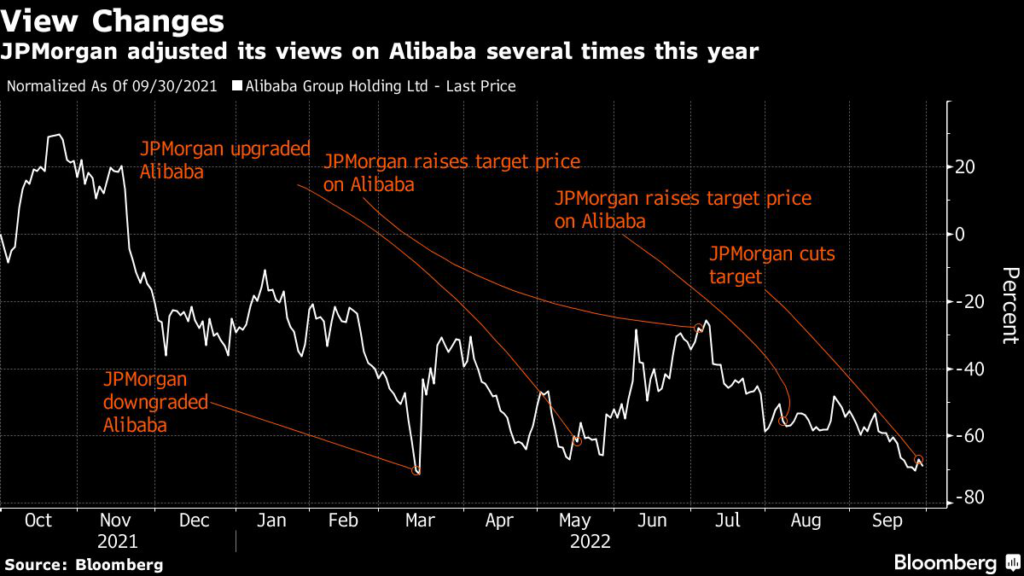
Alibaba’s sales outlook for the September quarter is eroding on soft China consumption, analysts including Alex Yao wrote in a note this week. JPMorgan lowered its target price for Alibaba’s US-listed shares to $135 from $145, marking the bank’s latest call on China’s technology stocks after switching its views several times this year.

“Alibaba’s weakening revenue outlook in the near term could continue to weigh on the share price despite an unchanged, or even potentially better, profit outlook,” the bank wrote in a research report. “We believe sentiment-driven fund flow is the current key share price driver and revenue recovery is the key determinant of market sentiment.”

Meanwhile, Morgan Stanley also trimmed Alibaba’s share price this week to $110 from $140, citing weak consumption and soft merchant sentiment.

In mid-March, the JP Morgan shocked the industry and triggered broad selloffs after calling the sector “uninvestable” in a report that more than halved Alibaba’s price target. JPMorgan editorial staff in charge of vetting the bank’s research asked for that word to be removed before publication, Bloomberg reported. Since then, the bank has been lifting the company’s price target, and upgraded the sector in May on an improved regulatory environment. 

An investor following Yao’s recommendations on US-listed Alibaba would have lost 67% over the past year, the worst performance among the analysts following the stock, according to Bloomberg-compiled data.

In the latest report, Yao and his team said macro headwinds in China may limit improvement in Alibaba’s core sales, given low visibility of a recovery in consumer sentiment and Covid policy relaxation. Customer management revenue, which accounts for a big chunk of its overall sales, may drop 4% on year in the third quarter following a 5% second-quarter fall, they added.


More stories like this are available on bloomberg.com

©2022 Bloomberg L.P.

Cash Is King for Pension Funds After UK Funding Market Shocks

(Bloomberg) — A dash for cash among sterling investors after market turmoil sparked by pension fund margin calls is coming at a bad time, according to an M&G Investments executive.

Nina Moylett, the firm’s head of cash and currency, sees her markets as divided between pension funds desperate for cash and others who have built up sufficient buffers. That’s become a crunch issue in UK funding markets and beyond this week after forced selling for collateral led the Bank of England to intervene to stem a rout in bond markets.

“The timing could not be worse with quarter end looming, increasing demand for bank balance sheet from non-bank market participants and an ever increasing war chest of cash from the liquidity ‘Haves’ chasing collateral,” Moylett wrote in a blog post on the firm’s website. “The urgent question — with an unclear answer at the moment in my view — is whether this could spill over into a broader liquidity breakdown.”

The BOE intervened as it was concerned collateral requirements on liability-driven investment strategies would have turned many pension funds into forced sellers of gilts. It warned that continued dysfunction could threaten financial stability and even damage the economy.

The Pension Problem That Threatened to Wreck the Gilt Market

So-called liability-driven investment strategies are popular among UK pension programs. They often employ derivatives with the aim of matching liabilities going out decades to the fund’s assets. The problem is the spike in gilt yields meant the counterparties to these deals are demanding more margin, meaning many funds need to raise cash by liquidating assets.

Pension funds are a significant provider of gilts to the repo market, where there is now some strain as bonds are either withdrawn from repo programs or lent out to raise cash to fund collateral calls, said Moylett, who also chairs the BOE’s Securities Lending Committee.

She stressed there are market participants that have ample liquidity in the form of cash right now. She has observed even more shoring up of cash buffers by these players over the past few days via shortening cash lending tenors, not extending term funding transactions and restricting liquid assets such as gilts from lending programs. 

The risk, she says, is that the “have nots” look to restore their cash piles while the “haves” continue to shore up their ample liquidity.

“One thing that goes without saying is that cash really is king at the moment.”

More stories like this are available on bloomberg.com

©2022 Bloomberg L.P.

Crypto Notable Quarterly Performer With Bitcoin on Pace to Gain

(Bloomberg) — Bitcoin is poised for a bit of a victory this quarter, even if the scale may not seem much for an asset class where outsized gains were until recently the order of the day. 

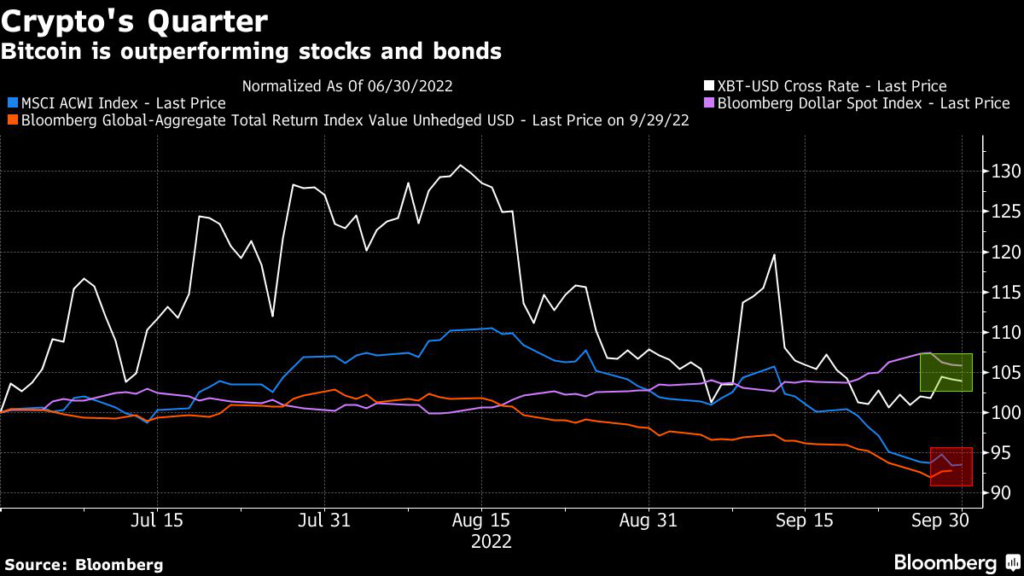
The biggest cryptocurrency is up 3.4%, recently trading about $19,364, compared to declines of about 7% for MSCI’s all-country stock index and Bloomberg’s total-return global bond index. It’s a further sign crypto prices may have stabilized following dramatic declines at the start of the year. By contrast, stocks are currently around 2022 lows. 

“It appears Wall Street believes crypto is close to the bottom and will become an attractive diversification strategy once the peak in Treasury yields is in place,” said Edward Moya, senior market analyst at Oanda Corp. “Despite all the doom and gloom on Wall Street, calls for another crypto crash have been somewhat quiet.” 

The gain might not be much, but it stands out in a sea of red. Asset classes across the board have been hit by a combination of rapid Federal Reserve interest rate hikes, stubbornly high inflation and heightened geopolitical tensions. The only major exception is the US dollar, with the Bloomberg Dollar Spot Index up about 6% since June 30.

Furthermore, Ethereum’s much-watched upgrade went smoothly, helping remove uncertainty, put a floor under prices and attract interest from institutional traders, said Darius Sit, co-founder of Singapore-based crypto investment fund QCP Capital. 

“The Ethereum merge was a strong Q3 2022 narrative,” Sit said. “Although we saw a post-merge dip in prices, the success of this watershed event bodes well for the space.”

Bitcoin is now also heading toward a historically more favorable time of the year. In the fourth quarter, it’s recorded gains two-thirds of the time with a median advance of 33%, pricing data back to 2010 shows. 

“While prices are depressed, the crypto ecosystem is actually thriving,” said Cici Lu, chief executive officer of Venn Link Partners Pte. “Developers are focusing on building the technologies.”

More stories like this are available on bloomberg.com

©2022 Bloomberg L.P.

Asian Equities Slide as Global Selloff Deepens: Markets Wrap

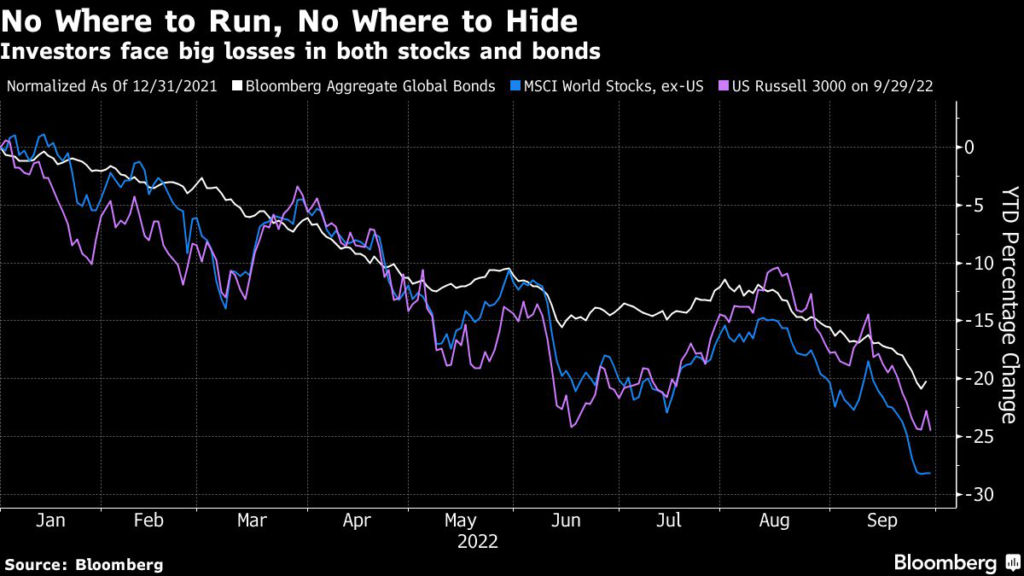
(Bloomberg) — Asian stocks dropped in the wake of another plunge on Wall Street as the prospect of higher interest rates and turmoil in Europe stoked fears of global recession. 

An index of the region’s equities headed for its seventh straight weekly loss, the longest losing streak since 2015. US futures fluctuated after the S&P 500 slid more than 2% to the lowest in almost two years. 

The dollar swung between gains and losses versus major currencies including the pound as investors weighed risks emanating from the debt crisis gripping the UK. Treasury yields were little changed after days of being whipsawed.

The Cboe Volatility Index has been well over 30 for almost all of this week, reflecting heightened worry among equity investors. Another group of Federal Reserve officials struck a hawkish tone, German inflation topped 10% and the UK government’s tax plan continued to weigh on market sentiment.

The Bank of Japan boosted its planned bond purchases at a regular operation on Friday as it sought to cap upward pressure on yields, while Prime Minister Fumio Kishida instructed his government to come up with an economic stimulus package by the end of October. 

The offshore yuan weakened and was at risk of further depreciation next week, when China goes on a one-week holiday, leaving Beijing unable to guide investor expectations with its daily reference rate.

“Our assumption is that the Chinese government will continue to fight this administratively as long as they can before they have to step in with direct intervention and have to start selling down US reserves,” Charlene Chu, senior analyst for Autonomous Research, said on Bloomberg Television.

Amid the economic pressure, China’s central government shifted to allow some cities to lower their mortgage rates for first home purchases in its latest bid to help the country’s struggling housing market.

The tech-heavy Nasdaq 100 dropped nearly 4% during the session after St. Louis Fed President James Bullard said investors have now understood that they can’t escape additional rate hikes in coming months. The index was dragged down by Apple Inc., which fell after a rare analyst downgrade from Bank of America warning of weaker consumer demand for its popular devices.

How much damage is a strong dollar causing? That’s the theme of this week’s MLIV Pulse survey. It’s brief and we don’t collect your name or any contact information. Please click here to share your views.

Key events this week:

  • Euro zone CPI, unemployment, Friday
  • US consumer income , University of Michigan consumer sentiment, Friday
  • Fed’s Lael Brainard and John Williams speak, Friday

Some of the main moves in markets:

Stocks

  • S&P 500 futures decreased 0.1% as of 12:13 p.m. Tokyo time. The S&P 500 fell 2.1%
  • Nasdaq 100 futures lost 0.1%. The Nasdaq 100 fell 2.9%
  • Japan’s Topix index fell 1.5%
  • South Korea’s Kospi index fluctuated
  • Hong Kong’s Hang Seng Index was down 0.1%
  • China’s Shanghai Composite Index fell 0.3%
  • Australia’s S&P/ASX 200 Index dropped 0.7%
  • Euro Stoxx 50 futures gained 0.3%

Currencies

  • The Bloomberg Dollar Spot Index fluctuated
  • The euro was down 0.1% at $0.9807
  • The Japanese yen decreased 0.2% to 144.68 per dollar
  • The offshore yuan fell 0.2% to 7.1135 per dollar

Cryptocurrencies

  • Bitcoin fell 0.5% to $19,403.41
  • Ether fell 0.7% to $1,328.31

Bonds

  • The yield on 10-year Treasuries was little changed at 3.79%
  • Australia’s 10-year bond yield rose two basis points to 3.95%

Commodities

  • West Texas Intermediate crude decreased 0.2% to $81.12 a barrel
  • Spot gold was at $1,662.94 an ounce

More stories like this are available on bloomberg.com

©2022 Bloomberg L.P.

Ian Latest: Carolinas-Bound Storm Regains Hurricane Strength

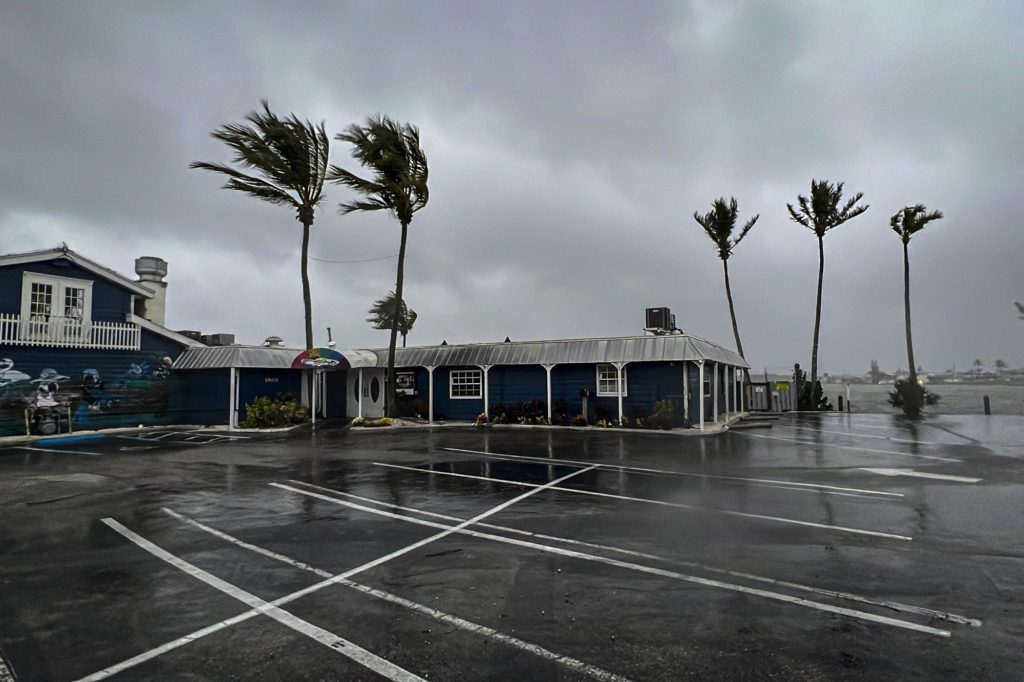
(Bloomberg) — Ian, now a hurricane again, is threatening to carve a new path of destruction through South Carolina Friday when it roars ashore north of Charleston.

The storm will drive a surge of water into the city of 3 to 6 feet (1.8 meters) and drop up to 8 inches (20 centimeters) of rain, according to Mike Doll, a meteorologist at commercial-forecaster AccuWeather Inc.

Power outages will reach far inland as Ian’s winds shake trees and power lines throughout the region. The storm is likely to create an even higher flooding surge further up the coast, with as much as 10 feet of water being pushed on shore in places, Doll said. Around Myrtle Beach, the surge could be also be 3 to 6 feet. 

The damage in South Carolina, and the flooding rains inland, will be severe but won’t rival the devastation across Florida, where it may take weeks or months to assess the true cost, Doll said.

“This is going to be among the most devastating hurricanes we have seen in the US,” Doll said. “Is it as bad as Katrina? Probably not, but the coastline in southwest Florida is going to be forever altered from this.” 

President Joe Biden has said early indications suggest that there could be a significant death toll. “We’re hearing early reports of what may be substantial loss of life,” Biden said on Thursday.

Orlando Airport, Disney World to Reopen Friday (11 p.m. NY)

Orlando International Airport will resume passenger flights at noon Friday and the Walt Disney World Resort will restart theme park operations in a phased approach starting Friday as the threatening winds and rain move north.

Ian’s winds have intensified to near 85 miles (137 kilometers) per hour as the storm was about 185 miles south of Charleston, the National Hurricane Center said in an update. 

Florida Sees Remaining Ports Reopening by Saturday (8 p.m. NY)

Ports in Florida that are still shut will reopen by Saturday, and the state is trucking in food, water, ice, blankets, tarp and pet supplies to help people devastated by the storm, Governor Ron DeSantis said at a press conference Thursday evening. 

“They will bounce back, but we have to make sure we pave the way for them,” DeSantis said of the people impacted by the hurricane in Southwest Florida.

DeSantis said he anticipates deaths from the storm, but wouldn’t say how many fatalities the state had been able to confirm yet. Trucks are delivering gasoline to fueling stations in the state and utility workers are restoring power to many, but in areas including Fort Myers Beach, Sanibel Island and Pine Island the damage is severe enough that blackouts will remain lengthy, he said. The state had more than 2 million customers without power, according to PowerOutage.us.

Ian’s Winds Reach Hurricane Strength Again (5 p.m. NY)

Ian’s wind have strengthened to 75 mph, making it a Category 1 hurricane on the five-step, Saffir-Simpson scale, the National Hurricane Center said in an advisory. 

The hurricane’s top winds will likely strengthen to 80 mph overnight, however it will still be a Category 1 storm, the hurricane center said. 

“Hurricane-force winds are expected across the coasts of South Carolina and southeastern North Carolina beginning early Friday, where a hurricane warning is in effect,” Eric Blake, a forecaster at the center, wrote in his outlook. “Hurricane conditions are possible tonight along the coasts of northeastern Florida, Georgia, and North Carolina where a hurricane watch is in effect.”

Cattle Ranches ‘Are Kind of Wrecked’ (4:42 p.m. NY)

Hurricane Ian swept through about 40% of Florida’s beef cattle country, leaving ranches “kind of wrecked,” Jim Handley, executive vice president of the Florida Cattlemen’s Association said by phone from Kissimmee. The key for animals now is for water on pastures to recede so they can resume feeding before hunger becomes critical. “It hammered us pretty good,” Handley said.

While Florida is not a major beef producer, the state provides supplies of young animals to top cattle states such as Texas and Oklahoma.

Utility With Major Outages Had Pole Woes in 2021 (4:26 p.m. NY)

Lee County Electric Cooperative said that 92% of its customers are without power as of Thursday afternoon after Ian swept through the region. One compounding issue may have been the condition of its utility poles.

When the cooperative filed a report to regulators on its storm-hardening efforts earlier this year, it disclosed that 5,904 distribution poles — or 19% of inspected poles on its network — failed inspections last year. The vast majority failed due to rot, decay or other damage. The utility said it repaired or replaced nearly 750 poles in 2021.

The cooperative also said its equipment wasn’t waterproof, although it was designed to be “water resistant” with the majority of its underground facilities, excluding conduits and cables, at or above existing grade, according to its report.

Storm Knocked Out 11% of Florida’s Wireless Networks (3:27 p.m. NY)

Storm damage and power outages knocked out more than 1,500 cell sites, leaving about 11% of Florida’s wireless networks out of service in the wake of Hurricane Ian, according to a status update from the Federal Communications Commission.

The scope of the mobile phone service disruptions span the entire state from the Keys, where Monroe County to Bradford County in northern Florida. So far, most of the severe damage was in western and southern Florida, including Lee and Hendry counties, where about 66% of cell sites are reported to be out of service.

The damage to communication systems also includes disruption to cable and phone company services such as TV, phone and internet. About half a million landline subscribers in the hurricane disaster area are without service, according to the FCC update.

Fertilizer Firm Sees No Chemical Leaks (3:10 p.m. NY)

Fertilizer maker Mosaic Co. found no releases of toxic fertilizer byproduct in the wake of Ian’s landfall, spokesman Bill Barksdale said Thursday by email. The company will continue to inspect sites in the coming days to confirm its initial assessment, he said.

Florida is home to much of America’s production of phosphate fertilizer and Ian’s path came close to Tampa, close to where Mosaic Co. has the bulk of its phosphate facilities. Environmental experts worried the possibility of storm damage poses a serious risk for a toxic spill due to the way phosphate is produced and its byproducts are stored.

Iconic Causeway Damaged from ‘Biblical’ Surge (2:51 p.m. NY) 

Sanibel Island off Florida’s Gulf coast was hit with a “biblical storm surge” from Hurricane Ian, which destroyed homes and caused a collapse of the sole road linking the island to mainland, according to Florida Governor Ron DeSantis.

The hurricane caused extensive damage to the Sanibel Causeway, an iconic trio of two-lane bridges spanning San Carlos Bay to connect the island of Sanibel to the mainland. The storm left the link unusable to vehicle traffic. The governor said there are air and boat operations to rescue those who are still stranded on the island, which is home to about 6,000 people.

Sanibel Island, a 25-mile drive from Fort Myers, is a popular tourist destination with many people visiting during the winter months.

Utility Uses Drones to Assess Damage (2:38 p.m. NY)

Florida’s largest utility said it will provide estimates for when power will be restored within 24 hours of assessing damage, though it will take longer for hard-hit areas, especially where Ian made landfall. Florida Power & Light has 21,000 people in the field working to assess damage and restore power.

“In areas impassable due to floodwater or debris, we will use a fleet of drones to assess damage,” company representative Bryan Garner said at an afternoon news briefing. The NextEra Energy Inc. unit invested in storm hardening for its grid during the past decade, which included burying infrastructure and replacing wooden poles with concrete ones. 

“That said, no grid is hurricane proof,” Garner said. “Hurricane Ian impacted almost the entire peninsula of Florida. Some areas, like southwest Florida, had catastrophic damage.”

Florida Gas Stations Wait for Power to Return (2:15 p.m. NY)

Florida gas stations that were in Ian’s path are closed while others outside the cone of destruction may face disruption as suppliers wait for the power to return and roads to clear.

Close to 11% of Florida’s gas stations were without fuel Thursday, said Patrick De Haan, head of petroleum analysis at GasBuddy. All of the stations between Fort Meyers and Naples were closed, Ned Bowman, executive director of the Florida Fuel Marketers Association, said in an interview. The state has about 7,400 retail stations, he said.

Fuel racks in Jacksonville were still closed, while flooded terminals in Orlando were waiting for deliveries from other parts of the state. Fuel bottlenecks could complicate efforts to rebuild from what is likely to amount to tens of billions of dollars in damages. Across Florida’s southwest, residents were still trapped in their homes with limited electricity and mobile phone coverage.

Duke Energy Prepares for Outages in Carolinas (1:58 p.m. NY)

Duke Energy Corp. said it’s readying crews to respond to potential power outages across the Carolinas as Ian approaches the region.

“The storm is expected to bring with it strong winds and heavy rains that could lead to localized flooding,” the company said in a statement.

High water and flooding is possible on Duke Energy lakes, said the company, which is lowering levels by moving water through its river systems, creating more storage for rainfall and runoff.

Financial Watchdogs Offer Regulatory Relief (1:44 p.m. NY)

The US Securities and Exchange Commission said those impacted by Ian can reach out to the agency to ask for relief from regulatory obligations with the agency. SEC staff will consider possible relief in some instances, the regulator said in a statement.

Federal and state banking regulators pledged Thursday to “provide appropriate regulatory assistance to affected institutions.” In a joint statement, watchdogs including the Federal Reserve and the Conference of State Bank Supervisors, also encouraged lenders to “work constructively” with borrowers in communities impacted by the storm.

President Biden Hears of ‘Substantial’ Loss of Life (1:17 p.m. NY)

President Joe Biden said at a Federal Emergency Management Agency briefing that he’s getting early indications of a significant death toll from Hurricane Ian.

 “We’re hearing early reports of what may be substantial loss of life,” Biden said at the agency’s headquarters in Washington, D.C.

Since 1980, tropical cyclones have killed an average of 156 people a year in the US, according to the National Centers for Environmental Information. In the time frame they were the deadliest weather events killing a total of 6,708 people.

Orange Juice Soars to 5-Year High (12:25 p.m. NY)

Orange juice surged to the highest since 2017 as a storm-ravaged Florida starts to assess citrus crop damage from Hurricane Ian.

“It will take another day or two to fully understand the damage the storm caused but damage is expected to be very big,” Jack Scoville, vice president of Chicago brokerage Price Futures Group, said in a note. Orange juice inventories in Florida are 41% below year-earlier levels, he said.

Ian is expected to be a massive blow to the citrus industry of Florida, which supplies nearly all of the orange juice to the country. The storm’s impact on domestic fertilizer output is also under scrutiny, since supply disruptions could hurt production of grains and other key crops.

More stories like this are available on bloomberg.com

©2022 Bloomberg L.P.

BlackRock, Allianz Join $300 Million Traveloka Funding Round

(Bloomberg) — Traveloka has secured $300 million in new financing from investors including BlackRock Inc., as Southeast Asia’s biggest online travel startup counts on a post-Covid rebound to expand in the region.

The Jakarta-based company said in a statement Thursday it struck a deal for financing with investors including Allianz Global Investors and the Indonesia Investment Authority.

The size of the funding round is significantly larger than the previously discussed target of about $200 million that Bloomberg News reported in June. Traveloka, backed by investors including GIC Pte and Expedia Group Inc., is considering an initial public offering in the US or in Indonesia, according to a person familiar with the matter, who asked to remain anonymous discussing a private matter.

The fresh funds strengthen Traveloka’s balance sheet and allow it to invest in its core business, President Caesar Indra said in an interview with Bloomberg Television’s Haslinda Amin, David Ingles and Rishaad Salamat in Singapore on Friday.

Southeast Asia’s tourism industry plunged into crisis during the pandemic when lockdowns all but brought travel to a halt. Traveloka ventured into financial services during the pandemic by partnering with banks including PT Bank Rakyat Indonesia and PT Bank Negara Indonesia. Representatives for the startup declined to comment.

What Bloomberg Intelligence Says

The revenue of Southeast Asian online travel agents (OTAs) might gain from the speedy rebound in domestic and international travel in the region, helped by high smartphone ownership and low penetration of brick-and-mortar travel agencies. We expect industry leader Traveloka to grow faster than rivals such as Tripadvisor and Booking Holdings, with our scenario projecting sales to expand by more than 40% from 2021-25 vs. the industry’s 36%. Traveloka, along with Indonesia’s Tiket.com, appears more able to weather industry challenges, the most crucial of which is achieving profitability amid IPO plans.

– Nathan Naidu, analyst

Click here for the research.

Many countries are now removing pandemic-era restrictions and reopening borders. For example, Thailand — where international tourism contributes about 12% to gross domestic product — has seen a rush of foreign travelers in recent months after scrapping restrictions in July.

Traveloka envisages a full recovery from the pandemic by 2024, Indra said. “We are very optimistic that domestic travel will drive the recovery, followed by international recovery,” he said.

Regional startups are raising funds despite worries about a global economic downturn, hoping to position themselves for an eventual rebound. Traveloka helps consumers book a range of services including airline tickets and hotels as well as spas and tourism attractions. It also offers food delivery and financing, payment and insurance products. Its app has been downloaded more than 100 million times, according to its website.

The valuation of the deal is unclear. Traveloka had been valued at $3 billion, according to CB Insights, but Bloomberg News reported in 2020 that it was seeking funds at a lower valuation.

(Updates with comment from executive starting in fourth paragraph)

More stories like this are available on bloomberg.com

©2022 Bloomberg L.P.

SoftBank Planning Vision Fund Staff Cuts of At Least 30%, Sources Say

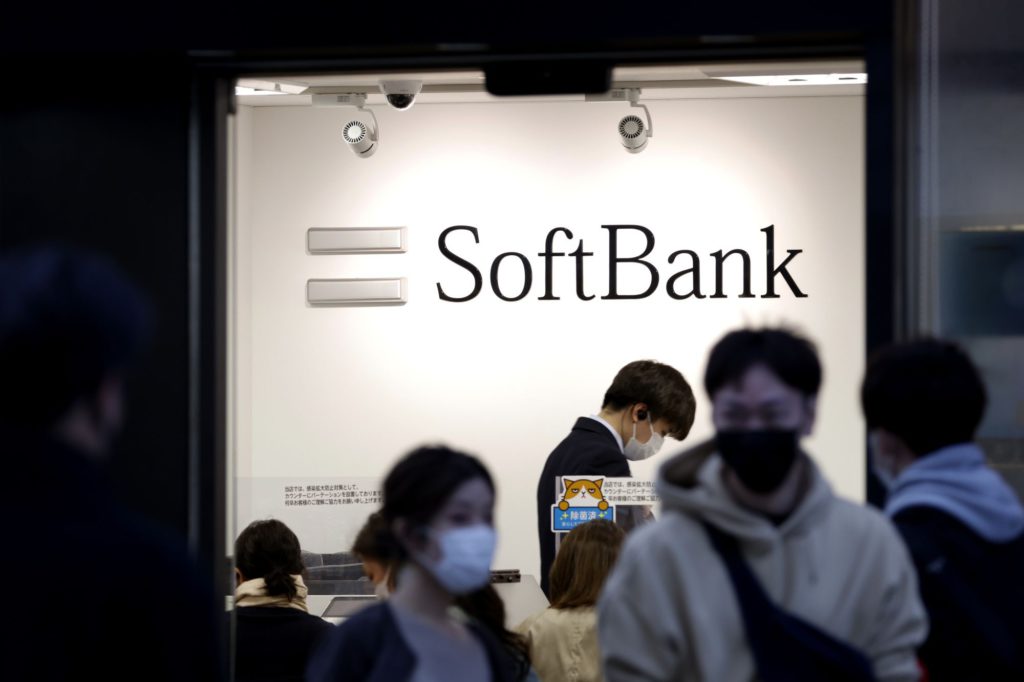
(Bloomberg) — SoftBank Group Corp. has started laying off employees at its loss-making Vision Fund and is expected to cut at least 30% of its staff, according to people familiar with the matter.

The Tokyo-based company began telling some workers of the reductions Thursday with at least 150 likely to be affected, said the people, asking not to be named as the information is not public.

Among those cut are US-based partners Tom Cheung, who spearheaded the fund’s investment in smart window maker View, and Raman Nanda, a longtime SB Energy executive specializing in climate tech, some of the people said. The Vision Fund unit, headquartered in London, had about 500 employees including staff at the Latin America fund. 

Representatives for SoftBank declined to comment. Shares in the company fell as much as 2.4% in Tokyo on Friday, following a broad selloff in tech stocks. 

Masayoshi Son, the billionaire founder of the group, had said in August he would implement cost cuts at his conglomerate and the Vision Fund investment arm after a record $23 billion loss. Most of the losses came from a plunge in the valuations of portfolio companies, including South Korea Coupang Inc. and DoorDash Inc. SoftBank also reported a $6 billion foreign exchange loss because of the weaker yen.

Internally, SoftBank debated how deeply to cut the Vision Fund unit. It planned staff cuts of at least 20%, Bloomberg News reported earlier this month, while some executives argued for as high as 50%. 

“Market conditions have noticeably worsened in the past month with the Vision Fund’s public portfolio on track for $5 billion in losses for the quarter,” said analyst Kirk Boodry of Redex Research who publishes on Smartkarma, in response to the bigger-than-expected scope of the cuts.

The Japanese entrepreneur said he would take defensive steps to navigate a prolonged tech downturn. SoftBank said last month that it had raised more than $17 billion by selling forward contracts on Alibaba Group Holding Ltd., the Chinese e-commerce company whose meteoric growth cemented Son’s reputation as a startup investor. 

Son is trying to wait out the technology slump so that he can pull off a successful initial public offering for Arm Ltd., the chip designer that SoftBank bought for $32 billion. The CEO has said he aims to make the offering the biggest-ever for a chip company.

(Updates with names of partners who were cut and stock price reaction from second paragraph)

More stories like this are available on bloomberg.com

©2022 Bloomberg L.P.
Facebook Co-Founder’s VC Firm Sees Funding Drought Until 2024

(Bloomberg) — B Capital Group, the investment firm run by Facebook co-founder Eduardo Saverin, expects startups to suffer from a fundraising drought until 2024 as turbulence in the financial markets persists.

Entrepreneurs will “have to make their capital last 18 months,” Raj Ganguly, B Capital’s co-founder and managing partner, said in an interview with Bloomberg Television’s Haslinda Amin and Shery Ahn in Singapore on Friday on the sidelines of the Milken Institute Asia Summit. “We see this period of volatility continuing through the end of 2023 and companies have to survive with the capital that they have.”

Soaring inflation and rising interest rates have weighed on tech stocks globally, forcing companies to postpone funding rounds and initial public offerings. Grab Holdings Ltd., long considered one of the rising stars of Southeast Asia, has lost more than 70% since it went public in the US in December as investors soured on unprofitable tech ventures. Even Sea Ltd., the region’s most valuable tech firm, warned this month it won’t be able to raise funds in the market.

Southeast Asia’s rising crop of tech companies are lobbying investors with scenarios of profitability, as mounting losses and rising interest rates compel VCs to become more choosy.

“We’ve gone from an era of talking about growth at all costs, to really talking about optimization and efficiency,” Ganguly said.

More stories like this are available on bloomberg.com

©2022 Bloomberg L.P.

Micron Braces for Massive Plunge in Demand by Slowing Production

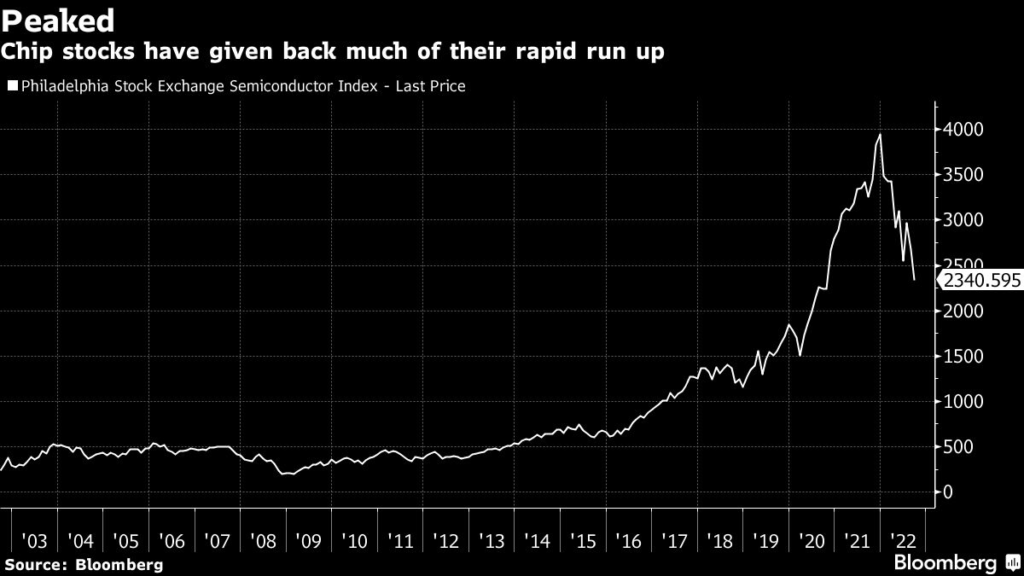
(Bloomberg) — Micron Technology Inc., the largest US maker of memory chips, is slashing production to cope with a steep plunge in demand, the latest sign of how the semiconductor industry’s boom times have quickly turned into a crisis. 

After forecasting quarterly sales that were nearly $2 billion below Wall Street estimates Thursday, the company said it was taking big steps to rein in supply. That includes slowing down production at existing plants and slashing its budget for machinery.

Micron and other chipmakers had been riding high during the pandemic, when the work-from-home trend fueled demand for computers and other consumer technology. But inflation and recession fears — plus a return to the office — have put a damper on purchases. That means Micron’s customers are sitting on stockpiles of unused chips.

“As we look ahead, macroeconomic uncertainty is high and visibility is low,” Chief Financial Officer Mark Murphy said on a conference call after the Boise, Idaho-based company released its quarterly results.

Micron’s aggressive moves to deal with the problem were enough to calm investors’ fears Thursday. The stock initially dropped more than 4% in the wake of its forecast, but soon rebounded.

Still, Micron will need help from competitors to address the oversupply problem. Memory chips are unique in the semiconductor field in that they’re built to industry standards, meaning products from rival companies are interchangeable. They’re traded like commodities, with publicly available pricing.

To restore the balance between supply and demand, South Korean competitors Samsung Electronics Co. and SK Hynix Inc. are showing signs of dialing back production. The country’s semiconductor output fell for the first time in more than four years last month.

For now, Micron is in for a difficult year. It expects sales of about $4.25 billion in its fiscal first quarter, which ends in November. That compares with an average analyst estimate of $6 billion, according to data compiled by Bloomberg. Excluding certain items, profit will be about 4 cents a share, compared with a 87-cent prediction by analysts.

As part of its response to the slump, Micron will cut capital spending by 30% in its fiscal year 2023, Chief Executive Officer Sanjay Mehrotra said.

“Yes, we have a challenging market environment, but we’re responding rapidly with actions,” he said in an interview. “Fiscal 2023 is, of course, an unprecedented environment, but the long-term drivers are intact.”

Customers across various industries are cutting orders to pare their stockpiles of chips, he said, and the industry is experiencing a tough pricing environment. Micron expects conditions to improve in the second half of the fiscal year, which begins in the May quarter.

Micron’s memory chips store data and help process information in phones, PCs and servers, making its outlook a key indicator of demand for a large swath of the electronics industry. While it has benefited from the spread of computing into everything from household devices to automobiles, it’s still heavily reliant on computers to fuel revenue. 

The stock had fallen 46% this year through the close, part of a rout for the semiconductor industry.

In the three months ended Sept 1, Micron’s revenue shrank about 20% to $6.64 billion, its first decline in more than two years. Net income was $1.49 billion, or $1.35 a share.

In August, the company said it would likely miss its own projections and there would be significant declines in profitability. That added to a chorus of similar warnings from chip companies. 

The US company competes with Samsung and SK Hynix, as well as Japan’s Kioxia Holdings Corp., in a market that has historically been perilous and unpredictable.

More stories like this are available on bloomberg.com

©2022 Bloomberg L.P.
Close Bitnami banner
Bitnami