

Bloomberg

Stocks Plummet to 22-Month Low as Fed Hawks Circle: Markets Wrap

(Bloomberg) — US stocks plunged to the lowest since November 2020 as another group of Federal Reserve officials struck a hawkish tone, and turmoil in Europe continued to fray investor nerves.

The S&P 500 fell as much as 2.9% during Thursday’s session but trimmed losses as markets closed. Its decline wipes out an ill-timed attempt Wednesday to rebound from a six-day slide. 

The tech-heavy Nasdaq 100 dropped nearly 4% during the session after St. Louis Fed President James Bullard said investors have now understood that they can’t escape additional rate hikes in coming months. The index was dragged down by Apple Inc., which fell as much as 6.1% after a rare analyst downgrade from Bank of America warning of weaker consumer demand for its popular devices.

Signs of stress emerged in the interest-rate swaps market and a leveraged-buyout deal was shelved. US Treasuries pared earlier losses, with the 10-year yield hovering around 3.76%.

In Europe, UK gilt yields rose after Prime Minister Liz Truss’s defense of unfunded tax cuts that sent markets into turmoil failed to persuade investors. German inflation topped 10% and the country agreed to energy caps that could add to inflationary pressures.

Investors are grappling with threats posed by discordant moves from central banks over the past few days, with Fed officials adamant on further monetary tightening, the Bank of England unveiling a plan to support government debt and authorities in Asia trying to prop up weakening currencies.

“I was actually really surprised by the impact that the Bank of England had on the global market,” said Fiona Cincotta, senior financial markets analyst at City Index. “Yet, it was short-lived, the relief rally. We sort of pushed past that quite quickly and it seems to be back to that narrative of inflation fears, higher-interest-rate fears.”

Fed officials haven’t shied away from warning that more rate-hike pain is yet to come, with Cleveland Fed President Loretta Mester echoing the rhetoric that her colleagues reinforced this week. San Francisco Fed President Mary Daly, after US markets closed, said the central bank should curb inflation in a manner that avoids a difficult downturn. 

Better-than-expected 2Q core PCE and personal consumption numbers on Thursday also paved the path for the Fed to stay aggressive. Weekly jobless claims fell to the lowest since April, showing a persistently tight labor market.

Recession concerns persisted as a gap in the government’s two primary measures of US economic activity during the first half of 2022 narrowed. The National Bureau of Economic Research’s Business Cycle Dating Committee uses this metric and other variables to make any recession call.

“The market is now coming to terms with the idea that a recession is almost a given at this point and it’s really making adjustments for that,” said Shawn Snyder, head of investment strategy at Citi US Wealth Management. 

Read More: Wall Street and Main Street Bail on Stocks as Fed Is Enemy No. 1

Separately, the European Commission announced an eighth package of sanctions that would include a price cap on Russia’s oil exports as Russia vowed to go ahead with the annexation of the parts of Ukraine that its troops currently control after UN-condemned votes, putting the Kremlin on a fresh collision course with the US and its allies.

How much damage is a strong dollar causing? That’s the theme of this week’s MLIV Pulse survey. It’s brief and we don’t collect your name or any contact information. Please click here to share your views.

Key events this week:

  • Fed’s Mary Daly speak at an event, Thursday
  • China PMI, Friday
  • Euro zone CPI, unemployment, Friday
  • US consumer income , University of Michigan consumer sentiment, Friday
  • Fed’s Lael Brainard and John Williams speak, Friday

Some of the main moves in markets:

Stocks

  • The S&P 500 fell 2.1% as of 4 p.m. New York time
  • The Nasdaq 100 fell 2.9%
  • The Dow Jones Industrial Average fell 1.5%
  • The MSCI World index rose 1.1%

Currencies

  • The Bloomberg Dollar Spot Index fell 0.3%
  • The euro rose 0.7% to $0.9801
  • The British pound rose 1.7% to $1.1077
  • The Japanese yen fell 0.2% to 144.44 per dollar

Cryptocurrencies

  • Bitcoin fell 0.8% to $19,409.32
  • Ether fell 1.2% to $1,334.31

Bonds

  • The yield on 10-year Treasuries advanced three basis points to 3.76%
  • Germany’s 10-year yield advanced six basis points to 2.18%
  • Britain’s 10-year yield advanced 13 basis points to 4.14%

Commodities

  • West Texas Intermediate crude fell 0.7% to $81.59 a barrel
  • Gold futures were little changed

More stories like this are available on bloomberg.com

©2022 Bloomberg L.P.
Apple’s Ugly Day Wipes Out $120 Billion, Spills Over Big Tech

(Bloomberg) — Apple Inc. shares buckled after a rare analyst downgrade exacerbated another wave of selling pressure that wiped out hundreds of billions of dollars in market value from the largest US technology stocks.

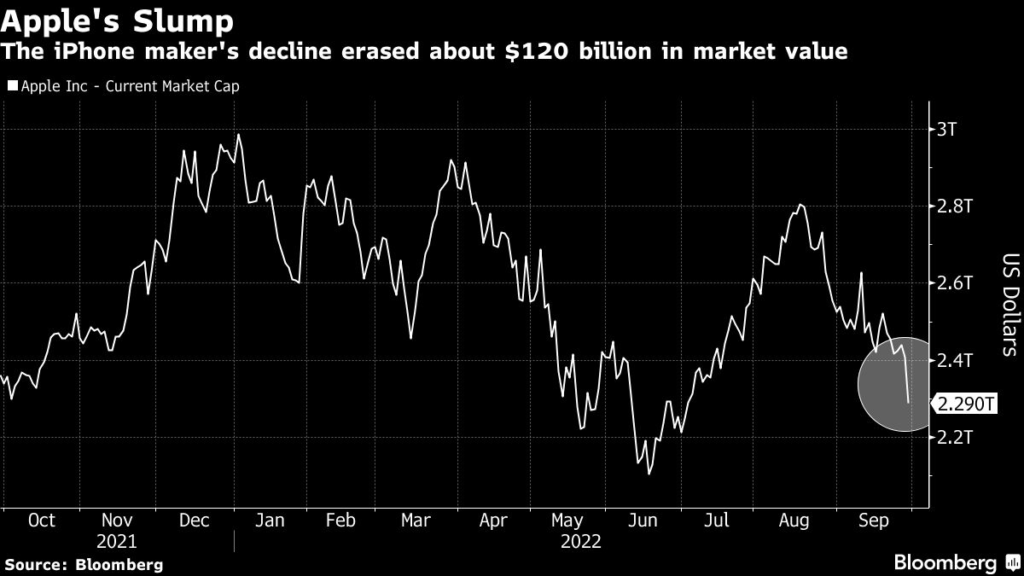
The iPhone maker dropped 4.9% after Bank of America cut its rating to neutral from buy, warning of weaker consumer demand for its popular devices. The selloff erased roughly $120 billion from Apple’s market capitalization.

There were few places to hide on Thursday with investors dumping stocks as Federal Reserve officials continue to talk tough on raising interest rates in the central bank’s fight against inflation. There were just three gainers in the Nasdaq 100 Stock Index, which fell 2.9% and within spitting distance of its June 16 low. Amazon.com Inc. and Alphabet Inc. fell nearly 3%, while Microsoft Corp. dropped 1.5%. 

Meta Platforms sank 3.7% after Chief Executive Officer Mark Zuckerberg outlined plans to reduce headcount for the first time ever. The social media giant’s shares have fallen 59% this year amid slowing user growth.

Read more: Exxon Overtakes Meta in Market Value for First Time in 5 Years

Apple has been treated as a haven for much of this year, outperforming fellow mega-caps and the broader tech gauge amid a steep selloff driven by recession fears. The world’s most valuable company with a market value of nearly $2.3 trillion has now fallen about 20% in 2022, compared to a 32% decline for the Nasdaq 100.

With consumer spending expected to cool across regions, BofA analysts led by Wamsi Mohan said demand for Apple’s services has already slowed and product demand is likely to follow. Pressure from a stronger dollar will only add to its woes, they said.  

While “Apple’s long-term prospects remain favorable,” BofA expects negative estimate revisions and valuation risks in the near-term. 

The Nasdaq 100 is on pace for its longest streak of quarterly declines in 20 years, yet investors are still bracing for more pain as the Federal Reserve aggressively raises interest rates and Wall Street analysts begin cutting profit estimates. 

Estimates for 2023 profit growth for tech companies in the S&P 500 have declined about 6 percentage points since the start of 2022, compared with a drop of 4 percentage points for the broader index, according to data compiled by Bloomberg Intelligence. 

(Adds closing prices throughout.)

More stories like this are available on bloomberg.com

©2022 Bloomberg L.P.
Top Apple Executive Is Leaving After Making Crude Remarks in TikTok Video

(Bloomberg) — One of Apple Inc.’s most senior executives is leaving after he turned up in a viral video on TikTok making an off-color joke that he fondles “big-breasted women” for a living.

In the video, published on Sept. 5, Apple’s Tony Blevins was approached by TikTok and Instagram creator Daniel Mac as part of a series where he asks owners of expensive cars their occupations. The executive was stopped by Mac while parking a Mercedes-Benz SLR McLaren, an out-of-production sports car that fetches hundreds of thousands of dollars.

When asked what he does for a living, Blevins said, “I have rich cars, play golf and fondle big-breasted women, but I take weekends and major holidays off,” according to the video’s captions. He also touted that he has a “hell of a dental plan.”

In reality, Blevins is Apple’s vice president of procurement and is in charge of striking deals with suppliers and partners. He recently worked on the company’s satellite agreement with Globalstar Inc., led negotiations over cellular modems with Qualcomm Inc. and Intel Corp., and has been in charge of driving down the costs of many critical parts that go into Apple’s mobile devices. 

After an internal investigation into the matter, Blevins’s team — which included about half a dozen direct reports and several hundred employees — was removed from his command, according to people familiar with the situation.

Blevins, a 22-year veteran of Apple, confirmed the incident to Bloomberg, saying the encounter took place on Aug. 18. “I would like to take this opportunity to sincerely apologize to anyone who was offended by my mistaken attempt at humor,” he said.

An Apple spokesman said Thursday that Blevins is departing the Cupertino, California-based company.

Blevins has been part of a roughly 100-person group of vice presidents at Apple and one of only about 30 executives that report to either Chief Executive Officer Tim Cook or Chief Operating Officer Jeff Williams. Williams has been Blevins’s boss for much of his career, though he briefly reported to Sabih Khan, Apple’s senior vice president of operations, according to the people. 

It was Williams’s decision for the company and Blevins to part ways, one of the people said. The operating chief will oversee Blevins’s old team, at least for now, according to the person.

The TikTok video was taken at a car show that Blevins attended last month in Pebble Beach, California. His remarks in the 25-second clip reference a line from the 1981 movie Arthur, where main character Arthur Bach describes his own career: “I race cars, play tennis and fondle women, but I have weekends off and I am my own boss.”

The video garnered more than 40,000 likes on Instagram and 1.3 million views on TikTok. After the clip was published, some members of Apple’s operations and procurement teams reported it to the human resources department, said the people, who asked not to be identified because the situation is private. The company then launched the investigation, they said.

The video became a topic of discussion among Apple employees in recent weeks, with some expressing anger about his comments — especially given that other executives, including Cook and Williams, have publicly championed workforce diversity and the empowerment of women — according to the people. The video has also begun to spread among employees at some of the company’s key suppliers.

Blevins’s departure opens up a void at Apple. He’s been integral to the company’s success over the past two decades, according to employees with knowledge of his work, helping Apple fatten its profit margins and get access to core technologies before rivals. He may be difficult to replace, given his understanding of Apple’s supply chain and his negotiating skills, they said.

The Wall Street Journal described him as Apple’s chief cost cutter in a 2020 feature story, saying he goes by “the Blevinator.”

(Adds detail on video captions in third paragraph)

More stories like this are available on bloomberg.com

©2022 Bloomberg L.P.

Kamala Harris Under a Microscope: Deft Asia Diplomacy Despite DMZ Gaffe

(Bloomberg) — Kamala Harris’s whirlwind tour of Japan and South Korea this week amounts to a microcosm for the state of her vice presidency: an ambitious, historic and increasingly confident effort still beset by the occasional high-profile gaffe.

In Japan, Harris stood alongside other world leaders at the state funeral for Shinzo Abe, the former prime minister whose assassination at a campaign event rattled a key American ally.

She delivered a carefully calibrated denunciation of China from the deck of a US warship intended to reassure allies — without deepening a rift with Beijing that President Joe Biden has widened with explicit pledges to defend Taiwan from an invasion.

Harris soothed South Korean leaders angry over new US tax credits for electric vehicles likely to disadvantage Asian automakers, while needling the country’s new president over gender inequities.

And at the Demilitarized Zone dividing the Korean peninsula, a photo-op of Harris gazing through binoculars across the heavily fortified border echoed the previous visits of five presidents.

But the clip of the vice president circulating on cable news the next morning featured an unfortunate slip of the tongue, after she said the US had a “strong alliance” with “the Republic of North Korea.”

The moment illustrated the microscope of scrutiny that Harris, the nation’s first female vice president, labors under as she tries to rebuild her stature within the White House and with voters. Her first year in office was marked by rampant staff turnover, rhetorical stumbles, and struggles to address migration from Central America, her highest-profile assignment from the president.

At the DMZ, Harris clearly meant to refer to the Republic of Korea — South Korea’s official name — and she is hardly the only politician to commit such a slip. Only hours earlier, Biden made a much more awkward gaffe when he called out for a deceased congresswoman at a White House event.

Still, White House officials say perceptions of Harris within the West Wing warmed in recent months as her office staff stabilized under a new chief of staff and the former California Senator demonstrated more political acuity.

She has earned praise even from skeptics in the administration for her leadership of the White House’s response to the Supreme Court ruling striking down national abortion rights. 

The vice president’s outspokenness on abortion has impressed Biden’s aides, according to a person familiar with their thinking, and is viewed as particularly helpful because the president — a nearly 80-year-old man and a practicing Catholic — can be uncomfortable speaking about the issue. 

Harris, who is 57, has stood out as a key interlocutor with state and local women’s rights groups, a second person said. And she’s served as a bridge to Black, young, female and progressive voters who have not always rallied behind Biden.

She’s also shown enthusiasm for space exploration, welcoming a chance to lead the president’s National Space Council. 

Many in the West Wing continue to fret that Harris’s retail political skills leave much to be desired, and her staff keep her public appearances closely managed. Her aides publicly bristled when she was given responsibility for addressing the root causes of migration from central America, and migrant flows at the Southern border have only increased.

Some in the White House say that her meticulous, prosecutorial approach to her portfolio is often risk-adverse and lacks a populist touch.

Diplomatic Skills 

But as her trip to Asia demonstrated, over-preparation can serve Harris well conducting high-stakes diplomacy. Abroad, she capably projects the image of a controlled and confident world leader who speaks for the president. 

Aides say the vice president is increasingly comfortable with that role. Less than two years into her term, Harris has met with more than 100 world leaders, one White House aide noted, including high-profile trips to Vietnam, Singapore, Japan, South Korea, Poland, Romania, Germany and France.

Enlisting Harris to help navigate Taiwan tensions is a particular signal of trust from the West Wing, which has intensified its focus on the relationship with Beijing ahead of Biden’s November trip to Asia.

The White House is engaged in a high-stakes balancing act: The US seeks to reassure allies in the region alarmed by China’s increasingly expansionist rhetoric and actions, while also maintaining a partnership with Beijing to avoid deepening trade disputes or a pivot toward Russia that could threaten American interests.

Pressure has only increased following House Speaker Nancy Pelosi’s August trip to Taiwan, which strained efforts to arrange a meeting between Biden and Chinese President Xi Jinping. 

Speaking from the windswept deck of the USS Howard –a Navy destroyer stationed in Japan — Harris was largely able to thread the needle. She accused China of “undermining key elements of the international rules-based order” but said the US would deepen its “unofficial” relationship with Taiwan, “consistent with our longstanding policy” — demonstrating a deft touch with ambiguity that has often seemed to elude Biden.

Overseas Icon 

The trip also showed that while Harris struggles to gain political traction at home, she is regarded as a trailblazing icon overseas. At Abe’s funeral, she was one of just a handful of women in attendance — a female leader in a sea of men in black suits.

The same was true during a meeting with Japanese business leaders, where Harris — the lone woman at the table — spoke about the benefits of a new US law for foreign semiconductor manufacturers.

Pictures of Harris meeting with leaders were splashed across the front pages of Japanese newspapers, and an announcement that she planned to visit the Philippines later this year garnered significant coverage. 

North Korea met Harris’s trip to the DMZ with a response that seemed to betray that Pyongyang, at least, regarded her visit as momentous. Kim Jong-Un’s regime launched three short-range missiles into the waters east of the country in the days ahead of the vice president’s arrival, adding two more after she left for good measure.

More stories like this are available on bloomberg.com

©2022 Bloomberg L.P.
Meta to Cut Headcount for First Time, Slash Budgets Across Teams

(Bloomberg) — Meta Platforms Inc. Chief Executive Officer Mark Zuckerberg outlined sweeping plans to reorganize teams and reduce headcount for the first time ever, calling an end to an era of rapid growth at the social media giant.

In what would be the first major budget cut since the founding of Facebook in 2004, Zuckerberg said the company will freeze hiring and restructure some teams to trim expenses and realign priorities. Meta will likely be smaller in 2023 than it was this year, he said.

He announced the freeze during a weekly Q&A session with employees, according to a person in attendance. He added that the company would reduce budgets across most teams, even those that are growing, and that individual teams will sort out how to handle headcount changes. That could mean not filling roles that employees depart, shifting people to other teams, or working to “manage out people who aren’t succeeding,” according to remarks reviewed by Bloomberg.

“I had hoped the economy would have more clearly stabilized by now,” Zuckerberg said. “But from what we’re seeing it doesn’t yet seem like it has, so we want to plan somewhat conservatively.” A Meta spokesperson declined to comment.

Meta stock, which was already trading down to start the day, fell further on the news, down 3.7% from Wednesday’s close. The shares have fallen 60% so far this year.

The further cost cuts and hiring freeze are Meta’s starkest admission that advertising revenue growth is slowing amid mounting competition for users’ attention. It’s not an ideal time to be cutting; besides economic pressures, the company’s advertising business, built on precise consumer targeting, has lost some of its edge due to new privacy restrictions from Apple Inc. on tracking iPhone users. TikTok is attracting  younger users away from Instagram. And Zuckerberg is making an expensive bet on the metaverse, an immersive virtual reality future where he imagines people will eventually communicate, an effort he has said will lose money for many years.

Meta said earlier this year that it was planning to slow hiring for some management roles, and had postponed handing out full-time jobs to summer interns.  The freeze announced Thursday was necessary because “we want to make sure we’re not adding people to teams where we don’t expect to have roles next year,” Zuckerberg explained in the meeting.

Zuckerberg had warned in July that that Meta would “steadily reduce headcount growth,” and that “many teams are going to shrink so we can shift energy to other areas.” Priorities internally include Reels, Meta’s TikTok competitor, and Zuckerberg’s metaverse. Meta had more than 83,500 employees as of June 30, and added 5,700 new hires in the second quarter.

Zuckerberg said Thursday that the company would be “somewhat smaller” by the end of 2023. “For the first 18 years of the company, we basically grew quickly basically every year, and then more recently our revenue has been flat to slightly down for the first time,” he told staff.

During its first-quarter earnings call, Meta  said annual expenses would be roughly $3 billion lower than initially projected, trimming an estimated range that had been as high as $95 billion.  In prior moves to reduce spending, a dual-camera watch the company was building to compete with the Apple Watch was shuttered.

Meta is not the only advertising-reliant company to be hit by broader economic challenges. Twitter Inc. enacted its own hiring freeze in May, and has been asking employees to watch their expenses and reduce travel and marketing costs. Alphabet Inc.’s Google, too, said that it would slow hiring during the back half of the year, and Snap Inc. cut 20% of its workforce in August. 

(Adds context on industry cuts in final paragraph)

More stories like this are available on bloomberg.com

©2022 Bloomberg L.P.

Toyota’s CEO Says EV Adoption Will Take Longer Than Expected

(Bloomberg) — Toyota Motor Corp. plans to keep gas-powered cars as a key part of its lineup, rejecting efforts by rivals to go fully electric amid concerns over how quickly consumers will embrace new technologies.

While the world’s largest automaker will introduce more electric vehicles in the coming years, it will also offer a range of other options, including gasoline-electric hybrids, hydrogen- and traditional fossil fuel-powered models, according to Chief Executive Officer Akio Toyoda, who met with reporters Thursday. 

Battery-electric vehicles “are just going to take longer than the media would like us to believe,” Toyoda, grandson of the automaker’s founder, told dealers gathered in Las Vegas. He pledged to offer the “widest possible” array of powertrains to propel cars cleanly. 

“That’s our strategy and we’re sticking to it,” he said.

Toyota’s stance reflects the numerous and sometimes conflicting considerations for automakers, which are seeking to boost sales, serve diverse customer bases and meet increasingly strict environmental standards in many countries. The decision contrasts with that of competitors such as General Motors Co., which has pledged to go all electric by 2035.

Environmentalists and shareholders have criticized Toyota for dragging its feet in embracing EVs, with Greenpeace putting the brand at the bottom of its ranking of global automakers’ decarbonization efforts. Critics have accused Toyota of clinging to its 25-year history with the gasoline-electric Prius hybrid, which once earned Toyota plaudits.

“The fact is: a hybrid today is not green technology,” Katherine Garcia, director of the Sierra Club’s Clean Transportation For All campaign, wrote in a blog post last month. “The Prius hybrid runs on a pollution-emitting combustion engine found in any gas-powered car.”

EV Pledge

The company last year pledged to spend 4 trillion yen, or $28 billion, to roll out 30 EVs by 2030. Still, that’s less than the $50 billion that Ford Motor Co. is spending to build EVs through 2026.

Despite the apparent disparity, Toyoda said his company already has been investing in battery-powered hybrids for more than two decades. He contends that makes Toyota the “top runner” in reducing carbon emissions from vehicles worldwide.

“Our investments may appear smaller than others’, but when you look at what Toyota has been doing over the last 20 years, the total amount might not necessarily be small,” Toyoda said.

The CEO said a lack of sufficient infrastructure will hold back EV adoption rates, which is a factor in its decision not to go all in on electricity.

“Toyota is a department store of all sorts of powertrains,” he said. “It’s not right for the department store to say, ‘This is the product you should buy.’”

Toyoda expressed skepticism that automakers will be able to achieve the California mandate that will effectively ban gasoline-fueled vehicles by 2035 and require a substantial portion of sales be EVs by 2030. New York said Thursday it would institute similar regulations.

“We have to look at the current price range and infrastructure availability and at what pace they’re going to be upgrading,” he said. “Realistically speaking, it seems rather difficult to achieve.”

(Updates with additional details in final two paragraphs)

More stories like this are available on bloomberg.com

©2022 Bloomberg L.P.

Airbnb Guests Are at the Mercy of Hosts for Hurricane Refunds

(Bloomberg) — Airbnb Inc. guests in the path of Hurricane Ian are relying on the generosity of hosts for refunds since the short-term rental company’s cancellation policy specifically excludes Florida’s storm season.

Ian, which struck Florida on Wednesday as a category 4 hurricane, dumped as much as a foot of rain onto some cities in the state, leaving about 2.6 million homes and business without power amid downed trees and inundated roadways. The storm is one of the costliest and most powerful in US history, with estimates of possible damage in the tens of billions of dollars.  

Florida, with its theme parks and hundreds miles of pristine beaches on Atlantic and Gulf coasts, is one of the most-visited states by foreign and domestic tourists. That makes the Sunshine State a popular destination for Airbnb guests too, with six cities among the top 10 trending summer domestic destinations this year, including Fort Myers and Cape Coral, both of which were in the eye of the storm. 

The state is also all too familiar with hurricanes, and gets hit almost twice as much as the next most hurricane-prone state of Texas, according to Universal Property, a casualty insurance company. That’s why Airbnb’s extenuating circumstances policies for cancellations and refunds covers some natural disasters, but not “weather or natural conditions that are common enough to be foreseeable in that location,” and specifically cites Florida’s hurricane season among the exceptions. Expedia Group Inc.’s platform Vrbo also won’t cover natural disasters or events beyond a home owner’s control. 

Read more about Hurricane Ian’s resumed strength as its storm path heads out over the ocean

The Fort Myers area on the Gulf Coast, which took a direct hit from Ian, has roughly 2,800 active short-term rentals across Airbnb and Vrbo, according to industry data tracker AirDNA. Given its waterfront real estate, 97% of all listings are full-home vacation rentals.

Bret Tracy, a 48-year-old sales director from South Carolina, has a town home in Tampa, about a two-hours drive north of Fort Myers, which he rents on Airbnb when he’s not staying there. Tracy was set to have a guest stay in his home during a local convention, which was subsequently canceled and Tampa was put under an evacuation order. Under Tracy’s normal refund policy, the guest would have only been eligible for a half-refund, but he granted a full one.

“In this situation, understanding the magnitude of it, we just said if you initiate it on your side we’ll grant you a full refund,” he said. “I don’t want to put anyone in harm’s way.” 

The arrival of Hurricane Ian is another example of the delicate balance that home-sharing companies try to strike between hosts, about half of whom make a living by renting out their properties, and guests, who often must pay upfront. During the early days of the pandemic, Airbnb came under fire from guests who were refused refunds as the onus was put on hosts to be accommodating. Airbnb then rolled back that policy, allowing guests full refunds, sparking the ire of hosts who were facing empty calendars and looming mortgage payments. Over the past few years, Airbnb has tried to appease both sides, by adding AirCover, which regulates cancellation policies, listing inaccuracies and other troubles, for both parties.

While the extenuating circumstances policy excludes the hurricanes, Airbnb says guests can filter their searches for homes with flexible cancellation policies that offer full refunds as well as purchase travel insurance. The company is also allowing hosts to cancel reservations without penalty. 

For many hosts in an Airbnb Facebook group, the question of whether to refund a guest during a hurricane was a no-brainer. A post asking about whether other hosts gave refunds drew more than 240 comments from sympathetic home-owners. “We fully refunded our guest,” Mary Singleton commented on the site. “We had to ask them to leave because the area was under mandatory evacuation, so we could prepare the house for the storm. This is a major hurricane and we didn’t think twice about refunding.”

Another host named Brian Wilson said he tends to be “a fairly cutthroat business person. But the day I sacrifice my morals for money is the day I’m walking away. It’s an emergency.”

Other hosts recalled issuing refunds during past natural disasters, including Hurricane Agatha in Mexico in May, or during wildfires in other states.

Some guests, however, haven’t been as lucky to have such accommodating hosts. Rebecca Lopez, a 38-year-old administrative assistant from Tannersville, Pennsylvania, was supposed to travel from Philadelphia to Orlando on Thursday for a family event, but her flight was canceled. Lopez had rented an Airbnb for $600 for the trip, but the property manager and owner refused to refund her money, telling her to contact Airbnb instead. 

“They’re each pointing the finger at one another and each refusing to help me,” Lopez said. “I have not had an issue before. I’m so shocked this is happening considering the extenuating circumstances of it.” 

More stories like this are available on bloomberg.com

©2022 Bloomberg L.P.
Amazon Will Close All But One US Customer Call Center

(Bloomberg) — Amazon.com Inc. will close all but one of its US call centers and shift hundreds of office employees to remote work in an effort to save on real estate, according to people familiar with the matter.

The call centers currently planned for shuttering are in Kennewick, Washington; Lexington, Kentucky and Phoenix, said one of the people, who who asked not to be named because they weren’t authorized to speak about the plans. The call center that remains open will most likely be in Huntington, West Virginia, or Houston, the person said, adding that the plans still could change.

Bloomberg reported Wednesday on Amazon’s plan to shift call-center employees from offices to work from home and close the Kennewick site. An Amazon spokesman declined to comment about any planned office closings, but on Wednesday confirmed the shift to remote work.

The e-commerce giant has been seeking to reduce expenses as revenue sales growth slows amid rising inflation and economic uncertainty. This year US online sales will increase just 9.4% to $1 trillion, the first time growth has slipped into the single digits, according to Insider Intelligence. The cost-cutting comes after Amazon quickly expanded its warehouses and logistics operations when consumer demand jumped during the early stages of the pandemic.

The pandemic also forced companies to embrace remote work for customer service roles and many employees are resisting efforts to return to offices. Offering work-from-home will help Amazon recruit employees in an industry with high turnover. Its cloud computing division sells Amazon Connect software that helps companies create remote customer service networks.

Customer support employees make up a small fraction of the company’s more than 1.5 million workers.

More stories like this are available on bloomberg.com

©2022 Bloomberg L.P.

Disney Plans to Begin Reopening Florida Theme Parks on Friday

(Bloomberg) — Walt Disney Co. plans to reopen its Florida theme parks and Disney Springs shopping area on Friday now that Hurricane Ian has passed through the area.

The facilities will reopen in phases, the company said on Twitter, with operating hours to be posted later Thursday.

Disney, the world’s largest theme-park operator, shut its four main parks for two days this week as Ian neared landfall. The company kept some hotels open so guests could shelter in place. 

Photos posted so far on social media by third parties show minimal damage to Disney’s facilities.

Universal Orlando Resort, a unit of Comcast Corp., said on its website that it expects to reopen Friday, while SeaWorld Entertainment Inc. planned to resume operations Saturday. Its parks include Busch Gardens in Tampa.

(Updates with Universal and SeaWorld in last paragraph.)

More stories like this are available on bloomberg.com

©2022 Bloomberg L.P.
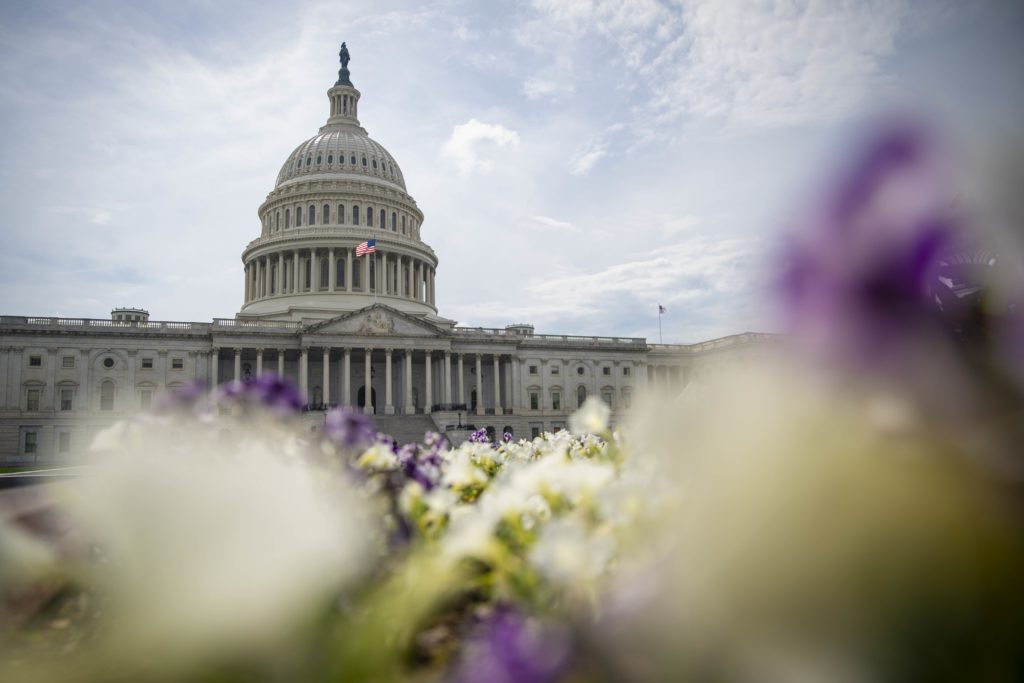
New Antitrust Bill Will Bolster US Fight Against Tech Giants With Small Reforms

(Bloomberg) — The House on Wednesday passed a package of bills intended to reinvigorate trust-busting in the US, marking the first time Congress has voted to expand antitrust laws in decades. 

The package passed 242-184 after days of infighting on both sides of the aisle. Next, it will go to the Senate, where it is expected to pass before moving on to President Joe Biden to be signed into law. 

The bills in the package are much narrower than a separate antitrust bill that Congress has been considering, called the American Innovation and Choice Online Act, which would prevent the largest technology platforms from using their market dominance to the disadvantage of rivals. That bill, which is co-sponsored by Democratic Senator Amy Klobuchar of Minnesota, has stalled amid an enormous lobbying campaign by Alphabet Inc.’s Google, Amazon, Apple Inc. and Meta Platforms Inc. 

Colorado Republican Representative Ken Buck, a co-sponsor of the bill, said the smaller package will “help America with Big Tech.” 

The bills that advanced Wednesday are designed to bolster procedures around antitrust enforcement, but won’t change existing laws. Still, by strengthening resources for the antitrust agencies and giving states control over where corporate consolidation cases are tried, the vote marks a win for the Biden administration and the growing movement of activists advocating for antitrust reforms. 

Democratic Rhode Island Representative David Cicilline, a co-sponsor of the bills, called the package a “modest yet critical first step to modernizing the antitrust laws.” 

The Merger Filing Fee Modernization Act would increase corporate filing fees for mergers and give that money to the Federal Trade Commission and the Justice Department’s antitrust division, which are both strapped for resources amid a consolidation wave.  

Another bill, the State Antitrust Enforcement Venue Act, would allow state attorneys general to pick the location where their federal antitrust suits are heard, making it easier and less costly to try their cases. The legislation, which Google has opposed, would bar companies from asking judges to shift the trial venue to their home courts where they might have an advantage.  

The third bill in the package would require companies pursuing mergers to disclose subsidies they have received from nations that pose a risk to the US, such as China. 

Shortly before the vote, House lawmakers held a fundraiser with Amazon lobbyists at a Capitol Hill winery, according to a copy of the attendees obtained by Bloomberg News. Key lawmakers, including the chairs of committees tasked with overseeing the tech industry, attended the event, which included corporate lobbyists representing a number of industries. 

The fundraiser comes as the larger bills that the tech companies oppose languish. The companies have expressed less opposition to the smaller bills that passed Thursday. 

The major tech companies and their trade groups have opposed the bills, though they are much narrower than separate legislation that would force the companies to change how they operate. That measure, called the American Innovation and Choice Online Act, has stalled but could still come up for a vote later this year. 

The legislation that passed Thursday was bogged down by bickering among both parties, which intensified this week when the House announced its intention to hold a vote. 

Despite support from Senate Republicans for the measure, House Minority Whip Steve Scalise of Louisiana earlier this week circulated a memo urging Republicans to vote against the package, claiming it would empower President Joe Biden’s “politically motivated regulators.” The top Republican on the House Judiciary Committee, Jim Jordan of Ohio, has echoed that anxiety, claiming the merger filing bill in particular would give new resources to FTC Chair Lina Khan, an increasingly important target for Republicans. 

At the same time, a handful of Democrats from California, home of most of the tech giants, circulated a letter opposing the state venues bill, claiming it would burden an “an already-overloaded court system.” But California’s Democratic Attorney General Rob Bonta, along with dozens of other attorneys general, are advocating in favor of the legislation, which could give them a home court advantage as they pursue complex and difficult antitrust litigation — particularly against the well-heeled tech companies. 

The disagreements foreshadowed a battle ahead over more sweeping changes to antitrust laws. If the GOP wins the majority in the House in November, Jordan, a major critic of antitrust reform, would likely become the leader of the Judiciary panel. 

More stories like this are available on bloomberg.com

©2022 Bloomberg L.P.

Close Bitnami banner
Bitnami
