
Bloomberg

Researchers Hit With Lawsuits, Records Requests for Fact-Checking Climate Claims

(Bloomberg) — Social media savvy climate scientists have something else to worry about beside the fallout from rising global temperatures.

A loose coalition of conspiracy theorists, libertarians and conservative groups—some with fossil-fuel ties—have gone after those who have provided fact-checks used to counter misleading claims circulating on sites such as Facebook and TikTok.

The climate researchers, who often volunteer their time, have faced lawsuits designed to drain resources and dissuade their work as well as requests seeking voluminous records from the public institutions that employ them— a tool often used by journalists and others to investigate public agencies. The researchers say the public records that are divulged as a result of the requests are sometimes then used to challenge — or smear — their work and are ultimately intended to muzzle them.

“They make a point of going after the fact-checkers because, in addition to stopping regulation, they also want to prevent or discourage climate scientists from doing things that might educate the public,” said Lauren Kurtz, executive director at the Climate Science Legal Defense Fund.

Kurtz’s organization provides legal assistance to the researchers, and she said 2022 has been the busiest year yet.

Doug MacMartin is just one of the fund’s recipients. Last fall, while he juggled washing the dishes and entertaining his newborn son at home, complete with flecks of vomit on his shirt, a stranger rang the doorbell and served him with a lawsuit.

The plaintiff, Dane Wigington, runs a website called GeoEngineering Watch, which is dedicated to exposing “global climate engineering,” or using technologies to alter weather systems. Wigington made a conspiracy theory-filled documentary, called “The Dimming,” on the same topic. Among its claims is that condensation trails behind airplanes were actually dangerous chemicals being disbursed by the government to alleviate global warming. 

MacMartin described the documentary as “pure fantasy” on the fact-checking website Climate Feedback, which TikTok and Facebook employ to assess the accuracy of science-related posts.

Wigington claims that MacMartin’s comments caused Facebook to limit the visibility of his documentary, curbing its reach and the amount of revenue it generated. He sought $75,000 in damages—not from Facebook or Climate Feedback—but from MacMartin himself.

“I mostly felt disbelief,” MacMartin recalls. “A bit of shock combined with, ‘I just don’t have time for this.’”

Researchers have been hit with lawsuits and Freedom of Information requests from their public employers seeking voluminous records, which then are used, sometimes out of context, to undermine their work, the researchers say.

Such efforts to target fact-checkers with lawsuits and public records requests waste time and money, sometimes out of their own pockets, the researchers said. The campaigns can also intimidate volunteers into keeping quiet, they said.

In a little more than a decade, the Climate Science Legal Defense Fund has helped 240 researchers fend off lawsuits and other types of challenges from opponents, including dozens involving fighting what they believe are requests for records that are meant for intimidation, according to Kurtz. The fund normally helps about 40 scientists a year, but has already assisted 35 so far in 2022, she said.

Public records requests, and the data they sometimes unearth, are a common tool used by journalists and others to investigate public agencies. They have been a key tool for both sides on the climate change issue, used to hold utility companies accountable but also by climate skeptics to extract information that could discredit a climate scientist.

Daniel Swain, a climate scientist at University of California, Los Angeles who often speaks publicly about wildfires and droughts in the Western US,  recalled his own frustrating experience dealing with a public record request. A group called Energy Policy Advocates sent a records request to UCLA seeking emails, text messages and private encrypted messages related to a fact-check by Swain and others of a Wall Street Journal review of the book, “Unsettled: What Climate Science Tells Us, What It Doesn’t, and Why It Matters,” by Steven Koonin, a former Undersecretary for Science in the US Department of Energy under President Barack Obama. 

Swain attempted to challenge the request with a university lawyer, complaining of the “presumptive intent of disrupting primary research and outreach activities by inundating climate scientists with requests.” A representative for the records department, while sympathetic, responded that the requesters’ motivations were irrelevant and that they were bound by law to provide the information.

“I spend nights and weekends compiling and going through thousands and thousands of emails because these requests are extremely broad,” he said. “In some cases they’re essentially open ended: they’re asking about multiple years, multiple keywords and multiple platforms.”Swain, who receives regular death threats and hate mail, said he is secure enough in his job that he plans to continue speaking out against what he believes are bogus climate claims. But he said not everyone has that luxury.

“I think some folks view this as, ‘Why would I voluntarily make this harder for myself?’” he said. 

Emmanuel Vincent, a French climate scientist who runs Paris-based Climate Feedback, said volunteer researchers and paid staff members who conduct fact-checks receive harassing emails daily. Climate Feedback is contracted by Facebook and TikTok to advise when a post should be removed or partially blocked, part of a broader effort to curb the spread of false information. The non-profit is currently embroiled in two lawsuits from subjects of their fact-checks, he said. 

Earlier this year, for instance, the organization was sued by Libertarian journalist John Stossel, who is seeking more than $2 million from it and co-defendant Meta Platforms Inc. Among Stossel’s claims is that Facebook limited the visibility of his video about the 2020 California wildfires named “Government Fueled Fires” because Facebook and Climate Feedback fact-checkers “falsely attributed to Stossel a claim he never made, and on that basis flagged the content as ‘misleading’ and ‘missing context,’” according to the lawsuit. 

In an interview Stossel dismissed the idea that the suit would intimidate scientists. Instead, he said it was focused on forcing Facebook to reconsider the labels it had placed on his videos. Stossel said part of his legal fees were being funded by wealthy individuals but declined to disclose their names. “Climate Feedback is an activist group that wants people to be hysterical about climate change,” he said. 

Among the groups filing the most public records requests and lawsuits are Energy Policy Advocates, which sought Swain’s records, and a related group, Government Accountability and Oversight. They go by the acronyms EPA and GAO, the same acronyms used by the U.S. Environmental Protection Agency and the Government Accountability Office.

According to their websites, the two organizations have brought hundreds of public access records requests to agencies and public universities that employ climate scientists, including some who have helped conduct fact-checks on Climate Feedback. 

GAO states on its website that it seeks to educate the public—using litigation and open records laws—about public resources being used to promote a specific agenda on environmental and energy policy.  Its co-founder, Christopher Horner, is an author whose books include “Red Hot Lies: How Global Warming Alarmists Use Threats, Fraud and Deception to Keep You Misinformed.” 

He and his organization have ties to the energy sector. Horner has received payments from fuel company Alpha Natural Resources, and GAO was given at least $300,000 from coal mining company Murray Energy, according to bankruptcy filings. The payment to GAO was previously reported by the Intercept. Alpha Natural Resources declined to comment, while Murray Energy didn’t respond to a request to comment. GAO provided EPA, which it shares a principal officer with, with at least $40,000 in funding in its early stages. 

One of EPA’s board members, Michael Gardner, is a lawyer who has worked for several coal mining companies, according to its website. 

(EPA has also sought public records referencing Michael Bloomberg, the founder of Bloomberg News parent Bloomberg LP, related to his philanthropy’s funding of positions in state attorneys general’s office to fight against actions that undermine climate change, clean energy and environmental protection. A representative for Bloomberg declined to comment.)

Rob Schilling, EPA’s executive director, said his organization focuses on what public records say “about the way certain actors are using the public’s trust and the public’s money. “We think the public deserves to know how the government came to be used for a particular agenda,” he said, in an email. Greenpeace uses similar methods, Schilling said, adding that EPA’s work is modeled after the environmental group. He declined to answer other questions submitted by Bloomberg.

Horner didn’t respond to a request for comment. 

Told of Schilling’s remark, Tim Donaghy, research manager at Greenpeace USA said, “Whether they copied our FOIA methods or not, they sure missed the boat on basic science.

“It is absurd for them to compare themselves to Greenpeace: we are trying to protect people and the planet,” he said. “They are trying to prop up a dying industry.” FOIA is shorthand for Freedom of Information Act request.Koonin, whose work was criticized by Swain and others, has previously accused Climate Feedback’s fact-checkers of suppressing open discussion. He said Swain and others criticized his work based on a review in the Wall Street Journal, not the book itself. “The fact-check was a pretty sloppy job, unworthy of a group of senior academics,” he said in an email, adding that he didn’t know Energy Policy Advocates or Government Accountability and Oversight.

Peter Neff, an assistant research professor at University of Minnesota who is better known as Icy Pete to his 195,300 TikTok followers, found out that EPA had requested his records while on vacation with his family last year. Neff, a fact-check volunteer at Climate Feedback since 2016, said he was instructed to turn over all his communications in the last year mentioning Emmanuel Vincent.

Neff didn’t have any explosive emails to share. But he said other scientists often take contrary positions when debating with colleagues—just the kind of thing that can be taken out of context and used against them.

“It’s enough to make you think twice about how you interact with the public, like you’re taking on a personal liability potentially for just speaking on what we are experts in,” he said.

For his part, MacMartin spent 10 months grappling with Wigington’s lawsuit but recently got some good news. On Sept. 1, a federal court judge in California threw out Wigington’s case.

Wigington said he plans to appeal.

(Updated to remove a typo in third paragraph and a redundant quote.)

More stories like this are available on bloomberg.com

©2022 Bloomberg L.P.
Apple Hit With Rare Downgrade as BofA Sees Dominance at Risk

(Bloomberg) — Apple Inc. fell 4.5% after suffering a rare downgrade as Bank of America warned of weaker consumer demand for its popular smartphones and laptops.

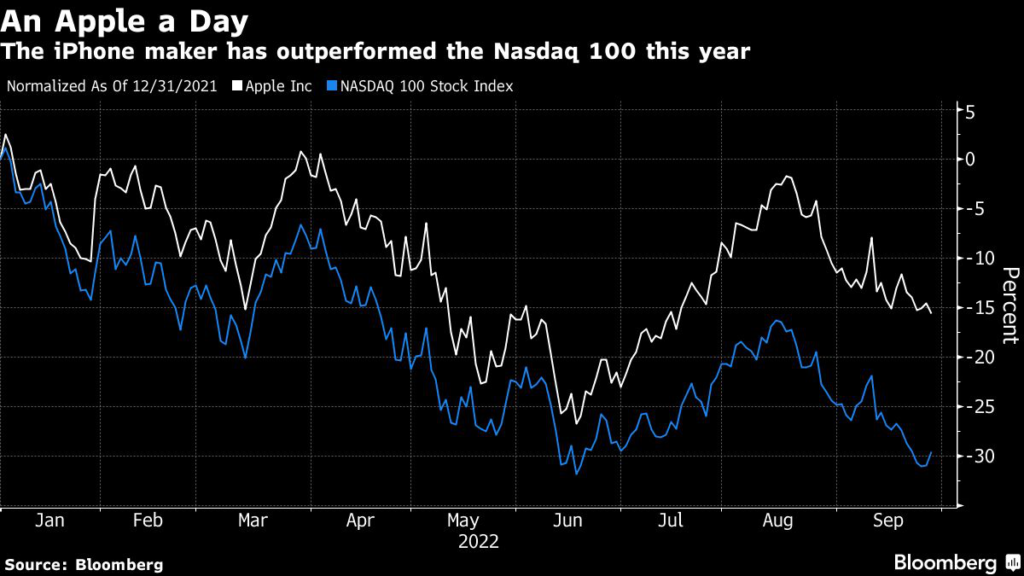
The world’s most valuable company has proved a haven for investors this year, outperforming fellow mega-caps and the wider tech gauge amid a steep selloff driven by recession fears. The $2.4 trillion company has fallen only 16% in 2022 as of the last close, compared to the near 30% declines for the Nasdaq 100 and the S&P 500 Information Technology Index. 

But Apple’s dominance is at risk, at least for now, BofA warned.

With consumer spending expected to cool across regions, BofA analysts led by Wamsi Mohan downgraded the recommendation to neutral from buy. The analysts said demand for Apple’s services has already slowed and product demand is likely to follow, pressure from a stronger dollar will only add to its woes.  


While “Apple’s long-term prospects remain favorable,” BofA expects negative estimate revisions and valuation risks in the near-term. 

Semiconductor demand is influenced heavily by discretionary consumer spending, BofA analyst Vivek Arya wrote in a separate note. However, Arya said that “risks to Apple suppliers are in a benign 1%-5% range and hence unwelcome but not a calamity.” 

Shares in the iPhone maker slipped to erase $110 billion in market value, extending losses from Wednesday after a Bloomberg report said that Apple is backing off plans to increase production of its new iPhones this year after an anticipated surge in demand failed to materialize.

The report confirmed analyst production estimates and bullish brokerages pointed to the demand in the higher-end iPhone 14 Pro line as a positive for the tech behemoth. 

Meanwhile, Rosenblatt Securities analyst Barton Crockett, who had a neutral rating on the stock since initiating coverage in April, raised his recommendation to buy, citing “substantial interest in Apple’s new iPhone 14 Pro Max and Ultra watch.” 

“We see reason to believe that consumers in other countries share this enthusiasm, prompting us to embrace more constructive near-term and long-term estimates,” Crockett said. 

Apple’s buy ratings have risen steadily going from 28 in the end of 2020 to 37 as of Thursday. It also has 10 holds and two sell recommendations, according to Bloomberg data.

(Updates stock move and market value loss in paragraph 7.)

More stories like this are available on bloomberg.com

©2022 Bloomberg L.P.

Trump Refuses to Delay Florida Deposition in Phone-Fraud Case Despite Hurricane

(Bloomberg) — Donald Trump’s deposition in a long-running class-action fraud suit. previously set for Friday at Mar-a-Lago, was ordered rescheduled because of Hurricane Ian. But that ruling came only after a fierce war of words between lawyers for plaintiffs and the former president.

Roberta Kaplan, the investors’ lawyer, wrote to a New York federal judge Wednesday seeking a delay, saying she could not get Trump’s attorneys to agree to reschedule the deposition or move it from the former president’s Florida residence to his golf club in Bedminster, New Jersey, due to the storm.

“We do not believe that is prudent or safe, and we have been unable to obtain defendants’ agreement to reschedule (or relocate) the deposition,” wrote Kaplan, who planned to fly to Florida Thursday morning. “The last we heard is that Defendants insist the deposition go forward at Mar-a-Lago and on Friday.”

Trump’s lawyers, who had already flown to Florida for the deposition, responded in a blistering letter of their own, saying Kaplan’s filing was “riddled with disingenuous and misleading statements” and criticizing her “hasty request” to cancel the deposition even after one of her partners had assured them as recently as Tuesday that they planned to travel.

‘Absolutely Absurd’

“We thought it absolutely absurd to travel from the New York area to West Palm Beach in the middle of a hurricane and would have been pleased to reschedule the deposition to another date, but plaintiffs insisted that it proceed,” Clifford S. Robert, a lawyer for Trump, wrote in a letter to the court last night.

But Kaplan said in her letter that she was “walloped” when she heard Trump’s lawyers went ahead with their flights to Florida.

Late on Wednesday, US Magistrate Judge Sarah Cave ordered the two sides to agree on a new date for the deposition, adding it must be held before Oct. 31. Hurricane Ian was “battering the Florida peninsula with catastrophic storm surge, winds, and flooding,” the judge wrote, citing the National Hurricane Center.

“Under these conditions, whether the deposition could occur on Friday, even remotely, is uncertain,” Cave said.

Hurricane Ian made landfall near Fort Myers, Florida, Wednesday afternoon resulting in extensive damage from high winds, and causing widespread flooding and power outages. “This is going to be a tragic event,” Florida Governor Ron DeSantis said during a briefing as the storm approached.

Read More: Trump’s Doomed Video Phones Loom in Backdrop of Media Foray

Trump, his company and his three oldest children were sued in 2018 by four investors who claim they were duped into paying thousands of dollars to become independent sellers with ACN Opportunity LLC, which sold a doomed videophone device that the Trumps touted as the next big thing but which was rendered obsolete by smartphones.

Trump fought for years to avoid the deposition but ultimately agreed earlier this year to answer questions under oath, after his attempt to dismiss the suit failed. The case is one of the lesser known legal disputes facing the former president as he weighs a possible 2024 run for the White House.

According to the suit, the Trumps, who promoted ACN on “Celebrity Apprentice,” lied about their faith in its products and also failed to disclose they were being paid to promote the company. Trump himself also starred in promotional videos and appeared in-person at events for the company.

He told recruits that the “tremendous” phones, which required ACN internet service to work, were doing “half-a-billion dollars’ worth of sales a year,” and that ACN was “at the forefront of innovation,” according to the complaint. The plaintiffs argue those claims were “abjectly false.”

Before the judge ordered the deposition rescheduled, Trump’s lawyers proposed holding the testimony by Zoom, “for the safety and security of all parties.” Kaplan rejected the proposal in a follow-up letter.

“We have more than 70 documents and 20 video clips we plan to or may use,” she told the judge, adding that made a deposition by Zoom unworkable.

The case is McKoy v. Trump Corp., 18-CV-9936, U.S. District Court, Southern District of New York (Manhattan).

More stories like this are available on bloomberg.com

©2022 Bloomberg L.P.

North Korea Launches Missiles After Kamala Harris DMZ Visit

(Bloomberg) — North Korea fired two short-range ballistic missiles hours after US Vice President Kamala Harris went to the Demilitarized Zone dividing the two Koreas — a high-stakes visit to show support for America’s South Korean ally against the nuclear threats posed by Pyongyang.

The missiles were fired Thursday from an area north of Pyongyang about five hours after Harris entered a hut from the South Korean side of the DMZ. The visit makes Harris the highest-ranking member of the Biden administration to enter the 4-kilometer (2.5-mile) wide buffer where hundreds of thousands of troops are stationed on opposing sides of razor-wire fencing in a place dubbed the Cold War’s last frontier.

The launch, coming shortly after Harris left the country, followed a single, short-range missile fired Sunday, and two others on Wednesday. The volleys were the first of the sort since June and added to the record launches this year by Kim Jong Un’s regime, which has not made a comment on its weapons tests this week or on Harris’s visit.

During her trip to the DMZ, Harris stood on the South Korean side of the demarcation line border while North Korean soldiers kept close tabs. Harris earlier held talks in Seoul with President Yoon Suk Yeol, where they denounced North Korea’s missile launches and pledged tough action if Pyongyang went ahead with its first test of a nuclear device in five years.

“The commitment of the United States to the defense of the Republic of Korea, I will report, is ironclad,” Harris said at the DMZ, referring to South Korea by its formal name and saying the North Korean launches were “clearly a provocation.”

She added the DMZ shows the paths the two Koreas took after their 1950-1953 war, with South Korea becoming a thriving democracy and North Korea becoming “a brutal dictatorship” with rampant human rights violations and an unlawful weapons program that threatens peace. 

The DMZ visit offered the chance for Harris to show she can tackle delicate relationships abroad, while burnishing her foreign policy credentials ahead of the 2024 presidential race. The visit also included meeting service members and receiving an operational briefing.

Yet Harris stumbled a bit in her remarks at the DMZ, at one point mistakenly saying that the US shares a “very important relationship, which is an alliance with the Republic of North Korea.” The Republican National Committee seized on the gaffe, tweeting a clip of the remarks, which were also featured on Fox News. 

The trip put attention on North Korea’s return to provocations and signaled support for allies in the region, including the two that host the bulk of US troops in the region — South Korea and Japan. The three are due to hold joint naval exercises from Friday, which should anger Pyongyang.

Japan’s defense minister and South Korea’s Joint Chiefs of Staff both said North Korea fired two, short-range ballistic missiles Thursday. South Korea said they traveled about 350 kilometers (220 miles) in distance and had an altitude of about 50 km, traveling at five times the speed of sound. 

Kim has ignored US calls to get back to stalled nuclear disarmament talks and fired off ballistic missiles in defiance of United Nations Security Council resolutions. The US, South Korea and Japan have all said North Korea may be readying to conduct its first nuclear test since 2017.

“If Kim is looking to conduct the long-anticipated nuclear test, conditioning the region to provocations with the short-range missile tests might be a way to set the tone for the region,” said Soo Kim, a policy analyst with the Rand Corp. who previously worked at the Central Intelligence Agency.

North Korea has a habit of timing its provocations to political events. The latest launch also took place as the USS Ronald Reagan arrived in South Korea for joint drills and about a month after the US and South Korea held the Ulchi Freedom Shield — their biggest joint military exercise in about five years. North Korea has bristled for decades at the joint military exercises, calling them a prelude to an invasion. 

In addition to North Korea, the Biden administration is facing an emboldened China that Biden aides worry is taking provocative actions in the Taiwan Strait.

The vice president’s office quietly planned the DMZ visit over the past two weeks, according to a senior administration official, once it became clear Harris would travel to the region to attend the state funeral of former Japanese Prime Minister Shinzo Abe. But South Korean Prime Minister Han Duck-soo upstaged her office by announcing her DMZ stop at the start of their bilateral meeting in Tokyo.

“Your visit to the DMZ and Seoul will be very symbolic demonstrations of your strong commitment to the security and peace to the Korean Peninsula,” Han said to Harris on Tuesday. 

A White House official then quickly confirmed the DMZ stop, raising the stakes for Harris’s already busy trip to the region.

In August, House Speaker Nancy Pelosi went to the Panmunjom truce village in the Demilitarized Zone. The place where soldiers from the two sides stare down each other is a symbol of military tensions that have simmered since the US came to South Korea’s defense in 1950 after North Korea invaded and started the Korean War.

While in the region, Harris met with Japanese Prime Minister Fumio Kishida and Australian Prime Minister Anthony Albanese, discussing Taiwan in both meetings, according to a senior administration official. She also led the US delegation to Abe’s state funeral, met with CEOs from the semiconductor industry to tout the recently passed CHIPS and Science Act, which is aimed at boosting competitiveness with China, and visited US troops stationed in Japan on the warship USS Howard.

(Updates with comment from analyst and details on missile flights.)

More stories like this are available on bloomberg.com

©2022 Bloomberg L.P.

Foxconn Starts EV Production in US With First Lordstown Pickups

(Bloomberg) — Taiwan’s Foxconn Technology Group has started building electric vehicles for Lordstown Motors Corp., a milestone as the company better known for making iPhones diversifies its operations.

Lordstown expects to deliver 50 of its Endurance pickups this year after the first two rolled off the line at a former General Motors Co. plant in Ohio, according to a statement Thursday. The EV company will have to raise additional capital to deliver the next 450 vehicles planned for the first batch of production, currently slated to be handed over in the first half of 2023.

Initial output is moving slowly due to “part pedigree and part availability issues,” Lordstown Chief Executive Officer Edward Hightower said in the statement. Lordstown shares fell 5.8% at 10:01 a.m. in New York.

For Foxconn, the primary maker of Apple Inc.’s signature phone, the start of production marks a significant step in its push into the EV space. The tech giant has said it plans to build vehicles for Fisker Inc. at the Ohio factory in addition to the ones for Lordstown. It also revealed its own “Foxtron”-branded prototypes last October, including a city bus, and has held talks with Saudi Arabia about making EVs there.

Foxconn had previously struggled to see through an LCD factory in the US that it had spent years during the Trump administration touting. That project has since stalled, and the plans have been greatly diminished.

The start of production with Lordstown comes four months after Foxconn completed its purchase of the plant. The company gave Lordstown $230 million in exchange for the factory and invested $55 million in a new joint venture with the startup, giving it much-needed cash.

Lordstown said Thursday that it expects to finish the third quarter with $195 million in cash and equivalents.

More stories like this are available on bloomberg.com

©2022 Bloomberg L.P.
Software Robots Are Gaining Ground in White-Collar Office World

(Bloomberg) — First they came for factory jobs. Then they showed up in service industries. Now, machines are making inroads into the kind of white-collar office work once thought to be the exclusive preserve of humans.

The latest wave of automation is building on advances in artificial intelligence and machine-learning that allow computers to perform tasks like speech recognition, and make some of the decisions that used to be reserved for employees. Unlike sophisticated machinery on assembly lines, or kiosks where consumers pay for groceries or order burgers, these are robots you can’t see.

The pandemic has ramped up demand for them. With wages rising fast, workers in short supply and near-record job vacancies, US businesses are racing to automate as much as they can.

“Technology adoption doesn’t actually happen in a steady, gradual way. It’s punctuated,” says Mark Muro, a senior fellow at the Brookings Institution. “There are surges,” he says, something he reckons the US is experiencing now given the tight labor market and technology advances.

Data is hard to come by. But on earnings calls this summer, executives at all kinds of firms — from Goldman Sachs Group Inc. to clothing retailer Abercrombie & Fitch Co. — were touting their investments in AI and other kinds of automation.

Small and Large

It’s not just corporate giants, capable of spending millions of dollars to develop their own technologies, that are getting in on the act. One feature of the new automation wave is that companies like Kizen have popped up to make it affordable even for smaller firms.

Based in Austin, Texas, Kizen markets an automated assistant called Zoe, which can perform tasks for sales teams like carrying out initial research and qualifying leads. Launched a year ago, it’s already sold more than 400,000 licenses.

“Our smallest customer pays us $10 a month and our largest customer pays us $9.5 million a year,’’ says John Winner, Kizen’s chief executive officer.

There are plenty of other ambitious companies cashing in on the trend, and posting steep increases in revenue — like UiPath Inc., a favorite of star investment manager Cathie Wood, as well as Appian Corp. and EngageSmart Inc.

Alongside the growth of AI and what economists call “robotic process automation” — essentially, when software performs certain tasks previously done by humans— old-school automation is still going strong too.

The number of robots sold in North America hit a new record in the first quarter of 2022, according to the Association for Advancing Automation. The World Economic Forum predicts that by 2025, machines will be working as many hours as humans.

`Many Winners, Many Losers’

What all of this innovation means for the world’s workers is one of the key open questions in economics.

The upbeat view says it’s tasks that get automated, not entire jobs — and if the mundane ones can be handled by computers or robots, that should free up employees for more challenging and satisfying work.

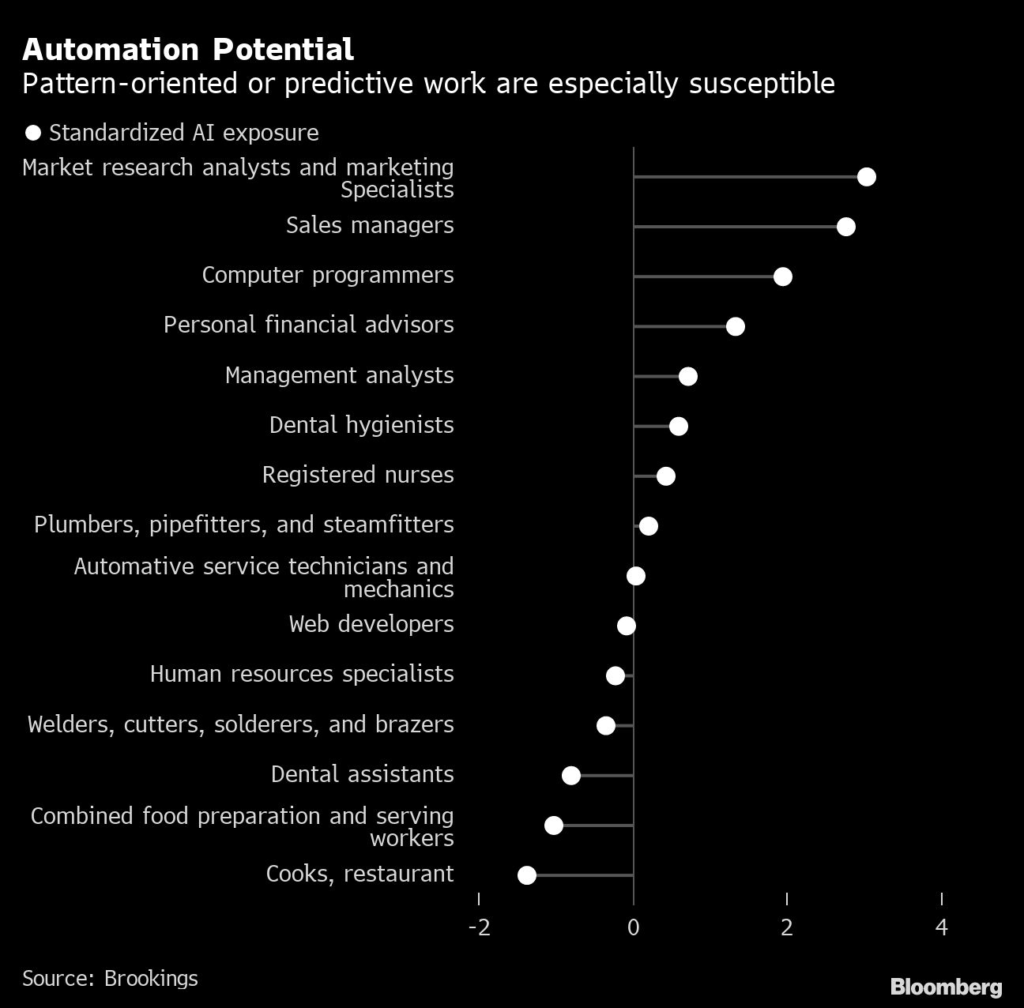
The downside risk: occupations from sales reps to administrative support, could begin to disappear — without leaving obvious alternatives for the people who earned a living from them. That adds another employment threat for white-collar workers who may already be vulnerable right now to an economic downturn, largely because so many got hired in the boom of the past couple of years.

Read More:  It’s White-Collar Jobs That Are at Risk in the Next Recession

The likeliest outcome is a bit of both, with “many winners and many losers,” according to Massachusetts Institute of Technology economist David Autor, a leading scholar in the field.

In particular, Autor warned in a recent paper, “computerization increases the productivity of highly educated workers by displacing the tasks of the middle-skill workers who in many cases previously provided these information-gathering, organizational, and calculation tasks.”

Those employees have been under pressure for some time. Back in 2014, research by the Federal Reserve Bank of Dallas found that mid-skill, routine jobs — in sales or administrative support, for example — had been declining since the 1990s, especially during recessions.

`We Didn’t Lose Any’

Many adopters of the new automation technologies say they haven’t cut jobs as a result.

KC Harvey Environmental, a consultancy based in Bozeman, Montana that works with businesses and governments on environmental issues, is one of Kizen’s clients. It uses the software to automate document control – for example, archiving and delivering new contracts to the right places and people. 

“A new project probably took our accounting group and project management team a day,” says Rio Franzman, KC Harvey’s chief operating officer. “This now probably streamlines it down to about an hour.” The firm employs about 100 people and “we didn’t lose any’’ as a result of automation, he says. “What it did allow is for the reallocation of time and resources to more meaningful tasks.” KC Harvey is now working with Kizen to bring AI into its marketing, too, with a partly automated newsletter among other projects.

Some of the biggest firms at the forefront of automation also say they’ve been able to do it without cutting jobs.

Engineering giant Siemens AG says it’s automated all kinds of production and back-office tasks at its innovative plant in Amberg, Germany, where it makes industrial computers, while keeping staffing steady at around 1,350 employees over several decades.

The firm has developed a technology known as “digital twinning,” which builds virtual versions of everything from specific products to administrative processes. Managers can then run simulations and stress-tests to see how things can be made better.

“We’re not going to automate people out of the process,” says Barbara Humpton, CEO of Siemens USA. “By optimizing automation systems, and by using digital tools and AI, workers have increased productivity at Amberg by more than 1,000%.”

`Left Over for People’

Higher productivity — essentially a measure of how much output is generated from each hour of work — is the holy grail of economics, and one of the key goals of automation. So far, at least, all the pandemic innovation in the US hasn’t led to better outcomes.

Productivity slumped in the first half of 2022. That means businesses — which were hiring at a rapid clip in the period, and paying higher wages — ended up spending more money on each unit they produced, when automation should help them to spend less.

To be sure, productivity numbers are volatile and subject to lots of revisions. It can take a long time for the fruits of innovation to show up in the data. And if the US is poised for a slowdown or even a recession, as many expect, that will likely add even more incentives for companies to invest in AI and robotics. Research suggests that when economies shrink, leaving firms with less revenue to pay their workers, automation tends to speed up.

Whatever the outcome, it’s unlikely to allay the deep unease that the idea of automation triggers among workers who feel their jobs are vulnerable. With the rise of AI, that group increasingly includes white-collar employees.

“By very definition, artificial intelligence is going after those tasks that require human intelligence,” says Florenta Teodoridis, an associate professor at the USC Marshall School of Business. That can make it difficult “to imagine what’s going to be left over for people to do.”

More stories like this are available on bloomberg.com

©2022 Bloomberg L.P.

Saudi Arabia Outlines Plans to Invest $38 Billion in E-Sports

(Bloomberg) — Saudi Arabia plans to invest 142 billion riyals ($38 billion) to turn the kingdom into a hub for e-sports by 2030, part of plans to diversify the economy of the world’s biggest oil exporter.

Savvy Games Group, a unit of the country’s sovereign wealth fund, will spend 50 billion riyals to acquire and develop a games publisher and 70 billion riyals to take minority stakes in gaming companies, according to a statement. 

It will also spend 20 billion riyals investing in mature businesses in the gaming industry and a further 2 billion investing in early stage gaming and e-sports companies.

“We are harnessing the untapped potential across the esports and games sector to diversify our economy, drive innovation in the sector and further scale the entertainment and esports competition offerings across the kingdom,” said Saudi Crown Prince and Chairman of Savvy, Mohammed Bin Salman.

Read More: Saudi Wealth Fund Makes Second $1 Billion Bet on Swedish Gaming

Saudi Arabia has already started to become an active investor in the e-gaming industry. Its Public Investment Fund has built up stakes in Activision Blizzard Inc., Electronic Arts Inc. and Nintendo Co.

Meanwhile, Savvy has bought a stake in Embracer Group AB and acquired the e-sports division of Modern Times Group at an enterprise value of $1.05 billion. Savvy’s Chief Executive Officer is Brian Ward, former head of worldwide studios at Activision Blizzard.

More stories like this are available on bloomberg.com

©2022 Bloomberg L.P.

Bed Bath & Beyond Traced an Erratic Path to Its Current Crisis

(Bloomberg) — The current crisis at Bed Bath & Beyond Inc., which on Thursday reported its lowest second-quarter revenue since 2006, is the culmination of years of management missteps and a dysfunctional corporate culture, according to people who have worked at the company.

The company said sales in the three months ended Aug. 27 fell 28% from a year earlier, the fifth consecutive quarter in which the retailer reported a double-digit fall in revenue. Bed Bath & Beyond said the job cuts and store closings it announced earlier this month are helping to cut costs. To stem the plunge in sales, the company is betting on its plan to discontinue three of its nine private-label merchandise lines and to sell updated versions of the well-known national brands that drew consumers to its stores during its heyday about a decade ago.

Bed Bath & Beyond shares fell as much as 5.4% in New York trading Thursday. The stock was down 56% this year through Wednesday, compared with 22% for the S&P 500 Index.

“Although still very early, we are seeing signs of continued progress as merchandising and inventory changes begin,” interim Chief Executive Officer Sue Gove said in a statement on Thursday. “Regaining market share and enhancing liquidity are our top priorities.”

But Bed Bath & Beyond’s struggles with past strategy shifts bode poorly for its current attempt at an overhaul.

“They’re in a deeper hole today than they were in the past,” said Cristina Fernandez, a Telsey Advisory Group analyst. “You’re executing a turnaround plan when it’s a tough consumer environment.” 

The retailer’s two previous CEOs failed to launch private-label brands that had staying power, undermined by the unrealistic time frames and expectations they set to finish projects, as well as a work environment that put teams at odds with one another and drove employees to tears, according to several people who worked in different parts of the company over the past few years. The accounts below are based on interviews with these people, who asked not to be named because they weren’t authorized to discuss internal company business.

Bed Bath & Beyond’s current pivot back to prioritizing national brands is probably too little, too late, according to the people, as well as investors and analysts. Many customers have already shifted their loyalty to competitors such as Amazon.com Inc. and Target Corp. High staff turnover and successive rounds of layoffs have undermined the morale of those employees at headquarters and stores who are left to execute the turnaround. The esprit de corps worsened after Chief Financial Officer Gustavo Arnal killed himself earlier this month. In addition to Gove at the top, the company now has an interim CFO. A Bed Bath & Beyond spokesperson didn’t respond to requests for comment for this story.

When former CEO Steve Temares, who ran the company from 2003 to 2019, started to move the business into private-label products, including furniture and towels, toward the end of his tenure, the appeal was clear: The business model, in theory, has higher profit margins. By designing and manufacturing items in-house, Bed Bath & Beyond kept more revenue for itself instead of having to pay outside suppliers. 

But the rollout of the private-label strategy was erratic. Temares and some other longtime members of the executive team seemed to only half-heartedly embrace the new private-label strategy and seemed unwilling to shake things up after overseeing so many years of growth in the past. 

Executives would instruct staff to design and order 1,500 to 2,000 couches, for example, at midmarket-to-high-end prices. Then, midway through their development, they would cut order quantities to 200 or fewer items and slash the price, saying cheaper items would probably sell better at Bed Bath & Beyond. The about-face would delay the rollout by months, adding to costs and frustrating the suppliers’ factories. 

Another hurdle was that sometimes the company’s merchants — who buy the items for the retailer to sell — only purchased small quantities of the private-label merchandise that their colleagues had designed and ordered, saying they didn’t think it would sell well. That meant the displays of private-label products online and in stores were sometimes small and inconsistent, undermining efforts to introduce these new brands to shoppers. 

Some of the merchants had been working at Bed Bath & Beyond for years, while many staffers brought on to implement the private-label strategy were recent hires, and that sometimes led to tensions about the best way forward for the company. For example, some of the merchants wanted to cater to the company’s existing, loyal customer base, which tended to be older, while the private-label team was trying to bring in younger, more fashion-forward shoppers.

Temares, in an emailed message, said Bed Bath & Beyond under his tenure “had a well-thought-out and healthy private-label business.” He added: “We are proud of our prioritization of our customers and our performance from inception through 2019.”

When Mark Tritton was appointed to replace Temares in 2019, many staff members had great expectations. They thought the former Target chief merchandising officer would be able to streamline the company’s glut of home goods and improve its private-label offerings. Tritton had overseen Target’s private brands, such as Made by Design and Up & Up. 

Tritton had a keen design sense and championed bold projects that aimed to offer shoppers things they wouldn’t be able to find at Amazon, Target, HomeGoods and others. But he and his team struggled to execute on that vision. Tritton declined to comment for this story.

One hurdle was that Tritton seemed to pull too heavily from his experience at Target, where the private-label design and development teams were much bigger. 

While Tritton listened to staff complaints about the poor quality of Bed Bath & Beyond’s website, upgrades happened too slowly, and the retailer continued to lose customers to competitors with better e-commerce systems. Employees joked that it was easier to find a Bed Bath & Beyond item by searching for it on Google than by looking on the company’s own website. 

The aesthetics of the website were also lacking. To cut down on costs, Bed Bath & Beyond asked many of its suppliers to take photographs of items and upload them directly to the company’s website. That led to mishaps such as one uploaded photo where the supplier captured his own reflection in the item for sale, and another where a high-end couch had some used gaming magazines scattered carelessly in front of it. 

The greatest challenge, though, was the time frame that Tritton and his executive team laid out to unveil the company’s new lines of private-label goods. While Temares had done too little, Tritton tried to do too much, too fast. During the first five months of 2021, Tritton pushed his teams to roll out six new lines, including Our Table, Simply Essential and Nestwell.

That pace is unusual in the industry, because typically companies want to introduce a brand to consumers with a social-media blitz and then work to differentiate it from existing ones in stores and online for at least several months.

The teams working on the private-label goods scrambled to design, order and oversee the manufacturing of thousands of items every three months. Their task was complicated by the supply-chain problems that stalled shipping traffic and delayed the arrival of goods to the US from factories in China. The design and development teams often worked more than 100 hours a week throughout the pandemic, and it was common to see and hear about colleagues crying out of frustration and physical and mental exhaustion. 

Bed Bath & Beyond hired consultancy AlixPartners to help increase productivity. One of the consultants calculated that each member of the design team would need to work even more than the 100 hours they were already clocking weekly to produce the required volume of product. A spokesman for AlixPartners declined to comment. 

When staff asked human resources to hire additional employees to ease the workload, they were told they could hire a few freelancers.

(Updates with shares in third paragraph.)

More stories like this are available on bloomberg.com

©2022 Bloomberg L.P.
Would-Be Nasdaq Buyers Await Earnings Washout for Buy Signal

(Bloomberg) — Technology stocks are tumbling again as the Federal Reserve steps up its fight against inflation and odds of a recession climb. Even with the Nasdaq 100 Stock Index on pace for its longest streak of quarterly declines in 20 years, investors are bracing for more pain. 

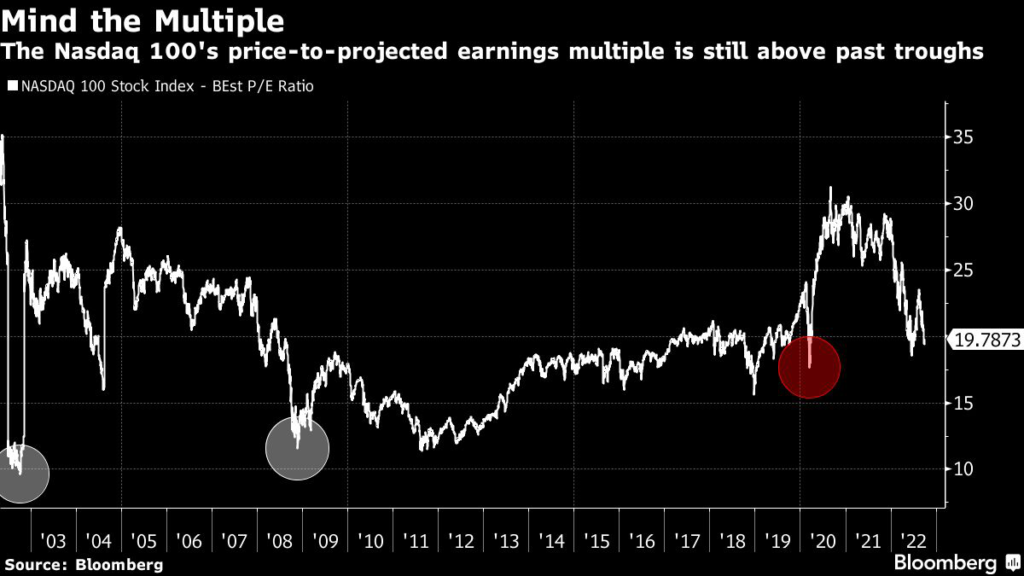
While bulls were no doubt heartened by Wednesday’s rally, one metric that’s still giving bottom hunters pause is valuation. The tech-heavy benchmark’s 30% plunge this year has removed a lot of froth, yet at 19.8 times projected profits, the index is still trading above past valuation troughs.

In the three recessions over the past two decades, the Nasdaq 100’s multiple bottomed around 13 times earnings estimates, on average, according to data compiled by Bloomberg.

On top of that, most investors expect profit estimates to fall as analysts start to factor in the deteriorating economy, a development that would shrink the denominator in the price-to-earnings equation and make valuations pricier. 

“It’s going to become more evident that earnings estimates are going to have to come down,” said Matt Maley, chief market strategist at Miller Tabak & Co. “As those estimates come down, it will show that many of these names are still expensive.”

The tech sector has seen estimates fall more than the average company this year. Estimates for 2023 profit growth for tech companies in the S&P 500 have declined about 6 percentage points since the start of 2022, compared with a drop of 4 percentage points for the broader index, according to data compiled by Bloomberg Intelligence. 

With two days left in the quarter, the Nasdaq 100 is down less than 0.1% since June 30, so it’s entirely possible the gauge finishes with a gain. That relatively buoyant performance reflects the summer rally that lifted the market from mid-June through mid-August. Since then, the market has slumped anew, pressured by the hawkish Fed. Now, the outlook for earnings is key to whether prices stabilize.

Should the index decline in the quarter, it would be the third straight quarterly drop, the longest since a similar streak that ended Sept. 30, 2002. The Nasdaq 100 fell 1.8% on Thursday. 

Bob Doll, chief investment officer at Crossmark Global Investments, agrees that estimates have further to fall but not as much as some of the more dire predictions are calling for. He expects tech stocks to struggle until inflation cools and the Fed signals it’s nearing the end of its tightening campaign.

“I suspect as we approach third-quarter earnings reports, we’re going to have more disappointments and that the earnings numbers will come down somewhat,” said Doll. “But as long as the consumer is OK, which they are, and corporations are OK, which they are, it’s hard to see big downside.”

Historically, earnings expectations have fallen about 15% to 20% in recessions, according to Mike Mullaney, director of global market research at Boston Partners.

“Everyone’s basically in the recession camp right now,” he said. “The third quarter is going to be a very important earnings quarter. I would expect estimates to come down dramatically.”


Tech Chart of the Day

The Nasdaq 100 might be down less than 0.1% in the third quarter, but that headline figure doesn’t tell the full story. The tech gauge rose as much as 19.3% in the quarter, only to come crashing back down as inflation surged and the Federal Reserve raised interest rates. While the swing in the first quarter of 2001 was much wider, the three months ending Sept. 30 will see the biggest intra-quarter gain erased.  

Top Tech Stories

  • Amazon.com Inc. announced a pay increase for hourly workers in the US that it says will take average starting wage for most front-line employees in warehousing and transportation to more than $19 an hour.
    • Amazon’s Astro robot, unveiled with fanfare last year but then shipped in very low quantities, should be more widely available within the coming months, the company’s devices chief said.
    • Amazon is encouraging customer service employees at some US call centers to work from home, signaling the company’s preference for remote work in certain roles that would help save money on real estate, according to people familiar with the matter.
  • SoftBank Group Corp. has started laying off employees at its loss-making Vision Fund, with cuts expected to exceed 20% of staff, people familiar with the matter said. Softbank founder Masayoshi Son is trying to wait out the tech slump so that he can pull off a successful initial public offering for Arm Ltd., the chip designer that SoftBank bought for $32 billion.
  • India plans to boost the financial incentives for manufacturers that make tablets and laptops in the country, wooing companies such as Apple Inc. and Dell Technologies Inc. as part of its bid to challenge China as a production base.
  • Traveloka has secured $300 million in new financing from investors including BlackRock Inc., as Southeast Asia’s biggest online travel startup counts on a post-Covid rebound to expand in the region.
  • Allegro.eu SA has cut its forecasts for this year as Poland’s biggest e-commerce platform sees risks that higher inflation and rising costs of living may bite into consumer demand. The stock slumped.

(Updates with market open.)

More stories like this are available on bloomberg.com

©2022 Bloomberg L.P.
Risk-Off Sentiment Returns With Focus on Inflation: Markets Wrap

(Bloomberg) — Risk-off sentiment returned to markets on Thursday as concern about inflation and the global economy overshadowed the Bank of England’s move to restore calm.

US equity futures declined as initial jobless claims fell, while the S&P 500 Index headed for its third straight quarter of losses for the first time since the global financial crisis. Technology shares slid in premarket trading, after Hong Kong’s Hang Seng Tech Index touched its lowest since inception and European stock valuations dropped to their lowest since 2012.

The dollar climbed and Treasuries slumped as investors focused on expectations the Federal Reserve will continue to deliver aggressive interest-rate hikes. The pound snapped a two-day gain and UK gilt yields rose as Prime Minister Liz Truss’s defense of unfunded tax cuts that sent markets into turmoil failed to persuade investors. 

European bond yields also rose as investors digested the latest inflation data and commentary from European Central Bank officials. Euro-area economic confidence dropped to the lowest since 2020 as Germany prepares to borrow as much as €200 billion ($194 billion) to finance a plan to limit the impact of soaring energy costs.

“Other than the dollar, there are not many assets that are trading constructively,” said Julia Raiskin, Asia-Pacific head of markets for Citigroup Inc. “The markets are very pessimistic. Investors are fairly on the sidelines.”

Investors are contending with threats posed by discordant moves from central banks over the past few days, with Fed officials adamant on further monetary tightening, the BOE unveiling a £65 billion ($71 billion) plan to support government debt and authorities in Asia trying to prop up weakening currencies.

“The central bank is in a very difficult position right now,” Julie Biel, Kayne Anderson Rudnick portfolio manager and senior research analyst, said of the BOE in an interview with Bloomberg TV. “Everyone has been a little bit backed into a corner in seeing the volatility and market reaction.”

Former Bank of England Governor Mark Carney accused the UK government of “undercutting” the nation’s economic institutions, and said that its fiscal plans were to blame for the drop in the pound and bonds. Simon Wolfson, the boss of Next Plc and a Conservative peer, also appeared to blame the Tory government for a crash in the currency and a worsening outlook for UK inflation, which the company cited as it lowered guidance for sales and profits. 

Next’s shares fell as much as 9.8% in London and an index of retailers plunged to the lowest in a decade. In other notable moves, Porsche AG rose after the largest initial public offering in Europe in more than a decade.

European miners rose and aluminum jumped by a record on the London Metal Exchange after Bloomberg reported the bourse plans to discuss a potential ban on new Russian metal supplies.

Separately, the European Commission announced an eighth package of sanctions that would include a price cap on Russia’s oil exports as Russia vowed to go ahead with the annexation of the parts of Ukraine that its troops currently control after UN-condemned votes, putting the Kremlin on a fresh collision course with the US and its allies.

How much damage is a strong dollar causing? That’s the theme of this week’s MLIV Pulse survey. It’s brief and we don’t collect your name or any contact information. Please click here to share your views.

Key events this week:

  • US initial jobless claims, GDP, Thursday
  • Fed’s Loretta Mester, Mary Daly speak at events, Thursday
  • China PMI, Friday
  • Euro zone CPI, unemployment, Friday
  • US consumer income , University of Michigan consumer sentiment, Friday
  • Fed’s Lael Brainard and John Williams speak, Friday

Some of the main moves in markets:

Stocks

  • Futures on the S&P 500 fell 1.4% as of 8:35 a.m. New York time
  • Futures on the Nasdaq 100 fell 1.8%
  • Futures on the Dow Jones Industrial Average fell 1.2%
  • The Stoxx Europe 600 fell 1.7%
  • The MSCI World index rose 1.1%

Currencies

  • The Bloomberg Dollar Spot Index rose 0.4%
  • The euro fell 0.4% to $0.9697
  • The British pound fell 0.3% to $1.0853
  • The Japanese yen fell 0.4% to 144.77 per dollar

Cryptocurrencies

  • Bitcoin fell 1.9% to $19,193.24
  • Ether fell 2.2% to $1,320.37

Bonds

  • The yield on 10-year Treasuries advanced eight basis points to 3.81%
  • Germany’s 10-year yield advanced 15 basis points to 2.27%
  • Britain’s 10-year yield advanced 19 basis points to 4.20%

Commodities

  • West Texas Intermediate crude was little changed
  • Gold futures fell 0.6% to $1,660.10 an ounce

More stories like this are available on bloomberg.com

©2022 Bloomberg L.P.

Close Bitnami banner
Bitnami
