Bloomberg

IPOs Vanish In Third Quarter as Market Mayhem Saps Deal Appetite

(Bloomberg) — The funding void created by this year’s stalled market for initial public offerings is getting deeper, leaving cash-hungry startups scrambling for backup plans.

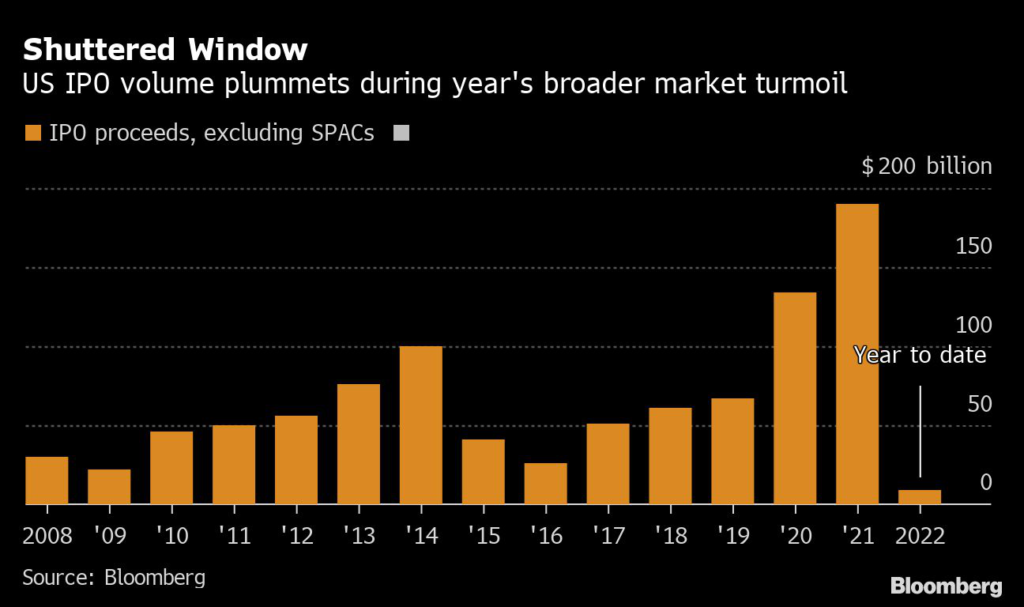
Surging interest rates and repeated market volatility have forced many companies to postpone plans for US IPOs. New issues raised just $2.7 billion in New York in the past three months, the lightest third quarter since 2008, according to data compiled by Bloomberg that excludes special purpose acquisition companies.

This is the third weak quarter in a row and represents a dramatic change from just last year, when historically low interest rates supported record levels of IPO activity. Many of the companies that were planning to go public in 2022 shelved the idea as valuations tumbled in a volatile market, Goldman Sachs strategists including Ryan Hammond wrote in a note on Wednesday. As a result, IPOs have raised $137 billion less than they did at this point in 2021.

“The market for initial public offerings has frozen this year,” they wrote. “The jump in the cost of capital has reduced the valuation of all companies, public and private. But the impact has been particularly severe for fast-growing firms that typically comprise a significant share of annual IPO volume.”

So, companies have sought other ways to raise funds. Private funding rounds by some firms are accompanying a slew of mergers with either large conglomerates or a buyer among an army of deal-hungry SPACs.

Meanwhile, new plans to go public are being announced at their slowest rate in years. Just 64 companies filed for potential IPOs during the third quarter, according to data compiled by Bloomberg, the fewest in any quarter since 2009. 

Deal Delays

“We’re getting into the kind of market where people are just saying there’s capitulation,” David Ethridge, US IPO services leader at PricewaterhouseCoopers LLP, told Bloomberg this month. “They’re busy people, and maybe they don’t want to fight at the board level about getting the process started when we’re not hearing anything good about IPOs.”

The developments are weighing on a strong pipeline. Top IPO candidates include Mobileye NV — Intel Corp.’s self-driving unit — plus pandemic darling Instacart Inc. and social-media firm Reddit Inc., home of the influential WallStreetBets community of retail traders. 

Intel this month scaled back its expectations for Mobileye’s valuation due to the broader market slump and might delay the listing until next year, according to people familiar with the process. Instacart, whose valuation also took a hit this summer, reportedly told investors that it wasn’t planning to issue many new shares in its IPO, which could happen as soon as the fourth quarter. Reddit’s listing also remains in limbo after previously targeting an IPO as soon as the first quarter of this year.

“People really don’t want to come to market when they could have gotten 20% more just a few months ago,” Georgetown University finance professor James Angel said in an interview. “We’re in a bear market and it feels like a recession is on its way. That means it’ll be a bumpy ride for the equity capital markets, and we probably wont see a lot of IPOs in these downdrafts.”

Tiny Bubbles

However, some of the smallest of firms in the market have provided an exception to the lull. An unusually frequent number of microcaps have delivered massive and often-fleeting price surges after conducting IPOs that typically raised less than $50 million apiece. This week, electric-vehicle charging firm Atlis Motor Vehicles Inc. traded as much as 918% above its offering price during its first two days as a publicly listed firm. 

Nasdaq is increasing its scrutiny of smaller listings after the string of pops that also included a 32,000% rally in AMTD Digital Inc. and spikes in firms such as Forza X1 Inc. and Treasure Global Inc.

Despite the year’s broader downturn, many dealmakers expect deal flow to return once the market stabilizes. Bank of America Corp. Chief Executive Officer Brian Moynihan this month called the pipeline “very full,” while JPMorgan Chase & Co. President Daniel Pinto expressed caution about cutting bankers in case the market bounces back.

Others, however, are less optimistic.

“We’ve had a very mild bear market after many years of rallies,” Angel said. “I remember living through the 1970s. It could get a lot worse.”

More stories like this are available on bloomberg.com

©2022 Bloomberg L.P.

Porsche Vows 911 Will Keep Its Roaring Engine as Long as Possible

(Bloomberg) — Porsche AG may be carving out a new future after pulling off Europe’s biggest listing in a decade, but the sports-car maker vowed that one thing will remain the same: The 911 running on gasoline.

Asked whether Porsche would electrify the iconic model introduced in 1964, Chief Financial Officer Lutz Meschke said while the company could flexibly react to new regulation, it’s reluctant to change the 911.

“It’s the core, it’s the heart, it’s the soul of our company,” Meschke said in an interview with Bloomberg Television’s Tom Mackenzie in Frankfurt. “We want to drive the 911 as long as possible with a combustion engine.”

READ: Porsche Rises in Landmark IPO Weathering Tough Markets 

Porsche shares debuted Thursday in Frankfurt, raising €9.4 billion ($9.1 billion) for parent Volkswagen AG, with another hint the iconic model is here to stay after the carmaker chose P911 as its ticker. 

While the Taycan electric vehicle outsold the 911 last year, the gasoline car remains Porsche’s most profitable model. Bloomberg Intelligence estimates the 911 makes up almost 30% of the company’s earnings on just 14% of unit sales. The 911 has a starting price of €113,492 in Germany.

“We can live very well” with the 911 as a combustion-engine car, Meschke said. “It’s very successful.”

(Adds 911 starting price in fifth paragraph.)

More stories like this are available on bloomberg.com

©2022 Bloomberg L.P.

Meta Rivals Want No Part of Defending Its Many Addiction Suits

(Bloomberg) — Meta Platforms Inc. says social media companies should stick together in a fight against dozens of lawsuits alleging they harm young people. 

Snap Inc., TikTok Inc., and Google say they’d rather go it alone.

A panel in St. Louis convenes Thursday to consider whether a single judge should be assigned to oversee suits across the US claiming the companies are causing teenagers to suffer from sleep deprivation, depression and anxiety — and even to take their own lives. Multidistrict litigation, or MDL, is used to centralize cases that raise common issues and promote efficiency. 

While Meta said in a court filing it would be impractical to split up the cases naming multiple companies as defendants, Snap, ByteDance Inc.’s TikTok, and Alphabet Inc.’s YouTube said they preferred to defend themselves separately.

They argued that Meta faces the bulk of the lawsuits, and that it would be inefficient for them to be dragged into the Instagram owner’s fight. 

TikTok said in a filing that the MDL process shouldn’t combine “competing defendants,” even if they offer similar products. YouTube objected to being forced to “participate in scores of cases in which it is not named as a party.”

When The Scrolling Doesn’t Stop: Social Media Lawsuits Pile Up

Snap, in a more nuanced argument, said the suits filed against it are different from those that target Meta. The apps are not, for example, “like chemically similar drugs that treat the same disease and have similar side-effects but are manufactured by different companies,” Snap said in a filing. 

Meta is named as a defendant in almost all of the more than 70 suits filed so far. Snap, which faces the next largest number of suits, has been named in about 20 cases. 

The suits against Meta stand out because they cite a whistle-blower’s complaint that Instagram knew from internal studies that many adolescent girls using the photo-sharing app were suffering from depression and anxiety around body-image issues.

More stories like this are available on bloomberg.com

©2022 Bloomberg L.P.

Palantir Extends Controversial Defense Contract That Google Abandoned

(Bloomberg) — Palantir Technologies Inc. has reupped and expanded more contracts with the US government that have been controversial within Silicon Valley. 

The Defense Department awarded the data analysis software company a broad deal to develop and deliver artificial intelligence and machine learning capabilities for the Special Forces, the Joint Staff and all branches the US armed services. The deal is worth up to $229 million over one year, the company announced Thursday. 

Palantir, co-founded by conservative billionaire Peter Thiel, has made support of the US and its allies core to the company’s identity. Thiel has attacked Palantir rival Google for eschewing work with military applications. Palantir’s latest deal is part of a program previously known as Project Maven, which made headlines in 2018 after employees at Alphabet Inc.’s Google objected to developing AI capabilities for the Defense Department. Google ditched the contract and Palantir took the lead, using AI and machine learning to improve existing video recognition software and analysis to increase the accuracy of actions like drone strikes.

Partly founded with seed money from the Central Intelligence Agency following the Sept. 11 attacks, Palantir has deep nationalistic roots. Thiel and Chief Executive Officer Alex Karp labeled Google’s abandonment of Project Maven as anti-American, and Palantir famously foreswore doing business in China and other countries not allied with American interests.

Earlier this week, Palantir announced another deal with the US, renewing its contract with Homeland Security Investigations, a division of Immigration and Customs Enforcement, or ICE. The latest contract is worth $95.9 million over a five-year period, the company said. Palantir has received criticism for its work with ICE in the past.

The deals further expand Palantir’s footprint within the US government. The company’s revenue from the public sector eclipses its revenue from its commercial clients. 

Palantir relocated its headquarters from Silicon Valley to Denver before going public in 2020, partly as a rebuke of its former home’s culture and strong democratic leanings. Since then, Palantir has made good on its promise to grow its revenue at a rate of more than 30% annually, although the company’s share price struggled even before the recent economic downturn. Palantir’s stock is down almost 70% over the last year. 

More stories like this are available on bloomberg.com

©2022 Bloomberg L.P.

BlackRock, Allianz Join $300 Million Travel Startup Funding

(Bloomberg) — Traveloka has secured $300 million in new financing from investors including BlackRock Inc., as Southeast Asia’s biggest online travel startup counts on a post-Covid rebound to expand in the region.

The Jakarta-based company said in a statement Thursday it struck a deal for financing with investors including Allianz Global Investors and the Indonesia Investment Authority.

The size of the funding round is significantly larger than the previously discussed target of about $200 million that Bloomberg News reported in June. Traveloka, backed by investors including GIC Pte and Expedia Group Inc., is considering an initial public offering in the US or in Indonesia, according to a person familiar with the matter, who asked to remain anonymous discussing a private matter.

Southeast Asia’s tourism industry plunged into crisis during the pandemic when lockdowns all but brought travel to a halt. Traveloka ventured into financial services during the pandemic by partnering with banks including PT Bank Rakyat Indonesia and PT Bank Negara Indonesia. Representatives for the startup declined to comment.

What Bloomberg Intelligence Says

The revenue of Southeast Asian online travel agents (OTAs) might gain from the speedy rebound in domestic and international travel in the region, helped by high smartphone ownership and low penetration of brick-and-mortar travel agencies. We expect industry leader Traveloka to grow faster than rivals such as Tripadvisor and Booking Holdings, with our scenario projecting sales to expand by more than 40% from 2021-25 vs. the industry’s 36%. Traveloka, along with Indonesia’s Tiket.com, appears more able to weather industry challenges, the most crucial of which is achieving profitability amid IPO plans.

– Nathan Naidu, analyst

Click here for the research.

Many countries are now removing pandemic-era restrictions and reopening borders. For example, Thailand — where international tourism contributes about 12% to gross domestic product — has seen a rush of foreign travelers in recent months after scrapping restrictions in July. 

Regional startups are raising funds despite worries about a global economic downturn, hoping to position themselves for an eventual rebound. Traveloka helps consumers book a range of services including airline tickets and hotels as well as spas and tourism attractions. It also offers food delivery and financing, payment and insurance products. Its app has been downloaded more than 100 million times, according to its website.

The valuation of the deal is unclear. Traveloka had been valued at $3 billion, according to CB Insights, but Bloomberg News reported in 2020 that it was seeking funds at a lower valuation.

(Updates with analyst’s comment from the fifth paragraph)

More stories like this are available on bloomberg.com

©2022 Bloomberg L.P.

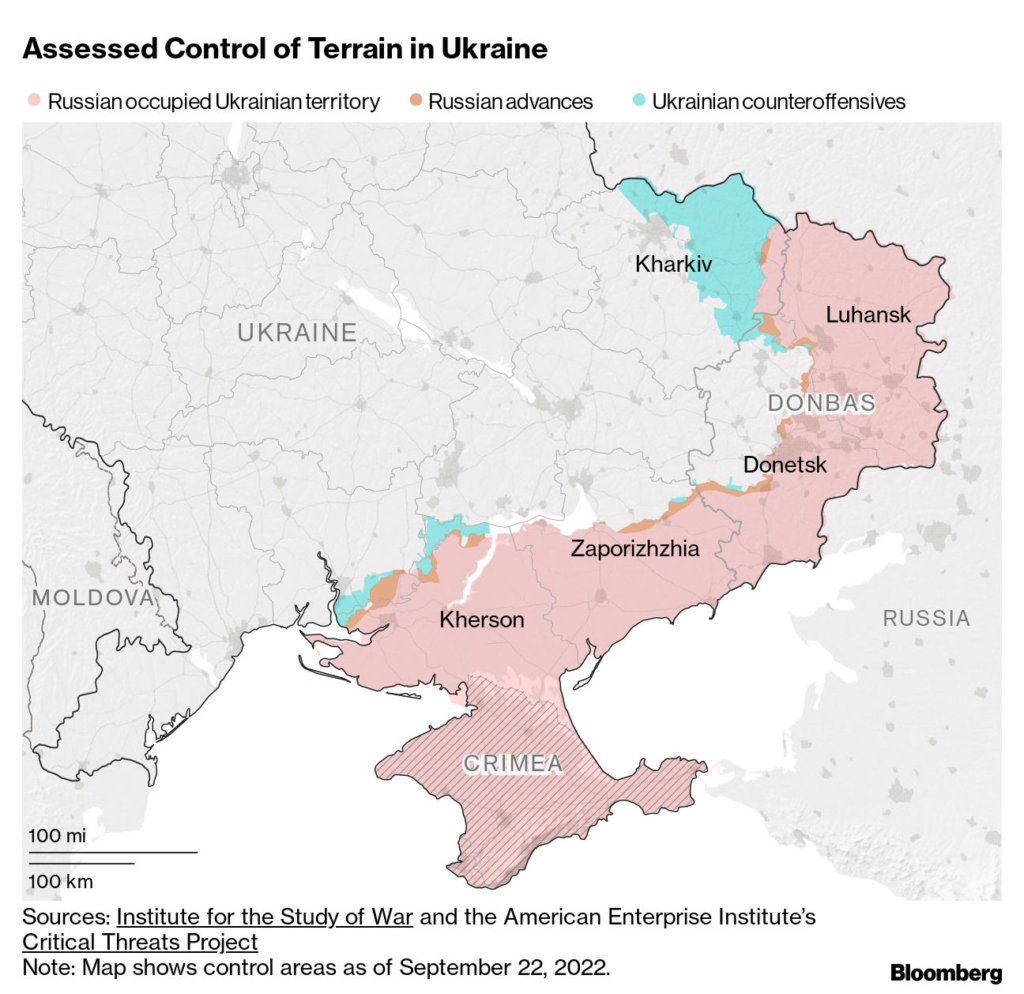
Ukraine Latest: NATO Calls Pipeline Leaks Reckless Sabotage

(Bloomberg) — NATO allies on Thursday said damage to the Nord Stream 1 and 2 natural gas pipelines appear to be “the result of deliberate, reckless and irresponsible acts of sabotage.” On Thursday, the Swedish Coast Guard’s Command Center identified a new pipeline leak in the Baltic Sea.  

The 18 High Mobility Artillery Systems that are part of the new $1.1 billion US assistance package to Ukraine have not yet been built and it will take a years before they’re delivered, a Defense Department official said Wednesday. 

European Commission President Ursula von der Leyen announced an eighth package of sanctions to target Russia over its attempt to annex more territory in Ukraine. The measures will include a price cap on Russian oil exports. 

(See RSAN on the Bloomberg Terminal for the Russian Sanctions Dashboard.)

Key Developments

  • More US Artillery Prized by Ukrainians Won’t Arrive for Years
  • Putin Raises Gas Pressure as He Moves to Annex Ukraine Lands 
  • Nord Stream Gas Pipes Now Have Four Leaks With Another Found 
  • Germany’s Network Regulator Sounds Alarm on Gas Consumption
  • Ukraine’s Plea for Tanks Bogs Down as US, Germany Confront Risks
  • Russia Declares Victory in Sham Ukraine ‘Referendums’

On the Ground

Russia struck the city of Dnipro with missiles overnight, including residential areas, local authorities said on Telegram. Three people, including a child, were killed. More than 60 private houses and several high-rise buildings were damaged. On Wednesday evening Russia launched five missiles towards Dnipropetrovsk and Zaporizhzhia regions, four of which were destroyed by air-defense forces, while one hit a grain-processing facility in Kryvorizka district, Ukrainian military’s southern command said on Facebook. More than 28 settlements, including Mykolaiv, Kryvyi Rih and Siversk, incurred Russian strikes over the past day, Ukraine’s General Staff said. Russian forces shelled the Kryvorizka district Thursday morning, hitting industrial infrastructure and wounding 13 workers, according to regional authorities. 

All times CET:

Regulator Says Germany Using Too Much Gas (11:43 a.m.)

Germany’s network regulator warned that households and companies used too much gas over the past week as temperatures dropped, and said savings of at least 20% are needed to avert a shortage of the fuel this winter.

Klaus Mueller, Bundesnetzagentur president, called the figures “sobering,” while cautioning that they provide only a “snapshot” and that the situation can quickly change.

Read more: Germany’s Network Regulator Sounds Alarm on Gas Consumption

Three Ships Leaves Ukraine’s Odesa-Area Ports (11:20 a.m.)

Three ships carrying Ukrainian agriculture products left the ports of Chornomorsk and Pivdennyi on the Black Sea on Thursday, the government said. 

The ships are bound for Africa and Asia, with cargoes including 27,500 tons of wheat to Tunisia. Ukraine has exported almost 5.5 million tons of agriculture products from three Black Sea ports since a safe-transit deal was reached with Russia in late July.

NATO Promises ‘Determined’ Response to Infrastructure Attacks (11:09 a.m.)

NATO allies warned that any deliberate attack against allies’ infrastructure would be met with a “united and determined response,” following gas pipeline leaks in the Baltic Sea discovered this week. 

In a joint statement, the North Atlantic Council echoed other officials, saying information currently indicates the leaks are the result of “deliberate, reckless and irresponsible acts of sabotage.” They added they are committed to defending against any “coercive use of energy or hybrid tactics by state and non-state actors.” 

Even as Poland has blamed Russia for the damage, the NATO statement refrained from naming any names as a joint investigation by Denmark, Sweden and Germany is under way.

Albania Says It Welcomes Russians, Lithuania Urges Citizens to Leave (11 a.m.) 

Albanian Prime Minister Edi Rama said Russians fleeing the country are “welcome” in Albania, according to Tirana-based portal Albanian Daily News. When it comes to the Balkan region, the Russian exodus so far has been focused on Serbia. 

In Lithuania, Defence Minister Arvydas Anusauskas reiterated advise for the country’s citizens to leave Russia, saying it’s “becoming a state where foreign citizens can simply become hostages” to the Kremlin regime. “No one can rule out that they won’t use foreign citizens as shields,” he said. 

Finland Sees Russia Turning More to Cyber-Spying (10:14 a.m.)

The war in Ukraine and the expulsions of Russian diplomats that followed have hampered Moscow’s espionage operations, causing the country increasingly to turn to the cyber environment for intelligence gathering, the Finnish Security and Intelligence Service, Supo, said in a national security overview.

Russia’s traditional method of spying is to use human intelligence under diplomatic cover and that has now “become substantially more difficult,” SUPO said. 

The security agency said authoritarian states “can secure access to or influence over critical infrastructure” via corporate acquisitions or investments. It identified China as a potential perpetrator, alongside Russia.

Read more: Finland Sees Russia Moving Espionage to Cyber Environment

Russian Stocks Brush Off New Sanctions Threat (9:32 a.m.)

Russia’s equity benchmark gained for a third day, trimming this month’s losses, as investors disregarded the threat of additional international sanctions and took advantage of the cheapest valuations on record.

The MOEX Russia Index gained as much as 2.1% on Thursday; it traded up 0.7% as of 10:30am in Moscow. 

Retailer H&M Takes Earnings Hit From Russian Exit (9:03 a.m.)

Retailer Hennes & Mauritz AB plans to cut costs by 2 billion Swedish kronor ($180 million) annually after its exit from Russia and higher garment and transport costs caused earnings to slump.

Operating profit dropped 86% in the three months through August. The figure includes a previously communicated one-time charge of 2 billion kronor for winding down operations in Russia. 

Fourth Nord Stream Leak Found by Sweden’s Coast Guard (8:30 a.m.) 

A new leak has been discovered on the Nord Stream 1 and 2 gas pipelines in the Baltic Sea, bringing the total number of ruptures to four, according to the Swedish Coast Guard’s Command Center. 

Gas has been bubbling up from the pipelines since earlier this week, with Denmark estimating that the links would empty by Sunday. Several governments have called the actions “deliberate” and “sabotage.” 

Lithuania’s Foreign Minister Gabrielius Landesbergis said the news was more evidence that the leaks are deliberate and “fit to be called a terrorist act.” 

Read more: Nord Stream Gas Pipes Now Have Four Leaks With Another Found 

Finland Reports Clear Drop in Russian Arrivals (8:21 a.m.)

Finland’s Border Guard said about 4,700 Russians crossed the border into the Nordic country on Wednesday, a “clear drop” compared with Tuesday, when more than 7,000 entered. 

Wednesday’s arrivals are comparable with the numbers from a week ago, when Vladimir Putin’s expanded military mobilization was announced. 

The UK defence ministry said that the Russian exodus in the past week “likely exceeds the size of the total invasion force Russia field in February,” with the better-off and well educated over-represented. 

Ukraine Infrastructure Minister on Time’s ‘Next 100’ List (8 a.m.)

Oleksandr Kubrakov was named this week to Time magazine’s “Next 100,” which recognizes “emerging leaders who are shaping the future.” 

The infrastructure chief, appointed in 2021, was cited in part for spearheading Ukraine’s grain exports under the UN/Turkey-brokered safe transit agreement from three Black Sea ports. The deal has seen more than 3 million tonnes of Ukraine’s agricultural products shipped after exports were halted after Russia’s invasion. 

Mykhailo Fedorov, Ukraine’s minister for digital transformation, was recognized by Time for being “at the center of an effort to counteract Russian propaganda in real time.” 

US Artillery Coveted by Ukraine Won’t Arrive for Years (10:59 p.m.)

The highly-prized HIMARS artillery system in the US’s latest $1.1 billion security assistance package for Ukraine will take a few years to be built and delivered, a Pentagon official said Wednesday.

The US announced it would send 18 High Mobility Artillery Systems, made by Lockheed Martin Corp., as part of the new assistance package. Unlike the 16 HIMARS already, the new ones will have to be produced under contract through the Ukraine Security Assistance Initiative, according to the official. 

Although Ukraine’s president welcomed what he called the “critical equipment that’ll bring victory closer,” the latest security assistance package is meant to be the beginning of a contracting process for Ukraine’s mid-to-long-term defense, the US official said. 

US Sending HIMARS Rockets, Armored Vehicles in $1.1 Billion Package (8:03 p.m.)

The Biden administration announced a $1.1 billion package of additional weapons and equipment to Ukraine.

White House Press Secretary Karine Jean-Pierre told reporters that it includes 18 new High Mobility Artillery Rocket Systems, beyond the 16 already committed. She said “it also includes hundreds of armored vehicles, radars and counter drone systems.”

Jean-Pierre also said sham referendums conducted by Russia in occupied areas of Ukraine “were straight from the Kremlin playbook. They were manufactured and manipulated. Ukrainian civilians were forced to cast ballots under the watch of armed guards.”

Putin’s Approval Rating Falls Amid Partial Mobilization (7:51 p.m.)

Approval ratings for Putin fell to 77% in September from 83% in August, according to the latest poll by the independent Levada Center. The first drop in approval since April comes days after Putin ordered a partial mobilization last week. The poll found 21% of respondents don’t approve Putin’s actions as his nation’s leader, the highest since February, when Russia invaded Ukraine.

Finland Says Only State Actor Capable of Nord Stream Sabotage (7:45 p.m.)

The rupture of the Nord Stream natural-gas pipelines in the Baltic Sea can only have been carried out by a state actor, Finland’s Foreign Minister Pekka Haavisto said.

“We’ve known that sabotage against critical infrastructure has been a realistic threat,” Haavisto told reporters in Helsinki on Wednesday. The acts appear to have been “deliberate” and “may have been intended to destabilize the Baltic Sea area,” Prime Minister Sanna Marin said at the same news conference.

Putin’s Draft Order Sparks Exodus of Russians (5:12 p.m.) 

At least 200,000 Russians left the country after Putin’s mobilization order in a dash for safety that’s causing turmoil at the borders and stirring fears in neighboring states about potential instability.

While Russia hasn’t released official data, statistics from Georgia, Kazakhstan and the European Union showed the scale of the departures amid fears among conscription-age men that the Kremlin may close the border for them. The total is likely an underestimate as other nearby countries popular with Russians including Armenia, Azerbaijan and Turkey haven’t disclosed arrival figures.

EU Announces New Sanctions Package (4:16 p.m.) 

The European Union proposed a new round of sanctions targeting Russia after Moscow announced a partial mobilization and staged widely condemned referendums on annexations in Ukrainian territory it’s occupying.

In addition to imposing a price cap on Russian oil, the measures will include an import ban on Russian products that will deprive Moscow of 7 billion euros ($6.7 billion) in revenue as well as export restrictions on aviation products, electronic components and chemical substances, von der Leyen told reporters in Brussels. 

Sanctions need to be approved unanimously by the EU’s 27 member states before they can be imposed.

Read more: EU Plans New Russia Import Bans, Tech Curbs Over Putin Land Grab


More stories like this are available on bloomberg.com

©2022 Bloomberg L.P.

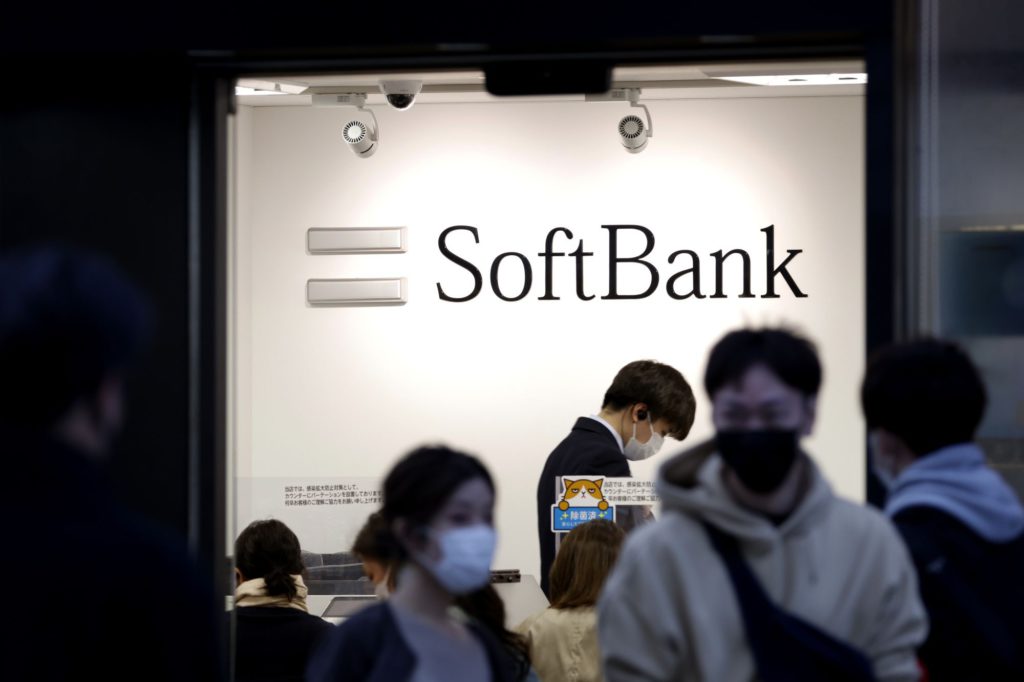
SoftBank Is Said to Have Started Vision Fund Staff Cuts

(Bloomberg) — SoftBank Group Corp. has started laying off employees at its loss-making Vision Fund, with cuts expected to exceed 20% of its staff, according to people familiar with the matter.

The Tokyo-based company informed some staff Thursday and at least 100 workers will likely be affected, said the people, asking not to be named as the information is not public. The Vision Fund unit, headquartered in London, had about 500 employees including Latin America funds staff. SoftBank had planned staff cuts of at least 20%, Bloomberg News reported earlier this month.

A spokesman for the Vision Fund didn’t immediately respond to requests for comment.

Founder Masayoshi Son, the billionaire founder of the group, had said in August he would implement cost cuts at his conglomerate and the Vision Fund investment arm after a record $23 billion loss. Most of the losses came from a plunge in the valuations of portfolio companies, including South Korea Coupang Inc. and DoorDash Inc. SoftBank also reported a $6 billion foreign exchange loss because of the weaker yen.

The Japanese entrepreneur said he would take defensive steps to navigate a prolonged tech downturn. SoftBank said last month that it had raised more than $17 billion by selling forward contracts on Alibaba Group Holding Ltd., the Chinese e-commerce company whose meteoric growth cemented Son’s reputation as a startup investor. 

Son is trying to wait out the technology slump so that he can pull off a successful initial public offering for Arm Ltd., the chip designer that SoftBank bought for $32 billion. The CEO is planning an initial public offering for Arm next year and has said he aims to make the offering the biggest-ever for a chip company.

More stories like this are available on bloomberg.com

©2022 Bloomberg L.P.
BYD-Backed RoboSense Seeks $150 Million in New Round

(Bloomberg) — RoboSense, a Chinese developer of sensor technologies used in self-driving cars, is raising about $150 million in a new funding round to bankroll its product expansion, according to people familiar with the matter.

The latest round has drawn investors including China Structural Reform Fund and Mirae Asset Securities Co., said the people, who asked not to be identified as the information is private. A number of existing investors of BYD Co.-backed RoboSense could also participate, one of the people added.

Deliberations are ongoing and some details may change, the people said. A representative for Mirae Asset Securities declined to comment, while representatives for BYD, China Structural Reform Fund and RoboSense didn’t immediately respond to requests for comment.

Founded in 2014 by Chief Executive Officer Qiu Chunxin, Shenzhen-based RoboSense has more than 1,000 employees and owns over 700 lidar-related patents globally as of end-2021, its website shows. Last year, the company signed a strategic cooperation agreement with BYD, which also invested an undisclosed amount, according to a statement.

Robosense is working with financial advisers on preparations for a Hong Kong initial public offering as soon as next year, Bloomberg News reported in December. A listing could raise as much as $1 billion, the people have said.

China Structural Reform Fund, a fund set up by China Chengtong Holdings Group Ltd. in 2016 with the approval of the State Council, manages about 350 billion yuan ($48.8 billion), according to Chengtong’s website. The fund has been involved in various mixed-ownership reform programs, helped state-owned enterprises in financial difficulty and recently stepped up investing in startups. It has participated in several Hong Kong initial public offerings as a cornerstone investor.


More stories like this are available on bloomberg.com

©2022 Bloomberg L.P.

How Is Crypto Affecting The Climate?

  • Listen to Bloomberg Crypto on the iHeartRadio App
  • Listen to Bloomberg Crypto on Apple Podcasts
  • Listen to Bloomberg Crypto on Spotify  

(Bloomberg) — On Sept. 27, Bloomberg reporters Allyson Versprille and David Pan participated in a Twitter Spaces with Costa Samaras, the White House’s chief advisor for energy policy in the Office of Science and Technology Policy.

They spoke about the office’s  crypto climate report and what’s next for US efforts. This episode features highlights from that conversation.

Follow us on Twitter @crypto, and subscribe to the Bloomberg Crypto Newsletter at https://bloom.bg/cryptonewsletter

More stories like this are available on bloomberg.com

©2022 Bloomberg L.P.

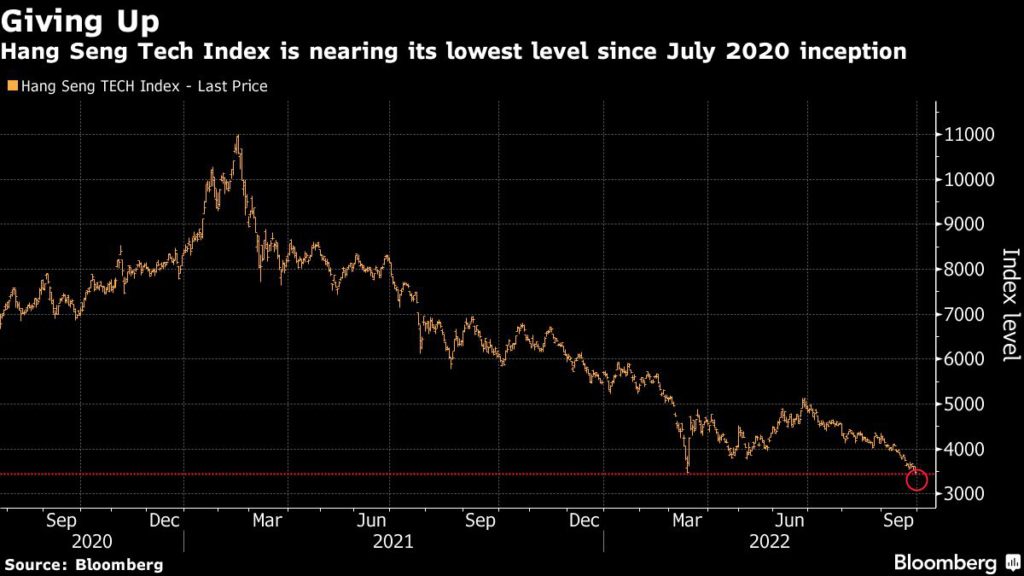
Hang Seng Tech Index Slides Toward Lowest Since 2020 Inception

(Bloomberg) — Chinese tech stocks slid as concerns about the Federal Reserve’s aggressive rate hikes and lingering regulatory risks mired the sector’s outlook. 

The Hang Seng Tech Index fell 1.2% on Thursday after briefly touching the lowest since its 2020 inception, dragged by shares of Xiaomi Corp. and Lenovo Group Ltd. The benchmark Hang Seng Index fell 0.5% to the lowest since October 2011.

Risk-off sentiment has deepened for Chinese growth shares after the Federal Reserve hiked interest rates by 75 basis points last week and signaled further pain ahead. The selling is also part of a global market turbulence triggered by the weakness in the pound, as investors worry the UK’s dramatic tax cuts may further fuel global inflation.

“Market sentiment is on a turbulent ride, driven by fluctuation of major currencies alongside governments’ intervention,” said Banny Lam, head of research at CEB International Investment Corp, adding that a weaker yuan is also hurting high-valuation tech stocks. 

The market tumble will be particularly jarring for authorities ahead of the Party congress meeting next month, a key twice-a-decade event. The CSI 300 Index, which is down more than 20% this year, is just 1.1% away from touching April 2020 lows. 

Authorities have tried to restore a semblance of calm in financial markets amid slowing growth, a property market crisis and concerns about Covid Zero policy. Earlier this month, Chinese regulators asked several big mutual fund houses and brokers to refrain from large sales of stocks before the event, even though it’s done little to boost shares.   

Meanwhile, many technology firms’ listing status in the US remains uncertain, with growing hostility between Beijing and Washington. US and Chinese authorities just had a tense start as they converged to discuss about reviewing audit work paper of the companies.   

(Updates throughout)

More stories like this are available on bloomberg.com

©2022 Bloomberg L.P.
Close Bitnami banner
Bitnami