

Bloomberg

Nord Stream Gas Leaks Could Be ‘Unprecedented’ Climate Disaster

(Bloomberg) — The 700-meter wide pool of bubbling water in the Baltic Sea caused by the rupture of the Nord Stream gas pipelines points to a climate disaster.

It’s the most visible of three major gas leaks emanating from the pipelines connecting Russia to Germany. Scientists are scrambling to work out just how much methane, one of the most powerful greenhouse gases, has escaped into the atmosphere. The fear is that it could be one of the worst releases ever.

The cause of the three near-simultaneous pipeline ruptures hasn’t been confirmed, but German and US officials said the incident looked like sabotage. 

While the Nord Stream 1 pipelines were halted — and Nordstream 2 had never even started — they all contained pressurized natural gas, the vast majority of which is methane.

“Given that, over twenty years, a ton of methane has a climate impact more than 80 times that of CO2, the potential for a massive and highly damaging emission event is very worrisome,” said David McCabe, senior scientist at Clean Air Task Force, a climate nonprofit. “There are a number of uncertainties but, if these pipelines fail, the impact to the climate will be disastrous and could even be unprecedented.”

Estimating the precise amount of methane that has escaped into the atmosphere is an extremely challenging task. Many so-called super-emitting events — large continuous discharges of methane — are captured by satellite imagery over land-based pipelines or fossil-fuel production sites. But capturing accurate data over water, is far more challenging given the light that reflects of the surface.

Read this QuickTake on the impact of methane on the atmosphere

There are a number of other key uncertainties — how much gas was in the pipelines at the time, what temperature and pressure it was being held at, and just how big the size of the rupture in the pipes was. Even when the gas escapes, some is likely to have dissipated into the water,  but that also depends on the density of microbial life, as well as the depth. To obtain accurate readings, a plane would probably have to take measurements from the air.

Despite that, scientists on social media were quick to do some back-of-the envelope calculations into just how much methane might have escaped. Andrew Baxter, director of energy strategy at the Environmental Defense Fund, estimated that around 115,000 tons of methane escaped, equivalent to around 9.6 million tons of Carbon Dioxide. In real terms, that’s the same climate impact as the emissions from 2 million gasoline cars over the course of a year, or two-and-a-half coal-fired power stations.

If that’s close to being accurate, it would be one of the biggest methane leaks ever. The biggest known release in the US, happened at gas storage facility in Aliso Canyon, Los Angeles, in 2015, where an estimated 97,100 metric tons of methane was emitted over several months. By comparison, the Nord Stream leaks may have happened over the course of several hours.

The expulsion of methane, comes amid growing public consciousness of its effects on the climate. At the COP26 summit in Glasgow, Scotland, over 100 countries pledged to drastically curb emissions. The European Union is also in the process of legislation that would raise the obligation on companies to reduce flaring of the gas, conduct regular inspections to stem leaks and boost transparency of leaks associated with imports.

At an event in the European Parliament Tuesday evening to launch “methane week,” lawmakers, scientists and environmentalists discussed how to measure the scale of the leak, but were united on one thing — it is likely to be an environmental disaster. The Green group’s co-lead negotiator for the bloc’s methane regulation, Jutta Paulus, pointed the finger firmly toward Russia, coming the same week as the Baltic Pipeline — connecting Norway to Poland — was opened.

“‘I don’t think it’s a coincidence that this is happened on the day the Baltic pipeline was opened,” Paulus said at the event. President Vladimir Putin is telling us “be sure you know what you’re doing when you’re applying more sanctions on us. We have to use all possibilities to apply energy efficiency and ramp up renewables.”

More stories like this are available on bloomberg.com

©2022 Bloomberg L.P.
Why Crypto Won’t Make You Rich

  • Listen to Bloomberg Crypto on the iHeartRadio App
  • Listen to Bloomberg Crypto on Apple Podcasts
  • Listen to Bloomberg Crypto on Spotify  

(Bloomberg) — If you’ve ever found yourself on Crypto Twitter, you’ll be familiar with the hype machine that keeps the industry’s thousands of projects going. Rallying cries of “WAGMI” — an acronym for We’re All Going To Make It — and “To the Moon!” abound, found in tweets from accounts with colorful, graphic profile pictures and usually a hashtag or two.

But there are two sides to every story, and if you’ve come across a Twitter display name featuring the Tulip emoji, you might find a crypto skeptic instead. A reference to the Dutch tulip mania of the 1600s, these figures – technologists, academics and writers among them – are working to counteract crypto enthusiasts’ bullish zeal with a dose of reality.

Stephen Diehl is a software engineer by trade, a leading crypto skeptic and now co-founder of the recently established Center for Emerging Technology Policy. He joins this episode to examine crypto’s promises of a brighter tomorrow, and uncover the parts that might actually be closer to myth.

Follow us on Twitter @crypto, and subscribe to the Bloomberg Crypto Newsletter at https://bloom.bg/cryptonewsletter

More stories like this are available on bloomberg.com

©2022 Bloomberg L.P.
NFT Trading Volumes Collapse 97% From January Peak

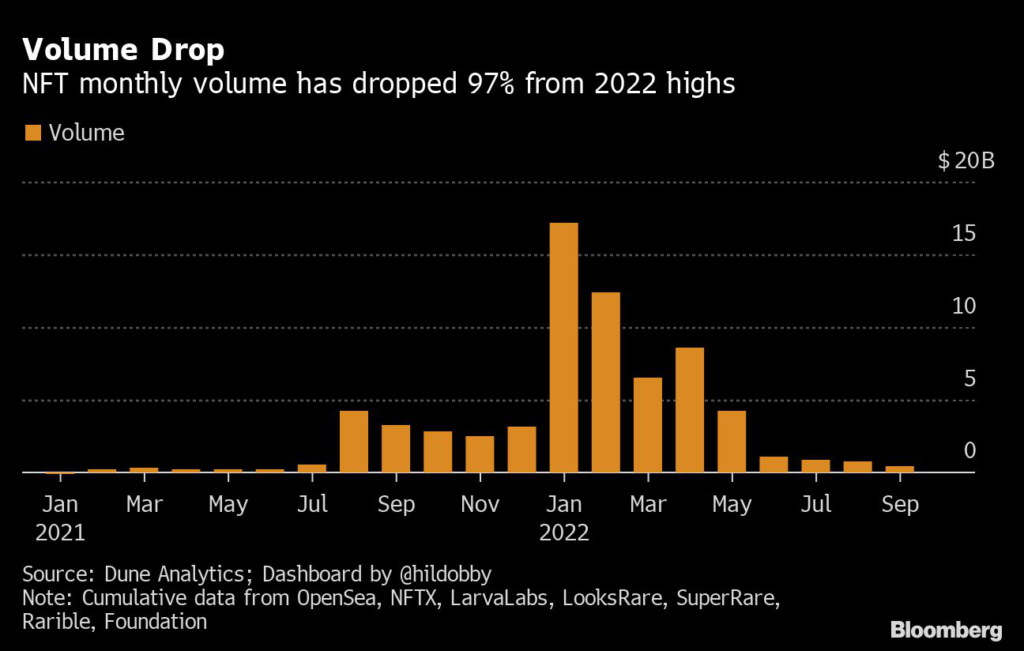
(Bloomberg) — Trading volumes in nonfungible tokens — digital art and collectibles recorded on blockchains — have tumbled 97% from a record high in January this year. They slid to just $466 million in September from $17 billion at the start of 2022, according to data from Dune Analytics. The fading NFT mania is part of a wider, $2 trillion wipeout in the crypto sector as rapidly tightening monetary policy starves speculative assets of investment flows.


More stories like this are available on bloomberg.com

©2022 Bloomberg L.P.
Russia Is Keeping Unsold Gas Underground Rather Than Flaring It

(Bloomberg) — The economic impact of Russia’s gas shutoff is dominating European politics, but there are also concerns about the environmental consequences. 

Officials from the bloc fear that Gazprom PJSC could be burning off fuel at its fields instead of exporting it to Europe. The evidence indicates those concerns are unfounded. 

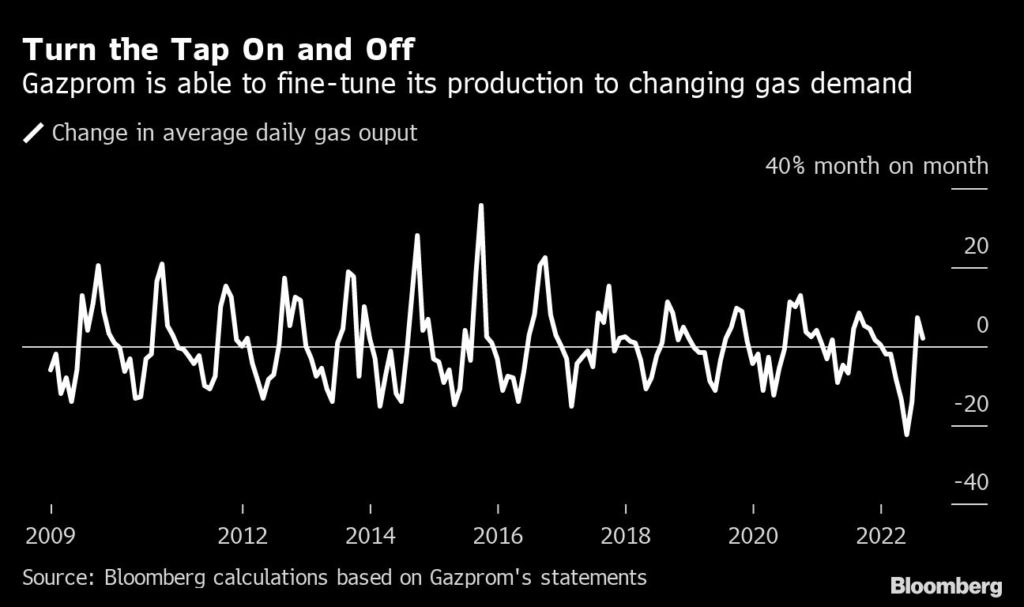
Surplus Russian gas is staying below the Siberian permafrost because the country’s fields have the flexibility that allows Gazprom to turn flows up or down as required, according to satellite data, industry analysts and the company’s historical figures. 

As the rift between the Kremlin and the west deepened after the invasion of Ukraine, Gazprom slashed its total deliveries to key foreign markets by 39% between January and mid-September. The deliberate rupturing by persons unknown of three halted pipelines that used to deliver Russian gas to Germany suggests the reduction in exports could be long lasting.  

The amount of gas observed being flared — burned off into the atmosphere — at Gazprom’s key production area in the Yamal peninsula between Aug. 10 and Sept. 21 averaged 1.18 million cubic meters a day, according to Bloomberg calculations based on satellite data analyzed by the Earth Observation Group at the Payne Institute for Public Policy, of the Colorado School of Mines. 

That’s nearly 28% below flaring levels observed in the area over the same period a year ago, the calculations show. It is above the average from the same timeframe in 2020, which was slightly more than 1 million cubic meters a day.

Gazprom’s Yamal flaring “trend has not changed in the past several months,” said Dr. Mikhail Zhizhin, researcher at Payne Institute for Public Policy, who analyzed the data. 

The observed flaring volumes are just a tiny fraction of Gazprom’s daily production, which averaged 838 million cubic meters from August through to mid-September. Output was down by 473 million cubic meters per day from the same period a year ago as exports to Europe were squeezed, Bloomberg calculations show. The producer’s daily shipments to key markets dropped by 302 million cubic meters compared to August-September 2021.

The flaring figures are based on night-time data from satellites measuring high radiant emissions associated with gas flares. The night-time detections are validated against daytime satellite images, as well as geographical and geological meta-data published by Russian oil and gas producers and governmental agencies. Cloudy nights limit detection of flares. 

Giant Fields

Even with the relative stability of flaring at Gazprom’s key gas production areas, Russia is still indisputably the worst offender when it comes to burning off gas into the atmosphere, according to data from the World Bank. The nation flared a total of 25.4 billion cubic meters of gas last year, the data show.

The Yamal peninsula is home to Gazprom’s largest fields, including the giant Bovanenkovо project that alone pumps over 20% of the producer’s total gas output. Yamal has been the main source of Russian gas supplies to Europe, which have been throttled since May as the Kremlin’s relationship with the West deteriorated over the invasion of Ukraine. 

Demand for natural gas has always been seasonal in nature, driven to a large extent by the need for heating in winter. Gazprom “has demonstrated that they could deal with higher balancing requirements without damaging fields’ productive capacities” said Vitaly Yermakov, senior research fellow at the Oxford Institute for Energy Studies.

Gazprom did not respond to a request for a comment.

“Due to the uneven consumption patterns, Gazprom has to change its production significantly on monthly basis every year,” said Vyacheslav Kulagin, head of department at the Energy Research Institute in the Russian Academy of Sciences.  “Gazprom’s several major upstream projects function like gas cylinders, where the tap is sometimes opened to the full, and sometimes significantly turned down.”

More stories like this are available on bloomberg.com

©2022 Bloomberg L.P.
Mike Novogratz Says Crypto More Resilient After Forced Seller Exodus

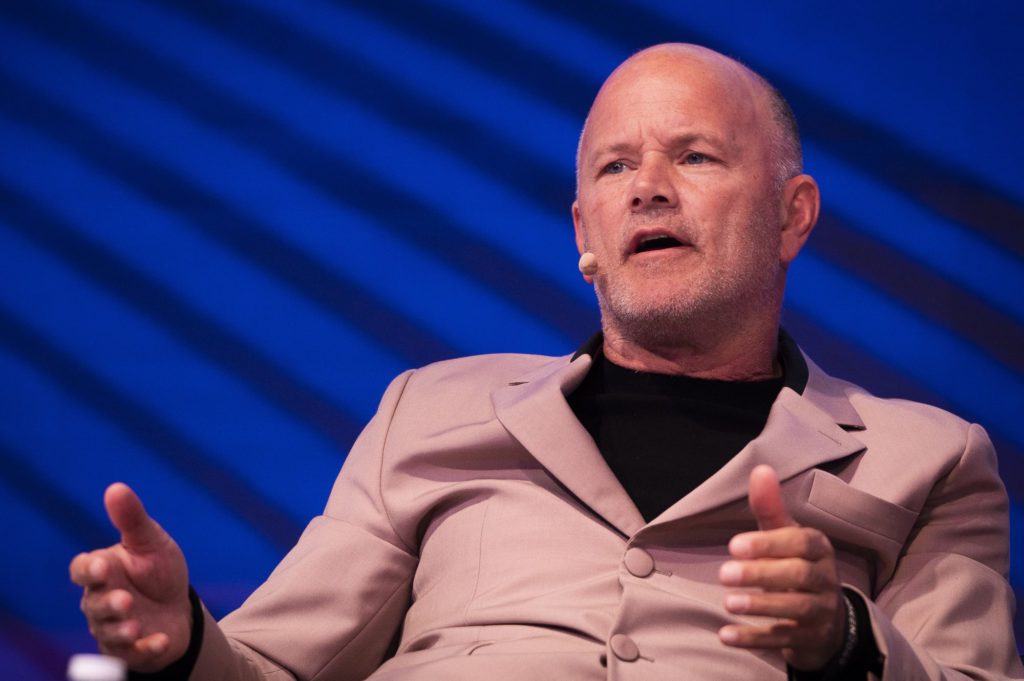
(Bloomberg) — Mike Novogratz, the billionaire founder of Galaxy Digital Holdings Ltd., said cryptocurrencies have been relatively resilient in the past month partly because there aren’t many forced sellers left in the sector.

“We’re in this weird equilibrium where there are a few buyers, there are a few sellers, and there’s not that energy in the market like you’re seeing in the equity market or the bond market where you have to sell, right?” Novogratz said.

A lot of leverage has been taken out of the crypto sector, he added in a discussion with Bloomberg’s Haslinda Amin at a conference in Singapore.

Digital tokens will take off again as soon as the Federal Reserve flinches from its current path of aggressive monetary tightening, but not in a sustainable fashion until mass adoption of Web3 projects, he added.

The term “Web3” refers to a vision of a decentralized internet built around blockchains, crypto’s underlying technology.

Novogratz also said:

  • Many crypto hedge funds won’t survive 2022’s rout in virtual coins
  • Galaxy Digital will probably slow down the pace of hiring
  • The implosion of Do Kwon’s Terraform Labs project was “heartbreaking” and a lesson for the crypto industry
  • Kwon is among the smarter people he’s met and “I wish him well”

Novogratz was a big backer of Terraform Labs. Kwon’s location is unclear and he is the subject of an Interpol red notice in the fallout of the collapse of his Terra ecosytem.

More stories like this are available on bloomberg.com

©2022 Bloomberg L.P.

Boohoo Issues Profit Warning as Shoppers Cut Back on Clothes

(Bloomberg) —

Boohoo Group Plc stock plunged after it cut profit guidance for the year as soaring energy and food bills stopped consumers from splashing out on clothes and shoes. 

The British online fashion retailer now expects an earnings margin of between 3% and 5%, compared with previous guidance of 4% to 7%. Boohoo said Wednesday that revenue dipped 10% in the first half, and is expected to keep falling due to inflation and weaker consumer demand. The stock fell as much as 18% in early trading in London. 

Boohoo, whose other brands include PrettyLittleThing and Nasty Gal, reported its first-ever UK sales decline in June as the cost-of-living crisis adds to supply-chain woes and waning pandemic consumer trends. The company also cut its sales projections twice last year and is recovering from a labor scandal in 2020 which sparked governance changes. 

“There’s no doubt that consumer confidence is weak,” Chief Executive Officer John Lyttle said in a phone interview. “I don’t think any consumer is able to avoid the current inflationary pressures so everything, whether you go out for a drink or buy food at the supermarket, everything is impacted by inflationary pressures.”

Shoppers are tightening their purse strings in the UK, Boohoo’s home market, as inflation soars to the highest level in four decades and as new Prime Minister Liz Truss’s emergency measures have yet to ease the load on consumers. Sales in the UK, which accounts for 62% of group revenues, declined by 4%, in part due to a much higher rate of product returns. 

A recent report from the British Retail Consortium and KPMG said clothing sales in the UK were “sluggish” in August amid weaker confidence among consumers. 

What Bloomberg Intelligence Says:

Boohoo’s profit warning reflects its long list of problems which are likely to last throughout fiscal 2024, accelerated by the cost of living crisis in the UK (62% of sales) and the lack of an international warehouse that’s hurting US demand (sales down 29%).

— Tatiana Lisitsina, BI retail analyst

Boohoo’s Pofit Warning Reflects Issues Lasting Into 2024: React 

Boohoo is seeking to control costs and is carrying less stock than before to be as flexible as possible against an uncertain consumer backdrop.

“We need to be agile and manage our costs as best as possible and be in a position to chase demand when it’s there,” said Lyttle.

Further afield, Boohoo’s performance in the US was also below expectations with revenue dropping 29% on the prior half with revenue also down 2% in the rest of Europe. In the US, Boohoo is also facing supply chain issues as deliveries take an average of 10 days compared with three to five days before the pandemic, said Lyttle.

Boohoo started charging customers £1.99 ($2.12) for returns this summer, following Zara owner Inditex SA imposing fees for online returns to tempt customers back into its brick-and-mortar stores. It reiterated Wednesday that return rates are “up significantly” from a year ago and higher than pre-pandemic levels.

(Updates with share move in first graph, CEO comments from fourth graph.)

More stories like this are available on bloomberg.com

©2022 Bloomberg L.P.
London Coroner to Review Instagram and Pinterest Role in Teen’s Suicide

(Bloomberg) — Senior Meta Platforms Inc. and Pinterest Inc. executives were quizzed over the malign influence of social media algorithms on young people at an inquest into the death of a British teenager.  

A two-week London inquest is examining factors that caused the death of 14-year-old Molly Russell who died by suicide in 2017. The coroner will decide whether her prolific social media use played a part. 

Russell, who was suffering from poor mental health, engaged with tens of thousands of social media posts in the six months before she died that included “dark” content depicting self harm and suicide. She was an active user of Pinterest and Meta’s Instagram. 

Russell had liked, shared or saved a total of 16,300 posts on Instagram, 2,100 of which were self-harm related, in the six-months before her death, according to her family’s lawyers. On Pinterest, Russell had 5,793 pin impressions and 2,692 close-ups in the same time period — types of engagement on the site.

A raft of lawsuits have been filed in the US against Big Tech from young people who claim social media addiction caused them to develop serious mental health issues. Meta whistle-blower Frances Haugen accused the company of knowingly preying on vulnerable young people to boost profits.

Read More: When The Scrolling Doesn’t Stop: Social Media Lawsuits Pile Up

Elizabeth Lagone, Meta’s head of health and wellbeing, was questioned on whether a number of posts interacted with by the teenager were “graphic depictions” of self harm and if they were safe for children. 

She said that some of the content could be “helpful” to people struggling with their mental health. She separately said the mobile app was “safe for people to be able to express themselves.”

However, the judge, Andrew Walker, told Lagone that she hadn’t once accepted “that this material might cause distress.” Walker warned on Monday there would be “distressing” videos shown as evidence that sought “to romanticize and in some way validate” harm to young people. 

A Meta spokesperson said these were complex issues and it had “never allowed content that promotes or glorifies suicide and self harm.” Since 2019 the company said it had updated its policies and deployed new technology to remove more violating content.

“Months of exposure to this material on social media, where a drip feed of daily hopelessness was actively promoted to her, affected Molly’s decision making and thought processes,” Ian Russell, her father, said in documents prepared for the hearing.

The UK was close to implementing sweeping new online safety laws for children aimed at protecting young people online. However, the Online Safety Bill could now be at risk of being altered by Prime Minister Liz Truss’s new administration after concerns were raised that some clauses risked stifling free speech.

Jud Hoffman, Pinterest’s head of community operations, gave evidence last week that the site was “not safe” when the teenager was using it in 2017. 

“We’ve strengthened our policies and enforcement practices around self-harm content, provided routes to professional and compassionate support for those in need,” a Pinterest spokesperson said. 

Anyone feeling emotionally distressed or suicidal can call Samaritans for help on 116 123 or email jo@samaritans.org.

EXPLAINER: Why EU Decided Tech Giants Can’t Police Social Media

More stories like this are available on bloomberg.com

©2022 Bloomberg L.P.

Dollar Rallies, Stocks Slump as Volatility Spikes: Markets Wrap

(Bloomberg) — The dollar soared after the White House talked down the prospect of a currency agreement to weaken the greenback and equities extended declines in Asia after hawkish comments from Federal Reserve policymakers.

Global stocks were headed for the lowest level in almost two years as major market levels crumbled. Hong Kong’s Hang Seng benchmark was at a decade low, the yield on 10-year Treasuries breached 4% for the first time since 2010 and a gauge of the greenback set another all-time high.

European and US futures slid, extending a move that saw the S&P 500 cap its worst run since early 2020. Apple Inc. scrapped plans to increase iPhone production, further weighing on sentiment.

The dollar’s rally brought further loses to the pound and the euro, while the onshore yuan fell to the weakest level against the greenback since the global financial crisis in 2008. The yen remained near the key 145 mark versus the dollar and within sight of levels that have drawn intervention from Japan.

The moves in the Treasuries continues to reverberate through bond markets. The Bloomberg Global Aggregate Index of government and corporate bonds has lost more than 20% since end-December and is in the first bear market since its inception in 1990.

Australia’s 10-year yield reached a three-month high while Japan’s benchmark yield was untraded after closing at the upper limit of the central bank’s target band on Tuesday.

Read More: Stock Bear Market Will Get Whole Lot Worse When Credit Cracks

Fed official James Bullard reiterated the central bank’s determination to tame inflation with tighter monetary policy, increasing the divergence with Japan and China. The urgency in the tone from Bullard and his US colleagues also contrasts with the Bank of England, which looks like it will wait until the next scheduled meeting in November to address inflationary forces triggered by planned tax changes and government spending.

“The fact we have such a strong increase in US yields is attracting flows into the US dollar,” said Nanette Hechler-Fayd’herbe, chief investment officer of international wealth management for Credit Suisse Group AG. “As long as monetary and fiscal policy worldwide are really not coming to strengthen their own currencies, we should be anticipating a very strong dollar.”

Leaks to a gas pipeline between Russia and Western Europe were labeled as sabotage by US and German officials, ratcheting up friction with Vladimir Putin’s regime. Russia threatened to cut off gas to Ukraine’s allies in Europe and annexed a large chunk of Ukraine in the latest signs of escalating conflict.

European gas prices rose while worries about slowing global growth weighed on other raw materials, sending a Bloomberg index of commodity prices to the lowest level since February. West Texas Intermediate crude fell to around $77 per barrel. The stronger dollar and signs of growing US stockpiles countered speculation that OPEC+ will cut output.

Dollar strength and diverging interest rate policy has formed a “negative feedback loop” for commodities, Goldman Sachs Group Inc. analysts warned in a note. “Market liquidity has fallen, volatility has risen and investor confidence in the bullish commodity outlook has evaporated.”

How much damage is a strong dollar causing? That’s the theme of this week’s MLIV Pulse survey. It’s brief and we don’t collect your name or any contact information. Please click here to share your views.

Key events this week:

  • Fed’s Mary Daly, Raphael Bostic, Charles Evans and ECB President Christine Lagarde speak at events, Wednesday
  • Euro zone economic confidence, consumer confidence, Germany CPI, Thursday
  • US initial jobless claims, GDP, Thursday
  • Fed’s Loretta Mester, Mary Daly speak at events, Thursday
  • China PMI, Friday
  • Euro zone CPI, unemployment, Friday
  • US consumer income , University of Michigan consumer sentiment, Friday
  • Fed’s Lael Brainard and John Williams speak, Friday

Some of the main moves in markets:

Stocks

  • S&P 500 futures fell 0.5% as of 7:17 a.m. in London. The S&P 500 declined 0.2%
  • Nasdaq 100 futures lost 0.8%. The Nasdaq 100 rose 0.2%
  • The Topix index dropped 1%
  • Australia’s S&P/ASX 200 Index fell 0.5%
  • The Kospi index slipped 2.5%
  • The Hang Seng Index declined 2.5%
  • Shanghai Composite Index fell 1%
  • Euro Stoxx 50 futures dropped 0.8%

Currencies

  • The Bloomberg Dollar Spot Index rose 0.3%
  • The Japanese yen was little changed at 144.72 per dollar
  • The euro slid 0.4% to at $0.9560
  • The British pound fell 0.5% to $1.0683
  • The offshore yuan fell 0.8% to 7.2341 to the dollar

Cryptocurrencies

  • Bitcoin fell 1.3% to $18,818
  • Ether dropped 3.0% to $1,285

Bonds

  • The yield on 10-year Treasuries advanced three basis points to 3.97%
  • Australia’s 10-year yield rose six basis points to 4.08%

Commodities

  • West Texas Intermediate crude slid 1.5% to $77.36 a barrel
  • Gold fell 0.3% to $1,623.22 an ounce

More stories like this are available on bloomberg.com

©2022 Bloomberg L.P.

Crypto Leadership Upheaval Gives Fresh Jolt to Industry

(Bloomberg) — Another round of executive departures hit the crypto industry Tuesday, the latest sign that the fallout from this year’s steep drop in prices — also marked by a pullback in venture capital, widespread layoffs and growing regulatory scrutiny — has yet to run its course.  

First came word that Celsius Network Ltd.’s Chief Executive Officer Alex Mashinsky — who helped found the crypto lender and was a cheerleader for its sky-high yield offerings until the company ran into trouble — resigned, calling his leadership an “increasing distraction” as the company struggles to survive its bankruptcy proceedings. Then FTX US President Brett Harrison announced he was stepping down at the crypto exchange and moving into an advisory role. He will be replaced by Zach Dexter, head of FTX US Derivatives, according to a company spokesperson.

“These are both high-profile resignations in the crypto space,” said Ed Moya, senior market analyst at Oanda. The changes represent a “short-term setback” that poses more uncertainty for the crypto industry, Moya said. But, he added, the leadership shakeups also make sense given the crypto market’s sharp downturn following a period of intense growth and hiring. Bitcoin, the biggest cryptocurrency, is down 60% this year after rising to an all-time high of almost $69,000 last November.

Mashinsky and Harrison add to a growing list of executive turnover in crypto. Jesse Powell, the often controversial co-founder of crypto exchange Kraken, announced last week that he was giving up the role of CEO to become chairman. Genesis CEO Michael Moro stepped down as the crypto broker slashed its workforce.  

Alameda Research co-CEO Sam Trabucco also gave up his title as he said it was difficult for him to spend a normal amount of time at work and that he had been enjoying seeing friends and family. Michael Saylor, the long-time CEO of MicroStrategy Inc., stepped aside to become executive chairman after the software maker and Bitcoin buyer reported a more than $1 billion quarterly loss related to the cryptocurrency’s huge price plunge.

The added stress of managing in a prolonged crypto downturn may be contributing to the wave of resignations. 

“The top executives have to manage several challenges like low cash flows, rising refinancing costs and very selective interest from venture capitalists,” said Alessio Quaglini, the co-founder and of Hex Trust and Clearpool. “That’s putting pressure on executives who were used to burning cash in 2021.”

Some of these departures were more surprising than others. While firms such as Celsius and Genesis experienced financial difficulties exacerbated by the downturn that could help explain a change in leadership, FTX US’s global affiliate, FTX, still has cash on its balance sheet and expects to be profitable this year, CEO Sam Bankman-Fried said in an interview with Bloomberg Television on Tuesday. 

Dan Matuszewski, co-founder of CMS Holdings, which has invested in FTX, spoke highly of Harrison’s leadership and said he was deeply involved with every product the exchange put out. “He reminded me a lot of Sam [Bankman-Fried],” Matuszewski said.

He did note that the “tumultuous” US regulatory environment could have posed a challenge for Harrison. Last month, FTX US received a cease-and-desist letter from the Federal Deposit Insurance Corp. due to “false or misleading statements” about certain products being eligible for insurance protection, which included a now-deleted tweet by Harrison as an example. “We really didn’t mean to mislead anyone, and we didn’t suggest that FTX US itself, or that crypto/non-fiat assets, benefit from FDIC insurance,” Harrison said at the time. 

As for whether Bankman-Fried has intentions to step down from FTX, he told Bloomberg on Tuesday that he wasn’t spending time on succession planning.  

“I’m going to be here for the long term,” he said.

(Updates with comment in 6th paragraph.)

More stories like this are available on bloomberg.com

©2022 Bloomberg L.P.

Bitcoin Reserve Linked to Fugitive Do Kwon Denies Moving Tokens

(Bloomberg) — A Bitcoin reserve connected to fallen crypto entrepreneur Do Kwon denied transferring digital tokens after a trail of coin movement prompted South Korean prosecutors to take steps to freeze assets.

The reserve, the Luna Foundation Guard, said on Twitter that it “hasn’t created any new wallets or moved $BTC or other tokens held by LFG since May 2022.”

The tweet emerged after prosecutors Tuesday sought to freeze assets linked to Kwon, who is wanted in South Korea on suspicion of breaking securities laws amid the $60 billion implosion of his Terraform Labs crypto ecosystem.

Prosecutors have confirmed reports that they sent requests to crypto exchanges KuCoin and OKX to freeze a total of 3,313 Bitcoins — worth about $67 million at current prices — that had been moved to the venues from a wallet linked to Kwon’s Luna Foundation Guard.

OKX confirmed the receipt of a request from South Korean authorities and said it’s been cooperating with the investigation. A KuCoin spokesperson said that the firm is willing to cooperate with law enforcement while adding it’s for authorities to comment further on the matter. 

Prosecutors in Seoul declined to comment on the Luna Foundation Guard tweet. 

South Korea has sought help from Interpol to find Kwon, whose Terra stablecoin project collapsed in May. His location is unknown after Singapore earlier this month said he’s no longer there. South Korean prosecutors on Sept. 14 said a court had issued a warrant for Kwon’s arrest. 

On Monday, the 31-year-old took to Twitter to say that he’s “making zero effort to hide,” adding “I go on walks and malls.” In his latest post, he said that he hasn’t “used kucoin or okex in at least the last year, and no funds of tfl, lfg or any other entities have been frozen.”

According to researcher CryptoQuant, a new wallet address believed to belong to the LFG was created on Sept. 15. After that, a total of 3,310 Bitcoins were moved from the wallet to KuCoin and OKX, CryptoQuant said. 

“CryptoQuant specified new Bitcoin addresses owned by LFG based on transaction patterns, adjacent flows and material non-public information,” the researcher said in an emailed statement. 

The TerraUSD stablecoin’s peg to the US dollar was mainly maintained through a complex mix of algorithms and trader incentives involving its sister token Luna. Earlier in the year, Kwon had set up the LFG as an additional safeguard, accumulating a reserve of crypto that could be deployed in times of stress.

Between January and March, the LFG bought $3.5 billion of Bitcoin, according to blockchain forensics firm Elliptic. Those measures ultimately proved useless in early May, with Kwon and the LFG both saying they’d spent nearly all of the reserve to try to stabilize TerraUSD and Luna.

(Updates with statements from exchanges in the fifth paragraph.)

More stories like this are available on bloomberg.com

©2022 Bloomberg L.P.

Close Bitnami banner
Bitnami