Bloomberg

Bitcoin Turns Lower as US Stock Selloff Extends Into Sixth Day

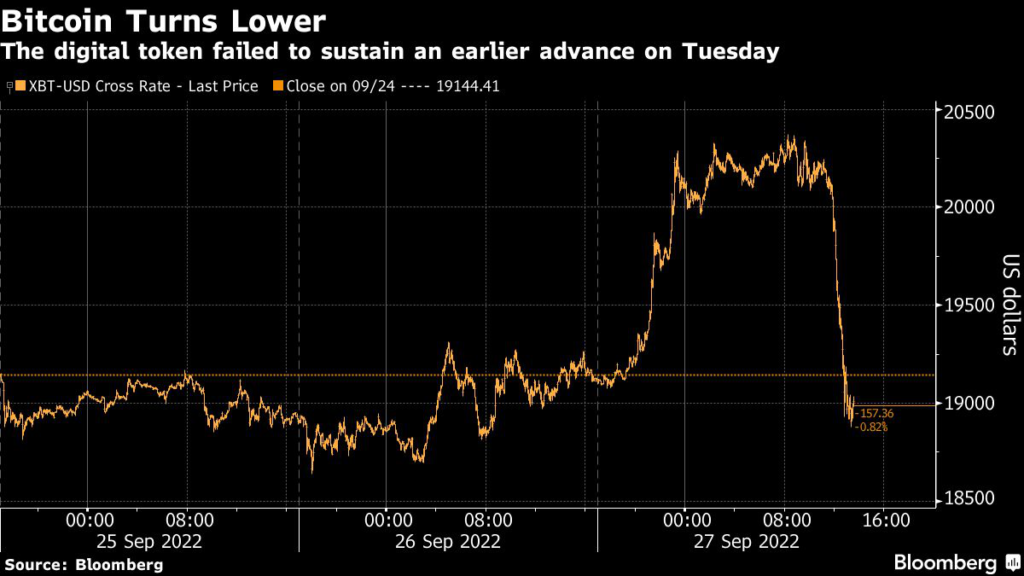
(Bloomberg) — Cryptocurrencies failed to hold onto gains Tuesday as US stocks also faltered and extended losses for a sixth straight session.

Bitcoin, the world’s largest digital asset by market value, fell as much as 1.2% to trade around $18,878, failing to sustain an earlier advance. Ether, the second-largest cryptocurrency, also dropped. Most major digital assets were posting declines as of 1:45 p.m. in New York. 

The downturn occurred as US stocks turned lower, with the S&P 500 on pace for a sixth session of losses. Global financial markets have been gripped by volatility as central banks continue to promise that they’re going to keep raising interest rates to fight inflation that’s proven stickier than many had thought. 

“BTC did seem to pick up the risk selloff once again today. Followers of the ecosystem have been excited to see correlations with risk-assets begin to break, meaning the ‘fast-money’ speculative crowd may be losing their influence on the space,” said Stephane Ouellette, chief executive of FRNT Financial Inc. “With today’s move, it doesn’t seem like we’re quite there yet — but consolidation at these levels continues to move in a bullish direction where loose hands sell BTC to the near cult-like ‘hodler’ community.”

Cryptocurrencies and US stocks have been trading largely in tandem throughout the year as both have been swayed by proclamations and actions by global central banks. The 60-day correlation coefficient of Bitcoin and the S&P 500 currently stands around 0.69, among the highest such readings in Bloomberg data going back to 2010 (A coefficient of 1 means the assets are moving in lockstep, while minus-1 shows they’re moving in opposite directions.)

Though crypto markets have been choppy, some investors have cheered the fact that digital tokens have held up relatively better than some other asset classes. Still, Bitcoin is down roughly 60% this year, while the S&P 500 is down more than 20% from the highs it had reached at the start of 2022. 

And some investors are betting that cryptocurrencies may continue to fall. Assets under management for the ProShares Short Bitcoin ETF have been climbing, according to data compiled by Vetle Lunde, analyst at Arcane Crypto, who said that traders might be seeking to speculate on further downside. 

Elsewhere in the cryptoverse, FTX US President Brett Harrison said he was stepping down and would be moving into an advisory role at the exchange. His exit is one of the latest high-profile departures from major crypto firms. 

More stories like this are available on bloomberg.com

©2022 Bloomberg L.P.

Bring a Trailer Clears $1 Billion in Car Sales So Far in 2022

(Bloomberg) — On Sept. 22, Bring a Trailer surpassed $1 billion in sales for a year that still has more than a quarter to run. 

The sum obliterated last year’s total sales at the car auction website, which scored $829 million for all of 2021. That beat the $578 million in total sales that Mecum Auctions reported on Dec. 28, 2021, and is more than double the $407 million in global car auction sales RM Sotheby’s reported for 2021. 

Factors seen and unseen have sped the growth, says Randy Nonnenberg, who co-founded the San Francisco-based online auction platform in 2007. 

“We were the first marketplace to make all our results permanent and transparent on the website, and that has fostered trust that most other venues don’t have. [Users] see that deep archive of results, and it helps make us their preferred market,” he says. “What isn’t seen are the systems and team behind the scenes that allow us to deliver our current 700-plus auctions per week, 100 every day.” 

BAT sells classic and collectible cars online in live auctions that typically last a week. (Some auctions in premium categories run longer.) Anyone can watch in real time as a clock ticks down, bids are placed, and comments—often lively and insightful—are posted. In the final two minutes of any sale, the clock restarts for a further two minutes when users place last-minute bids. At last count, BAT reported 880,000 active users and 390,000 registered bidders. 

Products at BAT can range from two record-breaking Porsche Carrera GTs that sold for about $2 million apiece in January to run-of-the-mill classics such as patina-covered Ford Mustangs and Jaguar E-Types. You won’t see many of those at Gooding’s or RM Sotheby’s: BAT’s volume is key to its ability to outpace the competition. The average sale price of a vehicle on BAT last year was $46,435, up from $34,996 in 2020. 

The platform has separated itself from traditional houses in more than just its live online auctions, which outfits such as RM Sothebys and Gooding & Co. did not offer until the Covid-19 coronavirus pandemic hit in 2020. BAT also requires buyers to pay just 5% of a car’s sale price as a fee, and the figure is capped at $5,000, regardless of the final price. Sellers pay a $99 flat rate. The fees are significantly lower than the double-digit percentages required by the traditional auction houses from both sellers and buyers. 

In 2021, BAT sold $828.7 million in cars. That constituted a 108% gain over the $398 million worth that it sold in 2020, and was a quarter-billion more than total sales at Mecum, its closest live-auction-house competitor. And that was just a year after Hearst Autos acquired BAT for an undisclosed amount. At the current rate, Nonnenberg says, BAT is on pace to hit $1.3 billion by yearend.

He says his own personal celebration will come around January, when the sequential lots sold are likely to hit 100,000. It would represent a significant achievement considering that when it first launched, BAT sold cars at a rate of three a week. Total lots sold are currently about to eclipse 87,000, he says. 


More stories like this are available on bloomberg.com

©2022 Bloomberg L.P.

Apple ‘Ageism’ Blamed by Senior Manager in His 60s for No Merit Bonus

(Bloomberg) — A senior manager sued Apple Inc., claiming he was denied a retention bonus of at least $800,000 because at age 64 he was no longer seen “as part of Apple’s future.”

Donald Shruhan Jr., who has worked for Apple since 2008 and is now 67, alleges in a lawsuit filed Monday in federal court in San Jose, California, that he wasn’t awarded restricted stock units or a merit increase in 2019 even though he was given an excellent performance review. Shruhan claims he was asked last year to submit his plan for retirement, although he hadn’t indicated any such intention. 

“This was an age-based assumption on the decision-maker’s part, with no basis in fact,” he argues. At the same time, Apple aimed to demote him, according to the complaint.

Apple didn’t immediately respond to phone and email requests for comment on the lawsuit.

QuickTake: Age Discrimination Is Common, Winning Lawsuits Rare

Shruhan says he’s a victim of discrimination against older workers in Silicon Valley, which is “obsessed with youth.” Citing a 2015 Payscale survey, he says that while the median age of a US worker is 42, it is 31 at Apple.

Shruhan is a director in Apple’s Intellectual Property Enforcement unit, where he has managed efforts to combat counterfeiting in the Asia-Pacific region, and has also served as a veteran senior manager on Apple’s global security team, he said. 

In the two preceding years after Shruhan earned excellent reviews, he was granted restricted stock units valued at $850,000 and $800,000, he claims. For 2019, Apple said he wouldn’t get his RSUs because they’re meant to be “an investment in the future and a retention hook,” according to his lawsuit. 

A supervisor’s response to his inquiry revealed that Apple no longer saw a need to incentivize him because he was nearing retirement age, according to the suit.

Shruhan said he had reached an impasse with Apple’s human resources department before suing. He seeks unspecified monetary damages for emotional distress, as well as a civil penalty against Apple under California’s unfair competition law. 

The case is Shruhan v. Apple, 22-cv-05481, US District Court, Northern District of California (San Jose).

More stories like this are available on bloomberg.com

©2022 Bloomberg L.P.

FTX US President Brett Harrison Steps Down From Crypto Exchange

(Bloomberg) — Crypto exchange FTX US president Brett Harrison is stepping down and will move into an advisory role, a surprise exit that came after less than 18 months on the job and as the industry weathers a downturn that’s curbed trading.  

Sam Bankman-Fried, co-founder and CEO of FTX, said Zach Dexter, head of FTX US Derivatives, and general counsel Ryne Miller will continue to oversee growth at the company as it plans a relocation of the entity’s headquarters to Miami from Chicago. 

“I’m remaining in the industry with the goal of removing technological barriers to full participation in and maturation of global crypto markets, both centralized and decentralized,” Harrison tweeted. 

The exit came as a surprise to many in the industry, even as Bankman-Fried said in an interview with Bloomberg TV that the departure had been in the works for “a little while.” Harrison joined FTX US as its first president in May 2021, after leaving Citadel Securities. He has been instrumental in building out the US operation of the crypto-exchange giant, which recently expanded into offering stock trading. Bankman-Fried, who earlier worked with Harrison at Jane Street for three years, has said Harrison was “the best developer to call when you absolutely had to get something online.” 

“He seemed deeply entrenched in all the products they were rolling out,” said Dan Matuszewski, co-founder of CMS Holdings, which has invested in FTX.

In August, FTX US received a cease-and-desist letter from the Federal Deposit Insurance Corporation due to “false or misleading statements” about certain products being eligible for insurance protection, which included a now-deleted tweet by Harrison as an example. “We really didn’t mean to mislead anyone, and we didn’t suggest that FTX US itself, or that crypto/non-fiat assets, benefit from FDIC insurance,” Harrison said at the time.  

Read More: Crypto Shakeout Engulfs the C-Suite as CEOs Start Leaving (1)

The crypto industry has seen a raft of successions that sets the stage for a changing of the guard in its roughly decade-old history. Celsius Network Ltd. Chief Executive Officer Alex Mashinsky also announced Tuesday he is stepping down as the crypto lender works its way throuugh bankruptcy proceedings. The series of high-profile resignations came after a period of fast growth and aggressive acquisitions followed by “the market coming to a screeching halt,” said Ed Moya, senior market analyst at Oanda. 

Asked about his own succession plans, Bankman-Fried said he has no plan to leave FTX and will be there “for the long term.” 

(Updates with more context, comments from Sam Bankman-Fried.)

More stories like this are available on bloomberg.com

©2022 Bloomberg L.P.

Ukraine Latest: Gas Pipeline Sabotage Suspected by US, Germany

(Bloomberg) — The US and Germany cited the prospect of sabotage after Swedish scientists said they detected two powerful underwater explosions near enormous leaks coming from the Nord Stream pipeline system that usually supplies Europe. 

Kremlin spokesman Dmitry Peskov said that Russia is “extremely concerned” about the reports of leaks, which prompted a surge in gas prices even though flows through the pipeline have been halted for months. Meanwhile, Russia’s Gazprom warned that a major source of Europe’s gas flows through Ukraine was at risk of being sanctioned because of a legal feud. European natural gas extended gains.

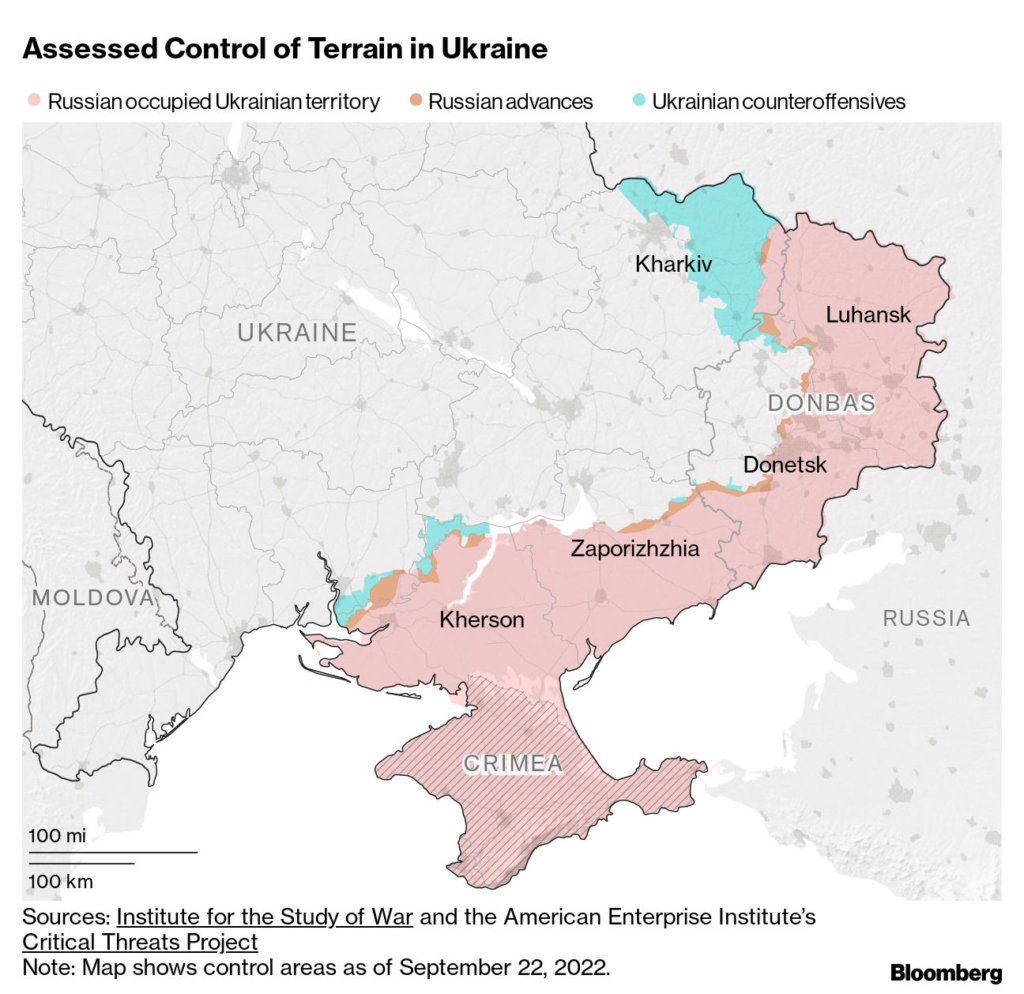
Ukrainian President Volodymyr Zelenskiy said the current focus of the war is Donetsk, describing the heavily industrial eastern region as the “primary target” for both Ukraine and invading Russian forces. He also urged the international community to step up pressure on Russia with sanctions.


(See RSAN on the Bloomberg Terminal for the Russian Sanctions Dashboard.)

Key Developments

  • Putin’s Mobilization Hits Russia’s Economy in Its Weak Spots
  • Europe’s Gas Crunch Could Shrink Its Economy as Much as 5%
  • Nord Stream Says Gas Pipeline Damage is Unprecedented
  • Putin Raises Stakes on Ukraine’s Bid for More Powerful Weapons
  • Sanctioned Billionaire’s Yacht Auctioned for $38 Million

On the Ground

Russian forces hit Kryvyi Rih airport in the Ukraine’s central Dnipropetrovsk region with a missile, rendering it inoperable, local authorities said late Monday. Russian rockets also struck the city of Zaporizhzhia. Ukraine’s General Staff reported that the situation at the Zaporizhzhia nuclear power plant remains tense, with staff reluctant to work with Russians and trying to flee occupied territories. In the south, Russia attacked the Odesa region with drones, all three of which were shot down by air-defense forces, while the city of Mykolaiv was heavily shelled overnight, local authorities said. Ukrainian forces continued to make advances north of Lyman and on the eastern bank of the Oskil River, according to the latest report by the Washington-based Institute for the Study of War.

All times CET:

NATO Monitoring Nord Stream Leaks, Stoltenberg Says (7:13 p.m.)

NATO Secretary General Jens Stoltenberg said the military alliance was closely monitoring the reports of the Nord Stream leakages, adding NATO was in close contact with the allies involved. 

“This is something that is extremely important to get all the facts on the table. and therefore this is something we’ll look closely into in the coming hours and days,” he said.

Blinken Says Reports Indicate Nord Stream Leaks Were Sabotage (6:37 p.m.)

Leaks in the Nord Stream pipeline are under investigation and initial reports indicate they may have been the result of sabotage, US Secretary of State Antony Blinken said.

“There are initial reports indicating that this may be the result of an attack or some kind of sabotage, but these are initial reports and we haven’t confirmed that yet,” Blinken told a news conference in Washington.

Blinken said the US and its allies were “working day in, day out” to address Europe’s energy security, and “the leaks will not have a significant impact on Europe’s energy resilience.”

Russia Prepares to Declare Staged Annexation Votes Passed (6:22 p.m.)

Occupation authorities in Russian-held parts of Ukraine reported as many as 90% of those voting favored joining their eastern neighbor in initial returns from “referendums,” as officials in Moscow said they plan to move quickly to formalize the annexation.

The United Nations, as well as Ukraine and its allies in the US and Europe, have denounced the votes, conducted largely in an active war zone, as illegal and illegitimate.

Gazprom Warns of Sanctions Risk to Ukraine Gas Flows (5:30 p.m.)

Russia’s Gazprom PJSC warned there’s a risk Moscow will sanction Ukraine’s Naftogaz, which would prevent it from being able to pay transit fees, and therefore put at risk gas flows to Europe via Ukraine.

If supplies through Ukraine are shut down, it would leave Gazprom sending gas only via the TurkStream pipeline to Turkey and a handful of European countries that didn’t sever business ties with Russia. 

Gas prices were up as much as 22% as traders factored in the prospect that Europe will have to live without Russian gas this winter — and beyond.

Read more: After Nord Stream Hit, Gazprom Warns on Ukraine Flows

Ukraine Demands EU Add New Russia Sanctions (5:25 p.m.)

Ukraine seeks a clear signal on a new sanctions package in reaction on sham referendums being held on its territory by Russia, Zelenskiy said during a meeting with French Foreign Minister Catherine Colonna. “We expect clear sanctions — both in the 8th package and separate signals of what will happen if Russia recognizes sham referendums,” Zelenskiy added.

Russia Senate May Vote to Annex Ukraine Lands Next Week: Tass (4:10 p.m.)

The upper house of Russia’s parliament isn’t currently planning a special session to vote to annex occupied territories in Ukraine and may discuss the issue at its next regular session on Oct. 4, Speaker Valentina Matviyenko said, according to Tass.

The Kremlin has pushed through “referendums” on annexation in the Donetsk, Luhansk, Zaporizhzhia and Kherson regions and local occupation officials are already reporting initial results showing 90%-plus voting in favor. The United Nations has condemned the “referendums” as illegal, as have Kyiv and its allies in the US and Europe.

Sweden Detected Underwater Blasts Near Nord Stream Leak (4 p.m.)

Two powerful underwater explosions were detected on Monday in the same area of sea as the Nord Stream gas leaks, according to the Swedish National Seismic Network.

The monitoring network said the first explosion occurred on Monday at 2:03 a.m. Swedish time with a magnitude of 1.9 on the Richter scale, followed by a second at 7:04 p.m. on the same day with a magnitude of 2.3.

“It’s clear that there has been some kind of explosions, and the coordinates match the leaks,” Peter Schmidt, a seismologist who works with the group, said by phone.

Danish Video Shows Extent of Pipeline Damage (3:20 p.m.) 

The leaks on the Nord Stream pipelines are forming an area of natural gas bubbles about 1 kilometer (1,090 yards) in diameter in the Baltic Sea, a video released by the Danish army showed.

Another smaller area with gas bubbles measured about 200 meters in diameter, according to the footage, which the Danish Defense shared on its website and via its Twitter account. 

UN Recorded Near 6,000 Civilian Deaths in Ukraine (3 p.m.)

United Nations specialists recorded 5,996 civilians being killed in Ukraine since the beginning of the Russian invasion, including 382 children, the UN Human Rights Monitoring Mission in Ukraine said in a new report.

The mission reported 8,848 corroborated civilian injuries, noting that actual figures may be much higher as hostilities severely hinder information gathering and verification.

Most of civilian casualties were due to the use of explosive weapons in populated areas. The UN also recorded willful killings and numerous cases of arbitrary detention and enforced disappearances, torture and ill-treatment, as well as conflict-related sexual violence, mostly in the territories controlled by Russian armed forces or affiliated groups.

Meta Blocks Propaganda Accounts From Russia (2:45 p.m.)

Meta Platforms Inc. has blocked thousands of “inauthentic” accounts, pages and groups from Facebook and Instagram that originated in Russia and spread propaganda about that country’s invasion of Ukraine.

The group behind the accounts created 60 websites “carefully impersonating legitimate news organizations in Europe,” Meta said.

Russian Billionaire Fights UK Sanctions Probe (2:40 p.m.)

Russian billionaire Petr Aven, fighting a UK investigation for evading sanctions, used companies supposed to manage his luxury mansion as a personal “piggy bank,” according to British authorities.

The investigation has focused on around 3.7 million euros ($3.6 million) routed to the UK from an Austrian trust in the hours before European sanctions were imposed.

Read more: Billionaire Without a Bank Account Fights UK Sanctions Probe

Denmark Says Pipeline Sabotage Can’t be Ruled Out (12:50 p.m.)

Denmark’s prime minister, Mette Frederiksen, echoed Peskov is saying that sabotage cannot be ruled out as the cause of damage to Nord Stream infrastructure off the island of Bornholm in the Baltic Sea.

“It’s hard to imagine that these are coincidences,” the prime minister said in an interview with broadcaster TV2 from Poland, where she’s attending the opening ceremony of Baltic Pipe, a separate gas link between Norway and Poland.

Ukraine Slams Lufthansa Over Stake in Russian Airline Caterer (12:15 p.m.)

Ukraine’s foreign minister accused airline Deutsche Lufthansa AG of taking “blood money” and damaging Germany’s reputation over its minority stake in Russian airline caterer Aeromar.

“I urge the company’s management to immediately withdraw from Aeromar and stop supporting Russia’s war crimes,” Dmytro Kuleba said in an interview with German public broadcaster ZDF. Responding to ZDF’s inquiry about the Aeromar stake, Lufthansa said it’s not in breach of European Union sanctions on Russia and as a minority shareholder had no influence over a decision to establish a facility in Russian-annexed Crimea, the broadcaster said.

Nord Stream Says Pipeline Damage Unprecedented (10:45 a.m.)

Nord Stream said the damage to its key pipeline to Germany is “unprecedented” and it’s impossible to say when flows could resume.

Germany is probing the incidents in the Baltic Sea on the two idled Nord Stream gas pipelines from Russia, while Denmark steps up security on its energy installations. It’s the clearest signal yet that supplies won’t resume this winter. European Union officials have repeatedly accused Moscow of weaponizing energy.

Latvia ‘Taking Russian Nuclear Threats Seriously’ (10:20 a.m.)

Russia wouldn’t be making threats about deploying nuclear weapons if it was winning its war in Ukraine, Latvian Foreign Minister Edgars Rinkevics said in an interview with TV3.

“A cornered rat is a dangerous rat” and Latvia is preparing for all scenarios, Rinkevics said. Latvia is supplying Ukraine with all the military equipment it has available and a swift end to the conflict isn’t in sight, he added.

Lithuania Arms Donations Constrained by NATO Needs (10 a.m.)

Lithuania cannot immediately hand over some critical military equipment that Ukraine needs such as NASAMS air-defense systems or howitzers without compromising operations with its NATO partners, according to an adviser to the Baltic nation’s president.

Lithuania is looking to find replacements for the equipment but this is unlikely to happen quickly, Kestutis Budrys, the president’s chief national security adviser, told radio broadcaster LRT. Lithuania has already supplied Ukraine with 50 armored personnel carriers, according to Defense Minister Arvydas Anusauskas.

Russian Traffic on Finnish Border Easing Further (8:45 a.m.)

Traffic on Finland’s eastern border remained busy on Monday, even as numbers of Russians crossing fell from a weekend peak, the Nordic country’s Border Guard said. Some 7,743 Russians entered via the land border, with about half that number returning to Russia.

Europe Ready for Winter Without Russian Gas: BNEF (8:30 a.m.)

Europe’s frenzied buying of liquefied natural gas means it’s likely to have enough of the power-generation fuel this winter to offset supplies from Russia, according to BloombergNEF.

The region may import almost 40% more LNG during the coming winter than the prior year, and it may increase purchases next summer by about 14% to rebuild lost inventories, BNEF said in a report. Along with demand destruction from higher energy prices, those shipments are enough to cover a complete halt in Russian pipeline flows from Oct. 1, it added.

Russia Expels Japanese Diplomat on Spying Charges (2:32 a.m.)

Russia expelled a Japanese consul in Vladivostok, accusing the diplomat of paying for sensitive information.

Tatsunori Motoki was given 48 hours to leave the country, the Foreign Ministry said, according to Tass. Earlier, the Federal Security Service said the envoy in the Far Eastern city had been caught collecting “restricted information” about Russia’s ties with an unspecified country in the region, as well as on the impact of sanctions on the local economy.

More stories like this are available on bloomberg.com

©2022 Bloomberg L.P.

Airbnb Co-Founder Bets on Remote Work Amid Back-to-Office Push

(Bloomberg) — Home-sharing company Airbnb Inc., initially paralyzed by pandemic lockdowns but revitalized by the recent travel boom, is betting that remote work is here for good.

Stays of 28 days or more — usually by so-called digital nomads who can do their jobs from various locales — now make up about a fifth of Airbnb’s business. And this year, the company made “work from anywhere” permanent for its 6,000 employees, eliminating pay tiers based on a location’s cost of living and allowing staffers to work up to 90 days a year from any region Airbnb operates in.

The company recently published a policy guide for cities and countries that want to lure remote workers, following an example set by Tulsa, Oklahoma, which attracted more than 1,600 people and boosted the region’s economy by nearly $20 million last year.

Bloomberg sat down with Airbnb co-founder and Chief Strategy Officer Nathan Blecharczyk to discuss how he sees the remote-work revolution playing out. His responses have been edited and condensed.

What’s the rationale behind the remote-work policy paper?

There’s huge demand for remote work. What’s interesting are the strategic implications for towns and cities. Historically, towns have done a lot to attract companies to invigorate their economy. And now there’s this avenue of going directly to the workers and their families and making the case of why this town is a great place from a quality-of-life perspective. Employees don’t have to choose between their high-paying job and a great quality of life. They can have both.

There are many cities that are attractive to remote workers where the cost of living has skyrocketed as so many people move there. Is that coming up in your conversations with these cities?

There are pros and cons to anything — one person’s economic development is someone else’s gentrification. Overall, this phenomenon is certainly stirring the pot a bit, and I think that’s probably generally a good thing. During the pandemic you saw people going to places like Florida and different suburbs, and they just became a little overheated. But I think as we get into a steady state, the opportunity can be spread over a broader surface area. 

Have you seen any impact from Airbnb’s remote-work policy on employee satisfaction or engagement?

What we saw over the pandemic was engagement did not fluctuate much. I think so much was happening in the world that in some ways, people’s perceptions and feelings about the company were just kind of locked in. The thing we did see move a lot is people’s attitudes about remote work. When we asked employees in September 2020 if they wanted to come into the office less than once a week — so basically to not be in the office — it was 37%. In November 2021, it was 59%. That’s eye-opening.

You got rid of location-based pay tiers. What was the rationale for that? 

If you are going to cut people’s pay if they relocate, then are you really creating flexibility? It makes it a really hard decision for employees to make that trade-off. We spend a lot of money on talent, and we spend a lot of money on office space. In the future we’re going to spend less money on office space. So our thought is that it will all come out in the wash.

What is lost by not having people coming to the office?

It’s worked well in the short term, but I do wonder, are there longer-term implications that we’re not just fully understanding yet? Just from personal experience, it’s less fun working from home than it is being in the office. But there’s an overhead to going into the office and there’s an inability to balance things in the same way. There is this kind of trade-off between efficiency of life versus the fun of colleagues. I think a lot of people, especially those who have kids, I think they’re saying, “I’ll take the efficiency, please. That’s what I need right now.” If you’re just out of college, you might say, “I want to socialize, that’s important to me.”

More stories like this are available on bloomberg.com

©2022 Bloomberg L.P.

Stocks Pare Gains as Data to Keep Fed Aggressive: Markets Wrap

(Bloomberg) — US stocks pared gains on Tuesday as investors parsed fresh data that showed the American economy remains robust, even as the Federal Reserve steps up its inflation battle. 

The S&P 500 climbed as much as 1.7%, but trimmed gains after hawkish comments from St. Louis Fed President James Bullard, who said inflation is a “serious problem” that the central bank must appropriately address. US Treasury yields rose, with the benchmark 10-year rate pushing past 3.90%. Oil rallied, aided by a weakening dollar.

Investors are digesting a flurry of data on Tuesday, including core capital goods orders and consumer sentiment, that paint a picture of an economy that can likely withstand additional harsh central bank tightening. Several Fed officials this week have already reiterated that the central bank will be aggressive in its efforts to tame inflation.

“The Fed’s tolerance for economic pain doesn’t bode well for risk assets. Financial conditions will tighten further, and recession implies an earnings downturn is approaching,” wrote Seema Shah, chief global strategist at Principal Global Investors. “Get defensive, times are getting tougher.”

Every tumultuous market day is a step closer to recovery, according to Julie Biel, portfolio manager for Kayne Anderson Rudnick.

“I think there’s more realism, there’s more understanding that a soft landing is just impossible to really navigate when you’ve let out this much fiscal and monetary policy,” she said. “It’s just not possible to engineer this with inflation this high. And so that realism is a positive thing. The thing is that we still kind of have a long way to go in terms of a possible correction.”

Beyond the US

The UK’s long-term bonds reversed earlier gains to slump on concerns over the nation’s fiscal and monetary policy, sending the 30-year yield to its highest since 2007. 

The country’s stock and bond markets have lost at least $500 billion in combined value since Liz Truss took over as Prime Minister and traders remained wary of the risk that the currency could slump to parity with the dollar after the Bank of England indicated it may not act before November to stem the rout.

Volatility across markets was also reflected by the risk of future price swings, which reached the highest since the beginning of the pandemic, as shown by a Bank of America index.

Meanwhile, Germany suspects the damage to the Nord Stream pipeline system used to transport Russian gas to Europe was the result of sabotage. Benchmark European gas prices climbed as much as 19% on Tuesday.

How much damage is a strong dollar causing? That’s the theme of this week’s MLIV Pulse survey. It’s brief and we don’t collect your name or any contact information. Please click here to share your views.

Key events this week:

  • Fed’s Mary Daly, Rafael Bostic, Charles Evans and ECB President Christine Lagarde speak at events, Wednesday
  • Euro zone economic confidence, consumer confidence, Germany CPI, Thursday
  • US initial jobless claims, GDP, Thursday
  • Fed’s Loretta Mester, Mary Daly speak at events, Thursday
  • China PMI, Friday
  • Euro zone CPI, unemployment, Friday
  • US consumer income , University of Michigan consumer sentiment, Friday
  • Fed’s Lael Brainard and John Williams speak, Friday

Some of the main moves in markets:

Stocks

  • The S&P 500 rose 0.4% as of 11:37 a.m. New York time
  • The Nasdaq 100 rose 0.7%
  • The Dow Jones Industrial Average rose 0.2%
  • The Stoxx Europe 600 rose 0.4%
  • The MSCI World index fell 1.3%

Currencies

  • The Bloomberg Dollar Spot Index fell 0.1%
  • The euro rose 0.1% to $0.9620
  • The British pound rose 0.7% to $1.0764
  • The Japanese yen was little changed at 144.69 per dollar

Cryptocurrencies

  • Bitcoin rose 5.2% to $20,108.06
  • Ether rose 3.7% to $1,373.76

Bonds

  • The yield on 10-year Treasuries advanced three basis points to 3.96%
  • Germany’s 10-year yield advanced 13 basis points to 2.24%
  • Britain’s 10-year yield advanced 26 basis points to 4.51%

Commodities

  • West Texas Intermediate crude rose 2.8% to $78.88 a barrel
  • Gold futures rose 0.4% to $1,639.30 an ounce

More stories like this are available on bloomberg.com

©2022 Bloomberg L.P.

Ukraine Latest: Sweden Detects Underwater Blasts Near Gas Leaks

(Bloomberg) — Swedish scientists detected two powerful underwater explosions near enormous leaks coming from the Nord Stream pipeline system that usually transports Russian gas to the region and Germany suspects sabotage is behind the damage. Gas prices surged further after Gazprom warned Russia may sanction Ukraine’s Naftogaz.

Kremlin spokesman Dmitry Peskov said that Russia is “extremely concerned” about the reports of leaks, which prompted a surge in gas prices even though the flows have been halted for months.

Ukrainian President Volodymyr Zelenskiy said the current focus of the war is Donetsk, describing the heavily industrial eastern region as the “primary target” for both Ukraine and invading Russian forces. He also urged the international community to step up pressure on Russia with sanctions.


(See RSAN on the Bloomberg Terminal for the Russian Sanctions Dashboard.)

Key Developments

  • Putin’s Mobilization Hits Russia’s Economy in Its Weak Spots
  • Europe’s Gas Crunch Could Shrink Its Economy as Much as 5%
  • Nord Stream Says Gas Pipeline Damage is Unprecedented
  • Putin Raises Stakes on Ukraine’s Bid for More Powerful Weapons
  • Putin Gives US Fugitive Edward Snowden Russian Citizenship

On the Ground

Russian forces hit Kryvyi Rih airport in the Ukraine’s central Dnipropetrovsk region with a missile, rendering it inoperable, local authorities said late Monday. Russian rockets also struck the city of Zaporizhzhia. Ukraine’s General Staff reported that the situation at the Zaporizhzhia nuclear power plant remains tense, with staff reluctant to work with Russians and trying to flee occupied territories. In the south, Russia attacked the Odesa region with drones, all three of which were shot down by air-defense forces, while the city of Mykolaiv was heavily shelled overnight, local authorities said. Ukrainian forces continued to make advances north of Lyman and on the eastern bank of the Oskil River, according to the latest report by the Washington-based Institute for the Study of War.

All times CET:

Gazprom Warns of Sanctions Risk to Ukraine Gas Flows (5:30 p.m.)

Gazprom PJSC warned there’s a risk Moscow will sanction Ukraine’s Naftogaz, which would prevent it from being able to pay transit fees, and therefore put at risk gas flows to Europe via Ukraine.

Gas prices surged immediately in late European trading.

Ukraine Demands EU Add New Russia Sanctions (5:25 p.m.)

Ukraine seeks a clear signal on a new sanctions package in reaction on sham referendums being held on its territory by Russia, Zelenskiy said during a meeting with French Foreign Minister Catherine Colonna. “We expect clear sanctions — both in the 8th package and separate signals of what will happen if Russia recognizes sham referendums,” Zelenskiy added.

Russia Senate May Vote to Annex Ukraine Lands Next Week: Tass (4:10 p.m.)

The upper house of Russia’s parliament isn’t currently planning a special session to vote to annex occupied territories in Ukraine and may discuss the issue at its next regular session on Oct. 4, Speaker Valentina Matviyenko said, according to Tass.

The Kremlin has pushed through “referendums” on annexation in the Donetsk, Luhansk, Zaporizhzhia and Kherson regions and local occupation officials are already reporting initial results showing 90%-plus voting in favor. The United Nations has condemned the “referendums” as illegal, as have Kyiv and its allies in the US and Europe.

Sweden Detected Underwater Blasts Near Nord Stream Leak (4 p.m.)

Two powerful underwater explosions were detected on Monday in the same area of sea as the Nord Stream gas leaks, according to the Swedish National Seismic Network.

The monitoring network said the first explosion occurred on Monday at 2:03 a.m. Swedish time with a magnitude of 1.9 on the Richter scale, followed by a second at 7:04 p.m. on the same day with a magnitude of 2.3.

“It’s clear that there has been some kind of explosions, and the coordinates match the leaks,” Peter Schmidt, a seismologist who works with the group, said by phone.

Danish Video Shows Extent of Pipeline Damage (3:20 p.m.) 

The leaks on the Nord Stream pipelines are forming an area of natural gas bubbles about 1 kilometer (1,090 yards) in diameter in the Baltic Sea, a video released by the Danish army showed.

Another smaller area with gas bubbles measured about 200 meters in diameter, according to the footage, which the Danish Defense shared on its website and via its Twitter account. 

UN Recorded Near 6,000 Civilian Deaths in Ukraine (3 p.m.)

United Nations specialists recorded 5,996 civilians being killed in Ukraine since the beginning of the Russian invasion, including 382 children, the UN Human Rights Monitoring Mission in Ukraine said in a new report.

The mission reported 8,848 corroborated civilian injuries, noting that actual figures may be much higher as hostilities severely hinder information gathering and verification.

Most of civilian casualties were due to the use of explosive weapons in populated areas. The UN also recorded willful killings and numerous cases of arbitrary detention and enforced disappearances, torture and ill-treatment, as well as conflict-related sexual violence, mostly in the territories controlled by Russian armed forces or affiliated groups.

Meta Blocks Propaganda Accounts From Russia (2:45 p.m.)

Meta Platforms Inc. has blocked thousands of “inauthentic” accounts, pages and groups from Facebook and Instagram that originated in Russia and spread propaganda about that country’s invasion of Ukraine.

The group behind the accounts created 60 websites “carefully impersonating legitimate news organizations in Europe,” Meta said.

Russian Billionaire Fights UK Sanctions Probe (2:40 p.m.)

Russian billionaire Petr Aven, fighting a UK investigation for evading sanctions, used companies supposed to manage his luxury mansion as a personal “piggy bank,” according to British authorities.

The investigation has focused on around 3.7 million euros ($3.6 million) routed to the UK from an Austrian trust in the hours before European sanctions were imposed.

Read more: Billionaire Without a Bank Account Fights UK Sanctions Probe

Denmark Says Pipeline Sabotage Can’t be Ruled Out (12:50 p.m.)

Denmark’s prime minister, Mette Frederiksen, echoed Peskov is saying that sabotage cannot be ruled out as the cause of damage to Nord Stream infrastructure off the island of Bornholm in the Baltic Sea.

“It’s hard to imagine that these are coincidences,” the prime minister said in an interview with broadcaster TV2 from Poland, where she’s attending the opening ceremony of Baltic Pipe, a separate gas link between Norway and Poland.

Ukraine Slams Lufthansa Over Stake in Russian Airline Caterer (12:15 p.m.)

Ukraine’s foreign minister accused airline Deutsche Lufthansa AG of taking “blood money” and damaging Germany’s reputation over its minority stake in Russian airline caterer Aeromar.

“I urge the company’s management to immediately withdraw from Aeromar and stop supporting Russia’s war crimes,” Dmytro Kuleba said in an interview with German public broadcaster ZDF. Responding to ZDF’s inquiry about the Aeromar stake, Lufthansa said it’s not in breach of European Union sanctions on Russia and as a minority shareholder had no influence over a decision to establish a facility in Russian-annexed Crimea, the broadcaster said.

Nord Stream Says Pipeline Damage Unprecedented (10:45 a.m.)

Nord Stream said the damage to its key pipeline to Germany is “unprecedented” and it’s impossible to say when flows could resume.

Germany is probing the incidents in the Baltic Sea on the two idled Nord Stream gas pipelines from Russia, while Denmark steps up security on its energy installations. It’s the clearest signal yet that supplies won’t resume this winter. European Union officials have repeatedly accused Moscow of weaponizing energy.

Latvia ‘Taking Russian Nuclear Threats Seriously’ (10:20 a.m.)

Russia wouldn’t be making threats about deploying nuclear weapons if it was winning its war in Ukraine, Latvian Foreign Minister Edgars Rinkevics said in an interview with TV3.

“A cornered rat is a dangerous rat” and Latvia is preparing for all scenarios, Rinkevics said. Latvia is supplying Ukraine with all the military equipment it has available and a swift end to the conflict isn’t in sight, he added.

Lithuania Arms Donations Constrained by NATO Needs (10 a.m.)

Lithuania cannot immediately hand over some critical military equipment that Ukraine needs such as NASAMS air-defense systems or howitzers without compromising operations with its NATO partners, according to an adviser to the Baltic nation’s president.

Lithuania is looking to find replacements for the equipment but this is unlikely to happen quickly, Kestutis Budrys, the president’s chief national security adviser, told radio broadcaster LRT. Lithuania has already supplied Ukraine with 50 armored personnel carriers, according to Defense Minister Arvydas Anusauskas.

Russian Traffic on Finnish Border Easing Further (8:45 a.m.)

Traffic on Finland’s eastern border remained busy on Monday, even as numbers of Russians crossing fell from a weekend peak, the Nordic country’s Border Guard said. Some 7,743 Russians entered via the land border, with about half that number returning to Russia.

Europe Ready for Winter Without Russian Gas: BNEF (8:30 a.m.)

Europe’s frenzied buying of liquefied natural gas means it’s likely to have enough of the power-generation fuel this winter to offset supplies from Russia, according to BloombergNEF.

The region may import almost 40% more LNG during the coming winter than the prior year, and it may increase purchases next summer by about 14% to rebuild lost inventories, BNEF said in a report. Along with demand destruction from higher energy prices, those shipments are enough to cover a complete halt in Russian pipeline flows from Oct. 1, it added.

Russia Expels Japanese Diplomat on Spying Charges (2:32 a.m.)

Russia expelled a Japanese consul in Vladivostok, accusing the diplomat of paying for sensitive information.

Tatsunori Motoki was given 48 hours to leave the country, the Foreign Ministry said, according to Tass. Earlier, the Federal Security Service said the envoy in the Far Eastern city had been caught collecting “restricted information” about Russia’s ties with an unspecified country in the region, as well as on the impact of sanctions on the local economy.

More stories like this are available on bloomberg.com

©2022 Bloomberg L.P.
Celsius CEO Alex Mashinsky Resigns From Bankrupt Crypto Firm

(Bloomberg) — Celsius Network Ltd. Chief Executive Officer Alex Mashinsky stepped down from his position at the embattled crypto lender. The company said in a statement that it had appointed Chief Financial Officer Chris Ferraro to the role of chief restructuring officer and interim CEO.

The leadership change represents a major shift for the company, which filed for bankruptcy in July. The company was one of the most notable casualties in this year’s crypto market downturn, which also included crypto lender Voyager Digital Holdings Inc. and hedge fund Three Arrows Capital.

The price of the Celsius token fell 7% to $1.37 following the announcement, according to CoinMarketCap.

More stories like this are available on bloomberg.com

©2022 Bloomberg L.P.

Avaya Loan’s Rapid Meltdown Reveals Leveraged Debt Market Risks

(Bloomberg) — Avaya Holdings Corp. isn’t exactly a household name in US financial circles. It’s a small-ish company in an unglamorous part of the technology business.

And yet it’s possible that years from now, Avaya, a provider of office telecommunications services, will be remembered as one of the first victims of corporate America’s post-pandemic financial reckoning. There are plenty of oddball elements to the story that are specific to Avaya — like the company’s dramatic earnings revisions and internal investigations — but in a larger sense, its sudden collapse to the brink of default underscores how quickly the mania captivating Wall Street investors has ended as interest rates soar and the economy cools.

“It’s a crazy situation that you don’t see everyday,” said John Fekete, managing director and head of capital markets at Crescent Capital Group. “There is a lot of litigation risk and uncertainty around liquidity.”

In a matter of weeks, Avaya descended from a highly levered company that could still convince Wall Street investors to lend to it to a deeply distressed company that disclosed “substantial doubt” about its ability to keep operating. It’s something of a cautionary tale of the downsides of the high-risk, high-return leveraged finance world, where, until recently, creditors were eager to lend if it meant a chance at juicy yields. 

Alarm Bells

Credit markets were already choppy when Avaya sought to raise new debt in June, but the company didn’t have much of a choice: it had convertible bonds due in 2023 that it needed to refinance. Investors were skeptical of the company’s prospects, and the overall outlook for highly indebted companies. But after being offered a yield of 10 percentage points on top of a benchmark interest rate, they snapped up the new $350 million leveraged loan nonetheless, and the company also sold a chunk of new convertible bonds to private investors. 

As is typical, prospective investors were able to speak with Avaya’s executives and bankers Goldman Sachs Group Inc. and JPMorgan Chase & Co., who assured them that the company was on track to reach earnings projections for the year, according to people with knowledge of the discussions.

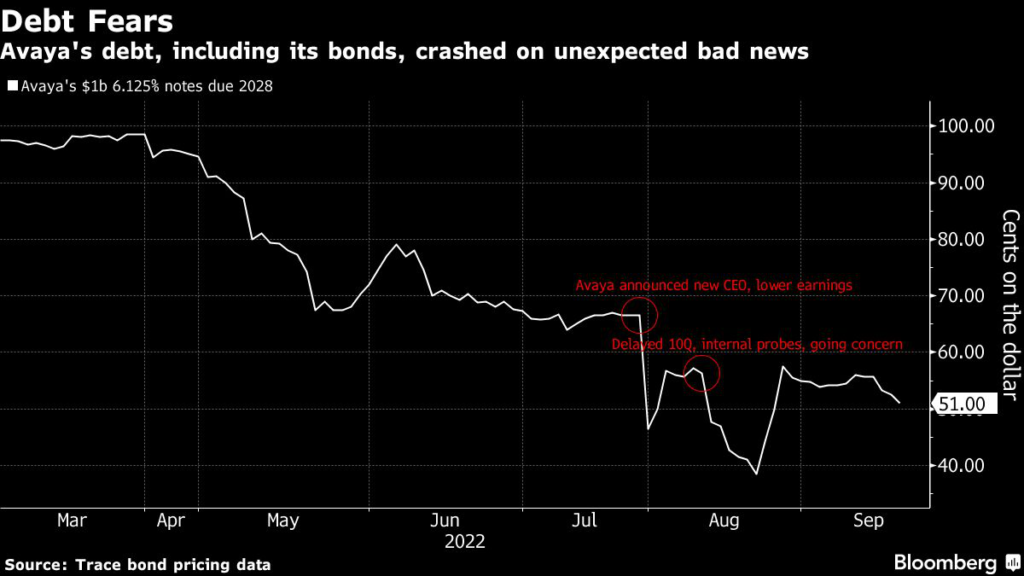
But weeks after the debt was sold, Avaya dramatically cut its forecasts, and eventually disclosed a significant earnings miss for the quarter through June 30. It fired its chief executive officer and said its prior financial guidance could no longer be relied on. Its debt, including the freshly issued term loan, plunged. 

Investors were stuck with millions in paper losses. The newly issued loan was quoted Tuesday at around 66 cents on the dollar, according to data compiled by Bloomberg, while its older convertible bonds were quoted at about 45 cents. 

Taking Action

The timing of the debt deal, in light of the later earnings revelations, spurred concerns from investors around Avaya’s governance and internal controls, according to creditors and industry observers. Groups of investors fuming over the debt’s collapse quickly banded together and brought in lawyers to explore their options. 

“Whether it’s stupidity, whether it’s simple human oversight, or whether someone did something rather naughty,” said Anthony Sabino, a law professor at St. John’s University and attorney focused on litigation, “then Avaya has to know that as well because they have to be prepared for the allegations that will be launched against them.”

“The creditors are going to get to the bottom of this one way or the other,” Sabino added.

Some of the lenders’ advisers have signed confidentiality agreements to assess the financial health of the company and begin formulating debt plans, the people said.

While the company delayed reporting public results, Avaya last month posted some financial information in a private data room, and said it’s meeting reporting requirements for its term loans, the people added. 

“That could set a pretty bad precedent where a company is able to go out and solicit financing with public financial information and then not be able to provide financials,” said Matt Zloto, a senior analyst at CreditSights.

More recently, Avaya’s advisers are examining an exchange offer for the convertible notes due 2023, including swapping into a secured note and extending the maturity, the people said. The company could also transfer valuable intellectual property to an unrestricted subsidiary and use that to issue new debt, they said. 

A group of new lenders had asked the company to place some $221 million from the loan sale in escrow in lieu of paying off the convertible notes now. The old unsecured convertible bonds rank below loans in line for repayment in a bankruptcy. 

Representatives for Avaya, JPMorgan and Goldman Sachs declined to comment.

Vicious Cycle

Meanwhile, individual equity investor Theodore King emerged as Avaya’s biggest shareholder. King, who owns a roughly 15.4% stake as of Aug. 22, said he believes the company’s new Chief Executive Officer Alan Masarek can execute a turnaround once the company reaches a deal with its creditors. 

“The vast majority of creditors are seeking to engage with the company constructively in order to put the issues to bed swiftly,” King said. 

Avaya’s move to a cloud and subscription business means it’s booking revenue based on monthly payments, rather than upfront payments. That ostensibly creates long-term stability and dependable revenue, as corporate clients are less inclined to switch to different software or devices with monthly or annual payments. 

The company’s last earnings miss was due to lower-than-expected subscription revenues, which could signal customers growing jittery over the company’s near-term debts, Masarek said on the August earnings call.

“Ultimately the question is how much of a mess are third-quarter results, whether it’s a one-time issue or if it indicates future performance,” said CreditSights’ Zloto .

More stories like this are available on bloomberg.com

©2022 Bloomberg L.P.

Close Bitnami banner
Bitnami