Bloomberg

‘They’re in a State of Fear’: CEOs Are Worried About Quiet Quitting

(Bloomberg) — Executives are worried about quiet quitting.

As news of the trend flooded the internet, human resources companies, consultants, law firms and even artificial intelligence startups have jumped in to offer advice on how to prevent and combat it. By all accounts there is demand: Leaders at large and well-known companies in finance, tech and health care are very concerned, said Ben Granger, chief workplace psychologist at survey firm Qualtrics.

“It’s pretty rare that a lot of leaders in major organizations would bring this up to us within as short of a time as this has been talked about in the media,” he said. “I don’t see that a lot.”

But executives don’t know what to do about it. Human resource professionals say leaders are concerned about whether they can rely on their employees if there’s a recession — or if they can afford to fire and replace quiet quitters in a tight labor market, Granger said. Leaders are worried they won’t be able to spot it spreading under their noses. 

“A lot of leaders and clients I work with, some for the first time in 30 years, they’re in a state of fear as an employer.” said Erica Dhawan, workplace consultant and author of a book about remote and hybrid work. “They feel they have to keep people that aren’t performing.”

Especially scary for leaders is the “invisible” nature of the trend, according to Granger. In a remote or hybrid environment, the classic signs that an employee is checked out, like tardiness and absenteeism, can be harder to spot. While their first reaction is often to blame quiet quitting on laziness, Granger said many come to realize that it’s actually a management problem. There’s even an artificial intelligence startup that claims to offer a solution, analyzing emails and Slack messages to detect engagement, burnout and turnover risk among employees.

However, chief human resource officers tend to be less freaked out about all the talk of quiet quitting than others in the C-suite, according to Caroline Walsh, vice president in the human resources practice at consulting firm Gartner. Since they’ve spent years focusing on and talking about burnout, the phenomenon comes as less of a surprise.

They could be underestimating the issue. More than half of HR professionals from a range of industries surveyed in late August were concerned about quiet quitting, according to a Society for Human Resource Management poll of over 1,200. Yet only about a third think it’s happening in their own organization, a perception that doesn’t align with Gallup’s recent estimate that a full 50% of the US workforce can be considered quiet quitters. 

Read More: ‘Quiet Quitters’ Make Up Half of the US Workforce, Gallup Finds

While it’s hard to say how much more quiet quitting is happening since the trend went viral, Granger said the fact more people are talking about it is itself significant because it’s more likely to catch on and spread.

“Now you’ve got a big problem,” he said. “If you get into a situation where organizations start to see this tip, and now there’s massive amounts of quiet quitting happening, that is almost certainly going to lead to some massive downstream effects on the business.”

More stories like this are available on bloomberg.com

©2022 Bloomberg L.P.

US Earnings to Watch: Nike, Bed Bath & Beyond, Micron, Vail Resorts

(Bloomberg) — Cost-cutting measures at firms from Meta and Google parent Alphabet, to Gap and FedEx demonstrate how persistent inflation continues to force US businesses to make tough decisions to navigate uncertainties around the pace and severity of a global economic slowdown. With a hawkish Fed signaling more rate hikes to come after its third straight 75 basis-point increase, company executives are walking a delicate line between managing pricing, cutting jobs and investing for growth — all without sacrificing margins, something that BlackRock is concerned will inevitably surface in the form of guidance cuts, saying the “tone of management teams” has begun to sour.

  • To subscribe to earnings coverage across your portfolio or other earnings analysis, run NSUB EARNINGS.

Earnings highlights to look for next week:

Monday: No major earnings expected.

Tuesday: Cracker Barrel (CBRL US) is due before market. The restaurant chain, whose locations are dependent on highway traffic, may see same-store sales growth slow to a gain in the single-digit range after five quarters of double-digit expansion. Price increases, virtual brand and catering sales growth may have been partly offset by weak travel due to high gas prices and soft spending by senior customers, Bloomberg Intelligence said. Retail sales likely haven’t fared well either due to tough y/y comparisons, consensus estimates show. BI continues to expect the chain to underperform peers because of its older clientele and weaker to-go business.

Wednesday: Vail Resorts (MTN US) will report fourth-quarter earnings after the bell. A limit on ski lift tickets announced by the resort operator last month may sway non-committal skiers into purchasing a pass sooner, potentially boosting and locking in reported ski pass sales, Barclays analysts said at the time. Managing overcrowding could also help improve guest experience during peak ski season, especially if the company again suffers staff shortages as it saw last season. Investors may pay attention to how the capacity constraints will affect revenue and Ebitda as the company is likely to give its first forecasts for fiscal 2023.

Thursday: Nike (NKE US) will release its first-quarter results after the market close. Its Chinese operations will be an area of focus as loosened Covid-19 restrictions and Beijing’s new policies to lift the economy put Nike on track to beat consensus expectations for fiscal 2023, Bloomberg Intelligence said. While consumer spending is expected to recover in China over the next 15 months, sales are likely to remain constrained in September and October due to lockdowns this month and lingering concerns about the virus going into next month’s holidays. Nike could also face hurdles expanding market share in the country, which accounts for about 13% of its revenue, as Chinese shoppers shift to local labels like Anta and Li Ning.

  • ESG in Focus: Nike, along with Levi Strauss and Lululemon, is leading a push to cut water usage by as much as 50% by 2025 as scarcity and supply-chain risks are leading them to use other fibers including hemp and flax, according to Bloomberg Intelligence. Cotton is water-intensive, and about half of the world’s crop will be exposed to drought by 2040. Simply switching to new materials may not be enough, however, as other companies are also shifting to recycled or greener materials and offering repairs and resale items, BI ESG Senior Analyst Gail Glazerman said.
  • Bed Bath and Beyond (BBBY US) is due before the market open. Questions about its future remain amid the death of its CFO, an ongoing search for a new CEO and its decision to close stores and cut jobs. The reductions, along with $500 million in fresh credit, are part of the home goods retailer’s plan to slash costs and recover customers and suppliers it lost when it shifted away from national brands to private-label offerings. Wells Fargo analysts said that the pivot “likely makes sense,” though they “see few reasons to believe comps and margins can structurally improve.” For now, Wall Street also appears unconvinced as the stock has 12 sells, 4 holds and no buy ratings.
  • Micron (MU US) is set to report fourth-quarter results after the bell. Its revenue, margins and earnings may be hit by lower memory prices and industry oversupply that are driving the chipmaker’s “grim outlook,” according to Bloomberg Intelligence. Mizuho analysts downgraded Micron and hard drive maker Western Digital to neutral from buy this week, saying “weak consumer demand, high inventory and continued supply growth will imply more downside risks over the next four to six months.” Wells Fargo analysts wrote the upcoming results appear “very negative”, adding that absolute cuts to revenue and earnings estimates may matter less than the company’s 2023 capital expenditure guidance and its commentary on when the industry bottoms.

Friday: No major earnings expected.

More stories like this are available on bloomberg.com

©2022 Bloomberg L.P.

Central African Republic’s Top Court Blocks President’s Bid to Overhaul Constitution

(Bloomberg) — The Central African Republic’s top court blocked President Faustin-Archange Touadera’s bid to push through a new constitution that his opponents say is an attempt to tighten the presidency’s grip on power and pave the way for him to stand for a third term. 

A constitutional review can only happen after a new senate has been sworn in, the court said on Friday in its ruling, which invalidated a decree to create a committee to draft a new constitution. 

The judgment is the second the Constitutional Court has delivered against Touadera, who’s due to step down in 2025 after serving the maximum two terms. Last month, it ruled that an attempt by the central African nation’s government to offer land and mineral resources to investors in return for payments in a local cryptocurrency, known as Sango Coin, was illegal. 

More stories like this are available on bloomberg.com

©2022 Bloomberg L.P.

Microsoft’s New Security Chief Looks to AI to Fight Hackers: Q&A

(Bloomberg) — Last year, Microsoft Corp. hired a top Amazon.com Inc. cloud-computing executive Charlie Bell to oversee a sprawling cybersecurity empire. His mission was to  chart a future course for the security business, which now generates more than $15 billion annually.

Bell reorganized, combining groups scattered across businesses like Azure cloud, Windows and Office and hired some new executives, but the company has also eliminated some open roles as it slows hiring in a weakening economy. He put Microsoft’s world-renowned lab for tracking nation-state and cybercrime gangs together with the company’s cybersecurity research units, under the leadership of John Lambert, a veteran at tracking hackers at Microsoft. 

It’s an ongoing, high-profile effort as Microsoft seeks to position itself as a security leader amid rampant nation-state hacking, and the war in Ukraine. 

Bloomberg spoke with Bell about his plans for the future and why he thinks artificial intelligence will be key to stopping hackers.

You’ve merged parts of Microsoft’s sprawling security business, why?

You’ve got to flip this asymmetry around. If the attackers could come from any angle, the one advantage that we have is we could see all of it. The way I describe it is we get to set the playing field. Imagine that you’re playing soccer, and the other team’s scoring quite a bit, what do I do to this playing field that makes it harder for anyone to score? Shrink the goal down to just about the size of the soccer ball, stretch the field out to be 20 miles long, and just make it harder. There’s a whole bunch of work you can do to just make the landscape just much, much harder.

The thing that’s so fascinating about this space is the humans are innovating to break everything you build. Every other problem you go solve, well, you solve the problem and move on to the better problem, keep making humanity go forward. But every time we take a step forward in security, there’s somebody out there scratching their head saying, well, what do I do to get around that, how do I break that?

How do you fight back?

Well, you innovate your machine learning algorithms to go look for those patterns and to try to save things that have been broken into and stop it where it happens. There’s this constant game going on of innovation. What’s exciting to me is I feel like we’re just finally at the turning point. We can gather all the data. We can have one brain. That’s why I put all the research together in one place. You have to have an end-to-end capability. It’ll be an ecosystem. It won’t just be Microsoft. That’s another thing I liked about Microsoft when I looked at it. Microsoft knows how to work with partners. 

What’s the role of AI in the future of cybersecurity?

The opportunity in AI is tremendous. The way I’ve been talking to the team is, you’ve got to run a marathon, but it’s got to be run at sprint speed. In other words, you’ve got to build the innovation environment, so that it’s not just some great stuff that you can put out there—features you get out there tomorrow—it’s going to have to be machinery that can keep going and keep going fast. It’s basically having the machinery to just continuously go fast, and especially in machine learning. All the model training and all of the data stuff and everything else is just a super-high priority. Microsoft has a tremendous amount of technology in the AI space. That was another thing I looked at. I said, whoever is going to solve this is really going to have deep capability in AI.

Where does Microsoft need to invest now to be great in security in 10 years? 

A big one is just being great at operations, because one of the things I think people overlook is that the ability to iterate and act on what you’re seeing in a changing world, the speed at which you can do that, the shortening of the cycle times. There are some really cool things in AI coming down. When you look at what’s going on in the large model space, the ability to take in a lot of data all at once, and then without a lot of effort, without a lot of long cycles of training, be able to change and react to what’s going on, I think that’ll be an important part of the story.

There aren’t enough people in the world to solve the security problem. That’s a big problem. You talk to customers, one of their big challenges is just hiring. Everybody’s hiring out of the same pool. We do need to do a lot of skilling. We need to teach a lot more of our population how to defend, but it’s not a problem we’re going to solve with people. The leverage in AI there is really the way out.

What are other priorities for you?

Being multicloud is a really important—that was one of the other things that got me here. I thought, well, all this cloud competition, Satya [Nadella] is going to be all about Azure. I talked to him about this—it’s a multicloud problem. Like nobody’s going to look at their security problem and say, “Okay, well, I’ll have all this stuff that secures my AWS stuff, and all the stuff that secures my on-prem stuff, and this one secures GCP, this one secures Azure.” They need a security solution, because the attackers, they find the seams in all of this. And so getting end-to-end on clouds, the multicloud story, continuing to stretch over all the cloud providers is a super-high priority right now.

If you have an operating system, you know a lot about what can be done to protect. But there are other operating systems. We’ve got to be great on Mac OS. We’ve got to be great on the mobile OSes, iOS and Android.

Microsoft eliminated some of the open positions in your security unit as the company slows hiring, will that constrain your ambitions?

We didn’t cut any heads. We basically just said, “Hey, we’re not going to hire the way we’ve been hiring.”

I think I’m kind of welcoming it. You look at some of the ultra-funded companies with tens of billions of dollars of market cap, and they go on hiring tear and just hire a whole bunch of people. I’ve got some experience that it doesn’t take very many people to get an awful lot done. And so, I’m not feeling any pinch on that front. I think we’re in a good spot.

You have to remember; we hired a ton of people. There’s a moment when these people become more productive and able to deliver faster, and sometimes it’s really good to take a little breather.

When we talk to customers, we hear some annoyance that Microsoft develops software with security flaws and then charges clients for other programs to fix that?

There are going to be vulnerabilities. That’s just the way it works. You’ve got a whole bunch of people taking everything that you do, and trying to figure out, well, how can I turn that into a weapon? And if you talk to security professionals, they generally totally understand that everything you’re going to produce, there will be breaches, there will be problems.

Picture the Romans with their arenas and the gladiator down there fighting the lion. There are plenty of people in the stands that can say, “Boo, boo.” Well, here, here’s a sword and a shield; you go down there and you go fight the lion.

This conversation has been edited and condensed for clarity

More stories like this are available on bloomberg.com

©2022 Bloomberg L.P.

Suspected Chinese Hackers Impersonated Tibet Media

(Bloomberg) — Alleged Chinese state-sponsored hackers are behind a barrage of emails that aim to collect intelligence from a range of targets linked to Tibet, posting at times as pro-independence political party and a prominent media organization, according to findings provided exclusively to Bloomberg News. 

The hacking group known as TA413 uses fishing emails and customized malicious software to collect intelligence likely on behalf of the Chinese government, according to Recorded Future Inc., a Massachusetts-based cybersecurity firm. 

Hackers exploited a zero-day vulnerability in a Sophos security technology to target Tibetan entities. They claimed in some instances to be the Tibet Times, a newspaper that’s operated in exile since 1996, the Tibetan Youth Congress and the Tibetan National Congress, according to research published Thursday.

Recorded Future said TA413 “has been particularly relentless in its targeting of the Tibetan community,” with a special focus on monitoring sources of information from Tibet. The targeted entities are located in Dharmasala, in northern India, beyond the grasp of Chinese law enforcement, but vulnerable to digital spying.

Tenzin Robyang, the managing director for the Tibet Times, said the newspaper regularly reports on people in Tibet who have gone missing or been arrested, and has become the target of frequent cyber-espionage attempts. 

“We’re a small media house, we don’t have a technical person on staff to constantly watch the back-end and see what is happening to our website,” he said. 

The malicious activity results in website downtime and lost photos, he said. Staffers back up their systems using physical hard drives, while technical specialists work to salvage data from hacked systems.

“The Chinese have kept strict vigilance on the outflow of news, compared to seven or eight years ago, it’s much more difficult now,” Robyang said. 

In one case, TA413 hackers masqueraded as the Central Tibetan Administration, the government in exile, promising a grant for female photographers. In fact, the messages included malicious Microsoft attachments that would have given the spies access to victims’ data. 

“The company you mentioned has fabricated so-called ‘attack by Chinese hackers’ many times,’” a Chinese foreign ministry spokesperson said in a statement to Bloomberg. “It has no professionalism nor credibility. I believe international community would have their own judgment.”

The People’s Republic of China asserted sovereignty over Tibet in 1951 as part of a broader effort by Mao Zedong’s communists to consolidate control over territory historically claimed by China before decades of colonialism, war and internal strife. The Dalai Lama fled to India to escape a government crackdown in 1959, and a Tibetan-independence movement has endured overseas ever since.

The security firm Proofpoint Inc. in September 2020 reported that TA413 had targeted Tibetan targets, using malware and spoofed web domains to breach victims. Attackers have used exploit code that multiple suspected Chinese hacking groups share, researchers noted. 

“Over the past several years, we have observed TA413 activity relentlessly targeting organizations and individuals associated with the Tibetan community,” said the Recorded Future report published Thursday. “Targeting this community has been a constant and is almost certainly indicative of the group’s primary intelligence assignments.” 

Sophos patched the security vulnerability in March, a process that would require organizations to update their systems. 

Pro-Beijing hackers have spent years trying to infiltrate Tibetan organizations as part of attempts to spy on individuals as well as to find data that could help identify other people to spy on, according to Lobsang Sither, director of technology at the Tibet Action Institute, a non-governmental organization that helps hacking victims recover from intrusions. 

“It’s something that happens constantly. It’s been almost two decades,” he said. “Whether it’s about protests or advocacy, or the Free Tibet movement, they are after information.” 

(A previous version incorrectly reported that hackers had used zero-day enamelware to target Tibetan agencies.)

More stories like this are available on bloomberg.com

©2022 Bloomberg L.P.

Global Risk Assets Swept Up in Rout on UK Stimulus: Markets Wrap

(Bloomberg) — A rout in global risk assets deepened as the UK government’s plan to boost its economy with tax cuts and spending fueled concerns about tighter monetary policy and slowing growth.

Gilts plunged and the pound fell to a fresh 37-year low as markets priced in a more aggressive pace of tightening to offset fiscal stimulus. A dollar gauge rose to yet another record and 10-year Treasury yields climbed to the highest in more than a decade.

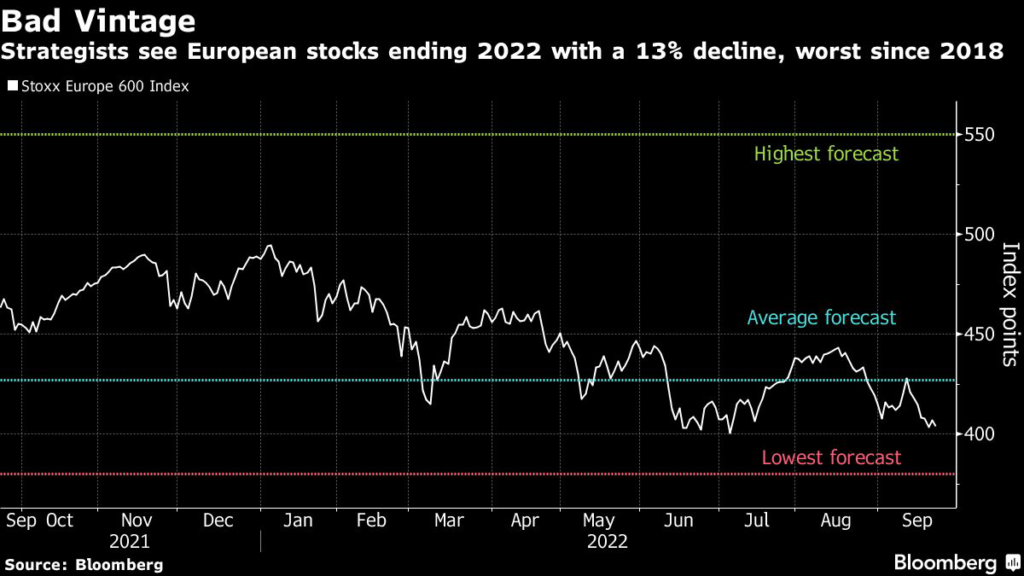
US equity futures dropped at least 1%, with major internet and technology stocks solidly lower in premarket trading. Europe’s Stoxx 600 Index tumbled to the lowest since December 2020 and was poised to enter a bear market as mining and energy shares fell alongside gold and oil. Credit Suisse Group AG slumped to a record amid strategy concerns. 

Goldman Sachs Group Inc. slashed its year-end target for the S&P 500 Index to 3,600 from 4,300, citing a higher interest-rate path from the Federal Reserve, and strategists gave up on a year-end rally for European stocks as private-sector activity in the region continued to contract. 

“It appears that traders and investors are going to throw in the towel on this week in what feels like ‘the sky is falling’ type of event,” Kenny Polcari, chief strategist at SlateStone Wealth, wrote in a note. “Once everyone stops saying that they ‘think a recession is coming’ and accepts the fact that it is here already – then the psyche will change.”

The yield on five-year UK bonds was set for the biggest increase on record in Bloomberg data going back 30 years, after Chancellor of the Exchequer Kwasi Kwarteng outlined the government’s most radical package of tax cuts since 1972 and the Debt Management Office increased its gilt sales plan more than expected. 

The pound plunged to the lowest level since 1985 and traders ramped up bets that the Bank of England will raise rates by one percentage point at its November policy meeting. Investors and economists expressed concern the package will drive the Treasury’s debt to unaffordable levels and fan inflation.

“The markets will do what they will,” Kwarteng said, when challenged in parliament about the mayhem in markets. 

The European Central Bank will also forge ahead with increases in borrowing costs, according to Governing Council member Martins Kazaks, even as recession risks rise across the continent.

While the dollar continued its relentless advance amid forecasts for a further 1.25 percentage points of tightening before year-end, a surprise cut by Turkey’s central bank sent the lira to a fresh all-time low and its longest weekly losing streak in 23 years. 

Meanwhile, the yen fell as traders braced for more action after Japan intervened to prop up the ailing currency for the first time since 1998. 

Investors are flocking to cash and shunning almost every other asset class as they turn the most pessimistic since the global financial crisis, according to Bank of America Corp. strategists. 

Will the Nasdaq 100 Stock Index hit 10,000 or 14,000 first? This week’s MLIV Pulse survey focuses on technology. It’s brief and we don’t collect your name or any contact information. Please click here to share your views.

Here are some of the main moves in markets:

Stocks

  • Futures on the S&P 500 fell 1.2% as of 8:30 a.m. New York time
  • Futures on the Nasdaq 100 fell 1.2%
  • Futures on the Dow Jones Industrial Average fell 1.1%
  • The Stoxx Europe 600 fell 2%
  • The MSCI World index fell 1.1%

Currencies

  • The Bloomberg Dollar Spot Index rose 0.7%
  • The euro fell 0.7% to $0.9765
  • The British pound fell 1.6% to $1.1076
  • The Japanese yen fell 0.4% to 142.91 per dollar

Bonds

  • The yield on 10-year Treasuries advanced four basis points to 3.75%
  • Germany’s 10-year yield advanced seven basis points to 2.03%
  • Britain’s 10-year yield advanced 27 basis points to 3.77%

Commodities

  • West Texas Intermediate crude fell 3.3% to $80.77 a barrel
  • Gold futures fell 1.5% to $1,656.60 an ouncebarrel
  • Gold futures fell 1.4% to $1,657.40 an ounce

More stories like this are available on bloomberg.com

©2022 Bloomberg L.P.

Look Out Guitar Heroes. Trombone Champ Is Taking Over the Internet

(Bloomberg) — The trombone has gone viral.

Trombone Champ, the self-proclaimed world’s first trombone-based rhythm music game, has racked up tens of millions of video views on social media since it launched last week.

With a similar game design to Guitar Hero, players command a virtual trombone with their computer mouse in an attempt to follow the melody of classical music like Mozart’s Eine Kleine, Strauss’s Blue Danube Waltz and the US national anthem, The Star-Spangled Banner, with predictable results. 

Its wildly chaotic and silly gameplay makes Guitar Hero seem like something on offer at Julliard.

Warbling notes, multiple unexplained references to baboons, and loading screens explaining that “two to four spiders – on average – live inside a trombone” keep the entertainment factor high.

The gaming community is impressed. PC Gamer declared it to be a “serious contender for game of the year.” Game reviewer IGN proclaimed, “move over Guitar Hero,” and the London Symphony Orchestra invited people to go “head-to-head with our trombone section” on Facebook.

Some corners of the music world aren’t so ecstatic. Jazz expert and author Ted Gioia wrote that he is “embarrassed” by the game, and said he wishes “it had really just been a joke,” in an email to Bloomberg News. Although he admits to laughing when he first saw a video of the game. 

His concern is for musicians. “Trombonists don’t get much respect in the world, and I doubt this game will help their cause,” said Gioia.

The game’s creator Dan Vecchitto was prepared for worse. “I honestly expected real trombonists to hate the game, because it’s not even remotely realistic,” he told PC Gamer. “The reception from them has been extremely positive.”

Steven Greenall, the creator of the pBone, a plastic and affordable trombone which sells for £140 ($155), is effusive in his praise for the game. As a trombone player who’s used to sitting in the back of the orchestra, “it’s nice to be in the spotlight, for once.” He notes that during the pandemic, brass playing was banned and business was bad. Now he sees the potential for higher sales. “Anything that clarifies what a trombone is good, it will inevitably raise awareness,” he adds.

The viral success of Trombone Champ invites comparisons to the mid-2000s craze for Guitar Hero and its plastic music accessories, which generated billions in revenue for Activision Blizzard Inc. Guitar Hero III: Legends of Rock racked up more than $1 billion in sales alone.

Vecchitto plans to capitalise on the game’s viral popularity. He spent four years working nights and weekends at his home in Brooklyn, New York, to build the game’s code with the help of his wife, Jackie, who together own the game development company Holy Wow Studios. They consulted musicians and worked with play-testers and visual artists to make sure the tone was just right, and that the virtual character was holding the instrument correctly.

The idea for the game came when Vecchitto, a saxophone and clarinet player who has never played the trombone, was building an arcade cabinet, or machine, for an earlier game. “I suddenly had the idea for an arcade cabinet with an enormous rubber (it had to be floppy rubber) trombone controller, with the player desperately trying to match a bunch of squiggly note lines headed their way,” he told PC Gamer. Future developments might include leaderboards so players can compete with friends, the ability to add new songs and the possible addition of a rap song. 

In his definitive history of jazz standards, Gioia writes that “not every horn [like the trombone] survived the transition from swing to bop during the middle years of the twentieth century.” 

Will the trombone survive its transition to the rhythm game universe? Its future may be in the hands of a game developer who, in fact, plays the saxophone.

More stories like this are available on bloomberg.com

©2022 Bloomberg L.P.

EU Nations Demand Tougher Russia Sanctions in Next Package

(Bloomberg) — Several European Union nations are pushing to broaden sanctions against Moscow over its invasion of Ukraine as the bloc races to find an agreement on capping the price of Russian oil.

Poland, Ireland and the three Baltic nations want the EU to extend its sanctions on Russian energy to include a ban on liquefied petroleum gas (LPG) products and restrictions on nuclear energy cooperation, according to a document seen by Bloomberg and to people familiar with the matter.

The proposals include cutting more banks from the international payments system SWIFT, starting with Gazprombank. The Russian lender has so far been spared from the bulk of the bloc’s sanctions as it is used by European firms to pay for gas deliveries. 

EU Rushes to Agree on an Oil Price Cap After Putin’s Threats

Latvia, Lithuania, Estonia, Ireland and Poland also want to see a ban on insurance services and transferring US dollar banknotes to Russia, as well as tougher restrictions on transactions involving crypto assets, according to the document. The Financial Times reported earlier Friday on the proposals.

EU member states and the European Commission, the bloc’s executive arm, are in talks to prepare a new package of sanctions which is likely to include more trade restrictions, individual listings and a drive to agree a price cap on Russian oil.

A price cap would align the EU with a US effort to keep the cost of crude from soaring. But it would also likely require the bloc to loosen a ban on services, such as insurance, needed to move oil in order to allow their provision for shipments below an agreed threshold. That ban is due to come into force in December and the cap will need the backing of all member states.

Cybersecurity, Technology

A senior diplomat from one of the five nations told Bloomberg that if the new suite of measures is to include a cap, then those countries would want to see the overall sanctions strengthened if they are to support the oil measure.

The five countries also propose to ban using Russian cybersecurity firm Kaspersky Lab in the EU, to tighten existing restrictions on technology exports and add more goods to the list of prohibited tech products, including data-processing machines, storage devices and several electronics.

Furthermore, the countries want to:

  • Broaden the scope of the restrictions imposed on Russian vessels entering EU ports, on providing business services to Russia and introduce a ban on IT services to Russia, including software and cybersecurity services
  • Ban importing diamonds that originate in Russia, extend import restrictions on steel as well as ban the sale of real estate to Russian companies and citizens who are not residents in the EU
  • Sanction more Russian propaganda outlets and ban EU-registered entities from receiving funding from organizations linked to the Russian state.

More stories like this are available on bloomberg.com

©2022 Bloomberg L.P.
Ethereum Centralization Debate Rages on After Much-Hyped Upgrade

(Bloomberg) — The high-profile upgrade of the world’s most commercially important crypto network was supposed to make it less centralized and vulnerable to attack. A little more than a week after the enhancement, industry observers fear it may have the exact opposite effect.

Crypto enthusiasts are poring over an obscure indicator birthed during the early days of crypto, dubbed the Nakamoto Coefficient, to evaluate the consequences of the ‘Merge’. The event replaced Ethereum’s power-hungry computers called miners with so-called validators that pledge Ether tokens as security so they can profit from ordering network transactions. 

Under the old proof-of-work format, 51% of miners would have needed to join together for a successful attack on the blockchain. Now, only about a third of validators need to join forces to gain control, according to Leland Lee, who helped formulate the indicator, which is named after Bitcoin’s supposed anonymous creator, Satoshi Nakamoto. 

The metric tracks the minimum number of participants in various important network support roles — code developers, parties ordering transactions, wallets and so on — that would have to collude or be compromised to take over a blockchain. The higher its coefficient value, the more decentralized a blockchain is. The Nakamoto Coefficient was proposed in 2017 by Lee, now head of platform and investor at Galaxy Digital, and venture capitalist and former Coinbase Global Inc. Chief Technology Officer Balaji S. Srinivasan. 

“The safety threshold for classical consensus protocols, including the protocol used in Ethereum 2, can be no higher than 33%,” Emin Gun Sirer, creator of the rival Avalanche blockchain and a former Cornell University professor, said in an email. “We know for certain that an attacker who controls 34% of the state can cause safety failures, including double-spends. The actual threshold for the Ethereum protocol is likely to be lower than 33%, because of the way validators are divided into slots.”

Alex Stokes, a researcher at the Ethereum Foundation, which supports the blockchain, said that a 33% or 34% attack “refers to the theoretical worst-case scenario.” That isn’t realistic given how geographically distributed Ethereum’s community is, he said. An attacker could also end up losing his entire stake of coins, something that few may want to risk. A more realistic threshold to pull off an attack that could wrestle control of the blockchain and potentially alter the code is 66% of validators, Stokes said.

Even so, Lee estimates 34% should be the threshold when considering Ethereum’s Nakamoto Coefficient. Before the upgrade, between three and five mining pools would have had to collude to be able to double-spend the same coin, for example. Currently, two validator addresses — Lido and Coinbase — control about 43% of Ethereum validator pools, according to block explorer Beaconcha.in.

“Ethereum is much more centralized than it was a week ago,” Lee said.

That’s a potentially troubling development as regulators circle Ether. Back in 2018, a US Securities and Exchange Commission official said Ether wasn’t a security thanks in part to the network’s “decentralized structure.” Now that structure may have been upended. SEC Chairman Gary Gensler said last week, without specifically referring to Ethereum by name, that proof-of-stake systems could fall under his agency’s securities rules.

That could have huge implications, not just for Ether investors, but also Ethereum users, who usually have to buy the tokens to use many of the network’s applications. Ethereum hosts nearly 3,500 decentralized apps and millions of users. 

Lee pointed out that the Nakamoto Coefficient is just one of many ways to measure decentralization. The top two mining pools ordered transactions in 43% of blocks in the two weeks leading up to the Merge. In a few days since, the two big validator addresses — Lido and Coinbase — have ordered transactions in 42% of the blocks, according to researcher Chainalysis. That would suggest that centralization has decreased slightly. Because Lido is a decentralized organization, controlled by its members and comprised of thousands of independently-owned nodes, it’s less likely to become an attack vector, some argue. Other observers see it differently. 

“The Nakamoto Coefficient of Ethereum post-Merge is embarrassingly low,”said Kyle Samani, co-founder of Multicoin Capital, which owns Sol, a native coin of Solana, which competes with Ethereum. It’s “the worst of all major chains.”

Ethereum’s proof-of-stake system also has another weak point, said Campbell Harvey, a finance professor at Duke University. Newly created entities called builders are packaging transactions into blocks and relaying them to validators. Currently, one relay, by Flashbots, handles more than 80% of all builder-made transactions, according to tracker Mevboost.org. Flashbots is also a builder, which accounts for the lion’s share of builder-built blocks.

“The world has gotten more complicated after proof-of-stake,” Lee said. “Quantifying what Nakamoto Coefficient was was much easier.”          

More stories like this are available on bloomberg.com

©2022 Bloomberg L.P.

A Startup Has Put Electrodes in a Patient’s Skull to Treat Depression

(Bloomberg) — This summer, doctors in St. Louis shaved away a small part of a person’s skull and replaced it with electrodes. The technology is intended to alleviate the patient’s severe depression by sending tiny electric pulses to the brain.

The startup behind the surgery is Inner Cosmos, one of a growing cadre of tech companies working on implanted devices for the brain. The trial, the first of its kind using implants in the bone of the skull to treat depression, represents a step forward for scientists’ efforts to treat mood disorders with hardware. It’s also a sign of progress for implants that sit within the skull itself.

“Any time you get a technology in a patient is a major milestone,” said Benjamin Rapoport, a New York-based brain surgeon who works with another company in the field. 

Other high-profile brain-related startups are focused on helping people cope with paralysis. Elon Musk says his company Neuralink has enabled monkeys to play video games with their minds. And Synchron Inc. recently started its first US human trial, which it hopes will let a person send emails and texts using only thoughts, as earlier Synchron patients have done in Australia. 

Unlike these companies, Inner Cosmos for now is focused on moods. It also uses a different type of surgery, allowing the device to be implanted within the bone of the skull. It’s less invasive than the technique planned by Neuralink, which has raised more than $360 million, and aims to place electrodes deeper inside the brain.

The simpler the surgery, the more people are likely to be open to it, said Inner Cosmos Chief Executive Officer Meron Gribetz. That’s helpful for the company’s goal of creating a new mass-market tool for treatment-resistant depression, which affects an estimated 2.8 million US adults. “We want to get the largest number of patients help,” Gribetz said.

As the technology around brain implants develops, more companies have pursued methods of embedding a device that don’t require actually piercing the brain itself. “Whether it penetrates brain tissue or not is a deep divide” when it comes to next-generation neuromodulation surgery, said Rapoport, who is the co-founder of brain-computer interface company Precision Neuroscience Corp. Before Precision Neuroscience, Rapoport was a founding member of Neuralink. Now, his company is focused on placing electrodes just inside the skull, on top of the brain, via a device thinner than Scotch tape.

In Los Angeles, a company called Kernel has moved away from deeper brain implants — and is now building an electrode-studded helmet that accomplishes similar goals but requires no surgery at all. And New York-based Synchron, which has raised more than $60 million, avoids brain surgery by sending electrodes to the brain via blood vessels, in a stent.

There are also startups working to embed devices in skulls, similar to Inner Cosmos. A company in Australia called Epiminder, among others, creates a small recess in the bone near the brain for its device, which aims to treat epilepsy.

The overall idea isn’t exactly new: Implanted electrodes have a yearslong track record of treating epilepsy and Parkinson’s. What is noteworthy about Inner Cosmos is its ability to capture what scientists call high-resolution local field potentials — localized electrical potential from the surface of the brain that overcome the randomness of individual neuron recordings — while not penetrating into the brain itself. If it works, the technique could eventually treat a much broader range of cognitive disorders.

Inner Cosmos said surgery went well for its first patient. Once a day for about 15 minutes, the implant will send pulses to the person’s left dorsalateral prefrontal cortex while measuring neuronal activity to gauge and adjust the correct amount of stimulation. The trial will last for one year, and may add one or two more patients. Neuroscientists have debated which part of the brain to target to achieve the best results in depression treatments. The area Inner Cosmos targets is similar to that of another technique, known as transcranial magnetic stimulation, which doesn’t require surgery but takes longer to implement than the Inner Cosmos device.

“We’re iterating and shrinking things all the time,” CEO Gribetz said. The device the patient in St. Louis received has more pieces and is bigger than Inner Cosmos’s eventual product will be.

There are trade-offs for brain devices that don’t go deeper into people’s heads. Stanford University neurosurgeon Jaimie Henderson, a consultant to Neuralink, works with neuron-by-neuron data from deep within the brain, with his research successfully enabling a paralyzed man to type using his thoughts. By remaining within or outside of the skull, Henderson said, devices don’t receive the same level of detailed data as they could by using more aggressive techniques that penetrate brain tissue. “Rather than a fine-grained representation of what is happening at the individual neuron level,” he said, “the information they capture is an average of the electrical activity within a certain brain area.”

Jesse Wheeler, Inner Cosmos’s chief technology officer, said that may actually make the data more useful for the company. Wheeler believes the broader sweep of information is less prone to distortions that might come from individual neurons.

Most scientists in the field believe that because the brain affects so many health areas, there’s room for a spectrum of surgical strategies. “Our view is not a winner take all approach,” said Michael Mager, the CEO of Precision Neuroscience.

“There are definitely more companies trying to do less and less invasive things, because that always makes a product easier to adopt and the path to market shorter,” said Max Hodak, the former chief operating officer of Neuralink, who is now running his own optics-based brain-computer startup, Science Inc. “But I think that long term, the most astonishing products will require an implant.”

More stories like this are available on bloomberg.com

©2022 Bloomberg L.P.

Close Bitnami banner
Bitnami
