Bloomberg

You Won’t See Beer Ads on Amazon’s ‘Thursday Night Football’

(Bloomberg) — To many viewers, Amazon.com Inc.’s first exclusive “Thursday Night Football” game last week looked like a typical NFL broadcast. There were pregame and halftime shows, sideline reporters and longtime NFL announcer Al Michaels calling the action.

But one thing was missing: beer commercials.

On a website with its advertising guidelines, Amazon says it prohibits ads that promote wine, beer and spirits in the US, and a few other countries, like Canada and Saudi Arabia. That applies to all of its platforms, including Prime Video.

“Ad content must not encourage, glamorize or depict excessive consumption of alcohol,” it says.

So while NFL fans saw ads during last week’s game from some of the usual sports marketers, such as insurance companies and movie studios, breweries were nowhere to be found.

It was a rare absence. Beer makers and the NFL have a long and deep relationship. Budweiser’s Clydesdales are famous for their Super Bowl ads.

The idea of an NFL game without a beer commercial is “unheard of,” said Brad Adgate, a media consultant and veteran observer of the ad industry. “They go hand in hand.” 

Breweries are still advertising on other NFL broadcasters. Beer brands have spent $60 million on TV commercials in the last two weeks, and 70% of that spending went to NFL programming, according to the measurement firm iSpot.tv. The top-spending brands were Corona, Michelob, Bud Light, Coors Light and Modelo. Jason Damata, a spokesman for iSpot.tv, said that a professional football game without a beer commercial is highly unusual, adding that it’s “hard to find an example of an NFL game without advertising from that category.”

There’s a chance that some beer commercials could still appear during Amazon’s NFL games this season, but they won’t be sold directly by the company. The NFL gets an allotment of commercial time during games and could use some of those spots to promote Anheuser-Busch InBev SA, the official beer sponsor of the league. And fans who live in the local markets of the competing teams can still watch the Thursday games on traditional TV and could see beer ads sold by the local broadcaster.

More stories like this are available on bloomberg.com

©2022 Bloomberg L.P.

Bitcoin Tests Almost 2-Year Lows; Ether Extends Post-Merge Slide

(Bloomberg) — Cryptocurrencies lingered near almost two-year lows as digital-asset investors sought a fresh catalyst with central bank rate increases depressing demand for riskier assets. 

Bitcoin, the largest token by market value, fluctuated around $19,000 for a third day. Earlier, it slid as much as 4% toward levels last seen in late 2020. Second-biggest coin Ether continued to underperform, shedding 3%, and it is now down about 20% since a much-touted network upgrade last week. 

Markets are shuddering at the Federal Reserve’s determination to fight inflation by constricting financial conditions. Shorter maturity Treasury yields jumped more than longer tenor rates, deepening a bond curve inversion seen as a signal of recession. A dollar gauge was at a record as investors sought a bolthole.

Such a backdrop offers little respite for crypto markets. They were already reeling from a $2 trillion plunge from a 2021 record high, an unraveling pockmarked with blowups such as the Three Arrows Capital hedge fund and the Terraform Labs project — whose co-founder Do Kwon is wanted by authorities.

“If the Fed keeps tightening, unless it implements yield curve control to keep the curve positively sloped, the crypto system will see a lot more failures,” said Brian Pellegrini, founder of Intertemporal Economics. “At the end a few very rich champions will emerge, but in the meantime there will be blood in the streets.”  

The MVIS CryptoCompare Digital Assets 100 Index is down this week, taking its losses for 2022 to about 60% compared with 23% for global stocks. The correlation between equities and Bitcoin is elevated and close to a record, a sign of how assets are being tossed around by common macro factors. 

‘Ponzi Schemes’

JPMorgan Chase & Co. Chief Executive Officer Jamie Dimon didn’t help the mood in digital-asset markets by reaffirming his skepticism and calling tokens “decentralized Ponzi schemes.”

Ether continues to take an additional hit as an earlier rally sparked by hype around the upgrade of its Ethereum network unwinds. Coins like Solana and Avalanche were up.

Some traders might look to measures like Bitcoin’s 14-day relative strength index for affirmation that a bounce is possible. The RSI, a momentum gauge, is close to oversold levels. But contrarian bets appeared few and far between for riskier assets following the Fed’s pugnacious performance.

More stories like this are available on bloomberg.com

©2022 Bloomberg L.P.

Elon Musk May Regret Putting Tesla’s First European Plant in Germany

(Bloomberg) —

Tesla recently outlined what will determine where the carmaker puts its next plant. Looking at the list, it’s easy to imagine Elon Musk wishes he had a do-over and didn’t put his first European factory in Germany.

The criteria relayed by Baird’s Ben Kallo includes “as little red tape as possible,” the analyst wrote in a Sept. 8 report. Tesla has experienced a good deal of this in Gruenheide, outside Berlin. It complained in April of last year about the “ irritating” process of getting final approval for the project. Musk’s dancing during the plant opening in March was a rare celebratory moment.

The facility — first announced in late 2019 — was delayed for months by legal challenges from environmental groups concerned the site would use too much water and threaten local wildlife. Weeks after production finally started, Musk referred to Tesla’s factories in Germany and Texas as “gigantic money furnaces” that were losing billions of dollars.

Now, more roadblocks are popping up. Last week, broadcaster RBB reported that authorities in Gruenheide had indefinitely postponed a vote on Tesla’s plan to expand the factory by around 100 hectares (247 acres) to add a freight yard and warehouse for stockpiling parts. At least part of the expansion would be into an environmentally protected area, and any plan to chop down more trees will surely run into stiff opposition. 

“There is a need for clarification with authorities regarding the development possibilities for the entire municipality of Gruenheide,” Arne Christiani, the town’s mayor, said by phone. “It’s unclear when this will be resolved.”

There have been signs Germany’s bureaucracy could be costly with respect to Tesla’s investment in Gruenheide. Late last year, the company decided to forgo 1.14 billion euros ($1.12 billion) of state aid because it opted to try producing a new type of battery cell in Texas first. The Wall Street Journal reported this month that the company was pausing plans to make battery cells in Germany and had discussed shipping cell-making equipment to the US.

Joerg Steinbach, the economy minister for the state of Brandenburg, where Tesla’s factory is located, tweeted Wednesday that he’s been assured all is well.

“The commitment in Gruenheide remains unchanged, especially regarding expansion plans for automobile production,” Steinbach tweeted after a conversation with Tesla representatives in Washington. “The battery factory will be completed. Internal process modifications and prioritizations are pending. But the factory is coming.”

Amid all these reports, Tesla recently hosted an open house at a Gruenheide convention center, where employees mingled with a few dozen visitors munching on pretzel sandwiches and donuts. Tesla staffers in black t-shirts presented the carmaker’s plans with respect to logistics, hiring and expansion, and also talked about more sensitive issues such as water consumption.

One theme dominated the conversations: Just-in-time production, the workers said, has become untenable due to supply-chain snags, Covid-caused factory shutdowns and skyrocketing logistics costs. This is the reason Tesla is trying to expand the factory with the warehouse to store more parts and a multi-track freight yard to shift deliveries to trains from trucks.

One employee said that for battery components from China, Tesla has had to deal with container bottlenecks at Hamburg harbor. Choosing more expensive air freight isn’t a great option either, as cargo planes are being diverted around the closed Russian-Ukrainian airspace, further driving up costs.

Tesla has made some unconventional moves to navigate out of production quagmires before, perhaps most notably in 2018, when it was struggling to mass-manufacture the Model 3. The company ended up constructing an assembly line under a massive outdoor tent to boost output.

Germany’s infamous red tape and its strong labor unions make that kind of unconventional problem-solving much harder. Last month, Musk said during Tesla’s annual meeting that where were still a “host of problems” to work through both in Austin and Gruenheide. While both may be having a hard time spooling up, the company has clearly shown a greater willingness to take on more in Texas.

More stories like this are available on bloomberg.com

©2022 Bloomberg L.P.

Apax Partners Raises $10 Billion for New Buyout Fund

(Bloomberg) — Apax Partners has raised more than $10 billion in five months for the first close of a new flagship private equity fund, people familiar with the matter said — about 75% of its target.

The London-based buyout firm is chasing roughly $13 billion for the latest global vehicle and plans to continue to raise funds from investors into next year, one of the people said, asking not to be identified discussing confidential information.

A representative for Apax declined to comment.

Apax closed its Apax X global fund at about $11 billion in early 2021. The firm also manages a range of region-specific funds that target investments across the technology, services, health care and internet and consumer sectors, according to its website.

Its new fundraise comes at a challenging time for private equity firms, which are facing more difficult dealmaking in a rising interest rate environment for the first time in more than a decade. The worsening macroeconomic outlook is leading some institutional investors to plan to trim allocations to private equity and venture capital funds.

This has ratcheted up competition in the race for investor cash and even the biggest names in the industry — including Blackstone Inc. and Apollo Global Management Inc. — have been deploying new tactics to beat out rivals. 

Apollo Co-President Scott Kleinman this week described the recent private equity fund raising environment as a “wacky dynamic,” saying there was an unusual number of managers seeking fresh capital. Investors who had already assigned their capital for 2022 were asking Apollo to keep its flagship fund raise open until next year in order to get an allocation, he said.

Read more: EQT Raises $15 Billion for New Fund, Defying Market Headwinds

(Adds fundraising timeline in second paragraph, Scott Kleinman quote in final paragraph)

More stories like this are available on bloomberg.com

©2022 Bloomberg L.P.

Investors Find a Lot to Like in Tech, Even as a Market Bottom Remains Elusive

(Bloomberg) — Even as the Federal Reserve jacks up interest rates and sends technology stocks tumbling, it only gets harder to stay away from the sector. 

On the one hand, there’s so much to like: The Nasdaq 100 Index is now 35% cheaper than at its 2020 peak, megacap companies like Apple Inc. are still filling their coffers with cash and the earnings outlook shows no sign of a significant slowdown. 

The index fell 0.8% on Thursday and is down almost 30% so far this year.

But, the Fed. The market chatter going into Wednesday’s monetary policy meeting was that there was a high likelihood of a relief rally in tech if the central bank, as expected, raised its benchmark rate by 75 basis points. Turns out it wasn’t that straightforward. The Nasdaq 100 slumped to early July lows, pretty much erasing most of the summer rally, after a more hawkish tone than hoped for from the Fed.

So why not avoid tech until the dust settles? That just isn’t an option for most institutional investors, given that the industry is by far the largest in the S&P 500 Index, at almost 27% of the benchmark. If tech stocks turn around and you miss out on the rally, it can be career-ending. 

Stockpickers thus are gravitating towards “quality” companies with durable businesses or stock charts. Apple Inc. is down just 13% this year. T-Mobile US Inc., cybersecurity company Palo Alto Networks Inc. and chipmaker Texas Instrument Inc. are a few of the others that also have managed to beat most of their tech peers.

“Look for businesses with high market share, a good moat, and low substitution risk,” said Brian Battle, director of trading at Performance Trust Capital Partners. “Microsoft makes stuff that people pay for. Apple sells billions in consumer goods, and it is hard to replace those.”

Companies that don’t have those attributes are getting slammed in the stock market. Take Meta Platforms Inc., the Facebook owner dependent on ads. It’s lost 58% of its value this year. It’s a similar picture with Snapchat owner Snap Inc. and streaming-video company Netflix Inc. 

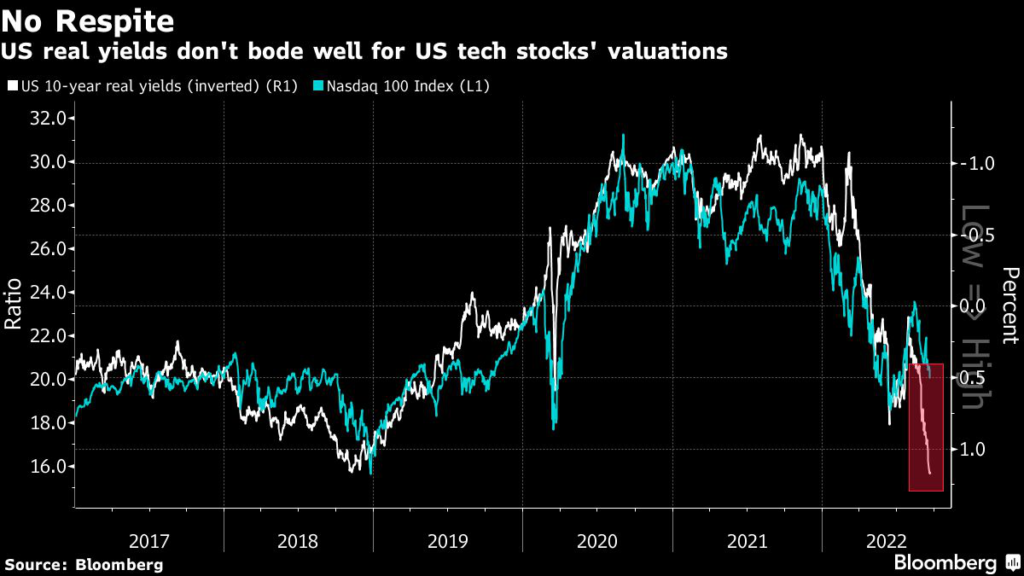
As long as real yields in the bond market keep going up, tech stocks probably haven’t bottomed, arguing against buying into the Nasdaq 100. While the index’s earnings multiple has come down a lot, it’s falling from very inflated levels. But stockpickers are finding plenty to buy in tech.  

“So it has gotten cheaper, but it isn’t cheap,” said Alec Young, chief investment strategist at Mapsignals, a quantitative research firm. “Until it feels like the Fed is able to take a pause on tightening, tech isn’t likely to be a leadership sector.”


Tech Chart of the Day

Top Tech Stories

  • Amazon.com Inc. lost a bid to exclude top executives including billionaire founder Jeff Bezos and Chief Executive Officer Andy Jassy from having to testify in a Federal Trade Commission probe.
  • Sometime next year, Tim Cook will appear before the Apple Inc. faithful and unveil the company’s next major computing platform, a headset that mixes virtual reality and augmented reality.
  • Meta Platforms Inc. was sued for allegedly building a secret work-around to safeguards that Apple Inc. launched last year to protect iPhone users from having their internet activity tracked.  Meta acknowledged that the Facebook app monitors browser activity, but denied it was illegally collecting user data.
  • Intel Corp. executive Sandra Rivera has what once would have been the most coveted job in the semiconductor industry: head of the company’s hugely lucrative data center division. Nowadays, it’s the toughest.
  • Microsoft Corp. won’t label social media posts that appear to be false in order to avoid the appearance that the company is trying to censor speech online, President Brad Smith said, hinting that the company is taking a different approach than other technology firms in dealing with disinformation.
  • BT Group Plc faces walkouts from staff who handle “999” calls for the emergency services, intensifying their dispute on pay amid a national surge in industrial action in the UK.
  • UK digital regulator Ofcom said it will launch a range of investigations into digital markets including cloud computing, internet messaging, and smart devices, marking another step up in the scrutiny of the world’s largest tech firms.
  • Kittyhawk, the air-taxi company backed by billionaire Google co-founder Larry Page, will be closing down, dealing a setback to the long-elusive dream of developing flying cars.
  • US intelligence agents gained control of parts of China’s telecommunications network after hacking into a government-funded university, a prominent state-backed newspaper reported, issuing Beijing’s latest accusation of US cyber-intrusion.
  • Former UK Prime Minister Boris Johnson was only half-way through rolling out several key policies when his government collapsed with a mass resignation. His successor Liz Truss now looks set to dilute a string of overdue decisions on technology and media.

(Updates to market open)

More stories like this are available on bloomberg.com

©2022 Bloomberg L.P.

Don’t Spy on Employees to Ensure They’re Working, Microsoft Says

(Bloomberg) — More than two years after remote work and hybrid jobs became widespread, there’s still a stark divide over how it’s going: About 85% of managers worry they can’t tell if employees are getting enough done, while 87% of workers say their productivity is just fine.

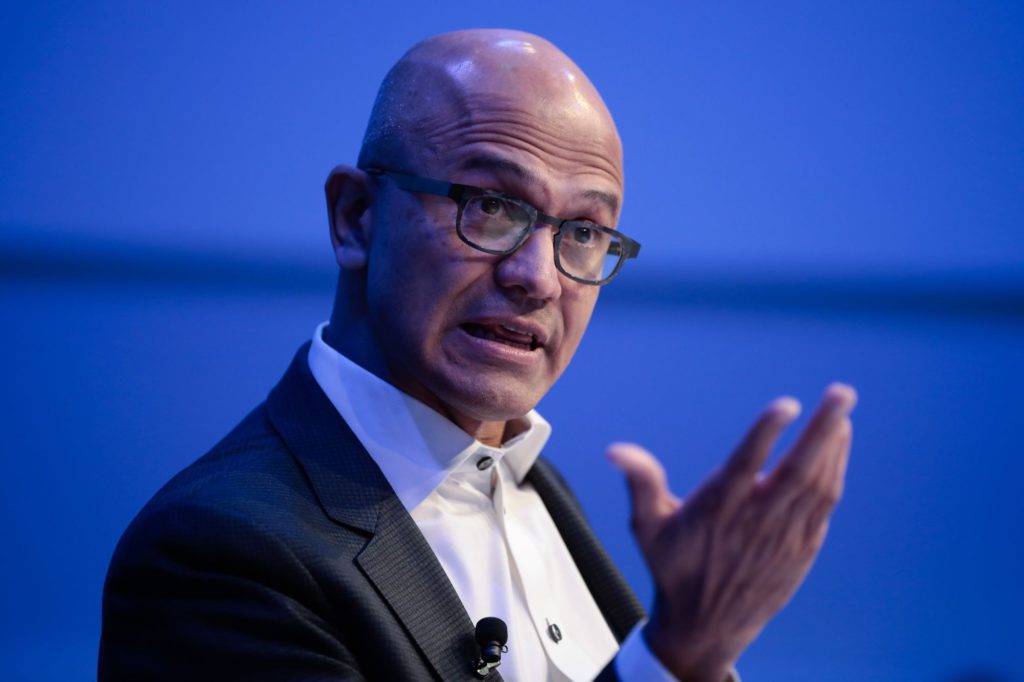
That was the finding of a survey on corporate attitudes by Microsoft Corp., the workplace software giant and owner of LinkedIn. Managers’ fears about idle workers are creating what Microsoft Chief Executive Officer Satya Nadella calls “productivity paranoia,” with undesirable results—like spying on employees. 

“Leaders think their employees are not productive, whereas employees think they are being productive and in many cases even feel burnt out,” he said in a Bloomberg Television interview. “One of the most important things for us in this new world of work and hybrid work is to bridge this paradox.”

Microsoft has been surveying global employees in a variety of industries a few times a year during the pandemic—the latest data polled 20,000 people in 11 countries—aiming to track trends and adjust its technology to fit the needs of customers.

The data has continually showed a disconnect between managers and the rank and file, and Microsoft has been offering tools like its Viva employee experience software to bridge the gap. Viva now has more than 10 million active monthly users at companies like PayPal Holdings Inc. and Unilever Plc, which use it to help teams align their goals and stay in touch. But even though new communication tools are putting bosses in closer contact with employees, Microsoft wants executives to know that workplace surveillance is not the answer to boosting productivity. 

“There’s a growing debate about employee surveillance, and we have a really strong stance—we just think that’s wrong,” said Jared Spataro, a Microsoft vice president. “We don’t think that employers should be surveilling and taking note of the activity of keystrokes and mouse clicks and those types of things because, in so many ways, we feel like that’s measuring heat rather than outcome.”

Microsoft itself has had to adjust and dial back some features in its workplace products because they enabled this kind of behavior. In 2020, the company made changes to its Productivity Score feature, which privacy advocates complained made it too easy to snoop on individual workers. 

Other pandemic work trends, like mass quitting, seem to be petering out. For the first time in 18 months, what LinkedIn and Microsoft dubbed the “Great Reshuffle” and others called the “Great Resignation” is slowing. The year-over-year growth in people changing jobs on LinkedIn is now flat, according to Ryan Roslansky, who runs the service. And more job listings are for in-person roles.

Before the pandemic, 2% of jobs on LinkedIn were listed as remote, a number that went up to 20% by March 2022. It’s now down to 15%, he said.

Many senior corporate leaders are longing to return to the pre-pandemic days of in-person work, Spataro said. But Microsoft still recommends a flexible approach. “People come to work for other people, not because of some policy,” Nadella said.

More stories like this are available on bloomberg.com

©2022 Bloomberg L.P.

Bond Yields Rise as Central Banks Rush to Join Fed: Markets Wrap

(Bloomberg) — Treasury yields climbed after a wave of monetary tightening from global central banks that followed the Federal Reserve decision.

Two-year rates continued to push above the 4% mark, deepening the curve inversion that signals economic headwinds. Contracts on the S&P 500 edged higher, signaling a rebound of the US equity benchmark after Wednesday’s rout.

The Fed gave its clearest signal yet that it’s willing to tolerate a recession as the necessary trade-off for regaining control of inflation, with officials signaling a further 1.25 percentage points of tightening before year-end. Switzerland, Norway and Britain followed with hikes of their own as officials rush to get to grips with rampant price increases. 

“The Fed is engineering a hard landing — a soft landing is almost out of the question,” Seema Shah, chief global strategist at Principal Global Investors, wrote in a note following the Fed decision. “Powell’s admission that there will be below-trend growth for a period should be translated as central bank speak for recession. Times are going to get tougher from here.”

Read more: Powell Signals Recession May Be the Price for Crushing Inflation

The Bank of England delivered a second consecutive half-point hike to quell price pressures. Even so, the move to 2.25% wasn’t as big as some were expecting, and the pound pared its rise against the dollar. The gilts 10-year yield climbed.

The Swiss National Bank matched the Fed by raising interest rates 75 basis points to bring borrowing costs above zero for the first time in almost eight years. Norway’s central bank, among the first in the rich world to start raising rates last September, lifted its key interest rate by a half point and signaled that its tightening may be nearing an end. 

The yen rose after Japan’s first intervention since 1998 shored up the currency’s 20% slide against the dollar this year. In contrast to the Fed, the Bank of Japan stuck steadfastly to its rock-bottom interest rate policy Thursday.


Will the Nasdaq 100 Stock Index hit 10,000 or 14,000 first? This week’s MLIV Pulse survey focuses on technology. It’s brief and we don’t collect your name or any contact information. Please click here to share your views.

Here are some of the main moves in markets:

Stocks

  • Futures on the S&P 500 rose 0.4% as of 8:53 a.m. New York time
  • Futures on the Nasdaq 100 rose 0.3%
  • Futures on the Dow Jones Industrial Average rose 0.4%
  • The Stoxx Europe 600 fell 0.5%
  • The MSCI World index was little changed

Currencies

  • The Bloomberg Dollar Spot Index fell 0.5%
  • The euro rose 0.5% to $0.9883
  • The British pound rose 0.6% to $1.1338
  • The Japanese yen rose 2.4% to 140.67 per dollar

Bonds

  • The yield on 10-year Treasuries advanced two basis points to 3.55%
  • Germany’s 10-year yield declined three basis points to 1.87%
  • Britain’s 10-year yield advanced nine basis points to 3.41%

Commodities

  • West Texas Intermediate crude rose 2% to $84.60 a barrel
  • Gold futures rose 0.9% to $1,690.30 an ounce

More stories like this are available on bloomberg.com

©2022 Bloomberg L.P.

Putin’s Call-Up Brings Reality of War Home to Many Russians

(Bloomberg) — President Vladimir Putin’s order to call up as many as 300,000 reservists to fight in Ukraine triggered alarm and demonstrations as Russians were forced to confront the reality of the deadly conflict.

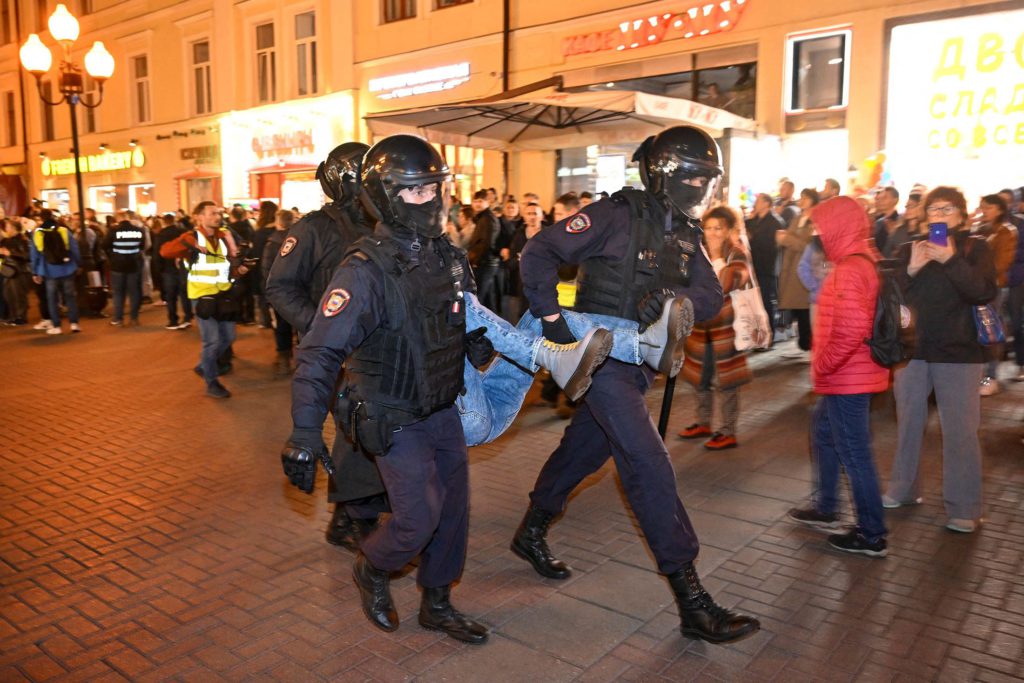
Police detained about 1,400 people at protests against the order in 38 cities Wednesday night, according to the OVD-Info monitoring group. Some of the male detainees were handed draft notices at police stations, and protesters may face criminal charges under the harsh laws against criticism of the war the Kremlin has imposed since the Feb. 24 invasion. Some university students who joined the demonstrations were threatened with expulsion, which could annul draft exemptions.

For millions of Russians who’ve been largely shielded from the reality of the Kremlin’s bloody seven-month war, Putin’s speech early Wednesday announcing a “partial mobilization” came as a shock. The authorities provided few details of how the order, which is the first in Russia since World War II, will be implemented and who will get drafted.

Regional governments quickly began issuing orders for reservists — a huge category covering people who served as conscripts, contract soldiers, and part-time officers — to prepare to be summoned and banning them from leaving the area, according to Pavel Chikov, a lawyer who advises on conscription cases. Doctors in Moscow also received mobilization notices, he said on Telegram.

Videos posted on social media showed draftees in the Yakutia region in Siberia being taken away by bus, seen off by crowds of tearful relatives.  

Authorities in some cases came in the middle of the night to round up conscripts in order to fill the regional quotas that the military sets. 

“They took my 40-year-old son at night,” said Antonina, a pensioner in the Far East who declined to give her last name. “Everyone who was taken in our village was over 40, not a single young one. They’ll grab anyone. There’s total panic and confusion.”

The mobilization order will affect 300,000 people and apply only to those with military experience, according to Defense Minister Sergei Shoigu. Students and people who haven’t served in the army won’t be called up, he said. 

But the presidential decree doesn’t specify which categories of Russia’s 2 million reservists will be called up and has a secret clause.

Legal restrictions on leaving the country for those subject to mobilization “haven’t been implemented yet because it’s a partial one,” said Andrey Kartapolov, head of the Defense Committee in the lower house of parliament, according to RBC. “As for how things will go in the future, we’ll see, as they say.”

Sold Out

Many Russians didn’t find comments like that reassuring. 

Finland’s border service reported a 50% surge in car traffic overnight and Georgian TV broadcast long lines on the Russian side of the border. Google data showed a spike in search requests for “how to leave Russia” and even “how to break an arm.” Social media were flooded with reports of soaring airline ticket prices.

A travel agent in Belgrade said tickets on Air Serbia, which offers the only flights from Russia to Europe, are sold out. “Until very recently, passengers looking to fly out of Moscow immediately had to wait for several days, maybe a week. Now there’s nothing, not even with stopovers” until mid-October, said Viza Air Travel agent Verica, who declined to give her last name.

For many the prospect of fighting in the war prompted drastic action. Kirill, the owner of an IT company, said he’s urgently relocating his 100 Moscow-based staff to Dubai to prevent them from being called up. 

Many borders remained closed to Russians. The leaders of the Baltic states said their countries won’t offer asylum or humanitarian visas to men trying to flee mobilization.

“The war was OK for them when they saw it on TV, sitting on a sofa, but it is no longer OK when your government and your Shoigu calls you to join the army and offers to take part in the war with your own physical body,” Lithuanian Prime Minister Ingrida Simonyte said. 

‘Major Problem’

“One of the consequences of mobilization will be the fact that the apolitical and passive population will be trawling the Internet and social media to search for answers over mobilization,” Tatiana Stanovaya, founder of the R.Politik research group, said on Telegram. “And they’ll find them not where the Kremlin wants them to, and not just information about how they’ll be drafted.”

Putin’s “major problem is his confidence that the people support him by default because he’s a leader who’s doing the right thing in the national interests,” she added.

Worried relatives of those facing the call-up for war vented their anger on the Telegram channel of Vyacheslav Volodin, the lower house of parliament’s speaker and a Putin ally. In March, the Russian president promised in his annual message of congratulations on International Women’s Day that he wouldn’t call on reservists to serve in Ukraine.

Russia Sees Smaller Economic Hit From Sanctions as War Escalates

A media outlet set up by jailed opposition leader Alexey Navalny fanned the discontent by broadcasting a conversation with the son of Putin’s spokesman Dmitry Peskov, in which the program’s host posed as an official from the military recruitment office. Nikolay Peskov, 32, said he wouldn’t obey the summons and would “sort this out at another level,” according to the audio recording. Peskov later said his son’s comments were taken out of context and that he would make the “only right decision.”  

Public disquiet over the call-up may also boost inflationary expectations and lead consumers to pull deposits out of banks, said Locko Bank economist Dmitry Polevoy, highlighting what he called “the burden of mobilization costs.”


(Adds details from 5th paragraph)

More stories like this are available on bloomberg.com

©2022 Bloomberg L.P.

Putin’s Order for 300,000 Fighters Drives Russians to the Streets in Protest

(Bloomberg) — President Vladimir Putin’s order to call up as many as 300,000 reservists to fight in Ukraine triggered alarm and demonstrations as Russians were forced to confront the reality of the deadly conflict.

Police detained about 1,400 people at protests against the order in 38 cities Wednesday night, according to the OVD-Info monitoring group. Some of the male detainees were handed draft notices at police stations, and protesters may face criminal charges under the harsh laws against criticism of the war the Kremlin has imposed since the Feb. 24 invasion. Some university students who joined the demonstrations were threatened with expulsion, which could annul draft exemptions.

For millions of Russians who’ve been largely shielded from the reality of the Kremlin’s bloody seven-month war, Putin’s speech early Wednesday announcing a “partial mobilization” came as a shock. The authorities provided few details of how the order, which is the first in Russia since World War II, will be implemented and who will get drafted.

Regional governments quickly began issuing orders for reservists — a huge category covering people who served as conscripts, contract soldiers, and part-time officers — to prepare to be summoned and banning them from leaving the area, according to Pavel Chikov, a lawyer who advises on conscription cases. Doctors in Moscow also received mobilization notices, he said on Telegram.

Videos posted on social media showed draftees in the Yakutia region in Siberia being taken away by bus, seen off by crowds of tearful relatives.  

Authorities in some cases came in the middle of the night to round up conscripts in order to fill the regional quotas that the military sets. 

“They took my 40-year-old son at night,” said Antonina, a pensioner in the Far East who declined to give her last name. “Everyone who was taken in our village was over 40, not a single young one. They’ll grab anyone. There’s total panic and confusion.”

The mobilization order will affect 300,000 people and apply only to those with military experience, according to Defense Minister Sergei Shoigu. Students and people who haven’t served in the army won’t be called up, he said. 

But the presidential decree doesn’t specify which categories of Russia’s 2 million reservists will be called up and has a secret clause.

Legal restrictions on leaving the country for those subject to mobilization “haven’t been implemented yet because it’s a partial one,” said Andrey Kartapolov, head of the Defense Committee in the lower house of parliament, according to RBC. “As for how things will go in the future, we’ll see, as they say.”

Sold Out

Many Russians didn’t find comments like that reassuring. 

Finland’s border service reported a 50% surge in car traffic overnight and Georgian TV broadcast long lines on the Russian side of the border. Google data showed a spike in search requests for “how to leave Russia” and even “how to break an arm.” Social media were flooded with reports of soaring airline ticket prices.

A travel agent in Belgrade said tickets on Air Serbia, which offers the only flights from Russia to Europe, are sold out. “Until very recently, passengers looking to fly out of Moscow immediately had to wait for several days, maybe a week. Now there’s nothing, not even with stopovers” until mid-October, said Viza Air Travel agent Verica, who declined to give her last name.

For many the prospect of fighting in the war prompted drastic action. Kirill, the owner of an IT company, said he’s urgently relocating his 100 Moscow-based staff to Dubai to prevent them from being called up. 

Many borders remained closed to Russians. The leaders of the Baltic states said their countries won’t offer asylum or humanitarian visas to men trying to flee mobilization.

“The war was OK for them when they saw it on TV, sitting on a sofa, but it is no longer OK when your government and your Shoigu calls you to join the army and offers to take part in the war with your own physical body,” Lithuanian Prime Minister Ingrida Simonyte said. 

‘Major Problem’

“One of the consequences of mobilization will be the fact that the apolitical and passive population will be trawling the Internet and social media to search for answers over mobilization,” Tatiana Stanovaya, founder of the R.Politik research group, said on Telegram. “And they’ll find them not where the Kremlin wants them to, and not just information about how they’ll be drafted.”

Putin’s “major problem is his confidence that the people support him by default because he’s a leader who’s doing the right thing in the national interests,” she added.

Worried relatives of those facing the call-up for war vented their anger on the Telegram channel of Vyacheslav Volodin, the lower house of parliament’s speaker and a Putin ally. In March, the Russian president promised in his annual message of congratulations on International Women’s Day that he wouldn’t call on reservists to serve in Ukraine.

Russia Sees Smaller Economic Hit From Sanctions as War Escalates

A media outlet set up by jailed opposition leader Alexey Navalny fanned the discontent by broadcasting a conversation with the son of Putin’s spokesman Dmitry Peskov, in which the program’s host posed as an official from the military recruitment office. Nikolay Peskov, 32, said he wouldn’t obey the summons and would “sort this out at another level,” according to the audio recording. Peskov later said his son’s comments were taken out of context and that he would make the “only right decision.”  

Public disquiet over the call-up may also boost inflationary expectations and lead consumers to pull deposits out of banks, said Locko Bank economist Dmitry Polevoy, highlighting what he called “the burden of mobilization costs.”


(Adds details from 5th paragraph)

More stories like this are available on bloomberg.com

©2022 Bloomberg L.P.

Suspected Chinese Hackers Target Tibet Media, Politicians

(Bloomberg) — Alleged Chinese state-sponsored hackers are behind a barrage of emails that aim to collect intelligence from a range of targets in Tibet, including pro-independence political party and a prominent media organization, according to findings provided exclusively to Bloomberg News. 

The hacking group known as TA413 uses phishing emails and customized malicious software to collect intelligence likely on behalf of the Chinese government, according to Recorded Future Inc., a Massachusetts-based cybersecurity firm. 

Hackers exploited a zero-day vulnerability in a Sophos security technology to target Tibetan entities including the Tibet Times, a newspaper that’s operated in exile since 1996, the Tibetan Youth Congress and the Tibetan National Congress, according to research published Thursday.

Recorded Future said TA413 “has been particularly relentless in its targeting of the Tibetan community,” with a special focus on monitoring sources of information from Tibet. The targeted entities are located in Dharmasala, in northern India, beyond the grasp of Chinese law enforcement, but vulnerable to digital spying.

Tenzin Robyang, the managing director for the Tibet Times, said the newspaper regularly reports on people in Tibet who have gone missing or been arrested, and has become the target of frequent cyber-espionage attempts. 

“We’re a small media house, we don’t have a technical person on staff to constantly watch the back-end and see what is happening to our website,” he said. 

The malicious activity results in website downtime and lost photos, he said. Staffers back up their systems using physical hard drives, while technical specialists work to salvage data from hacked systems.

“The Chinese have kept strict vigilance on the outflow of news, compared to seven or eight years ago, it’s much more difficult now,” Robyang said. 

In one case, TA413 hackers masqueraded as the Central Tibetan Administration, the government in exile, promising a grant for female photographers. In fact, the messages included malicious Microsoft attachments that would have given the spies access to victims’ data. 

“The company you mentioned has fabricated so-called ‘attack by Chinese hackers’ many times,’” a Chinese foreign ministry spokesperson said in a statement to Bloomberg. “It has no professionalism nor credibility. I believe international community would have their own judgment.”

The People’s Republic of China asserted sovereignty over Tibet in 1951 as part of a broader effort by Mao Zedong’s communists to consolidate control over territory historically claimed by China before decades of colonialism, war and internal strife. The Dalai Lama fled to India to escape a government crackdown in 1959, and a Tibetan-independence movement has endured overseas ever since.

The security firm Proofpoint Inc. in September 2020 reported that TA413 had targeted Tibetan targets, using malware and spoofed web domains to breach victims. Attackers have used exploit code that multiple suspected Chinese hacking groups share, researchers noted. 

“Over the past several years, we have observed TA413 activity relentlessly targeting organizations and individuals associated with the Tibetan community,” said the Recorded Future report published Thursday. “Targeting this community has been a constant and is almost certainly indicative of the group’s primary intelligence assignments.” 

Sophos patched the security vulnerability in March, a process that would require organizations to update their systems. 

Pro-Beijing hackers have spent years trying to infiltrate Tibetan organizations as part of attempts to spy on individuals as well as to find data that could help identify other people to spy on, according to Lobsang Sither, director of technology at the Tibet Action Institute, a non-governmental organization that helps hacking victims recover from intrusions. 

“It’s something that happens constantly. It’s been almost two decades,” he said. “Whether it’s about protests or advocacy, or the Free Tibet movement, they are after information.” 

More stories like this are available on bloomberg.com

©2022 Bloomberg L.P.

Close Bitnami banner
Bitnami