Bloomberg

Kid-Friendly Deodorant Wins $20,000 in Female Founder Pitch Event

(Bloomberg) — Coming off the heels of New York Fashion Week, US designer Rebecca Minkoff has been stepping up her efforts to give back to the startup community. On Sept. 21, her Female Founder Collective (FFC), in partnership with Webex by Cisco, hosted “The Pitch,” a live-streamed event in which six eager entrepreneurs competed for a $20,000 grant to kickstart their business.

As in an episode of Shark Tank, the founders were given a set amount of time to pitch their company to the judging panel, which included Minkoff; Erica Duignan Minnihan, a partner with Reign Ventures; and Aruna Ravichandran, chief marketing officer of Webex by Cisco and sponsor of the $20,000 grant. About 160 people tuned in to the virtual event, cheering on the women in chat as they talked about the problems they were solving, the size of their total addressable markets, and what differentiates them from the competition.

After each presentation, the judges scored the pitch and then tallied them all up during a final deliberation. The winner was Chantel Powell of Play Pits, a maker of kid-friendly deodorant sold at Target and on Amazon.com. The company was founded in 2018 and achieved a milestone of $1 million in sales in 2021, according to Powell, a figure that impressed the judges. After tearing up when awarded the prize, she said the $20,000 grant would help the company recover from a devastating fire that destroyed its headquarters last week.

A second prize of $10,000 from FFC was awarded to runner-up Tania Kottoor of WestxEast. She and co-founder Liya Thachil developed an AI-powered app that custom-fits brides and grooms in South Asian wedding apparel, as well as for other occasions. With wedding season commencing in October and running into December in the South Asia region, WestxEast has thousands of customers waitlisted, Kottoor said during her pitch session. “The money is going to go towards purchasing our first laser-cutting machine to achieve a one-week delivery time.”

Although a grant of $20,000 might not seem like much compared to the millions of dollars Silicon Valley startups get, it can be a lifeline when you’re just starting out, Minkoff says. “We recently gave a grant to a founder that enabled her to secure production when she was having supply chain issues, and she was able to get her goods turned around faster and her business grew healthier than her competitors.”

In recent years, Minkoff has become more involved in mentoring startups, and in August announced North, a platform to help founders get coaching on preparing decks, meeting investors, and navigating the challenges of building a business.

The women were selected from applications submitted online. The four other finalists were Sara Shah of Journ, which makes beauty products for women of color; Gwenn Nolan of Mother Compost, a subscription service that collects food scraps and returns them as fertilizer for a garden; Tina McCord of  Zuni Learning Tree, an educational platform; and Kate Giovambattista of  Beyond Main, a marketplace of local merchants.

Minkoff says she co-created “The Pitch” because she wanted to shine a light on the innovation taking place in the female founder community that has been consistently ignored by traditional venture capital. According to PitchBook, women get only 2% of venture funding in the US, a figure that has remained low since 2008, when the research firm began tracking it.

That funding disparity was cited by tennis great Serena Williams during a recent Bloomberg interview in which she said she is being trying to help create more opportunities for underrepresented groups via her investment arm, Serena Ventures.

More stories like this are available on bloomberg.com

©2022 Bloomberg L.P.

SoftBank Cuts Valuation of IPO-Bound Oyo to $2.7 Billion

(Bloomberg) — SoftBank Group Corp. has slashed the valuation of Oyo Hotels on its books by more than 20% as the once high-flying Indian startup prepares for an initial public offering, people familiar with the matter said.

The Japanese investor, the largest shareholder in the hotel-booking firm, cut its estimated value for Oyo to $2.7 billion in the June quarter from an earlier $3.4 billion after benchmarking it against peers with similar operations, said the people, asking not to be named because the information isn’t public. The lodging firm had reached a valuation of $10 billion in a 2019 funding round. 

Oyo, formally known as Oravel Stays Ltd., filed a fresh round of financial documents with India’s market regulator on Monday as it plans for a stock-market debut after cost cuts and recovery in travel helped it reduce losses. The company expects approval from the Securities and Exchange Board of India for the public debut soon and aims to tap the market at a valuation of about $5 billion early next year, the people said. Oyo’s deliberations about its IPO aren’t final and its plans could still change, depending on market conditions.

The startup was targeting a valuation of about $9 billion in its IPO after preliminary conversations with potential investors, Bloomberg News reported in January. In its preliminary filing in September last year, the company had said it planned to raise 84.3 billion rupees ($1 billion) through the sale of new shares and those held by existing investors.

A spokesman for SoftBank didn’t immediately provide comment. Oyo said it was confident that its valuation shouldn’t have been marked down given its recovering business performance, adding that it hadn’t decided on the timing for an IPO.  

“We are confident that the above speculations about valuation markdown is patently incorrect. Valuation is an outcome of business performance,” the startup said in a statement. “We have not decided the exact timing for the IPO and the IPO valuation is also highly speculative.”

Read more: SoftBank-Backed Oyo Seeks to Resurrect IPO as Growth Resumes

The latest filings from Oyo showed narrower losses and a rebound in sales for the year through March 2022 and the following three months. It reported a loss of 18.9 billion rupees for the year through March 2022, nearly halving from the previous 12 months.

But investors worldwide have sold down stocks this year as macroeconomic risks mounted, ascribing lower valuation multiples to tech companies.

The company has been one of the more controversial startup bets by SoftBank founder Masayoshi Son, with parallels to his support for WeWork and its eccentric founder Adam Neumann. Son has backed Oyo founder Ritesh Agarwal for years and urged him to rapidly expand in markets like Japan and the US — with disastrous consequences. 

As an investor in hundreds of private startups, SoftBank estimates the value of its holdings each quarter and then books the changes as a profit or loss on its income statement. It reported a record $23.4 billion loss on plunging portfolio valuations and foreign currency losses in June quarter.

More stories like this are available on bloomberg.com

©2022 Bloomberg L.P.

China to Send Former Technology Minister to Abe’s Funeral

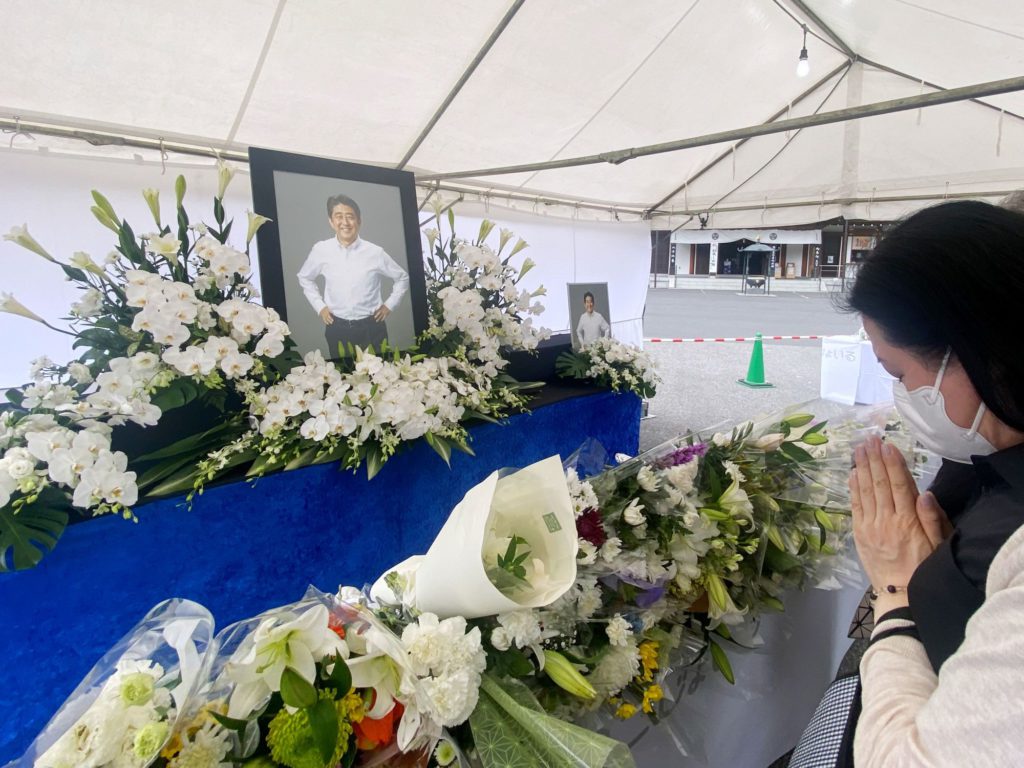
(Bloomberg) — China will send a former science and technology minister to the state funeral for ex-Japanese Prime Minister Shinzo Abe next week, Japan’s top government spokesman said.

The selection of Wan Gang — dubbed the father of China’s electric vehicle industry, but relatively unknown outside the country — comes amid difficult ties between the neighbors. It contrasts with the US’s decision to send Vice President Kamala Harris to the memorial for Abe, who was shot while on the campaign trail in July.

Chief Cabinet Secretary Hirokazu Matsuno said Thursday that Japan received word from China about Wan’s visit for the funeral Tuesday. Asked during a regular press briefing who China would send, Chinese Foreign Ministry spokesman Zhao Lijian said only that an announcement would be made in due course. 

Beijing dispatched Vice President Wang Qishan to the state funeral of Queen Elizabeth II in London earlier this week. Japan has long sought to balance ties with China, its biggest trading partner, and with the US, its only formal military ally. That task is becoming increasingly difficult as tensions rise over Taiwan. 

Wan, vice chairman of the Chinese People’s Political Consultative Conference, is credited with pushing the country to adopt the then-untested technology of vehicle electrification two decades ago. He heads one of the eight minor political organizations that the ruling Communist Party allows to exist in China.

Wan’s Zhi Gong Party, which organized anti-Japanese campaigns during World War II, has sometimes served as a go-between for the Communist Party and outside groups. 

Why Taiwan’s Status Risks Igniting a US-China Clash: QuickTake

Taiwan is also planning to send its own delegation to the memorial service, Japanese national broadcaster NHK reported earlier this month, a move that is likely to irritate China, which sees the island as part of its territory.

The funeral has faced growing criticism from the Japanese public. Polls indicate most people oppose holding the event, citing the cost and anger over Abe’s ties to a controversial religious group that came to light after he was gunned down in July.

(Updated with details about Wan Gang’s time as minister from second paragraph.)

More stories like this are available on bloomberg.com

©2022 Bloomberg L.P.

Crypto Shakeout Engulfs the C-Suite as CEOs Start Stepping Down

(Bloomberg) — The cryptocurrency industry’s epic shakeout, having cost thousands of jobs and set off a round of consolidation, is reaching the corner office. 

Crypto exchange Kraken announced on Wednesday that co-founder Jesse Powell will step down as CEO, to be replaced by Chief Operating Officer David Ripley. The reshuffle comes shortly after Genesis’s Michael Moro and Bitcoin evangelist Michael Saylor, along with Sam Trabucco of Alameda Research, relinquished top positions. 

The raft of successions sets the stage for a changing of the guard in the roughly decade-old industry. Many of crypto’s most prominent leaders, like Powell, are technologists who discovered digital assets early, cultivated devout Twitter followings and didn’t hesitate to engage their detractors in online battles. With the sector reeling from a slump that’s shaved off roughly $2 trillion from cryptocurrencies’ market value and landed some bosses in bankruptcy court, regulators’ cross-hairs or worse, boards are starting to look for different skills. 

“If there is a firm in complete crisis and meltdown, you need an adult in the room, and you need that adult in the room to understand regulation and compliance,” said Deepali Vyas, who leads executive search for areas including crypto at Korn Ferry.


Vyas is currently looking for CEOs for a crypto exchange and a crypto miner which she declined to identify, and she expects more C-suite changes throughout the industry in the fall.  

Insiders Take Over

This wave of changes started in earnest in early August with Saylor, who founded MicroStrategy in 1989, giving up his CEO title to focus more on Bitcoin — even after his buying of the token led to a $918 million second-quarter impairment charge. Two weeks later, Moro stepped down as CEO of Genesis, the crypto brokerage stung by exposure to defunct hedge fund Three Arrows Capital. 

On Aug. 24, Alameda co-CEO Trabucco announced that he’s stepping down to “prioritize other things.” Like at Kraken, insiders are taking over at MicroStrategy and Alameda, while Genesis appointed Chief Operating Officer Derar Islim as interim CEO while it searches for a permanent replacement.

Powell, 42, said his decision to step down was more than a year in the making, and driven in part by a desire to deal with “personal stuff.” He plans to devote “maybe 40 hours a week instead of 80 hours” to Kraken, he said in an interview, adding that he’ll focus more on products and advocacy and less on management. 

“This will allow me to have more time to work on the things that I really enjoy doing and where I’m strongest,” Powell said. “And not do the stuff that I really don’t enjoy, which is managing a huge team.” 

Founder-Influencers

In June, the New York Times published an article that said Powell had “ignited a culture war” among Kraken’s employees through comments some saw as “hurtful.” On June 15, the day the Times’s story ran, Powell published a Twitter thread that said, among other things, that about 20 Kraken workers were “totally not on board” with its corporate culture. 

Replacing founders carries its own set of risks. 

“They tend to have this incredible ability to influence the community or engage developers. That is very important in crypto,” said Stefan Cohen, a partner at Bain Capital Crypto, an investment fund focused on early-stage protocol projects and investor in BlockFi and MakerDAO. “It’s very hard to move these people out and I don’t think you’d really want to.”

Most crypto board members and investors are used to the volatile nature of the asset class and so tend to be less inclined to blame management in a “down cycle,” Cohen said.

That said, crypto is changing in ways that will likely drive further changes in companies’ top ranks. After market calamities ranging from the implosion of a major stablecoin in May to several crypto lenders around the world going bankrupt in the following months, regulators are determined to tame the industry and pre-empt what they perceive as potential risks to the wider financial system.  

Crypto Rules Crackdown Looms for $150 Billion Stablecoin Market

Already, some crypto CEOs facing regulatory action are facing restive shareholders. Some investors in Zipmex Pte, the crypto exchange against which Thailand’s securities regulator has filed a police complaint, have urged CEO Marcus Lim to step down, Bloomberg reported in August. 

Monetary Policy Threat

Add to that the biggest overhang not just for crypto, but all global markets: Central bankers led by the Federal Reserve who were arguably late in identifying persistent global inflation and are now moving fast to make sure it doesn’t become too entrenched. Their efforts in tightening monetary policy have set in motion the collapse in digital-asset prices that laid bare much of the industry’s hidden risks. 

The Fed’s latest salvo came Wednesday. The US central bank raised benchmark interest rates by 75 basis points and signaled no letup in its fight against inflation.

“With the extreme market volatility and what has happened over the last few months, and given the looming macroeconomic conditions, this is a time where you’re seeing a lot of exits,” Vyas of Korn Ferry said. 

One job that might need filling in the next few years: running Binance Holdings Ltd., operator of the world’s biggest crypto exchange.  

Binance’s billionaire CEO and co-founder Changpeng “CZ” Zhao has indicated that he may step aside within five years to become chairman. “I’ve been CEO of Binance for five years. I don’t think a CEO should be longer than 10 years,” Zhao said on a July podcast with Bankless. “So I think somewhere between now and five years later, I should retire.”

A Binance spokesperson told Bloomberg News that Zhao “believes strongly that fresh ideas, especially for top leadership, is essential” and “succession planning and a robust cadre of top leaders is something that CZ has always kept as a priority and Binance has had training programs and strategies around this since the beginning.” 

Asked about Coinbase Global Inc. CEO Brian Armstrong’s succession plan, a spokesperson for the crypto exchange pointed to the company’s April proxy statement, which says the board’s nominating and corporate governance committee — consisting of venture-capital luminaries  Katie Haun, Fred Wilson and Marc Andreessen — regularly evaluates succession planning for senior positions, including the CEO. 

FTX declined to comment on succession plans for CEO Sam Bankman-Fried.  

(Updates with Zipmex example in 16th paragraph.)

More stories like this are available on bloomberg.com

©2022 Bloomberg L.P.

PlayUp Agrees to Go Public in SPAC Deal at $350 Million Value

(Bloomberg) — PlayUp Ltd. is merging with a special purpose acquisition company in a deal that will value the online betting operator at $350 million.

The transaction with IG Acquisition Corp. will help fund expansion of the business and is expected to close in the first quarter, the companies said Thursday in a statement. A fund managed by Yorkville Advisors Global has agreed to invest an additional $70 million in the business. 

PlayUp allows fans to bet on sports, horse racing and daily fantasy sports in Australia, New Zealand and India. The company recently entered the US market. For the year ended June 30, PlayUp had gross revenue of $36.6 million, up from $23.4 million the previous year.

IG raised $300 million in its initial public offering in 2020. The SPAC is run by Bradley Tusk, a venture capitalist and a consultant who has worked with FanDuel Inc. Tusk was also a campaign manager for Michael Bloomberg, the owner of Bloomberg LP who was a three-term mayor of New York.

Shares of sports-betting operators have tumbled this year as investors have grown wary of ongoing losses and the cost of acquiring new customers. DraftKings Inc., which went public in a $3.3 billion SPAC deal in 2020, has fallen 39% this year.

PlayUp has the ability to offer several types of wagers on one app, including bets on sports, casino games and even esports, where it’s legal, according to Tusk. That will allow it to target customers through niche media channels and not pricey TV ads.

“I don’t want to compete in the traditional sports betting market,” Tusk said in an interview. “It’s too expensive.” 


More stories like this are available on bloomberg.com

©2022 Bloomberg L.P.

US Futures Waver; Yen Rallies as Japan Intervenes: Markets Wrap

(Bloomberg) — US equity futures wavered as the Federal Reserve’s hawkish decision gave way to optimism that a recession will act as a circuit breaker for aggressive action. The yen rallied after Japan intervened to support the yen and global central banks hoisted up their own borrowing costs.

Contracts on the S&P 500 swung between losses and gains after the benchmark’s tumble Wednesday took it more than 20% below the record high in January. The Stoxx Europe 600 fell 0.8% in the wake of losses from Wall Street to Hong Kong following the Fed’s third consecutive 75 basis-point hike on Wednesday.

The yen rose after Japan’s first intervention since 1998 shored up the currency’s 20% slide against the dollar this year. In contrast to the Fed, the Bank of Japan stuck steadfastly to its rock-bottom interest rate policy Thursday, pushing the yen lower versus the US currency. 

The Fed gave its clearest signal yet that its willing to tolerate a recession as the necessary trade-off for regaining control of inflation with officials signalling a further 1.25 percentage points of tightening before yearend. 

“The Fed is engineering a hard landing — a soft landing is almost out of the question,” Seema Shah, chief global strategist at Principal Global Investors, wrote in a note following the Fed decision. “Powell’s admission that there will be below-trend growth for a period should be translated as central bank speak for recession. Times are going to get tougher from here.”

Read more: Powell Signals Recession May Be the Price for Crushing Inflation

Traders are also bracing for the Bank of England to deliver its seventh back-to-back rate hike later today, after contending with outsized moves by central banks in Switzerland and Norway rushing to get to grips with inflation spiraling out of control. 

The Swiss National Bank matched the Fed by raising interest rates 75 basis points to bring borrowing costs above zero for the first time in almost eight years. Norway’s central bank, among the first in the rich world to start raising rates last September, raised its key interest rate by a half point and signaled that its tightening may be nearing an end. 

Sentiment took an additional hit from Russia’s escalation of its war with Ukraine and tensions between Beijing and Taiwan. 

Key events this week:

  • The Bank of England interest rate decision, Thursday
  • US Conference Board leading index, initial jobless claims, Thursday

Will the Nasdaq 100 Stock Index hit 10,000 or 14,000 first? This week’s MLIV Pulse survey focuses on technology. It’s brief and we don’t collect your name or any contact information. Please click here to share your views.

Here are some of the main moves in markets:

Stocks

  • Futures on the S&P 500 were little changed as of 5:55 a.m. New York time
  • Futures on the Nasdaq 100 were little changed
  • Futures on the Dow Jones Industrial Average rose 0.2%
  • The Stoxx Europe 600 fell 0.8%
  • The MSCI World index fell 0.3%

Currencies

  • The Bloomberg Dollar Spot Index was little changed
  • The euro rose 0.2% to $0.9860
  • The British pound rose 0.2% to $1.1297
  • The Japanese yen rose 0.6% to 143.20 per dollar

Bonds

  • The yield on 10-year Treasuries advanced one basis point to 3.54%
  • Germany’s 10-year yield declined four basis points to 1.85%
  • Britain’s 10-year yield declined two basis points to 3.29%

Commodities

  • West Texas Intermediate crude rose 0.9% to $83.66 a barrel
  • Gold futures rose 0.2% to $1,678.70 an ounce

More stories like this are available on bloomberg.com

©2022 Bloomberg L.P.

Bitcoin Erases Drop Sparked by Fed’s Warning of Rate-Hike Pain

(Bloomberg) — Cryptocurrencies fought off declines triggered by another large Federal Reserve interest-rate hike, though sentiment remained cautious given the central bank’s warning of economic pain ahead from tightening policy.

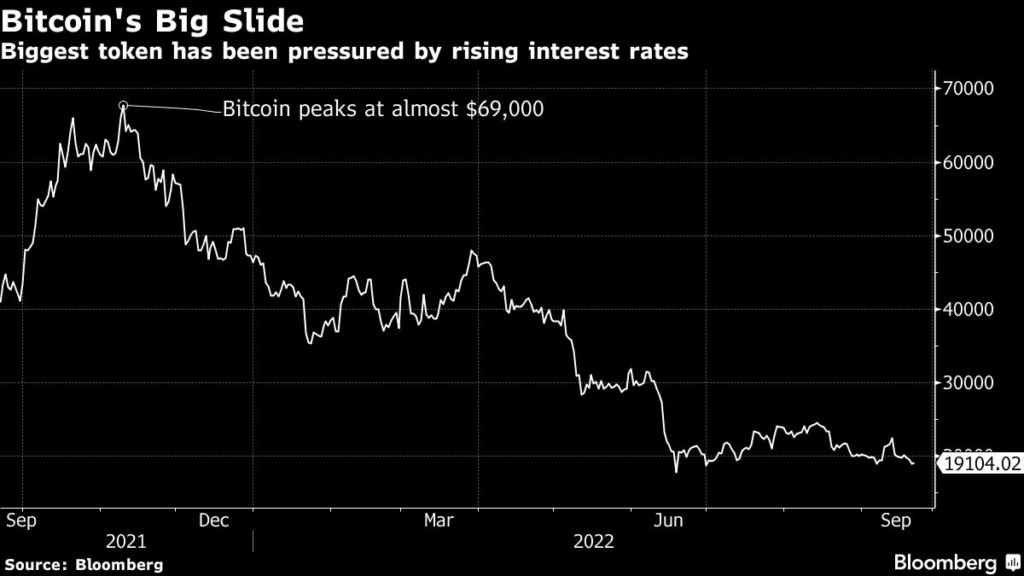
Bitcoin, the largest token, was about 1.2% higher as of 10:50 a.m. in London on Thursday after earlier sliding as much as 4% toward levels last seen in 2020. Second-biggest coin Ether continued to underperform, shedding 2%.

Markets are shuddering at the Fed’s determination to fight inflation by constricting financial conditions. Shorter maturity Treasury yields jumped more than longer tenor rates, deepening a bond curve inversion seen as a signal of recession. A dollar gauge was at a record as investors sought a bolthole.

Such a backdrop offers little respite for crypto markets. They were already reeling from a $2 trillion plunge from a 2021 record high, an unraveling pockmarked with blowups such as the Three Arrows Capital hedge fund and the Terraform Labs project — whose co-founder Do Kwon is wanted by authorities.

“If the Fed keeps tightening, unless it implements yield curve control to keep the curve positively sloped, the crypto system will see a lot more failures,” said Brian Pellegrini, founder of Intertemporal Economics. “At the end a few very rich champions will emerge, but in the meantime there will be blood in the streets.”  

The MVIS CryptoCompare Digital Assets 100 Index is down this week, taking its losses for 2022 to about 60% compared with 23% for global stocks. The correlation between equities and Bitcoin is elevated and close to a record, a sign of how assets are being tossed around by common macro factors. 

‘Ponzi Schemes’

JPMorgan Chase & Co. Chief Executive Officer Jamie Dimon didn’t help the mood in digital-asset markets by reaffirming his skepticism and calling tokens “decentralized Ponzi schemes.”

Bitcoin was at about $19,158 and Ether $1,288. Ether continues to take an additional hit as an earlier rally sparked by hype around the upgrade of its Ethereum network unwinds. Coins like Solana and Avalanche were up.

Some traders might look to measures like Bitcoin’s 14-day relative strength index for affirmation that a bounce is possible. The RSI, a momentum gauge, is close to oversold levels. But contrarian bets appeared few and far between for riskier assets following the Fed’s pugnacious performance.

(Updates prices)

More stories like this are available on bloomberg.com

©2022 Bloomberg L.P.

Murder, Kidnapping Pose ‘Existential’ Threat to South Africa

(Bloomberg) — Surging rates of murder, extortion and kidnapping are among signs that crime is posing an “existential” threat to South Africa, according to a report by the Global Initiative Against Transnational Organized Crime.

The murder rate has risen 38% since 2010, the number of kidnappings for ransom has quadrupled, and there is a 187 billion rand ($10.6 billion) annual impact from infrastructure theft such as the looting of copper-power cables, the Geneva-based group said in a report released on Wednesday. All of these are signs that the state is struggling to contain criminal activity, it said.

“Organized crime is an existential threat to South Africa’s democratic institutions, economy and people,” Mark Shaw, the director of the group, said in an introduction to the 206-page document. “It often lies behind and connects numerous seemingly disparate criminal incidents we see occurring in South Africa every day.” 

GI-TOC, as the group is known, places the blame on the country’s apartheid history, which has resulted in poorer areas being neglected by the state. That’s been exacerbated by the weakening of state institutions during the nine-year rule of former President Jacob Zuma, who was ousted by his party in 2018.

While Zuma has denied wrongdoing, the current administration has said at least 500 billion rand was stolen during his rule. State corruption became entrenched and public procurement budgets were looted. 

‘Unprecedented Foothold’

Zuma’s rule was “one driven by personality and personal interests,” GI-TOC said. This resulted in political appointees to key positions at state companies, resulting in “patronage networks, which in turn helped facilitate grand-scale corruption and enabled business and organized crime to secure an unprecedented foothold in the state apparatus.”

Organized crime in South Africa ranges from heroin, meth and cocaine trafficking to people-smuggling, rhino poaching and the stripping of metal from state power, water and transport companies. Pipelines are targeted and syndicates demand contracts from mining and construction companies, which they are paid for but don’t fulfill. 

Other issues include a surge in vigilante killings and a jump in cash-in-transit robberies. Cybercrime is also on the rise, with South Africa becoming the biggest location of internet-protocol addresses used for digital extortion in Africa. Gold and platinum are illegally mined or stolen and sold illicitly.

The murder rate is currently more than 40 per 100,000 citizens and over 10,000 people were kidnapped for ransom in the most recent year assessed, GI-TOC said, citing government data.

“South Africa faces a complex, hybrid criminal threat. Having originated in highly constricted conditions under apartheid, in three decades organized crime has spread across the country and forged links across the world,” the group said. 

“Left unchecked, organized crime will continue to seriously impair South Africa’s reputation and development.”


(Updates with drug trafficking detail in seventh paragraph)

More stories like this are available on bloomberg.com

©2022 Bloomberg L.P.

Now That Ethereum’s Merge Happened, What’s Next?

  • Listen to Bloomberg Crypto on the iHeartRadio App
  • Listen to Bloomberg Crypto on Apple Podcasts
  • Listen to Bloomberg Crypto on Spotify  

(Bloomberg) — So, ‘The Merge’ happened. After years of anticipation, multiple false starts and delays, the biggest ever software upgrade to the Ethereum blockchain is complete. The most headline-grabbing consequence of that upgrade relates to energy usage. The switch that upgrade enabled, from what’s called “proof of work” to what’s known as “proof of stake”, promises to reduce Ethereum’s energy consumption by 99%.

And now the question is: what’s next?  What are the other major milestones for the future of Ethereum’s ecosystem and the Ether token itself?

In this episode, you’ll hear from Bloomberg reporter Olga Kharif and from Dave Liedtka, senior editor for crypto.

Follow us on Twitter @crypto, and subscribe to the Bloomberg Crypto Newsletter at https://bloom.bg/cryptonewsletter

More stories like this are available on bloomberg.com

©2022 Bloomberg L.P.

Chief Metaverse Officers Are Getting Million-Dollar Paydays. So What Do They Do All Day?

(Bloomberg) — Advertising giant Publicis Groupe SA introduced the newest member of its C-suite at a technology conference in Paris this year. He goes by Leon. He’s the chief metaverse officer.

Publicis wants Leon to help blue-chip clients like Walmart Inc., UBS Group AG and Nestle SA understand what the blockchain, NFTs and a more immersive internet experience could mean for their businesses. The stakes are potentially big: McKinsey & Co. consultants estimate that annual global spending related to this virtual landscape could reach as much as $5 trillion by 2030.

Leon has a LinkedIn profile, an email address and a French accent. But he doesn’t get a paycheck: Leon is a lion-esque digital avatar.

While Leon isn’t human, companies are increasingly hiring real people to help them navigate the so-called “meta-jungle.” Firms as varied as consumer-products giant Procter & Gamble Co., talent manager Creative Artists Agency (CAA), Spanish telecom carrier Telefonica SA, luxury-goods maker LVMH and wedding-registry retailer Crate & Barrel have all decided they need a chief metaverse officer.

Though a recent tech-sector downturn has hit metaverse stalwarts like Meta Platforms Inc. and Roblox Corp. particularly hard, it hasn’t stopped firms from doling out million-dollar paydays to new executives as a down payment to secure their digital future. Gartner Inc. analysts say one in four people will spend at least an hour a day in the metaverse within a few years. What we’ll be doing there isn’t clear, but P&G, for one, hopes it will involve engagement with Crest toothpaste or Herbal Essences shampoo.

“Brands need to get closer to their customers, and the metaverse is a channel to do that,” said Hamza Khan, a McKinsey partner who co-leads the firm’s metaverse efforts. “Compared to the early days of e-commerce, this time around brands are a lot more active a lot earlier.”

Pressure to keep up with tech trends has spawned new C-suite titles for decades. The 1980s saw the rise of the chief information officer, who understood the inner workings of IT and how it applied to broader business strategy. Later, chief technology officers emerged as big-picture thinkers who could evaluate developing technologies and how they might be used in the long term. More recently, chief digital officers have sought to modernize outdated business practices so companies don’t get “Amazoned,” or steamrolled by a nimbler, more tech-savvy rival.

Digital FOMOChief metaverse officers first appeared at video-game makers, where immersion in a digital universe is central to the products. But the role has been popping up at more staid institutions dipping their toes into web3.

P&G launched a digital platform called BeautySPHERE this year and reimagined a popular TV ad from the 1980s into a video game. Nike Inc. bought a virtual sneaker company and created a world modeled on its real-life headquarters. Starbucks Corp. is introducing coffee-themed NFTs, or non-fungible tokens, linked to its customer-loyalty program. Walmart might create its own cryptocurrency. Luxury brands like Gucci, Balenciaga and Dolce & Gabbana have brought their fashions to virtual domains in the hopes of converting extremely online youth into real-world buyers of pricey handbags, watches and jewelry.

Few of these experiments have made money. But that’s not the point right now. Many big companies moved too slowly to embrace other technology, and history isn’t kind to latecomers. At Walmart in the late ’90s, e-commerce wasn’t taken seriously. Its website was initially set up under a stand-alone company. Store managers blanched at putting the site’s URL on shopping bags, for fear of sacrificing in-person sales. Such dismissal and delay opened a window that Amazon.com Inc. exploited to become a giant.

Call it metaverse FOMO. Bosses feel it. Crate & Barrel Holdings Inc. Chief Executive Officer Janet Hayes said it’s “essential” that the company has “an impactful presence in the metaverse.” Walt Disney Co. chief Bob Chapek said the metaverse will “create an entirely new paradigm for how audiences experience and engage with our stories.” At CAA, it will influence “shifts in content creation, distribution and community engagement that drive significant opportunity for our clients,” President Jim Burtson said.

QuickTake: What the Metaverse Is, Who’s in It and Why It Matters

Translating that talk into action is the job of executives like P&G’s Ioana Matei, whose title is head of emerging and immersive technologies, and LVMH’s Nelly Mensah, vice president of digital innovation and emerging solutions at the home of Fendi and Bulgari. Disney’s man in the metaverse, Mike White, is senior vice president in charge of next-generation storytelling and consumer experiences. At Publicis, Leon the avatar acts as an “ambassador and guide” in the metaverse, a spokeswoman said, while in reality the company has more than 1,000 employees creating web3 experiences for clients.

It’s common for now for newly named metaverse mavens to hold on to other responsibilities. Take Crate & Barrel’s Sebastian Brauer. His day job is leading product design and development, but he says he spends about 20% of his time on meta-duties like strategy, outreach, and finding ways to bridge physical and virtual domains.

Brauer’s background is in design — his mother is an architect — and he admits he isn’t a tech savant. An Ecuador native whose passion for technology was sparked by his first iPod, Brauer said he got the metaverse gig after talking to Hayes, the CEO, about the success he had trading crypto and NFTs.

“She had the courage to say this is something we want to learn about and decided to appoint me as leader,” he said.

Winning Over Metaverse SkepticsThe ideal metaverse chief can speak as fluently about AR and VR as she can about sales and marketing, according to Cathy Hackl, who helps companies set up their meta-business units and claims to be the “world’s first chief metaverse officer” — a title she bestowed upon herself.

“They’re not easy to find, but there are people who straddle both of these worlds,” she said.

Metaverse chiefs need to forge external partnerships and win over internal skeptics, adds Wendy Doulton, managing partner at Katalyst Group, a consumer tech recruitment firm. Joanna Popper is one example: The newly minted chief metaverse officer at Creative Artists Agency hails from HP Inc., where she ran its virtual-reality efforts, working with studios like Disney and Paramount. Earlier, she held roles in marketing, consulting and investment banking. CAA, whose Hollywood clients include actors Tom Hanks and Reese Witherspoon, also represents NFT artists like Micah Johnson and, through a separate partnership, has invested in metaverse entities such as NFT marketplace OpenSea.

Popper said her role is to “build a metaverse strategy” by making investments, partnerships and content on behalf of clients, while ensuring the entire 3,200-person agency understands how critical it is. She said she was courted by companies in a variety of industries for chief metaverse officer roles before settling on CAA.

Popper’s unique skill set is the reason why chief metaverse officers can attract compensation packages upwards of $1.5 million, say those with knowledge of their contracts.

Another approach is to simply tap someone internally who gives the organization a bit of credibility in the metaverse, as Crate & Barrel did. Since being hired, Brauer has recruited a small “think tank” of like-minded colleagues who find time outside their regular duties to strategize about web3. “We’re not rushing into it,” he said. “We’re privately held, so we have no pressure.”

Early Innings of the MetaverseHe might not feel pressure, but the tech sector’s recent rout could prompt the metaverse’s biggest players to rethink their ambitions. Meta, the tech giant formerly known as Facebook that rebranded to emphasize its pivot to what CEO Mark Zuckerberg calls “the next frontier,” is slowing the pace of long-term investments after the company’s first-ever quarterly revenue decline. A Meta spokesperson declined to comment on the topic of chief metaverse officers, but previously has said that the company is looking to fill various leadership roles in areas like AI, gameplay and machine learning.

Shares of computer-graphics chipmaker Nvidia Corp., which wants its Omniverse platform to undergird the metaverse, have fallen by more than half this year as demand for PCs declines. Roblox, the video-game platform that houses immersive experiences for brands including Gucci, Chipotle and Ralph Lauren, also delivered disappointing results, with daily users falling short of expectations.

Crypto winter is upon us, purchases of NFTs have slowed, and increasingly cost-conscious companies need to focus on what will actually make them money. Brauer acknowledges as much: “The last thing I want to do as we head into a potential recession is consume company resources,” he said. “But I see this as investing to grow. It’s R&D. This train is coming.”

CAA’s Popper said the downturn actually creates an “opportune time” to build. “This is early innings in a long extra-inning game.”

Whether these early evangelists will still be there in the later innings is unclear. Just because they got the role “does not mean they are prepared to lead it for the next 5 to 10 years,” said Nada Usina, an executive adviser and recruiter at Russell Reynolds Associates. “When you start to scale, you have a different leader step in. The metaverse will continue to evolve, so the notion of a chief metaverse officer is also fairly dynamic.”

In other words, Leon better watch his virtual back. It’s a jungle out there.

More stories like this are available on bloomberg.com

©2022 Bloomberg L.P.

Close Bitnami banner
Bitnami