Bloomberg

Bitcoin Pares Drop Sparked by Fed’s Warning of Rate-Hike Pain

(Bloomberg) — Cryptocurrencies pared declines triggered by another large Federal Reserve interest-rate hike, though sentiment remained cautious given the central bank’s warning of economic pain ahead from tightening policy.

Bitcoin, the largest token, was about 1% lower as of 5:20 a.m. in London on Thursday after earlier sliding as much as 4% toward levels last seen in 2020. Second-biggest coin Ether continued to underperform, shedding over 3%.

Markets are shuddering at the Fed’s determination to fight inflation by constricting financial conditions. Shorter maturity Treasury yields jumped more than longer tenor rates, deepening a bond curve inversion seen as a signal of recession. A dollar gauge was at a record as investors sought a bolthole.

Such a backdrop offers little respite for crypto markets. They were already reeling from a $2 trillion plunge from a 2021 record high, an unraveling pockmarked with blowups such as the Three Arrows Capital hedge fund and the Terraform Labs project — whose co-founder Do Kwon is wanted by authorities.

“If the Fed keeps tightening, unless it implements yield curve control to keep the curve positively sloped, the crypto system will see a lot more failures,” said Brian Pellegrini, founder of Intertemporal Economics. “At the end a few very rich champions will emerge, but in the meantime there will be blood in the streets.”  

The MVIS CryptoCompare Digital Assets 100 Index is down this week, taking its losses for 2022 to about 62% compared with 22% for global stocks. The correlation between equities and Bitcoin is elevated and close to a record, a sign of how assets are being tossed around by common macro factors. 

‘Ponzi Schemes’

JPMorgan Chase & Co. Chief Executive Officer Jamie Dimon didn’t help the mood in digital-asset markets by reaffirming his skepticism and calling tokens “decentralized Ponzi schemes.”

Bitcoin was at about $18,700 and Ether $1,260. Ether continues to take an additional hit as an earlier rally sparked by hype around the upgrade of its Ethereum network unwinds. Coins like Solana and Avalanche were mixed.

Some traders might look to measures like Bitcoin’s 14-day relative strength index for affirmation that a bounce is possible. The RSI, a momentum gauge, is close to oversold levels. But contrarian bets appeared few and far between for riskier assets following the Fed’s pugnacious performance.

More stories like this are available on bloomberg.com

©2022 Bloomberg L.P.

US Agency Broke Into China’s Telecom Networks, State Media Says

(Bloomberg) — US intelligence agents gained control of parts of China’s telecommunications network after hacking into a government-funded university, a prominent state-backed newspaper reported, issuing Beijing’s latest accusation of US cyber-intrusion.

The National Security Agency’s cyber-warfare unit “penetrated and controlled” unnamed telecom operators, the Global Times reported on Thursday, citing information provided by officials. It gained remote access to their core networks through an email phishing attack on a leading university, which then opened a route into the carriers. The attackers made off with network equipment and administrative passwords, file-transfer protocols and other sensitive data, the newspaper said.

Beijing and Washington have increasingly sparred over claims of cyber-snooping, with China becoming more direct in naming American agencies as perpetrators. The US has in the past blamed China for widespread industrial espionage to “ransack” American companies, in addition to national security-related operations.

China’s network is largely run by three carriers — China Mobile Ltd., China Unicom and China Telecom Corp. But the extent of the alleged hack remains unclear, and the Global Times didn’t provide many details on how the attackers made the leap from within Northwestern Polytechnical University, an institution known for its aeronautics and space research programs.

Shares in the three carriers as well as telecom gear makers ZTE Corp., FiberHome Telecommunication Technologies Co. and Datang Telecom Technology Co. fell in the morning, tracking regional market weakness. Representatives for the NSA weren’t available for comment outside normal US hours.

Read more: Chinese Firm That Accused NSA of Hacking Has Global Ambitions

Federal Bureau of Investigation Director Christopher Wray warned in July that China operated a “lavishly resourced hacking program that’s bigger than that of every other major country combined.”

But Beijing has taken a more aggressive approach in recent months, pushing back against US accusations. The Global Times has published multiple articles on reports from Chinese cyber companies, including a discovery by Qi An Xin Technology Group Inc.’s Pangu Lab of US-sponsored malware in domestic IT systems it claimed was linked to the NSA.

Thursday’s report from the Global Times, which is affiliated to the Communist Party’s mouthpiece People’s Daily, sprang from an alleged “overseas attack” that Northwestern Polytechnical reported in June after discovering trojan malware. 

The country’s National Computer Virus Emergency Response Center and 360 Security Technology Inc. said this month their analysis of the university’s information systems found the NSA had collected more than 140 gigabytes of data of “great value,” spanning more than 10,000 cyberattacks against Chinese targets in recent years.

The NSA and US State Department had declined to comment on the earlier allegations.

Read more: China Says US Hacked Aeronautics, Space Research University

More stories like this are available on bloomberg.com

©2022 Bloomberg L.P.

Transcript ‘Zero’ Episode 2: Why Venture Capital Is Crucial to the Climate Fight

(Bloomberg) — For Episode 2 of the Zero podcast, Bloomberg Green reporter Akshat Rathi interviewed venture capitalist Gabriel Kra about VC’s role in the climate fight: Is it a force for innovation, a facilitator of bad business models, or a little of both? Listen to the full episode below, learn more about the podcast here, and subscribe on Apple, Spotify, Google and Stitcher to stay on top of new episodes.

Our transcripts are generated by a combination of software and human editors, and may contain slight differences between the text and audio. Please confirm in audio before quoting in print. 

Akshat Rathi  00:00

Welcome to Zero. I am Akshat Rathi. This week: getting arrested, getting lucky, and finally getting a climate bill. 

This summer, I went to the US and spent three weeks visiting climate startups and talking to investors who give those startups money. One of those conversations spoke particularly well to the role that venture capital plays in funding climate tech. 

Akshat Rathi

The model of venture capital is to make many bets. 

Gabriel Kra

Yes. 

Akshat Rathi

Early on. 

Gabriel Kra

Yes. 

Akshat Rathi

Risky bets. 

Gabriel Kra

Yes.

Akshat Rathi

Very few will succeed. 

Gabriel Kra

Yes. 

Akshat Rathi

What succeeds… how much of that is luck?

Gabriel Kra  

[Long breath] That’s an interesting question. I don’t think it is luck. I don’t think that’s the right word. 

Akshat Rathi

Chance. 

Gabriel Kra

No, no, no. It’s almost like it’s not the right concept.

Akshat Rathi  01:05

That’s Gabriel Kra, a co-founder of the venture capital firm Prelude. Now, venture capital is both loved and hated. Some say it’s the only way to fund companies that change the world. Others say it is unaccountable, it can game markets, and it can launder reputations. 

That’s the black-and-white version of the narrative. And you’d be surprised how many smart people buy into it. 

Gabriel is someone who is comfortable in the gray zone. He started his career in the 90s as a Greenpeace activist, even getting arrested on the steps of the Washington Monument as part of a climate protest. Two decades later, he co-founded Prelude with members of the Simons family. Their wealth comes from hedge funds, and they have been active in climate investment for decades. Prelude has invested in more than 60 startups so far, everything from batteries and hydrogen to solar and fertilizers. 

Venture capital is nothing new. Many of the services that you use today, maybe even the software you’re listening to this podcast on, were made possible because some venture capitalists gave some entrepreneur lots of money to try some crazy idea. 

Venture capital for climate startups, though, is a little different. It’s not just about the entrepreneurs. The physics must make sense. The chemistry must be sound. And the engineering must be scalable so that you can build physical things – what many call “hardtech.” Even if you get all those things right though, there is a chance of falling into what’s called the valley of death, a desert landscape filled with the skeletons of startups. 

This is where venture capitalists can help. The experience of building companies that some of these investors bring, alongside their money, can help climate startups escape the valley of death and grow big enough to cut a meaningful amount of emissions. 

When I went to the US this summer, I got a taste of what Gabriel sees every day. And I’m excited to share it with you in future episodes. For this conversation, we met up in Gabriel’s office in San Francisco to understand how he makes a difference to the companies he invests in, the ways in which the US climate bill boosts cleantech startups, and what makes the current climate tech boom so much better than the first one.

Akshat Rathi  03:30

Gabriel, welcome to the show.

Gabriel Kra  03:32

It’s great to be here. Thanks for having me, Akshat. 

Akshat Rathi  03:34

So let’s start with your story. You’ve taken sort of an unusual route to being a VC. Where did it start for you?

Gabriel Kra  03:41

Well, maybe not so typical compared to many other folks who are VCs. I was an East Coast kid, grew up on Long Island, went to school in New York at Columbia. And the summer of my junior year, I drove cross country. And instead of getting all the way out to Palo Alto where my sister was in grad school, I ended up working for a summer in Yellowstone Park as a waiter so that I could spend my weekends hiking and discovering the mountains and the beauty of that park. That’s where my journey as an environmentalist, a climate person started. That’s my motivation. I wanted to get involved and protect these beautiful places. In 1991 or 1992, I moved to DC. And I got a job with Greenpeace. It wasn’t a glamorous job. I was going door to door canvassing for Greenpeace, but eventually I did some internships and I worked in the national office. Greenpeace back then, and still, was a practitioner of nonviolent civil disobedience. I was actually arrested in front of the Washington Monument, and I think it must have been 1992 protesting the failure of the United States government to participate fully in the Rio Earth Summit. That was me back then. 

Then I went to school to get a master’s degree in atmospheric chemistry. I wanted to better understand the science and the processes behind what I was so passionate and talking about. I realized in that process that I didn’t want to be an academic, I didn’t want to spend the extra years getting my PhD – no offense to those in this room who have one. I respect you all the more for my failure to have the discipline to stick with it. To fast forward to 2009, [by then I’d worked at] three different startups, some moderately successful, some gloriously unsuccessful. A couple of hard tech startups and one engineering. [In 2009] I was working in solar and semiconductor banking at Deutsche Bank, and I met with the folks who would become the Prelude limited partners. I went out for lunch with Nat Simons and his wife, Laura Baxter-Simons who were already active in climate. We started working through and thinking through what kind of investment platform we could build within their family office. It took a while but by 2013, we had what was Prelude Ventures. 

Akshat Rathi

What is the vision?  

Gabriel Kra

The vision is that by focusing your efforts on companies that can impact carbon dioxide or CO2 equivalents in the atmosphere, [if] that’s what you look for, then you can focus on the same sorts of things that people focus on when they’re looking at traditional venture capital: great teams going after hard to solve problems with big market opportunities if they’re successful. So if you think about our theory of change, [it’s] something along the lines of — by investing in companies who, when they are massive, have a huge positive climate impact.

Akshat Rathi  07:13

Have any of your startups actually reduced emissions so far? 

Gabriel Kra

Yes. Absolutely. 

Akshat Rathi

An example?

Gabriel Kra  07:20

Well, I’m not the sort of person who recalls numbers off the top of my head. [But] we have a company called Renew Financial, which was one of the first companies we invested in in 2013 or 2014. It finances energy efficiency and solar projects in people’s homes. Several years ago, it was the equivalent of…God, like I said, terrible with numbers… a million car miles not driven, that kind of number. Another example is Pivot Bio. I don’t know the acres under management. But for every acre that Pivot has its fertilizer substitute, which is a microbe, that’s [an acre of] fertilizer that’s avoided. And the Haber-Bosch derived fertilizer accounts for what? Five to seven percent of global greenhouse gas emissions? We have some battery companies that are now starting to deploy, we have some solar companies that also have avoided emissions. So there’s a decent, solid number that are coming. Many of them are at that inflection point where [in the next few years] we can point to emissions avoidances or reductions and [that] will continue to grow.

Akshat Rathi  08:35

The model of venture capital is to make many bets. 

Gabriel Kra

Yes. 

Akshat Rathi

Early on. 

Gabriel Kra

Yes. 

Akshat Rathi

Risky bets. 

Gabriel Kra

Yes.

Akshat Rathi

Very few will succeed. And some of those that succeed wildly will pay for the many, many failures that were funded. 

Gabriel Kra

Yes. 

Akshat Rathi

What succeeds? How much of that is luck?

Gabriel Kra  08:54

That’s an interesting question. I don’t think it is luck. I don’t think that’s the right word. 

Akshat Rathi

Chance. 

Gabriel Kra

No, it’s almost like it’s not the right concept. I’m having trouble with the word luck. And I’m wondering, why am I having trouble with it? Because in the simplest formulation, luck does matter. It plays a role, but I’m thinking of some specific companies that I’ve had the privilege to be involved with. And you could say, “Oh, they got lucky there.” But what I really did was I chose the right set of entrepreneurs. 

There’s a company that’s public now in our portfolio called QuantumScape led by Jagdeep Singh. And I think QuantumScape is his third or fourth successful venture, at least by financial metrics. QuantumScape still has a ways to go. But the original chemistry, the original idea for the battery was nothing [like] what they are bringing to market now. It was a completely different set of physics principles that they were investigating. And even the earliest iterations of the electrochemical battery that they started on were very different from what they ended up with. 

So was it luck that they made those discoveries? Or was it an incredible team, backed by supportive venture capitalists, who saw that this was a team that was solving problems and pivoting and making changes that succeeded? Was it luck? Or was it a great team?

Akshat Rathi  10:27

Another way to ask that question is: Would the company have succeeded, regardless of whether Prelude bet on it? The fundamentals of the company and the people and the ideas and the grit and the combination and the pivots would have happened, regardless of where the money came from? Whether [the money] came from Prelude or somebody else? 

Gabriel Kra  10:47

I think there’s some entrepreneurs who are going to succeed for whom the money is just a source of fuel. I think there’s a small segment of those. I think there’s a much larger middle range that probably would have succeeded with whomever backed them. But [their] investors did something to help them out. I’m not going to use names on these kinds of descriptions. I held hands through six or nine months with the CEO. We were on the phone multiple times per week, trying to sort out what was going on in the company. I wasn’t helping with the tech, let’s be clear. I had no helpful insights into that in the least. But I was working super closely with the CEO, and the founding team to solve the problems on the business side and on the investor side. And one of the most rewarding things of my career is when the technical founder, not just the CEO said to me, after we had an exit, he said, “we sat back and had identified a number of single points of failure, and you were one of them. Had you not been there, this company would have failed.” So there’s also circumstances like that. 

A mentor told me early in my career, you spend most of your time with your problem children. You spend a lot of your time as a VC helping the ones who need the help, rather than the ones who are just crushing it, who just call you when they need some advice. The most gratifying part is when you find somebody or a team that needs the help not out of distress, but because you know something, or have a set of experience that they do not have. And that’s the real joy and fun part of investing in seed and A round companies, because I’ve been there and seen it a bunch of times. And I can say, “let’s put that down. Let’s not focus on that now.” So that’s at least for me, what’s really fun about the job, when I find those circumstances where I can add expertise.

Akshat Rathi  12:59

Right. In a way when a company succeeds, the kind of people who get credit for that success is the people who run the company most of the time – the CEO or the Chief Technology Officer. If what you’re saying is true, which is that venture capital investors like you are involved in their success then why do we not hear those names?

Gabriel Kra  13:23

Meh. Cause credit is being apportioned where it is due. Let’s be honest, I’ll say it here. I’ll say it whenever anybody asks: My job is so much easier than theirs. Which metric do you want to look at? They’re solving hard technical, hard business, hard fundraising, hard HR, hard corporate development problems. They are all in on it. They’ve pushed their chips to the center of the table on this company. And sure, Silicon Valley has a culture of celebrating, or at least valuing failure. But you know, there’s nothing fun about working hard on something for two, three, five, seven years and then having it not produce value or having it produce value for somebody else. That is a hard thing. That sucks. And I have a portfolio. So if I get to be on the stage, when they ring the bell on the NASDAQ or the New York Stock Exchange, but I’m the guy in the back corner as the CEO and her team are celebrating, and I get to go to that dinner that night and somebody says, “Oh, was that fun Gabriel?” and I get to go “yeah, that was great.” Like, that’s about the right proportion of… that’s probably more credit than I deserve at that moment.

Akshat Rathi  14:45

Okay, so the next thing [Gabriel and I] talked about requires some context. US investments in climate startups can be quite neatly split into two eras. The first one, clean tech 1.0 started around the mid 2000s. Investors plowed a bunch of money into startups and then didn’t make much in return. A lot of the technology didn’t work or couldn’t scale. Then came clean tech 2.0. That started in 2012. And we are still in it. I asked Gabriel: What changed between the two eras of investing and what lessons we learned?

Gabriel Kra  15:20

I think a lot of things have changed and some things fundamentally may have not changed. If you think about cleantech 1.0, it really launched in 2005. And it reached its heyday just before the financial crisis hit. There were a lot of things that were more poorly understood back then. So if you think about what it takes to scale solar, the venture dollars that went into solar, we didn’t quite understand what it took to make a really big business, and what were the risks of scaling those businesses. So those were some mistakes. And the volume of the capital that would be required and where it was going to come from, really, a lot of that money just came from the Chinese government.

Akshat Rathi  16:31

This is the story of so many cleantech industries. The technology is perfected in the US with its labs, and its scientists and talent coming from all over the world. But then the tragedy for the inventors is that there is no way to get to the next stage, the bigger stage. Remember the valley of death? That’s where these companies end up. 

China, on the other hand, has a planned economy. And that means if they decide that they want to dominate the clean energy market, they can do it. Its government pours money in at a scale that no other country matches. This is what happened with solar. It’s what happened with batteries. And it’s what’s happening now with hydrogen. It might mean disappointing returns for American venture capitalists, but for the world, it is a net good. Now back to Gabriel.

Gabriel Kra  17:20

Fast forward to today, we now have the cheapest form of electricity on the planet. Most everywhere you look is either solar, wind, or some combination thereof. A lot of money went into batteries, both electric and others, starting in 2007, or 2008. And a lot of those companies just flat out failed. The electrochemistry didn’t work, the scaling didn’t work. But some of them are succeeding. And some of the lithium-ion bulk manufacturing of those batteries that wasn’t even venture-backed came down the cost curve. So now we have lithium-ion batteries that serve one purpose –  electric vehicles. Those things came hugely down the cost curve. 

[There’s also] the advances in machine learning and in cloud computing and the capabilities that you can now bring to bear to solve hard problems. Between when that first wave started [in 2005] and 2015 when the second wave started, [that] enables companies to do lots of things that they couldn’t do in that first wave. 

And then the last thing that’s different [is], if you recall, the climate bill debate and the climate urgency. In 2008 or 2009, there was not the urgency and the fierce understanding back then that we have now. I went to all the early ARPA-E conferences, and – 

Akshat Rathi  18:54

– the Advanced Energy bet from the Department of Energy. 

Gabriel Kra  18:58

That’s right. And from 2009 to the early parts of the next decade, that conference was where everybody gathered who were worrying about [and] thinking about clean tech and climate tech. All of those conferences and others had this sense of urgency. 

But now, I firmly believe that people, corporations, and governments all understand. And obviously our government has some barriers. But by and large, [it] is a far different environment. And it has flowed through to the capital markets. And I’m saying capital markets from venture early-stage to late-stage growth to projects, et cetera.  There is capital available for great entrepreneurs  – and good entrepreneurs – to tackle really hard problems in a way that wasn’t available in that first wave. So I think the core technologies have changed, the participants have changed, the capital availability has changed, the building blocks have changed, and that is what is leading to this second, more successful wave of innovation. And it’s not just on the venture side, I firmly believe this is a systems problem. I love venture capital. It’s what I do. I wake up every day thinking about how to invest in great entrepreneurs solving really hard problems. Venture capital is not going to solve this problem alone. It’s a structural problem of the economy. It’s that we didn’t realize for 200 years that we were creating this really massive problem. And it’s going to take structural systemic change to solve it. 

Akshat Rathi  20:37

After the break, I talked to Gabriel about the US climate bill and an unforgettable conference we attended last year. And if you were wondering about the companies Gabriel invested in and the emissions they avoided over their lifetime so far, Gabriel did follow up with the numbers. 

One of his solar companies, Renew Financial avoided about 1.5 million tonnes. That’s equivalent to 300,000 cars taken off the road for one year. And the fertilizer company  Pivot Bio has avoided about half a million tonnes of emissions. We’ll be back after the break.

Akshat Rathi  21:32

So the US has passed its largest climate bill, funnily named the Inflation Reduction Act. It’s going to do a lot of climate things. Is it going to help startups?

Gabriel Kra  21:45

Yes. If we ended this conversation right now, the answer is, yes. If you are a battery manufacturer for long duration storage, or for I think it’s also for electrical storage, but I’ve been focused on the long duration storage, there are a number of ways that it helps. First, if you manufacture domestically [there is a] production tax credit, direct pay production tax credit. That makes it economic for us to manufacture and sell from day zero, right? 

Akshat Rathi  22:20

Right. Right? If you’re wondering how these tax credits can help, let’s take an example. Say you’re a young company with a breakthrough idea for carbon capture. Congrats. Now, you need money to buy supplies, hire people and build factories. And that’s where tax credits come in. Prior to the Inflation Reduction Act, the US government wanted to grow a domestic carbon capture industry, but it wouldn’t give you cash. Instead, it would give you a tax credit – money you can get back on your income tax. Of course, you barely have an income. And this tax credit might seem useless. Unless you can find someone who does have a lot of taxable income, like a bank. They buy your tax credit from you, usually not at 100% face value, but at least now you have some cash. 

That’s a long process, and you didn’t get all the benefits. In the new climate bill, there is a shortcut for some, and it’s called direct pay. You can cash tax credits directly from the US government. Something that Gabriel is a fan of. 

Gabriel Kra  23:30

So that has all sorts of phenomenal impacts. One, it’s great for the company. It also enables us to go faster and to bring down our cost faster, because now we’re saying, let’s just manufacture as much as we can and sell these batteries. And we can do that faster and get down those cost curves faster. It also brings that manufacturer unequivocally onshore. If there was a doubt, this keeps it onshore. There’s similar provisions in the supply chain for electric vehicle batteries. In particular, I already know of a bunch of startups that [were] not certain where they were going to manufacture, they now know where they’re going to manufacture. 

I also know a bunch of bigger companies are thinking through “how do we get those materials, get those raw materials, get that supply chain onshore?” Because they’re going to have some of the credits, they’ll probably go through a period of time where they can’t quite take advantage of all the onshore credits, and then they’re going to be able to bring them onshore. That’s on the production side. On the demand side, I’ll stick with batteries, there is a standalone storage investment tax credit and that creates the demand for the company. So whereas before, we knew our progression, and we had a pretty robust and strong progression. Now people are beating down our doors because they know that they can afford the batteries. Before there was a limited number of use cases where people really knew it and believed it and we believed we were going to grow that over time. That market size has just increased.

Akshat Rathi  24:59

Since you got arrested, there have been plenty of environmental protests. If anything, they have grown in number. And there are a lot more people getting arrested because emissions haven’t started declining and the level of CO2 in the atmosphere keeps going up. Would you get arrested again? 

Gabriel Kra  25:23

Never say never. But we were together at the TED conference in Edinburgh on climate, Akshat, and Lauren MacDonald had the most powerful moment that I’ve witnessed in a very long time on climate where she walked off the stage that she was sharing with Ben van Beurden, the CEO of Shell. 

Archival Tape: Lauren MacDonald 25:44

Disproportionately in the Global South, so many people are already dying due to issues related to the climate crisis, such as pollution, extreme heat, and weather related disasters. This is not an abstract issue and you are directly responsible for those deaths. 

Gabriel Kra  26:04

There was a staged protest and some other members from her group came in and they had a banner and they were trying to shut down an offshore oil project off the coast of Scotland. And the protesters asked everybody in the audience to walk out with them. And I sat there wondering, where did I belong? Did I belong in the audience? Because I thought it was a really interesting conversation. It was Ben van Beurden, Christiana Figueres and the hedge fund activist.  So I thought that was a really interesting conversation. And then after sitting there for an extra minute, I said, I want to be outside. So I walked out to join the protesters, after sitting there really confused for a couple of minutes, where did I belong? What did I want to do? And I didn’t quite join them chanting slogans and waving my fist. But I also stayed out there for quite a while and only went back inside and watch the remainder of the session on video in the lobby. I wanted to respect their action and not walk back into the theater. 

That action sparked a lot of conversation both at the conference and in the weeks after: was she right? Should she have stayed? Should she have engaged in dialogue? Could she have had a better outcome? And I thought, and I still think, no. She did really well. I don’t think she could have done better with that stage at that point in time. Because here I am, almost a year later, we’re still talking about it. 

Archival Tape: Lauren MacDonald 

We will never forget what you have done, and what Shell has done. I hope you know that as the climate crisis gets more and more deadly, you will be to blame and I will not be sharing this podium with you any longer. 

Archival Tape: Christiana Figueres

Lauren.

Archival Tape: Ben van Beurden 27:53

That’s a shame. And I’m really sorry. 

Akshat Rathi 

Thank you for reminding me, because we had such a great conversation after that. The entire conference was just talking about that. 

Gabriel Kra 

Yeah. 

Akshat Rathi 

Suddenly, you had this three-day, four-day gala turn into one five-minute window. 

Gabriel Kra 

Right. 

Akshat Rathi 

And most people were not on your side? 

Gabriel Kra 

I think that’s right. Yeah. 

Akshat Rathi 

Most people were like, well, there’s the CEO of Shell sitting on a stage at a climate conference, willing to get in a conversation with you, the climate activist, and what do you do? You get up, you call him names, you say you have failed to engage with us, we don’t think you will engage now. And we’re going to walk out. So why do you think that is still the right thing to have done?

Gabriel Kra  28:44

Because of who she is. And who he is. And what are their respective roles? When I was on that side of that interaction, I knew that I was not necessarily going to convince that other person that they were wrong and I was right. But that’s not the goal. The goal is to draw attention to the problem, the goal is to shine a light on something. And the goal is to get lots of other people thinking about it and talking about it. Ben van Beurden is paid a whole heck of a lot of money to run a very large company. And it’s his job to be up there. And to take that heat. That is actually one of the biggest things he’s paid to do. And he’s probably really good at it. He wasn’t gonna give up anything up there on stage, but she created a situation or everybody knew about this problem that she was trying to stop and I believe that offshore field eventually got pulled.

Akshat Rathi  29:51

Yes, the protest was for stopping the Cambo oil field that Shell was trying to get permission for in the North Sea in the UK. And the Cambo oil field did not get its permissions. Except now it’s back on the table because of where we are with oil and gas prices.

Gabriel Kra  30:10

Well, that’s the nature of being an activist. This is not around climate, but I can remember a good friend of mine, when I was still working for Greenpeace, Fred. When the Japanese announced that they were going to resume whaling in certain regions. And this is 1991, Fred was like, “Why? Didn’t didn’t we win on that back in the early 80s? Why are we fighting that again?!” But that’s the nature of the beast. 

This crisis in Europe, the global crisis precipitated by Putin invading Ukraine for his own reasons that have nothing to do with climate, has created circumstances where a lot of entities, governments, companies, individuals have some really hard choices to make. And those choices have to balance long-term climate impact with some real short-term pain that people are going to feel. This winter and next winter, there are very likely to be not shortages, but absences of natural gas for heating in Europe, and people will be cold, and maybe also without electricity. And the solution to that of importing more LNG to Europe, means other countries who don’t have the economic resources that the developed European nations have are going to have to pay more for their LNG or go without. So this is going to ripple across from the most advantaged to the least advantaged communities both within Europe and globally. And [there are] short term answers of building more LNG facilities [but those facilities] don’t necessarily come online fast enough to have an impact, but have 30-year implications on climate. So you’re always fighting the same battles over and over again, and we just have to keep working on it.

Akshat Rathi  32:22

That was a great conversation. Thank you for taking all the hard questions.

Gabriel Kra  32:26

I appreciate the opportunity to have this conversation. And I think we’re at an inflection point. It’s a wonderful opportunity to reflect back on the last 10 or 15 years and gaze a little bit into the future.

Akshat Rathi  32:52

Let’s gaze into that future a little more, because currently, there is a lot of noise about a recession. If that happens, you might assume that it will doom investments in clean technologies. It happened the last time. But all the venture capitalists I spoke to on my trip left me thinking that this time is different. The cleantech boom with the backing of this new climate bill may even be recession-proof. 

As for Lauren MacDonald, in addition to the Cambo oil field, which is back on the table because of the energy crisis, she is now campaigning against a new gas field called Jackdaw, another Shell project. 

Thanks for listening to Zero. If you like the show, please rate review and subscribe. 

Tell a friend or tell a cousin.  If you’ve got a suggestion for a guest or topic or something you want us to look into. Get in touch at zeropod@bloomberg.net.  

Zero is produced by Christine Driscoll and Oscar Boyd. Our theme song is composed by Wonderly. Many people helped make the show. Each week I’ll tell you about one of them. This week thanks to Kira Bindrim. She’s the editor of Greener Living and she never kills a joke without coming up with a better punchline first. I’m Akshat Rathi, back next week.

More stories like this are available on bloomberg.com

©2022 Bloomberg L.P.

How Crucial Is Venture Capital to the Climate Fight?

(Bloomberg) — Subscribe to Zero on Apple, Spotify, Google, and Stitcher.

Love it or hate it, there is no denying that venture capitalists have played a role in shaping the world over the past few decades. It’s just that most of the venture money in that period has gone towards funding software and internet companies. 

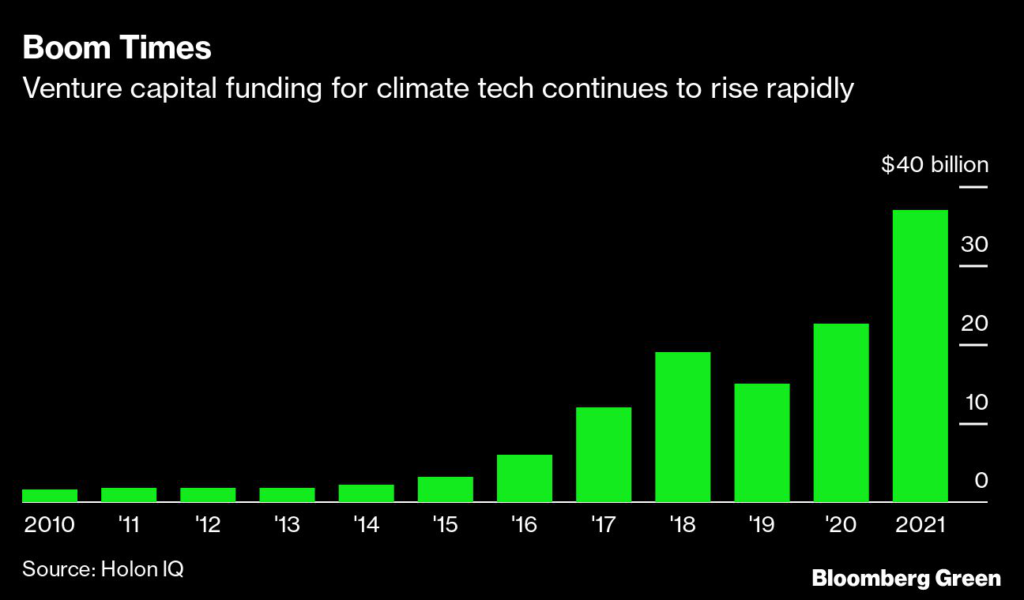
That’s now starting to change. As the climate crisis worsens and governments look to reshape markets, venture capitalists are beginning to pour increasing sums into startups that will provide some of the solutions to cutting emissions. Throw in $374 billion into climate- and energy-related government spending included in the new US climate bill, and you can expect a startup supercharge.

“People are beating down our doors,” says Gabriel Kra, co-founder of the venture capital firm Prelude, in a discussion on Bloomberg Green’s Zero podcast. “The market size has just increased.”

Kra spoke to Zero about the role that venture capitalists play in building companies, which goes beyond the money they invest. He also talked about that time he got arrested at a climate protest, and why he’ll never say never on getting arrested again.

This is an edited and condensed version of the highlights of Kra’s interview. You can listen to the full conversation with Kra below, and read a full transcript here.

Akshat: Would companies you back have succeeded regardless of whether Prelude gave them money?

Gabriel: There are some entrepreneurs for whom the money is just a source of fuel. That’s a small segment. There’s a much larger segment where investors did something beyond funding them that helped them succeed.

A mentor told me early in my career that you spend a lot of your time as a VC helping the companies that need help, rather than the ones that are crushing it and only call you when they need some advice. So the most gratifying part of my job is when you find a team that needs help. Not out of distress, but because I know something or I have a set of experiences that they do not have.

Akshat: US investing in climate startups can be neatly split into two eras. One starting in the mid-2000s until 2011, and then the second one starting in 2012 that’s still going. What changed between the two eras?

Gabriel: Let’s take batteries as an example. We worked a ton on batteries starting in 2007 or maybe even a little earlier. A lot of those companies just flat-out failed. The electrochemistry didn’t work. The scaling didn’t pan out. But many battery startups are succeeding now. Partly because of the advances in machine learning and the cost of cloud computing that we can now bring to bear to solve hard problems.

The other thing that has changed is the sense of urgency. I now firmly believe that people, corporations, and governments all understand the problem. That has resulted in the right flows to the capital markets. Not just venture capital, but everything from early-stage investing to late-stage growth. There is capital available for great entrepreneurs who are tackling hard problems in a way that wasn’t possible in the first era. That is why this second clean tech boom has been more successful.

Akshat: How exactly does the Inflation Reduction Act boost US startups?

Gabriel: I’ve been focused on grid-scale batteries. The bill has tax credits for domestic manufacturing that make it economic for many startups to manufacture and sell their new batteries from day zero. It enables us to go faster and bring down the cost faster. And that brings manufacturing onshore, not just for startups but also for big companies. There are also standalone credits for energy storage that creates demand for batteries. We believed we had a robust and strong progression, but now people are beating down our doors.

Read the full transcript of this episode. Check out more episodes of Zero, and subscribe on Apple, Spotify, Google and Stitcher to hear new ones every Thursday. 

More stories like this are available on bloomberg.com

©2022 Bloomberg L.P.

Free-Marketeer Truss Could Water Down UK’s Tech, Media Reforms

(Bloomberg) — Former UK Prime Minister Boris Johnson was only half-way through rolling out several key policies when his government collapsed with a mass resignation. His successor Liz Truss now looks set to dilute a string of overdue decisions on technology and media.

One of Truss’s biggest inspirations is Margaret Thatcher, who deregulated finance and privatized public assets in the 1980s. With the Truss government planning to announce various new policies over the coming weeks, including a multi-billion pound giveaway in Friday’s mini-budget, here are some possible changes for the sectors.

Online Safety

Before Johnson’s resignation, the UK’s Online Safety Bill was close to being implemented. It’s a sweeping law to make British sites safer, imposing new rules which could affect as many as 25,000 businesses according to government estimates. However on Tuesday new Culture Secretary Michelle Donelan said that she plans to “edit” provisions that would have regulated “legal but harmful” posts, in a move that would please free speech campaigners.

Gambling

A wide-ranging review of Britain’s successful betting sector was pledged in the Conservatives’ 2019 manifesto and has been delayed several times. Former gambling minister Chris Philp had sent it to Prime Minister Johnson for final approval, and in his resignation letter in July urged him to push through tough reforms. 

But the decision has been left to Truss’s government. A mandatory levy on betting companies to raise money for mitigating harm was unpopular at the Treasury, according to a person familiar with the discussions. Stake limits for online betting were also under consideration.

A representative for the Treasury didn’t immediately respond to a request for comment.

However, Culture Secretary Donelan spoke out in favor of restrictions on gambling machines back in 2018, and another minister in her department, Damian Collins, has spoken out in favor of regulations on gambling ads. And influential Conservative lawmakers who backed Truss like former leader Iain Duncan Smith are also in favor of a crackdown. 

Broadcasting

As part of a shake-up in broadcasting rules, Johnson’s Culture Secretary Nadine Dorries wanted to sell Channel Four Television Corp, the state-owned advertising-funded station. Truss has expressed a preference for privatization too, but the policy is controversial and it may slip down the agenda as the country grapples with a cost of living crisis. On Tuesday, Donelan said that policy was being re-examined.

In the same industry, a planned ban on advertising for food and drink high in fat, sugar and salt could be scrapped, according to a person familiar with the matter.

Chips and China

The government is due to publish a semiconductor strategy in the coming weeks. That may not face major changes, but officials are leaning toward unwinding or imposing restrictions on the Chinese-backed takeover of the UK’s biggest semiconductor component factory, Newport Wafer Fab, Bloomberg reported earlier this month. 

China hawk Tom Tugendhat is now security minister, which means businesses with links to Beijing may face tougher rules under this government. During her leadership campaign, Truss herself also said Britain should crack down on Chinese firms, possibly including social media giant TikTok.

Johnson previously banned Huawei from the UK’s 5G networks, but only after he’d previously given it the green light. He’s also spoken about not wanting to scare away Chinese investment.

Big Tech 

The last government was expected to give powers to a new tech regulation unit inside its antitrust watchdog, the Competition and Markets Authority. However, the legislation needed to introduce those powers was delayed indefinitely, and time is running out in the Parliamentary calendar before the next general election.

Alongside other potential policies including an Online Sales Tax, a review of online advertising, and a push to woo tech companies like Arm Holdings Ltd. to list in the UK, Truss’s team have their work cut out for them.

Representatives for the Department for Business, Energy and Industrial Strategy and the Department for Digital, Culture, Media and Sport didn’t immediately respond to requests for comment.

More stories like this are available on bloomberg.com

©2022 Bloomberg L.P.
Crypto Exchange CoinFlex Floats Plan for Creditors to Own 65%

(Bloomberg) — Cryptocurrency exchange CoinFlex has detailed a restructuring plan in which creditors will own 65% of the company, with a vote on the proposal coming over the next week.

Existing ordinary and Series A shareholders will lose their equity stakes, while the CoinFlex team will be allocated 15% in the form of an employee share option plan that will vest over time. Series B investors will continue to be shareholders and will be incentivized with future equity, a statement showed.

“As with any reorganization, unfortunately, most shareholders get wiped out,” CoinFlex said. “This situation is no different.”

A slew of crypto firms have folded or gone into restructuring, hurt by the slump in digital assets this year, including a 60% plunge in the largest coins. 

CoinFlex filed for restructuring in the Seychelles last month as it sought to resolve a shortfall due to a counterparty failing to make a margin call. The exchange froze withdrawals in June after the counterparty, which it identified as crypto investor Roger Ver, failed to pay a margin call. Ver, however, denied he defaulted on debt owed to CoinFlex.

Read more: ‘Bitcoin Jesus’ Roger Ver Spars With Exchange Over Margin Call

A vote on the new proposal will occur in the next week, with approval of 75% of creditors by value of CoinFlex vote tokens held needed for passage. If it passes, the company will present it to the Seychelles Courts to approve the reorganization, CoinFlex said. If it doesn’t pass, they’ll rework the terms and come back again.

Other aspects of the proposal include:

  • The BCH Alliance will assume the responsibility of the SmartBCH Bridge and use its own BCH to exchange the sBCH Tokens held by the DeFi SmartBCH users on a 1:1 basis.
  • Creditors will get rvUSD, equity, and USDC.
  • FLEX Coin isn’t being distributed as those tokens may be used for marketing and other purposes, and it was believed creditors “would have a better outcome” if FLEX is owned by the company as opposed to distributed out.

More stories like this are available on bloomberg.com

©2022 Bloomberg L.P.

Dollar Steals Global Payment Flows From Euro Amid Market Turmoil

(Bloomberg) — The use of the euro as a global payment currency dwindled last month, reaching the smallest share in more than two years, as the common currency comes under pressure amid a strengthening US dollar. 

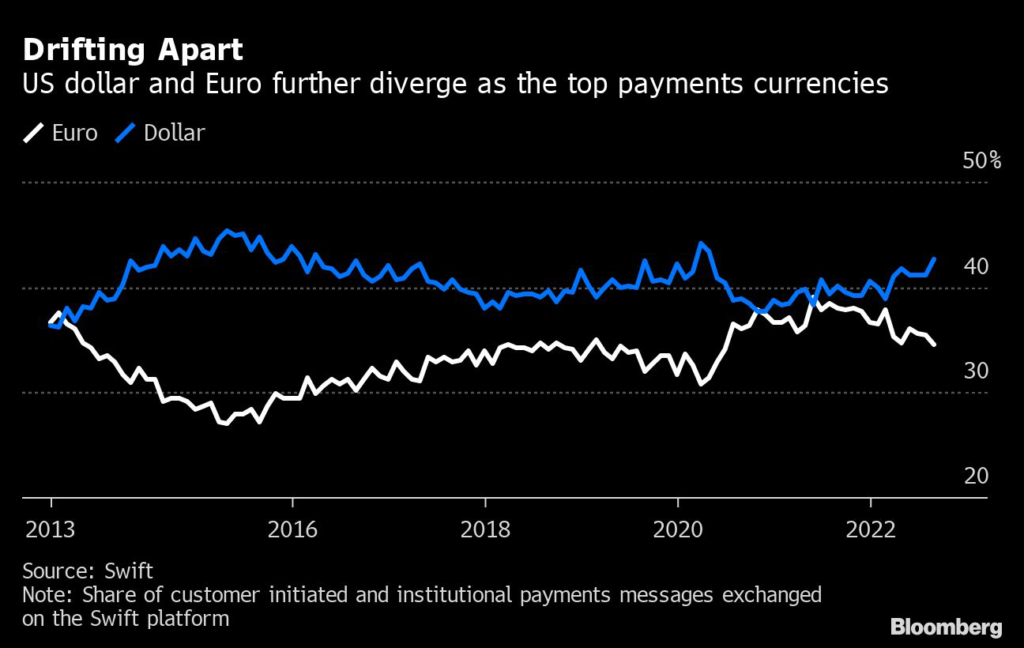
Payments using the euro dropped to 34.5% of the market in August, a full percentage-point lower from the previous month, according to data from the Society for Worldwide Interbank Financial Telecommunications, or SWIFT, a global financial messaging firm. Meanwhile, the dollar has been gaining share since May and remained in the top spot for the fifteenth consecutive month with a 42.6% share, the report released Wednesday showed.

As Europe teeters on the brink of recession amid record inflation and an energy crisis worsened by Russia’s escalating war in the Ukraine, the euro has lost its appeal for use in deals. Instead, investors are fleeing to the safety of the dollar and further cementing its place as investors’ currency of choice. The greenback has been dominating global payments, for the most part, since 2013.

Such moves have also pushed the gap between payments in the two currencies to the widest in nearly two and half years as the euro’s proportion of payments fell to the lowest since June 2020. The spread has broadened from just over 1 percentage point in February to more than 8 percentage points in August. That falls in line with the euro’s more than 12% depreciation against the dollar this year.

Still, despite usage falling for the third straight month, the euro held onto its spot as the second most used legal tender in the world after the greenback, keeping ahead of currencies like the British pound and the Japanese yen.

Elsewhere, the Chinese yuan’s share of transactions rose to the highest since January at 2.3%, even as the country grapples with an economic slump. And the use of the Canadian dollar was the worst since February 2018. The loonie has slumped over the past week and continued to trade at two-year lows against the dollar on Wednesday.

A struggling Japanese yen, which fell to a level unseen since 1998 earlier this month and is down about 20% year-to-date against the dollar, hasn’t gained ground when it comes to transactions either. Use of the yen slid slightly in August to make up just 2.7% of all global payments, its lowest since May. 

More stories like this are available on bloomberg.com

©2022 Bloomberg L.P.
Japan, South Korea Pledge Better Ties in First Summit Since 2019

(Bloomberg) — The leaders of Japan and South Korea used their first summit in nearly three years to pledge to resolve historical issues that have damaged ties between the US allies.

South Korean President Yoon Suk Yeol and Japanese Prime Minister Fumio Kishida met for about 30 minutes in New York, where both had addressed a session of the United Nations General Assembly. Statements from both sides issued Thursday said the pair also discussed the importance of cooperation that includes the US as they face threats from the likes of North Korea.

“The two leaders shared the need to resolve the pending issues and restore a healthy relationship between Japan and South Korea,” a statement from Japan said. South Korea said the two shared an urgency to “improve bilateral relations by resolving pending issues, and to this end, they instructed the diplomatic authorities to accelerate dialogue.”

Decisions by South Korean courts in recent years finding certain Japanese companies liable for compensation to Korean laborers for work done during Japan’s 1910-1945 colonial rule over the peninsula has soured ties. It also briefly touched off a trade dispute between the neighbors that the Biden administration has been courting as it seeks to secure supply lines for crucial goods such as semiconductors that diminish dependence on China.

Japan has said the South Korea court rulings were unjust, and matters of compensation were “settled completely and finally” under a 1965 agreement that normalized relations.

Yoon, a conservative who came to office in May, has pursued greater military cooperation with the US and rolled out security policies backing a tough line on China and North Korea that are in line with positions taken by Kishida’s government. 

Yoon and Kishida met briefly at a NATO summit in June but the last formal summit between the countries took place in December 2019, when then Japanese Prime Minister Shinzo Abe met Yoon’s predecessor, President Moon Jae-in, a progressive who sought rapprochement with North Korea and a soft touch with Beijing.

South Korea and Japan host the bulk of US troops in Asia, and both seek a delicate balance between security ties with Washington and economic cooperation with China, the biggest trading partner for both.

In August, the US announced it had conducted a joint missile defense exercise off Hawaii with Japan and South Korea, raising the profile of the drills and showing a willingness to work together to counter threats posed by North Korea and China.

A plan being floated by Yoon to solve the labor issue through a joint fund between the governments stands little chance of support in Japan, which is still angry after a similar fund for women trafficked into Imperial Army brothels was scuttled by Moon.

South Korea’s Foreign Ministry submitted an argument to the Supreme Court a few months ago that asked for a delay issuing a verdict on liquidizing assets of a Japanese company to pay compensation for the conscripted workers.

The ministry added it was making various diplomatic efforts to resolve the issue.

More stories like this are available on bloomberg.com

©2022 Bloomberg L.P.
Bitcoin, Ether Drop as Fed Warning of Rate-Hike Pain Hits Crypto

(Bloomberg) — Cryptocurrencies came under pressure Thursday after the Federal Reserve delivered another big interest-rate hike and warned of economic pain from the aggressive policy tightening still to come.

Bitcoin, the largest token, fell as much as 4% and came perilously close to dropping below $18,000, in touching distance of levels last seen in 2020. Second-biggest coin Ether continued to underperform, shedding up to 7.2%.

The Fed’s determination to raise rates to levels that hammer inflation at the cost of sliding asset prices sent a chill across global markets. Shorter maturity Treasury yields jumped while longer tenor rates fell, deepening a bond curve inversion seen as a harbinger of recession.

Such a backdrop offers little respite for crypto markets. They were already reeling from a $2 trillion plunge from a 2021 record high, an unraveling pockmarked with blowups such as the Three Arrows Capital hedge fund and the Terraform Labs project — whose co-founder Do Kwon is wanted by authorities.

“If the Fed keeps tightening, unless it implements yield curve control to keep the curve positively sloped, the crypto system will see a lot more failures,” said Brian Pellegrini, founder of Intertemporal Economics. “At the end a few very rich champions will emerge, but in the meantime there will be blood in the streets.”  

The MVIS CryptoCompare Digital Assets 100 Index is down this week, taking its losses for 2022 to about 62% compared with 22% for global stocks. The correlation between equities and Bitcoin is elevated and close to a record, a sign of how assets are being tossed around by common macro factors. 

‘Ponzi Schemes’

JPMorgan Chase & Co. Chief Executive Officer Jamie Dimon didn’t help the mood in digital-asset markets by reaffirming his skepticism and calling tokens “decentralized Ponzi schemes.”

Bitcoin was at about $18,500 as of 7:45 a.m. in Singapore. Ether was around $1,250 and continues to take an additional hit as an earlier rally sparked by hype around the upgrade of its Ethereum network unwinds. Coins like Solana and Avalanche were also in the red.

Some traders might look to measures like Bitcoin’s 14-day relative strength index for affirmation that a bounce is possible. The RSI, a momentum gauge, is close to oversold levels. But contrarian bets appeared few and far between for riskier assets following the Fed’s pugnacious performance.

More stories like this are available on bloomberg.com

©2022 Bloomberg L.P.

Intel Executive With Industry’s Toughest Job Plots Comeback

(Bloomberg) — Intel Corp. executive Sandra Rivera has what once would have been the most coveted job in the semiconductor industry: head of the company’s hugely lucrative data center division. Nowadays, it’s the toughest.

Rivera, who has been at Intel for more than 20 years, became general manager of the unit 14 months ago — shortly after Pat Gelsinger returned to the company as chief executive officer. The business had clearly been losing market share and its technological edge, but Rivera said she underestimated how big of a turnaround job her new role would be.

“Of course, I knew that we had a number of execution issues which had been years in the making,” she said in an interview from her office at Intel’s headquarters. “I probably under-called just how much work we had to do.”

The business of providing the microprocessors that run the internet and corporate networks had long been the crown jewel of what was the world’s largest chipmaker. The company’s total dominance of the market — where components can sell for more than $10,000 each — helped bring in huge profits for Santa Clara, California-based Intel. 

But more recently, Rivera’s unit has come to represent Intel’s struggles. Data center revenue dropped 16% last quarter from a year earlier, and the business’s operating margin collapsed to 5% from 38%. Intel missed its overall projections for the quarter and slashed its annual forecast.

Rivals such as Advanced Micro Devices Inc. and Nvidia Corp., meanwhile, have been snatching away customers. And Intel’s shares are down 43% in 2022, an even worse rout than the rest of the chip industry suffered this year.

One of the root causes of Intel’s weak performance, highlighted by Gelsinger on an earnings conference call, is the delay in a new chip for the data center market.

The setbacks stem largely from past design choices, Rivera said. Intel was overly ambitious in trying to develop too many new technologies and features. That resulted in delays, preventing customers from receiving a product that they should have gotten by now, she said.

Before her current role, Rivera served as Intel’s chief people officer under Gelsinger’s predecessor, Bob Swan. And prior to that, she was responsible for the company’s attempt to get into networking. The executive, in her 50s, holds an electrical engineering degree from Pennsylvania State University.

Rivera oversaw HR during a chaotic time for the company. Swan had taken the top job on an interim basis after CEO Brian Krzanich left over revelations of an affair with a subordinate. The stand-in CEO, whose position was later made permanent, tasked her with repairing Intel’s culture.

That may still be a work in progress. The problem, Rivera says, was a fundamental change in the way Intel approaches innovation — a shift away from empowering engineers at all levels to have a say in key decisions. 

It takes years to design and manufacture chips. Deciding how best to array billions of microscopic transistors — in a way which that anticipates the needs of computing years in the future — is extremely complex. Often the hardest part is deciding what to leave out. Intel was famous under its founders for being a place where, armed with convincing data, even lower-level engineers were heard, particularly when highlighting problems.

According to Rivera, that practice withered and the company became a place where it required too much courage and perseverance to speak up. The old guard, which Gelsinger replaced, had become too secure in its own beliefs. Executives knew the way technology was headed and didn’t want to hear otherwise, she said. Just as bad, Intel wasn’t listening to its customers and adapting fast enough to changes in computing technology, Rivera said.

“It cannot take heroes to bring that forward, to drive an organization of the size and scale and complexity of Intel,” she said. 

Gelsinger, a former chip designer himself, is detailed-obsessed. And the company has adopted mechanisms to reward those who speak up, Rivera said. It’s also established benchmarks for judging whether programs are on track and whether they’re going to result in technology that customers want. That means their fate is less subject to the whims or hunches of leaders, she said.

Rivera’s former responsibility — networking — is now a bright spot for the company. Intel has a growing foothold in markets such as mobile phone equipment, where it previously had little presence. That unit, run these days by Nick McKeown, posted sales of $2.3 billion in its most recent quarter. That was a gain of 11%.

Tapping new opportunities is something Rivera is attempting with the data center business as well. But Intel knows it has to fix more fundamental issues and win back the trust of its current customers, Rivera said. 

“I don’t think we get permission to talk about other things until we get the core franchise healthy,” she said. 

Intel has coughed up market share to AMD and seen giant customers such as Amazon.com Inc.’s AWS switch to their own chips. Nvidia, meanwhile, has taken a lead role in the exploding area of artificial intelligence computing.

But Intel is still the biggest force in computer processors, even if it’s not the utterly dominant company it once was. The chipmaker’s share of the market for servers running on PC processors was 86% at the end of the second quarter.

Intel’s outsize role in the chip business is one reason its product delays were so painful. Customers and much of the rest of the industry had become accustomed to timing their own products and plans around Intel’s schedules. When Intel proved unreliable, more customers began defecting. 

And the suffering isn’t over. Delays with Intel’s latest processor model will likely cost it more market share, Gelsinger warned in July.

Gelsinger, an Intel veteran who left for 11 years to lead VMware Inc., is trying to run a tighter ship. He frequently holds senior management meetings on Saturday and Sunday mornings, and is doing what he can to get Intel back on schedule, Rivera said.

But advanced microprocessors have a lengthy birthing process, and current executives will spend years dealing with mistakes from the past. Products scheduled for release next year and the year after will have to arrive on time before Intel can expect to regain trust, she said.

“The good news is that we are in a large and growing market,” Rivera said. “The amount of data that continues to be generated in the world — that needs to be processed, needs to be moved, stored, encrypted, compressed, delivered — continues to grow.” Intel just needs to show up on time.

(Updates chart after 20th paragraph.)

More stories like this are available on bloomberg.com

©2022 Bloomberg L.P.
Close Bitnami banner
Bitnami