Bloomberg

The Tricky Business of Calculating Crypto’s Market Value

  • Listen to Bloomberg Crypto on the iHeartRadio App
  • Listen to Bloomberg Crypto on Apple Podcasts
  • Listen to Bloomberg Crypto on Spotify  

(Bloomberg) — This crypto winter is still blowing cold and it’s not clear when or if a so-called spring will arrive. 

The losses have affected the entire cryptocurrency ecosystem, from hedge funds, to lenders, to countless individual retail investors. By most calculations, $2 trillion worth of value has been wiped out. 

Before the big chill, the estimated total market value of crypto assets worldwide stood around $3 trillion in November 2021. That’s a sizable chunk. But how is market value calculated? And how representative is it of crypto’s actual economic value? Did the digital asset boom ever even happen? Is there an element of groupthink when it comes to crypto’s overall valuation? Do we need to rethink market value?

Bloomberg reporter Vildana Hajric joins this episode to weigh in on this increasingly disputed metric.

Follow us on Twitter @crypto, and subscribe to the Bloomberg Crypto Newsletter at https://bloom.bg/cryptonewsletter

More stories like this are available on bloomberg.com

©2022 Bloomberg L.P.

Schneider to Buy Aveva in £9.5 Billion Industrial Software Deal

(Bloomberg) — Schneider Electric SE agreed to buy out minority shareholders in Aveva Group Plc in a deal that values the UK industrial software company at £9.5 billion ($10.8 billion), the latest foreign takeover of British tech company.

Schneider will pay £31 per share, the company said in a statement on Wednesday, confirming an earlier Bloomberg News report. Under the terms of the deal, the company, which already owns 59.14% of Cambridge, England-based Aveva, will pay about £3.87 billion for the remaining equity. 

Read More: Schneider Is Said to Near £9.4 Billion Aveva Buyout Deal

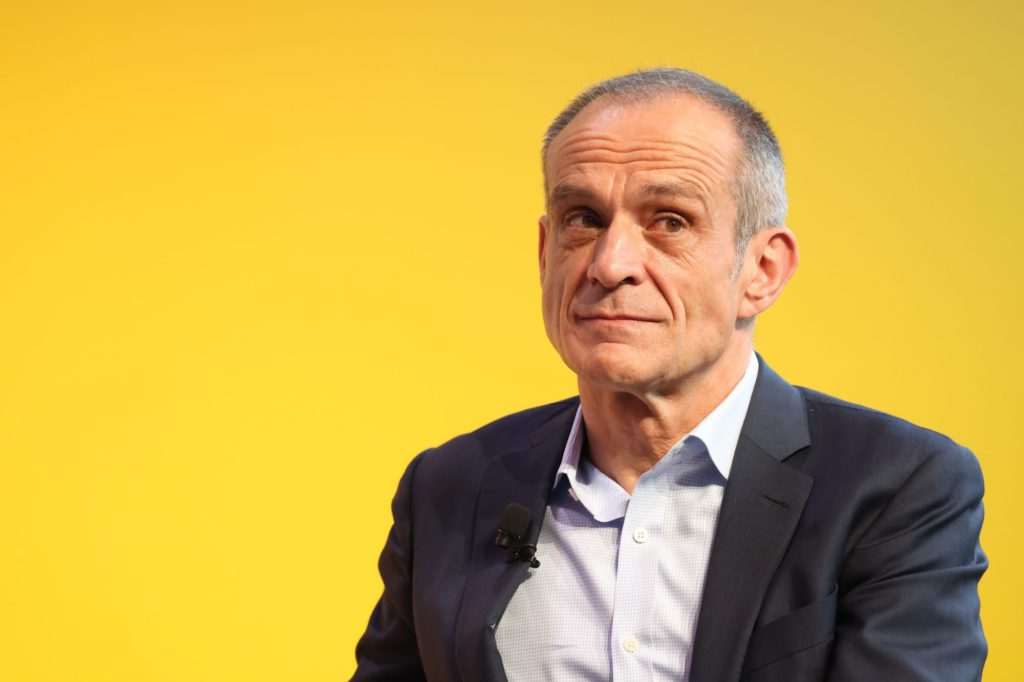
Schneider Chief Executive Officer Jean-Pascal Tricoire, 59, will gain full control of an asset he’s coveted since at least 2015, when the company made its first failed attempt to buy Aveva. Control of Aveva will help Schneider accelerate plans to move the power plants and factories its customers own onto more digital services, selling software that reduces energy use and increases efficiency.

Aveva becomes the latest of a number of UK tech firms to be taken over by a foreign acquirer and delisted from the London Stock Exchange, a trend that’s raised concern in the government.

The French industrial giant initially took control of Aveva in a deal announced in 2017, getting a majority stake in the company in exchange for its software unit and a cash payment. At the time, peers including Siemens AG and General Electric Co. were also investing in their own software businesses, products that would help customers automate, design and optimize power plants and factories. 

Read More: Aveva Gains on Schneider Bid, Room for Improvement: Street Wrap

Aveva — which provides software tools for utilities, oil and gas producers, transportation firms and other companies — said in the statement that its revenue has declined in the first five months of this fiscal year “by a mid-single digit rate” compared to a year earlier and costs “have increased significantly.” 

“While Schneider has majority ownership already and did appoint the current CEO, Aveva performance has been slightly inconsistent and Schneider management may see benefits from total control especially in terms of strategy alignment and speed of action,” RBC Capital Markets analyst Mark Fielding said in a note to investors on Wednesday.

The share price is a more than 40% premium to Aveva’s trading price on Aug. 23, the last full trading day before Bloomberg News first reported the potential bid. The deal, which is expected to close in the first quarter, gives Aveva an enterprise value of £10.2 billion. 

Schneider shares fell 0.9% to 115.02 euros at 9:52 a.m. in Paris trading. The stock has declined 33% this year. Aveva rose 2.3% to £31.17 in London, just above the offer price. 

Aveva will be able to keep its headquarters in Cambridge and Schneider doesn’t plan to make “any material change” to the number of Aveva employees, Schneider said in the statement. 

Still, the takeover will make Aveva the latest UK tech company to be taken over by a foreign bidder. The UK government is increasingly pushing back on these deals, which have claimed some of the country’s biggest tech businesses in the last decade. 

Cambridge-based Arm, which designs semiconductors for everything from smartphones to supercomputers, was acquired by SoftBank Group Corp. in 2016 and is now planning a public offering in the US. Prime Minister Liz Truss is lobbying the Japanese investor to list in the UK, the Financial Times said this month. 

Welsh chipmaker Newport Wafer Fab’s sale to a Chinese-owned company is being probed by the UK government, which is leaning toward restricting or blocking the takeover more than a year after it was signed, people familiar with the matter had said. 

EXPLAINER: Why Arm is Headed for an IPO After Failed Nvidia Deal

Schneider and Aveva had been in on-again, off-again talks about a combination since at least 2015, when they reached an initial agreement. Those talks fell apart within months because of concerns about the complexity of the French company’s business and integration costs. Another round of talks ended in 2016 two days after becoming public. 

Aveva has since bought SoftBank-backed industrial software maker Osisoft in 2020 at a valuation of $5 billion including debt. 

Schneider worked with Citigroup Inc. while Aveva’s lead financial adviser was Lazard Ltd. and joint financial advisers and brokers were JPMorgan Chase & Co. and Numis Corp.

The deal must still be approved by shareholders in a meeting that’s anticipated to take place in mid-November, and will require regulatory approvals. 

(Updates with analyst comment in sixth paragraph)

More stories like this are available on bloomberg.com

©2022 Bloomberg L.P.

HappyFresh Wins Funding, Reshuffles Board as Business Resumes

(Bloomberg) — HappyFresh has secured funding from investors to resume online grocery operations in Indonesia, staving off a potential cash crunch fomented by the regional economic slowdown.

The Instacart-style grocery delivery service said it’s restarting operations in its home market on Wednesday, after a strategic review. It will work with venture debt funds Genesis, Innoven and Mars on restructuring the business, HappyFresh said in a statement.

As part of a reshuffle, representatives of the investigations firm Kroll will replace three former directors on its board, including Naver Corp.’s Lee Jung An. The startup, which didn’t disclose the amount of new funding, said it will now focus on Indonesia while considering options for its businesses in Thailand and Malaysia.

Jakarta-based HappyFresh, which struggled this year to raise capital after a sharp downturn in the young online grocery sector, had hired turnaround firm Alvarez & Marsal Holdings LLC during a review of its financial situation, Bloomberg News reported this month. Chief Executive Officer Guillem Segarra, Chief Financial Officer Frederic Verin and Chief Operating Officer Christoph Krauss have been reinstated after stepping back from their day-to-day duties.

“We have gone through a lot,” Filippo Candrini, managing director of HappyFresh Indonesia, said in a statement. “Over the past weeks when we paused operations, we saw numerous comments from customers across various social media platforms stating their reliance on our service offering while requesting for the service to be resumed as soon as possible.”

Read more: HappyFresh Board Is Said to Hire Alvarez & Marsal for Review

Founded in 2014 as one of the first Instacart-style grocery delivery services in Southeast Asia, HappyFresh has raised at least $97 million in equity funding in addition to debt financing. Formally known as ICart Group Pte, it operates in Indonesia, Malaysia and Thailand. In February, the startup launched HappyFresh Supermarket to extend fresh and dry grocery accessibility by expanding its footprint of dark stores, or storage facilities where delivery staff pick up products from.

But the market for grocery delivery services has soured in the face of slowing economic growth, surging inflation and higher interest rates. 

Grab Holdings Ltd., a Southeast Asian ride-hailing and delivery company and a backer of HappyFresh, said last month it decided to shut its dark-store operations in Singapore, Vietnam and the Philippines to cut costs and streamline its deliveries operations, retreating from the earlier strategy. And pandemic darling Instacart Inc., which was valued at $39 billion in a March 2021 funding round, slashed its internal valuation by about 40% a year later.

Alvarez & Marsal was the restructuring adviser that wound down Lehman Brothers Holdings’ operations about a decade ago. The global firm with more than 6,000 employees has expanded its Asia forensic technology team this year, and appointed Manas Tamotia, a 20-year consulting veteran and former chief strategy officer of HappyFresh, as a managing director to lead private equity for its Southeast Asia and Australia division.

More stories like this are available on bloomberg.com

©2022 Bloomberg L.P.
French Tycoon Swoops on Vodafone: The London Rush

(Bloomberg) — Here’s the key business news from London-listed companies this morning.

Vodafone Group Plc: Atlas Investissement, backed by French billionaire Xavier Niel, has bought about 2.5% of the British telecommunications giant. 

  • The entrepreneur sees “opportunities to accelerate both the streamlining of Vodafone’s footprint and the separation of its infrastructure assets,” according to a statement Wednesday
  • Niel becomes the second French mobile mogul to swoop on a British telecom with a weak share price, after rival Patrick Drahi bought 18% of BT Group Plc last year

Aveva Group Plc: French conglomerate Schneider Electric SE agreed to buy the remaining stake in the UK industrial software developer it doesn’t already own in a deal that values Aveva at £9.48 billion. 

  • Bloomberg reported Tuesday that Schneider was nearing a deal for Aveva

S4 Capital Plc: Martin Sorrell’s digital advertising agency reported first-half revenue growth 60% and said it implemented cost measures including a brake on hiring. 

  • “Combinations remain a key part of our growth strategy, however, for the time being we are focused on organic growth and maximising value from our existing businesses, where momentum remains strong,’’ Sorrell said

Outside the City

The government plans to slash the wholesale prices that are incorporated into business energy bills this winter, people familiar with the matter told Bloomberg. Compared with the current market prices facing suppliers, the cap would impose a discount of roughly 50% on the winter contract for electricity and 25% on gas for next month.

Meanwhile, The Times reported that Liz Truss plans to cut stamp duty rates for home purchases. The move probably bolster home prices, which soared during the pandemic when the tax was suspended for many buyers.

Mohamed A. El-Erian details the four hurdles Truss is facing to spur growth. 

In Case You Missed It 

Investor coalitions representing money managers that have committed to reduce carbon emissions from their portfolios are calling on Truss to uphold the UK’s existing commitment to eliminate net greenhouse gas emissions.

Link Administration Holdings Ltd. could be forced to pay an additional £50 million fine to the UK’s financial watchdog over the administration of a collapsed fund of former star investor Neil Woodford.

Elsewhere, Rio Tinto Plc Chief Executive Jakob Stausholm made it clear yesterday that its offer is final to take over a company that is behind one of the world’s largest copper mines.

Looking Ahead

All eyes will be on the Bank of England tomorrow, which will announce whether it’s pushing through the biggest interest rate hike in 33 years to quell rampant inflation. Traders have so far priced in 200 basis points of hikes over the next three decisions. 

For a news fix when the day is done, sign up to The Readout with Allegra Stratton, to make sense of the day’s events.

More stories like this are available on bloomberg.com

©2022 Bloomberg L.P.
Schneider Agrees to Buy Aveva in £9.48 Billion Software Deal

(Bloomberg) — Schneider Electric SE has agreed to buy out minority shareholders in Aveva Group Plc in a deal that values the industrial software company at £9.48 billion ($10.8 billion) and will strengthen the French company’s foothold in the UK. 

Schneider will buy out minority shareholders for £31 per share, the company said in a statement on Wednesday, confirming an earlier Bloomberg News report. The company, which already owns 59.14% of Cambridge, England-based Aveva, will pay about £3.87 billion for the remaining equity. 

Read More: Schneider Is Said to Near £9.4 Billion Aveva Buyout Deal

The share price is a more than 40% premium to Aveva’s trading price on Aug. 23, the last full trading day before Bloomberg News first reported the potential bid. The deal, which is expected to close in the first quarter, gives Aveva and enterprise value of £10.2 billion. 

Schneider Chief Executive Officer Jean-Pascal Tricoire will be able to use the combination to cut costs and accelerate sales at the merged company, Omid Vaziri, an analyst at Bloomberg Intelligence, said in a note in August after the talks were initially revealed. Tricoire has been selling off non-core businesses at the French industrial giant, investing more in companies that will help the French industrial giant move toward digitalization. 

Aveva — which provides software tools for utilities, oil and gas producers, transportation firms and other companies — will be able to keep its headquarters in Cambridge and Schneider doesn’t plan to make “any material change” to the number of Aveva employees, Schneider said in the statement. The deal must still be approved by shareholders in a meeting that’s anticipated to take place in mid-November, and will require regulatory approvals. 

Schneider initially took control of Aveva in a deal in 2017, getting a majority stake in the company in exchange for its software unit and a cash payment. At the time, industrial giants including Siemens AG and General Electric Co. were also investing in their own software businesses, products that would help customers automate, design and optimize power plants and factories. 

The companies had been in on-again, off-again talks about a combination since at least 2015, when Schneider and Aveva reached an initial agreement. Those talks fell apart within months because of concerns about the complexity of the French company’s business and integration costs. Another round of talks ended in 2016 two days after becoming public. 

Aveva has since bought SoftBank Group Corp.-backed industrial software maker Osisoft in 2020 at a valuation of $5 billion including debt. 

Schneider worked with Citigroup Inc. while Aveva’s lead financial adviser was Lazard Ltd. and joint financial advisers and brokers were JPMorgan Chase & Co. and Numis Corp.

(Updates with additional details throughout)

More stories like this are available on bloomberg.com

©2022 Bloomberg L.P.

China Leading Race to Make Technology Vital for Green Hydrogen

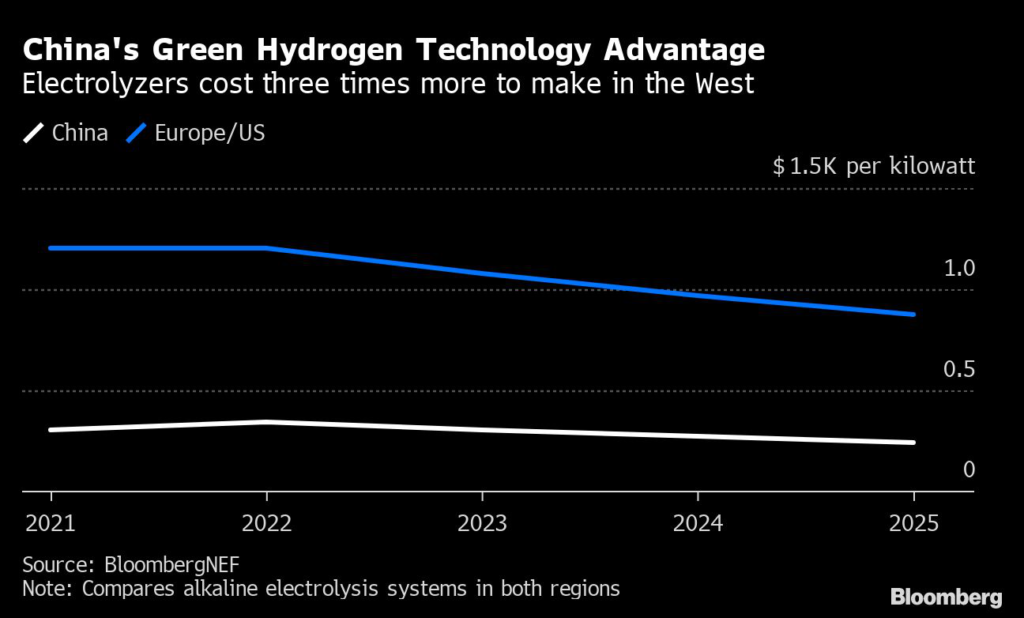
(Bloomberg) — Chinese factories can produce electrolyzers at a fraction of the cost of US and European competitors, giving them an edge in the race to manufacture the key technology for unlocking green hydrogen.

A Chinese alkaline electrolysis system costs about $343 per kilowatt, compared with $1,200 per kilowatt in the West, BloombergNEF said in a report. Electrolyzers run an electric current through water, separating it into oxygen and hydrogen. When powered by renewable energy, they can produce hydrogen gas to fuel everything from cars to steel mills without any carbon emissions.

Orders for the systems are soaring as more industries seek to decarbonize, which should help manufacturers build up economies of scale and reduce costs by 30% by 2025, BNEF analysts including Xiaoting Wang said in the report. 

Chinese factories enjoy cheaper labor and a more developed supply chain for the components and raw materials, according to BNEF. China also had a relatively larger electrolyzer manufacturing industry before the green hydrogen boom, because of industrial demand in sectors like polysilicon manufacturing, it said.

Why Hydrogen Is the Hottest Thing in Green Energy: QuickTake

Even given added costs for transportation and installation, Chinese systems can be delivered to international markets at a significant discount to Western manufacturers. BNEF expects China’s share of European and US sales to be less than 30% through 2025, but says there’s a chance to increase it beyond then.

Any move to erect trade barriers would likely be met by Chinese firms expanding manufacturing into Southeast Asia, following the blueprint of the solar industry, BNEF said.

“Chinese manufacturers have started their march into international markets,” it said in the report. “Electrolysis products made in China are likely to become popular worldwide during 2025-30.”

More stories like this are available on bloomberg.com

©2022 Bloomberg L.P.

Haven Assets Up on Putin; Stocks Slip Ahead of Fed: Markets Wrap

(Bloomberg) — Treasuries and haven assets including gold rose after Russian President Vladimir Putin announced a “partial mobilization.” Stocks fell as investors awaited a hefty interest-rate from the Federal Reserve.

Ten-year Treasury yields slumped four basis points and the rate on similar dated German debt fell five basis points. The euro dropped 0.6%.

Shares declined in Japan, Hong Kong and Australia after the S&P 500 Index dropped more than 10% below the August high marking the peak of its rally from this year’s low. US contracts and European stock futures fell.

A dollar gauge traded near a record high amid the market jitters while bitcoin dropped below $19,000. The offshore yuan fell to the lowest against the greenback since mid 2020, even after the People’s Bank of China set the daily reference rate for the currency stronger-than-expected for a 20th day.

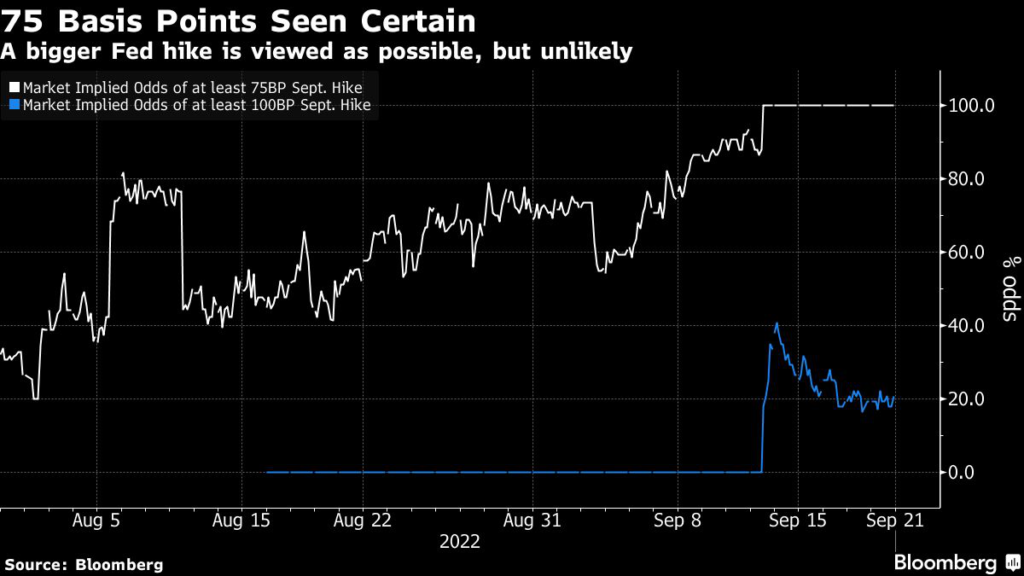
Fed officials are about to put numbers on the “pain” they’ve been warning of when the central bank publishes new economic projections Wednesday. They’re expected to hike by 75 basis points again, according to the vast majority of analysts surveyed by Bloomberg. Only two project a 100 basis points move. 

“Volumes remain light and the mood cautious, with few looking to take on large positions before hearing what the Fed says and where policy makers see rates going by the end of the hiking cycle,” said Fiona Cincotta, senior financial markets analyst at City Index. “This is what will drive the markets, not the rate hike tomorrow, but what the Fed plan to do next.”

Nouriel Roubini, who correctly predicted the 2008 financial crisis, sees a “long and ugly” recession occurring at the end of 2022 that could last all of 2023 and a sharp correction in the S&P 500. “Even in a plain vanilla recession, the S&P 500 can fall by 30%,” said the chairman of Roubini Macro Associates. In “a real hard landing,” which he expects, it could fall 40%.

Still, some professional speculators are refusing to surrender to a punishing equity market prone to volatility — boosting bullish and bearish positions at the fastest rate in five years. As the S&P 500 plunged last week, hedge funds snapped up single stocks while betting against the broad market with products like exchange-traded funds, data from Goldman Sachs Group Inc.’s prime brokerage show.

Christopher Smart, chief global strategist for Barings LLC, said equity markets faced further stress from weaker valuations while certain corners of the credit markets remained attractive. “Investment grade and high-yield are places my colleagues are finding a lot of opportunities,” he said on Bloomberg Television. “The fundamentals of the U.S. economy are very strong. They need to weaken a little bit to cool some of these inflation pressures, but you can find a lot of companies that have strong balance sheets.”

Key events this week:

  • Federal Reserve decision, followed by a news conference with Chair Jerome Powell, Wednesday
  • Big-bank CEOs testify before US Congress in a pair of hearings on Wednesday and Thursday
  • US existing home sales, Wednesday
  • EIA crude oil inventory report, Wednesday
  • Bank of Japan monetary policy decision, Thursday
  • The Bank of England interest rate decision, Thursday
  • US Conference Board leading index, initial jobless claims, Thursday

Will the Nasdaq 100 Stock Index hit 10,000 or 14,000 first? This week’s MLIV Pulse survey focuses on technology. It’s brief and we don’t collect your name or any contact information. Please click here to share your views.

Some of the main moves in markets:

Stocks

  • S&P 500 futures fell 0.1% as of 7:30 a.m. in London. The S&P 500 fell 1.1%
  • Nasdaq 100 futures dropped 0.2%. The Nasdaq 100 fell 0.9%
  • Japan’s Topix slid 1.2%
  • The Hang Seng Index fell 1.3%
  • Euro Stoxx 50 futures fell 0.8%

Currencies

  • The Bloomberg Dollar Spot Index rose 0.2%
  • The euro was fell 0.6% to $0.9912
  • The Japanese yen was at 143.62 per dollar
  • The offshore yuan fell 0.4% to 7.0566 versus the dollar

Bonds

  • The yield on 10-year Treasuries slipped four basis points to 3.52%

Commodities

  • West Texas Intermediate crude rose 1.5% to $85.72 a barrel
  • Gold traded at $1,674.56 an ounce

More stories like this are available on bloomberg.com

©2022 Bloomberg L.P.
Taiwan’s Exporters Struggle as Demand from China Falls

(Bloomberg) — Taiwan’s exporters are feeling the pain of China’s economic weakness, with the global slowdown and escalating geopolitical tensions also taking their toll on Asian tech powerhouse.

In a sign of the waning demand, Taiwan export orders plateaued in August from July, with the almost $55 billion in new orders down 20% from the peak in December last year. Orders are a leading indicator of future demand, and the more than 25% drop in orders from mainland China and Hong Kong last month indicate that exports and company revenue are likely to continue weakening.  

Some of Taiwan’s biggest companies, from iPhone maker Hon Hai Precision Industry Co. to food and beverage giant Want Want China Holdings, have flagged growth concerns this year when reporting profits, citing problems like supply chain bottlenecks in China and slower demand. That cautious outlook is a sign that the global slowdown is starting to have real-world impact in places like Taiwan, which plays a key role in the world’s semiconductor supply chain and had benefited from two years of pandemic-induced demand. 

“If China’s economy remains sluggish and reopening in China keeps on being postponed, that is a very significant pressure on Taiwan’s trade side,” said Ma Tieying, an economist at DBS Group Holdings Ltd. “In terms of electronics, chemicals, commodities-related sectors, the dependence ratio on China’s market is still pretty high for Taiwan’s exports.”

Read more: Chipmakers’ Pandemic Boom Turns to Bust as Recession Looms

Mainland China and Hong Kong together take around 40% of the island’s exports. Even though China showed some signs of a pickup in August, the economy is struggling, weighed down by Covid Zero policies which have undercut domestic spending and incomes, a housing slump which has hit industrial demand, slowing export growth, and also temporary factors such as a heatwave and power shortages over the summer.

Taiwan’s trade with the mainland is dominated by electrical equipment and chips components, and its companies, notably its biggest chip-maker Taiwan Semiconductor Manufacturing Co., also operate factories on the mainland. However demand for those products is falling in China, with mobile phone output dropping 8% in August and computer production falling by almost 19% from a year earlier. 

Hon Hai posted better-than-expected net income earlier this year, but its chairman Liu Young-way said the company would need to “pay close attention to the development of geopolitics, inflation, and the pandemic” in the second half of this year.

Growth Boost

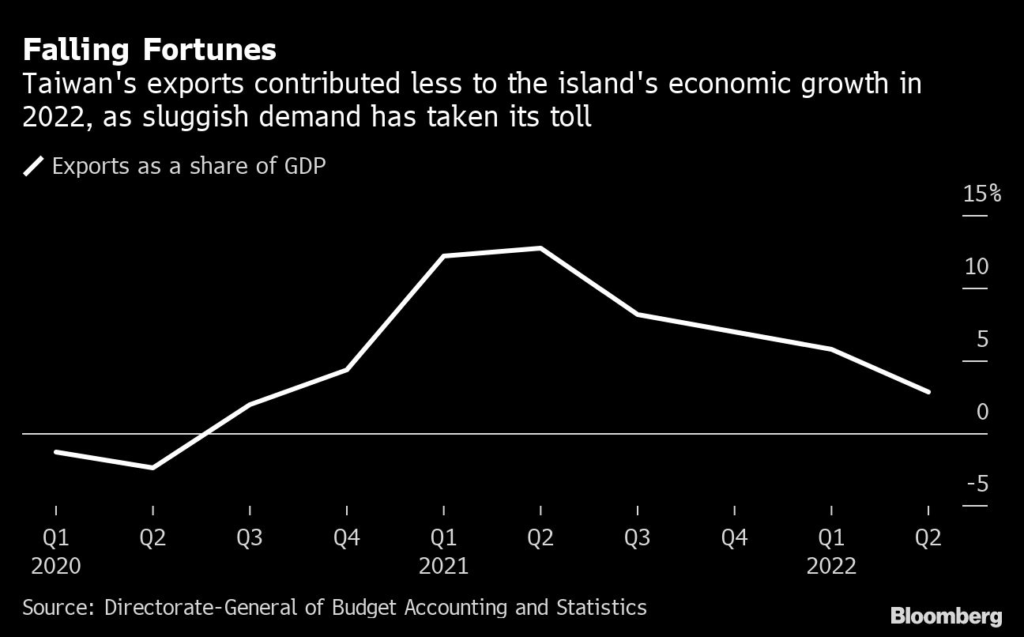
Strong exports helped support Taiwan’s economic growth last year even as domestic consumption took a hit during the pandemic. However as exports this year have slowed, the contribution to overall growth has dropped to less than 3% in the second quarter, compared to nearly 13% the year before.

Overseas shipments have also been hurt by global inflation, rising interest rates, and Russia’s war in Ukraine, which have have cut into demand from US and Europe, said Beatrice Tsai, chief statistician of the Ministry of Finance. While there was still demand for electronic components, more than half of the island’s major export categories — including plastics and base metals — declined for the first time in two years, she told reporters earlier this month.

Exports in August grew only 2% from the year before, which was the slowest pace of growth since July 2020, but they may shrink by as much as 3% this month, according to Tsai. Further interest rate increases in the US are also likely to hit export demand, with growth already slowing to just 2.3% in August from the double-digit expansions seen in the previous 19 straight months. 

The economy and trade are also facing growing geopolitical risks, with Beijing halting some trade in apparent retaliation for US House Speaker Nancy Pelosi’s August visit to the island. While the amount is small now, there are concerns that intensifying cross-strait tensions could lead to more damaging measures targeting Taiwanese wood, minerals, or even electronic components.

In further signs of the downturn, Taiwan’s manufacturing index has contracted for three consecutive months, falling in August to 42.6 points — its lowest reading since May 2020. The economy’s industrial output growth slowed in July to 1.1% and is forecast to have slowed even more in August.

Taiwan’s government has for years sought to reduce its economic reliance on China for political reasons and since the beginning of this year there has been some diversion of Taiwanese exports to Southeast Asia, according to Darson Chiu, research fellow at the Taiwan Institute of Economic Research. Countries from the Association of Southeast Asian Nations were the second largest buyer of Taiwanese exports in August and new orders in August were a record high.

“This can somewhat make up for the blows from exports to China, but China’s supply chain is definitely still stronger than that of Southeast Asia,” Chiu said. 

More stories like this are available on bloomberg.com

©2022 Bloomberg L.P.
Bitcoin Hovers in Sight of Lowest Level Since 2020 as Fed Looms

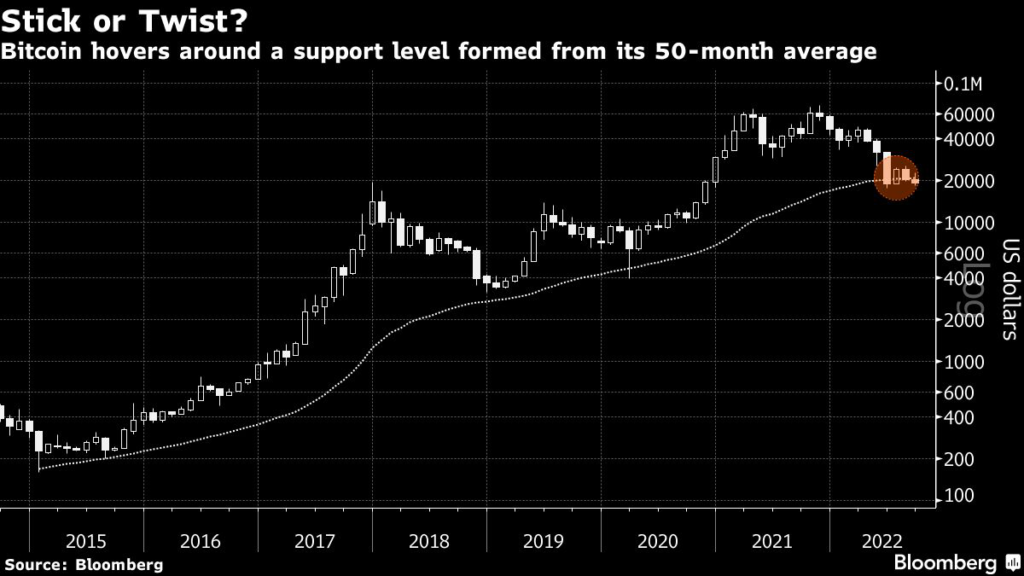
(Bloomberg) — Cryptocurrency investors waited with bated breath for a Federal Reserve policy decision that likely holds the key to whether Bitcoin can avert a drop to levels last seen when the pandemic was raging globally.

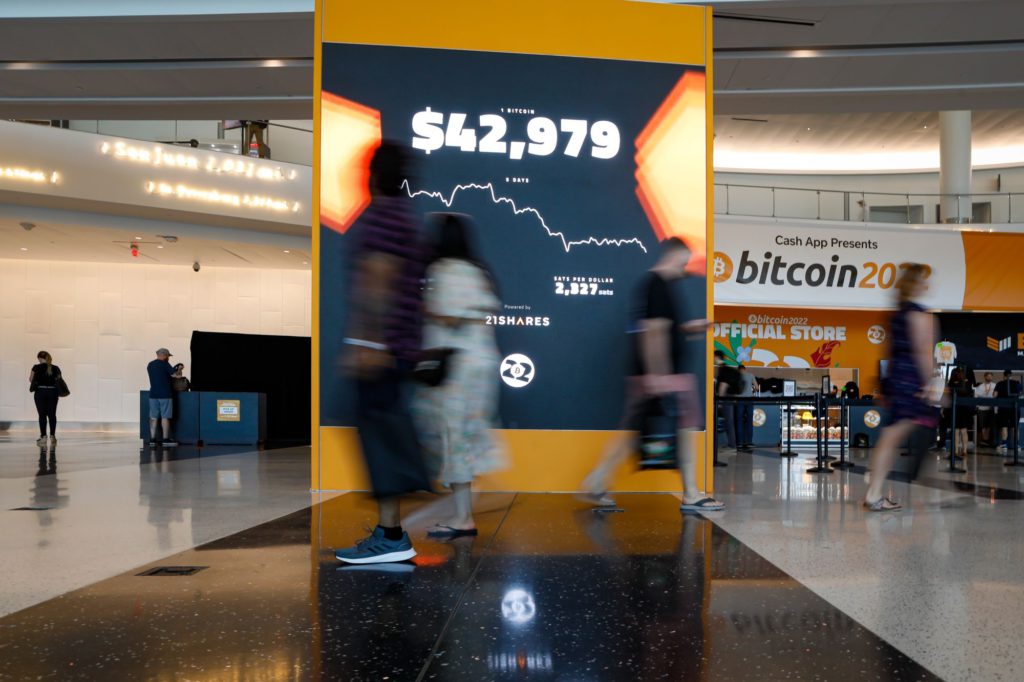
The largest token was little changed at $19,000 as of 11:44 a.m. in Singapore on Wednesday, while other major coins like Ether, Solana and Avalanche were also steady. A drop of more than 7% in Bitcoin — something that can happen in a few seconds in digital assets — would send it back to 2020 prices. 

Markets could breathe a temporary sigh of relief if the Fed raises borrowing costs by three-quarters of a percentage point again as expected and avoids becoming even more hawkish. But a bigger, one-percentage-point increase to fight inflation might heap pressure on riskier assets by imperiling liquidity.

“If the FOMC delivers less than a 100 basis points hike, it would make sense to see a small relief rally — this could be quite large if the FOMC were to deliver less than a 75 basis points increase, although this seems highly unlikely,” said John Toro, head of trading at digital-asset exchange Independent Reserve.

The MVIS CryptoCompare Digital Assets 100 Index is down this week, taking its losses for 2022 to about 60% compared with 21% for global stocks. The correlation between equities and Bitcoin is elevated and close to a record, a sign of how assets are being tossed around by common macro factors.

“If we do end up seeing 100 basis points, we might see quite the volatility” in virtual coins following the Fed announcement, Laura Vidiella del Blanco, vice president of business development and strategy at LedgerPrime, said on Bloomberg Television.

More stories like this are available on bloomberg.com

©2022 Bloomberg L.P.
China Runs Down Oil Stockpiles as Market Eyes Big Export Quotas

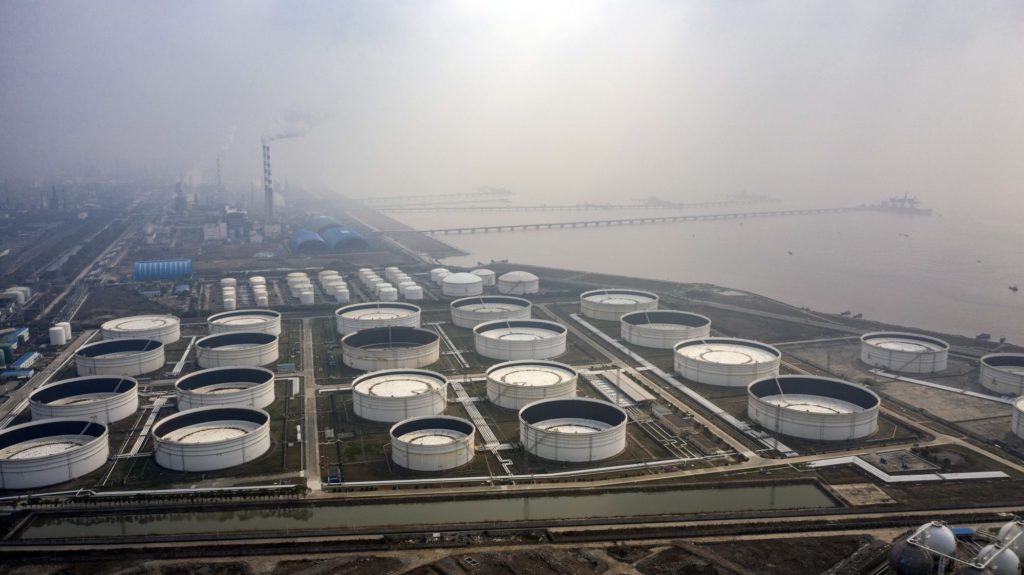
(Bloomberg) — China has begun running down its crude oil stockpiles, which could signal that refiners are getting ready to boost fuel exports as part of the government’s efforts to revive the economy.  

Onshore crude inventories stood at 909 million barrels as of Sept. 15, the lowest since May 12, according to Emma Li, an analyst with Vortexa Ltd. About 1 million barrels a day has been drawn from stockpiles over the past three weeks, she said. Satellite data firm Ursa Space Systems puts the figure at 1.05 billion barrels, down 7.5 million barrels from the prior week, and the fourth weekly draw in five, according to analyst Geoffrey Craig.   

The reduction may only be seasonal, but it could also be an indication that processors are ramping up run rates in anticipation of a push to produce and export more fuels, including gasoline and diesel. Refiners and traders have applied for an extra 15 million tons of export quotas, which, if approved, would raise allocations so far this year to a level similar to that seen over the whole of 2021. 

National oil companies are considering raising their utilization rates by 10% to 15% next month, according to a note from industry consultant FGE, although whether the extra quotas are granted is still subject to jockeying between different government departments, said Energy Aspects Ltd. 

JP Morgan Chase & Co., meanwhile, said it thinks China is unlikely to approve that level of exports, calling the volumes applied for excessive. 

Oil refining activity has been holding near pandemic-era lows in recent months. China has been slow to use up stockpiled crude because of a weaker economy and the government’s stringent virus controls, which have stifled the usage of transport fuels and slowed petrochemicals demand.

Events Today

(All times Beijing unless noted otherwise)

  • IEA webinar on China’s Electric Power Sector Transformation, 15:00
  • EU-China Energy Cooperation Platform’s Future of Gas panel discussions, focusing on supply security and carbon capture, 15:00
  • China Mining Conference and Exhibition, online, day 1

Today’s Chart

The slump in China’s metals-intensive property market appeared to deepen in July and August, says Bloomberg Economics. Fresh cuts in mortgage rates and efforts by local governments to generate demand for housing are failing to get traction, and the sector is set for a painful, long-term adjustment. Decisive policy steps could be needed to prevent a crash scenario.

Housing Demand in Deep Slump

On The Wire

  • Kerry Sees Prospect for Thaw in Frozen US-China Climate Talks
  • China’s Unipec Buys W. Africa, Brazil Oil as Prompt Demand Gains
  • Taiwan to Buy $600m in Iowa Corn Goods as US-China Tension Brews
  • Chinese Metal Producers Expand Stakes, Develop Acquired Mines
  • Nickel Industries Signs Cooperation Pact With QMB New Energy
  • Senators Seek Secondary Sanctions on Russian Oil Purchases
  • China Scoops Up Cheaper Argentina Soybeans as US Harvest Begins

The Week Ahead

Thursday, Sept. 22

  • EU-China Energy Cooperation Platform’s Future of Gas panel discussions, focusing on competitive markets and renewable gas, 15:00
  • China Mining Conference and Exhibition, online, day 2
  • USDA weekly crop export sales, 08:30 EST

Friday, Sept. 23

  • Bloomberg China economic survey for September, 10:00
  • China weekly iron ore port stockpiles
  • Shanghai exchange weekly commodities inventory, ~15:30
  • China Mining Conference and Exhibition, online, day 3

More stories like this are available on bloomberg.com

©2022 Bloomberg L.P.
Close Bitnami banner
Bitnami