Bloomberg

Qualcomm-Backed Drone Maker Weighs $125 Million India IPO, Sources Say

(Bloomberg) — IdeaForge Technology Pvt., India’s largest drone maker backed by Qualcomm Inc., is considering an initial public offering in Mumbai that could raise about $125 million, according to people familiar with the matter.

The company is working with financial advisers on the potential listing, which could happen in the first quarter of 2023, the people said. The Mumbai-based firm is seeking a valuation of about $700 million in the share sale, which could mostly consist of new shares, the people said.

IdeaForge is looking to file a preliminary draft prospectus with the regulator by December, said the people, who asked not to be identified as the information is private. 

Considerations are at an early stage and details of the offering including size and timeline could still change, the people said. A representative for IdeaForge declined to comment.

Founded in 2007, IdeaForge make drones for India’s armed forces, police and homeland security as well as industrial applications, according to the company’s website. It is licensed by the Ministry of Defence to manufacture unmanned aerial vehicles. In addition to Qualcomm Ventures, it also counts Infosys Ltd. and Florintree Capital Partners, which was co-founded by former Blackstone Inc. fund manager Mathew Cyriac, among its backers.

India’s IPO activity has slowed significantly amid a global slump on concerns over rising interest rates and a potential recession. Companies have raised about $5.5 billion through first-time share sales in India this year, down by almost half from the $10.2 billion raised during the same period in 2021, according to data compiled by Bloomberg.

(Adds IPO data in the last paragraph.)

More stories like this are available on bloomberg.com

©2022 Bloomberg L.P.

Asian Stocks Decline Ahead of Expected Fed Hike: Markets Wrap

(Bloomberg) — Asian stocks opened lower after US shares declined and Treasury yields held near multiyear highs as investors position for a hefty interest rate hike from a hawkish Federal Reserve. 

Equities fell in Japan, Hong Kong and Australia after the S&P 500 Index dropped more than 10% below the August high marking the peak of its rally from this year’s low. US contracts fluctuated and European stock futures fell.

Two-year Treasury yields inched back from close to 4% as traders weigh the risk that monetary tightening will push the economy into recession. The Bank of Japan announced an unscheduled bond-purchase operation as it seeks to cap upward pressure on yields before a policy decision later this week.  

A dollar gauge traded near a record high amid the market jitters while bitcoin remained under pressure below the $19,000 level.

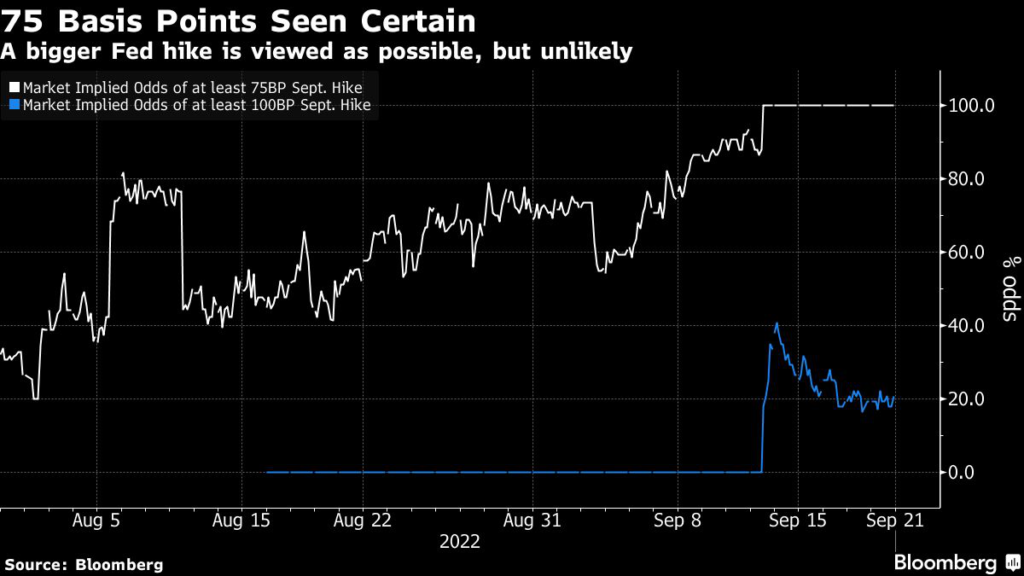
Fed officials are about to put numbers on the “pain” they’ve been warning of when the central bank publishes new economic projections Wednesday. They’re expected to hike by 75 basis points again, according to the vast majority of analysts surveyed by Bloomberg. Only two project a 100 basis points move. 

“Volumes remain light and the mood cautious, with few looking to take on large positions before hearing what the Fed says and where policy makers see rates going by the end of the hiking cycle,” said Fiona Cincotta, senior financial markets analyst at City Index. “This is what will drive the markets, not the rate hike tomorrow, but what the Fed plan to do next.”

Nouriel Roubini, who correctly predicted the 2008 financial crisis, sees a “long and ugly” recession occurring at the end of 2022 that could last all of 2023 and a sharp correction in the S&P 500. “Even in a plain vanilla recession, the S&P 500 can fall by 30%,” said the chairman of Roubini Macro Associates. In “a real hard landing,” which he expects, it could fall 40%.

Still, some professional speculators are refusing to surrender to a punishing equity market prone to volatility — boosting bullish and bearish positions at the fastest rate in five years. As the S&P 500 plunged last week, hedge funds snapped up single stocks while betting against the broad market with products like exchange-traded funds, data from Goldman Sachs Group Inc.’s prime brokerage show.

Elsewhere in markets, oil fell below $84 a barrel and gold was steady.

Key events this week:

  • Federal Reserve decision, followed by a news conference with Chair Jerome Powell, Wednesday
  • Big-bank CEOs testify before US Congress in a pair of hearings on Wednesday and Thursday
  • US existing home sales, Wednesday
  • EIA crude oil inventory report, Wednesday
  • Bank of Japan monetary policy decision, Thursday
  • The Bank of England interest rate decision, Thursday
  • US Conference Board leading index, initial jobless claims, Thursday

Will the Nasdaq 100 Stock Index hit 10,000 or 14,000 first? This week’s MLIV Pulse survey focuses on technology. It’s brief and we don’t collect your name or any contact information. Please click here to share your views.

Some of the main moves in markets:

Stocks

  • S&P 500 futures were little changed as of 10.49 a.m. in Tokyo. The S&P 500 fell 1.1%
  • Nasdaq 100 futures were steady. The Nasdaq 100 fell 0.9%
  • Japan’s Topix slid 1.3%
  • Australia’s S&P/ASX 200 Index dropped 1.4%
  • South Korea’s Kospi Index fell 1%
  • The Hang Seng Index fell 1.3%
  • Euro Stoxx 50 futures fell 0.2%

Currencies

  • The Bloomberg Dollar Spot Index was little changed
  • The euro was steady at $0.9966
  • The Japanese yen was at 143.68 per dollar
  • The offshore yuan traded at 7.0431 versus the dollar

Bonds

  • The yield on 10-year Treasuries fell two basis points to 3.54%
  • The yield on the Australia’s 10-year government bond rose seven basis points to 3.71%

Commodities

  • West Texas Intermediate crude fell 0.9% to $83.72 a barrel
  • Gold futures traded at $1,664.64 an ounce

More stories like this are available on bloomberg.com

©2022 Bloomberg L.P.

Wintermute Hacked for About $160 Million in DeFi Operations

(Bloomberg) — Crypto market maker Wintermute said about $160 million had been hacked from its decentralized finance unit, the latest in a string of exploits hitting the digital assets industry.  

Wintermute’s centralized finance and over-the-counter operations were not affected and the company remains “solvent,” its founder and Chief Executive Officer Evgeny Gaevoy said on Twitter on Tuesday. 

A cryptocurrency wallet address labeled on blockchain explorer platform Etherscan as belonging to the Wintermute exploiter showed a series of transactions took place earlier on Tuesday, one of which involved transferring 112 million native tokens of Curve’s 3pool, a platform for swapping stablecoins, from a null address to the hacker. 

These tokens were swapped for $29.5 million in USDT, $61.4 million in USDC and $23.6 million in DAI, worth a total of $114.4 million. Data on blockchain analysis platform Arkham confirmed those figures, while also pointing to around $48.9 million in other tokens including wrapped Bitcoin, Ether and USDP.

Hackers are a rising menace in DeFi, where crypto investors trade, borrow and lend without using a central intermediary. North Korea-affiliated hackers alone stole about $1 billion from DeFi protocols in the first seven months of the year, accounting for more than half of the total value of crypto hacks, according to a report published by researcher Chainalysis last month.

Gaevoy offered the hacker a 10% bounty on the funds taken, nudging the attacker to transfer all of the money, excluding $16 million USDC, to a specific wallet address. 

Marina Gurevich, the firm’s chief operating officer, said in an email that Wintermute was working with external teams and cybersecurity specialists “to identify the exact nature of the hack and person(s) responsible.”

“We can confirm we remain in a financially strong position and there is no more further damage possible in relation to this hack,” she added.

Vanity Address

The attack was likely the result of the hacker exploiting an old Wintermute wallet address which still retained administrative access to the market maker’s vault contract, said Mudit Gupta, chief information security officer at blockchain platform Polygon. Vault contracts are digital wallets that are used to store tokens and automate DeFi transactions. 

The Wintermute wallet involved in the hack used a so-called “vanity address,” which replaces the letters and numbers in a typical Ethereum address with zeroes to make it look more simple. Earlier this month a vanity address tool called Profanity disclosed a critical bug that made its addresses unsafe to use, though it is not known whether Wintermute used Profanity. 

Counterparties

Wintermute counterparties — those that either borrow from, lend to or trade with the firm, could be affected by the hack. 

Wintermute is listed as the top borrower on DeFi liquidity marketplace Clearpool, with a total of $22.2 million in USDC outstanding on the platform. It also has an outstanding loan for $92.1 million in USDT with TrueFi, according to Andrew Thurman, content lead at Nansen. The TrueFi loan will mature on Oct. 15, the platform’s website showed.

Meanwhile Maple, another DeFi lender, said in a tweet that it was communicating with Wintermute about any fallout from the attack, with assurances that Wintermute has “sufficient equity to cover hack and repay loans.” Wintermute has $75 million in active loans on Maple, according to Thurman.

Executives at Clearpool, TrueFi and Maple did not immediately respond to requests for comment.

Gaevoy reassured those with agreements with Wintermute that their funds are safe and that the business remains solvent, but said the company would work with any lender that preferred to have their loan repaid. “There will be a disruption in our services today and potentially for next few days and will get back to normal after,” he added.

(Updates with the offer of a bounty in the sixth paragraph.)

More stories like this are available on bloomberg.com

©2022 Bloomberg L.P.

Tencent Music Starts Trading in Hong Kong Without Raising Funds

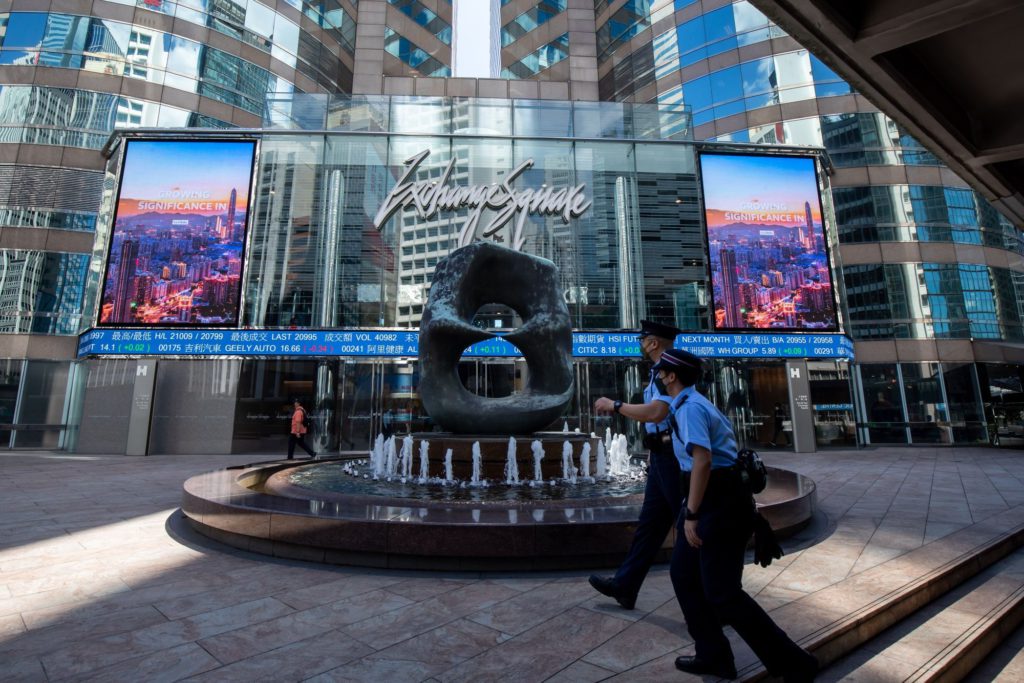
(Bloomberg) — Tencent Music Entertainment Group began trading in Hong Kong’s exchange on Wednesday without selling new shares or raising funds. 

The stock traded as high as HK$18.04 on Wednesday, having started at HK$18 in the Asian city. That compares to a closing price of $4.58 (HK$35.95) for the American depository receipts on Tuesday.

The Shenzhen-based company chose to debut in the Asian financial hub by way of introduction, a quicker and easier route for firms already listed elsewhere. The firm controlled by tech giant Tencent Holdings Ltd. is part of a growing group of Chinese firms choosing the method to list closer to home as escalating Sino-US tensions fuel delisting risks stateside. 

Volatile equity markets, high inflation and surging interest rates capped valuations worldwide for companies seeking to go public this year through traditional initial public offerings. As a consequence, there’s been a slump in proceeds raised in venues from New York to London and Hong Kong. 

Tencent Music Is Latest Cashless Debut Coming to Asia: ECM Watch

Electric-vehicles producer Nio Inc. debuted in Hong Kong in March using the same process, and later began trading in Singapore via the same method. US-listed platform for housing transactions and services KE Holdings Inc. and software as a service firm OneConnect Financial Technology Co. took the same path earlier this year. 

Tencent Music raised some $1.07 billion through a new share sale in New York about four years ago, with the shares now trading about two-thirds below their listing price. 

More stories like this are available on bloomberg.com

©2022 Bloomberg L.P.

SEC Lawsuit Hints at Case for US Jurisdiction Over Ethereum

(Bloomberg) — The saga over cryptocurrency regulation took another twist courtesy of a comment buried in a Securities and Exchange Commission lawsuit that hints at a case for US jurisdiction over the Ethereum blockchain.

The suit lodged Monday is against the founder of a crypto investment research firm over allegedly undisclosed incentives linked to an initial coin offering. It also detailed the movement of Ether tokens in relation to the case.

Those Ether transactions originated in America and “were validated by a network of nodes on the Ethereum blockchain which are clustered more densely in the US than in any other country,” the SEC said. “As a result, those transactions took place in the US.”

The comment appears in the 69th paragraph of the 23-page filing, a lowly position which perhaps cautions against reading too much into it. Still, it winks at the possibility of a case for US jurisdiction over the most commercially important blockchain based on where the bulk of its computing happens.

An SEC spokesperson said the regulator didn’t have a comment “beyond public filings.” 

“The bigger issue here is the problems over jurisdiction of blockchain activities more generally,” said Elizabeth Morton, research fellow at Australia’s RMIT Blockchain Innovation Hub. “Multiple jurisdictions with their own regulatory frameworks can make independent claims.”

Over $40 billion is sitting in decentralized-finance applications on Ethereum, which lets users trade, lend and borrow coins, DeFi Llama data shows.

The digital ledger is used by people in many countries. According to Etherscan, about 46% of all Ether nodes — computers helping to operate and secure the network — are in the US, followed by nearly 19% in Germany.

The SEC was already circling Ether, the blockchain’s native token, after the digital ledger’s upgrade last week to a much more energy-efficient system. 

SEC Chair Gary Gensler signaled a feature of this revised approach, whereby Ether holders can earn financial rewards by allowing the network to use some of their assets, could fall under securities rules. 

Decentralized blockchains sprawling across computer networks around the globe, and tokens that can make or lose billions of dollars in the blink of an eye, are giving regulators headaches. They are also stirring a contest among agencies for the right to manage oversight.

(Updates with SEC comment in the fifth paragraph.)

More stories like this are available on bloomberg.com

©2022 Bloomberg L.P.

Korea Early Exports Edge Higher Amid Weakening Global Demand

(Bloomberg) — South Korea’s early trade data showed exports are only just still growing in September in a sign of fallout from lockdowns in China and a struggling global economy.

Daily shipments advanced 1.8% on average in the first 20 days of the month compared with a year earlier, the customs office said Wednesday. Headline exports dropped 8.7%, led by a 14% decline in shipments to China. Semiconductor sales still increased by 3.4%.

Exports have slowed in recent months as international demand weakens in response to Russia’s war on Ukraine, Covid outbreaks in China and rapid policy tightening by central banks. The Bank of Korea has been relying on resilient overseas sales to underpin its policy tightening as it seeks to rein in inflation.

Trade deficits are another concern as energy prices remain elevated and the currency weakens to hover around levels last seen during the global financial crisis.

The trade deficit amounted to $4.1 billion so far this month. While that’s half the the record $9.5 billion for the full month of August, Finance Minister Choo Kyung-ho said risks to exports continue as chip demand cools and the economy slows in China, while volatility in energy prices remains elevated. 

Korean exports tend to reflect trends in international economic activity with the nation’s companies embedded widely across global supply chains, including semiconductor and automobile makers.

Technology products, which account for a third of Korean exports, were among the first to cool as global demand slackened. They fell 4.6% last month, with semiconductors, smartphones and computers all declining.

(Adds trade deficits, comments from finance minister, details throughout)

More stories like this are available on bloomberg.com

©2022 Bloomberg L.P.

China Losing Appeal as European Firms Rethink Future Investments

(Bloomberg) — China’s focus of political goals like Covid Zero over economic objectives is making the country less appealing to European companies as a place to invest, a business group said, calling on Beijing to refocus on reform. 

Recent Chinese policy decisions mean the country is now seen as “less predictable, less reliable and less efficient” according to the report published Wednesday by the European Union Chamber of Commerce in China. This has led to a loss of confidence in China and firms are increasingly looking to shift planned or future investments to other markets that are seen as providing “greater reliability and predictability,” the paper said. 

“Business people are here for the market and we can see that because of ideology the market is shrinking,” said Joerg Wuttke, president of the chamber. “Ideology trumps the economy,” he said, referring to examples such as the dogged pursuit of controlling all Covid infections despite the rising cost, the crackdown on the tech sector, or power shortages last year driven by prioritizing emissions control over economic activity. 

China’s application of Covid Zero is acting as a deterrent to European firms because of its inflexible and inconsistent implementation, the chamber said. It’s already having a “crippling effect” on attracting and retaining foreign and Chinese talent, and the Chinese operations of European companies are becoming increasingly isolated because staff can’t travel freely to headquarters, the report said. 

There is no sign of when the country might start to get rid of domestic virus controls and also start to reopen international borders. A scenario where that starts to happen in the second half of next year is “optimistic,” according to Wuttke, who cited the country’s lack of herd immunity and relatively low vaccination rates among the elderly as factors which will likely delay a quick reopening. 

“The trend of declining FDI is unlikely to reverse while European executives are heavily restricted from traveling to and from China to develop potential greenfield projects,” the brief said. 

The report from the European firms is another sign of how the image of China as a good place to do business has declined, with the US-China Business Council saying last month that American firms’ optimism had fallen to a record low. 

Some New Money

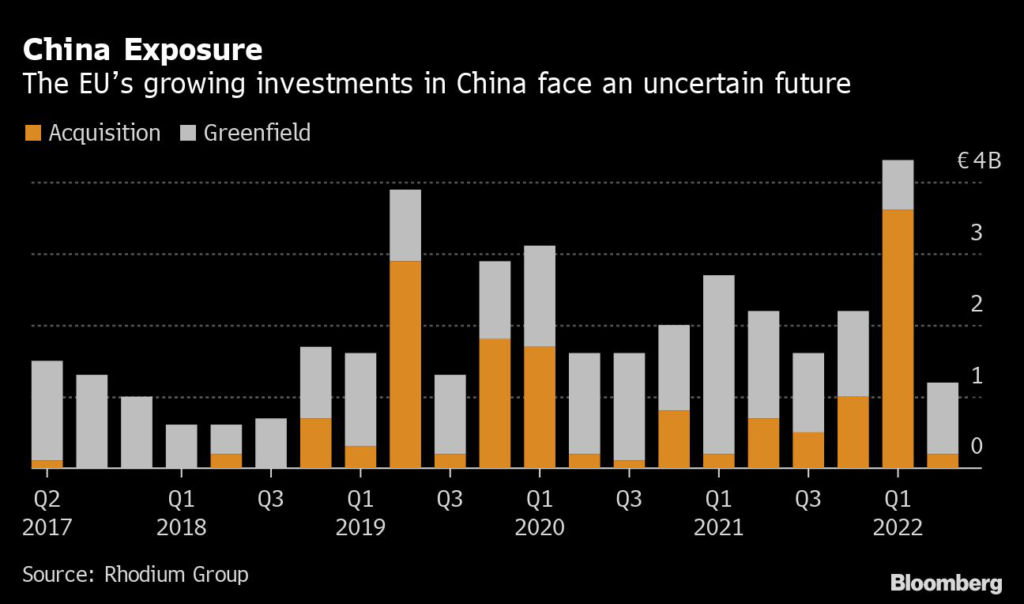
Despite the increasing difficulty, a few European companies are still adding to their investments in the country. Investment from the European Union into China was up 15% in the first half of 2022 compared to a year ago, according to data from Rhodium Group, helped by BMW AG’s purchase of a controlling stake in its car-making joint-venture in the first quarter.

And just this month German chemical maker BASF SE opened the first stage of its new plant in the country. The plant is planned to be one of the largest single foreign investments ever in China and the largest investment by BASF, which is planning to spend up to 10 billion euros ($10 billion) by 2030, according to a company statement. 

Those are indicative of the trend in investment from Europe, which is becoming concentrated around a handful of large, mostly German firms, according to a separate study by Rhodium Group. 

Changing Attitudes

Companies are also reconsidering where and how to make their goods. 

“With China staying largely closed, European companies see the need to make their global supply chains more resilient,” the report said. “This presents opportunities to other emerging markets that are ready to welcome new investment and jobs.”

There has also been changes in how the public and government in Europe view China, with tensions over Taiwan, sanctions related to Xinjiang, and Chinese economic policies all contributing to the recent decline in relations. “The change in European public sentiment towards China, and the increasing need to ensure fairness in its Single Market, has resulted in the European Union re-evaluating and updating its China policy,” the report said. 

New laws in the US or Europe around eliminating forced labor and ensuring free and fair market access also increase the regulatory burden on European firms in China, the report said. “To justify their investments, European companies therefore need China to demonstrate more transparency and predictability, as the challenge of aligning China operations with both global corporate pledges and legislation increases,” the report said. 

“There will not be full decoupling from China, but alternative supply chain strategies are increasingly being discussed in boardrooms,” according to the report, which contained almost 1, 000 recommendations to improve the business situation in China. 

“Over the last year, there has been a significant shift in focus at the headquarters of European companies when evaluating China. Where discussions once centered primarily on investment opportunities, they are now focused on building supply chain resilience, the challenges of doing business, managing the risk of reputational damage and the importance of global compliance.”

China still has significant growth potential, and has a manufacturing base and world-class industrial clusters, that were hard, if not impossible, to replicate elsewhere, the report said. “However, the extent of European firms’ engagement can no longer be taken for granted,” it added.

More stories like this are available on bloomberg.com

©2022 Bloomberg L.P.

Hong Kong Tycoon-Backed Firm Is Raising $500 Million to Invest in Crypto, PE

(Bloomberg) — C Capital, a firm started by Hong Kong real estate tycoon Adrian Cheng, plans to raise $500 million to invest in blockchain assets, credit and private-equity over the next 18 months, betting prices of private companies and digital assets are bottoming out.

Also co-founded by ex-Bank of America Merrill Lynch banker Ben Cheng, the firm is marketing a $200 million blockchain fund and plans to gather about $300 million to invest in private-equity and private credit strategies next year, people familiar with the matter said, asking not to be identified discussing fundraising details.   

“When people are on defense, we’re on the offense,” Ben Cheng, the firm’s chief executive officer and president, said in an interview. This type of environment historically “will yield the best result. After another 6 to 9 months, it will come back.”

The fresh funds will add to the about $1 billion C Capital has invested in private companies, digital assets and credits. Its hedge fund strategy mainly focuses on crypto trading, and it has turned down approaches from angel funds or firms at a seed stage because they have high valuations and limited upsides, according to Cheng.

Started as a venture capital investor, the five-year-old firm has in recent years expanded to later-stage companies, investing in more than 60 businesses including protective phone case company CASETiFY and blockchain gaming company Animoca Brands.

The blockchain fundraising comes amid a steep drop in crypto prices that began in late 2021. Even so, Cheng said that the value of its existing crypto investments swelled by 40% in the first half, after doubling last year.

Private equity and credit strategies take up about 40% of its capital, with the remaining 20% deployed in the hedge fund asset class, said Cheng. Its credit fund provides senior and mezzanine loans of up to 70% of asset values to families, funds and corporates backed by residential and commercial collateral. More than half of the assets are located in Hong Kong, he said.  

The prolonged turbulence in China’s property sector has had a limited impact on the firm since it only focuses on landmark properties in prime locations, according to Cheng. It’s also looking at more credit opportunities in Australian residential and commercial real estate, he said.

C Capital has 25 employees, 10 of whom are focused on private-equity and 10 on credit and hedge funds. The firm currently has four offices and is expanding globally, Cheng said. 

Adrian Cheng, the grandson of tycoon Cheng Yu-tung, is chief executive officer of New World Development Co. and heir to the Chow Tai Fook family fortune. The developer’s holdings include Hong Kong luxury mall K11, which combines high-end retailers, restaurants and art installations. 

More stories like this are available on bloomberg.com

©2022 Bloomberg L.P.

House Stablecoin Bill Would Put Two-Year Ban on Terra-Like Coins

(Bloomberg) — Legislation to regulate stablecoins that’s being drafted in the House would place a two-year ban on coins similar to TerraUSD, the algorithmic stablecoin that collapsed earlier this year.

Under the latest version of the bill, it would be illegal to issue or create new “endogenously collateralized stablecoins,” according to a copy obtained by Bloomberg. The definition would kick in for stablecoins marketed as being able to be converted, redeemed or repurchased for a fixed amount of monetary value, and that rely solely on the value of another digital asset from the same creator to maintain their fixed price.

TerraUSD, also known as UST, was designed to maintain a 1-to-1 peg to the US dollar through an algorithm and trading in a sister token called Luna. That experiment failed spectacularly when UST crashed in May, resulting in billions of dollar of losses and prompting policymakers to take renewed interest in stablecoins.

The draft legislation would mandate a study on Terra-like tokens from Treasury in consultation with the Federal Reserve, the Office of the Comptroller of the Currency, the Federal Deposit Insurance Corp., and the Securities and Exchange Commission. 

House Financial Services Committee Chairwoman Maxine Waters and Ranking Member Patrick McHenry have been working to reach an agreement on the stablecoin legislation, though people familiar with the discussions said it’s unclear if McHenry, a Republican, has approved the latest draft. Terms of the proposal could still change before a final version is released.

McHenry and Waters’s offices didn’t return a request for comment.

In addition to addressing what unfolded with Terra, the bill would allow banks and nonbanks to issue stablecoins. Bank issuers would seek approval from their typical federal regulators, such as the OCC. The legislation would direct the Fed to establish a process for making decisions on applications from nonbank issuers.

The bill would also preserve a role for state regulators. Nonbank stablecoin issuers approved at the state level and that register with the Fed within 180 days of that approval would be able to operate under the bill. 

The legislation would prohibit businesses from commingling customers funds — including stablecoins, private keys and cash — with company assets in an effort to protect consumers in cases of bankruptcy. And it would direct the Fed to study the impact of a potential US digital dollar — also known as a central bank digital currency — including the possible effects on the financial system and banking sector, as well as the privacy of Americans. 

It’s possible the panel could vote on the bill as early as next week, the people familiar with the discussions said. But Brad Sherman, one of the most senior Democrats on the committee, told Bloomberg Tuesday that a markup date hasn’t yet been decided. 

The panel’s window for considering the bill before the end of the year is shrinking, with the upcoming midterm elections throwing a wrench into the process.

(Updates to add details from the legislation beginning in seventh graph.)

More stories like this are available on bloomberg.com

©2022 Bloomberg L.P.

Biden’s Antitrust Chiefs Seek Funds for Ambitious Enforcement

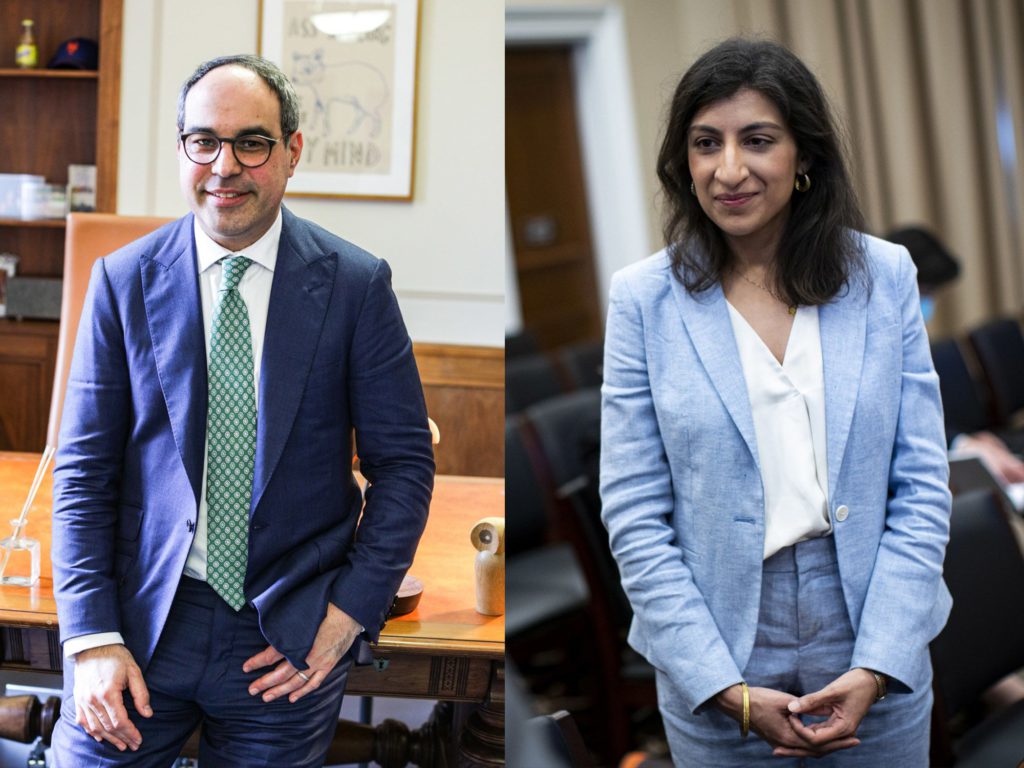
(Bloomberg) — The Biden administration’s top antitrust enforcers asked Congress for more money to continue their ambitious enforcement strategy, telling a Senate panel that they’re “outgunned” by the legal power wielded by giant corporations.

During a Senate Judiciary Antitrust Subcommittee oversight hearing on Tuesday, Jonathan Kanter, the assistant attorney general for antitrust, said the Justice Department would litigate more mergers this year than any fiscal year on record and remains “committed to bringing difficult cases.” 

Kanter’s testimony came the day after a federal judge rejected the department’s bid to block UnitedHealth Group Inc.’s $7.8 billion acquisition of Change Healthcare Inc., dealing a blow to the division’s aggressive agenda.

“While I am proud of the work we are doing, we lack the resources to fully address these challenges,” Kanter said, pointing out that the antitrust division has 350 fewer people today than it did in 1979. 

Federal Trade Commission Chair Lina Khan said in its monopolization case against Meta Platforms Inc., the commission is “outgunned one to 10.”

Read More: UnitedHealth Wins Court Approval for Change Healthcare Deal

Khan said vigorous antitrust enforcement is critical to economic growth, adding that that when industries become more consolidated, “prices rise, wages fall, and our markets become more fragile and less resilient.” 

She said that the agency has had “significant success with at least six mergers being abandoned due to an FTC lawsuit.” 

The abandoned deals include Lockheed Martin Corp.’s proposed acquisition of Aerojet Rocketdyne Holdings Inc. and Nvidia Corp.’s deal to buy Softbank Group Corp.’s ARM. Three hospital groups also quit plans to merge as did Great Outdoors Group, the closely-held owner of Bass Pro Shops and Cabela’s, which sought to buy Sportsman’s Warehouse Holdings Inc.


Khan and Kanter, together with White House adviser Tim Wu, were hailed as the Holy Trinity of a new antitrust movement that advocates for a stronger government hand in addressing market concentration. Their calls to return trust-busting to its more aggressive roots breaking up the steel barons and oil tycoons of the last century have found enthusiastic support from progressives, as well as more populist Republicans who also decry the abuses of corporate power. 

This attitude has found an especially rich target in technology giants — both in legislation that seeks to restrict anticompetitive practices in the internet economy and in federal antitrust enforcement. Kanter’s Justice Department division is suing Alphabet Inc.’s Google and investigating Apple Inc., while Khan’s FTC is suing Meta and investigating Amazon.com Inc.

Such cases, however, are challenging after decades of what progressives view as lax enforcement and conservative rulings that built up case law favoring the view that consolidation can benefit consumers with lower prices. Khan and Kanter have indicated that they are prepared to bring aggressive cases — even if they are hard to win — to force companies to reconsider mergers and acquisitions that they’ll have to defend in court. 

This year alone, the Justice Department has gone to trial seeking to block four deals, an unusually high number of cases for antitrust prosecutors to be pursuing at the same time. Decisions in three of the cases remain outstanding, and the antitrust division heads to court next week in a fifth suit against American Airlines Group Inc. and JetBlue Airways Corp. over a joint venture between the airlines.

The UnitedHealth merger challenge wasn’t the Justice Department’s only trial loss this year. In June, five chicken industry executives, including the former Pilgrim’s Pride Corp. chief executive officer, were found not guilty of price-fixing after an unprecedented two mistrials. Following the June trial loss, prosecutors dismissed charges against most other executives, Koch Foods Inc. and Claxton Poultry Farms Inc. 

The FTC and Justice Department are now rewriting federal guidelines on mergers with an eye toward persuading courts to block more deals.

Republican senators criticized Khan for what they described as the politicization of the FTC. Mike Lee of Utah, the top Republican on the subcommittee, needled her for being willing to “sacrifice actual enforcement for flashy headlines.”

“Getting good press isn’t enough,” Lee said. “What little we have seen from the FTC is legally questionable and ill considered.”

Republican FTC commissioners Noah Phillips and Christine Wilson submitted a statement disagreeing with parts of the testimony approved by the three Democratic commissioners. Phillips and Wilson said the majority misrepresented the agency’s work under Khan and complained about an “unfortunate departure from the agency’s tradition of working towards bipartisan consensus.”

Amy Klobuchar, the chair of the Senate’s antitrust subcommittee, praised Khan and Kanter. She also reinforced the need for new legislation, such as her American Innovation and Choice Online Act, to give the FTC and DOJ new rules and authority to prevent the largest US technology companies from abusing their market dominance. 

“We have many opportunities to create some common sense rules of the road to make sure entrepreneurs and small businesses can compete on a level playing field, and also to give those that appear before us today more tools to do their job in a modern economy” Klobuchar, a Minnesota Democrat, said at the hearing.

However, momentum is slowing for Klobuchar’s bill, which has advanced further than any US legislative effort to address the market power of some of the world’s richest companies. The Senate only has a handful of weeks and several competing priorities before leaving Washington for November’s elections.

More stories like this are available on bloomberg.com

©2022 Bloomberg L.P.

Close Bitnami banner
Bitnami