

Bloomberg

Meta Suffers Setback in EU Attack of German Antitrust Order

(Bloomberg) — Meta Platforms Inc.’s Facebook suffered a setback in its European Union court challenge of a German antitrust decision that ordered an overhaul of the social media giant’s business model.

Competition authorities probing a company over alleged abuses of a dominant position are justified to also consider other rules, such as the EU’s General Data Protection Regulation in the course of an investigation, an adviser to the bloc’s top court said on Tuesday in a non-binding opinion. Such a ruling would hit at the heart of Meta’s appeal.

When interpreting other rules such as data protection law, competition watchdogs are “bound by the duty to cooperate in good faith” with the relevant privacy regulators and “must, in full mutual respect, assist each other in carrying out tasks which flow from” EU law Athanasios Rantos, an advocate general at the EU Court of Justice, said.

Tuesday’s case is viewed as a test of how far antitrust regulators can go to make sure Silicon Valley firms don’t mishandle massive data sets gleaned from users to cement their market power. Meta told the EU Court of Justice in a May hearing that Germany’s Federal Cartel Office conflated data protection and antitrust law in violation of its actual powers. Its decision was flawed and the authority’s approach “misguided,” it said.

Facebook’s Model Attacked by German Antitrust Regulator

The case was referred to the EU court by judges in Germany who sought the EU court’s guidance on whether a violation of data regulations can be cited in an antitrust case. It’s one of several challenges the tech firm is facing in Europe, including from privacy watchdogs.

The EU court often follows opinions in its final ruling, which could come in the next four to six months. 

“We await the final judgment to determine any next steps,” Meta said in a statement. 

The court adviser’s view that data protection law can play an important role in antitrust investigations “is good news,” the German authority’s president Andreas Mundt said in a statement. He said the opinion had confirmed his office’s position “on key points.”

Meta in its challenge accused the German antitrust authority of violating a key EU principle of “sincere cooperation,” by failing to include the Data Protection Authority in Ireland, where Meta has its EU base, in its investigations, before adopting a final decision.

Rantos on Tuesday said that “EU law does not provide detailed rules on cooperation between a competition authority and supervisory authorities within the meaning of the GDPR in such a situation,” and that antitrust watchdogs are subject “at the very least, to a duty to inform and cooperate with the competent authorities.”

The EU’s GDPR, which took effect in 2018, gave data watchdogs unprecedented fining powers and also made those authorities, where a firm has its EU base, the main supervisor over them. 

The case is: C-252/21, Facebook Inc. and Others v. Bundeskartellamt.

(Updates with German cartel office’s response in the eighth paragraph)

More stories like this are available on bloomberg.com

©2022 Bloomberg L.P.

Stocks Getting Hit With Yields at Multiyear Highs: Markets Wrap

(Bloomberg) — Stocks were under pressure as Treasury yields hit multiyear highs, with traders bracing for a hawkish Federal Reserve that’s expected to boost rates to levels not seen since before the 2008 financial crisis.

About 93% of the S&P 500 companies fell, with the gauge pushing toward its lowest since July. Ford Motor Co. tumbled as the automaker joined the chorus of major corporations warning about challenges rippling through the economy. Two-year US yields approached 4%, remaining on course for their biggest annual increase since 1994. The dollar rose to another record.

Fed officials are about to put numbers on the “pain” they’ve been warning of when they publish new projections for the economy, which could show a substantial rise in rates and unemployment ahead as the estimated price tag for reducing inflation. Officials are widely expected to boost rates by 75 basis points Wednesday — and a few market observers say a full-point hike might also be on the table.

To Charlie McElligott, cross-asset strategist at Nomura Securities International, the market is underpricing the possibility that the Fed could opt for a bigger move of 100 basis points. In addition to last week’s inflation surprise, he cited the fact that both the labor market and wages remained “hot” since Fed Chair Jerome Powell’s Jackson Hole speech at the end of August.

Only two of the 96 analysts surveyed by Bloomberg are currently predicting a full-point move this month. 

“The idea that the Fed will raise rates and immediately cut again in mid-2023 should now be put back into storage alongside the beach chairs,” said Gargi Chaudhuri,  head of iShares investment strategy for the Americas at BlackRock Inc. “Recent data have confirmed the necessity of the Fed’s tough stance. We believe we are entering a new regime of structurally higher volatility and slowing growth.”

Nouriel Roubini, who correctly predicted the financial crisis, sees a “long and ugly” recession occurring at the end of 2022 that could last all of 2023 and a sharp correction in the S&P 500. “Even in a plain vanilla recession, the S&P 500 can fall by 30%,” said the chairman of Roubini Macro Associates. In “a real hard landing,” which he expects, it could fall 40%.

Professional speculators are refusing to surrender to a punishing equity market prone to seemingly endless volatility — boosting bullish and bearish positions at the fastest rate in five years. As the S&P 500 plunged last week, hedge funds snapped up single stocks while betting against the broad market with products like exchange-traded funds, data from Goldman Sachs Group Inc.’s prime brokerage show.

The appetite for protection against an index-wide drop in the S&P 500 in the next three months has been falling together with the stock market, pushing the put-to-call ratio to a fresh one-year low, data compiled by Credit Suisse Group AG’s derivatives strategists show. The opposite has been happening on a single-stock level: A similar ratio jumped to a one-year high as company-specific announcements have been triggering outsized stock reactions.

The risk-off sentiment on Tuesday also dragged down cryptocurrencies, with Bitcoin sinking below $19,000.

Meantime, Nasdaq Inc. is making its first major push into crypto, as the second-largest stock exchange prepares to capitalize on increasing appetite for digital currencies among big-money investors.

Read: Dimon Blasts Higher Capital Requirements as CEOs Head to Capitol

Will the Nasdaq 100 Stock Index hit 10,000 or 14,000 first? This week’s MLIV Pulse survey focuses on technology. It’s brief and we don’t collect your name or any contact information. Please click here to share your views.

Key events this week:

  • US existing home sales, Wednesday
  • EIA crude oil inventory report, Wednesday
  • Federal Reserve decision, followed by a news conference with Chair Jerome Powell, Wednesday
  • Bank of Japan monetary policy decision, Thursday
  • The Bank of England interest rate decision, Thursday
  • US Conference Board leading index, initial jobless claims, Thursday

Some of the main moves in markets:

Stocks

  • The S&P 500 fell 1% as of 11:05 a.m. New York time
  • The Nasdaq 100 fell 0.6%
  • The Dow Jones Industrial Average fell 1.1%
  • The Stoxx Europe 600 fell 1.1%
  • The MSCI World index fell 0.8%

Currencies

  • The Bloomberg Dollar Spot Index rose 0.3%
  • The euro fell 0.3% to $0.9990
  • The British pound fell 0.2% to $1.1409
  • The Japanese yen fell 0.4% to 143.72 per dollar

Bonds

  • The yield on 10-year Treasuries advanced 10 basis points to 3.59%
  • Germany’s 10-year yield advanced 14 basis points to 1.94%
  • Britain’s 10-year yield advanced 16 basis points to 3.29%

Commodities

  • West Texas Intermediate crude fell 1.8% to $84.15 a barrel
  • Gold futures fell 0.3% to $1,673.80 an ounce

More stories like this are available on bloomberg.com

©2022 Bloomberg L.P.

Can the NFL Push Virtual Reality Into the Mainstream?

(Bloomberg) — One of the hurdles to virtual reality going mainstream has been a lack of hit content to lure the masses. The National Football League and two former football players are trying to change that.

A few years ago, Troy Jones, who played quarterback in college, and Andrew Hawkins, a former NFL wide receiver, pitched the league and the NFL Players Association on a virtual reality video game. The duo, co-founders of StatusPro, won the licenses earlier this year and last week NFL Pro Era debuted for download on Meta Platforms Inc.’s Meta Quest 2 and Sony’s PlayStation VR.

“We know what it’s like to be on the field,” Hawkins, the company’s president, said in an interview for the latest episode of Business of Sports, a series from Bloomberg Quicktake. Their goal is to “make sure every fan of the game also gets to experience that, and this technology is what made that possible.”

Adoption of virtual reality by consumers is picking up steam with retail prices for headsets declining, according to Bloomberg Intelligence. Hardware sales may triple to more than $7 billion by 2024, the researcher said. A game featuring NFL players, teams and stadiums could expand the audience.

One of the most successful franchises in the history of gaming is Electronic Arts Inc.’s Madden NFL, which has the exclusive video game licenses for the NFL and NFLPA. And just like Madden, NFL Pro Era has a star player — in Baltimore Ravens quarterback Lamar Jackson — to be the face of the game.

“Content goes hand in hand with any hardware and sports is probably what brings the most diverse group of people together,” said Jones, chief executive officer of StatusPro. “I think a lot of people will try VR for the first time” after the launch of the game, he said.

Jones and Hawkins initially created a VR experience as a training tool. They won over coaching staffs by pitching the product as a way for players to get virtual reps in the offseason when rules don’t allow in-person practices. Defensive coaches first utilized the technology as a way to get players more experience identifying offensive formations and lining up before the snap of the ball.

“We sat in the lab, and we were like: ‘position-by-position, coach-by-coach — how do we make their job easier?” said Hawkins, who played for the NFL’s Cincinnati Bengals and Cleveland Browns.

After seeing the positive response from players, the company saw an opportunity to bring the experience to fans. The gameplay puts the player in the shoes of an NFL quarterback who breaks the huddle, takes a snap and looks for receivers downfield, while trying to avoid getting sacked by the defense.

“You’ll gain an appreciation of when you see a quarterback have to break out of the pocket, extend a play and find a receiver downfield with 280-pound guys running and chasing them down,” Jones said.

While time will tell if this game speeds up adoption of VR headsets, StatusPro is already contemplating expansion.

“We want to create these experiences across sports, not just football,” Hawkins said. To make games “that make people say: ‘I wanna try VR. I wanna put myself in this scenario.’”


More stories like this are available on bloomberg.com

©2022 Bloomberg L.P.

Ford Drops After Inflation Warning Adds to Gloomy Economic Commentary

(Bloomberg) — Ford Motor Co. tumbled the most in seven months after saying inflation is pushing supplier costs $1 billion higher than expected in the current quarter, joining the chorus of major corporations warning about challenges rippling through the economy.

The automaker expects adjusted earnings before interest and taxes in the range of $1.4 billion to $1.7 billion when it reports results next month. The preliminary estimate is well below the $3.7 billion in adjusted EBIT Ford reported last quarter and the $3 billion it earned a year ago. Shortages of key parts will also keep its inventory of half-completed vehicles elevated, according to a statement Monday.

“Higher inflation-related supplier costs seem to have a higher chance of recurring in comparison to chip shortages, suggesting some impact to 2023,” Ryan Brinkman, an analyst with JPMorgan Chase & Co., said in a note.

Ford’s shares fell 8.5% at 10:20 a.m. Tuesday in New York after an earlier drop of 11%, the biggest intraday since February. The stock declined 28% this year through Monday’s close.

The manufacturer is the latest household name to cite economic pressures weighing on operations. From FedEx Corp. to General Electric Co. to McDonald’s Corp., companies are pointing to flagging demand, stubborn supply-chain snags and the growing possibility of a recession.

Ford’s warning comes as the Federal Reserve is expected this week to raise interest rates again in the fight against inflation, which has moderated little in recent months.

Read more: Fed to Reveal ‘Pain’ Coming in Next Stage of Inflation Fight

Ford now anticipates that the number of partially built vehicles — which it described as “largely high-margin trucks and SUVs” — will stand at around 40,000 to 45,000 as of the end of the third quarter, which ends Sept. 30. It expressed confidence that it could complete and sell those vehicles by the end of the year.

The carmaker said it still expects to earn $11.5 billion to $12.5 billion for the full year, unchanged from its previous forecast. Ford will “provide more dimension” about its financial expectations for 2022 along with its quarterly earnings report on Oct. 26.

Still, the inventory issue shows automakers continue to struggle with ongoing parts shortages. Ford’s latest comments echo those of rival General Motors Co., which said in July that was trying to cut down its inventory of partially completed vehicles, which had swelled amid short supplies of semiconductors. 

More stories like this are available on bloomberg.com

©2022 Bloomberg L.P.

HSBC, Goldman, Santander Ink $810 Million in Financing for Kavak

(Bloomberg) — Kavak, Latin America’s biggest startup, signed structured financing agreements with HSBC Holdings Plc, Goldman Sachs Group Inc and Banco Santander SA worth $810 million as it looks to expand operations amid a downturn in the tech industry.

Specifically, HSBC will provide $675 million of financing to purchase Kavak’s current and future loan portfolio in Mexico while Goldman Sachs and Santander will provide loans backed by assets including warehouses and cars worth a combined $135 million, chief financial officer Moises Flores said in an interview at the company’s Mexico City offices.

Kavak, which has built a digital platform to allow customers to buy and sell used cars while financing the operations, was last valued at about $8.7 billion in a funding round that concluded in September 2021. Kavak is negotiating more debt financing deals with banks and could raise a total $1.2 billion this year, including the amount announced on Tuesday, Flores said. 

Flores declined to disclose the terms of the loans but said the financing was cheaper than what’s available in the market and did not carry prohibitive covenants in a sign of the banks’ faith in their business. The discussions with banks began about 18 months ago, long before liquidity tightened for startups, Flores said. 

“This is the Ferrari of debt,” Flores said. “This is the kind of thing that you achieve when you’re public and you’ve been in the market for many years, and we’re doing this many years ahead of that.”

The Mexico City-based firm is funded for at least 36 months and it may turn its first profitable month in Mexico in December or January, he said, if current targets are hit. “It is going to be in the next six months for Mexico for sure, and then in the other countries we will need a bit more scale,” he said.

Technology startups around the world have found themselves under increasing pressure to turn a profit as investors recoil from risky ventures. Companies are now turning to bank financing as rising interest rates around the world depress valuations and increase the cost of funding.

The company currently has around 30,000 loans and a loan book of $200 million, Flores said. Kavak is seeking to set up loans similar to the HSBC facility in other markets, he said. 

Kavak expanded operations to Colombia, Chile and Peru as well as Turkey since late last year, building on its operations in Mexico, Brazil and Argentina. 

“We are in a very strong financial position,” he said. “We can ensure infinite runway, if we wanted to, we’ll just have to pace the growth.”

(Updates with CFO comment on profitability in other countries in paragraph six.)

More stories like this are available on bloomberg.com

©2022 Bloomberg L.P.

Genstar Capital Mulls $6 Billion Exit of Prometheus

(Bloomberg) — Private equity firm Genstar Capital is considering strategic options for software maker Prometheus Group that could include a sale, according to people familiar with the matter.

Genstar has held talks with potential advisers over exploring a sales process that could value Raleigh, North Carolina-based Prometheus at about $6 billion, said the people, who asked not to be identified because they weren’t authorized to speak publicly.

Prometheus, which makes plant maintenance operations and optimization software, is likely to attract interest from potential corporate buyers, the people said. A final decision hasn’t been made and Genstar could still decide to keep the business, they said.

A spokesperson for San Francisco-based Genstar declined to comment. A representative for Prometheus didn’t immediately respond to requests for comment. 

Genstar bought a majority stake in Prometheus for more than $1 billion in 2019 from Francisco Partners, which retained a minority interest, according to the company’s website. The firm has since backed management, led by founder and Chief Executive Officer Eric Huang, with acquisitions, including S&V, Viziya, WorkTech, Engica and Roser ConSys.

Prometheus, which was founded in 1998, provides industrial software solutions across sectors including oil and gas, paper, mining and metals and utilities, according to its website. 

More stories like this are available on bloomberg.com

©2022 Bloomberg L.P.

Peloton Row’s $3,195 Price Tag Makes It the Most Expensive on the Market

(Bloomberg) — Peloton Interactive Inc. is launching its long-awaited rowing machine, a $3,195 product aimed at expanding the fitness company’s appeal and helping reverse a sales slide.

The company will start taking orders for the Peloton Row on Tuesday and begin initial deliveries to US customers in December. Peloton has been working on the new machine for several years, with Bloomberg News first reporting on the project in 2019. The shares were little changed at $9.90 in New York on Tuesday morning.

The device marks Peloton’s first major new piece of exercise equipment since 2020, when it debuted a cheaper version of its treadmill. Like the company’s other products, the Row has a dark exterior design with a touch screen for viewing workout content and classes. The Row’s 23-inch (58-centimeter) display is designed to swivel, and customers can store the machine vertically on a wall when they’re not using it.

Peloton could use another hit product. Its exercise bikes were a hot item during the early days of the pandemic, but demand fell off steeply once people returned to offices and gyms. The hope is to lure new users with the rowing machine and get them hooked on Peloton’s subscription services.

The Row will use Peloton’s delivery and installation service, which is included in the overall price. The company has begun to wind down its in-house logistics teams, relying instead on third-party providers. Peloton also is switching to bikes that users can assemble themselves and has started selling products via Amazon.com Inc. But those options aren’t available for the new device.

The Peloton Row’s screen has three main modes: Form Assist, Form Rating and Insights, and Personal Pace Targets. The first feature shows users how to adjust their form while rowing, while the second one rates their form. The last mode allows users to set custom pace targets for working out during classes.

Peloton shook up its management in February, bringing in Chief Executive Officer Barry McCarthy to turn around the fitness company. But the comeback has been slow to take hold, and the shares remain down more than 90% in the past year.

McCarthy is trying to streamline the company by pulling several levers, including layoffs, parting ways with longtime executives, a shift away from in-house manufacturing, entering new sales channels and shuttering the majority of its retail stores.

At $3,195, the Peloton Row becomes one of the priciest rowing machines on the market. NordicTrack’s highest-end rower is $1,799, while competitors like Aviron and Ergatta have machines that top out under $2,500. Peloton argues that its device is superior because of its design, software and content integration, as well as the equipment’s near-silent row movements. 

The Row requires Peloton’s $44-per-month subscription to access any rower content, a slight shift from its bikes, which include three basic classes without the service. Users who already have subscriptions can expand them to include the Row without paying extra.

The Row becomes Peloton’s second-most-expensive device, behind its $3,495 Tread. McCarthy said in August that the company needs to generate more cash, and pricier products like the Row could help bolster revenue. The New York-based company also has been steering customers toward a new leasing program, which combines the hardware and content costs into a single monthly price, but that offering isn’t available for the Row. 

The company said last month that revenue will come in between $625 million and $650 million in its first fiscal quarter, missing Wall Street estimates by over $100 million. The Row will launch in the second quarter, and the company hasn’t said how it may affect sales. Peloton also didn’t say when it would be available outside the US.

McCarthy is aiming to make the company cash flow positive in the second half of the coming fiscal year. “We continue to make steady progress, but we still have work to do,” he said in August.

(Updates with market trading.)

More stories like this are available on bloomberg.com

©2022 Bloomberg L.P.
Compass Eliminates More Jobs as Real Estate Brokerage Seeks to Cut Costs

(Bloomberg) — Compass Inc. cut more jobs, part of cost-reduction moves by the real estate brokerage as it aims to turn a profit even in a weakening US housing market.

Chief Executive Officer Robert Reffkin said in a memo obtained by Bloomberg that the biggest reduction was in the technology team. Compass said Tuesday in a regulatory filing that it estimates it will take a pre-tax cash charge of about $23 million to $26 million for severance and other benefits for employees being terminated during the third quarter. A company spokesman declined to disclose how many employees were being laid off. 

“Today we reduced the size of some of our non agent-facing teams, focused on areas that do not impact your day-to-day experience,” Reffkin said in the memo to Compass agents.

Compass still has more than 700 employees in its technology team, which Reffkin said was likely more tech workers than every traditional real estate brokerage combined. That’s about half of the “over 1,500 highly experienced product and engineering professionals” worldwide that the company reported in a February filing.

Compass has become a go-to brokerage in New York, Los Angeles and Miami, luring agents with its tech offerings and generous pay packages supported by venture capital funding, including roughly $1 billion from SoftBank Group Corp. But it’s never produced an annual profit, even in 2021 as it sold $251 billion worth of homes, more than any other US brokerage, according to RealTrends.

Now the company is facing a swift downturn in the housing market, urgently seeking ways to cut costs and stay afloat in the traditionally low-margin world of residential brokerages. 

The layoffs were the brokerage’s second major wave of job cuts this year, after reducing its workforce by 10% in June as US home sales began to slow. Compass said last month that it would seek to implement cost cuts that would save the company about $320 million in expenses next year.

The company had previously pitched its technology offerings to investors and agents as what differentiated it from other brokerages. New York-based Compass spent $900 million over a decade building a sales platform and other tools that executives say are complete and no longer require the same amount of staffing that was needed while the technology was being developed.

Compass rode the pandemic housing boom to an initial public offering in April 2021, when the shares were priced at $18. The stock has slid since then, with shares down 4.1% to a record low of $2.58 at 9:36 a.m. in New York Tuesday. 

Chief Technology Officer Joseph Sirosh was ousted in August and the company said it didn’t intend to replace him. Chief Financial Officer Kristen Ankerbrandt announced earlier in the year that she planned to depart in September.

(Updates shares in ninth paragraph.)

More stories like this are available on bloomberg.com

©2022 Bloomberg L.P.

Netflix Rekindles Analyst Interest After 60% Wipeout

(Bloomberg) — Analysts increasingly are betting that Netflix Inc.’s move into advertising can help turn around the performance of one of the weakest stocks of 2022. 

At least three firms on Wall Street have upgraded the streaming-video company’s shares this month, citing its planned introduction this year of an ad-supported subscriber tier.


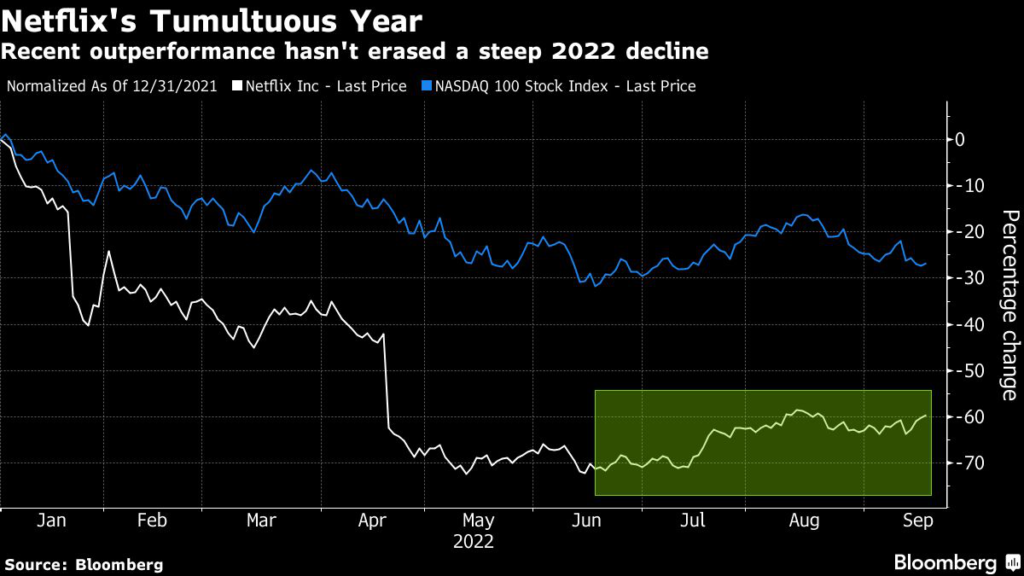
Netflix shares have plunged 60% in 2022, making it the fourth-worst performer in the Nasdaq 100 Index. The bulk of the losses followed a pair of catastrophic earnings reports, including the first quarter since 2011 in which its user base shrank. The stock fell 0.4% on Tuesday.

The results raised questions about its ability to hold onto pandemic-era gains, an issue the cheaper ad tier could help address. The Wall Street Journal reported that Netflix projects the ad-supported offering will reach about 40 million viewers by the third quarter of 2023.

“Netflix has already taken its medicine, and it has these catalysts ahead that are identifiable and that it can execute on,” said David Klink, senior equity analyst at Huntington Private Bank.

Netflix has long resisted introducing ads to its service, preferring instead to count on must-watch content like “Squid Game” and “Stranger Things” to attract paying subscribers. But with consumers’ finances getting pinched by rising inflation, the company reported a massive customer loss this year. An ad-supported offering with a lower monthly cost could provide a new revenue stream and attract a wider user base.

Even if ads aren’t a panacea for the company’s woes, the stock is more attractive as it offers both value and growth characteristics, said Klink.

“It’s weird to think of Netflix as a value stock, but given the uncertain backdrop, a lot of portfolios would benefit from having a stock like this, that is both offense and defense,” he said.

Oppenheimer was the latest firm to take a more positive view, writing Monday that the ad tier should accelerate subscriber growth. Evercore and Macquarie also adopted more bullish stances, with Evercore calling the ad offering “a clear catalyst on the horizon,” one that “can drive a material re-acceleration in revenue growth.”

The consensus still leans cautious. Fewer than a third of analysts recommend buying Netflix, while more than half have the equivalent of a hold rating. At the start of the year, more than 70% of analysts tracked by Bloomberg had a bullish rating on the stock. 

Still, the growing optimism has supported the stock, burning short sellers. Since June 16, a recent closing low for the Nasdaq 100, Netflix is up 39%, compared with a 6.5% gain in the index. Evercore’s upgrade last week contributed to a 2.8% weekly gain for streamer, while the Nasdaq 100 had its worst week since January.

Netflix’s valuation undergirds the bull case: Netflix trades 22 times estimated earnings, versus a 10-year average above 80 and the Nasdaq 100’s 20.6.

Denny Fish, who manages the $4.4 billion Janus Henderson Global Technology and Innovation Fund, said Netflix’s valuation and prospects make it more attractive than other fallen market favorites like Facebook parent Meta Platforms Inc.

“Growth has slowed, there’s more competition, but it might be one to be more comfortable with over the long term,” he said.

Tech Chart of the Day

The selloff in tech stocks last week has shrunk the valuation of the Nasdaq 100 Index, bringing its projected price-to-earnings ratio in line with the benchmark’s 10-year average. Investors could dip back into the sector but they might stay cautious until the Federal Reserve’s rate decision on Wednesday.

Top Tech Stories

  • Apple Inc. unveiled major increases to its price tiers on apps and in-app purchases from Europe to Asia, protecting its margins as major currencies tumble against the US dollar.
    • Apple is working on a software update for the iPhone 14 Pro and Pro Max aimed at fixing a bug that makes the rear camera on the device physically shake when used with some third-party apps.
  • Jack Dorsey, the co-founder of Twitter Inc., will be questioned under oath Tuesday in the social media company’s lawsuit against his longtime friend Elon Musk, according to court filings.
  • Kavak, Latin America’s biggest startup, signed structured financing agreements with HSBC Holdings Plc, Goldman Sachs Group Inc. and Banco Santander SA worth $810 million as it looks to expand operations amid a downturn in the tech industry. The company operates a digital platform to allow customers to buy and sell used cars while financing the operations.
  • Demand for cryptocurrencies as a payment method has drastically declined over the past six months, according to Takis Georgakopoulos, global head of payments at JPMorgan Chase & Co.
  • Smart-car technology company ECARX Holdings Inc. is exploring going public in Hong Kong once it has completed the planned US listing via a merger with a blank-check company, according to people with knowledge of the matter.

(Updates to market open.)

More stories like this are available on bloomberg.com

©2022 Bloomberg L.P.

MicroStrategy’s Saylor Makes Smallest Bitcoin Buy in More Than 2 Years

(Bloomberg) — MicroStrategy Inc., the largest corporate buyer of Bitcoin, made the smallest purchase of the cryptocurrency in more than two years after the company’s co-founder dropped his CEO title last month to focus on the company’s digital-asset strategy. 

The enterprise-software maker bought 301 Bitcoin for about $6 million, at an average price of about $19,851, the company said in a US Securities and Exchange Commission filing Tuesday. The purchases were made with excess cash. The aggregate purchase is already underwater, with Bitcoin trading at less than $19,000. 

As of Sept. 19, MicroStrategy and its subsidiaries held an about 130,000 Bitcoin, which were acquired at an aggregate purchase price of approximately $3.98 billion and an average purchase price of about $30,639 per token. MicroStrategy’s aggregate holdings have dropped in value by about $1.5 billion, or around 38% since it first started buying the virtual currency in 2020.

Earlier this month, the company filed with the SEC to sell as much as $500 million in stock with proceeds potentially being used to buy more of the cryptocurrency. 

On Aug. 2, co-founder Michael Saylor gave up his chief executive officer role to focus on the company’s Bitcoin strategy. That was the same day the Tysons Corner, Virginia-based company reported a loss of more than $1 billion related to the second-quarter plunge in the price of the cryptocurrency. Saylor, who co-founded the company in 1989, continues to serve as executive chairman.  

Shares of MicroStrategy fell about 3.5% to $199 as of 9:38 a.m. in New York. They’ve tumbled about 64% this year, about equal to the slide in the price of Bitcoin during the same period.      

More stories like this are available on bloomberg.com

©2022 Bloomberg L.P.

Close Bitnami banner
Bitnami