Bloomberg

Philippine Allows Call Centers to Fully Implement Remote Working While Keeping Tax Perks

(Bloomberg) — The Philippines has allowed outsourcing companies to fully implement remote work while keeping tax perks, resolving a months-long issue in favor of the economically important industry.

Information technology and business process outsourcing firms, which include call centers, may enjoy incentives under a work-from-home setup by shifting their registration from the Philippine Economic Zone Authority to the Board of Investments or BOI, according to separate statements from the Finance and Trade Departments.

“From the beginning, our priority has been to secure a solution for the sector’s WFH setup, which has become the new normal post-pandemic,” Trade Secretary Alfredo Pascual said in a statement sent to media Monday. The previous administration’s economic officials wanted outsourcing companies to return to the office to help boost economic activity, or risk losing their tax perks.

Outsourcing industry players however earlier warned that the return-to-office push could threaten their growth, as more employees opt to work from home due to the pandemic. 

Outsourcing revenues reached $29.5 billion in 2021, near the $31 billion cash remitted by overseas Filipinos for that year. The industry that’s been a key economic pillar can create 1.1 million new direct jobs by 2028, according to the IT & Business Process Association of the Philippines.

Finance Secretary Benjamin Diokno said in a separate statement that the revised rule “establishes a more permanent solution to the issue.” Outsourcing firms may continue their economic zone registration and remote work for up to 30% of workers until the end of the year during the transition. The BOI is the only investment promotion agency that’s not covered by a legal requirement for projects to be in an ecozone or freeport to qualify for tax perks.

More stories like this are available on bloomberg.com

©2022 Bloomberg L.P.

Bitcoin, Ether Extend Crypto Selloff as Big Fed Rate Hike Looms

(Bloomberg) — Cryptocurrencies extended a slide on Monday, hampered by a further drop in the second-largest token Ether as well as the prospect of a global wave of monetary tightening this week spanning the US to Europe.

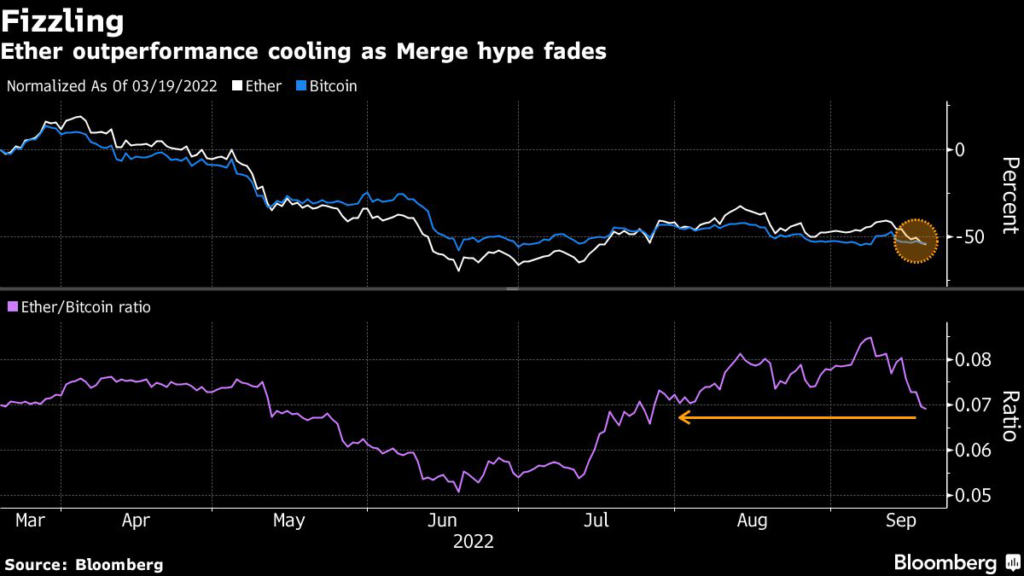
Ether fell as much as 5.6% to a two-month low and was trading around $1,302 as of 10:35 a.m. in Singapore, while Bitcoin shed about 5% to recede below $19,000. Tokens like XRP, Avalanche and Polkadot posted heavier losses.

An Ether jump since mid-June that was spurred by hype around an upgrade of the Ethereum blockchain is rapidly unwinding now the revamp is done. Meanwhile, investors are bracing for volatility from the jumbo interest-rate hike expected this week from the Federal Reserve to fight price pressures.

The Ethereum update — the Merge — to slash energy usage is a “ginormous shift” but “in this inflationary environment macro trumps everything,” Antoni Trenchev, managing partner at crypto lender Nexo, wrote in a note.

That’s evident in the pressure on a range of assets: global stocks are closer to wiping out a climb since mid-June that for many was a bear-market rally. US equity futures were in the red Monday, while a dollar gauge pushed higher.

Elsewhere, reports that Ripple Labs Inc. and the US Securities & Exchange Commission are seeking an immediate ruling in a court case over Ripple’s affiliated token XRP saw the latter shed as much as 12%. The SEC argues Ripple was “reckless” in its claims that XRP isn’t a regulated security.

More stories like this are available on bloomberg.com

©2022 Bloomberg L.P.

Professor Behind $12 Billion Empire Fuels China’s Tech Rise

(Bloomberg) — Li Zexiang grew up in rural China during the Cultural Revolution, when capitalists were the enemy. Now the 61-year-old academic has quietly emerged as one of the country’s most successful angel investors, backing more than 60 startups including drone giant DJI.

Li was among the first Chinese to study in the US before returning to teach in Hong Kong’s pre-eminent technology university. From there, he’s groomed a generation of entrepreneurs and set up an incubation academy, funding or nurturing promising players in robotics and artificial intelligence valued at almost $12 billion.

Intentionally or not, the robotics expert is playing an increasingly pivotal role in a battle between the US and China to dominate defining technologies. As Washington prepares to broaden sweeping curbs against its rival’s chip and AI sectors, Li’s talent for ferreting out scientific achievements is likely to prove more crucial than ever.

“In crisis is opportunity born,” he told Bloomberg News on the sidelines of a conference in Hong Kong. “Historically, Chinese companies and their technology have been second choice for even local companies. But now they have the chance to transcend that.”

It’s a characteristically optimistic perspective from Li, member of a select club of venerated intellectuals-turned-financiers that includes Turing Award-winner Andrew Chi-Chih Yao. Like his peers, the robotics savant Li has been at the forefront of some of the most important Chinese innovations of the past decade — tracking the country’s evolution from world’s factory to hothouse for technology giants.

Li wouldn’t comment at length on Washington’s efforts to contain China’s ascendancy — a sensitive topic as relations between the two countries edge toward their most tense in decades. 

“No matter how intense the conflict gets between the US and China, no matter how the decoupling proceeds, the fact is it’s akin to losing 800 soldiers for every 1,000 killed,” he said.

But it’s clear the pendulum has swung in his favor, as Beijing galvanizes efforts to replace US hardware and circuitry, and cracks down on a decade of free-wheeling expansion by internet giants. Li, who operates privately and without ties to the government, nonetheless has good official contacts. He was among about 40 honorees chosen by the Shenzhen government in 2020 for their role in helping transform the once sleepy fishing village into a southern economic powerhouse.

While social media and retail internet pioneers from ByteDance Ltd. to Alibaba Group Holding Ltd. and Tencent Holdings Ltd. once hogged the limelight, an increasing amount of capital is now flowing into hard-core tech pursuits like semiconductors, robotics and AI. Xi Jinping this month renewed calls for China to step up the development of such technologies for the sake of national security.

Read more: How a 75-Year-Old Harvard Grad Propels China’s AI Ambitions

That’s where Li comes in.

He studied in the US in the 1970s and 1980s, joining the early waves of Chinese students along with fellow academic Yao. It was a life-changing experience for a native of the same landlocked agrarian province of Hunan that birthed Mao Zedong. 

While awaiting college admission, Li worked in a school-run factory making electric insect traps. He was one of the lucky ones — winning a seat at a local school before discovering the joys of scientific rigor abroad. 

After getting a PhD in electrical engineering and computer science from the University of California at Berkeley, he became a research scientist at the Massachusetts Institute of Technology, then joined the robotics lab at New York University.

“Going to college in the US was a big turning point for me,” Li said, adding he benefited from the liberal thinking prevalent at Berkeley. 

In 1992, he finally headed homeward to join the Hong Kong University of Science and Technology.

It was in the Asian financial center that he developed a passion for cultivating startups. In nearly three decades spent there, he’s backed scores of startups via his incubation platform, Xbotpark. Their total market value now exceeds 80 billion yuan ($11.5 billion), according to Li. 

Some are leaders in their respective spheres, others attracted global financiers including Sequoia China and Hillhouse Capital. None are better known than SZ DJI Technology Co. 

Li is credited with salvaging the startup when it hit its nadir, and still holds the post of chairman. Many employees, disillusioned with its prospects, had quit. Several even began copying and selling its products. Founder Wang Tao needed $100,000 to keep his year-old startup afloat — so he turned to his college mentor Li.

The professor made his protege wait outside his classroom for two hours, but finally agreed to the capital infusion. Crucially, the MIT-trained academic brought many of his other students on board. That was in 2007. Today DJI is valued at $15 billion and commands three-quarters of the consumer drone market.

“DJI was China’s version of the American dream,” Li told Bloomberg News last month. “It was a student-led vision that became reality without a single bit of military or government resources — just the markets at work.”

A pattern emerged of Li pushing beyond scholarly endeavor and into real-world results, to the extent he often staked his most promising students some cash to get them started. 

The founders of ePropulsion in 2012 for instance were torn between focusing on the technology over going commercial, till Li stepped in and advised them to get a more popular low-powered electric motor to market first. That saved the company, recalled co-founder and CEO Tao Shizheng.

“Talk is cheap, show me your code. Paper is cheap, show me your project,” said Zhang Di, the founder of Direct Drive Tech, reciting a favorite mantra of Li’s. Ironically, Zhang dropped out of Li’s masters program soon after his teacher stumped up 300,000 yuan for his drive motors startup. His company is now backed also by 5Y Capital. 

DJI’s Wang, who also goes by Frank, is arguably the best-known of Li’s disciples. After Wang’s brush with piracy, the professor advised the model airplane enthusiast to focus overseas first, then expand into industrial drones. Wang’s company even developed a driving system for a car with SGMW, a venture between SAIC Motor Corp., General Motors Co. and Liuzhou Wuling Motors Co., that went on sale in August.

DJI’s success laid the foundation for Xbotpark, Li’s current passion. The professor sold part of his stake in the drone giant to bankroll the incubation platform with two professors in 2014 in Dongguan, less than two hours from manufacturers and shipping terminals in Shenzhen, Guangzhou and Hong Kong.

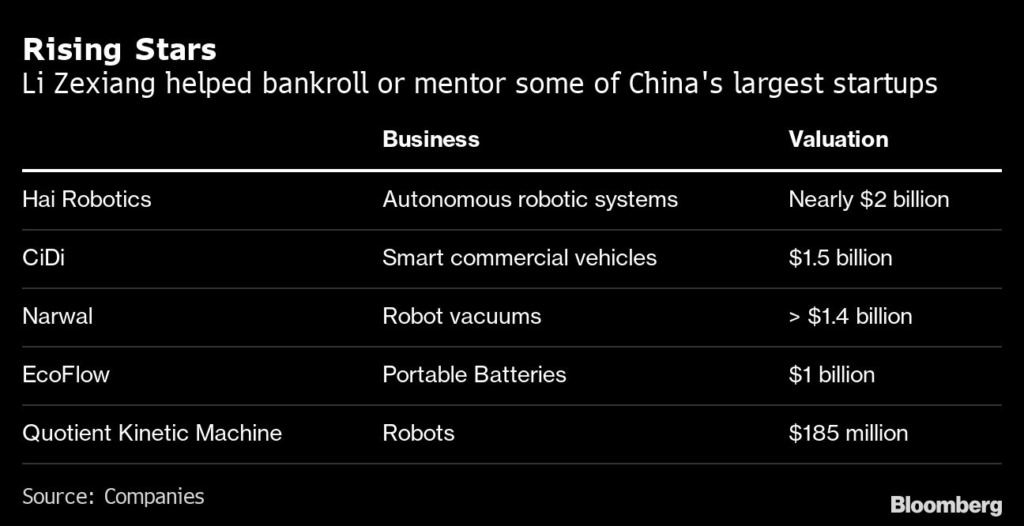
It’s had a few notable hits. Hai Robotics, a provider of robotics systems to Philips and SF Express, got over $100 million of financing in June at a valuation of almost $2 billion. Robo-vacuum maker Narwal was the first project incubated at Li’s Xbotpark and now, valued at more than 10 billion yuan, cleans a million households worldwide. Sequoia China and Hillhouse Capital-backed EcoFlow, the battery unicorn founded by a former DJI employee that won a coveted “Little Giant” label from Beijing in 2021, is preparing a domestic IPO.

Not all of Li’s bets have paid off. Of the dozens of ideas he’s financed or endorsed over the years, only a handful have evolved into unicorns or global names.  But more often than not, his proteges benefit from his contacts in finance and tech. “Professor Li’s personal brand is very influential in the industry,” Zhang said.

It helps that Li’s efforts dovetail with Beijing’s vision. In robotics alone, the Ministry of Industry and Information Technology is targeting average annual revenue growth of more than 20% to 2025 in a five-year plan unveiled December.

In recent years, Li opened satellite XbotPark locations across the country from Ningbo to Chongqing. He also set up an investment fund with Sequoia and Hillhouse to directly finance members, including Zhang’s Direct Drive Tech, though he declined to provide specifics on its capital.

He envisions Xbotpark becoming one of several unicorn birthing grounds, just as Beijing diverts more capital toward semiconductors, AI, cleantech and cars. But it’s a little like setting out to scale the world’s tallest peaks, Li admits.

“These politicians, all they can see are the giant companies,” he said. “What they fail to notice is the grassroots technology movement, yet the firms that spring from that represent our future hopes and dreams.”

More stories like this are available on bloomberg.com

©2022 Bloomberg L.P.

Xi’s Heir Is Likely Among China’s Rising ‘Luckiest Generation’

(Bloomberg) — The spotlight at China’s leadership congress next month will fall on the elite line-up installed to steer the world’s No. 2 economy. But another lesser-watched group will also advance, and an eventual successor to President Xi Jinping is likely among them.

They’ve been called the Luckiest Generation: Communist Party cadres born in the 1970s. They missed both the Mao Zedong era, which unleashed havoc on education and the economy, and the high unemployment levels and housing crises facing today’s graduates. 

Instead, China’s startling economic rise carried them into university and to the top of industries from finance to commodities. They built careers during a brief window of internet freedom, economic integration through the World Trade Organization and global mobility — freedoms Xi has constricted with censorship, trade actions and Covid border closures. 

More than 100 of the ’70s generation already occupy senior positions across provinces and ministries. As Xi moves toward a landmark third term at the party’s twice-a-decade congress, they’ll march closer to power. They’ll comprise some 10% of the 370-odd members on the next Central Committee, mostly as alternates, according to Cheng Li, a scholar at the John L. Thornton China Center at The Brookings Institution. 

If Xi keeps age caps for everyone but himself as widely expected, leaders born in the ’60s will retire over the next decade. That would clear a path for the ’70s cohort to join the powerful Politburo. Xi himself will be 79 if he reaches the 2032 congress as party leader, older than any previous general secretary. 

“This is a very important generation. They’ll be the ones who run up against a potential power transition,” said Victor Shih, an associate professor at the University of California San Diego who researches elite Chinese politics. “Their mentality could be a bit more open to the world at just the right time.”

The ’70s generation will ascend to China’s leadership ranks during a period in which the country could finally overtake the US as the world’s largest economy, even as growth slows and population decline takes hold. They’ll likely be in charge of key regions and agencies in the latter part of this decade, when American military commanders estimate Xi will achieve the capability to take action across the Taiwan Strait. 

Still, their relatively easy success could have given them “above average” expectations about the party’s ability to enrich society, leading them to endorse more state control and opposition to Western values, said Fei-Ling Wang, professor at Sam Nunn School of International Affairs at the Georgia Institute of Technology. “They only have memory of the good years,” he said. “Until, of course, very recently.”

Here are five officials to watch:

Zhuge Yujie, 51

In March, Zhuge became the youngest deputy party secretary in the country, as right-hand man to Shanghai party chief Li Qiang — a long-time Xi associate. The financial hub where Zhuge was born and raised has traditionally been a springboard to high office. Xi is a former Shanghai party secretary. Zhuge worked in state-owned enterprises before entering politics, a career path common among the 1970s cohort, many of whom have led flagship enterprises or major financial institutions. 

Liu Hongjian, 49

Liu became the youngest member of a provincial party standing committee when promoted to lead a government legal affairs unit in 2021. Previously, he worked in Fujian for almost two decades, overlapping with Xi who was posted there from 1985 to 2002. Several officials promoted under Xi have crossed career paths with the top leader. 

Liu Qiang, 51

Before becoming Shandong province’s vice governor, Liu racked up 25 years in the financial sector as head of the Agricultural Bank of China Ltd.’s Shanghai branch and a vice president at Bank of China Ltd. In March, he became party chief of Jinan, capital of Shandong province that lies halfway between Beijing and Shanghai.

Shi Guanghui, 52

Shi has about 30 years of experience working in Shanghai, at first for a state-owned steel producer, then later as vice mayor. He was promoted to Guizhou deputy party secretary earlier this year, becoming the second 1970s leader to hold that level role after Zhuge.

Guo Ningning, 52

One of the few female 1970s leaders, Guo worked for the Bank of China in Hong Kong and Singapore, and was vice president at the Agricultural Bank of China, before entering politics. Now vice governor of Fujian, she’s also media savvy. For a 2020 campaign to promote local seafood, Guo feasted on eels in a live video that attracted more than 1 million viewers on e-commerce platform Taobao.

More stories like this are available on bloomberg.com

©2022 Bloomberg L.P.

Biden Says He Warned Xi of Investment Chill If China Backs Putin

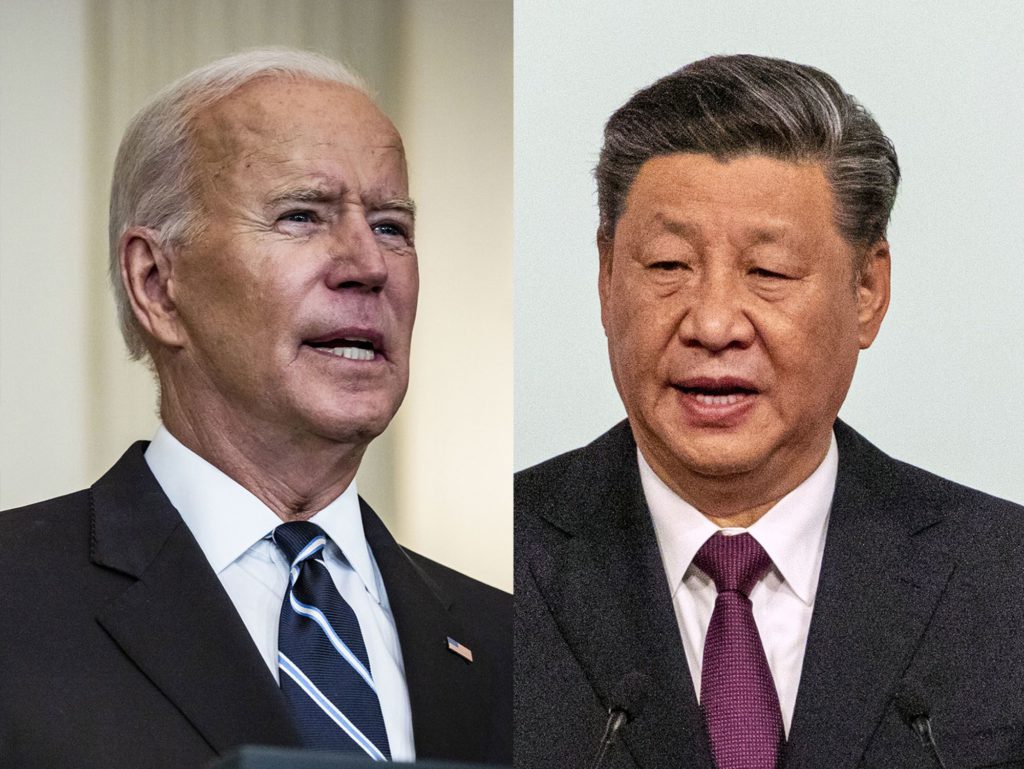
(Bloomberg) — President Joe Biden said he warned Chinese President Xi Jinping it would be a “gigantic mistake” to violate sanctions imposed on Russia, but that there’s been no indication that Beijing has provided weapons to Moscow for its invasion of Ukraine.

Biden, according to excerpts from an interview with CBS’s “60 Minutes” airing Sunday, said he spoke with Xi shortly after the Chinese president met with Russia’s Vladimir Putin during the Olympics in February. Russia invaded days after the games’ closing ceremony.

“Not long after that, I called President Xi — not to threaten at all, just to say to him, ‘we’ve met many times.’ And I said, ‘if you think that Americans and others are going to continue to invest in China based on your violating the sanctions that have been imposed on Russia, I think you’re making a gigantic mistake, but that’s your decision to make,’” Biden said. 

He didn’t specify when the call took place, but the statement echoes a US readout of a call between the two leaders in March, after which the US said Biden “described the implications and consequences if China provides material support to Russia as it conducts brutal attacks against Ukrainian cities and civilians.”

Biden told CBS there’s so far no sign of material support for Russia by China. “Thus far, there’s no indication they’ve put forward weapons or other things that Russia has wanted,” he said, declining to elaborate. 

Even without any signs of China violating sanctions, economic ties between the two countries are already strained. The White House has taken steps to secure domestic supply chains, including in semiconductors, to cut its reliance on the Asian nation and has increased scrutiny of foreign investments in the US. Biden also continues to review whether to ease tariffs imposed on Chinese goods by his predecessor, Donald Trump.

Cold War?

Asked whether the relationship between China and Russia could put the US in a “new, more complicated Cold War,” Biden replied: “I don’t think it is a new, more complicated cold war.”

Xi and India Prime Minister Narendra Modi expressed concern last week about Putin’s invasion, as a Ukrainian counteroffensive pushes Russian forces back in parts of the country. Putin told Xi he understands China’s “questions and concerns,” while Modi told Putin that “today’s era is not one for war.”

Read more: Modi Urges Peace in Ukraine, Joining Xi in Questioning Putin

More stories like this are available on bloomberg.com

©2022 Bloomberg L.P.
Electric Big Rigs Face Uphill Trip From Show Floor to Highways

(Bloomberg) —

After electric cars, here come the battery trucks.

Global leaders Daimler Truck Holding AG and Volvo AB are joining dozens of commercial-vehicle makers in Germany this week to showcase their latest electric semis, with more zero-emissions vehicles debuting at the IAA Transportation show than ever before.

Daimler is unveiling the Mercedes-Benz eActros, capable of hauling 22 tons of cargo for 311 miles before it needs to recharge. Traton SE’s MAN brand is showing off a 40-ton truck that will accommodate fast charging. Sweden’s Volvo is offering visitors test drives of its electric rigs at the Hanover event.

The key question executives will have to answer is just how long it will take for their heavy-duty vehicles to make the jump from show floor to cruising along highways. High battery prices and a virtually non-existent truck charging network remain significant hurdles just as haulers weigh investments during an unprecedented energy crisis in Europe and a slowing global economy.

“A lot more electric trucks are available now, but their adoption is lagging behind, especially in Europe,” said Nikolas Soulopolous, an analyst at BloombergNEF. “Production capacity is still ramping up slowly, there are not enough suitable public chargers available and truck batteries remain expensive.”

Still, there’s pressure to make the shift. Companies in Europe need to comply with tighter rules on trucks operating in urban areas as cities push to improve air quality. Electrifying heavy-duty vehicles will be key for tackling climate change as they’re responsible for around a quarter of the European Union’s road transport emissions.

Brussels wants the industry to cut CO2 output of new trucks 30% by 2030, and most manufacturers are betting that battery-electric — rather than hydrogen fuel cells — will be the dominant technology to achieve that. Yet the majority of countries in the region aren’t offering anything close to the $40,000 incentives the US plans to dole out to buyers of an electric heavy-duty truck.

Traton, owned by Volkswagen AG, has pledged that half of its trucks shipped by the end of this decade will run without fossil fuels. Its Scania brand this year delivered an 80-ton electric truck to forest company SCA, which is using the vehicle to haul timber in northern Sweden. Last week, Volvo started series production of its heavy-duty electric rigs and said it has already sold more than 2,600 battery-powered trucks.

“For some use cases, in particular shorter urban duty cycles, the total cost of ownership of battery-electric trucks can soon be as low as that of a diesel vehicle,” Soulopolous said.

Capacity Crunch

Timelines for series production vary as manufacturers struggle to ramp up capacity and battle to source enough parts.

Daimler’s eActros won’t be mass-produced until 2024, with MAN’s rig due a year later. Nikola Corp., which plans to unveil its fuel-cell Tre FCEV Beta at this week’s show, has only delivered a few dozen trucks and now risks becoming distracted by the criminal fraud trial of its founder Trevor Milton. And Tesla Inc. has delayed its Semi several times.

Volvo, Traton and Daimler are planning to spend 500 million euros ($498 million) in the next five years to install at least 1,700 chargers in Europe for heavy-duty vehicles. Daimler joined a smiliar project with BlackRock Inc. in the US, and the industry is working to improve batteries and speed up charging times.

“Europe needs a rather dense network of high-speed truck chargers to facilitate wider adoption of long-haul battery-electric trucks,” said Romed Kelp, a partner with consultancy Oliver Wyman. “The appropriate locations need to be identified, and at some of those it’s not yet clear if the energy infrastructure is ready to cope with demand.”

More stories like this are available on bloomberg.com

©2022 Bloomberg L.P.
China Bus Accident Leaves Dozens Dead, Xinhua Reports

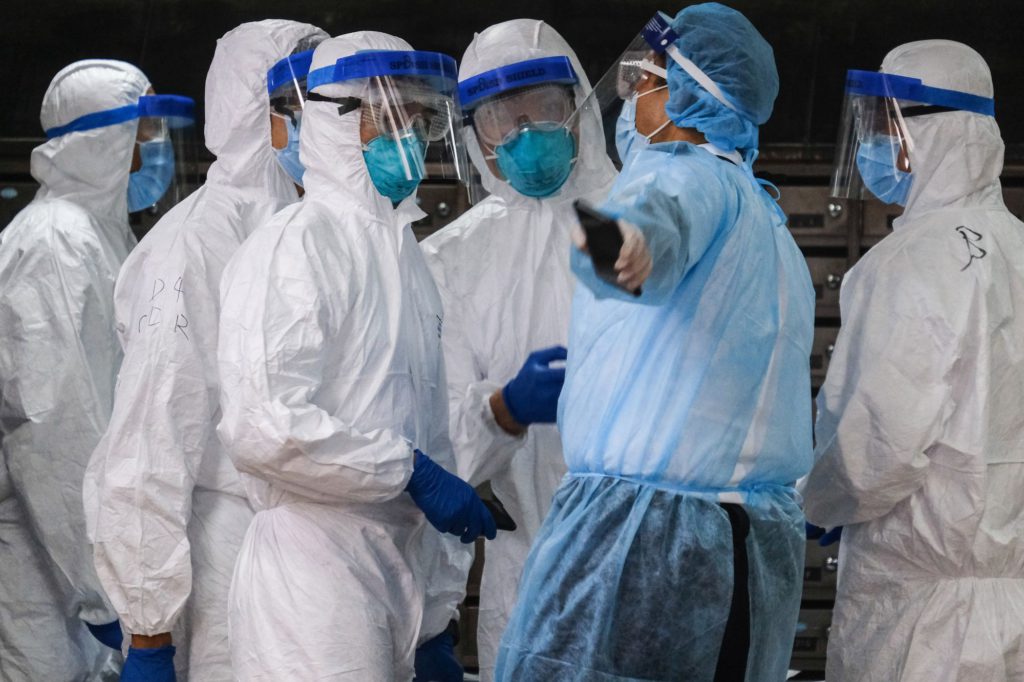
(Bloomberg) — At least 27 people were killed in a highway bus accident in southwestern China’s Guizhou province early Sunday morning, with a local media report saying the vehicle was usually used to ferry people to Covid quarantine facilities.

The vehicle carrying 47 passengers overturned, and those who survived were injured, the official Xinhua News Agency reported, citing local authorities.

The bus was used to transfer people to Covid quarantine facilities for the province’s capital city of Guiyang, the Guizhou Daily reported, without providing specifics. On-site rescue is completed and an investigation into the cause of the accident is underway, it said.

Incidents and struggles linked to China’s Covid-Zero strategy have gone viral domestically and triggered anger toward authorities. Chinese internet users have criticized the country’s Covid response such as strict stay-at-home orders.

The bus accident comes just weeks before the Communist Party holds its twice-a-decade leadership summit, where President Xi Jinping is expected to break precedent by securing a third term in office. His opening address at the event will be scrutinized for signals on whether China will shift from trying to eliminate the virus to living with it like the rest of the world.

“This is the exact kind of incident the leadership wants to avoid, at all cost, before the Congress, to keep social stability,” said Andy Chen, a senior analyst with Beijing-based consultancy Trivium China. “It also happens to be the kind of event people who oppose the ongoing Covid-control policies will try to play up and point to to demand changes.”

Chen said authorities could make an example out of the accident by severely punishing officials who they deem responsible.

“We should expect heads rolling at the local government in very short order,” he said.

The accident was the most trending search topic on Chinese social media platform Weibo as of Sunday evening. The prime-time 7 p.m. news program on state broadcaster CCTV had no mention of the accident.

(Updates with details of vehicle from first paragraph)

More stories like this are available on bloomberg.com

©2022 Bloomberg L.P.
China ‘Quarantine Bus’ Crash Leaves Dozens Dead

(Bloomberg) — At least 27 people were killed in a highway bus accident in southwestern China’s Guizhou province early Sunday morning, with a local media report saying the vehicle was usually used to ferry people to Covid quarantine facilities.

The vehicle carrying 47 passengers overturned, and those who survived were injured, the official Xinhua News Agency reported, citing local authorities.

The bus was used to transfer people to Covid quarantine facilities for the province’s capital city of Guiyang, the Guizhou Daily reported, without providing specifics. On-site rescue is completed and an investigation into the cause of the accident is underway, it said.

Incidents and struggles linked to China’s Covid-Zero strategy have gone viral domestically and triggered anger toward authorities. Chinese internet users have criticized the country’s Covid response such as strict stay-at-home orders.

The bus accident comes just weeks before the Communist Party holds its twice-a-decade leadership summit, where President Xi Jinping is expected to break precedent by securing a third term in office. His opening address at the event will be scrutinized for signals on whether China will shift from trying to eliminate the virus to living with it like the rest of the world.

“This is the exact kind of incident the leadership wants to avoid, at all cost, before the Congress, to keep social stability,” said Andy Chen, a senior analyst with Beijing-based consultancy Trivium China. “It also happens to be the kind of event people who oppose the ongoing Covid-control policies will try to play up and point to to demand changes.”

Chen said authorities could make an example out of the accident by severely punishing officials who they deem responsible.

“We should expect heads rolling at the local government in very short order,” he said.

The accident was the most trending search topic on Chinese social media platform Weibo as of Sunday evening. The prime-time 7 p.m. news program on state broadcaster CCTV had no mention of the accident.

(Updates with details of vehicle from first paragraph)

More stories like this are available on bloomberg.com

©2022 Bloomberg L.P.

Do Kwon, No Longer in Singapore, Says He’s Not ‘On the Run’

(Bloomberg) — Do Kwon, the founder of the collapsed Luna and TerraUSD tokens, said he’s not “on the run” hours after Singapore police stated he was no longer in the country. 

Kwon, along with five others, is facing arrest in South Korea. As recently as Sept. 14, the prosecutor’s office in Seoul said he and the others, who are accused of violations of capital markets law, were all in Singapore. After local police issued a statement Saturday, Kwon tweeted that he doesn’t have anything to hide and is in “full cooperation” with government agencies.

“For any government agency that has shown interest to communicate, we are in full cooperation and we don’t have anything to hide,” Kwon said, without providing specifics on his whereabouts. “We are in the process of defending ourselves in multiple jurisdictions — we have held ourselves to an extremely high bar of integrity, and look forward to clarifying the truth over the next few months.”

Korean prosecutors refuted his comments on Sunday and alleged Do Kwon is “obviously on the run,” according to Yonhap News Agency. He had plans to flee the country before the collapse of the Luna token in May, the report said. Prosecutors said Kwon is not cooperating with probes and he told investigators via an attorney he had no intention to appear before them for questioning, Yonhap said, citing people it didn’t identify. 

A spokesperson for the prosecutor’s office could not be reached outside of normal business hours in Seoul on Sunday. Kwon didn’t respond to an email seeking comment on the Yonhap report.

The South Korean prosecutor’s office is also seeking permission from the country’s foreign ministry to have Kwon’s passport revoked. If that happens, Kwon would have to return to Seoul within 14 days, according to policy.

Singapore police told Bloomberg they will assist the Korean National Police Agency “within the ambit of our domestic legislation and international obligations.” Kwon has a Singapore employment pass which is due to expire Dec. 7, the Straits Times reported Saturday. An application to renew or apply for a new pass is pending approval, the paper said.

Kwon also applied for an EntrePass — which is meant to allow eligible foreign entrepreneurs to start and operate businesses in Singapore — and was rejected, the Straits Times said, citing Ministry of Manpower records.

Terra Founder Kwon Under More Pressure From Crypto Collapse

Kwon found himself at the center of one of crypto’s biggest blowups when TerraUSD, also known as UST, crumbled from its dollar peg and brought down the ecosystem he had built. The $60 billion wipeout also saw the implosion of a related token known as Luna. The collapse in May shook faith in the digital-asset sector, which has yet to recover much of the losses.

(Updates with rejection of Singapore entrepreneur pass in second last paragraph)

More stories like this are available on bloomberg.com

©2022 Bloomberg L.P.
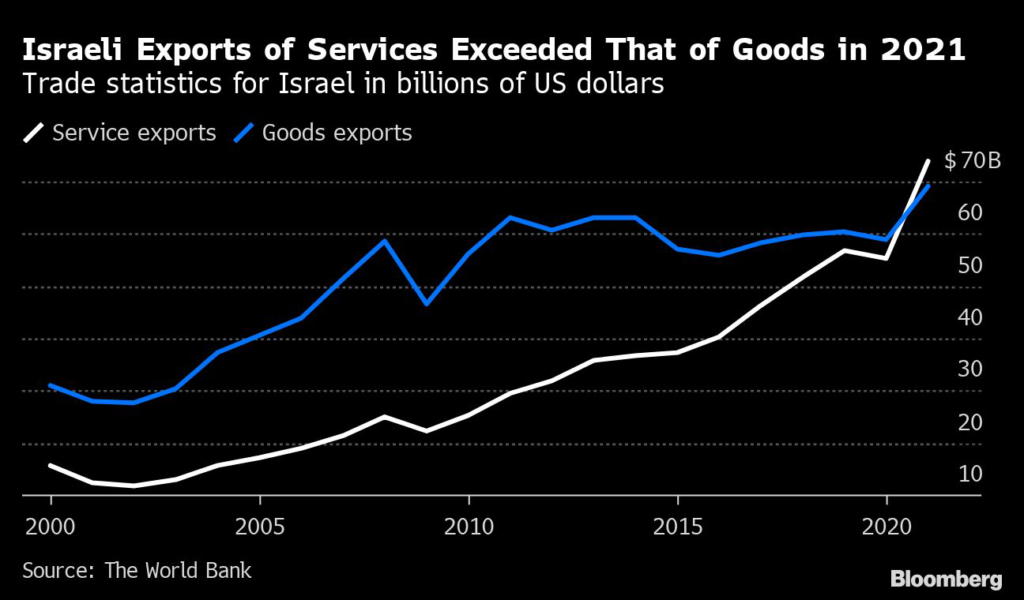
A Former General Has Her Focus Set on Israel’s Skewed Economy

(Bloomberg) —

Just over a year into her job as Israel’s economy minister, Orna Barbivay’s ambition is colliding with political reality.

Fractious coalition governments have given many of her predecessors little time to leave their mark. But two months out from elections — Israel’s fifth vote since 2019 — the job’s requirements are clear to her. Israel needs to abandon the protectionism of its founders, and close the gap between its turbocharged technology industry and the rest of its economy.

For Barbivay, 60, politics is the second profession in which she’s broken through the barriers of Israel’s male-dominated workforce. She was the first woman to attain the rank of major general in the army, and is now the first to become economy minister. 

Whether the political cards fall in her favor or not after elections in November, the job means presiding over an economy riven by inequality as vast amounts of wealth pour into its vaunted technology sector. The difference between the tech and non-tech sectors is so vast that Barbivay says she’s dealing with “two economies.”

“For years in the military I saw the challenge through the eyes of security and today I see how much the economy is a bridge to close other gaps,” she said in an interview. “My job is to reduce the gap.”

The ministerial post, with oversight of commerce, industry and labor, is the second-most senior economic role in government, capping a career for Barbivay that included more than three decades in the military. 

While an unprecedented diplomatic thaw with Arab nations has kept her in the limelight signing trade deals with former foes, the focus is turning to home, with Israel’s high living costs topping the list of voter concerns at a time when inflation is around the fastest since 2008.

During her time as economy minister, she’s helped ease import regulations, cut customs costs and reduce bureaucracy, aiming to increase competition and ultimately bring down prices. Those efforts attracted interest from international chains including grocer Carrefour SA. 

As part of a government presently led by Yair Lapid of the Yesh Atid party, she also eliminated separate Israeli standards for foreign products, a major change in protectionist rules instituted with the establishment of the state in 1948 that had contributed to making goods more expensive.

“When I analyzed the economy, I saw there were built-in obstacles,” Barbivay said. “We were a young nation and because of the desire to protect the domestic industry they put in place a lot of regulations.”

Born in the mixed Arab-Jewish town of Ramla to a mother from Iraq and a father from Romania, Barbivay grew up poor in Afula, a northern city once home to three large transit camps for newcomers. It’s since seen waves of immigrants from Ethiopia and former Soviet republics. As economy minister, she calls it an “existential need” to better prepare the less affluent parts of the population — including Arab women and Orthodox Jewish men — for the workforce, and to bring jobs and investment to where they live.

“When I look at the two economies, I see the economy minister’s job to increase productivity and start the engine of growth,” she said. “We need to set targets. We need to get to the periphery.”

In the army, Barbivay headed its personnel directorate and was the first female member of the military’s decision-making central staff. After entering politics in 2019, she joined Lapid’s centrist party and became economy minister in June 2021, one of a record number of women in Israel’s newest cabinet. 

Barbivay, who understands Arabic, has been among the public faces of its outreach to the Arab world, which is transforming Israel’s standing in the region both diplomatically and financially. Milestone deals cemented relationships with governments including Bahrain and Morocco. In May, she travelled to Dubai to sign a free-trade pact with the UAE, less than two years after a political breakthrough between the two countries.

Ties with Turkey, once a firm ally in the region, have also been restored. Regional heavyweight Saudi Arabia isn’t yet showing interest in establishing formal relations, but Barbivay says she’s hopeful President Joe Biden’s recent visit to the kingdom will help to open that door. ‘’Everything in its time,” she said. “I hope it will turn into diplomatic ties.”

Different Tracks

Back at home, the economy remains a reflection of disparities writ large. Poverty is widespread among Arab citizens and ultra-Orthodox Jews, leaving Israel as one of the world’s most unequal high-income countries. 

The divide is similar to levels in the US, according to the Paris-based Global Inequality Lab, a group founded by French economist Thomas Piketty. Its findings showed that the bottom half of Israel’s population earns 13% of total national income, while the top 10% share is 49%.

Over the past three decades, inequality in Israel has stayed high even as it’s decreased since 2012. But now, the part of the economy that employs the bulk of the workforce is increasingly lagging behind the technology sector by wages and productivity. 

Giving incentives for tech companies to move into the periphery will lift up less developed areas and reduce violence, and the companies that invest in diversity will “see how it benefits their business,” Barbivay said. “I’ll invest in you to move to the periphery, then you will benefit, I will benefit, the state will benefit.”

‘Political Instability’

But Israel’s politics may prove a challenge she can’t overcome.

She’s number two on Lapid’s list — the second-largest to former Prime Minister Benjamin Netanyahu’s Likud — and may find herself demoted come November. 

Yesh Atid is running behind Likud in the polls and is lagging Netanyahu in potential coalition-forming. There’s also a possibility of a unity government of the largest parties, which may leave her just where she is.

“If political instability continues it will hurt everyone — civilians, Israel’s international image, the ability of the government to carry out any programs,” Barbivay said. “But if there is stability in the government, the sky is the limit.”

More stories like this are available on bloomberg.com

©2022 Bloomberg L.P.

Close Bitnami banner
Bitnami