Bloomberg

US-China Tech Rivalry Adds to Headaches for Stock Investors

(Bloomberg) — China’s heated rivalry with the US over tech supremacy is adding fresh pain points to the world’s second-largest stock market, as the Biden administration steps up efforts to reduce economic reliance on the Asian nation. 

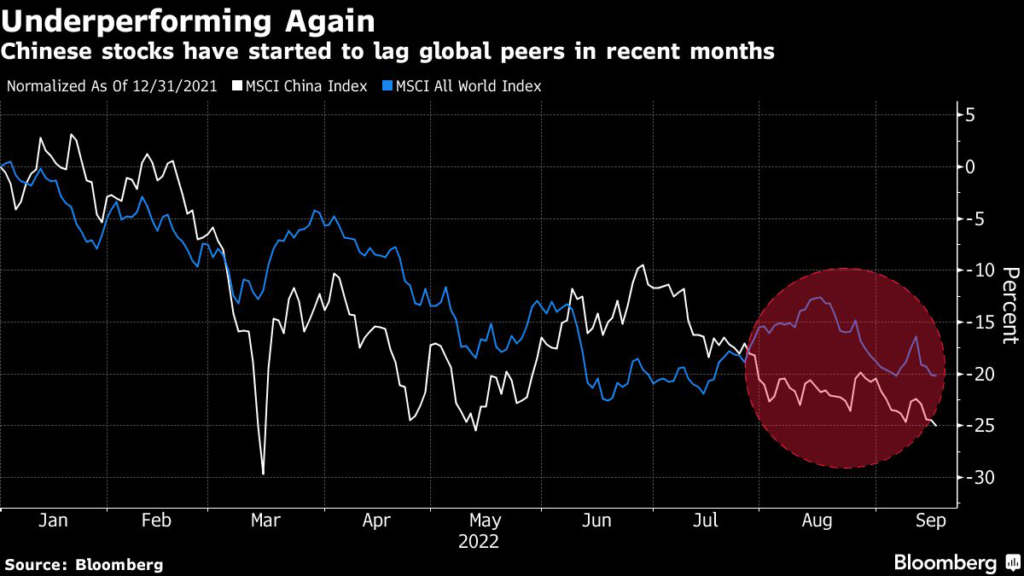
From biotech to electric vehicles, shares of China’s key manufacturers have seen heavy selling recently as US initiatives to secure domestic supply chains and solidify its industrial superiority raised uncertainties for Chinese firms. The MSCI China Index has fallen more than 7% this month, versus a 2.5% drop in the global gauge. 

Investors also worry that rising tension over Beijing’s stance toward Russia and Taiwan may accelerate the economic decoupling. President Xi Jinping’s meeting with his Russian counterpart last week has been closely watched by traders for any gesture that may provide basis for US sanctions. 

“China’s relationship with the US will remain challenging in 2022 and beyond with geopolitical risks remaining high as both economies increasing see each other as competitors,” said Zhikai Chen, head of Asian and global emerging market equities at BNP Paribas Asset Management. “We are focused on the defensive and policy beneficiary names and avoid those subject to higher geopolitical risk.” 

The latest developments are further dampening sentiment in a market reeling from stringent Covid restrictions, a weakening economy and a property market slump. Chinese stock gauges are among the worst-performing major benchmarks this year. 

Additional flash points may emerge as President Joe Biden and Xi face key political tests in coming months — the US midterm elections and the Communist Party Congress. Nicholas Yeo, head of China equities at abrdn plc, said market volatility may increase with the risk of “noise around China” in the US campaign.  

Just last week, biotech bellwether Wuxi Biologics Cayman Inc. slumped nearly 20% in a day following Biden’s executive order to bolster domestic bio-manufacturing. EV makers also fell as China’s ambassador to the US warned against the risk of trying to cut the country off the vehicle supply chains.

Investors will have to brace for further swings. Biden looks set to sign an executive order in the following days that intensifies national security reviews on foreign investments, with new criteria applied to sectors including semiconductors, artificial intelligence, biotech and clean energy technologies.

Tech Battlefield 

On the flip side, some see investment opportunities as China’s self-sufficiency drive gathers pace. 

“Any homegrown semiconductor company will be supported by Chinese government,” said Alicia Garcia Herrero, chief economist for Asia-Pacific at Natixis Corporate & Investment Banking, adding that questions remain on how successful these companies can be with the pressure from the US. 

China’s largest chipmaker Semiconductor Manufacturing International Corp.’s second-quarter profit beat estimates and its Hong Kong-listed shares rose 3.2% in September, versus a 6% drop in the Hang Seng Index. 

Earlier this month, Xi has renewed calls to step up tech development. That came after he prioritized the role of state institutions in recent years over private giants such as Alibaba Group Holding Ltd. or Tencent Holdings Ltd. in spurring technological advancement. 

But the unpredictable nature of geopolitical tensions means China stocks are a market to be shunned for some investors.

“I see decoupling as on the rise, and my China equity allocation remains zero,” said Brock Silvers, chief investment officer at private equity firm Kaiyuan Capital. The weakness in China’s economy “has significantly reduced its appeal relative to its associated risks,” he added. 

More stories like this are available on bloomberg.com

©2022 Bloomberg L.P.

Crypto’s Do Kwon Says He’s Not  ‘On the Run,’ Won’t Disclose Location

(Bloomberg) — Do Kwon, the founder of the collapsed Luna and TerraUSD tokens, said he’s not “on the run” hours after Singapore police stated that he was no longer in the country. 

Kwon, along with five others, is facing arrest in South Korea. As recently as Sept. 14, the prosecutor’s office in Seoul said he and the others, who are accused of violations of capital markets law, were all in Singapore. After local police issued a statement Saturday, Kwon tweeted that he doesn’t have anything to hide and is in “full cooperation” with government agencies. 

“For any government agency that has shown interest to communicate, we are in full cooperation and we don’t have anything to hide,” Kwon said, without providing specifics on his whereabouts. “We are in the process of defending ourselves in multiple jurisdictions — we have held ourselves to an extremely high bar of integrity, and look forward to clarifying the truth over the next few months.”

The South Korean prosecutor’s office is also seeking permission from the country’s Foreign Ministry to have Kwon’s passport revoked. If that happens, Kwon would have to return to Seoul within 14 days, according to policy.

Singapore police told Bloomberg they will assist the Korean National Police Agency “within the ambit of our domestic legislation and international obligations.”

Read More: Terra Founder Kwon Under More Pressure From Crypto Collapse

Kwon found himself at the center of one of crypto’s biggest blowups when TerraUSD, also known as UST, crumbled from its dollar peg and brought down the ecosystem he had built. The $60 billion wipeout also saw the implosion of a related token known as Luna. The collapse in May shook faith in the digital-asset sector, which has yet to recover much of the losses.

(Updates to add background on TerraUSD’s collapse)

More stories like this are available on bloomberg.com

©2022 Bloomberg L.P.

Social Media Buzz: DeSantis v. Newsom, the Queen, Figma, Cardi B

(Bloomberg) — What’s buzzing on social media this morning:

BUZZING HEADLINES:

The argument over Florida Governor Ron DeSantis’s contentious flight of Venezuelan asylum seekers to Massachusetts widened to conflict between possible contenders for the US presidency — and to their respective hair-care products. 

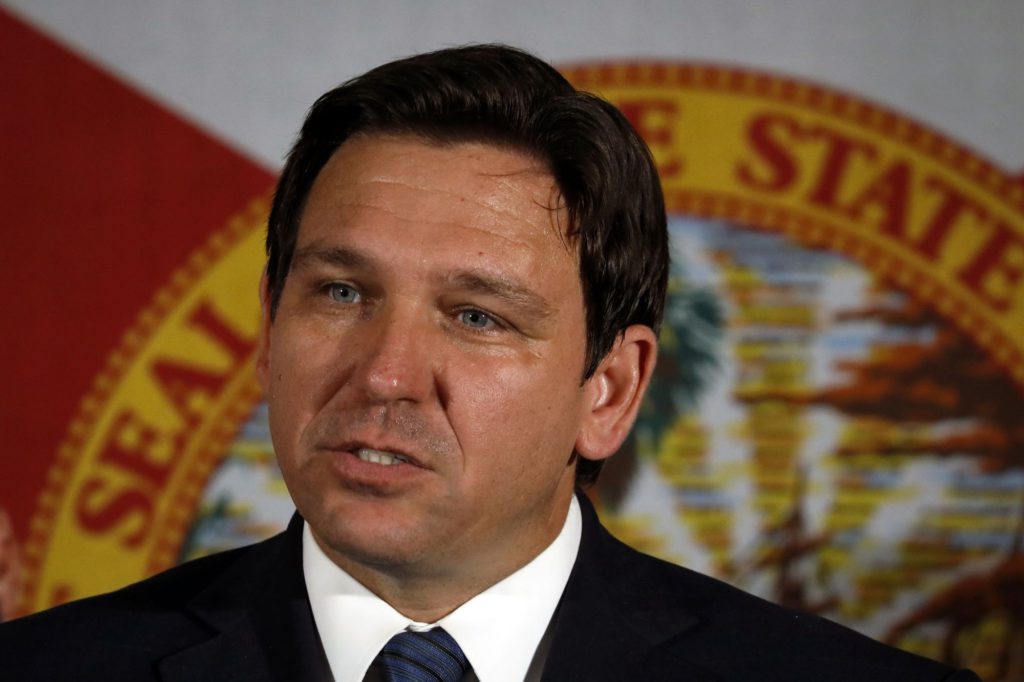
California Governor Gavin Newsom, a Democrat, challenged DeSantis to debate the move, accusing the Republican governor of “playing politics with people’s lives.” DeSantis mocked Newsom earlier on Friday for asking the US Department of Justice to investigate the flight as well as the transport by Texas of migrants to northern cities, saying “his hair gel is interfering with his brain function.” Newsom, in calling for debate, tweeted hat he’d bring his gel but told DeSantis: “You bring your hairspray.” The governors are considered top possibilities for their parties’ presidential nomination.

The UK is saying goodbye to Queen Elizabeth in a particularly British way, with an orderly queue to pay respects to her coffin that at one point was 24 hours long. By Saturday the line had shrunk back to about 12 hours. 

BUZZING COMPANIES:

Wall Street analysts didn’t mince words over FedEx’s landslide miss of its forecast for the current quarter and its withdrawal of full-year guidance. It was the “weakest set of results we’ve seen relative to expectations in our ~20 years of analyzing companies,” researchers at Deutsche Bank AG said. The stock finished down 21% on Friday.

While early investors in Figma, the design software startup, reaped a windfall of at least $2 billion from its sale to Adobe for $20 billion, some creatives are questioning what changes might come to the platform. At least for now, nothing, according to Figma’s co-founder and chief executive officer, Dylan Field. “When we started Figma, our stated vision was to ‘eliminate the gap between imagination and reality.’ I believe we can reach this goal substantially faster through our plan to join forces with Adobe,” he said in a blog post. 

BUZZING TWEETS:

Rapper Cardi B weighed in on the US economy, noting that interest rates are on the rise as the Federal Reserve tries to tame inflation, and “rent is over the top high.” She also referenced the housing shortage, an issue around the world, from the US to Canada and Singapore.


More stories like this are available on bloomberg.com

©2022 Bloomberg L.P.

Crypto Speculation Falls Out of Favor With Game Studios

(Bloomberg) — In late 2021, as crypto prices hit fresh records, several major gaming studios sought to position nonfungible tokens as the next big thing. Mere months later, falling prices and criticism from players and their own employees have muted that enthusiastic chorus.

Studios expected cryptoassets to create opportunities for players to own their in-game digital items while forging a new revenue stream for the publishers. The reality has been less straightforward.

Speculative assets like NFTs or in-game cryptocurrencies fundamentally change the dynamics of a game and the expectations of its players. These items, even if they’re a magic sword or a robot costume, are real-world financial assets. They possess an embedded level of speculative risk, with the potential for both reward and losses. Their presence in a game turns both creators and players into investors.

Mojang, the Microsoft-owned developer behind one of the world’s best-selling video games, said NFTs create “scarcity and exclusion.” The Minecraft developer banned companies from creating worlds on blockchain networks or game-affiliated NFTs, effectively terminating some ongoing experiments.

“NFTs are not inclusive of all our community and create a scenario of the haves and the have-nots,” Mojang said in a July blog post. “The speculative pricing and investment mentality around NFTs takes the focus away from playing the game and encourages profiteering, which we think is inconsistent with the long-term joy and success of our players.”

  • Read More: Minecraft Developers Confront Gaming Giants’ NFT Love Affair

In the crypto-native gaming world, that “investment mentality” is even more explicit. One of the best-known blockchain-based games is Axie Infinity, which allows players to unlock and earn in-game tokens called Smooth Love Potion. Those tokens can be traded on crypto exchanges or converted into currencies like the US dollar.

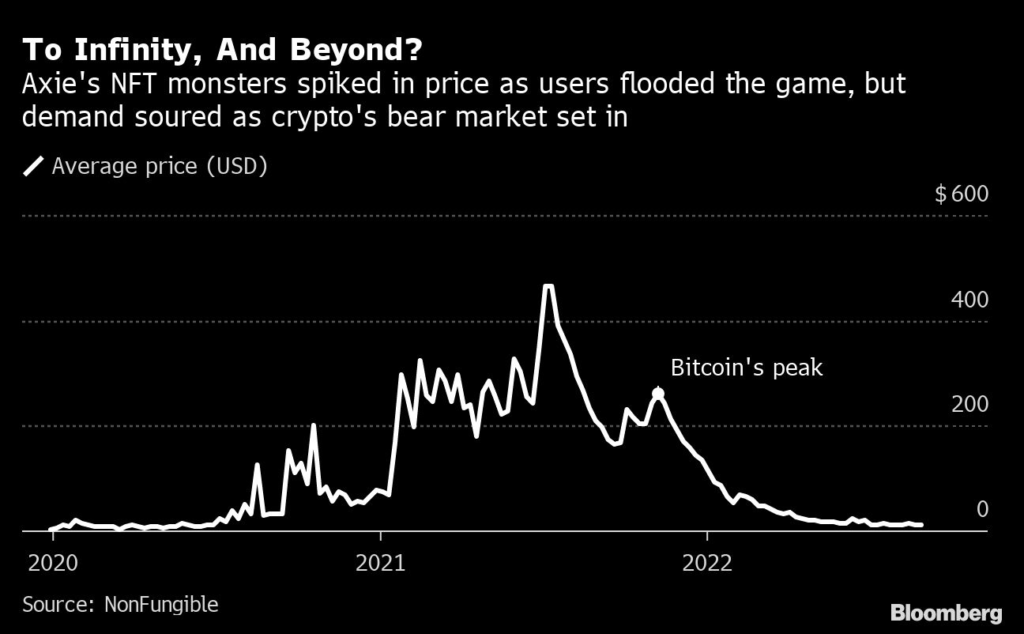
In Axie, it isn’t free for players to generate those initial rewards. In order to qualify to “play to earn”, as the mechanic was called, players first had to acquire three NFT “monsters”. At its July 2021 peak, that would have cost nearly $1,400, or around $446 for each NFT, according to data from NonFungible. Potential earnings hovered around $700 a fortnight.

Classic tactics like guilds, used by teams in traditional games such as World of Warcraft to grind for rare assets, emerged in games like Axie. In return for fronting those costs for the so-called scholars to play the game, guild managers would receive a portion of their teams’ crypto earnings indefinitely — sometimes as much as 90%.

  • Read More: A Billion-Dollar Crypto Game Promised Riches and Delivered Ruin

In March, hackers stole more than $600 million from Axie, a major attack that prevented players who relied on the game for income from accessing their earnings. In response, the poster child for the “play-to-earn” gaming model rebranded the category as “play-and-earn” — shifting the focus toward the “fun” of playing, rather than the financial reward.

Game of Trust

For game engineers, skepticism of the model is linked to the perception that these games are bad experiences for players. Discussions on platforms like Reddit and Discord are rife with complaints from game developers that blockchain games are less concerned with being high quality or fun to play, and more focused on how much hype their financial assets can generate. 

That focus on hype over gaming experience leads to a breach of trust with players, developers say. Studios are also becoming aware of the potential reputational damage they could incur from being involved in crypto without a clear focus, said Catherine Flick, a researcher who is working on a paper about the ethics of NFTs out of De Montfort University in the UK. Gamers form a sense of “identity” around the publishers they buy from, Flick said.

Mark Venturelli, a game developer whose criticism of these kinds of games went semi-viral in gaming circles, said programmers dislike the focus on NFTs because they are lovers of video games and more tech-savvy than most. “When you combine these two things, it’s easy to see why they fail to see the appeal of a gimmicky technology that provides nothing of value besides a ‘make money quick’ scheme,” he told Bloomberg in an email.

It’s also hard to compete with rivals inside the blockchain sector if your game isn’t at least fun to play, said Kevin Beauregard, CEO of crypto gaming startup Atmos Labs. “If people just want to play an economic simulator, then ultimately you’re breaking that competition piece,” he said at the Bloomberg Crypto Summit in July.

In a bid to draw in new talent and players, Sky Mavis, the studio that developed Axie, made the intellectual property for Axie freely available to developers who wanted to build their own games on it. Teams seeking to join the so-called Builders Program receive grants in the game’s crypto tokens, and all payment by players must happen in those cryptocurrencies too. A portion of any revenue generated by the game must go back to Axie’s treasury to support the economics of the ecosystem. In short, the financial success of a game built on Axie — and its developers’ livelihood — are inseparable from the performance of those tokens.

Phil Spencer, chief executive of Microsoft’s gaming division, said he was cautious about play-to-earn games. “Sometimes, it’s a hammer looking for a nail when these technologies come up,” Spencer told Bloomberg TV in August.

One of the top pitches for investing in NFT development was interoperability, a future scenario that would allow an item bought in one game to be used in another. Players could receive ownership tokens for the items they earned, and so not only make a potential profit from selling that item later, but also take those magic swords and robot costumes with them across different games.

While some of the larger blockchain experiences like Alien Worlds, Decentraland and The Sandbox are trying to harmonise their platforms, most crypto games have struggled to combine incompatible game engines and art styles, competing blockchains, and carefully licensed intellectual property franchises.

At traditional studios, even the development of NFTs that are playable in a single game has not gone smoothly. French publisher Ubisoft canceled an experiment with an in-game NFT marketplace called Quartz earlier this year after a swifft backlash from staff and players.

When Quartz closed, players who bought the NFTs were left with largely useless tokens that have attracted few, if any, bids on secondary-market platforms like Rarible. A spokesperson for Ubisoft said the studio considered itself in a research and development phase when it comes to digital assets, adding that “both internally and externally, we will keep iterating on the value proposition that web3 tools offer.”

Rival Square Enix launched a collection of art from its blockbuster Final Fantasy franchise last month that came with an NFT to prove its authenticity, following a promise of “aggressive” investment in the space in 2022. Others have stuck to outsourcing the effort via third-party partnerships. Square Enix, Ubisoft, Sega and Bandai Namco have all signed up to support an external company’s gaming blockchain network. 

“It’s a bit of a ‘hedging your bets’ situation, right?” researcher Flick said. “There’s always a possibility that it’s going to fail, and maybe this one, if it doesn’t fail, could be really lucrative.”

Meanwhile Take-Two Interactive Software Inc., a New York-based firm behind the wildly popular game franchise Grand Theft Auto, bought mobile developer Zynga in January for $12.7 billion, citing its blockchain prowess. Since that acquisition, though, Take-Two has ignored the topic of its ambitions for crypto completely in every subsequent earnings call.

The gaming industry has weathered multiple run-ins with negative press in its short history, from a panic over violence in games that led to the creation of age-based ratings, to more recent concern from regulators over “loot boxes” — virtual purchases that can contain multiple, random and potentially high-value items — as akin to introducing kids to gambling.

“We’re not going to create an economy to enable our enhanced speculative activity,” said Strauss Zelnick, CEO of Take-Two, at a Jefferies conference in January. “Are we going to bleed over into gambling? Well, not unless we’re regulated and honest about it, straightforward. And even then, I’m not sure if it’s here. But we’re certainly not going to like pretend that speculation is entertainment, even if we could make money doing it.”

More stories like this are available on bloomberg.com

©2022 Bloomberg L.P.

FedEx’s Warnings Highlight Economic Risks and Its Own Issues

(Bloomberg) — Sign up for the New Economy Daily newsletter, follow us @economics and subscribe to our podcast.

FedEx Corp.’s profit warning this week hit a nerve with global markets already jittery over the state of the economy. 

Shares of the delivery giant sank 21% Friday, wiping out $11 billion in market value, and dragging the broader market to its worst week since June, as the results fueled concern of weaker e-commerce and business-to-business activity. Yet FedEx has made itself particularly vulnerable to a demand slowdown, due to its own idiosyncrasies and recent missteps. 

“An investor mentioned to me — and I thought it was a good analogy — that FedEx has a weak immune system, and they’re usually the first ones to get sick,” said Bloomberg Intelligence analyst Lee Klaskow.

For all of FedEx’s warnings about macroeconomic challenges, the company has stumbled repeatedly in recent years after struggling to integrate a 2016 acquisition and as its own dueling networks increase costs. The revision is an early sign of trouble for new Chief Executive Officer Raj Subramaniam, who promised to boost sales and profit under a new three-year plan unveiled in June. 

FedEx’s sudden swing stands in contrast to key rival UPS Inc., whose management earlier this month reaffirmed their full-year financial targets, despite the return of Covid-19 lockdowns in China and Europe’s energy crisis. 

Although parcel demand is clearly slowing, FedEx’s performance “likely stands out to the downside versus UPS,” Citigroup analyst Christian Wetherbee said in a note, “as the company has been historically challenged in rapidly deteriorating freight markets.”

FedEx’s Express unit was the largest contributor to the miss, with revenue coming in $500 million below the company’s expectations, which it blamed largely on economic weakness in Asia and service difficulties in Europe.

The challenges in Europe point to continued issues with FedEx’s integration of TNT Express, which the American company acquired in 2016 to better compete against UPS and Deutsche Post AG’s DHL, argues Klaskow. 

“We were at least hoping to start seeing some fruits of their labor and the benefits of that acquisition to start transforming, whether it’s in share gain or better margins,” Klaskow said. “That clearly was not the case.”

Profit margins at Express were 1.7% compared to 6% a year ago, the unit’s worst for a quarter since 2009, according Robert W Baird & Co. 

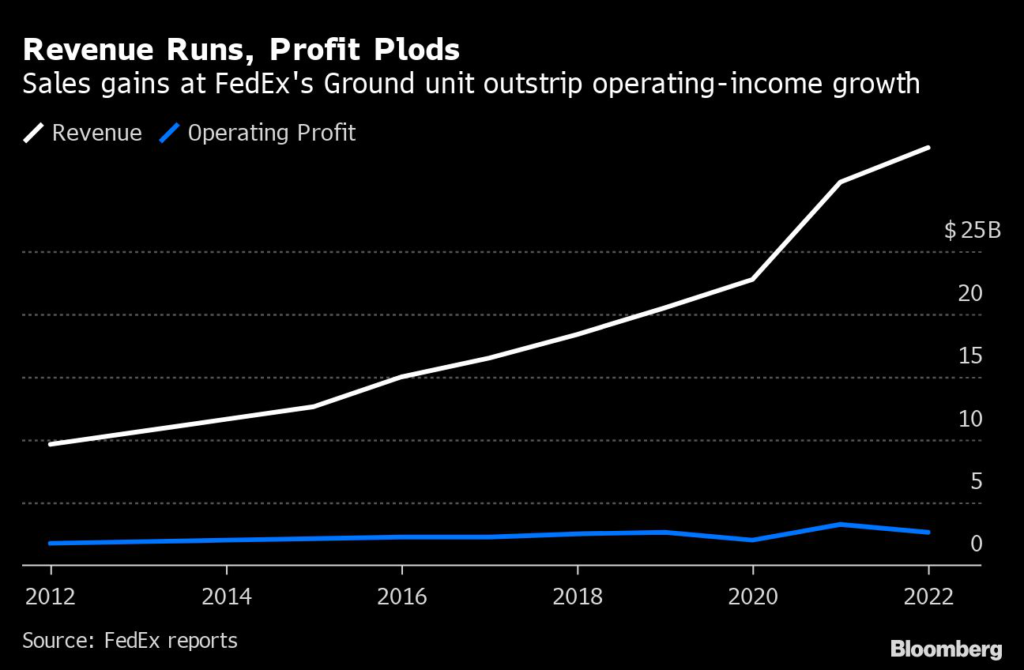
Unlike UPS, FedEx also has to contend with the cost of operating two distinct delivery networks. FedEx Express uses company employees to handle overnight deliveries, while FedEx Ground relies on independent contractors who employ nonunion drivers to deliver parcels to homes.

The “fixed cost structure” was one of the reasons cited by Bank of America Corp. analyst Ken Hoexter, who downgraded the stock to “neutral” from “buy” and also cut his target price and annual earnings estimates through 2025. Deutsche Bank AG called the report “the weakest set of results we’ve seen relative to expectations” in 20 years.

“There’s a case to be made that maybe combining the two networks would be better because it would just create a lot more synergies and a lot more density within their network,” Klaskow said.

The company plans to release its full third-quarter earnings results Sept. 22, when the new CEO and his management team will have to face stunned Wall Street analysts on a conference call. A FedEx representative declined to comment on the company’s challenges beyond its Thursday release. 

Subramaniam was named to take over from founder and current chair Fred Smith earlier this year as part of a long-planned handover. In the six months since then, the outlook has gone from bad to worse. FedEx faces a slowdown in e-commerce package deliveries, increasing signs of recession, labor strife among its delivery workforce and a legacy of questionable decisions such as its troubled TNT acquisition in Europe.

Read more: FedEx’s New Boss Sets Path Under Glare of Founder, Activist 

FedEx has said it expects to be able to raise prices enough to exceed inflation over the next three years, but it’s unclear how the company will retain the pricing power it enjoyed during a boom in shipping that accompanied the pandemic. So far, Subramaniam has provided few satisfying answers to investors.

Meanwhile, FedEx’s dire message has added to the mounting pile of companies across industries that are painting a grimmer picture of the economy. 

Retailers such as Walmart Inc. and Target Corp. have warned of a slowdown in spending, particularly on big-ticket items, as red-hot inflation makes everyday essentials a bigger drain on household budgets. Manufacturers such as General Electric Co. continue to struggle with supply chain turmoil and labor shortages that are slowing assembly lines and pushing out delivery timetables.

Surging energy costs in Europe and a return of Covid-19 lockdowns in China are also among factors exacerbating the shift in consumer spending away from goods.

“FedEx’s preliminary release provides another bullet point for downside scenarios and may be a canary in the coal mine for the upcoming quarterly earnings season,” Cowen analysts including Helane Becker said in a note.

More stories like this are available on bloomberg.com

©2022 Bloomberg L.P.
ECB Taps Amazon, Four Others to Pitch Digital Euro Prototype

(Bloomberg) —

US tech giant Amazon is among the five companies the European Central Bank has chosen to develop a prototype for a digital euro.

Spain’s CaixaBank, France’s Worldline SA, Italy’s Nexi S.p.A. and EPI, a consortium of banks and third-party acquirers, join Amazon in winning a bid to develop prototypes, with each company focusing on a specific digital use for the euro-area currency. The five were chosen from a pool of 54 front-end providers who submitted applications in April, the ECB said in a statement.

“The aim of this prototyping exercise is to test how well the technology behind a digital euro integrates with prototypes developed by companies,” the Frankfurt-based institution said.

The ECB is likely to be among the first advanced-economy central banks to issue a digital form of its currency, with officials pointing to the middle of this decade for a possible rollout. It’s currently in the two-year “investigation phase” of the digital euro project and has taken no formal decision on whether to launch a digital euro.

More stories like this are available on bloomberg.com

©2022 Bloomberg L.P.

A European Stock Trader’s Guide to an Era of Scorching Inflation

(Bloomberg) —

Rampant inflation has been at the core of this year’s equities selloff and it’s not going away. Now comes the hard part: positioning for it.

In theory, steeply rising prices should favor cheaper, so-called value stocks such as banks, while denting growth shares. Interest-rate hikes to keep prices in check mean bigger profits for lenders, while hurting the likes of technology stocks by creating a larger discount for the present value of future profits.

Yet with a recession on the horizon, it’s not so simple. Firms whose products are most at risk of a cost squeeze such as retailers, leisure providers and homebuilders are viewed as being most susceptible to slowing economies, while those with better pricing power, like consumer staples and health care, are trading at big premiums to the broader market as investors flock toward safer havens.

“There’s an inflation recalibration going on and that comes with severe, important consequences from an equity market perspective,” said Wouter Sturkenboom, chief investment strategist for EMEA and APAC at Northern Trust. “Investors are looking at this world through a new lens and it’s more inflation-focused and more risk reduction-focused,” he said in an interview.

In the circumstances, any signs of an easing in prices are likely to be taken positively. “It’s the direction of inflation that matters for share prices,” said Liberum Capital Ltd. strategist Joachim Klement. “Every decline in inflation reduces some of the cost pressures companies face.”

Here’s a look at how Europe’s inflation crisis is playing out across sectors.

Commodities

Energy is the only European sector in the green this year, boosted by the surge in oil prices. And analysts aren’t ruling out further gains. Credit Suisse Group AG lifted price targets across the sector on Friday, citing top pick Shell Plc and TotalEnergies SE as stocks that may outperform further.

Renewable stocks, meanwhile, are seen as long-term winners as countries invest heavily to reduce reliance on fossil fuels and imports from Russia.

For mining stocks, the outlook is less certain. While they tend to outperform during periods of elevated inflation, gains may be curtailed by concern about China’s demand for metals due to the country’s housing downturn and the economic impact of its Covid-zero policy, according to Morgan Stanley analysts including Alain Gabriel.

Banks

The sector, which falls into the value category, is emerging as an inflation winner, showing the best performance among industry groups in Europe this month. Higher interest rates to cool prices mean bigger profits on lending.

Bank of America Corp. analyst Alastair Ryan says the sector could see an 88 billion-euro ($88 billion) boost to net interest income boost from expected rate hikes. “This very large revenue increment is why we remain positive on the banks in the face of troubles elsewhere,” he wrote in a note.

On the flip side, lenders face worries over the volume of bad debts that could materialize during the impending recession, which may explain why rising bond yields haven’t provided a bigger boost than they have.

Staple Goods

Pricing power is key during inflationary periods. Firms that are able to shield their margins as costs rise — like consumer staples, health care and grocers — are likely to be favored, says James Athey, investment director at Abrdn Plc.

Yet inflation also poses risks to European staples. According to Morgan Stanley analysts including Pinar Ergun, consumers in the region are more vulnerable to rising living costs than elsewhere in the world due to an unstable geopolitical backdrop and the energy crisis.

“Investors appreciate the defensiveness of the sector, but at current valuation levels, many opportunities have become prohibitive,” they said.

Retail

Retailers are the worst-performing industry group in Europe this year, and inflation has a lot to do with it. With budgets crimped by the cost of everything from food to energy to mortgages, consumers don’t have as much left for shopping, while rising costs are eating into profitability too.

It’s “a gloomy picture for retail stocks,” said Charles Hepworth, investment director at GAM Investments. “Disposable incomes of most consumers have been massively squeezed, and trade-down substitutions into cheaper brands is hardly the best fillip for any hope of a consumer-led recovery,” he wrote.

Luxury apparel may be among safer bets. Sophie Lund-Yates, an analyst at Hargreaves Lansdown Plc, favors firms such as LVMH, with customers of its Louis Vuitton brand “less likely to be hurt by the downturn in real wages.”

Technology

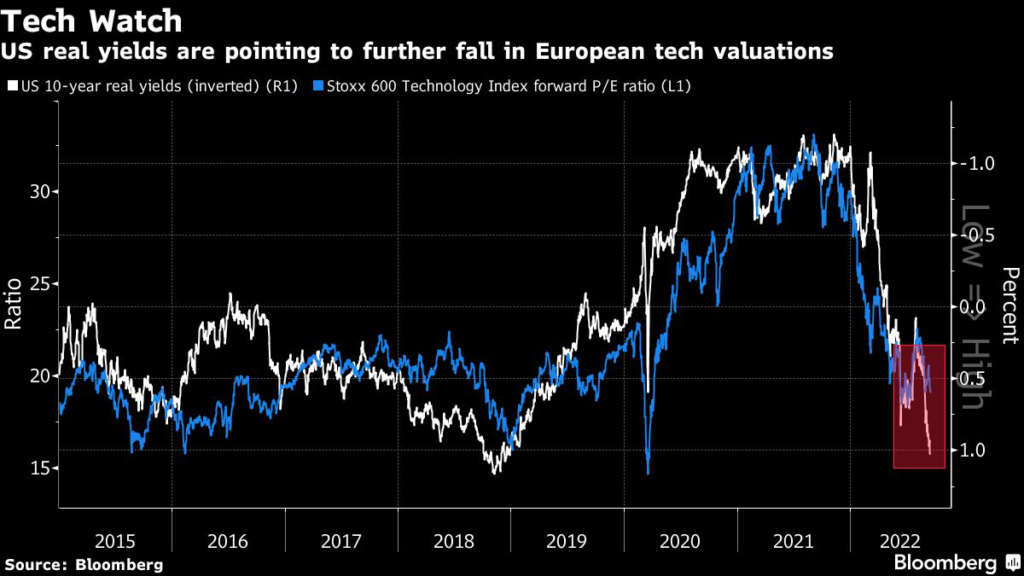
As a core part of the growth category, technology stocks have been at the forefront of this year’s global equity rout due to surging bond yields. And despite its underperformance, the sector “remains very expensive,” according to Barclays Plc strategist Emmanuel Cau.

“With burgeoning signs of lower demand coming from semiconductors, demand destruction may be the next shoe to drop,” Cau said.

Construction, Real Estate

Construction faces a precarious outlook. The industry is “anxiously waiting to see how the double headwinds of squeezed budgets and rising rates will impact demand,” says Danni Hewson, analyst at AJ Bell. Homebuilders like Barratt Developments Plc and Persimmon Plc have plunged more than 40% this year, while Hewson says suppliers to the sector could also be at risk. HeidelbergCement AG and Travis Perkins Plc are among stocks to watch.

Meanwhile, Goldman Sachs Group Inc. analyst Jonathan Kownator warned on Friday of escalating macroeconomic risks for commercial real estate, downgrading Land Securities Group Plc, British Land Co Plc and Aroundtown SA. The sector has a very high negative correlation with bond yields, he said. 

More stories like this are available on bloomberg.com

©2022 Bloomberg L.P.
Ether Falls to Lowest in Seven Weeks; Offshoot Token Plunges

(Bloomberg) — Ether dropped to a seven-week low and a bonus token awarded to holders of the digital asset tumbled as crypto investors turned their attention back to the broader selloff in riskier assets. 

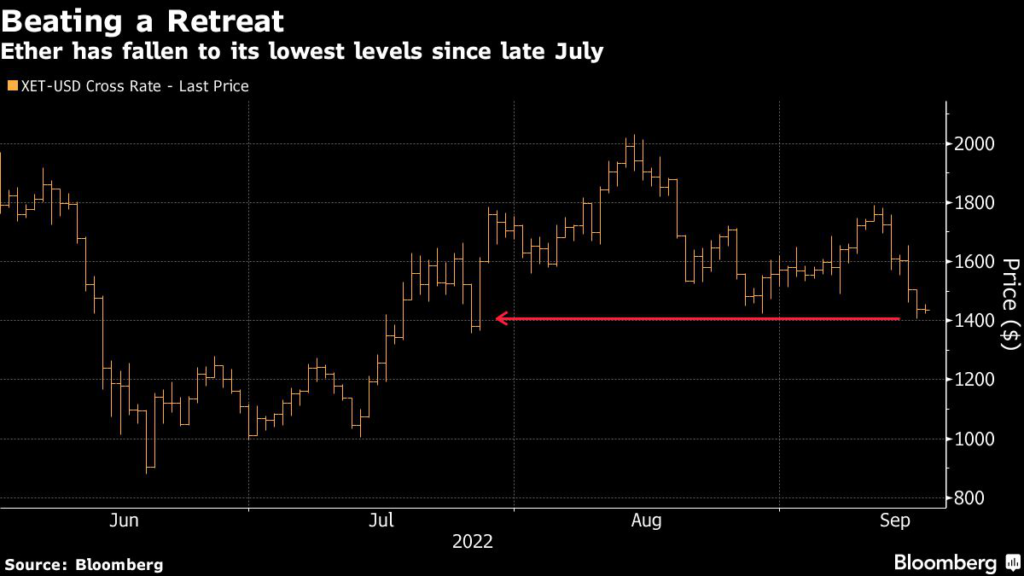
Ether, the native currency of the Ethereum blockchain, fell for five straight sessions, dropping as much as 6.5% to $1,407 on Friday to the lowest since July 27. It was largely holding those losses on Saturday. The transition of the network to a more energy-efficient method of handling transactions known as the Merge had captured the focus of investors for weeks. 

“It’s likely due to a worsening macro backdrop that is causing a decline in value of all risk assets in general,” Christine Kim, a research associate at Galaxy Digital, wrote on Twitter. “There was a widespread view among traders that the Merge was a ‘sell-the-news’ event despite the upgrade’s long-term positive impacts.”   

Bitcoin was up about 0.6% to $19,861 as of 1:20 p.m. in Singapore on Saturday. The largest cryptocurrency by market value slumped around 7.3% in the week ended Friday, compared with a 16% slide in Ether. 

“With the Merge ending up mostly a non-event and overarching macro headwinds still at play, traders unwound their ETH positions and rotated back into Bitcoin,” said Jason Lau, the San Francisco-based chief operating officer of the Okcoin exchange.

The additional cryptocurrency token that investors received after the Merge tumbled since late Thursday. 

EthereumPOW, as the offshoot is known, represents much of the legacy computing operations of the blockchain that chose not to participate in the software upgrade. Ethereum moved from a so-called proof-of-work system to a proof-of-stake method for securing the network.  

The new cryptocurrency rose to a price of as much as $60.68 on Thursday, according to data from CoinMarketCap.com that reflects the value of IOUs on some exchanges, and was on bourses such as FTX before Ether holders received the token. It was trading at about $10.59 on Saturday. 

“Now that the Merge has (very successfully) concluded, we’ve run out of near-term positive catalysts and we’re running into a wall of bearish macro sentiment,” said Henry Elder, head of decentralized finance at Wave Financial.

More stories like this are available on bloomberg.com

©2022 Bloomberg L.P.
Terra Founder Kwon’s Singapore Employment Permit at Risk: ST

(Bloomberg) — Do Kwon, whose collapsed Terraform Labs cryptocurrency ecosystem sparked a meltdown in digital assets, may see his work status in Singapore at risk, the Straits Times reported. 

Kwon has applied to renew his Employment Pass, which gives him the right to work in Singapore and which expires on Dec. 7, according to the report. Kwon applied for an EntrePass — which is meant to allow eligible foreign entrepreneurs to start and operate businesses in Singapore — and was rejected, the Straits Times said, citing Ministry of Manpower records.

The Terra founder faces potential deportation back to South Korea after officials sought to have his passport revoked, according to South Korea’s prosecutor’s office on Thursday. That comes after a court issued arrest warrants for six individuals including Kwon on allegations including the violation of capital-markets law.  

MOM has the discretion to reject work application renewals if there is deemed to be a breach of the law. Some expats had their employment passes revoked after they were found guilty of flouting government-imposed lockdowns in 2020. 

If there’s a police case or lawsuit against a work-pass holder, or other adverse records like involvement in a scam, MOM takes those factors into consideration when considering the person for renewal of the pass, Regent Law criminal lawyer Rajan Supramaniam told the ST.

MOM and Do Kwon didn’t immediately reply to requests for comment from Bloomberg News on Saturday. 

More stories like this are available on bloomberg.com

©2022 Bloomberg L.P.
MicroStrategy’s Saylor Sees Bitcoin Getting Stronger After Merge

(Bloomberg) — MicroStrategy Inc. co-founder Michael Saylor, one of the biggest advocates of Bitcoin, said the software update of the Ethereum blockchain serves to boost the outlook for the world’s largest cryptocurrency. 

Ethereum just moved to a far less energy-intensive method of securing its network knows as proof-of-stake, ditching the power-hungry proof-of-work system that’s criticized for a big carbon footprint and still used by Bitcoin.

Bitcoin now accounts for 95% of the overall market value of tokens using proof-of-work, which “is really the only universally accepted, proven method for creating a digital commodity,” Saylor said via video to a conference in Australia on Saturday. “I see Bitcoin getting stronger, not getting weaker,” he added.

In contrast, some see the green credentials of the Ethereum upgrade — the Merge — as giving its native token Ether, the world’s second largest, a bigger shot at one day topping Bitcoin. Both coins are down about 60% in 2022.

Enterprise-software maker MicroStrategy has spent about $4 billion on Bitcoin purchases and last month reported a more than $1 billion quarterly loss related to the plunge in the digital asset. Saylor remains executive chairman after shedding his chief executive officer role.

More stories like this are available on bloomberg.com

©2022 Bloomberg L.P.

Close Bitnami banner
Bitnami