Bloomberg

BitConnect Promoter Gets 38 Months in $2.4 Billion Ponzi Scam

(Bloomberg) — The top North American promoter of the BitConnect cryptocurrency investment platform was sentenced to 38 months in prison for running a $2.4 billion Ponzi scheme that defrauded at least 4,500 people from 95 countries. 

Glenn Arcaro, 45, was sentenced Friday in federal court in San Diego, where he pleaded guilty in September 2021. Arcaro admitted he fraudulently marketed BitConnect’s proprietary coin offering and digital currency exchange as a lucrative investment. He touted BitConnect’s phony “Trading Bot” and “Volatility Software” as guaranteed ways to make money on the volatility of cryptocurrency exchange markets. 

In reality, BitConnect paid early investors using money received from later investors. BitConnect closed its exchange in January 2018 after getting cease-and-desist letters from state regulators in Texas and North Carolina. 

“Fiscal crimes that combine the allure of cryptocurrency with new technology and a savvy marketing strategy are borderless and often begin through a relationship built on trust, hope, and promise,” said FBI Special Agent Gregory Nelsen, who runs the agency’s Cleveland office. 

Arcaro, a Los Angeles resident, cooperated with prosecutors, court records show. He agreed to forfeit $24 million. 

Bitconnect founder Satish Kumbhani, of Hemal, India, was indicted this year for leading the fraud. But the US Securities and Exchange Commission, which sued him in September 2021, said this year that he “has likely relocated from India to an unknown address in a foreign country.”

The day after BitConnect shut down, one of Kumbhani’s promoters based in South Korea warned that “some people here are talking about committing suicide” and that “lots of [Korean investors] invested everything they have,” according to the indictment. A promoter in Australia also wrote that “we are getting death threats…[and] the coin will be useless!!!!!” 

In November, prosecutors said they would sell about $57 million in cryptocurrency seized from Arcaro. A judge later approved an amended order for the sale.

Read more: BitConnect’s Indicted Founder Kumbhani Vanished, SEC Says

More stories like this are available on bloomberg.com

©2022 Bloomberg L.P.

Texas Social-Media Law on  Web Censorship Upheld by Federal Appeals Court

(Bloomberg) — A federal appeals court upheld the validity of a Texas social media law that companies like Meta Platforms Inc. and Twitter Inc. say will prevent them from blocking hate speech and extremism.

The 5th US Circuit Court of Appeals in New Orleans on Friday lifted a lower court injunction that had blocked the legislation from taking effect.

The Texas law bars social media platforms with more than 50 million users from discriminating on the basis of viewpoint. Texas Governor Greg Abbott and other Republicans argue the legislation is needed to protect conservative voices from being silenced. But tech groups say the measure unconstitutionally bars platforms from removing neo-Nazi and Ku Klux Klan screeds or Russian propaganda about its invasion of Ukraine.

“We reject the platforms’ attempt to extract a freewheeling censorship right from the Constitution’s free speech guarantee,” a panel of judges on the appeals court said. “The platforms are not newspapers. Their censorship is not speech.”

The judges remanded the case back to the lower court for further proceedings, consistent with their opinion.

NetChoice, a trade group representing Facebook owner Meta and other internet companies, said it was disappointed with the decision, which “undermines First Amendment protections.” 

“Balancing free expression and online safety is what makes the internet usable,” the group said in a statement. “When going online, no one should be forced to wade through awful and offensive content.”

The majority opinion was written by Judge Andrew Oldham, who was nominated to the bench by President Donald Trump. Judge Edith Jones, a nominee of President Ronald Reagan, agreed with Oldham. Judge Leslie Southwick, a nominee of President George W. Bush, partly dissented with the majority.

Abbott signed the legislation, known as HB20, a year ago as part of a broader Republican push against what the party sees as censorship of its viewpoints.

Critics of the law have said it will wreak havoc on social media platforms by removing their ability to moderate and remove content that falls outside user guidelines. It would also allow Texas residents to sue platforms if posts are removed by claiming that their content is being censored.

The law runs counter to rising pressure on social media platforms to tighten their rules on content moderation and more effectively ban posts that incite violence or harm. This week, executives from Meta, YouTube, Twitter and TikTok testified before a Senate committee and faced questions over what the companies are doing to protect users.

A similar law in Florida was struck down by the 11th US Circuit Court of Appeals in Atlanta. In its statement, NetChoice noted that that decision was unanimous. The group had hoped that the New Orleans panel would follow the same path. 

“We will not,” the judges wrote in their decision. “Florida’s and Texas’s laws are very different.”

The latest ruling “creates a circuit split with the unanimous decision of the 11th Circuit,” said Carl Szabo, NetChoice’s vice president and general counsel. “We remain convinced that when the US Supreme Court hears one of our cases, it will uphold the First Amendment rights of websites, platforms and apps.”

(Updates with NetChoice comment starting in sixth paragraph.)

More stories like this are available on bloomberg.com

©2022 Bloomberg L.P.

Goldman Sachs Faces Fed Scrutiny of Money-Losing Marcus Consumer Unit

(Bloomberg) — Goldman Sachs Group Inc.’s six-year foray into consumer banking — the unit dubbed Marcus — is the focus of a new review at the Federal Reserve.

Fed officials have been looking into the Wall Street giant’s online-banking platform aimed at retail customers, according to people with knowledge of the matter. For at least several weeks, they’ve been peppering Goldman management with questions and follow-ups in a process that’s still continuing, the people said, asking not to be identified discussing confidential information. 

The review goes beyond the central bank’s regular oversight of the firm, and is distinct from its more frequent industrywide looks at business lines of interest. By zeroing in on Marcus, the central bank is taking stock of a division that’s relatively new and growing substantially inside a company without much history dealing with the general public.

While it’s not indicative of any wrongdoing, it is another headache as Chief Executive Officer David Solomon marches ahead with his ambition to expand Goldman — a merchant of high finance — in the world of consumers: soaking up deposits, issuing credit cards and, at some point, offering checking accounts to the masses. The examination puts yet more pressure on the bank’s leaders to showcase their command of the business and tighten controls. 

Representatives for Goldman Sachs and the Fed declined to comment.

The bank has been signaling recently that it’s taking a more cautious approach toward Marcus’s growth. Behind the scenes, Goldman President John Waldron has assumed a bigger role in overseeing the business in an attempt to bring expenses in line and stanch losses. 

At mid-year, the bank’s own internal forecast estimated the business would post a record loss of more than $1.2 billion this year.

The cash burn has gotten all the more painful in recent months as a pandemic-era surge in Wall Street deals subsides, making Marcus a fraught topic among Goldman managers. Investment bankers and traders bracing for job cuts or lower bonuses are competing with a division that was once supposed to break even in 2022, but has instead eaten up more than $4 billion since inception in 2016. That’s not including Goldman’s acquisition of installment-loans provider GreenSky Inc. in a deal initially valued at more than $2.2 billion last year at what turned out to be the peak of the market for fintech ventures. 

With business lines such as investment banking, capital markets and asset management cooling off, analysts predict the firm will post a more-than 40% drop in net income this year. The shares have tumbled 15% since 2022 began amid a broader selloff of financial stocks.

The earnings slump has Goldman tightening its belt. The bank’s leaders set aside 31% less for compensation in the first half. And in recent weeks, they have been getting ready to resume an annual culling cycle that was paused during the pandemic, sketching out plans to eliminate several hundred roles.

Waldron’s efforts to put Marcus back on track are being welcomed outside the bank. Credit Suisse Group AG analyst Susan Katzke wrote in a note last month that she was assured by Goldman management that, even as the firm remains committed to such growth initiatives, it’s shifting the emphasis toward wealth management and less on retail banking. The Waldron-led team promised a narrower focus on consumer banking after acknowledging the firm “tried to do too much at once,” according to the report. 

Some key executives who helped get the consumer business off the ground are no longer at the company. They include former Chief Financial Officer Stephen Scherr, Harit Talwar, a consumer-banking veteran who was brought on for his retail know-how, and Omer Ismail, who left to run a new banking venture backed by Walmart Inc.

Other authorities have also shown interest in Marcus. Goldman last month disclosed a probe by the Consumer Financial Protection Bureau into the company’s credit-card practices, including how the lender resolves incorrect bills and processes refunds. Such investigations have typically resulted in modest fines and operational tweaks that don’t imperil the business. 

But for Goldman, it’s an unwelcome intrusion into a marquee partnership with Apple Inc., a major client that trumpeted its partnership with the lender when the two firms expanded into credit cards in 2019. 

(Updates with share performance in ninth paragraph.)

More stories like this are available on bloomberg.com

©2022 Bloomberg L.P.

Guinea to Start Trial for 2009 Massacre This Month

(Bloomberg) — Guinea will begin the trial of those accused of a 2009 massacre of opponents in the capital Conakry on Sept. 28, Justice and Human Rights Minister Alphonse Charles Wright said.

The start date, initially set for Sept. 26, was postponed to allow the International Criminal Court’s prosecutor to attend the opening of the trial, Wright said Friday on state-broadcaster Radio Television Guineenne.

The new start date is the 13th anniversary of the massacre, which occurred when security forces opened fire on protesters who had gathered at a sports stadium to demonstrate against military rule led by Captain Moussa Dadis Camara.

Camara has been charged, as well as his aide Aboubacar Diakite. Other defendants include Colonel Claude Pivi, who was minister in charge of presidential security, and Colonel Moussa Tiégboro Camara, then minister in charge of the fight against drugs and organized crime. 

At least 150 people were killed and dozens of women were sexually assaulted, according to a UN commission of inquiry.

“The trial will allow President Moussa Dadis Camara to deliver his part of the truth,” his lawyers said in a statement, adding they expect to obtain a “pure and simple acquittal” for him.

Guinea holds the world’s biggest reserves of bauxite, the raw material used to make aluminum.

(Updates with statement from former leader’s lawyers in next-to-last paragraph.)

More stories like this are available on bloomberg.com

©2022 Bloomberg L.P.

UK Food Producers Face C02 Crunch After Plant Closure

(Bloomberg) — One of Britain’s biggest suppliers of carbon dioxide halted output at a plant in England, further reducing local supplies of the gas vital for production of food from pork chops to fizzy drinks.

CF Industries Holdings Inc. stopped ammonia production at its Billingham factory in northeast England earlier this week, the company said. It warned in August of the temporary outage, which it blamed on soaring natural gas prices. The fertilizer plant produces CO2 as a byproduct, and had supplied 42% of the UK market. 

As well as putting the bubbles in soft drinks and beer, carbon dioxide is used to stun animals for slaughter and in packaging that extends the shelf life of food. The UK market has worked to diversify its CO2 supplies since 2021, when a CF production stoppage sparked chaos in the supply chain.

UK food and drink manufacturers now depend on imports, Kate Halliwell, chief scientific officer for the Food and Drink Federation, said.

“This only adds to the enormous pressures food companies are facing this autumn, from soaring energy prices, volatile exchange rates, rising ingredient costs and stubborn labour shortages,” Halliwell said in an email. “Urgent action is needed to address these issues and we stand ready to work with the new government on ways in which we can do this.”

More than 70% of European fertilizer production capacity has been curtailed in Europe as prices for natural gas, the number one input for most nitrogen fertilizer, has soared. Ensus Ltd., the country’s second-biggest CO2 supplier, also temporarily stopped production for routine maintenance in early September.

The Billingham plant will continue to produce ammonium nitrate, which can be used as a nitrogen fertilizer, and nitric acid.

(Adds comments in paragraphs four, five.)

More stories like this are available on bloomberg.com

©2022 Bloomberg L.P.

If You Work in Film and TV, Get Ready for Layoffs

(Bloomberg) — If you work in film and TV, the bad news is arriving almost daily.

Warner Bros. Discovery Inc. said this week it’s sacking 100 TV ad salespeople, Paramount Global acknowledged it may stop offering Showtime as a standalone streaming service, and Netflix Inc., an industry gravy train for the last decade, announced yet-another round of layoffs.

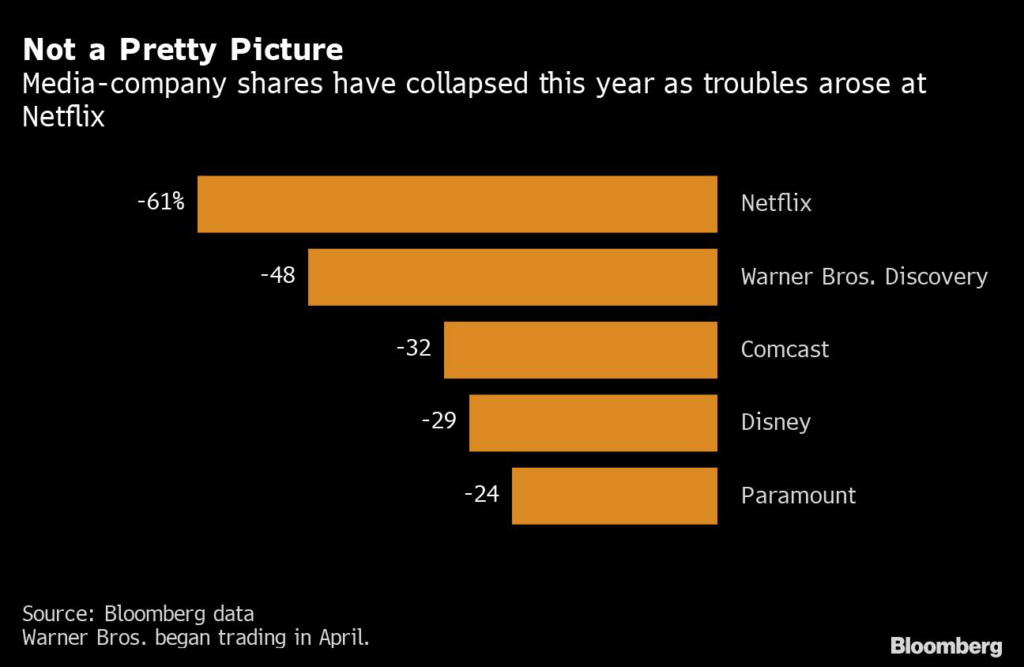
A multiyear boom in film and TV production, driven by media companies racing to sign up subscribers for their new streaming services, has come to a painful halt, giving way to firings, introspection and handwringing. While much of the country only worries about a recession, major media companies are cutting jobs or consolidating. Their stock prices have collapsed.

“The very foundation that the streaming business sits on has been devolving on sand,” Walt Disney Co. Chief Executive Officer Bob Chapek said in a recent interview. “It’s all been shifting.”

Netflix, which shocked the industry and Wall Street earlier this year with its first subscriber losses in a decade, has let go hundreds employees and vacated office space. Warner Bros., which completed its merger with Discovery in April, has been in cost-cutting mode, with CEO David Zaslav working to deliver a promised $3 billion in savings from the deal. 

Profit Matters

Early on, Chapek said, he targeted profitability in 2024 for his Disney+ streaming service because he knew investors would tire of ongoing losses. The company reduced its forecast for content spending this year by about 10%. Chapek said the current number is “steady state.” 

Still, even experienced producers are finding it hard to get projects going at studios, unless they’re based on familiar material.

“Nobody wants to do anything other than sequels,” said Bill Mechanic, a former head of Fox Filmed Entertainment. “It’s harder. The environment has gotten worse.”

That’s creating even more than the usual amount of anxiety in Hollywood.

“There is a general sense of uncertainty of when things will pick back up,” said Sheenie Ambardar, a Los Angeles psychiatrist with many entertainment industry clients. “There’s a general sense of where is this going and how are we going to get out of this?”

Under Zaslav, Warner Bros. will no longer approve movies for its HBO Max streaming service budgeted at more than $30 million to $40 million, agents and producers are being told. That’s half what it was before. The company has stopped ordering reality shows or live-action shows for kids on HBO Max. The Discovery+ service could be folded into HBO Max and supply some of those programs.

Executives at other studios are canceling projects even with stars attached or putting them on the back burner. They’re also regularly asking for 20% reductions in budgets for series, according to talent agents Bloomberg News spoke with. The tighter spending is impacting other ongoing work in Hollywood, like a push to boost diversity on screen. Recent cancellations include “Woke,” a Hulu series about a Black cartoonist, and “Chad,” a TBS show focused on a Persian-American family.

Read more: ABC Relocates ‘Dancing With the Stars’ to Disney+

Agents said they’re now less willing to deliver completed scripts to studios, preferring instead to offer story outlines that executives can ponder and develop a sense of ownership in. Proposals for shows now get sent up to the highest levels for approval, where they can sometimes languish. “The script is on Jen’s desk,” has become a common refrain from Amazon.com Inc. development executives, one agent said, referring to studio chief Jennifer Salke.

“The fear in town is it’s an all-or-nothing game,” said Chris Fenton, an executive producer, most recently of lower-budget pictures such as this year’s “Block Party.” “Either you’re involved in the super-premium category or you’re nervous.”

Spending Spree

Only a few years ago, Netflix was signing high-priced deals with some of the most successful TV creators, including Shonda Rhimes and Ryan Murphy, as well as notables such as the Obamas and Prince Harry and Meghan Markle. Outside of a few hits, most notably “Bridgerton” and “Inventing Anna” from Rhimes, it hasn’t had much to show for it and would be unlikely go on a binge like that again.

The result is fewer employment opportunities, a trend that could worsen if the US falls into a recession. The executive recruiting firm Korn Ferry is seeing a flood of resumes, according to William Simon, who handles entertainment industry placements, and the number of spots to fill is diminishing. 

“Everybody’s pumping the brakes,” he said. 

Project Casting Inc., an online job site for actors and other crew members, said openings for TV and video positions have tumbled 48%, dropping every month since June. “After Netflix announced their subscriber loss, it was a like a shockwave throughout Hollywood,” CEO Jonathan Browne said in an interview.

After posting three consecutive record quarters, filming in Los Angeles County fell 5.8% in the second quarter, as measured by days of shooting. The culprit was TV production, which was down nearly 16%, according to FilmLA, which provides the permits to work in the county.

Fewer Pilots

Some mainstays of the business, such as the pilot, that first episode that was used to test a new show, have all but disappeared as streaming services now go straight to a full series order on concepts they like. The length of a series, typically 22 episodes on broadcast TV, is being cut to just a handful online.

Actor and TV show creator Owen Dennis got his bad news while driving home from work in mid-August. Warner Bros had just pulled his animated show, “Infinity Train,” from the Cartoon Network and HBO Max. A writer with a cult following, Dennis spent the next few days trying to figure out why. In a long post on Substack, he spoke for many in the business about the budget cuts sweeping Hollywood.

“Across the industry, talent is mad, agents are mad, lawyers and managers are mad,” he wrote. “Even execs at these companies are mad.”

More stories like this are available on bloomberg.com

©2022 Bloomberg L.P.

FedEx Miss Is Worst Deutsche Bank Analysts Have Seen in 20 Years

(Bloomberg) — Wall Street analysts didn’t mince words in discussing FedEx Corp.’s forecast for the current quarter — which missed by a landslide — and its withdrawal of full-year guidance. It’s really bad.

To researchers at Deutsche Bank AG it’s the worst report they’ve seen in two decades. 

“FedEx preannounced last night the weakest set of results we’ve seen relative to expectations in our ~20 years of analyzing companies,” the bank’s analysts including Amit Mehrotra said in a note to clients. 

The package delivery giant said in a statement Thursday night that it expects first-quarter earnings, excluding some items, to be $3.44 per share, or roughly 33% below the average analyst estimate of $5.10. In addition, FedEx withdrew its earnings forecast for 2023, saying macroeconomic trends have “significantly worsened,” both internationally and in the US, and are likely to deteriorate further, fueling fears of a broad-based earnings decline.

At least four sell-side analysts covering the stock lowered their recommendations on FedEx Friday, as the stock sank as much as 24% before finishing the day down 21%. Robert W. Baird & Co. analyst Garrett Holland summed up the opinions, calling it an “ugly quarter.” The bleak outlook pushed shares of rival United Parcel Service Inc., e-commerce giant Amazon.com Inc. and European delivery companies well into the red.

“The FedEx warning came as a slap. It’s a solid sign that the economy started slowing,” said Ipek Ozkardeskaya, a senior analyst at Swissquote. “This is certainly the first in a series of warnings that we may see for the quarters to come.” 

Some strategists were already cautious on the earnings outlook before FedEx’s warning. Bank of America Corp.’s Michael Hartnett said in a note Friday that an earnings recession will likely drive US stocks to new lows, while Deutsche Bank strategists have said that company profits are set to drop, putting the S&P 500 at risk of a much deeper selloff.

FedEx isn’t the only company making a warning that the macroeconomic backdrop is likely to impact the bottom line. General Electric Co.’s finance chief said on Thursday that supply-chain challenges are weighing on its third-quarter performance, while some of Wall Street’s biggest banks expect deep declines in investment-banking fees for the current quarter with investors still spooked by inflation, rate hikes and possible recession.

In Europe, the profit warnings have already begun to trickle in. UK conglomerate Associated British Foods Plc warned that profit in the next fiscal year will be lower as rising energy costs and a stronger dollar weigh on its Primark clothing business, while Swedish appliance maker Electrolux AB said earnings would decline “significantly” in the third quarter amid rapidly accelerating inflation and low consumer confidence.

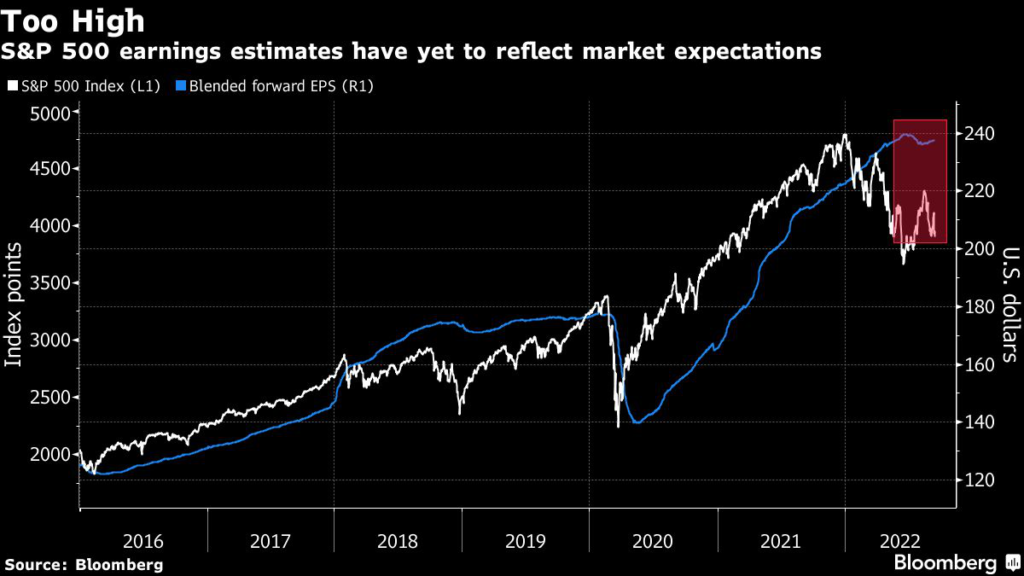
These ominous signs have already prompted analysts to moderate expectations, with weekly earnings downgrades outpacing upgrades for about four months in the US, according to a Citigroup Inc. index. But there may still be a long way to go to reset expectations — analysts’ earnings estimates for US companies are near record highs, despite an 18% slump for the S&P 500 benchmark this year.

To hedge against the myriad headwinds facing companies, some strategists suggest being selective about regional exposures heading into the earnings season.

“The weakness in FedEx earnings is centered in Asia and Europe, where indeed we are seeing the biggest economic challenges, while US activity is reasonably strong,” said Marija Veitmane, a senior strategist at State Street Global Markets. “This fits with our broader assessment of the macro conditions at the moment. Indeed, the US is our favorite market.”

Goldman Sachs Group Inc. strategists agree, saying US firms that do most of their business at home will fare better than those exposed to Europe, where a recession is all but guaranteed. In dollar terms, the Stoxx Europe 600 has lagged the S&P 500 this year, while a Goldman basket of US firms with 100% domestic sales has outperformed one tracking those with high exposure to Europe.

(Updates closing price for FedEx shares.)

More stories like this are available on bloomberg.com

©2022 Bloomberg L.P.
Meta, Nvidia Pummeled in Nasdaq 100’s Worst Week in 8 Months

(Bloomberg) — Investors betting that the worst is over for battered technology stocks got a painful reminder this week that there’s more gloom in store.

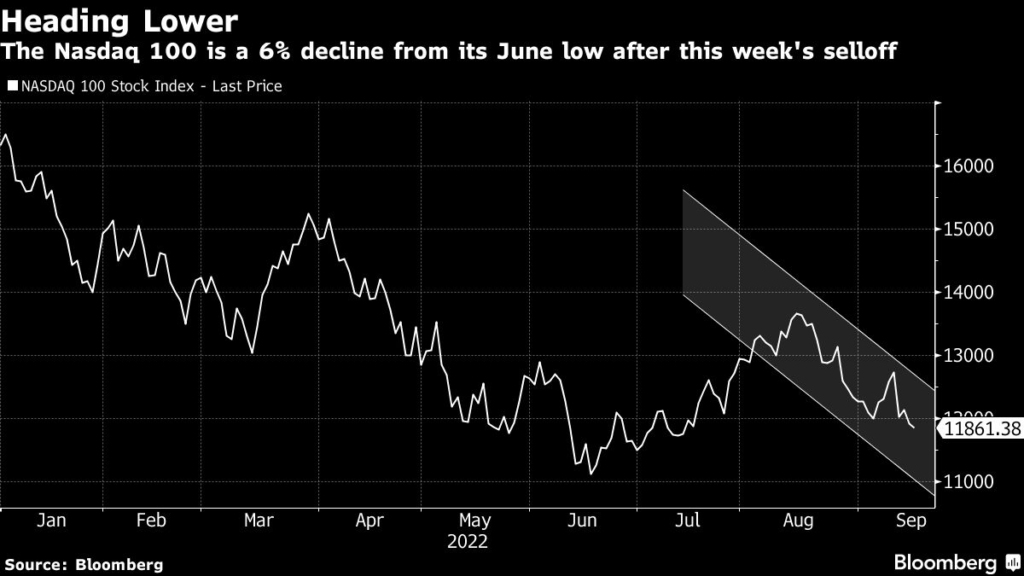
The Nasdaq 100 Stock Index sank 5.8% in its worst week since January, after an inflation report on Tuesday suggested prices could stay higher for longer than anticipated. The loss was the index’s third weekly drop of 4% or more since the summer rebound ended in mid-August. 

The Nasdaq 100 remains above this year’s low reached on June 16, but the gap is narrowing and many of the tech sector’s biggest names are already plumbing new depths. Facebook-parent Meta Platforms Inc. hit the lowest since early 2019 after tumbling 14% this week. Meanwhile, chipmaker Nvidia Corp. is at the lowest in a year-and-a-half following an 8% drop. 

“Big tech faces more pain until inflation is solved,” said Matt Maley, chief market strategist at Miller Tabak + Co. “Markets still need to adjust to the fact that we’re no longer going to have massive levels of liquidity and artificially low interest rates.”

Read more: Meta Eyes Lowest Close Since Jan 2019 as Selloff Accelerates

After this week’s consumer price index report, traders are betting that another three-quarter percentage point rate hike is assured when officials convene next week. Any hints they give about their future pace of tightening will help dictate where the economy and tech shares are headed in coming weeks.

Late Thursday, package-delivery company FedEx Corp. added to fears that the US economy is destined for recession after it withdrew its profit forecast, citing a deterioration in business conditions. The news helped send broad indexes sharply lower on Friday while shares of e-commerce giant Amazon.com Inc. fell more than 2%.

Nine Nasdaq 100 stocks made new lows on Friday, the most since the first week of July, according to data compiled by Bloomberg. Among them were megacap shares like Alphabet Inc. as well as Intel Corp. and Zoom Video Communications Inc.

Still, for some investors, this week’s selloff presents another good opportunity to scoop up tech stocks like Microsoft Corp. at cheaper prices.

Roar Back

Phil Blancato, chief executive officer of Ladenburg Thalmann Asset Management, remains optimistic that inflation is poised to cool in coming months, which would allow the Fed to pause its rate hiking campaign. 

“The second the Fed says we’re going to slow down because we’ve done enough the market will absolutely roar.”

Erika Klauer, a portfolio manager at Jennison Associates, is taking a more cautious approach given how much uncertainty revolves around the Fed’s inflation fight, even though she believes that long-term growth trends for companies with disruptive technologies remain intact.

“If we over-tighten, that will be very painful for corporate earnings and for the consumer pocketbook,” she said. “I think headwinds are going to win over the short term.”

(Updates with closing prices throughout.)

More stories like this are available on bloomberg.com

©2022 Bloomberg L.P.

How Good Is the Apple Watch Ultra? Lifestyle Features Up Close

(Bloomberg) — Apple Inc.’s newest devices are designed to help you be more adventurous outdoors, become a better content creator, and—according to the company—keep yourself alive.

That’s the vibe I got after testing the new iPhone 14 lineups, Apple Watch Ultra, and AirPods Pro 2—Apple’s latest top-of-the-line products. They’re expensive, yes, but many will feel the new offerings make them worth the money.

Apple is releasing three new watch models (Apple Watch SE, Series 8, and Ultra), two iPhone models (the 14 and 14 Pro, each in two sizes), and the second-generation AirPods Pro. As a Bloomberg Pursuits journalist who focuses on lifestyle products, I’m going to home in on those packed with the most features and therefore the priciest ones—the Apple Watch Ultra (from $799) and iPhone 14 Pro (from $999).

Apple Watch Ultra

With a 49mm titanium case and a rugged appearance, the Apple Watch Ultra is not your ordinary smartwatch. Yes, it has all the features other Apple Watches have, but it’s able to handle extreme outdoor conditions.

The customizable “action button,” available only on the Apple Watch Ultra, is on the left side of the device and coated in a color called “international orange.” It’s a new hardware addition to make the watch easier to navigate. By pressing the physical button, you can track workout intervals, start up a built-in diving computer (the Oceanic+ app by Huish Outdoors LLC, available this fall, which automatically launches after you submerge, and calculates and monitors dive parameters), set up a stopwatch, or drop waypoints—geographical pinpoints—along your route.

RELATED: Apple’s Latest Products and Services Are All About Loyalty… to Apple

Coupled with dual-frequency GPS, the waypoints feature allows anyone from hikers to people living in dense urban areas to accurately document the locations they’ve been to and retrace the route they took in case they get lost. Although I didn’t go into the woods to test the GPS system, the working of the function felt intuitive. One push on the action button will drop a pin on the location you’re at, and a simple scroll of the crown on the watch’s right side can take you to the previous point you dropped. Selecting the “Backtrack” function within the Action Button app will map the route you’ve taken.

The regular Apple Watch Series 8 also has the upgraded compass that allows waypoint dropping and backtracking, but it requires more manual maneuvering without the action button—which is probably fine for many folks who don’t worry about getting lost in the wilderness on a regular basis.

In a noisy environment—say, because of the harsh wind on a mountaintop or the hustle and bustle of a big city—the Apple Watch Ultra has an upgraded microphone system to pick up your voice for clear phone calls, as well as a new speaker that can blast a loud emergency siren that Apple says can be heard up to 600 feet, or 180 meters, away. (The demonstrator at the presentation said it was too loud to test there.) Another lifesaving function, also available for the Series 8, is a new sensor to detect a car crash and notify emergency services.

Along with older features for tracking sleep, ECG, heart rate, and blood oxygen, both watch models added two sensors, one on the back of the device and the other inside and behind the display, to discern changes in body temperature. Apple pitches the feature as a family planning tool: By wearing the watch all the time, women can track their ovulation cycles (after it analyzes at least two months of temperature readings) and decide on the best time to get pregnant. The idea seemed cool, but I have reservations about wearing a chunky device on my wrist to bed. And to voluntarily relinquish so much data and control to a piece of technology gave me a bit of Black Mirror flashbacks.

The Apple Watch Ultra, priced at $799, can also sustain 36 hours of battery life, or 60 hours on a low power setting, endure temperatures from -4F to 131F, and remain water-resistant to a depth of 100 meters.

iPhone 14 Lineups

As mentioned, Apple is prioritizing the “lifesaving” aspect of many of the new features. All the iPhone 14s are capable of sending an emergency SOS via satellite (the service will be available in November). That means even without Wi-Fi or cellular data the phones can make emergency calls using satellite technology. They also have a crash detection sensor that will alert emergency services if you’re in an accident.

RELATED: Apple’s New iPhone Sets Off Slew of Wireless Carrier Promotions

Other than the lifesaving functions, there are cool features like setting up multiple lock screens, taking better photos in low light, and more stabilized action videos. I tested the autofocus front camera while uncomfortably taking a selfie under the gaze of a model dressed in all kinds of shades of green, who eventually joined me in a photo and exclaimed, “Look, it can focus on both of us.” It did. In a dim-lit room, I captured another model’s bored face with cameras on both an iPhone 14 Plus and iPhone 14 Pro. The trio of cameras balanced the dark purple and brown colors while showing the person clearly.

The iPhone 14 (from $799) and iPhone 14 Plus (from $899) seem like a standard upgrade from the iPhone 13—including better 12-megapixel wide cameras and different colors (midnight, blue, starlight, purple, and (PRODUCT)RED). Apple offers a 6.1-inch and 6.7-inch screen, respectively, for the two identical designs and eliminated the Mini option.

In comparison, the most exciting features are packed in the pricier iPhone 14 Pro and iPhone 14 Pro Max. Available in a 6.1-inch and 6.7-inch screen, the two cost at least $999 and $1,099, respectively. A notable addition is the pill-shaped black area at the top of the screen, where the speaker and front camera are located. Apple calls it the Dynamic Island. It’s a multitasking tool that helps people track what they’re doing. Say, if you’re listening to music and need to switch to another app, the music app will be automatically shifted up to the island. You can later expand the island to change songs or pause the music. You can also glance at it for a phone call’s duration and an animated waveform of the audio; a voice memo’s recording; a timer’s progress; or see a combination of apps working in the background.

The camera system is a big deal for the iPhone 14 Pro and Pro Max, which each have three cameras in the back. The main wide camera is 48 megapixels, a monumental boost from 12 megapixels for the iPhone 13 Pro.

The Always-On display for the new models dims the screen instead of completely turning it off, so users can see essential information such as the time, date, and temperature without tapping the screen—the essentials are customizable, and you can turn off the Always-On display, too.

And the Fitness app that used to appear on your iPhone only after pairing with an Apple Watch? It’ll show up on your home screen once you upgrade to iOS 16, even if you don’t own an Apple Watch. The Fitness+ tab within the app (coming this fall) is filled with workouts, meditations, and motivational episodes. New Apple Watch buyers get Apple Fitness+ for free for three months (existing owners get one month free), then the subscription is $9.99 a month or $79.99 annually.

More stories like this are available on bloomberg.com

©2022 Bloomberg L.P.
Uber CEO Testifies at Fraud Trial of Security Chief He Fired

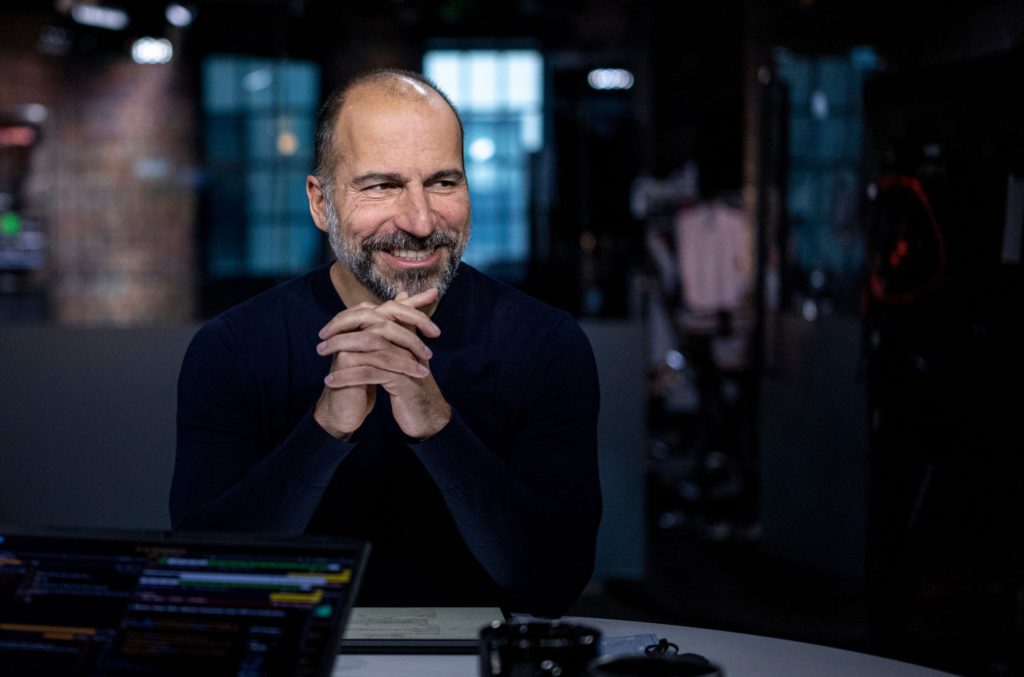
(Bloomberg) — Uber Technologies Inc. Chief Executive Officer Dara Khosrowshahi testified that he fired the company’s chief security officer soon after taking the helm in 2017  “because I couldn’t trust his judgment anymore.”

Khosrowshahi was called by prosecutors Friday as a witness against Joe Sullivan, who’s charged with concealing a 2016 hack into company servers that compromised the personal data of 50 million customers and 7 million drivers.

The CEO said he learned early in his new job of inconsistencies in what Sullivan reported about the incident and why it hadn’t been disclosed to regulators.

“I thought the decision not to disclose at the time was the wrong decision that led me to conclude that I needed to bring in a different head of security,” Khosrowshahi told jurors. “I need to trust my direct reports.”

Sullivan claims the company made him a scapegoat for its tardy public disclosure of the breach.

David Angeli, a lawyer for Sullivan, told jurors in opening arguments that the former security chief was targeted by new management at Uber as part of Khosrowshahi’s campaign to make a clean break from the company’s problematic past.

“His mantra was Uber 2.0,” Angeli said. “He wanted to turn the page of what Uber was doing.” 

Read More: Uber’s Old Problems Deserve New Self-Reflection After Techlash

Sullivan claims Uber’s legal department and other managers were aware of the data breach before it blew up publicly. In legal filings and pretrial arguments he has also said that his firing was calculated by Khosrowshahi to help to close a $9 billion investment deal with SoftBank Group Corp.

Uber was in negotiations with SoftBank at the time and hadn’t yet determined whether it was required to disclose the 2016 hack — until the investment company learned some details and demanded it, according to court filings by Sullivan.

“We are changing the way we do business,” the new CEO wrote in a November 2017 blog post disclosing the breach, the same week Uber fired Sullivan and another executive.

Khosrowshahi was asked by a prosecutor why there was a “delay” on the disclosure after he discovered discrepancies in Sullivan’s account of events.

Read More: Uber Hacks Past and Present Hang Over Ex-Security Chief’s Trial

The CEO said the company “moved quickly as we thought was responsible” to learn the truth and publicly disclose it.

“I wouldn’t characterize it as a delay,” he testified.

Uber has cooperated with US prosecutors; the company and the government has been aligned in arguing Sullivan was a rogue employee. Uber’s lawyer has accused Sullivan’s legal team of manufacturing a “conspiracy theory” about the company serving him up to the US Justice Department.

Sullivan, a former federal prosecutor and longtime Silicon Valley fixture who previously headed security for Facebook, is charged with obstructing a government investigation and defrauding drivers in addition to hiding the data breach. He faces as long as 20 years in prison if convicted of the most serious charges against him — though his sentence would likely be far less.

He spent 2 1/2 years at Uber as one of then-CEO Travis Kalanick’s top lieutenants before a series of scandals drove the co-founder out of his job. Sullivan most recently worked as chief security officer for Cloudflare Inc.

In an odd twist, Uber disclosed late Thursday that the company was investigating a new breach by a hacker who claimed to have penetrated its internal databases.

The case is U.S. v. Sullivan, 20-cr-00337, U.S. District Court, Northern District of California (San Francisco).

(Updates with CEO’s testimony)

More stories like this are available on bloomberg.com

©2022 Bloomberg L.P.
Close Bitnami banner
Bitnami