Bloomberg

Amazon Antitrust Offer Gets Guarded Welcome From EU’s Vestager

(Bloomberg) — Amazon.com Inc.’s proposals to settle two European Union competition probes “appear relevant” to address concerns but might need some more improvements, according to the bloc’s antitrust chief.

The European Commission has started to assess industry feedback on the company’s offer concerning the use of non-public data from sellers on its marketplace and a possible bias in granting sellers access to its Buy Box and its Prime program, Competition Commissioner Margrethe Vestager said in prepared remarks for a speech in the US on Friday.

“The commitments offered by Amazon appear relevant to address the harm and have the potential to transform Amazon’s business model as a marketplace and retailer,” she said. “But we are not there yet” and “are now in the process of assessing” feedback, “some of which pointed to potential improvements on several points.” 

Amazon Seeks Antitrust Truce With EU as Scrutiny Intensifies

The settlement offer included a commitment to stop using data on independent sellers on its marketplace for its competing retail business, and “to apply equal treatment to all sellers when ranking their offers for the purposes of the selection of the winner” for a “buy box,” where Amazon highlights sellers of a particular product.

Earlier this month, a group of civil society groups and non-governmental organizations urged the commission to reject Amazon’s offer, saying the remedies are “weak, vague and full of loopholes.” 

Instead, the commission should “continue vigorously to pursue its antitrust cases against Amazon, imposing remedies and penalties (on the Commission’s own terms) as necessary,” they said in a letter.

More stories like this are available on bloomberg.com

©2022 Bloomberg L.P.

Here’s What Happened in the City of London This Week

(Bloomberg) — Good afternoon from Bloomberg’s UK finance team. Here are five news stories from the Square Mile and beyond that caught our eye this week.

1)  UK’s New Government Courts Bankers on Toxic Bonus QuestionThe new chancellor has dived head first into one of the most contentious political issues in UK finance.2)  Barclays Is Buying Back $7.7 Billion of Securities After MistakeBarclays is close to concluding a buyback of securities after the bank accidentally issued billions of dollars more structured and exchange-traded notes than it had registered with the Securities and Exchange Commission. 3)  HSBC CFO Says Bank May ‘Materially’ Raise Staff Pay in 2023HSBC Chief Financial Officer Ewen Stevenson said rising inflation could force the bank to significantly raise salaries as it eyes “brutal” cuts in an attempt to keep a lid on costs.

4) Woodford Administrator Faces Possible £306 Million Hit, UK SaysThe Financial Conduct Authority said the administrator of Neil Woodford’s failed fund could face a penalty of up to £306 million over its collapse, a first indication of the likely findings from the UK regulator’s longrunning probe.5)  King Charles Means £18 Billion Shift for Royal Family’s FinancesQueen Elizabeth II’s death is prompting an outpouring of grief around the world and bringing parts of the UK to a standstill ahead of her state funeral on Monday. Less visibly, it also set in a motion a wholesale restructuring of the royal family’s finances.

More stories like this are available on bloomberg.com

©2022 Bloomberg L.P.

Maker of Lunar Landers to Go Public in Blank-Check Deal

(Bloomberg) — Intuitive Machines LLC plans to go public through a blank-check deal valuing the space exploration company at more than $1 billion.

The firm will be listed on the Nasdaq exchange after a combination with Inflection Point Acquisition Corp., according to a statement Friday. The boards of both companies have unanimously approved the deal, which is expected to be completed in the first quarter of 2023.

The move will give Intuitive Machines access to additional capital as it tries to fortify its position providing technology and services for lunar missions at the same time that NASA is plotting a return to the moon. The Houston-based company expects to transport government and commercial payloads to the surface of the moon with its lander, called Nova-C, early next year.

NASA awarded the company and two others multimillion-dollar contracts in 2019 through the space agency’s Commercial Lunar Payload Services program. The winners had been expected to fly as early as 2020, while Intuitive Machines at the time was targeting a landing in mid-2021. 

One of the three original contract winners dropped out, but Intuitive Machines and the remaining award winner, Pittsburgh-based Astrobotic Technology, are still in competition to be the first CLPS provider to land on the moon — and potentially become the first commercial US company to bring a private lander to the lunar surface.

“We are all still in the very early days of this new phase of space exploration, with tremendous growth potential ahead,” Kam Ghaffarian, Intuitive Machines’ co-founder and executive chair, said in the statement.

The Intuitive Machine launch plan marks a shift from its prior target to lift off by the end of this year. The company’s lander will ride on a Falcon 9 rocket under an agreement with Elon Musk’s SpaceX.

Lunar Data

Beyond lunar transportation services, Intuitive Machines says it’s also focused on “lunar data services” by building out a constellation of lunar satellites that can help with communications and navigations on the moon. The company is also working on services in Earth orbit, such as satellite refueling and orbital debris removal, as well as other space products and services like propulsion, navigation and engineering.

Intuitive Machines projects $102 million of sales this year and $291 million in 2023. As a public company, it will have an implied enterprise value of $815 million and pro forma equity value in excess of $1 billion, assuming no redemptions by Inflection Point shareholders, the companies said.

Inflection Point holds about $330 million of cash in trust. Intuitive Machines’ existing equity holders are expected to own about 62% of the combined company after the transaction.

Inflection Point shares rose 1.5% at 9:40 a.m. in New York.

(Updates with stock movement in final paragraph)

More stories like this are available on bloomberg.com

©2022 Bloomberg L.P.

Shopify Lets Staff Decide Cash-Stock Pay Mix as Shares Dive

(Bloomberg) — Shopify Inc. is changing its compensation practices to let staff decide how much of their pay will be cash versus equity, as volatility continues to buffet shares of technology companies.

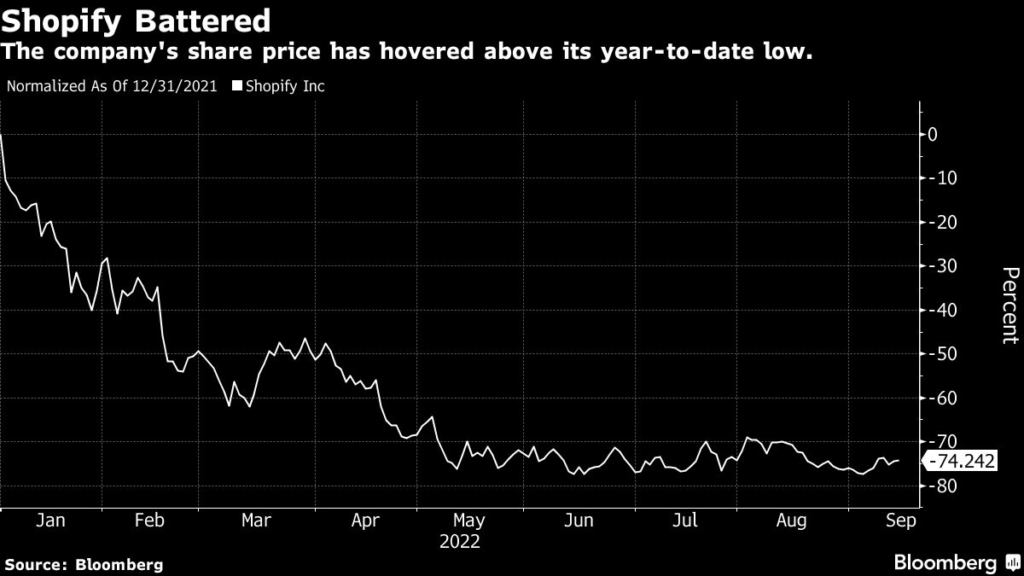
The Canadian e-commerce firm, which has seen its share price fall 75% this year, will allow employees to choose a mix of cash, restricted stock units and stock options, with the ability to withdraw equity immediately. 

Under the previous structure, management determined the mix of cash and stock that staff would receive. Equity was locked in for the first year of employment.

“The ongoing industry-wide realities in which we had to operate were not uncomplicated: compensation tied to market value; geographic salary disparities for a global workforce; and the few making choices for the many,” the company said in a blog post.

Shopify stressed that the shift will provide flexibility to employees who may opt to receive more cash when saving for a house, for example. That said, staff will receive a 5% bonus if they allocate more money to equity than is required under minimum “guardrails.” These vary from country to country, based on legal requirements, the company said.

The move is the latest in a string of changes Shopify has enacted over the past year. In July, it cut about 10% of its workforce, with Chief Executive Officer Tobi Lutke acknowledging he overestimated how much e-commerce would grow after the pandemic compared to physical retail. 

In June, the company completed a 10-for-1 split of its common stock in a bid to spark interest among retail investors. But it appears to have had little impact. 

Shopify shares fell 4.5% to C$42.77 at 9:41 a.m. in Toronto.

(updates with share price)

More stories like this are available on bloomberg.com

©2022 Bloomberg L.P.

Figma’s Record-Breaking Sale to Adobe Delivers Billions to Top VCs

(Bloomberg) — Danny Rimer first invested in Figma in 2012, shortly after the company was established and began developing software tools for designers. Rimer, a partner at the venture capital firm Index Ventures, invited Figma’s co-founder and chief executive officer, Dylan Field, to dinner and ordered a bottle of wine to celebrate the deal. It was then that the young entrepreneur hesitated. “Danny, I’m 19,” Field said. Rimer went ahead, he recalled, and ordered the Pinot anyway.

On Thursday, Adobe Inc. said it will buy Figma in a deal valued at about $20 billion — the largest exit of a privately held, VC-backed startup in at least 20 years, according to PitchBook data. Field, 30, is now of legal drinking age in the US, and both he and Rimer stand to make a lot of money from the sale.

Index is the biggest outside shareholder in Figma. It holds more than 12%, said a person familiar with the business who asked not to be identified because the information is private. Rimer and Figma declined to comment on the size of Index’s stake. The firm’s first check and its subsequent investments are now worth about $2.6 billion.

Field had made an early impression on Rimer as an intern at Flipboard, which makes a news aggregation app. Rimer was on the board and watched a young Field give a polished presentation. Field briefly attended college, but dropped out to join a fellowship program funded by Peter Thiel and soon went to work on Figma. At the outset, Field told Rimer he would spend up to three years developing Figma’s design tools before releasing them to the public. “It wasn’t an incremental, small thing,” Rimer said.

Figma amassed a roster of some of the top VC firms as its backers. Greylock Partners got in as the lead investor of a $14 million funding round in 2015, and Kleiner Perkins led a $25 million round in 2018; its stake is nearly 11%, said people familiar with the business. The early backers each ended up with at least $2 billion, said another person, who also asked not to be identified discussing private details.

Sequoia Capital invested in 2019, valuing Figma at $440 million. (The Sequoia partner who did the deal, Andrew Reed, tweeted a photo of Field signing the original paperwork with some of the terms clearly legible.) Sequoia put in $97 million in total and snatched a 6% stake in Figma, said a person familiar with the details. Sequoia’s stake is now worth $1.3 billion, and the single investment had a return exceeding the total value of the US growth fund it came from, the person said.

Another storied firm, Andreessen Horowitz, invested in Figma in 2020 and its stake is now worth about $500 million, according to a person familiar with the situation.

As for Rimer, he’s been thinking a lot about the dinner in 2012. To mark Thursday’s news, Rimer said he plans to send Field a case of wine.

(Corrects detail about VC-backed exits in the second paragraph. An earlier version corrected the size of Sequoia’s stake.)

More stories like this are available on bloomberg.com

©2022 Bloomberg L.P.

Elon Musk Enters In-Flight Wi-Fi Market With Small Satellites

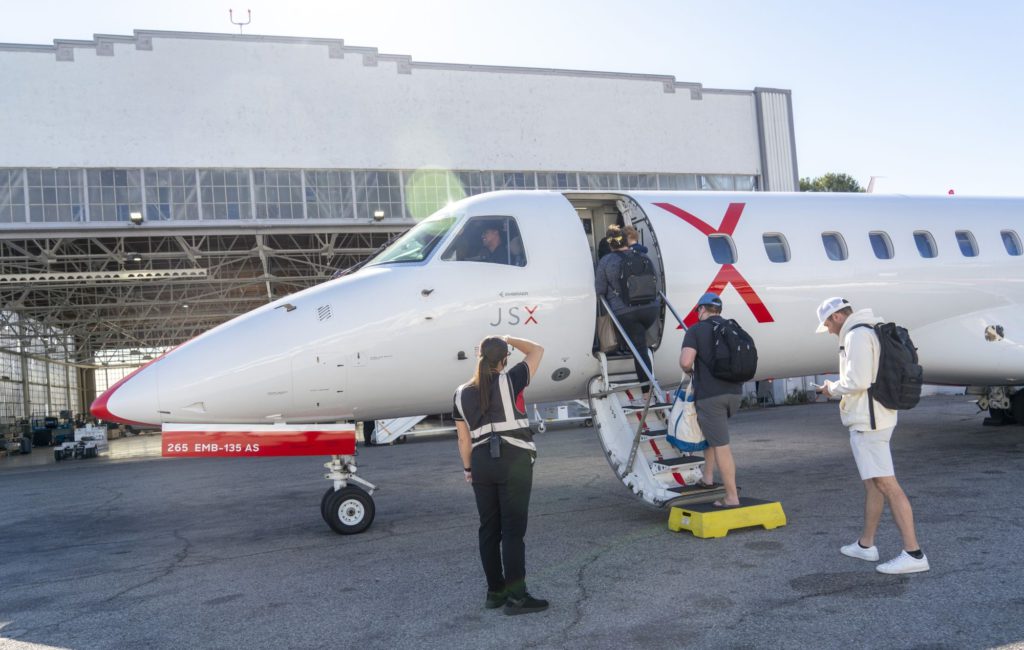
(Bloomberg) — SpaceX wants to show the world its Starlink satellite system can deliver Netflix and YouTube at 30,000 feet. So it recently held a demo for the media aboard a jet operated by its first airline customer, regional carrier JSX. 

The short jaunt from Burbank to San Jose, California marks the start of Elon Musk’s bid to seize in-flight business from satellite providers Intelsat and Viasat Inc. that already serve thousands of aircraft.

It won’t be easy, even for a serial market disrupter such as Musk.

“Are they a serious competitor? Yes,” said Jeff Sare, president of commercial aviation for Intelsat, a leading provider of wireless service on airlines. Still, Sare said, “We don’t believe there’s anybody that can beat us.”

Starlink, part of Musk’s Space Exploration Technologies Corp., delivers broadband from a constellation of low-flying small satellites. Lower satellites circle the planet in 90 to 120 minutes. That’s a departure from the established practice of using a few powerful spacecraft in higher and slower orbits. An upside for Starlink is its signals arrive sooner. 

That’s a plus for the company’s core business of serving broadband to mainly rural households in sparsely populated areas. Starlink has launched more than 3,000 satellites and serves over 400,000 subscribers, the company said in recent filings.

But a downside for Musk’s technology is that small satellites have less capacity and may struggle to meet the needs of big aircraft in crowded skies. Scores of airliners swarm travel hubs, with each plane carrying 100 or more connected passengers. Because satellites whiz around the globe, only a few may be serving an area such as Atlanta and its busy airport, raising capacity questions, B. Riley Financial said in a note last year. SpaceX said projections underestimate how quickly the system is evolving.

US regulators recently cited Starlink’s “still developing technology” when they turned down the service for an $866 million government subsidy.

Starlink says it can serve aircraft of all sizes, and cites an agreement with the parent of Hawaiian Airlines to serve large Airbus and Boeing planes. As for the subsidy rejection, the company said it was unfairly rejected by officials who judged the current data speeds rather than the faster service envisioned when the celestial network is built out. 

“You’ve got to get it to work, and you’ve got to get it cheap,” said Chris Quilty, a partner at Quilty Analytics, a consultant to the space and satellite industry. “It’s a very complex market. And the airlines have historically been exceedingly cautious.”

Starlink executives know they have their work cut out for them. “There are a lot of challenges to get to where we want to be,” said Jonathan Hofeller, vice president of Starlink commercial sales. “It will take time for people to adopt the mentality that JSX and Starlink have.”

The company’s deals with JSX and Hawaiian, announced in April, came after SpaceX had pitched Starlink to four of the largest US airlines, without success, according to people familiar with the issue.

“This is a foot in the door for Starlink,” said telecommunications analyst Roger Entner. “This is the proof of concept. Once it works on JSX it will work everywhere.”

Part of the attraction for JSX was Starlink’s flat antenna, not much bigger than a large pizza box. It’s less bulky than the swiveling dishes widely used by other satellite services, so it fits atop the bodies of the smaller regional jets from Brazil’s Embraer SA that JSX flies. 

The antenna “is definitely an advantage in terms of winning in-flight connectivity contracts for regional aircraft,” said Louie DiPalma, an analyst with William Blair & Co. The firm does business with Viasat.

Airlines in coming years may upgrade over 1,000 aircraft in regional fleets from slow legacy internet systems, and Starlink is “a leading contender” to win such contracts, DiPalma said. 

Intelsat says it remains the largest provider of in-flight service, with about 2,000 aircraft linked by its satellites and about 1,000 aircraft connected by air-to-ground systems that communicate with earthbound gear. Viasat says its in-flight system serves about 1,930 aircraft, with agreements to outfit another 1,210 planes.

About 10,000 commercial aircraft already have in-flight wireless, a number projected to exceed 36,000 by 2031, according to NSR, a satellite and space industry researcher owned by Analysys Mason. Annual revenue in the market is expected to more reach more than $7.3 billion by 2031, from $1.9 billion in 2021, NSR said in an email. 

On the JSX test flight, the Starlink system consistently registered transmission capabilities exceeding 100 megabits per second, as measured by the Ookla app, a testing service. There were about a dozen people aboard. Additional devices onboard boosted demand to the equivalent of 20-to-30 passengers using the system. 

“I’m thrilled,” said JSX Chief Executive Officer Alex Wilcox, who was aboard the flight over California trying out web surfing and WhatsApp calls on the system. “It exceeded my expectations.”

Days after the test flight, a cross-country trip on a full American Airlines Airbus with Viasat gear and more than 100 passengers delivered around  2.2 megabits per second.

On both flights, Netflix and YouTube videos flowed smoothly and two-way video chats worked well via WhatsApp. On each plane, email was received and sent out with ease, another selling point – or perhaps not – for those who recall air flight as a refuge from work.   

More stories like this are available on bloomberg.com

©2022 Bloomberg L.P.

GM’s Cruise Pushes Past Glitches to Map Robotaxi Expansion

(Bloomberg Businessweek) — It was a bit surprising when Cruise, the autonomous vehicle startup that’s 80% owned by General Motors, said it planned to expand its robotaxi service to Phoenix and Austin over the next three months.

The company had just recalled a previous version of its self-driving software that was in use when a car got in an accident with a human-driven Toyota Prius back in June. That same month, a bug in the system caused about a dozen Cruise autonomous vehicles to all stop in one intersection, blocking traffic for hours. There were no serious injuries — and the Prius driver was speeding — but it seemed like one of the many moments when self-driving technology had some glitches and needed to pause.

Not so, said Cruise Chief Executive Officer Kyle Vogt. After providing thousands of truly driverless rides and doing a lot more testing, those two incidents were rarities, he said. The software is becoming a better driver all the time, Vogt said. The barrier to deploying these robot-driven rides to even more cities has nothing to do with whether the autonomous technology is safe enough, he said, it’s how fast GM can manufacture the cars.

“The technology works, there are people using it,” Vogt said. “We’re putting cars in the cities. Now we just need to build more of them.”

GM is pumping $2 billion a year into Cruise and will begin building the Origin, a 4- to 6-passenger shuttle designed solely to be used for autonomous ride sharing, alongside the electric Hummer pickup next year at its plant in Detroit. Cruise is using a modified version of the Chevy Bolt EV now, but will switch to the Origin as the plant starts cranking them out.

I took a 30-minute ride in the car and thought it did quite well. The fastest speed I noticed was 24 miles per hour. It also doesn’t make a right turn on red. But it did navigate San Francisco’s busy streets and the plethora of pedestrians quite well. Since it’s San Francisco, the car rarely could get up to anything even close to highway speed. A Lyft driver told me he doesn’t like getting stuck behind Cruise’s cars. I suspect that will be different on the broad streets of Phoenix and Austin, where motorists can easily go faster than 40 mph. 

Vogt said that once the car can handle San Francisco, “it works well out of the box in other cities.” After Phoenix and Austin, Cruise has a list of Sun Belt cities it is eyeing up, said Rob Grant, the company’s government affairs director. Rapid expansion is how Cruise thinks they will get to $1 billion in revenue by the end of 2025.

Cruise won’t talk about profit forecasts, but Vogt did say the business will be helped by the fact that the Origin is cheaper to build than the modified Bolts they are using now. Cruise is also working on robots to charge up the vehicles when the battery runs down and clean the cars if a passenger makes a mess. Vogt said he can imagine a day in a couple of years when humans don’t touch an Origin for “a couple hundred thousand miles.”

Interestingly, Cruise thinks that with a larger Origin, more people will take shared rides. Right now, few Uber and Lyft riders take a shared ride. In a small car like the Bolt, two strangers might find it awkward. But in a bigger and more comfortable space, Vogt said said people might take the option and get a lower fare to do it.

Either way, Cruise thinks autonomy has finally arrived as a business and not just an expensive R&D exercise. The company will start small as it expands into new cities, but if Cruise can avoid any more snafus it may be onto something big.

More stories like this are available on bloomberg.com

©2022 Bloomberg L.P.

Schroders to Spend $1 Billion a Year On Secondary Private Equity

(Bloomberg) — Schroders Plc plans to double the amount of money it invests in pre-existing private equity deals to around $1 billion a year, seeking to take advantage of a growing trend for buyout managers holding onto businesses for longer.

The London-listed firm is focused on general partner-led secondaries deals. Usually a buyout firm, also known as a general partner, needs to sell its portfolio companies after a set period and return money to its investors. In secondaries deals, Schroders replaces investors who want to cash out — giving the buyout firm more time to improve the business’s valuation, all the while generating fees. 

“There is a lot of opportunity here,” said Christiaan van der Kam, head of secondaries at Schroders Capital, the $939 billion investment group’s private assets platform. “There are fewer active investors in the GP-led market today versus last year given current market challenges. Furthermore, deals are being repriced downward and buy-side terms are improving.”

Van der Kam said the firm’s sweet spot is small or mid-market deals. Schroders Capital has invested more than $1 billion in over 30 transactions since the onset of Covid-19. Van der Kam, who joined from Unigestion in September 2020, plans to grow his six-person team to 10 by the end of next year. 

Demand for GP-led secondaries deals hit a record $60 billion in 2021 but have since tumbled, according to a report by Campbell Lutyens & Co., a private markets advisory business. 

Read more: Private Equity Fees at Risk as Continuation Funds Lose Luster

More stories like this are available on bloomberg.com

©2022 Bloomberg L.P.

Ethereum Faces ‘Blockchain Trilemma’ as ‘Merge’ Mania Cools

(Bloomberg) — After much celebration over the successful transition of Ethereum, the question remains what’s next for the most commercially-significant crypto project. 

The long-awaited software revision, termed the Merge, shifted the blockchain from a so-called proof-of-work system to a more energy efficient proof-of-stake method for securing the network. There was no changes related to network transaction costs or speed, which are common gripes among Ethereum users. 

Completing the upgrade without any software downtime is a brilliant engineering feat, said Harsh Rajat, the Mumbai-based co-founder of Ethereum Push Notification Service or EPNS. “Akin to changing the foundation of a skyscraper while it still remains standing!”

Now developers will address a key existential question. The Merge was the first step toward a series of upgrades on Ethereum to solve the scalability trilemma. After some point, the theory suggests that a blockchain has to compromise on one of its three key aspects — scalability, decentralization and security. And that a blockchain cannot have all three at the same time. 

Read More: The ‘Blockchain Trilemma’ That’s Holding Back Crypto: QuickTake

For Ethereum the first step to solve this problem was moving to POS with the merge and next comes four more phases of development.

  • The Surge: Implementation of sharding, a scaling solution which will lower the cost of bundled transactions on Ethereum.
  • The Verge: Introduction of ‘verkle trees,’ an update which will make the network more decentralized by making it easier for users to become validators.
  • The Purge: Elimination of historical data and technical debt.
  • The Splurge: Miscellaneous updates after the first four stages to ensure smooth functioning of the network.

“The ultimate aim for all these upgrades is to make Ethereum more scalable, faster and cheaper to use,” said Aditya Khanduri, head of marketing at Biconomy, a protocol that helps improve user onboarding and transaction experience on decentralized applications.   

“It’s hard to talk about the timelines of the following four stages because all of them are still under active research and development. But, in my opinion, it will easily take 2-3 years before all phases are complete,” said Sameep Singhania, co-creator of QuickSwap, a decentralized exchange built on Ethereum scaling solution Polygon.

The network will eventually be able to process 100,000 transactions per second after the completion of these five stages, according to Ethereum co-founder Vitalik Buterin.

In the meantime, more investors in Ether, the native token of the network, are expected to lock up their tokens in digital wallets that earn their owners a return under the new proof of stake format. But they won’t be able to take them out, at least not for a while.

Locked Ether plays a vital role on the upgraded network. Wallets with what’s being referred to as staked Ether are being used to help order network transactions. Currently, about 11% of Ether is already locked up — either directly or via providers such as Lido, Coinbase Global Inc. and Kraken — in staking wallets on the Beacon Chain of Ethereum that was used to test the process, according to blockchain analytics firm Nansen.

Ethereum will have to undergo yet another software change dubbed Shanghai, which is at least six months away, to enable withdrawals of the staked Ether. Even then, the withdrawals will be capped.

“After the Merge, the Ether locked in the staking contract would still not be available to withdraw,” said Kunal Goel, a research analyst at Messari.  

Ethereum developers are also working on something called EIP 4844, or Proto DankSharding, that seeks to minimize the high network transaction costs referred to by users as gas fees, Goel said. 

Ether declined for a fifth day, dropping about 2.2% to $1,469 as of 7 a.m. in New York. 

More stories like this are available on bloomberg.com

©2022 Bloomberg L.P.

South Korea, China to ‘Closely Communicate’ on US Missile Shield

(Bloomberg) — South Korean President Yoon Suk Yeol told Li Zhanshu, China’s top legislator, that he doesn’t want a US-made missile shield deployed by Seoul to become “an obstacle to relations” after Beijing slammed its use.

The talks on Friday in Seoul with China’s National People’s Congress chairman took place after Yoon floated expanding the system known as Thaad — Terminal High Altitude Area Defense. Li agreed with Yoon to continue to “closely communicate” regarding the matter, a statement from South Korea’s presidential office said.

Yoon has been trying to balance relations between its long-standing US ally and China, South Korea’s biggest trading partner. The president sent ripples through relations with Washington when he decided against having a face-to-face meeting with US House Speaker Nancy Pelosi during a trip to Seoul last month. The snub of the first sitting House speaker to visit the country in about 20 years drew criticism from members of South Korea’s opposition and Yoon’s own conservative party. 

South Korea Leader Snubs Pelosi Over Holiday, Adding to His Woes

Yoon has pledged make the current Thaad system fully operational and install another unit in the Seoul area. China objects to the shield over concerns its powerful radar would allow spying on its own missile systems.

“I highly appreciate your role in developing our bilateral relations,” Yoon said to Li during the meeting, according to South Korea’s presidential office. Li thanked Yoon for taking time to have talks, the office said. 

South Korea Says Missile Shield ‘Not Negotiable’ With China 

Yoon’s office earlier said the president plans to meet US President Joe Biden next week when he travels to New York for a session of the United Nations General Assembly. 

South Korea has shown its displeasure over the Inflation Reduction Act signed last month by Biden, which includes tax credits of as much as $7,500 for purchases of electric vehicles made in North America. That could disadvantage major South Korean brands like Hyundai and Kia, which don’t have operational EV plants in the US. 

South Korea Sees ‘Betrayal’ in Biden’s Electric Vehicle Push

That friction risks Biden’s efforts to build a tighter network of partners to counter China’s rising influence. Yoon’s administration has remained non-committal about joining Biden’s Chip 4 Alliance, a new group of major powers that also includes the US, Taiwan and Japan and is aimed at safeguarding the supply of semiconductors. China’s opposition to the move could blow back on South Korea’s chipmakers. 

Since coming to office in May on pledges to take a tougher line with Beijing, Yoon has stepped up security cooperation with the US and sought to align his country more closely with America’s allies in Europe — attending a NATO summit in June.

NATO Finds Embrace in China’s Backyard, Stoking Xi’s Worst Fears

More stories like this are available on bloomberg.com

©2022 Bloomberg L.P.
Close Bitnami banner
Bitnami