Bloomberg

Brace for More Profit Warnings as FedEx Flags Slowing Economy

(Bloomberg) — FedEx Corp.’s warning has rattled markets in the US and Europe as a realization sinks in for investors — it’s probably the first of many.

Shares in the package-delivery giant plunged 20% in premarket trading, dragging US index futures lower, after the company withdrew its earnings forecast, saying macroeconomic trends have “significantly worsened,” both internationally and in the US. Conditions could deteriorate further in the current period, FedEx said, fueling fears of a broad-based earnings decline.

FedEx Pulls Outlook on Macro Worries in Ominous Sign for Economy

“The FedEx warning came as a slap. It’s a solid sign that the economy started slowing,” said Ipek Ozkardeskaya, a senior analyst at Swissquote. “This is certainly the first in a series of warnings that we may see for the quarters to come.” The bleak outlook also hit shares of rival United Parcel Service Inc., e-commerce giant Amazon.com Inc. and European delivery companies.

Some strategists were already cautious on the earnings outlook before FedEx’s warning. Bank of America Corp.’s Michael Hartnett said today that an earnings recession will likely drive US stocks to new lows, while Deutsche Bank AG strategists have said that company profits are set to drop, putting the S&P 500 at risk of a much deeper selloff.

Aside from FedEx, some other firms have also warned that the macroeconomic backdrop is likely to impact earnings. General Electric Co.’s finance chief said on Thursday that supply-chain challenges are weighing on its third-quarter performance, while some of Wall Street’s biggest banks expect deep declines in investment-banking fees for the current quarter with investors still spooked by inflation, rate hikes and possible recession.

In Europe, the profit warnings have already begun to trickle in. UK conglomerate Associated British Foods Plc warned that profit in the next fiscal year will be lower as rising energy costs and a stronger dollar weigh on its Primark clothing business, while Swedish appliance maker Electrolux AB said earnings would decline “significantly” in the third quarter amid rapidly accelerating inflation and low consumer confidence.

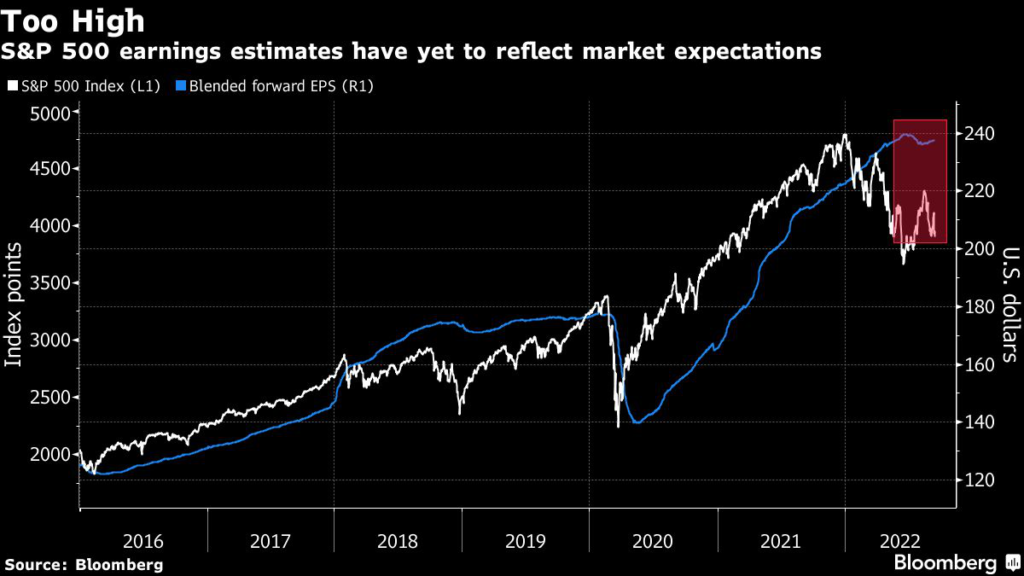
These ominous signs have already prompted analysts to moderate expectations, with weekly earnings downgrades outpacing upgrades for about four months in the US, according to a Citigroup Inc. index. But there may still be a long way to go to reset expectations — analysts’ earnings estimates for US companies are near record highs, despite an 18% slump for the S&P 500 benchmark this year.

To hedge against the myriad headwinds facing companies, some strategists suggest being selective about regional exposures heading into the earnings season.

“The weakness in FedEx earnings is centered in Asia and Europe, where indeed we are seeing the biggest economic challenges, while US activity is reasonably strong,” said Marija Veitmane, a senior strategist at State Street Global Markets. “This fits with our broader assessment of the macro conditions at the moment. Indeed, the US is our favorite market.”

Goldman Sachs Group Inc. strategists agree, saying US firms that do most of their business at home will fare better than those exposed to Europe, where a recession is all but guaranteed. In dollar terms, the Stoxx Europe 600 has lagged the S&P 500 this year, while a Goldman basket of US firms with 100% domestic sales has outperformed one tracking those with high exposure to Europe.

More stories like this are available on bloomberg.com

©2022 Bloomberg L.P.

Uber Probes Hacker’s Claim to Have Penetrated Key Databases

(Bloomberg) — Uber Technologies Inc. has shut down internal Slack messaging as it investigates a cybersecurity breach by a hacker claiming to have accessed sensitive company data.

Employees on Thursday received a Slack message from an unknown person claiming “I am a hacker,” according to one person with knowledge of the matter. The perpetrator co-opted a staff member’s account and claimed to have gained access also to internal databases, the person said. The cyberattacker was an 18-year-old who managed to infiltrate a plethora of internal systems, providing snapshots of emails and code repositories to prove his exploits, the New York Times reported.

Uber shares fell 5.2% in pre-market trading in New York Friday. 

The perpetrator or perpetrators appeared to have gained access to part of Uber’s Amazon and Google-hosted cloud infrastructure, said Sam Curry, a researcher with Yuga Labs who said he had been in contact with the attacker. They also got into the “HackerOne” system, which helps Uber with a so-called bug bounty program that rewards hackers for exposing and reporting vulnerabilities.

“Pretty much everything,” Curry said when asked what got compromised. “They had access to all of HackerOne’s reports.” An Uber representative confirmed a breach had occurred but declined to elaborate.

The company, which said on Twitter it’s contacted law enforcement, froze all Slack communications while it investigates the hacker’s claims. Uber’s ride-hailing and food delivery services appeared to be operating normally across the world, the people said.

Uber has run afoul of hackers before. It paid $148 million to settle claims related to a large-scale data breach that exposed the personal information of more than 25 million of its US users in 2016. The New York Times reported the latest hack earlier on Thursday.

“HackerOne supports its customers. We’re in close contact with Uber’s security team, have locked their data down, and will continue to assist with their investigation,” Chris Evans, its chief hacking officer, said in a statement.


(Updates with more details on the claims from the second paragraph, shares in third paragraph.)

More stories like this are available on bloomberg.com

©2022 Bloomberg L.P.

Putin’s Taiwan Support Outweighs Any Xi Concerns About Ukraine

(Bloomberg) — Even as Vladimir Putin admitted that Xi Jinping had concerns about the war in Ukraine, the Russian leader’s comments on Taiwan may ultimately matter more to his Chinese counterpart.

During their first in-person talks since the Ukraine war began, Putin on Thursday blasted what he called “provocations by the US and its satellites in the Taiwan Strait,” while reiterating support for Beijing’s “one China” principle. 

Beijing’s statement on the call thanked Moscow for its position on the island while asserting that “no country is entitled to act as a judge on the Taiwan question.” The statement made no mention of Ukraine, where Russia’s military has suffered humiliating setbacks recently.

Despite questions about the extent to which China supports Putin’s invasion of Ukraine, Beijing has been clear it agrees with Russia’s gripes about the US’s expansion of the North Atlantic Treaty Organization posing a security threat. China has accused the US of seeking to establish an Indo-Pacific version of the alliance, and views recent actions by policy makers in Washington as encouraging separatism in Taiwan.

Putin Acknowledges Xi’s ‘Concerns’ on Ukraine, Showing Tension

Tensions around Taiwan have increased after US House Speaker Nancy Pelosi visited the island in early August, with Xi ordering unprecedented drills by the People’s Liberation Army in the Taiwan Strait. Beijing is also warning of yet more upheaval if US lawmakers pass the Taiwan Policy Act, which would give Taipei $4.5 billion for defense over four years and potentially recognize the island as a major non-NATO ally.

“Rather than Putin seeking more support from China on Ukraine, he pledged more support on the Taiwan issue,” said Henry Wang Huiyao, founder of the Center for China & Globalization, a policy research group in Beijing. “That’s something new to me and shows Putin wants to get closer with China, rather than vice versa.”

Although currently the focus is on what help China may be able to help Russia in its war on Ukraine, over the long term Beijing may be calculating what support Moscow could provide in any Taiwan conflict. If war were to break out, Russia could be crucial in ensuring supplies of food and fuel that could be disrupted by sanctions and any military moves by the US and its allies.

The Ukraine war is giving Beijing more leverage to continue to buy oil and gas from its neighbor, which could translate into greater Russian military support for China over the long term, according to Alexander Gabuev, senior fellow at the Carnegie Endowment of International Peace. 

“The material help will be in strengthening the PLA — nuclear deterrence, transferring weapon designs and transferring new systems,” Gabuev said. “This is material support for China’s Taiwan policy that’s not advertised.” 

Taiwan Aid Bill Stirs White House Unease as Senate Hawks Dig In

In the event of a war over Taiwan, China would need a stable strategic supporter at its back as it faces challenges from the sea, Zhao Huasheng, a professor from Shanghai-based Fudan University who researches Russia, wrote in an article published last month by Tsinghua University’s Center for International Security and Strategy. 

Russia’s oil and gas exports to China, which will come via pipelines, could bypass sanctions in case of an embargo imposed by the West, he wrote, adding that marine shipping would become unreliable. “In the case of a major international crisis, Russia will be the most important external source of crude oil that China could think of — if not the only one.” 

Official readouts from the Xi-Putin meeting on the sidelines of the Shanghai Cooperation Organization summit in Uzbekistan mentioned very little concrete details about possible energy collaboration, including on gas pipelines. China, Russia and Mongolia separately said they would actively push forward the construction of China-Russia gas pipeline in Mongolia, according to Xinhua. 

It’s still possible that discussions took place behind closed doors. Gabuev from Carnegie noted the presence of Russian Deputy Prime Minister Alexander Novak at the event. 

“He’s the guy in charge of the energy relationship with China,” Gabuev said, adding that Russia has a “massive incentive” to work closely with China on energy given the challenges it faces in Europe because of punitive measures taken in response to the war in Ukraine. 

The Asian nation surpassed the European Union to be single largest buyer of Russian crude this summer, according to the International Energy Agency. That pace could continue given the EU is due to put shipping and insurance sanctions on Russian oil trade after Dec. 5.

“Where does Russia go?” Gabuev said. “China is the main destination.”

More stories like this are available on bloomberg.com

©2022 Bloomberg L.P.

NetEase Primed For Turnaround After Games Approval: Tech Watch

(Bloomberg) — Options traders are indicating that one of China’s largest gaming companies is primed for a stock market turnaround after a long-awaited regulatory approval.

This week, NetEase Inc. won approval for a new game for the first time since Chinese regulators froze all licensing in 2021 as part of a crackdown to curb gaming addiction. The company had missed out on previous rounds of approvals that resumed in April, worrying investors.

The green light prompted traders to bid up bullish options contracts, sending the put-to-call ratio to the lowest level since October, Bloomberg data showed. That’s good news for a stock that’s tumbled 23% from its high for the year in June, with the ratio dropping as much as 42% during that period. 

The global video game industry has faced a sluggish year as it deals with supply chain issues, inflation and a lack of big hits. Interest in gaming has also cooled as pandemic measures ease. In China, where lockdowns are still commonplace under Xi Jinping’s Covid Zero, there is the added regulatory risk given the yearlong crackdown. 

NetEase is considered a bellwether of China’s online gaming industry, with almost 80% of its revenue coming from the sector and more than 90% of sales from the country. Investors say the approval is a big step toward a turnaround for its stock and broader gaming share sentiment because it signals that Beijing is easing its grip. Tencent Holdings Ltd., which was another holdout, also received an approval.

“I have no question that they will be getting more games approved,” said Ivan Su, analyst at Morningstar Inc., who puts NetEase as his top pick in the industry. “Each of these games will make like a small contribution to the revenue, but if you combine them together, then the impact will be more material.”

Shares of the gaming giant also look attractive when it comes to valuation, according to money managers. The stock’s so-called PEG ratio — the price-earnings multiple divided by its earnings growth rate, a measure popularized by famed investor Peter Lynch — is one of the lowest among all global peers, according to Bloomberg data.  

The road ahead may be bumpy, however. NetEase’s newly approved game, the basketball-themed All Star Streetball Party, represents only a small portion of NetEase’s total revenue. The firm will need to continue offering top-grossing games that can be approved by Beijing. 

“Given the absence of titles with significant grossing potential and the continued drag from macro weakness, industry revenue momentum likely will remain soft in the near term, in our view,” said Credit Suisse analyst Kenneth Fong. 

Still, broader policies by Chinese authorities to stabilize markets and support growth may be a tailwind for firms like NetEase, according to Minyue Liu, investment specialist for Greater China and Asian equities at BNP Paribas Asset Management. 

“We expect a number of selective names to benefit from further revenue growth from their mobile gaming business driven by new game title launches and market share gain in overseas markets,” she said. 


Tech Chart of the Day

The 56% slump in Meta Platforms Inc.’s stock this year has cut the Facebook parent’s market value to $401.9 billion, dropping it further down the list of the largest publicly traded companies. Exxon Mobil Corp., at $395.2 billion, is within striking distance of overtaking Meta in size for the first time since 2017 after a 55% surge in 2022. A year ago, Meta stood at more than $1 trillion, compared with less than $240 billion for Exxon.

Top Tech Stories

  • The latest iPhone hits stores Friday, and Apple Inc. is counting on well-heeled shoppers to make the device a hit during a year of roaring inflation and shaky technology spending.
  • Texas Instruments Inc. authorized $15 billion in share repurchases and boosted its quarterly dividend by 8% to $1.24 a share, rewarding investors after a difficult year for chip stocks.
  • TikTok’s parent company is offering to buy back as much as $3 billion of its own shares from investors at a valuation of about $300 billion, giving existing backers a way to cash out after plans for an initial public offering stalled.
  • South Korea’s exports of its most lucrative memory chip fell by the most since 2019, indicating a deepening slump in technology demand central to global economic growth.
  • Adobe Systems Inc. spent $20 billion on its biggest acquisition ever of design software maker Figma Inc. to win the exact kind of consumers and small businesses the company has struggled to reach in recent years. Wall Street panned the half-stock, half-cash purchase as too expensive, and Adobe shares suffered their worst day since 2010.
  • With crypto firms from Bitpanda GmbH to BlockFi Inc. slashing jobs, many tech workers are finding that with the right skills, they can find themselves in demand at the heart of the finance industry.
  • Chinese President Xi Jinping has a goal of turning a quiet Shanghai suburb into the country’s next Silicon Valley, but more than three years into its making, that vision is facing mounting challenges.
  • A European court ruling this week that upheld a record European Union antitrust fine against Alphabet Inc.’s Google over its Android mobile operating system represents a clear “win” for regulators who confront technology giants, said EU competition chief Margrethe Vestager.
  • Elon Musk is demanding Twitter Inc. make the former head of its consumer division answer questions about spam or robot accounts on the social-media platform that are central to the billionaire’s legal fight to back out of a $44 billion buyout of the company.

More stories like this are available on bloomberg.com

©2022 Bloomberg L.P.

NetEase Shares Primed For Turnaround After China Games Approval

(Bloomberg) — Options traders are indicating that one of China’s largest gaming companies is primed for a stock market turnaround after a long-awaited regulatory approval.

This week, NetEase Inc. won approval for a new game for the first time since Chinese regulators froze all licensing in 2021 as part of a crackdown to curb gaming addiction. The company had missed out on previous rounds of approvals that resumed in April, worrying investors.

The green light prompted traders to bid up bullish options contracts, sending the put-to-call ratio to the lowest level since October, Bloomberg data showed. That’s good news for a stock that’s tumbled 23% from its high for the year in June, with the ratio dropping as much as 42% during that period. 

The global video game industry has faced a sluggish year as it deals with supply chain issues, inflation and a lack of big hits. Interest in gaming has also cooled as pandemic measures ease. In China, where lockdowns are still commonplace under Xi Jinping’s Covid Zero, there is the added regulatory risk given the yearlong crackdown. 

NetEase is considered a bellwether of China’s online gaming industry, with almost 80% of its revenue coming from the sector and more than 90% of sales from the country. Investors say the approval is a big step toward a turnaround for its stock and broader gaming share sentiment because it signals that Beijing is easing its grip. Tencent Holdings Ltd., which was another holdout, also received an approval.

“I have no question that they will be getting more games approved,” said Ivan Su, analyst at Morningstar Inc., who puts NetEase as his top pick in the industry. “Each of these games will make like a small contribution to the revenue, but if you combine them together, then the impact will be more material.”

Shares of the gaming giant also look attractive when it comes to valuation, according to money managers. The stock’s so-called PEG ratio — the price-earnings multiple divided by its earnings growth rate, a measure popularized by famed investor Peter Lynch — is one of the lowest among all global peers, according to Bloomberg data.  

The road ahead may be bumpy, however. NetEase’s newly approved game, the basketball-themed All Star Streetball Party, represents only a small portion of NetEase’s total revenue. The firm will need to continue offering top-grossing games that can be approved by Beijing. 

“Given the absence of titles with significant grossing potential and the continued drag from macro weakness, industry revenue momentum likely will remain soft in the near term, in our view,” said Credit Suisse analyst Kenneth Fong. 

Still, broader policies by Chinese authorities to stabilize markets and support growth may be a tailwind for firms like NetEase, according to Minyue Liu, investment specialist for Greater China and Asian equities at BNP Paribas Asset Management. 

“We expect a number of selective names to benefit from further revenue growth from their mobile gaming business driven by new game title launches and market share gain in overseas markets,” she said. 


Tech Chart of the Day

The 56% slump in Meta Platforms Inc.’s stock this year has cut the Facebook parent’s market value to $401.9 billion, dropping it further down the list of the largest publicly traded companies. Exxon Mobil Corp., at $395.2 billion, is within striking distance of overtaking Meta in size for the first time since 2017 after a 55% surge in 2022. A year ago, Meta stood at more than $1 trillion, compared with less than $240 billion for Exxon.

Top Tech Stories

  • The latest iPhone hits stores Friday, and Apple Inc. is counting on well-heeled shoppers to make the device a hit during a year of roaring inflation and shaky technology spending.
  • Texas Instruments Inc. authorized $15 billion in share repurchases and boosted its quarterly dividend by 8% to $1.24 a share, rewarding investors after a difficult year for chip stocks.
  • TikTok’s parent company is offering to buy back as much as $3 billion of its own shares from investors at a valuation of about $300 billion, giving existing backers a way to cash out after plans for an initial public offering stalled.
  • South Korea’s exports of its most lucrative memory chip fell by the most since 2019, indicating a deepening slump in technology demand central to global economic growth.
  • Adobe Systems Inc. spent $20 billion on its biggest acquisition ever of design software maker Figma Inc. to win the exact kind of consumers and small businesses the company has struggled to reach in recent years. Wall Street panned the half-stock, half-cash purchase as too expensive, and Adobe shares suffered their worst day since 2010.
  • With crypto firms from Bitpanda GmbH to BlockFi Inc. slashing jobs, many tech workers are finding that with the right skills, they can find themselves in demand at the heart of the finance industry.
  • Chinese President Xi Jinping has a goal of turning a quiet Shanghai suburb into the country’s next Silicon Valley, but more than three years into its making, that vision is facing mounting challenges.
  • A European court ruling this week that upheld a record European Union antitrust fine against Alphabet Inc.’s Google over its Android mobile operating system represents a clear “win” for regulators who confront technology giants, said EU competition chief Margrethe Vestager.
  • Elon Musk is demanding Twitter Inc. make the former head of its consumer division answer questions about spam or robot accounts on the social-media platform that are central to the billionaire’s legal fight to back out of a $44 billion buyout of the company.

More stories like this are available on bloomberg.com

©2022 Bloomberg L.P.

Spat Out by Crypto, Tech Staff Find They Are in High Demand

(Bloomberg) — No sooner had the 32-year-old developer joined Coinbase Global Inc. than he was on his way out.

The developer, who asked not to be identified talking about his workplaces, joined the largest cryptocurrency exchange in the US last year from a tech giant. He was lured by a base salary of $175,000 and a generous stock option package. Back then, the crypto markets were riding high. 

Within months the markets were crashing and colleagues around him, who had converted some of their pay to crypto, began to panic. He jumped ship before his own shares in the company could plummet, and before the firm cut 1,100 staff, or 18% of its workforce, in June. 

He initially left Coinbase off his resume as he began to look for another job. In fact, his time there turned out to be a blessing. After interviewing with Wall Street companies, he joined Facebook’s parent company Meta Platforms Inc. this summer on a base salary close to his previous one.

Meanwhile, one software engineer who was let go by Coinbase said he was inundated with messages from crypto firms, recruiters and Wall Street banks, but went back to his team at his previous employer, Uber Technologies Inc. He also asked not to be named talking about his employment.

With crypto firms from Bitpanda GmbH to BlockFi Inc. slashing jobs, many workers like this are finding that with the right skills, they can find themselves in demand at the heart of the finance industry. Citigroup Inc., Goldman Sachs Group Inc. and JPMorgan Chase & Co. are seeking staff with blockchain experience — and they’re not the only ones, as the technology that underpins crypto markets continues to grab the attention of banking clients and regulators.

“The downturn in crypto trading, with activity dropping and slow hiring, became an opportunity for incumbents,” said Thomas Olsen, a financial services partner at the consultancy Bain & Co. His company has been hiring white-collar workers exiting the crypto sector. “We’re hearing people for the next six to nine months seeing this as an opportunity when they couldn’t hire before.”

‘Right Mindset’

Wall Street giants have mostly avoided the spot market for cryptocurrencies such as Bitcoin due to regulatory uncertainty and “know your customer” rules. But they’re developing alternate ways to trade the volatile asset class, while exploring wider uses for the blockchain in areas such as payments and supply chains. 

Citi is advertising for a director-level digital asset risk manager to cover cryptocurrencies, stablecoins and decentralized finance, after it announced plans in November to hire as many as 100 staff to support digital asset capabilities for institutions. Citi is seeking candidates who have worked at traditional financial services or technology firms in addition to digital asset initiatives, according to a person briefed on the search.

Goldman Sachs has advertised in recent months for a vice president for its digital assets legal group, a vice president to work as a digital assets software engineer and an associate to work on digital assets in consumer wealth management and private wealth management. A spokesman for Goldman Sachs declined to comment. The bank launched crypto derivatives trading last year and is exploring ways to use blockchain technology elsewhere in the business. 

JPMorgan’s asset and wealth management business, which looks after $2.7 trillion, is seeking someone to oversee blockchain strategy including crypto and digital tokens. The bank is also looking for a product manager and other roles for its Onyx Digital Assets service, a blockchain network for assets including debt and equities with more than 200 employees.

Competition for tech talent in particular “is incredibly strong,” said Charlotte Richards, head of talent acquisition at Starling Bank Ltd., a British online lender. “Software engineers with the right experience and the right mindset who suddenly find themselves available are likely to be in great demand.”

A crypto worker’s prospects will depend on their previous role, according to Sabrina Wilson, chief operating officer at Copper.co, a London-based firm that helps financial institutions develop blockchain infrastructure. “Tech, security, compliance and client management staff will be particularly in high demand,” said Wilson. “It is essential for compliance workers wanting to switch from traditional finance firms to understand anti-money laundering, crime prevention and know-your-customer requirements.”

Wilson herself joined Copper from Citi earlier this year, in a sign that it’s still a two-way street between banks and crypto during the retrenchment. Copper has added 75 staff in recent months, including its head of prime who joined from Bank of America Corp., as well as people from Goldman Sachs, Morgan Stanley, Coinbase and the crypto firm BlockFi, Wilson said.

Fewer Offers

Some parts of Wall Street are more skeptical about hiring crypto industry veterans. One senior banking executive, who asked not to be named because of the sensitivity of the issue, said his firm wasn’t interested in people who spent several years berating the banking establishment, only to change their minds when they wanted a job.

Salary bidding wars between firms have calmed down a little, as candidates were getting fewer offers, according to Zeth Couceiro, founder of crypto recruitment firm Plexus Resource Solutions. Still, some finance firms including payment providers are keen to take advantage of crypto job cuts to bolster their blockchain efforts, while job applicants are now looking forward to the stability that big traditional financial firms can offer, Couceiro said.

One former Coinbase employee, who also did not wish to be named discussing their former workplace, said they were leaving the sector and going into academia. 

Even with crypto prices far below their peaks, some tech-focused firms are still aiming to offer customers the chance to trade. Revolut Ltd. is creating a European crypto hub in Cyprus while increasing its overall crypto headcount by 20%, the London-based fintech firm said in August.

Open banking payments platform Plaid is also hiring for crypto-focused roles, a spokesperson for the San Francisco-based company said, while mobile payments provider Block Inc. has about 30 open roles in crypto listed on its website. 

Florida-based payments platform Stax hopes to have a crypto division up and running by early 2023 and is “absolutely open to hiring folks from crypto companies,” Sal Rehmetullah, the company’s president and co-founder, said in an interview. 

In the meantime, firms such as Coinbase are licking their wounds but looking to the future. A spokeswoman for the company said it’s continuing to hire for “mission-critical” roles. The firm is looking to fill about 60 positions in areas such as business operations and strategy, human resources and recruiting and legal and compliance, according to its website. 

“We are committed to bringing the full suite of Coinbase retail, institutional, and ecosystem products to new and existing markets,” the spokeswoman said in an email. “We remain focused on our mission of promoting economic freedom around the world.”

More stories like this are available on bloomberg.com

©2022 Bloomberg L.P.

Shrimp Farming Is Coming to a City Near You

(Bloomberg) —

Shrimp are one of the most popular seafood globally, but farmed production of the crustaceans can have a devastating impact on local habitats — and in some cases the climate. A Singapore-based startup now says it has a new planet friendly solution for growing the food without the sea. 

When along coastlines, shrimp farms can generate a steady stream of chemicals, feces and antibiotics that are pumped back into the ocean. While that’s worrying enough, the industry has also been linked to global warming. Thirty percent of the destruction of mangroves — a powerful carbon sink — and coastal land-use change in Southeast Asia have been attributed to shrimp farming, according to nonprofit think tank Planet Tracker.

Trawling for wild shrimp, meanwhile, can impact other marine life and destabilize fragile ecosystems. By the time seafood reaches dinner plates in the US, Europe or Japan, it’s often traveled thousands of miles from farms in China, Thailand or Brazil — racking up a hefty carbon footprint. 

To that end, shrimp farming’s best future might look like a mashup of a data center and your local parking garage — if Vertical Oceans has anything to do with it. The startup says its algorithms enable shrimp production in autonomous tanks, which it plans to stack near onshore demand centers like Las Vegas or Tokyo, eliminating ocean discharge. The approach produces locally grown food harvested and delivered to your doorstep the same day.

“We’re demonstrating what the future of efficient protein production could look like,” says co-founder and Chief Executive Officer John Diener.

Vertical Oceans is the latest company aiming to develop more sustainable onshore aquaculture models for core food sources. Land-based production of salmon, for instance, can offer ecological benefits when the fish are raised in saltwater pens because it removes the animals from natural marine habitats, eliminating the risk they can pass on viruses and parasites to wild species. 

Read more: Want Cleaner, Healthier Salmon? Raise Them on Land

Investor appetite for food-related tech companies is surging with venture capitalists plowing more than $39 billion into the sector in 2021, double the amount they financed the year before, according to research group Pitchbook Data Inc. Although more than half of that funding went to digital grocers and online marketplaces, aquaculture is poised to become a larger part of the supply chain.

Venture capital firms Khosla Ventures and SOSV invested a combined $4 million during Vertical Oceans’ seed round mid last year.

Risks for systems like the one Vertical Oceans is building are that if either the mechanical or biological system breaks down, things can go awry, said Cyr Couturier, a marine biologist and aquaculture scientist at the Fisheries and Marine Institute of Memorial University of Newfoundland in Canada. Companies can encounter challenges when they attempt to scale up production, although Vertical Oceans’ modular design should allow it to expand in small increments, as long as it can service capital requirements, he said.

Couturier said he’s seen multiple systems for salmon and shrimp production run into problems over the past decade because engineers didn’t understand how the organisms would interact with the facilities they built.

“Biological systems are often unpredictable over the longer term,” Couturier said in an email.

Vertical Oceans’ tanks are roughly the size of a school bus. They aerate and recirculate the water, feed the shrimp and use macro-algae like umibudo to gobble up nitrogen, phosphorus and feces, eliminating the need to discharge waste water, according to Diener. The company doesn’t use any chemicals or antibiotics in production and the multispecies environment results in a much healthier aquatic ecosystem.

“The reason we’re able to avoid bacterial pathogenic problems is largely because we’ve got this healthy and more balanced ecosystem,” said Diener.

There’s also hope tank-grown seafood can deliver on the most important point for most consumers: taste. Scientists have found that ocean acidification — caused by excessive amounts of dissolved carbon dioxide — is making shellfish less appealing to our palates.  

Vertical Oceans has produced about 1 metric ton of shrimp so far through a proof-of-concept project located on a small recreational island off the coast of Singapore and is looking to open its first commercial site in the US next year. The company has been selling directly to consumers in Southeast Asia and supplying local eateries, including Singapore restaurant Open Farm Community.

More stories like this are available on bloomberg.com

©2022 Bloomberg L.P.
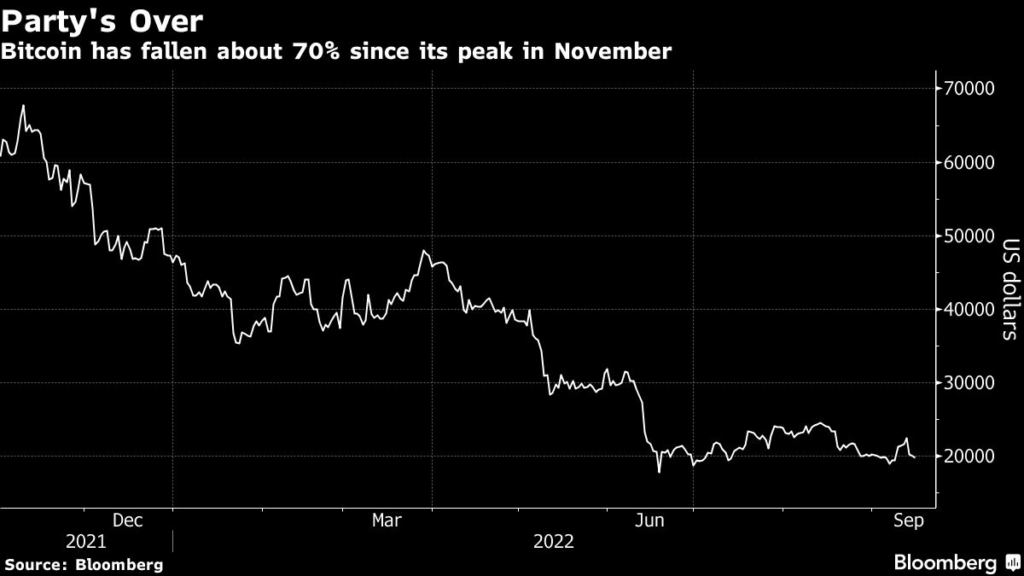
White House Wants Regulators to Find Fraud, Abuse in Crypto Trading

(Bloomberg) — The White House wants American financial watchdogs to do more to weed out fraud and abuse in crypto trading as the US inches ahead with plans for the asset class.

The Biden administration called on the Securities and Exchange Commission and other regulators to “aggressively pursue investigations and enforcement actions against unlawful practices.” The recommendation is part of a new White House document that it billed as a “comprehensive framework for responsible development of digital assets.” 

Washington has long struggled to strike a balance between cracking down on market abuses and encouraging a fast-growing industry that could have major economic and national security implications. While regulators have brought some cases against large crypto firms, the industry has fought back by raising significant legal challenges. 

Thus far, US oversight also has been marked by a patchwork of overlapping approaches and jurisdictional battles. The conclusions released on Friday by the White House follow months of reviews by agencies that were required in a March executive order. 

While the Biden administration called for a range of actions by government agencies, it stopped short of drawing many firm conclusions and in several cases simply called for more review. 

For example, on the hot-button issue of the Federal Reserve issuing a central bank digital currency, or CBDC, the White House reached no major conclusion.

“The administration encourages the Federal Reserve to continue its research and experimentation,” National Economic Council Director Brian Deese and National Security Adviser Jake Sullivan said in a statement. “We will also launch an interagency working group to support Federal Reserve efforts by the considering policy implications of a potential CBDC, especially for our national security.”

The administration also laid out plans to explore how crypto-related technologies could bolster financial inclusion. Biden would weigh recommendations for a federal framework for overseeing nonbank payment services, the White House said.

Meanwhile, the White House urged the Consumer Financial Protection Bureau and the Federal Trade Commission to follow up on consumer complaints related to unfair, deceptive or abusive practices in crypto. At the same time, the US Treasury Department will finish a risk assessment on potential illicit activity linked to decentralized finance and nonfungible tokens next year. 

“Innovation without adequate regulation can result in significant disruptions and harm to the financial system and individuals,” Treasury Secretary Janet Yellen said during a press briefing ahead of the White House’s release. 

Friday’s report follows a related White House document last week that said crypto mining could hamper efforts to combat climate change. 

More stories like this are available on bloomberg.com

©2022 Bloomberg L.P.

Jeff Bezos’s Rocket Engine Nears Debut, Ending US Reliance on Russia

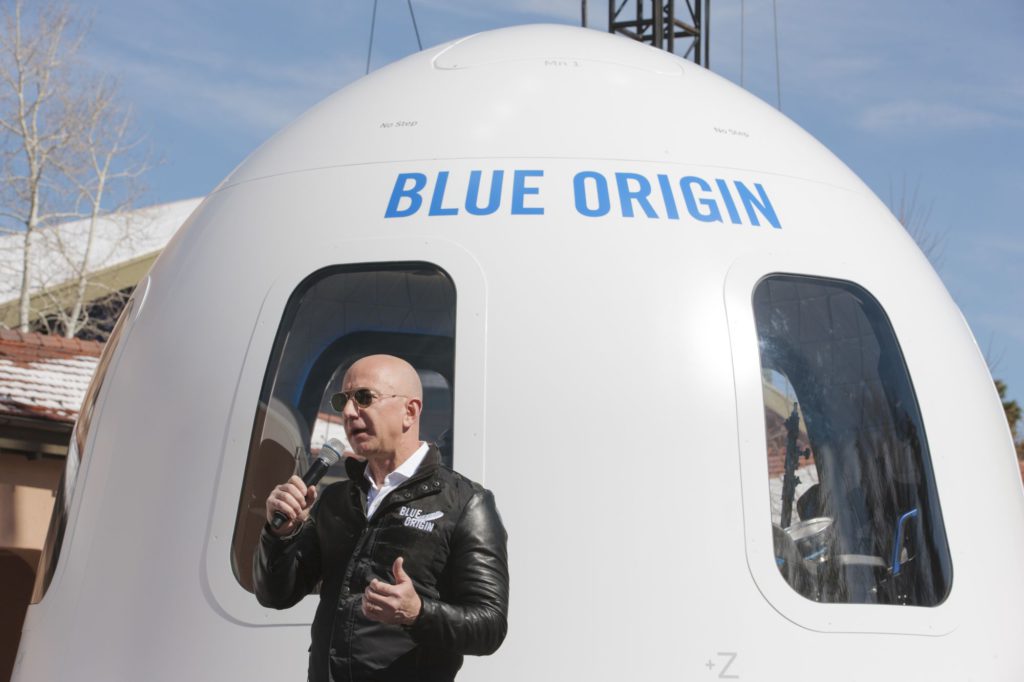
(Bloomberg) — An engine made by Jeff Bezos’s Blue Origin LLC appears on track to show it can power heavy payloads to space for the Pentagon after several years of delay, bringing the US closer to ending its politically fraught dependence on a Russian-made model.

Blue Origin predicted in 2014 that its BE-4 engine would be ready by 2017 to launch the new Vulcan rocket built by the United Launch Alliance, a joint venture of top Pentagon contractors Boeing Co. and Lockheed Martin Corp. But the Government Accountability Office as recently as June cited “continued technical challenges in developing a US-produced rocket engine.”

Now, the US Space Force is expressing optimism, saying in a statement that “Vulcan launch system development activities continue to make progress” toward a first test launch by December because “ULA and Blue Origin have completed originally planned BE-4 development testing, and have successfully demonstrated full engine performance.”

United Launch Alliance used the dependable Russian-made RD-180 engine to launch its Atlas V heavy rocket on about 80 successful civil, commercial and national security launches since 2000, according to the Congressional Research Service. 

But Congress demanded a replacement for the Russian engines after Russia annexed Crimea in 2014, and that argument has only gained force since President Vladimir Putin’s military invaded Ukraine in February.

Elon Musk, Bezos’s fellow billionaire and competing space entrepreneur, ripped into that Russian connection in his successful fight to compete with what he called the Boeing-Lockheed monopoly for Pentagon satellite launches. 

Musk’s Space Exploration Technologies Corp., or SpaceX, has received final certifications to fly its Falcon Heavy rocket to launch the most sensitive classified missions, including the first one between October and December using reusable boosters.

For Bezos, the Space Force’s positive view on his company’s progress provides some good news after closely held Blue Origin was forced to abort a launch Sept. 12 of its suborbital New Shepard rocket shortly after takeoff in West Texas. It was the first major failure for the company since transitioning to routine commercial flights. The New Shepard is powered by an engine different from the BE-4. 

United Launch Alliance’s Vulcan program “is now focused on completing BE-4 qualification testing and flight engine deliveries,” the Space Force said in its statement. Its “other elements are progressing through final qualification testing to support initial launch capability.” ULA needs two successful flight tests that are planned for commercial launches as a requirement for Space Force certification that rockets powered by the new engine can carry the most sensitive U.S. military and intelligence cargo.

Frank Calvelli, the Air Force’s assistant secretary for space systems, said in a statement that ULA and Blue Origin “have done a lot to reduce risk, but a lot of work and testing remains to meet this December’s launch.”

The Space Force said it expects to complete ULA’s initial certification of the Vulcan rocket with the BE-4 engine as soon as March 2023 for “lower launch vehicle performance and payload capabilities” and final certification in 2025 for “our largest and most stressing” national security missions.

Those certifications would position ULA to better compete against SpaceX, and possibly other companies, for a third round of as many as 39 national security space launch missions from fiscal 2025 through fiscal 2027, with the first award by October 2024.

“The first BE-4 flight engine is undergoing acceptance testing at Blue Origin’s facilities in Van Horn, Texas,” company spokesman William Boyington said in a statement. “Once final acceptance testing is completed, flight engines will be delivered to ULA, with full-rate BE-4 production already underway.”

Asked about the biggest technical challenges the BE-4 engine has had to overcome, ULA spokeswoman Jessica Rye said in a statement that it’s “the largest liquefied natural gas-fueled engine to be developed, and utilizes a high performance operating cycle. This required the maturation of multiple advanced technologies, which have been proven out through a rigorous development test program.”

More stories like this are available on bloomberg.com

©2022 Bloomberg L.P.

White House Touts $1 Billion in Grants to Fight Cybercrime

(Bloomberg) — The Biden administration has called on states and local governments to apply for new cybersecurity grants worth $1 billion over four years.

The move is part of US efforts to beat back attacks from criminal hackers, who have successfully targeted everything from gas pipelines and meat factories to schools and hospitals.

“Cyberattacks have emerged as one of the most significant threats to our homeland,” said Secretary of Homeland Security Alejandro Mayorkas, adding that attackers are exploiting the “limited capacity” of states and local governments.

US jurisdictions battling ransomware and other cyberattacks on schools, railways, power grids, waste-water systems and more now have 60 days to apply for some of the $185 million available in the first installment, which runs through this year, part of the infrastructure bill that was approved in 2021. Officials said every state is eligible for $2 million to develop their own statewide cybersecurity plan.

The administration has made numerous efforts to try to curb the deluge of attacks, including indicting hackers, going after entities that allegedly aid in laundering illicit proceeds and ordering software companies that do business with the government to attest that they comply with new cyber standards.

More stories like this are available on bloomberg.com

©2022 Bloomberg L.P.

Close Bitnami banner
Bitnami