

Bloomberg

ByteDance to Buy Back $3 Billion in Shares After IPO Stalls

(Bloomberg) — ByteDance Ltd. is offering to buy back as much as $3 billion of its own shares from investors at a valuation of about $300 billion, giving existing backers a way to cash out after plans for an initial public offering stalled.

The Beijing-based company, parent of the hit TikTok video app, informed shareholders of the plan Friday via email. The offered price per share of just under $177 gave the company an implied valuation of $300 billion, the company wrote in the memo viewed by Bloomberg News. It also said that it was extending its existing stock incentive plan for another 10 years.

ByteDance has grown into the world’s most valuable startup on the success of apps like TikTok and its Chinese counterpart Douyin, but it’s been squeezed between Beijing’s crackdown on internet firms at home and Washington’s suspicions of the services in the US. Just this week, TikTok Chief Operating Officer Vanessa Pappas came under withering pressure to seal off US user data from Chinese review during Senate hearings. 

TikTok has already been banned by the government of India, following a border dispute in 2020 that soured relations with China. That forced the service out of what had been its largest market by number of users, with 200 million regular viewers.

TikTok Owner Spends Record $2.14 Million on US Lobbying

ByteDance has considered taking TikTok public for years, a move that could both reward investors and ease some political pressure as the company separates from its Chinese parent. It contemplated a separate IPO for Douyin and its China businesses in Hong Kong. But both debuts have been put off repeatedly as Beijing steps up scrutiny of internet giants and, more recently, a sharp decline in tech stocks. 

ByteDance’s valuation soared to more than $400 billion in private trading, but that figure dropped to below $300 billion, Bloomberg News reported in July. The company told its 110,000 global employees last month that it will lower the price of its stock options by 20%, as a compensation to retain workers during a broader wave of layoffs across the Chinese internet sector.

While the current $300 billion offer is down from ByteDance’s peak valuation, it still holds out the promise of a remarkable return for early investors in the decade-old company, including Sequoia Capital and Susquehanna International Group. Beijing’s crackdown has hammered the value of tech companies in China, at one point wiping out more than $1 trillion of value from publicly traded giants such as Alibaba Group Holding Ltd. 

ByteDance is joining bigger rivals Alibaba and Tencent Holdings Ltd. in buying back their own shares, at a time when global investors like Warren Buffett and SoftBank Group Corp. are exiting some of their most lucrative Chinese stock investments.

To offset the general market angst, Tencent has been repurchasing its shares traded in Hong Kong on a near-daily basis in recent weeks, while Alibaba committed $25 billion to a new buyback program.

Read more: Legendary China Bets Unwind as Buffett, SoftBank Sell

ByteDance’s founder Zhang Yiming stepped down as chairman and chief executive officer last year, one of several billionaires to move out of high-profile positions after the regulatory scrutiny.

During a virtual townhall in August, ByteDance management said the company has no current plan or timetable for a stock market debut, according to attendees. Executives also said the company needed to expand cautiously and focus resources on key growth engines including TikTok, e-commerce, and the Slack-style work app Lark.

Beijing’s hardline policies led ByteDance to shut down most of its online education operations and disband its venture investment arm over the past year. Meanwhile Washington’s renewed scrutiny over how TikTok safeguards American user data triggered a record $2 million in spending on lobbying by ByteDance during the second quarter.

(Updates with details of tech buybacks from the 8th paragraph)

More stories like this are available on bloomberg.com

©2022 Bloomberg L.P.

Gautam Adani’s Elder Son to Oversee Newly Acquired Cement Companies

(Bloomberg) — Karan Adani, the elder son of world’s third-richest man Gautam Adani, is set to oversee the family’s scaled up cement business, according to people familiar with the matter, as the rapidly expanding conglomerate seeks to integrate the two cement companies it acquired for $10.5 billion in May. 

Besides bringing in his son, the Indian billionaire is also planning to enlist key senior executives to help grow the cement business and mentor Karan, according to the people, who asked not to be identified as the information is private. Karan, 35, is currently the chief executive officer of Adani Ports and Special Economic Zone Ltd. He’s expected to find synergies between the group’s ports and cements businesses in order to create an integrated logistics firm, the people said. 

An announcement on Karan’s appointment could come as soon as Friday, the people said. A representative for Adani Group declined to comment.

Gautam Adani has surged to prominence this year, as an eye-catching leap in his fortune made him one of the richest people on the planet in a matter of months, leapfrogging compatriot Mukesh Ambani and titans like Bill Gates and Warren Buffett. He’s now gaining on world No. 2 Jeff Bezos.  

A combination of soaring coal prices and skyrocketing equity gains fueled the wealth surge, which has enabled his Adani Group to supercharge its ambitions, rapidly diversifying beyond its commodity and fossil-fuel roots into airports, media, digital services and telecommunications. The tycoon is also making a $70 billion bet on green energy, a shift that’s been criticized as an attempt to greenwash the group’s coal focus. 

Asia’s Richest Man Sells the World a Green Dream Built on Coal

Adani’s biggest spend this year has, however, been on cement, with the billionaire creating India’s second-largest cement producer by buying Ambuja Cements Ltd. and ACC Ltd. from Switzerland’s Holcim Ltd. in May. 

More stories like this are available on bloomberg.com

©2022 Bloomberg L.P.
Lithium Smashes New Record as Supply Struggles to Feed EV Growth

(Bloomberg) — The surge in prices of lithium, the key battery material used to power electric cars, is seemingly unstoppable.

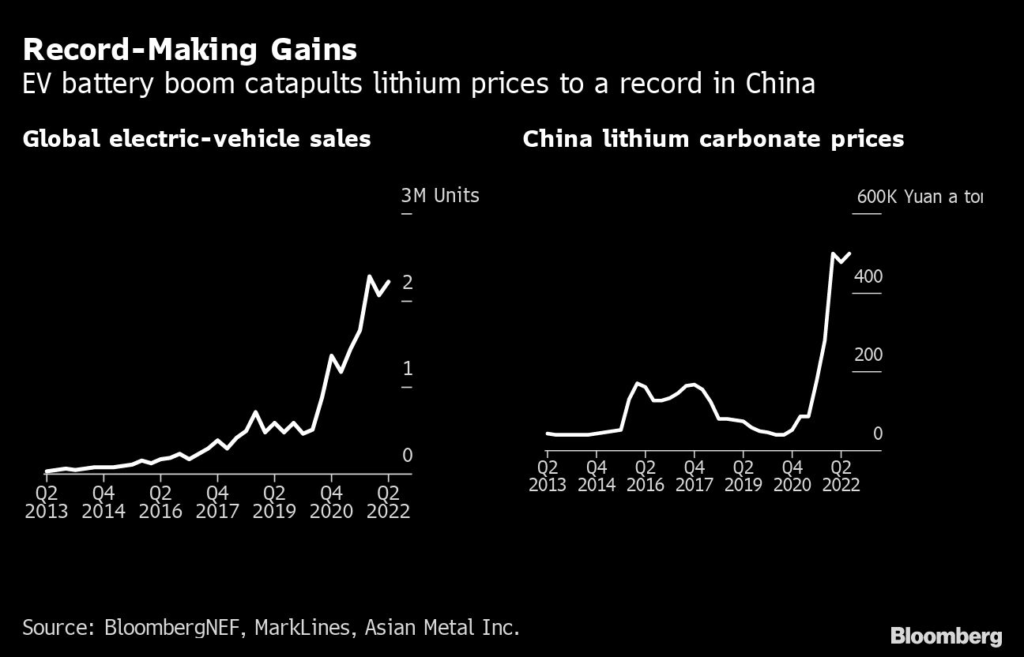
Lithium carbonate hit a fresh record of 500,500 yuan ($71,315) a ton in China Friday, according to data from Asian Metal Inc. Prices more than tripled in the past year, inflating the cost of batteries used in electric vehicles, with recent gains driven by strong demand and disruptions at a domestic producing hub. 

Consumer support for new-energy vehicles has been gathering pace amid a global transition away from fossil fuels. The China Passenger Car Association has raised its forecast for sales of EVs to a record 6 million this year, double the total in 2021, while battery usage in the nation is also expected to almost double, according to Bloomberg Intelligence.

Meanwhile, a power crunch during August in Sichuan province — home to more than one-fifth of China’s lithium production — caused two weeks of electricity cuts, hampering supply in an already-squeezed market. 

“EV production and sales have held steady in recent months,” according to Rystad Energy, a research firm, which added there are concerns over whether China’s power crisis could return this winter when demand for heating rises. “This could lead to new power shortages and hit lithium operations,” it wrote, expecting prices to stay firm around this level through to the end of the year.

China held a meeting to review developments on Thursday and asked the top companies to help stabilize prices, according to the Ministry of Industry and Information Technology. Producers should not collude on pricing and not quote prices that deviate a lot from costs, it said. The government will take steps to encourage exploration, stabilize imports and promote recycling, it added.

On Thursday, Soc. Quimica & Minera de Chile SA, the world’s No. 2 lithium producer, predicted a “very tight market” in the years ahead. SQM sees “slightly higher” prices this quarter from the previous three months and expects prices to stay at similar levels in the fourth quarter, according to a presentation to investors in New York. 

Battery-makers and the automobile industry have been rushing to lock in reliable and stable supplies of lithium. Still, the raw-material price hikes are likely to stoke inflation concerns and add cost pressures to the supply chain. 

A battery-making unit of China’s top producer, Ganfeng Lithium Co., told customers last week that prices for new orders would be reassessed amid a substantial hike in power-cell costs. The company supplies small polymer lithium batteries for smart wearable products and Bluetooth headset batteries for companies including Xiaomi Corp.

More stories like this are available on bloomberg.com

©2022 Bloomberg L.P.
The Bitcoin Gamble in the Central African Republic

  • Listen to Bloomberg Crypto on the iHeartRadio App
  • Listen to Bloomberg Crypto on Apple Podcasts
  • Listen to Bloomberg Crypto on Spotify  

(Bloomberg) — By now you’ve probably heard that El Salvador became the first country in the world to adopt Bitcoin as legal tender in September 2021. Did you know the Central African Republic made a similar move in April, becoming the first country in Africa to welcome a cryptocurrency to its sovereign ranks?

Not only did the decision cause disagreement and confusion within the country, it also drew skepticism and concern from organizations such as the International Monetary Fund and the World Bank.

Why would a country with very low levels of access to electricity and the internet follow the path of a digital token? Who stands to benefit, and who stands to lose?

Joining this episode is Bloomberg reporter Katarina Höije.

Follow us on Twitter @crypto, and subscribe to the Bloomberg Crypto Newsletter at https://bloom.bg/cryptonewsletter

More stories like this are available on bloomberg.com

©2022 Bloomberg L.P.
Banker Who Brought Goldman Clout to SoftBank Starts Venture Bets

(Bloomberg) — Before his abrupt departure from SoftBank Group Corp. last year, Katsunori Sago was seen as a potential successor to billionaire founder Masayoshi Son. He’s now charting his own course in startup investments.

SoftBank’s ex-Chief Strategy Officer joins a growing cadre of Son’s former lieutenants who have caught the venture capital bug. Chief Operating Officer Marcelo Claure, who left earlier this year, is deploying billions through his family office. Rajeev Misra, who helped Son set up the initial Vision Fund, has stepped down from his role as a corporate officer and is launching his own fund. 

Sago, 54, is putting his own money into Japanese startups such as ispace Inc., which is developing a moon lander for NASA‘s Commercial Lunar Payload Services project, and renewable electricity generation forecaster Sustech Inc. He also backs mortgage lender Aruhi Corp. and online real-estate brokerage platform Tsukuruba Inc., hunting for investment returns that will help fuel his long-term bets.

Before joining SoftBank, Sago was chief investment officer at Japan Post Bank Co., which then had roughly $1.4 trillion of assets under management. Prior to that, he had been tipped as a possible president of Goldman Sachs Group Inc.’s Japan unit. Now he’s bringing his connections to a country that until recently was seen as a unicorn-bereft venture backwater. 

“I want to be the kind of investor who has a shared sense of purpose with entrepreneurs, like Peter Thiel,” Sago told Bloomberg News in his first media interview following his departure from SoftBank. He said he admired the PayPal Holdings Inc. co-founder’s reputation as a startup picker and his ability to attract other investors into new ventures. 

Sago’s move comes during a shift in Japan’s perception of startups. In a country where the most-sought careers are at banks and city hall, Japanese startups now draw top talent. Prime Minister Fumio Kishida is also putting entrepreneurs front and center of his New Capitalism agenda, setting a five-year goal to boost the number of ventures tenfold by increasing funding from the likes of the Government Pension Investment Fund.

Executives like Sago and their personal networks are a boon to the startup community. “He’s introduced us to banks and at least ten people whose help we needed,” Sustech Chief Executive Officer Yusuke Tanno said in a phone interview. Sago helped the year-old firm craft a financing strategy that allowed it to buy its own power plant — a key step to secure corporate clients like furniture retailer Nitori Holdings Co., Tanno said.

Sago joined SoftBank in 2018, shortly after the company launched the first Vision Fund. In the Japanese conglomerate, Sago saw the potential of a company that could hold its own against global asset management firms — something that was missing in Japan when he was looking for counterparts big enough for Japan Post Bank. Sago jumped at a chance to work with Son, whom he called “a rare visionary.”

With his blue-chip pedigree, Sago — who had modeled for a men’s fashion magazine when he was a student at the elite University of Tokyo — lent a sheen of respectability to SoftBank within Japanese financial circles, where people sometimes looked down on Son, his Korean ancestry and his love of risky bets.

Sago wasn’t directly involved in the Vision Fund, SoftBank’s primary startup investment vehicle led by Misra, or the Latin America funds run by Claure. Sago, over the course of three years, did help recruit a team of Japanese financial experts to provide oversight on due diligence, with a focus on Asia — complementing the company’s effort to reinvent itself from a telecom firm to the operator of the world’s largest technology fund.

Sago brought “a whole new perspective” and “played a crucial part in expanding SoftBank’s potential as an investment company,” Son said of Sago’s departure in a statement last year. SoftBank declined to comment further.

Sago pushed a risk-averse Japan Post Bank to broaden its pool of investments, but his measured approach may not have fit SoftBank’s, said LightStream Research analyst Mio Kato, who publishes on SmartKarma. Sago “seemed disciplined, whereas SoftBank’s investment style seems quite erratic.” When the Vision Fund first launched, SoftBank didn’t wait for investors’ money to deploy billions of dollars into startups, with Son often deciding to invest within minutes of meeting founders.

Sago left while SoftBank was still riding high on its stakes in some of the world’s most prominent startups. But the more time Sago spent at SoftBank, speaking with Son and other entrepreneurs who were passionate about their businesses, the more he wanted to build something of his own, or back founders he believed in. 

“There were times I disagreed with Son on strategy or on investment methods, but I wouldn’t leave because of that,” he said.

In the year since Sago struck out on his own, a rout in tech valuations forced SoftBank to log a record $23 billion net loss in the quarter ended June. SoftBank is now planning to cut at least 20% of its Vision Fund staff. Echoing Son’s warnings at SoftBank’s earnings release last month, Sago warned that market turbulence could continue. 

Many startup founders who are hoping to go public are now struggling to raise funds, reluctant to accept the new reality of lower valuations. With rising interest rates and fears of recession, the market could be headed for a major collapse in the second half of next year to 2024, said Sago, who has lowered the number of companies in his portfolio from about 30 firms last year to 18 firms now. 

Shares of Tsukuruba fell 9.8% on Friday in their biggest drop since February. Aruhi’s stock price jumped 6.8%, extending its gains after SBI Holdings announced earlier this week a tender offer for a majority stake in the mortgage firm.

“The market has not yet fully priced in valuation falls of unlisted companies,” he said. 

(Updates to add Tsukuruba’s share price move in 17th paragraph)

More stories like this are available on bloomberg.com

©2022 Bloomberg L.P.
Vedanta Drops Most in Months as Chip Factory Plan Unclear

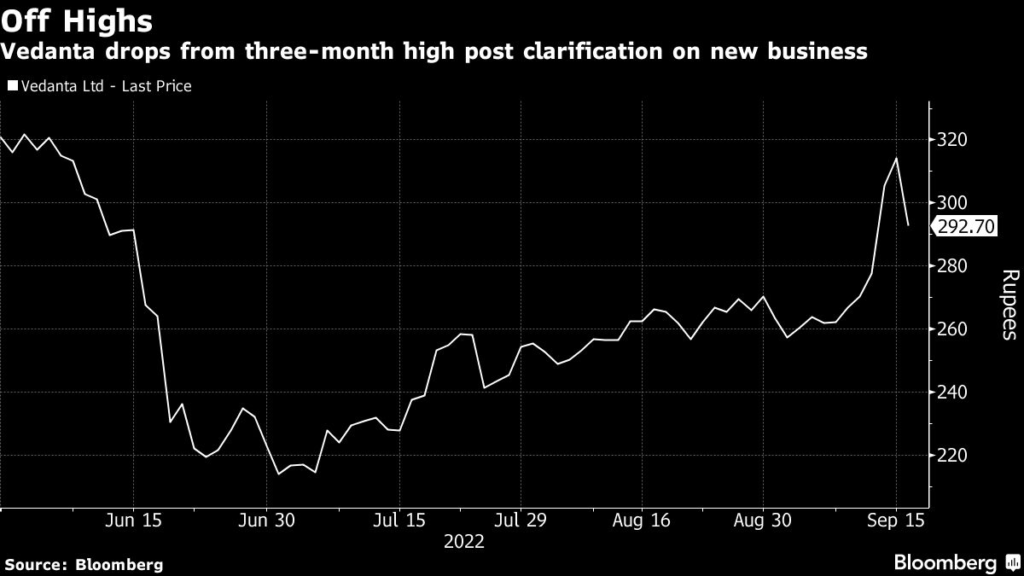
(Bloomberg) — Vedanta Ltd.’s stock dropped the most in almost three months, amid questions about the billionaire Anil Agarwal-backed mining company’s involvement in a “landmark” Indian semiconductor factory investment. 

Shares in the company fell as much as 8.7% on Friday, snapping six days of gains, after the Mumbai-listed firm said the manufacturing business would fall within the purview of family trust Volcan Investments Ltd. That raised questions after Agarwal tweeted on Sept. 13 saying Vedanta was making the 1.54 trillion rupee ($19.3 billion) investment.  

“The rally in Vedanta shares happened following euphoric statements from the founders about their new line of business. But, this is not going to benefit the shareholders of Vedanta Ltd.,” said Kranthi Bathini, a strategist with WealthMills Securities Pvt. “This is resulting in selling pressure.”

Vedanta Ltd. this week announced it had joined forces with Hon Hai Precision Industry Co., the assembler of most of the world’s iPhones, to build a chipmaking facility in Gujarat, the home state of India’s Prime Minister Narendra Modi. 

The partners have little experience running large chip operations, but are betting on rising demand as everything from smartphones and cars to home appliances contain semiconductors. 

News of the investment, which Agarwal termed “landmark,” also prompted questions about how it would impact its backers’ finances. While Vedanta Ltd. has an investment-grade rating, Moody’s classifies its parent as high-yield.  

Vedanta Ltd. is majority-held by Vedanta Resources Ltd. and provides its London-listed owner with a steady stream of dividends. The parent uses them to pay down debt. Agarwal’s family trust Volcan is the ultimate parent of both entities.  

Reflecting worries about its payment abilities, the dollar bond of Vedanta Resources Ltd. due in August 2024 plunged to a more than two-year low of roughly 50 cents on the dollar on July 5, a level typically considered distressed. It has since recovered and was trading at 66 cents on the dollar on Friday. 

“Vedanta Resources dollar bonds could come under pressure on rising capex and ambiguity around how it will affect funding needs and liquidity. It plans to commit an additional 250 billion rupees ($3.14 billion) to support its aluminum business and plans a $20 billion semiconductor joint venture.” 

– Mary Ellen Olson and Sheenu Gupta of Bloomberg Intelligence 

Vedanta Resources has more than $4 billion of debt maturing in the next four years, with the biggest chunk in 2024, the data show. 

Any impact on credit “will depend on the details of the funding plans, which are yet to emerge,” said Neel Gopalakrishnan, an analyst at S&P Global. “Our belief is that the company will manage its investments prudently so as to not put debt servicing at Vedanta Resources at risk.”


More stories like this are available on bloomberg.com

©2022 Bloomberg L.P.

UK Retail Sales Drop Most This Year as Squeeze Tightens

(Bloomberg) —

UK retail sales fell at the sharpest pace in eight months in August as a worsening cost-of-living crisis and plunging confidence forced consumers to cut back on spending. 

The 1.6% drop was more than three times the decline predicted by economists and reflects the squeeze on households from soaring energy bills and inflation near a 40-year high. All retail categories saw sales decline for the first time since July 2021.

The pound extended its drop after the release, and was down 0.4% to $1.1417 as of 9:21 a.m.

The government is responding to the crisis, announcing a £100 billion ($114 billion) subsidy package to stop gas and electricity bills spiking again over the winter. That may be enough to avert a recession, but consumers still face months of hardship amid sharply rising prices of everything from food to clothes. Real wages are dropping, and the the squeeze has sent consumer confidence plunging to a record low.

It’s also meant that many households have to buy fewer discretionary items in order to afford the essentials. 

John Lewis Partnership Plc, a bellwether for British retail, said this week its first half loss more than tripled compared with a year earlier, and blamed the “unprecedented cost-of-living crisis.” THG Plc, the online shopping emporium, said earnings would miss guidance.

What Bloomberg Economics Says…

“We expect consumer spending to come under more pressure in the coming months given the unrelenting squeeze on incomes… Discretionary purchases will come under particular pressure and consumers are likely to trade down to cheaper brands where possible when buying food.”

Click here for the full REACT

The retail-sales slump in August left sales 5.4% lower than a year earlier, a fifth straight year-on-year decline. Excluding the earlier days of the Covid pandemic, such a bad streak hasn’t been seen on the British High Street in more than a decade. 

UK retail stocks have plunged more than 12% over the past month, making them among the worst performing sectors. The FTSE 350 Index as a whole has fallen by 4.4%.

Retail sales are almost certain to act as a drag on the economy in the third quarter. Sales will fall over the period unless September sees a 3.1% surge. 

The plight of consumers is unlikely sway the Bank of England, which is expected to keep raising interest rates — including a possible 75 basis-point hike next week — in an effort to head off a wage-price spiral. 

(Updates with retailers, stocks starting in sixth paragraph)

More stories like this are available on bloomberg.com

©2022 Bloomberg L.P.

Solar Panels Floating in Space Could One Day Power Your Home

(Bloomberg) — Longi Green Energy Technology Co., the world’s biggest solar technology manufacturer, will send panels into space as the first step in plans to test the feasibility of harnessing the sun’s power in orbit and transmitting it back to Earth.

The Xi’an-based clean energy giant, which has helped China dominate the solar industry and drive down costs, will also study the use of its products in harsher environments, and assess their suitability for use in space programs, it said in a statement. 

Longi’s decision to establish a laboratory focused on the task could be a first step in the solar sector’s collaboration with China’s space program and toward off-planet power stations, said Wu Zhijian, president of the China Space Foundation, a government-backed agency under the China National Space Administration.

China Tests Tech That Could Beam Solar Power From Space to Earth

The prospect of harnessing solar power from space is attracting attention from industry and academics because it promises to remove the technology’s major drawback — that panels don’t operate effectively in darkness — by placing them into orbit with an unrestricted view of the sun. 

Chinese researchers in Shaanxi’s Xidian University said earlier this year that they had successfully tested a full-system model of a technology designed to transmit solar power from outer space. Their project captures sunlight high above the ground, converts it into microwave beams and transmits it through the air to a receiver station on the ground to be converted into electricity. It’s a process advocates hope can be be expanded to cover the long distances from orbiting panels back to Earth.

Scientists at the California Institute of Technology also launched a space solar program after a $100 million grant in 2013, while teams in nations including Japan, Russia and India are also studying the possibilities

Longi’s new laboratory will also consider plans for energy monitoring satellites and environmental verification from space.

More stories like this are available on bloomberg.com

©2022 Bloomberg L.P.
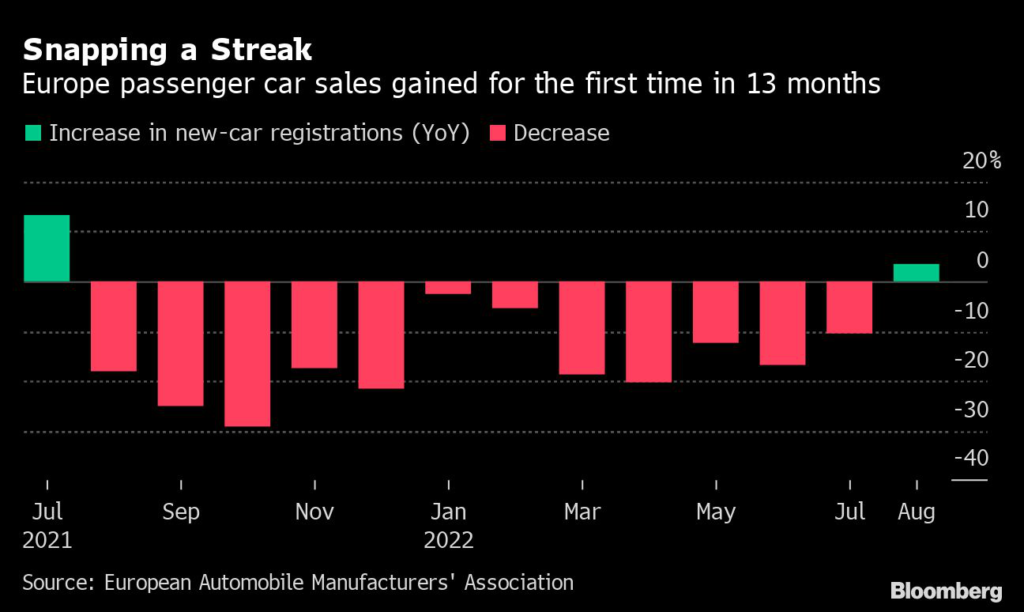
Europe Car Sales Return to Growth After Painful Year of Declines

(Bloomberg) — Europe’s new-car market returned to growth in August for the first gain in 13 months, though the respite may be short-lived as record inflation and an unprecedented energy crisis threaten to put off buyers.

Registrations rose 3.4% to 748,961 vehicles last month, the European Automobile Manufacturers’ Association said Friday. Germany’s Mercedes-Benz AG was among the best performers with a 16% jump from a year ago. 

Carmakers are seeing glimmers of improvement with some supply-chain constraints such as the lack of semiconductors beginning to ease. Even so, runaway inflation and a slowing global economy are clouding sales forecasts. Last month’s showing compares to poor year-earlier performance and remains well below pre-pandemic levels.

“High inflation, rising interest rates and waning consumer confidence, coupled with customers extending the replacement cycle amid the improved reliability of newer cars and swiftly changing technology may challenge underlying demand in 2023 and beyond,” Bloomberg Intelligence’s Gillian Davis said in a note this week.

Forecasting vehicle purchases remains difficult as consumers worry about surging energy bills and the risk of rolling blackouts as Russia cuts gas deliveries. Authorities in Germany, Europe’s biggest auto market, this week urged industrial consumers to cut their gas consumption. One of the German car industry’s biggest polymer suppliers is cutting production in Europe because of excessive energy costs.

READ: Chemical Giant Cuts European Production as Gas Crisis Worsens

The cost of energy and rising interest rates squeezing car buyers are likely to cap high vehicle prices that gained when semiconductor shortages curtailed car availability. European Central Bank officials have said they expect to raise borrowing costs further at their next several meetings after last week’s jumbo rate hike.

Registrations grew by 3% in Germany, 3.8% in France and 9.1% in Spain.


More stories like this are available on bloomberg.com

©2022 Bloomberg L.P.

Ether Falls as Ethereum Revamp Turns Into ‘Sell-the-News’ Event

(Bloomberg) — Ether led digital assets lower after a groundbreaking software upgrade of the token’s underlying network turned into what some market observers labeled a “sell-the-news” event. 

The second-largest token dropped as much as 3.8% on Friday and was trading around $1,475 as of 12:40 p.m. in Singapore following a more than 6% slide Thursday. Ether is paring a rally since mid-June sparked in part by optimism about the Ethereum update — the Merge — to slash the network’s energy use. 

“Now the excitement around the Merge is done, and we don’t have a catalyst for Ethereum in the short term,” said Martha Reyes, head of research at BeQuant, crypto exchange and prime broker. “It would be natural to expect a bit of rotation back” into Bitcoin, Reyes added.

Bitcoin dropped as much as 1.4% earlier and was trading below $20,000. Smaller coins such as Avalanche, Polygon and Solana also wavered. 

Ethereum’s revamp makes it vastly more energy efficient and paves the way for it to scale up and become quicker, the network’s developers have said. The move to a so-called proof-of-stake approach from proof-of-work was years in the making and seems to have gone smoothly, though hiccups remain possible.

“The Merge event definitely was a success,” Preston Van Loon, co-founder Prysmatic Labs and an Ethereum developer, said on Bloomberg Television. “What we will see over time is, do the metrics hold up? The switch to proof-of-stake has really unlocked the next stages of upgrades.”

Crypto prices have tumbled this year along with other riskier investments, weighed down by tightening monetary policy to fight high inflation. The MVIS CryptoCompare Digital Assets 100 Index has shed almost 60% in 2022.

The Merge, however, is viewed as a potential longer term catalyst for Ether as it improves the environmental profile of Ethereum. 

“Lots of extra demand will probably come to the network via financial institutions, many of which have really committed to getting busy on the Ethereum network in terms of understanding the technology and even potentially running some of the infrastructure,” Joe Lubin, the founder of ConsenSys and a co-founder of Ethereum, said in an interview Thursday.

More stories like this are available on bloomberg.com

©2022 Bloomberg L.P.

Close Bitnami banner
Bitnami
