Bloomberg

Barclays Ex-CEO Diamond Takes Stake in Investment Bank Cascadia

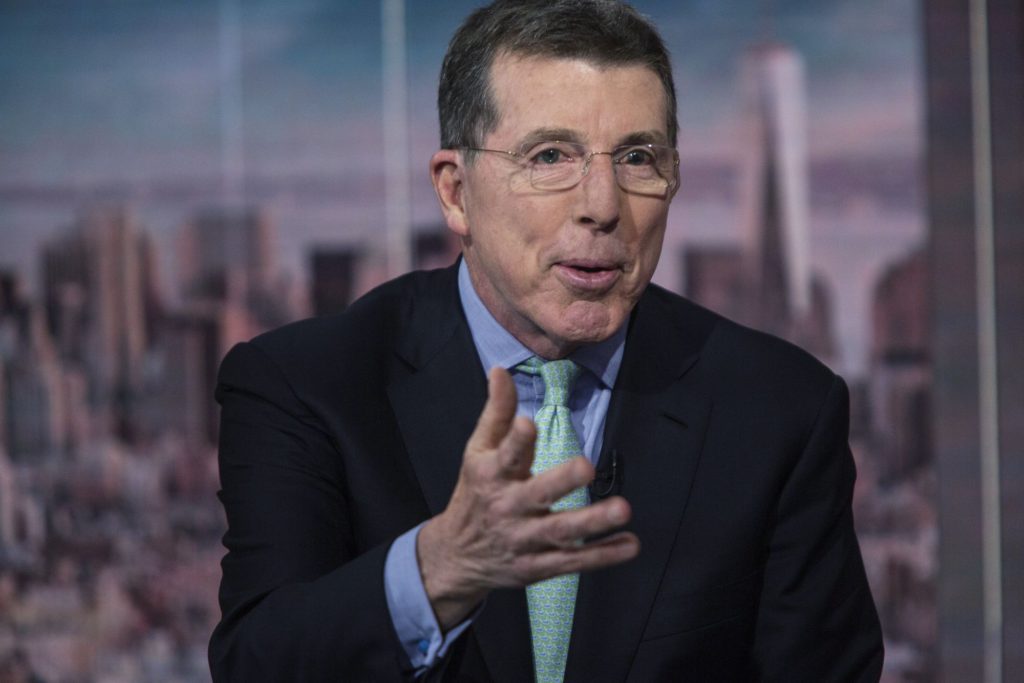
(Bloomberg) — A firm run by former Barclays Plc Chief Executive Officer Bob Diamond is taking an equity stake in middle-market investment bank Cascadia Capital as the advisory business looks to expand.

An investment fund tied to Diamond’s New York-based Atlas Merchant Capital will provide Seattle-based Cascadia with a “strategic growth equity investment,” the companies said in a joint statement Wednesday. Terms weren’t disclosed.

“We like to find investments where we can really add to the growth agenda,” Diamond said in an interview. “There are so many ways we can help.”

The agreement arrives as banks venture deeper into financial services targeted at middle-market companies via acquisitions. Huntington Bancshares Inc. acquired advisory firm Capstone Partners earlier this year, while Toronto-Dominion Bank agreed to buy US brokerage Cowen Inc. to increase its reach into capital markets.

“Over the years we’ve been approached by large institutions in Japan, Europe, the United States and Canada about being purchased,” Cascadia CEO Michael Butler said in an interview. “We felt that the right thing for our clients, our partners and our employees was to remain independent. But at the same time, we realized we needed more gas in the tank in terms of capital.”

Bulking up the private equity practice is a priority, Butler said. The investment bank will also put the equity infusion toward expanding its dealmaking arm more broadly, a move that will require outside hires, he said.

More stories like this are available on bloomberg.com

©2022 Bloomberg L.P.

Mobius to Buy Brazil Assets If Lula Wins in Peaceful Transition

(Bloomberg) — The veteran emerging-market investor Mark Mobius is poised to put more money to work in Brazil should leftist leader Luiz Inacio Lula da Silva win the presidential election next month and take office in a peaceful transition. 

It’s the latter of those two points that is the big question, because while Lula is well ahead in the polls, Mobius is concerned that incumbent President Jair Bolsonaro might contest the result in the sort of controversy that saw protesters storm the US Capitol on Jan. 6 last year.

And while traders say that isn’t in their base-case scenario, Mobius said in an interview that it’s enough of a tail risk to prevent him from boosting his current Brazilian exposure, which remained relatively unchanged in the past months. Bolsonaro, who has questioned Brazil’s computer-based vote counting system as former US President Donald Trump did, has pledged to accept the results “as long as the elections are clean.”

“If election goes well and Lula gets in, then we probably will look to add some of our holdings,” said Mobius, 86, who left Franklin Templeton Investments in 2018 to set up Mobius Capital Partners. “It’s not because of Lula only, but because there’s a stable transition of power and that’ll be good news.”

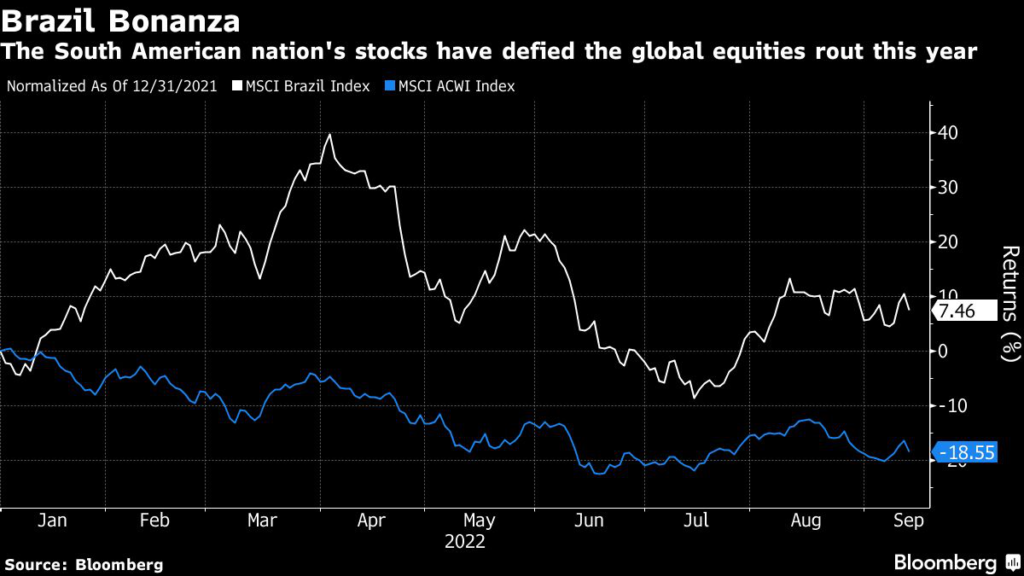
Local stocks might benefit from a potential peak in Brazil’s monetary tightening cycle and the fact that the nation is well positioned to gain from global supply-chain disruptions, according to Mobius. Even after the year-to-date rebound, the Ibovespa index is selling at about 6.5 times forward earnings, versus its 10-year historical average of 11.5 times, Bloomberg data show. 

Brazil “is isolated from those problems in Europe” and “has a lot of the resources that people want,” said Mobius, adding that Lula is likely to foster consumer spending.

In the run-up to the vote, Mobius has been favoring software companies amid strong demand for their product, with Totvs SA being a top pick.

“The key, of course, will be the size of spending and how far he goes, but let’s remember the government can spend as long as the country is growing and productivity is going up,” he said. “That should not be a big issue if they’re able to continue to grow the country, and also if there’s good employment.”

More stories like this are available on bloomberg.com

©2022 Bloomberg L.P.

Germany Weighs Nationalizing Uniper as Energy Crisis Worsens

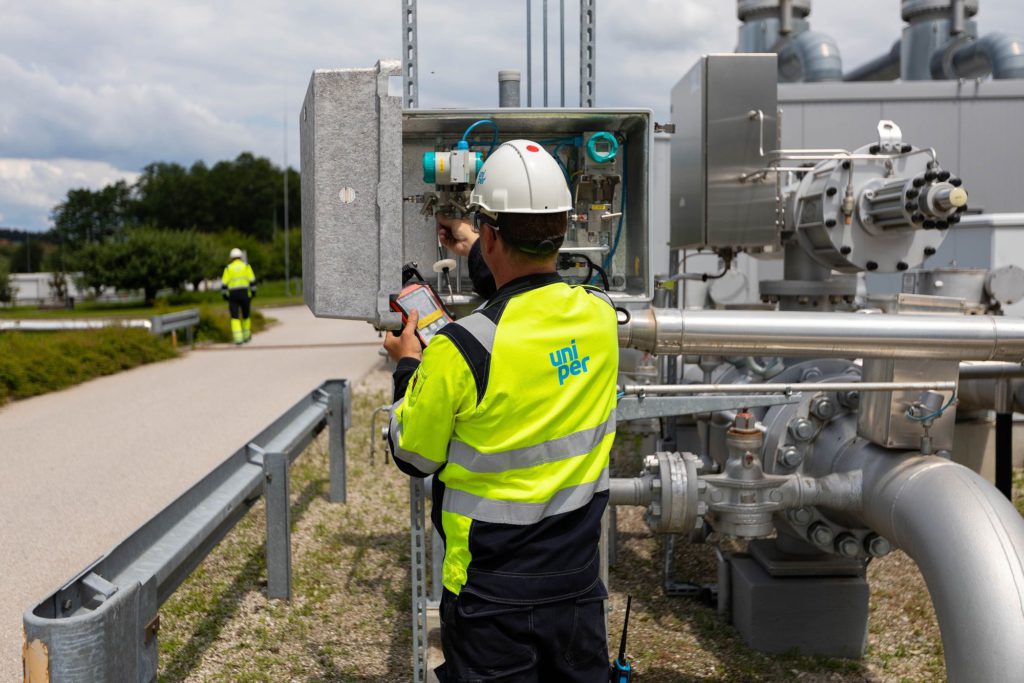
(Bloomberg) — The German government may increase its stake in Uniper SE above 50% and is open to taking the historic step of fully nationalizing the country’s biggest gas importer to prevent a collapse of the energy system.

Dusseldorf-based Uniper needs more help from the state after already tapping into a support package that could be worth as much as 20 billion euros ($20 billion), according to people familiar with the matter. A surge in natural-gas prices and Russian supply cuts have triggered millions in daily losses, prompting the government to step in with a rescue package in July which included a 30% stake.

Chancellor Olaf Scholz’s administration is ready to inject more capital and increase its stake above the 50% threshold, said one of the people, who asked not to be identified because the information is confidential. 

A full nationalization is also under discussion, and Uniper’s Finnish parent company Fortum Oyj would have a say in that decision, the person said. Talks with the Finnish government — Fortum’s majority owner — are ongoing, and Germany has previously said it isn’t willing to buy out the Finnish stake.

Uniper confirmed on Wednesday that one of the options being discussed is the German government taking a “significant majority” stake. Beate Baron, a spokeswoman for Germany’s economy ministry, declined to comment. 

Uniper shares were down 9.6% as of 12:19 p.m. in Frankfurt after earlier surging as much as 10.6%, while Fortum shares were down 0.9% after rising as much as 7.1%.

Fortum said in a statement Wednesday that no decisions have been made “beyond what was agreed in the stabilization package in July” but added that “alternative solutions” are being considered.

“The deteriorating operating environment and Uniper’s financial situation have to be taken into account while Fortum, the German government and Uniper continue their discussions on a long-term solution,” Fortum said, adding that it would “update the market as and if necessary.”

What Bloomberg Intelligence Says…

“Uniper’s potential nationalization by Germany could give minority investors a way out ahead of an uncertain recovery, with losses from having to replace the halted Russian gas supply at current prices likely to surpass 18 billion euros this year, our analysis shows.”

–Patricio Alvarez and Joao Martins. Read more here.

Germany is determined to ensure Uniper’s survival in coming months, when the energy crunch could worsen as temperatures fall heading into winter. Russian supply curtailments have forced the company to buy gas in the expensive spot market to fulfill contracts, pushing it to the edge of insolvency.

Gas futures are about three times higher than a year ago as Russia retaliates for sanctions over its war in Ukraine. Rising energy prices have rocked energy companies, with margin calls — the collateral required to back trades — surging to unsustainable levels.

VNG AG, a subsidiary of German utility EnBW AG and another major gas importer, submitted an application for government aid last week.

Uniper Chief Executive Officer Klaus-Dieter Maubach warned last week in an interview with Bloomberg that losses to replace missing Russian gas flows might reach a 7 billion-euro ($7 billion) limit this month, which would force the government to step in again.

The stabilization package with the government includes a 7 billion-euro backstop to secure the company until the fourth quarter, but hitting that limit “will definitely be earlier,” Maubach said on the sidelines of a conference in Milan.

The aid package offered by the government in July still needs to be signed and then approved by the European Union. The agreement included mandatory convertible securities of 7.7 billion euros as well as a 9 billion-euro credit line from state development bank KfW, which Uniper is seeking to increase to 13 billion euros.


(Updates with Uniper comments from fifth paragraph)

More stories like this are available on bloomberg.com

©2022 Bloomberg L.P.

Russia Gives China’s Yuan a Boost as Firms Cope With Sanctions

(Bloomberg) — As Xi Jinping and Vladimir Putin prepare for a likely meeting this week to cement China-Russia relations, one area where stronger economic ties are already being seen is on the currency front.

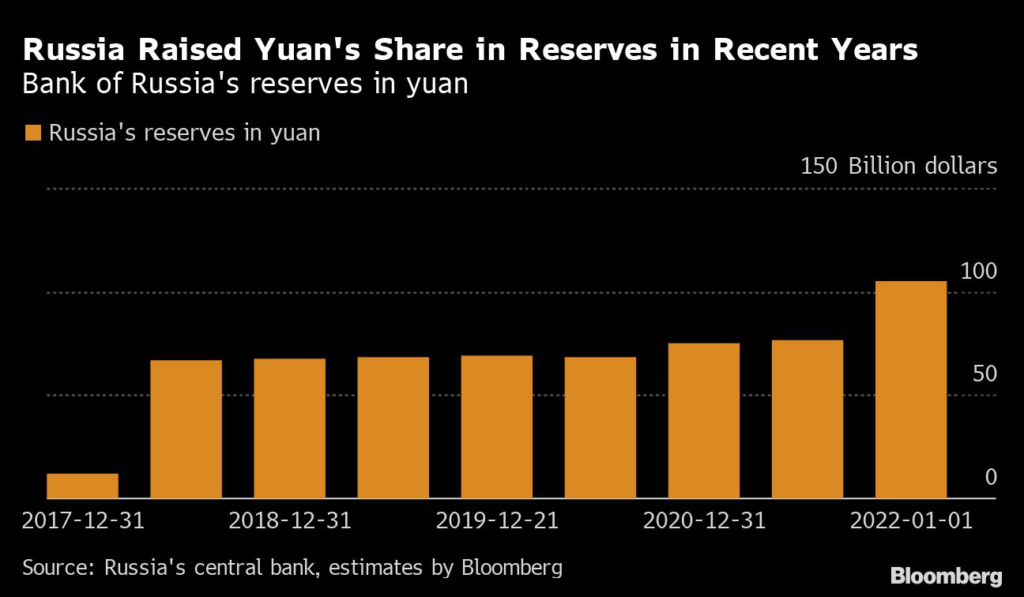
China’s yuan is proving to be a useful release valve for Russian companies hemmed in by sanctions that prevent them trading in dollars. Russian businesses are using yuan to settle more of their trade and are boosting borrowing in the Chinese currency. Moscow is also increasing holdings of yuan in its foreign-exchange reserves. 

While the overall amounts are modest and Russia has described its pickup in demand for yuan as temporary, the development is adding to greater use of the Chinese currency in the global economy, coming on the back of a years long export boom. Russia’s increased use of the yuan could also serve as a template for other Chinese trading partners looking to gradually reduce their reliance on the dollar, which dominates global trade.

“I wouldn’t be surprised to see a further increase in yuan usage,” said Hui Feng, a senior lecturer at Griffith University in Queensland, Australia and co-author of ‘The Rise of the People’s Bank of China.’ “The fundamental factor here is that China’s trade surplus will remain high this year. On top of this is the Russia factor.”

Russia-China trade has soared since the invasion of Ukraine in February. China is buying more oil than ever before from Russia, while its exports to Russia are growing at a double-digit pace even as shipments to many other places slow down. 

In August, China’s ambassador to Russia, Zhang Hanhui, said the two countries should step up coordination to resolve difficulties in trade settlement brought about by Western sanctions on Russia. China will continue to support using more local currency settlement in bilateral trade, Zhang said in an interview with Russian media.

More of those transactions are already being settled in yuan. State-run gas giant Gazprom PJSC said it will shift its contract to supply gas to China to rubles and yuan from euros. Russian institutions accounted for 4% of all offshore yuan payments made through the SWIFT system by July — putting it in third place after Hong Kong and the UK. At the end of 2021, Russia wasn’t even in the top 15 countries with most offshore yuan payments. 

Chinese currency bonds are also becoming a source of funding for some Russian firms. Oil giant Rosneft PJSC is readying the country’s biggest yuan-denominated bond. Polyus PJSC, Russia’s biggest gold miner, increased the amount of five-year yuan bonds it was selling to 4.6 billion yuan ($660 million) from 3.5 billion yuan initially. Aluminum giant United Co. Rusal International sold yuan bonds in July.

Russia’s government is considering a plan to buy as much as $70 billion in yuan and other “friendly” currencies this year to slow the ruble’s surge before shifting to a longer-term strategy of selling its holdings of the Chinese currency to fund investment, Bloomberg News reported Sept. 1. 

Even before the war, Russia had become one of the largest holders of reserves in the Chinese currency in the world. 

The yuan has a long way to go to truly challenge major peers. The Chinese currency accounted for 2.2% of global payments by value in July, up from 1.9% two years ago and compared with 41% for the greenback, 35% for the euro, and 6% for the pound, according to the Society for Worldwide Interbank Financial Telecommunication, or SWIFT.

Eswar Prasad, a professor at Cornell University and a China expert, said the yuan will get a boost from countries looking to skirt the dollar, although the greenback’s dominance remains assured. 

“The proliferation of new technologies that are reducing frictions in international payments, along with the desire of many countries to circumvent reliance on the dollar, are likely to enhance the yuan’s share of global payments,” he said. “Still, it is likely this will at most amount to a modest shift in the next few years and certainly won’t seriously undermine the dollar’s status.”

There are a number of hurdles to the yuan becoming a more global currency, including capital controls and the government’s tight grip on how the yuan trades. China’s legal system lacks the transparency of major trading rivals, while an aggressive crackdown on the technology industry and other sectors has spooked foreign investors.

Cyclically, the Federal Reserve’s aggressive interest rate hikes are pulling investors away from Chinese securities — outflows hit a record earlier this year — while a property slump and ongoing economic hit from restrictions to curb Covid-19 have further dented the yuan’s appeal. Slowing exports will have an impact. 

Still, the currency is gaining ground, even if slowly.

The value of China’s trade settled in renminbi reached a record high of 2.5 trillion yuan in the second quarter, according to data from the People’s Bank of China, reflecting an exports boom that has only recently started to slow.  

At the same time, central banks are gradually diversifying their dollar-denominated holdings. The yuan’s share in official foreign exchange reserves rose to 2.88% in the first quarter of this year, up from 1.2% in 2017, according to the PBOC.

The International Monetary Fund gave the yuan a boost as well in May, lifting its weighting in the Special Drawing Rights currency basket to 12.28% from 10.92%. In the Hong Kong bond market, sales of corporate and government debt denominated in offshore yuan — so-called Dim Sum bonds — jumped to a record.  

The pickup in two-way trade with Russia may also be bolstering China’s cross-border interbank yuan payment system, run by CIPS Co.

While CIPS has only a fraction of transaction volumes compared with SWIFT, it’s steadily growing. The daily average value of transactions handled by the CIPS system in the first half of 2022 was 21 times that of 2016, and most of the overseas yuan settlement banks have already or will soon be connected to the CIPS, according to chief executive officer Xu Zaiyue.


The sheer weight of China’s global economic influence, its closer relations with the so-called BRICS countries of Brazil, Russia, India and South Africa, and the diversification by central banks will continue to bolster the yuan’s status, said Becky Liu, head of China macro strategy at Standard Chartered Plc.

“We expect faster progress of the renminbi’s internationalization in the years ahead,” she said.

(Updates with comments from China’s ambassador to Russia.)

More stories like this are available on bloomberg.com

©2022 Bloomberg L.P.

Ukraine Latest: EU Promises ‘Seamless’ Market Access for Kyiv

(Bloomberg) — Ursula von der Leyen, the head of the European Union’s executive, pledged in her annual state of the union address to work to guarantee “seamless” access for Ukraine to the bloc’s massive single market to help its economy recover from the war. 

The US is preparing another package of aid to Ukraine, according to John Kirby, spokesman for the National Security Council, who cited a “shift in momentum” in the war after the government in Kyiv said it recaptured more than 2,300 square miles of occupied territory. 

Russia has secretly funneled more than $300 million to foreign political parties and candidates since 2014 to influence elections, and may ramp up its efforts in the coming months in a bid to blunt the effect of sanctions, a senior US official told reporters.

(See RSAN on the Bloomberg Terminal for the Russian Sanctions Dashboard.)

Key Developments

  • Xi Lands in Kazakhstan for First Foreign Trip in Over Two Years
  • Yuan’s Clout Gets a Boost From Russia Trade as Sanctions Bite
  • Azerbaijan and Armenia Resume Fighting as US, France Urge Truce
  • Russia’s Invasion Put Ukraine’s Renewables Gains in Jeopardy
  • EU Starts Talks With Norway to Try to Cut the Price of Gas

On the Ground

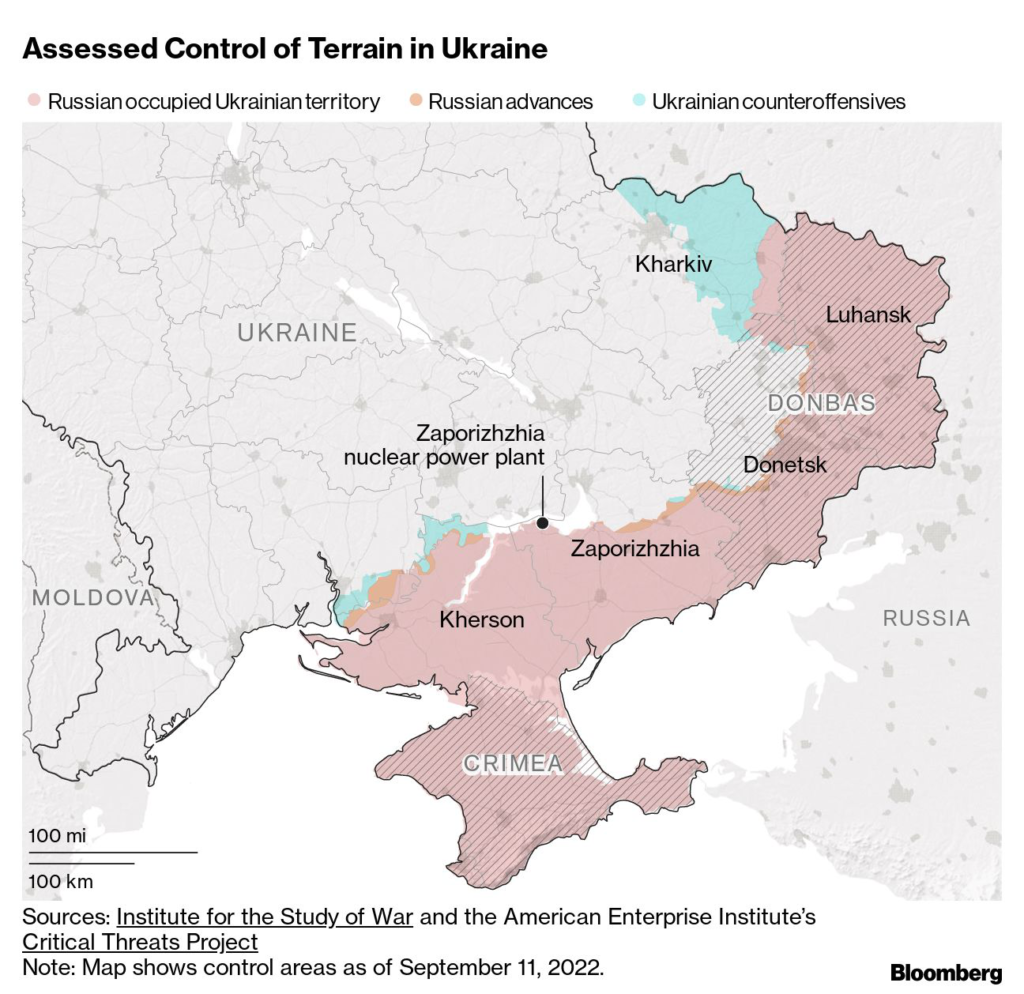
Ukraine was consolidating control over territory retaken from occupying Russian forces during its recent counteroffensive, Ukrainian President Volodymyr Zelenskiy said, following a push that shifted momentum in Kyiv’s favor. Fighting continued in the south, the Ukrainian military said. Russia again targeted civilian infrastructure, according to Ukraine’s General Staff, while local authorities said the cities of Mykolaiv and Nikopol were shelled overnight.

(All times CET)

Ukrainian Deputy Prime Minister Says Russia Sought Talks: France 24 (11:05 a.m.)

Russian officials reached out to Ukraine in recent days about negotiations, Ukrainian Deputy Prime Minister Olha Stefanishyna told France 24 in an interview.

Moscow doesn’t reject negotiations with Ukraine, Russian Foreign Minister Sergei Lavrov said on state television Sunday. However, the longer they are delayed, the more difficult the talks will be, he said.

There haven’t been substantial peace talks since the early days of the war, and the prospect of a settlement appears dim following Ukraine’s successful counteroffensive this month. Billionaire Roman Abramovich attempted to revive contacts between the sides in April but failed to achieve a breakthrough.

EU’s von der Leyen to Travel to Kyiv Wednesday (9:40 a.m.)

Von der Leyen, president of the European Commission, said she would make her third trip to Ukraine since the war began later Wednesday to discuss a plan to ensure “seamless access to the single market of the European Union” with President Volodymyr Zelenskiy.

“Europe’s solidarity with Ukraine will remain unshakable,” von der Leyen told European lawmakers in her annual speech in Strasbourg. Sanctions imposed by the EU against Russia following its invasion “are here to stay.”

Von der Leyen said she will travel to Kyiv with Ukraine’s first lady, Olena Zelenska, who attended the speech.

US Says Russia Gave $300 Million to Foreign Political Parties (7:30 a.m.)

Russia has secretly given more than $300 million since 2014 to influence elections in more than two dozen countries, according to a senior US official, who spoke to reporters on condition of anonymity.

Russia transfers the funds — cash, cryptocurrency and non-monetary contributions — using intermediaries including security services, oligarchs and supposedly independent foundations or think tanks, the State Department said in a note to dozens of US embassies that was shared with reporters.

Biden Cites ‘Significant Progress,’ With Caveat (3:10 a.m.) 

President Joe Biden, asked if Ukraine’s recent battlefield successes marked an inflection point in the war, said Tuesday evening that “the question is unanswerable right now.”

“It’s clear the Ukrainians have made significant progress,” he told reporters after voting in Wilmington, Delaware. “I think it’s gonna be a long haul.”

US Cites ‘Shift in Momentum,’ Readies Another Round of Aid (8:25 p.m.)

The US is preparing another round of military aid for Ukraine, as the Biden administration sees a “shift in momentum” favoring Kyiv’s forces against its Russian opponents, National Security Council spokesman Kirby told reporters.

Additional supplies of weapons that will be announced in the “coming days” could help Ukraine keep up its counteroffensives against the Russians, Kirby said without detailing what will be provided.

Saying Ukrainians have made “more dramatic” advances in the country’s north than in the south, Kirby said. “I would let President Zelenskiy determine and decide whether he feels militarily they’ve reached a turning point. But clearly, at least in the Donbas, there’s a sense of momentum here by the Ukrainian armed forces.”

More stories like this are available on bloomberg.com

©2022 Bloomberg L.P.
Google Suffers Setback in Court Fight to Topple Record EU Fine

(Bloomberg) — Google lost most of the first round of its battle to topple a record 4.3 billion-euro ($4.3 billion) European Union antitrust fine that struck at the heart of the US tech giant’s power over the Android mobile-phone ecosystem. 

In a boost for EU antitrust chief Margrethe Vestager, judges upheld the vast majority of the European Commission’s arguments, but cut the penalty to 4.1 billion euros after finding faults in some of the regulator’s analysis and that Google’s right to a fair hearing had partly been infringed.

“The General Court largely confirms the commission’s decision that Google imposed unlawful restrictions on manufacturers of Android mobile devices and mobile network operators in order to consolidate the dominant position of its search engine,” the Luxembourg-based EU tribunal said in a statement.

The Android case is one of a trio of decisions that have been the centerpiece of Vestager’s bid to rein in the growing dominance of Silicon Valley. She’s fined Alphabet Inc.’s Google more than 8 billion euros and has since opened new probes into the company’s suspected stranglehold over digital advertising.

“We are disappointed that the court did not annul the decision in full,” Google said in an emailed statement. “Android has created more choice for everyone, not less, and supports thousands of successful businesses in Europe and around the world.” 

The judgment is a “victory for the European Commission and a vindication of FairSearch’s 2013 complaint that triggered the case,” said Thomas Vinje, a lawyer for the FairSearch coalition, which includes Oracle Corp. and TripAdvisor Inc.

EU’s Google Ad Tech Probe Strikes at Heart of Business Model

Wednesday’s ruling can be appealed to the bloc’s top court, the EU’s Court of Justice.

The commission in its 2018 decision accused Google of three separate types of illegal behavior that helped cement the dominance of its search engine.

First, it said Google was illegally forcing handset makers to pre-install the Google Search app and the Chrome browser as a condition for licensing its Play Store — the marketplace for Android apps.

Second, the EU said Google made payments to some large manufacturers and operators on condition that they exclusively pre-installed the Google Search app. 

It was on this point that EU judges found fault in the commission’s analysis, saying the regulator hadn’t provided enough evidence. 

Lastly, the EU said the Mountain View, California-based company prevented manufacturers wishing to pre-install apps from running alternative versions of Android not approved by Google.

While the EU claimed that Google’s actions were an illegal restraint on trade, the company said the EU’s findings undermined a business model that allowed it to provide the Android software for free while it generated ad revenue. 

‘Illegal Conduct’

Despite the EU court appeal, Google had to comply with an ultimatum by the commission “to bring its illegal conduct to an end in an effective manner.” 

Proposed tweaks included allowing mobile device makers partners to develop “forked” smartphones for Europe, and allowing them to license the Google mobile application suite separately.

Google last year proposed further changes, including to scrap a fee and add more mobile search apps for users to choose from on new Android phones, which the EU welcomed as “positive.”

Google’s contracts with smartphone makers over Android are also at the center of two antitrust lawsuits pending in the US against the search giant by the Justice Department and state attorneys general. 

The case is: T-604/18, Google and Alphabet v. Commission.

FROM THE ARCHIVE: Why Google’s Android Fell Afoul of EU on Antitrust: QuickTake

More stories like this are available on bloomberg.com

©2022 Bloomberg L.P.
On The Verge Of The Ethereum ‘Merge’

  • Listen to Bloomberg Crypto on the iHeartRadio App
  • Listen to Bloomberg Crypto on Apple Podcasts
  • Listen to Bloomberg Crypto on Spotify  

(Bloomberg) — The highly anticipated software upgrade of the Ethereum blockchain, called “the Merge,” is expected to happen this week. The crypto network runs Ether, the world’s second-most-valuable digital asset. What does the change mean for you? In this episode Bloomberg Senior Editor Dave Liedtka talks with reporters David Pan and Olga Kharif during a recent Twitter Spaces event about the possible outcomes of the big event.

Follow us on Twitter @crypto, and subscribe to the Bloomberg Crypto Newsletter at https://bloom.bg/cryptonewsletter

More stories like this are available on bloomberg.com

©2022 Bloomberg L.P.
Elon Musk Says Fed Should ‘Drop 0.25%’

(Bloomberg) — Elon Musk suggested the Federal Reserve should cut interest rates by 0.25%, saying that a major hike would risk deflation. 

The suggestion by the world’s richest man came in response to a Twitter user who asked Musk what the Fed should do, and after an earlier post from Ark Investment Management’s Cathie Wood. 

On Tuesday, unexpectedly hot inflation data virtually assured markets that the Fed will raise rates by 75 basis points next week.

More stories like this are available on bloomberg.com

©2022 Bloomberg L.P.
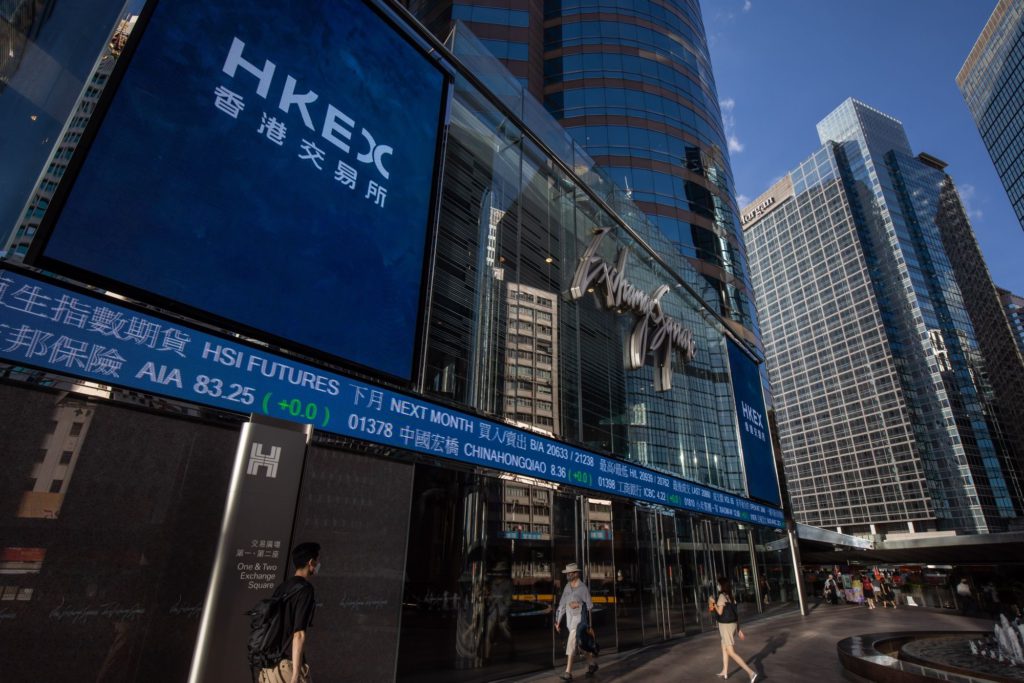
Hong Kong Weighs Lower Revenue Threshold for Hard-Tech IPOs

(Bloomberg) — Hong Kong Exchanges & Clearing Ltd. is discussing a system that will slash the revenue requirements for hard-tech companies to go public in the city, according to people familiar with the matter. 

The bourse is planning a new chapter 18C scheme to accommodate companies in sectors ranging from artificial intelligence and chips to autonomous vehicles and smart manufacturing, the people said, asking not to be identified because the matter is private. The HKEX could seek public consultation as soon as this month and aims to finalize the plan by the year’s end, they added. 

Granting easier access to public markets for hard-tech firms fits with China’s push to beef up its artificial intelligence and semiconductor industry. For the HKEX, the move may boost its appeal as a listing hub and broaden its revenue stream, after a bruising year hit by Covid and regulatory setbacks that have dented its listing business. 

The exchange has already been trying to attract biotech and internet firms, dovetailing with President Xi Jinping’s call for stepping up the development of technology critical to national security. 

The considerations are ongoing and details of the proposal could still change, said the people. Company types that could be included are new energy, software as a service (SaaS), platform as a service (PaaS), smart manufacturing and robotics, semiconductors, quantum computing, autonomous driving and AI.

Here are the specific terms proposed for the two types of companies, according to the people: 

  • Firms pre-commercialization: the market value requirement for such companies at the time of their initial public offering would be more than $2 billion
  • Commercialized firms: Revenue requirement would be HK$200 million ($25 million) to HK$300 million, versus the current requirement of HK$500 million; market value requirement would be at least $1 billion

The HKEX said it continues to work on a range of new initiatives to ensure its listing franchise remains attractive. 

“We are therefore studying how best to create a listing chapter to cater for the funding needs of large-scale advanced technology companies that are at an early stage of product commercialization,” it said in an emailed statement. “We will update the market should there be any new developments.”

Xi’s Plea

As China decouples from the US, Xi has been exhorting top officials to pool their resources and focus on breakthroughs critical to the country’s future. 

The US, after years of targeting specific companies like Huawei Technologies Co., is enacting broader restrictions on the entire Chinese economy. The Biden administration implemented new controls over the sale of artificial intelligence chips to Chinese customers, a blow to the development of cutting-edge technologies, and is weighing an executive order that would curtail investment in the country.

Hong Kong could play a larger role in attracting capital to support hard-tech company growth, while it tries to compete with other hubs to lure cutting-edge startups. 

That’s especially important as the HKEX comes under financial strain. In the first half, IPOs were down more than 90%, while overall trading volumes slid 27%. The bourse’s profit slid 22% and it lost HK$274 million of investments in the second quarter.

(Updates with HKEX statement in the eighth and ninth paragraphs)

More stories like this are available on bloomberg.com

©2022 Bloomberg L.P.
Ferrari Unveils First $390,000 SUV With a Plea: ‘Don’t Call It an SUV’

(Bloomberg) — Ferrari NV unveiled its long-awaited 390,000-euro ($390,195) Purosangue crossover that will haul the supercar maker into a new era of broader appeal.

The company’s most utilitarian model in its 75-year history — with four doors, four seats and a 473-liter (125-gallon) trunk — will hit showrooms next year. While heavily geared over four years of development to meet Ferrari’s track-worthy credentials, the Purosangue represents a break from the manufacturer’s low-slung racing machines and dispels doubts it would ever produce a versatile vehicle.

Ferrari exudes confidence about the Purosangue fitting that description, and is offering a surprise answer to one question: So is it a sport utility vehicle or not?

“Please don’t call it an SUV, because it isn’t,” Chief Executive Officer Benedetto Vigna told reporters in Maranello, northern Italy. “It’s a Ferrari.”

Vigna’s comment indicates the world’s best-known performance-car maker is still coming to terms with a segment some prancing-horse purists believe should be verboten for the brand. When asked in 2016 whether Ferrari would ever consider producing a crossover, then-CEO Sergio Marchionne quipped: “You’d have to shoot me first.”

Crossovers and SUVs tend to be less agile than what Ferrari drivers are used to, though  the almost 225,000-euro Lamborghini Urus and 206,800-euro Bentley Bentayga have been well-received. The Purosangue beats both on acceleration, racing to 100 kilometers (62 miles) per hour in 3.3 seconds.

Read More: Ferrari Vows Electric Shift Won’t Eat Up its Luxury Margins

While Ferrari offers the 296 GTB and the SF90 Stradale sports cars as plug-in hybrids, the Purosangue will only be powered by a combustion engine. The mid-front mounted, naturally aspirated, 715-horsepower V12 and automatic transmission will get the vehicle to a top speed of 310 kilometers per hour.

“We discussed for a long time which kind of powertrain to mount on the Purosangue,” said Enrico Galliera, Ferrari’s chief marketing and commercial officer. “We finally decided on a full internal combustion one, since we weren’t willing to compromise and we got that this was what our most loyal customers wanted.”

Giving people something SUV-like without upsetting idealists isn’t the only tightrope Ferrari is walking. Transitioning to electric powertrains will be needed to comply with emissions regulations, but the manufacturer will also have to meet the expectations of select clientele who pay up for a piece of motoring glory.

After delivering just over 11,100 vehicles last year, Vigna in June detailed Ferrari’s battery strategy, which includes a first fully electric model about three years from now. Battery-only and plug-in hybrid autos are slated to make up 60% of Ferrari’s portfolio by 2026 as part of a 4.4 billion-euro investment plan.

The company remains fully committed to making its vehicles carbon-neutral by the end of the decade, Galliera said at the event.

Related: High-End Motors Give Ferraris an Edge in the Electric Age

Pre-orders for the Purosangue — which features a brand-new chassis with a single-shell, carbon-fiber roof to lower its center of gravity — have likely exceeded more than 2,000 units already. Ferrari is holding a four-day event this week for those who’ve placed a request to purchase.

To maintain exclusivity, Ferrari has said Purosangue deliveries won’t exceed 20% of the carmaker’s total sales during the model’s life cycle.

(Updates with former CEO’s comment in the fifth paragraph.)

More stories like this are available on bloomberg.com

©2022 Bloomberg L.P.

Close Bitnami banner
Bitnami