

Bloomberg

Thoma Bravo Wins Battle for Coupa in $6.2 Billion Deal

(Bloomberg) — Thoma Bravo LLC agreed to acquire Coupa Software Inc. for an equity value of $6.2 billion after outbidding Vista Equity Partners. 

The acquisition of Coupa caps off a year of sizable take-private deals for Thoma Bravo, including Anaplan Inc., Sailpoint Inc. and Ping Identity. It beat out Vista, another technology-focused private equity firm, which had also been in talks to buy Coupa. 

Thoma Bravo will pay $81 a share in cash for San Mateo, California-based Coupa, a 77% premium to the closing price on Nov. 22, prior to a Bloomberg News report regarding the potential sale of the company, according to a statement on Monday.

The deal, which has an enterprise value of $8 billion and is expected to close in the first half of 2023, also includes a “significant minority investment” from the Abu Dhabi Investment Authority.

Coupa provides so-called business-spend management software, which helps companies track and manage the purchasing of goods and services. Customers have included Nestle SA and Groupon Inc., according to its website.

The market for tech buyouts has been busy despite financing being harder to come by. Bloomberg reported on Friday that private credit funds were pulling together debt packages for a buyout of Coupa. 

Read more: Private Credit Firms Prep $3 Billion Loan for Coupa Bidders

The price is lower than what some shareholders have been seeking. HMI Capital Management, a top shareholder in Coupa, said earlier this month the software company should fetch at least $95 a share in a sale. 

Another shareholder, Meritage Group, has also been in touch with Coupa on its views on the company’s value. 

Billy Montana, a partner and portfolio manager at Jackson Square Partners, said in an email Friday that his firm owns 1.8 million shares and has told Coupa’s board it supports them in engaging with interested buyers to determine if there’s an attractive acquisition offer. 

“An adequate takeout premium would represent immediate and certain value creation in an uncertain environment,” Montana said. 

Coupa, led by chief executive officer Rob Bernshteyn, went public in 2016 at $18 a share.  

–With assistance from Davide Scigliuzzo and Katie Roof.

(Additional context.)

More stories like this are available on bloomberg.com

©2022 Bloomberg L.P.

US Futures Rise With Central-Bank Moves in Focus: Markets Wrap

(Bloomberg) — US equity-index futures edged higher at the start of a pivotal week for monetary-policy decisions from the Federal Reserve, European Central Bank and a host of their peers. 

Contracts on the S&P 500 and Nasdaq 100 indexes were about 0.3% higher after weekly losses for the underlying indexes. Treasuries advanced, with the 10-year yield shedding four basis points, while the dollar was steady. The Stoxx Europe 600 Index slid for the sixth time in seven days.

Investors are looking for firmer clues on how far and fast central banks will tighten monetary policy from here on as recession fears resurface. The Fed is projected to slow its hiking spree to a 50 basis-point move on Wednesday, though officials have said borrowing costs will need to remain restrictive for some time. US inflation figure on Tuesday will throw more light on whether that’s the case or markets have a case for expecting rate cuts in late 2023.

“Throughout this year, we have seen the Fed taking serious aggressive monetary-policy measures to control inflation,” Naeem Aslam, the chief markets analyst at Ava Trade Ltd., wrote in a note. “However, the last reading made the Fed believe that inflation has started to move in the right direction. This means that they need to do less as there is plenty more tailwind behind this which will continue to push inflation lower.”

Read: The 24 Hours of Hikes That End Year of Fighting Inflation

Still, a robust labor market and lingering concerns about inflation prevent traders from turning bullish. Disparities in the economic outlook between the world’s regions, from the resurgence of Covid in China to energy volatility in Europe, keep a lid on risk sentiment. The dollar was little changed, after posting a small gain earlier.

Following the Fed, the ECB will announce its rate decision Thursday, and may opt for a 50 basis-point hike. Markets also have to contend with decisions from the Bank of England and monetary authorities in Mexico, Norway, the Philippines, Switzerland and Taiwan.

While the tumult of this year has a gauge of global stocks headed for its biggest annual loss since 2008, the world’s biggest investors predict that stocks will see low double-digit gains in 2023. As many as 71% of respondents in a Bloomberg News survey expect equities to rise, versus 19% forecasting declines. For those seeing gains, the average response was a 10% return.


An index of Asian equities dropped, ending a two-day winning streak. The rapid spread of Covid cases in China added to concern, with Hong Kong’s Hang Seng Index down about 2%.

Treasuries rose across the curve, with longer-dated securities seeing bigger yield decreases than the shorter ones. 

West Texas Intermediate oil traded 0.9% lower. Crude remains on track for its first back-to-back quarterly decline since mid-2019 as the demand outlook sours and thin liquidity exacerbates price swings into the year-end. 

Retail, Pro Investors Clash on Best Pre-FOMC Trade: MLIV Pulse

Key events this week:

  • US CPI, Tuesday
  • FOMC rate decision and Fed Chair news conference, Wednesday
  • China medium-term lending, property investment, retail sales, industrial production, surveyed jobless, Thursday
  • ECB rate decision and ECB President Lagarde briefing, Thursday
  • Rate decisions for UK BOE, Mexico, Norway, Philippines, Switzerland, Taiwan, Thursday
  • US cross-border investment, business inventories, empire manufacturing, retail sales, initial jobless claims, industrial production, Thursday
  • Eurozone S&P Global PMI, CPI, Friday

Some of the main moves in markets:

Stocks

  • Futures on the S&P 500 rose 0.3% as of 7:31 a.m. New York time
  • Futures on the Nasdaq 100 rose 0.3%
  • Futures on the Dow Jones Industrial Average rose 0.2%
  • The Stoxx Europe 600 fell 0.6%
  • The MSCI World index fell 0.2%

Currencies

  • The Bloomberg Dollar Spot Index was little changed
  • The euro rose 0.3% to $1.0571
  • The British pound rose 0.3% to $1.2291
  • The Japanese yen fell 0.2% to 136.83 per dollar

Cryptocurrencies

  • Bitcoin fell 1% to $16,947.18
  • Ether fell 1.4% to $1,247.19

Bonds

  • The yield on 10-year Treasuries declined four basis points to 3.54%
  • Germany’s 10-year yield declined three basis points to 1.90%
  • Britain’s 10-year yield declined five basis points to 3.14%

Commodities

  • West Texas Intermediate crude fell 0.5% to $70.69 a barrel
  • Gold futures fell 0.3% to $1,805.30 an ounce

This story was produced with the assistance of Bloomberg Automation.

More stories like this are available on bloomberg.com

©2022 Bloomberg L.P.
EV Sector Needs More Clarity on Biden’s Energy Law, LG Chem CEO Says

(Bloomberg) —

A key supplier to the electric vehicle sector is urging the Biden administration to clarify details of a law aimed at drawing more battery manufacturing investment to the US.

It’s still not clear whether certain sourcing scenarios — such as processing minerals in the US from overseas mines, or from operations controlled by foreign companies — will run foul of the Inflation Reduction Act, according to LG Chem Ltd., one of the world’s biggest chemical companies and a key producer of battery materials.

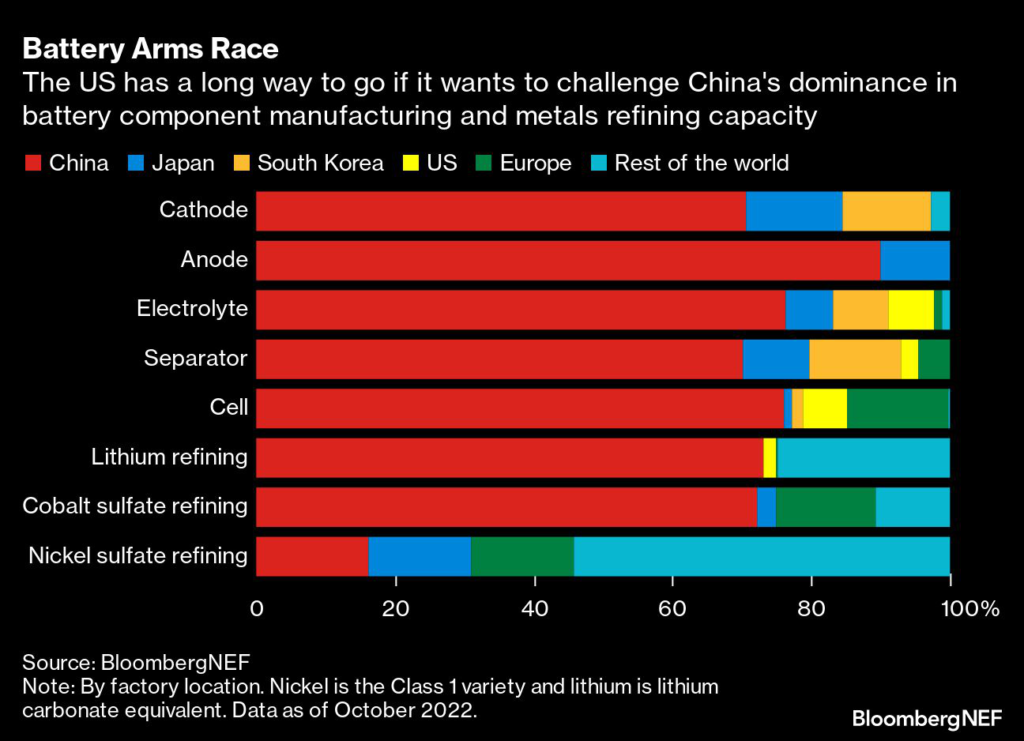
The legislation signed into law in August aims to boost US production of EVs and curtail China’s dominance of the industry’s supply chains. Its requirements have drawn pushback from politicians and executives in countries including France, Argentina and South Korea. Automakers will be required to secure battery minerals from countries that have free trade agreements with the US to be eligible for $7,500-per-vehicle tax credits for consumers.

LG Chem last month announced plans to invest $3 billion to build a facility in Clarksville, Tennessee, that would be the largest US factory producing cathode material used in lithium-ion battery cells. The supplier also is keeping a close watch on the potential impact of the new law on costs, according to Chief Executive Officer Shin Hak-Cheol.

“We are trying to take a safe route in terms of keeping ourselves enough room, not skating through the edge of the ice,” Shin said in an interview this month in Seoul. “And I’m hoping that the ice will not break while you’re still skating.”

Here’s an edited transcript of the interview with Shin covering the IRA, rising demand and future plans.

How well is LG Chem prepared for the implications of the IRA?

We are giving our commitment to our customers — battery manufacturers and OEMs — that we will be IRA compliant. However, there are some unclear scenarios. If you have all the metal mines owned by a US company, and then you assemble there — that’s clear-cut. There are many scenarios in between, and those scenarios eventually have to be worked out by the US government. We haven’t figured out every detail yet.

Will there be enough capacity in supply chains by 2030 to enable OEMs to produce the volume of electric models that they are promising?

You have to dissect every component to determine what is the supply bottleneck and can it be resolved — by when, by what method? It’s no secret that demand is much larger than supply. You just cannot build factories fast enough. You cannot hire people that fast.

Suppliers have had to deal with higher raw material costs this year. How challenging is the cost picture over the next few years?

The cost element is one of many things we are dealing with. We are trying to produce the best quality, and to have stable quality in mass production — that’s by far the most important focus.

When it comes to prices or metals, we’re not the only company worrying about that. I think in this kind of a tumultuous situation, you need to make it simple and focus on what you can deliver and control as opposed to trying to fundamentally change what you cannot. I think the industry at large has to focus on what they can deliver — to kind of calm down, use data and facts, and do the best they can do. If everybody’s doing that in every value chain, then the whole industry will benefit. If one person is trying to solve all the problems, that creates more problems than solutions.

Will there be a cost premium for supply chains that become completely IRA compliant, or compliant with any similar laws in the EU or elsewhere?

I don’t know until I see the facts. It is true that the US government is offering some incentives in the form of various tax credits, not just the $7,500 subsidy to consumers who are buying EVs, but also a number of provisions related to tax abatement for manufacturing operations in North America. So whether that will offset some of these things, I don’t know. I think there had to be the realization on the part of whoever enacted the law that it’s inevitable that there will be added cost.

Is LG looking beyond cathode materials?

We are looking at all options, all possibilities, though you need an anchor product. We want to be the best cathode supplier in the world — in quality and technology — before we worry about all the other elements. With the joint venture with Toray, we are already parlaying into separators. We already announced during our investor conference that we eventually want to become the world’s best battery-materials supplier — like binders, and carbon nanotubes.

More stories like this are available on bloomberg.com

©2022 Bloomberg L.P.

Microsoft to Buy 4% of London Stock Exchange Group on Cloud Deal

(Bloomberg) — Microsoft Corp. agreed to buy a 4% stake in London Stock Exchange Group Plc in a $2.8 billion cloud-computing deal that pushes big tech further into financial markets.

As part of the agreement, LSEG said it will spend at least that amount on cloud services with Microsoft over the next 10 years. The partnership will speed up the migration of its markets to the cloud and allow it to develop new products and services, it said Monday.

The transaction adds to a recent trend of exchanges and tech firms linking up after similar partnerships between Nasdaq Inc. and Amazon.com Inc., as well as Alphabet Inc.’s Google and CME Group. It points to increased demand from investors for information that gives them an edge in increasingly fast electronic markets. 

Global spending on financial market data and news rose 7.4% to a record $35.6 billion in 2021, according to an April report by Burton-Taylor International Consulting.

“We will be generating meaningful revenue growth in the coming years by accessing new products and enhancing our existing product capabilities,” LSEG Chief Executive Officer David Schwimmer said in a phone interview.

At Friday’s closing price, a 4% stake in LSEG was valued at around £1.6 billion ($2 billion).

Microsoft will buy its stake from a consortium made up of Blackstone, Thomson Reuters Corp. and affiliates of the Canada Pension Plan Investment Board and Singapore’s GIC, according to the statement. Thomson Reuters said in a statement it plans to use its proceeds from the transaction “to pursue organic and inorganic opportunities in key growth segments and provide returns to shareholders.”

LSEG’s shares were up 3.2% at 11:37 a.m. in London.

Minimum Spend

The deal underlines LSEG’s increasing focus on data and analytics. The company completed a $27 billion purchase of Refinitiv last year, kicking off a new era where the majority of its revenues come from data. The parent company of Bloomberg News competes with Refinitiv to provide financial news, data and information.

The Microsoft agreement is expected to cost LSEG between £250 million to £300 million between 2023 and 2025, including about £100 million in capital spending. 

Additional spending beyond the $2.8 billion minimum depends on the “success of the strategic partnership” and demand for LSEG’s data platform and professional services, according to the UK firm. Microsoft estimated in a separate statement that the “partnership, and broader market opportunity, could generate an additional $5 billion in revenue for the company over the next 10 years.”

Scott Guthrie, Microsoft’s executive vice president for cloud and artificial intelligence, will be appointed as a LSEG director.

Data Consolidation

The past few years has seen consolidation among the finance industry’s biggest data providers. Last year, S&P Global Inc. agreed to buy IHS Markit Ltd. while Deutsche Boerse, LSE’s biggest European rival, took a majority stake in Institutional Shareholder Services Inc., the corporate-governance adviser.

Read More: LSE Completes Refinitiv Deal to Kickstart Data-Driven Era

It’s not the first time Microsoft has struck a deal alongside unveiling a sizeable cloud deal. In 2018, it invested in Grab, with the ride-hailing firm agreeing to adopt Azure as its preferred cloud platform.

These cross-selling deals don’t always end in success. In 2012, the US tech firm spent $300 million in a stake in then struggling bookseller Barnes & Noble’s e-book division Nook. 

As part of the deal, Barnes & Noble agreed to make e-reading content for Microsoft. Two years later, Barnes & Noble bought out Microsoft’s stake for about $125 million, after Nook struggled to win over customers.

–With assistance from Chris Reiter.

More stories like this are available on bloomberg.com

©2022 Bloomberg L.P.
Star Southeast Asia Unicorns See $51 Billion Gone Since Listings

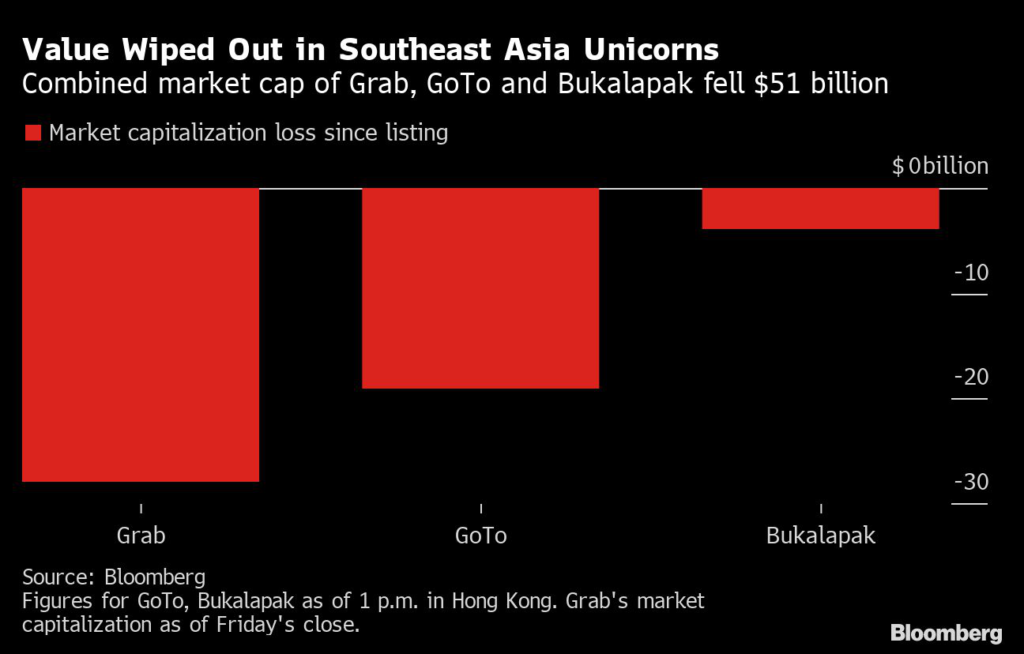
(Bloomberg) — Global investors who put their faith in three of Southeast Asia’s high-profile tech startups are facing a grim reality that’s seen the firms lose $51 billion in value in the past year-and-a-half since their equity debuts.

Singapore-based ride-hailing firm Grab Holdings Ltd., which listed in New York about a year ago, has shed over 70% of its market value. It was Southeast Asia’s most valuable startup at the time it merged with Altimeter Growth Corp., the blank-check firm of Brad Gerstner’s Altimeter Capital Management. Grab lured more than $4 billion from investors including BlackRock Inc., Fidelity International and T. Rowe Price Group Inc.

PT GoTo Gojek Tokopedia, Indonesia’s largest initial public offering this year, and PT Bukalapak.com, which listed in 2021, have plunged 74% and 69%, respectively, since their first day of trade in Jakarta following widely-expected IPOs. Both companies underperformed local benchmarks and about a 30% drop in the Nasdaq 100 since the start of the year.

READ: GoTo’s 61% Slump Is the World’s Worst Among Large 2022 Tech IPOs

Grab is now worth $11.6 billion, Bloomberg data show. While the stock trimmed some losses since it announced it narrowed losses in the third quarter as revenue beat expectations, investors remain skeptical of when it may reach profitability.

The Southeast Asian newcomers join a slump engulfing recently-listed Indian startups as investors question their high valuations. The three firms offered investors an exposure to Southeast Asia’s booming e-commerce sector at a time when traders were still eager to snap up growth stocks. But rising interest rates globally and risks of recession are taking a toll on technology shares.

There are also concerns that early investors will be paring their stakes after initial lockup periods end, something that happened with several companies in India. GoTo lost nearly 60% in market value over the past month amid the expiry of a lockup on its major shareholders’ stakes and as investors fret about the unprofitable Indonesian internet company’s prospects.

GoTo on Thursday said it has enough funds to last the company until it reaches profitability. 

Online marketplace Sea Ltd, another Singaporean unicorn that listed in the US back in 2017, also lost about $169 billion in market value since a peak in October 2021.

More stories like this are available on bloomberg.com

©2022 Bloomberg L.P.

Did Stimulus Checks Contribute to the Crypto Crash? That’s One Theory (Podcast)

(Bloomberg) — Listen to Bloomberg Crypto on the iHeartRadio App, Apple Podcasts or  Spotify.

What do pandemic stimulus funds have to do with the recent collapse of crypto prices and entities like FTX? According to Bloomberg Opinion writer Robert Burgess, the answer is basically everything.

As he wrote in a recent column, “When historians look back on the spectacular rise and collapse of the cryptocurrency market, they will conclude that it couldn’t have happened without the pandemic. And they’d be right. This isn’t as controversial an opinion as it might seem. Burgess joins this episode.


Subscribe to the Bloomberg Crypto Newsletter at https://bloom.bg/cryptonewsletter 

This podcast is produced by the Bloomberg Crypto Podcast team: Supervising producer: Vicki Vergolina, Senior Producer: Janet Babin, Producers: Sharon Beriro and Muhammad Farouk, Associate Producers: Mo Andam and Ty Butler. Sound Design/Engineer:  Desta Wondirad.


More stories like this are available on bloomberg.com

©2022 Bloomberg L.P.

US Futures Steady With Central-Bank Moves in Focus: Markets Wrap

(Bloomberg) — US index futures posted modest gains and the dollar erased an advance at the start of a pivotal week for monetary-policy decisions from the Federal Reserve, European Central Bank and a host of their peers. 

Contracts on the S&P 500 and Nasdaq 100 indexes were about 0.1% higher after weekly losses for the underlying indexes. Treasuries advanced, with the 10-year yield shedding 3 basis points. Oil fell as traders weighed the demand outlook amid growing economic concerns. The Stoxx Europe 600 Index slid for the sixth time in seven days.

Investors are looking for firmer clues on how far and how fast central banks will tighten monetary policy from here on, as recession fears resurface. The Fed is projected to slow its hiking spree to a 50 basis-point move on Wednesday, though officials have said borrowing costs will need to remain restrictive for some time. US inflation figure on Tuesday will throw more light on whether that’s the case or markets have a case for expecting rate cuts in late 2023.

“Throughout this year, we have seen the Fed taking serious aggressive monetary-policy measures to control inflation,” Naeem Aslam, the chief markets analyst at Ava Trade Ltd., wrote in a note. “However, the last reading made the Fed believe that inflation has started to move in the right direction. This means that they need to do less as there is plenty more tailwind behind this which will continue to push inflation lower.”

Read: The 24 Hours of Hikes That End Year of Fighting Inflation

Still, a robust labor market and lingering concerns about inflation prevent traders from turning bullish. Disparities in the economic outlook between the world’s regions, from the resurgence of Covid in China to energy volatility in Europe, keep a lid on risk sentiment. The dollar was little changed, after posting a small gain earlier.

Following the Fed, the ECB will announce its rate decision Thursday, and may opt for a 50 basis-point hike. Markets also have to contend with decisions from the Bank of England and monetary authorities in Mexico, Norway, the Philippines, Switzerland and Taiwan.

While the tumult of this year has a gauge of global stocks headed for its biggest annual loss since 2008, the world’s biggest investors predict that stocks will see low double-digit gains in 2023. As many as 71% of respondents in a Bloomberg News survey expect equities to rise, versus 19% forecasting declines. For those seeing gains, the average response was a 10% return.

Europe’s equity benchmark fell. All its industry subgroups posted losses, with commodity companies being the biggest drag. An index of Asian equities dropped, ending a two-day winning streak. The rapid spread of Covid cases in China added to concern, with Hong Kong’s Hang Seng Index down about 2%.

Treasuries rose across the curve, with longer-dated securities seeing bigger yield decreases than the shorter ones. 

West Texas Intermediate oil traded 0.9% lower. Crude remains on track for its first back-to-back quarterly decline since mid-2019 as the demand outlook sours and thin liquidity exacerbates price swings into the year-end. 

Retail, Pro Investors Clash on Best Pre-FOMC Trade: MLIV Pulse

Key events this week:

  • US CPI, Tuesday
  • FOMC rate decision and Fed Chair news conference, Wednesday
  • China medium-term lending, property investment, retail sales, industrial production, surveyed jobless, Thursday
  • ECB rate decision and ECB President Lagarde briefing, Thursday
  • Rate decisions for UK BOE, Mexico, Norway, Philippines, Switzerland, Taiwan, Thursday
  • US cross-border investment, business inventories, empire manufacturing, retail sales, initial jobless claims, industrial production, Thursday
  • Eurozone S&P Global PMI, CPI, Friday

Some of the main moves in markets:

Stocks

  • The Stoxx Europe 600 fell 0.5% as of 9:53 a.m. London time
  • Futures on the S&P 500 added 0.1%
  • Futures on the Nasdaq 100 rose 0.1%
  • Futures on the Dow Jones Industrial Average were little changed
  • The MSCI Asia Pacific Index fell 0.9%
  • The MSCI Emerging Markets Index fell 1.1%

Currencies

  • The Bloomberg Dollar Spot Index was little changed
  • The euro rose 0.2% to $1.0560
  • The Japanese yen fell 0.2% to 136.80 per dollar
  • The offshore yuan fell 0.2% to 6.9787 per dollar
  • The British pound was little changed at $1.2269

Cryptocurrencies

  • Bitcoin fell 0.9% to $16,966.76
  • Ether fell 1% to $1,252.77

Bonds

  • The yield on 10-year Treasuries declined three basis points to 3.55%
  • Germany’s 10-year yield advanced one basis point to 1.94%
  • Britain’s 10-year yield declined three basis points to 3.15%

Commodities

  • Brent crude fell 0.9% to $75.41 a barrel
  • Spot gold fell 0.4% to $1,790.64 an ounce

This story was produced with the assistance of Bloomberg Automation.

More stories like this are available on bloomberg.com

©2022 Bloomberg L.P.

Paytm Board to Weigh Buyback on Tuesday After Historic Slump

(Bloomberg) — Paytm’s board is meeting Tuesday to consider a share buyback after the Indian fintech company’s stock lost three-quarters of its value since its 2021 initial public offering.

Directors of Paytm, officially known as One 97 Communications Ltd., are set to decide on the number of shares the company will potentially repurchase and at what price.

Once India’s most valuable startup, Paytm shares fell 75% for the worst first-year share plunge among large IPOs over the past decade. It jumped 7.2% on Friday after announcing the proposed buyback, as investors assessed a repurchase program’s potential impact and the unprofitable company’s prospects.

On Monday, Paytm was down 1.1% to 538.75 rupees in a broader Mumbai market that was little changed.

“Buyback at current valuation makes a lot of sense given declining need for organic capital allocation and very compelling valuation,” Rahul Jain, an analyst at Dolat Capital Market Ltd. in Mumbai, said in a note. He estimated the appropriate size of a buyback at about 8 billion rupees ($97 million) to 10 billion rupees and said Paytm would likely buy the shares on the open market.

Jain is among eight analysts who recommend buying the stock, according to data compiled by Bloomberg. Three say hold and Macquarie analysts led by Suresh Ganapathy, taking an opposite view, last month flagged rising competition from billionaire Mukesh Ambani’s Jio Financial Services.

Aditya Kondawar, a partner at wealth management firm Complete Circle Capital, questioned the value of a potential buyback. Newer companies should invest their cash in their businesses rather than attempt to manage their share prices, he said.

“They need to use it in the right manner that delivers them profits and free cash flow,” Kondawar said. “If capital allocation is not done judiciously, the cash is going to exhaust, leaving them with a limited runway.”

Indian companies cannot use money raised from an IPO to fund a share buyback, Paytm said in an emailed statement. Any buyback, if approved by the board, will be done using cash on the company’s books, it said.

Paytm, backed by Ant Group Co. and SoftBank Group Corp., had a cash balance of 91.8 billion rupees at the end of September, according to its earnings statement last month.

–With assistance from Anto Antony.

More stories like this are available on bloomberg.com

©2022 Bloomberg L.P.

Microsoft Takes LSE Group Stake in Cloud Tie-Up: The London Rush

(Bloomberg) — The blanket of snow that fell over the country last night caused today’s power prices to surge to record levels, a cause of concern for energy officials fighting to keep lights and heating on. Some relief comes in the form of slightly warmer-than-expected GDP figures, although the tepid economic growth is unlikely to lift the gloom over the UK. Meanwhile, watch LSE Group today after it reported that Microsoft will buy a 4% stake in the company.

Here’s the key business news from London this morning:

In The City

London Stock Exchange Group Plc: Microsoft will buy an equity stake of about 4% of the company’s shares as part of a 10-year strategic partnership that will see the companies collaborate on data and analytics and cloud infrastructure solutions.

  • The tech giant will buy shares from a group of companies including Blackstone and Thomson Reuters, and Microsoft will name a non-executive director to LSE Group’s board

Silverwood Brands Plc: The Aquis-listed investment company will conditionally buy a nearly 20% stake in high street cosmetics retailer Lush, and a majority of Japan-based skincare manufacturer Sonotas.

Home REIT Plc: The Social Housing landlord’s auditor is carrying out enhanced audit procedures, in light of a short-selling report that has impacted it shares.

  • The company also announced a slew of other updates, including adding a new non-executive director with experience in property and ESG matters, and warned that it might not be able to publish its year-end accounts in time

UK GDP: The UK economy expanded in October as businesses recovered output lost following the death of Queen Elizabeth II.

  • Gross domestic product rose 0.5% from September, which included an extra public holiday for the queen’s funeral and a period of national mourning. Economists were expecting an increase of 0.4%

In Westminster

Rishi Sunak’s government is planning for military staff and civil servants to cover for striking workers at air and sea ports as Britain braces for industrial action set to cause major disruptions in the coming weeks. The measures are among contingency plans due to be discussed at an emergency Cobra meeting today. 

UK power prices for Monday jumped to record levels as freezing temperatures are set to cause a surge in demand, just as a drop in wind generation causes a supply crunch. 

Elsewhere, Trade Secretary Kemi Badenoch is traveling to New Delhi to start off a sixth round of free trade agreement talks with India. During her visit, Badenoch will also meet with business leaders as a number of UK companies, including Pret a Manger, Revolut and Tide, are planning to expand in India.

In Case You Missed It 

UK home-sellers cut their asking prices at the quickest pace in four years after soaring interest rates made buyers more hesitant, Rightmove Plc said. While sellers usually offer discounts in December to help complete sales before Christmas, Rightmove said the reduction was larger than usual for this time of year.

Meanwhile, Britain’s manufacturing sector shrank by more than 4% this year, with predictions of another sharp decline in 2023.

Looking Ahead

The world’s biggest central banks, including the Bank of England, will this week wrap up the most aggressive year for interest-rate hikes in four decades with their fight against inflation still not over even as their economies slow. 

Labour market data tomorrow will be closely watched for further signs of a cooling UK market. Bloomberg economists expect the unemployment rate to pick up slightly to 3.7% in the three months to October, but still see wage growth outpacing the rate that’s consistent with the BOE’s inflation target.

For a news fix when the day is done, sign up to The Readout with Allegra Stratton, to make sense of the day’s events.

–With assistance from Kwaku Gyasi.

More stories like this are available on bloomberg.com

©2022 Bloomberg L.P.

World’s Biggest Miner BHP Invests in Power Technology to Decarbonize Mines

(Bloomberg) — BHP Group Ltd., the world’s biggest mining company, is investing in technology that uses surges of electricity to shatter rocks in a bid to cut energy usage and carbon emissions at mines.

The Melbourne-based firm has taken a stake in I-ROX, a pulsed-power venture owned by Robert Friedland’s I-Pulse Inc. and a European fund tied to Bill Gates’ Breakthrough Energy Ventures, the companies said Monday without disclosing the size of the investment. 

BHP will work with I-ROX to speed development of a technology that uses short, high-intensity bursts of power to streamline crushing and grinding, processes that make up the most energy-intensive and expensive part of mining. A similar arrangement was struck with I-Pulse to identify new applications, such as in mineral exploration, drilling, tunnel boring and blasting.

The deal is big mining’s latest investment in applications that could help decarbonize steps of the mineral extraction process. Cleaning up mines is key for gaining social acceptance for expansions needed to feed metals like copper to power grids and car fleets around the world in the move away from fossil fuels.

–With assistance from Thomas Biesheuvel.

More stories like this are available on bloomberg.com

©2022 Bloomberg L.P.

Close Bitnami banner
Bitnami