

Bloomberg

Visa Warns Merchant Codes Won’t Show Customer Gun Purchases

(Bloomberg) — Visa Inc. warned a new system that gun-control advocates are saying will limit mass shootings might not have the desired effect. 

Earlier this month, the International Organization for Standardization approved a new merchant category code, or MCC, that banks will use when processing transactions for gun and ammunition stores. Gun-control advocates were quick to celebrate the move, arguing it would help banks flag suspicious activity at these retailers. 

The problem, Visa says, is when it processes transactions for any merchant it doesn’t have access to data showing what products consumers are actually buying. That means the network and its banking partners would have no idea if a consumer is buying an automatic rifle or safety equipment at these stores. 

“We have no visibility into what items a consumer is purchasing — this is true irrespective of which MCC applies to a merchant,” Visa said in a statement on its website. Many are “advocating the use of MCCs to track gun sales as a potential tool in combating gun violence. That’s not what merchant codes are designed for, nor should they be.”

In recent years, Visa and its rivals have faced repeated criticism over how their networks are used for commerce. The company, for instance, has stopped allowing use of its cards on Pornhub and other sites owned by MindGeek that permit user-generated adult content. The move came after a New York Times column in 2020 accused Pornhub of distributing videos depicting child abuse and non-consensual violence. All along, though, Visa and its rivals have maintained that they will allow their networks to be used for legal commerce. 

“We do not believe private companies should serve as moral arbiters,” Visa said. “Asking private companies to decide what legal products or services can or cannot be bought and from what store sets a dangerous precedent. Further, it would be an invasion of consumers’ privacy for banks and payment networks to know each of our most personal purchasing habits. Visa is firmly against this.”

Visa shares fell 3.4% in New York trading Tuesday to $199.67 and have declined 7.9% this year.

(Adds Visa shares in seventh paragraph. A previous version of this story was corrected to mention sites owned by MindGeek.)

More stories like this are available on bloomberg.com

©2022 Bloomberg L.P.

Canada Declares Holiday to Honor Queen But TSX Stays Open

(Bloomberg) — The Canadian government has declared Monday a federal holiday for the funeral of Queen Elizabeth II, but financial markets will function normally.

TMX Group Ltd., operator of the Toronto Stock Exchange, said the main exchange, the TSX Venture Exchange and TSX Alpha Exchange will follow normal trading hours on Sept. 19. Payments Canada, which runs the country’s payment clearing and settlement infrastructure, said it will be fully operational on the day. 

The Bank of Canada, however, is rearranging its bond auction schedule. A planned 10-year bond auction on Monday will be moved to Sept. 22. A scheduled 5-year bond auction on Sept. 22 will be held Sept. 26. All other operations that support financial markets will run normally on Monday, the central bank said in a statement. 

The status of other financial institutions is unclear. Federally-regulated companies including banks, life insurers, telecommunications companies and transportation firms won’t be required to close, Labor Minister Seamus O’Regan said on Twitter. 

Details of the holiday are still being finalized and the federal government is working with provincial governments “to try and see that we’re aligned on this,” Trudeau said. The British monarch is Canada’s head of state. 

“Declaring an opportunity for Canadians to mourn on Monday is going to be important, so for our part we will be letting federal employees know that Monday will be a day of mourning where they will not work,” Prime Minister Justin Trudeau  said, speaking to reporters at a Liberal caucus retreat in New Brunswick.

Some provinces automatically align their holidays with federal ones, while other provinces do so on a case-by-case basis. Ontario will not declare a holiday, instead marking it a day of mourning, Premier Doug Ford said in a statement. This will allow students to stay in school, learning about the Queen’s many contributions, he said. 

“We encourage all Ontarians to use this day to honor Her Majesty and pay tribute to the extraordinary legacy she leaves behind,” Ford said.

Quebec Premier François Legault — who is in the middle of a re-election campaign in the majority French-speaking province — also ruled out making Monday a provincial holiday.

(Updates with bond auction rescheduling in third paragraph.)

More stories like this are available on bloomberg.com

©2022 Bloomberg L.P.
Texas Beats Google’s Push to Toss Out Ad Tech Antitrust Suit

(Bloomberg) — An antitrust suit by state attorneys general accusing Alphabet Inc.’s Google of monopolizing the technology underlying online advertising can move forward, a New York federal judge ruled.

Judge P. Kevin Castel said Tuesday the bulk of the states’ antitrust lawsuit can proceed, though he dismissed one claim against the search giant. Google sought to dismiss the case, arguing that all of the conduct that the states target is legal.

Attorneys general for 16 states plus Puerto Rico sued Google in 2020 for monopolizing the advertising technology market. The states, led by Texas, alleged that Google entered into a secret deal, nicknamed Jedi Blue, to give Meta Platforms Inc. advantages on the exchange it runs to buy and sell online ads. In exchange, the social media company abandoned plans to adopt a new type of technology that would have undercut Google’s online advertising monopoly.

Castel dismissed that claim, saying “there is nothing inexplicable or suspicious” about what led the companies to enter into the agreement.  

The states also alleged that Google manipulated the auctions held on its exchange in ways designed to ensure its own products nearly always won.

The case is In re Google Digital Advertising Antitrust Litigation, 21-md-03010, U.S. District Court, Southern District of New York (Manhattan).

More stories like this are available on bloomberg.com

©2022 Bloomberg L.P.
Crypto Traders Flee Indian Exchanges for Binance to Escape Taxes

(Bloomberg) — Binance Holdings Ltd.’s billionaire Chief Executive Officer Changpeng Zhao is tightening his grip on India’s market for cryptocurrency trading in the fallout from a major tax change.

Downloads of Binance’s app in India jumped to 429,000 in August, the highest this year and almost triple that of runner-up CoinDCX, data from market intelligence firm Sensor Tower show. Only Binance among the top exchanges achieved higher downloads in India compared with July. 

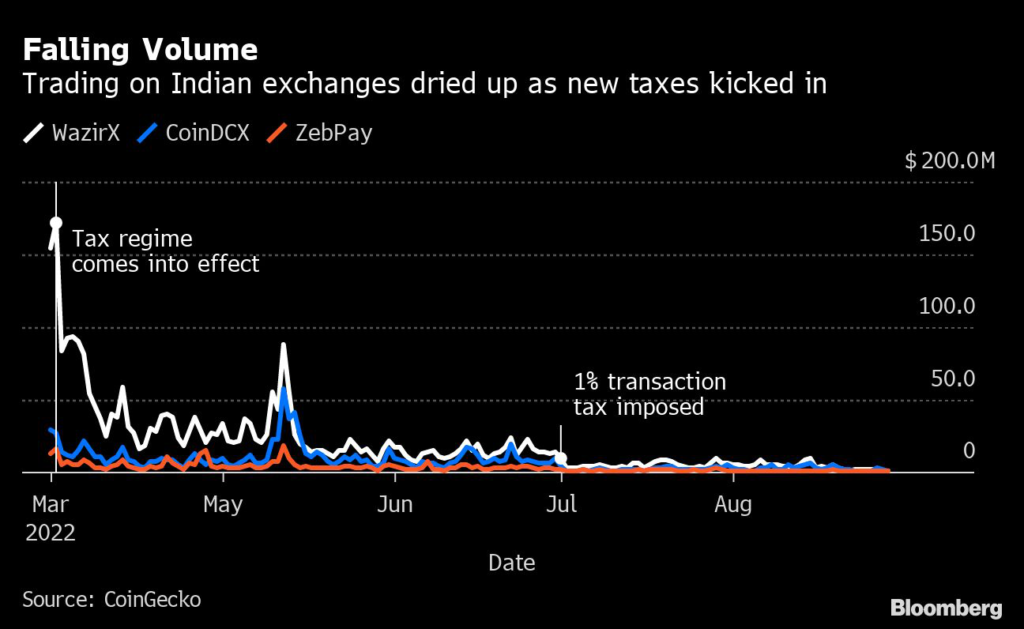
The operator of the world’s largest crypto exchange stands out in a market where rivals are reeling from steep taxes and the difficulty of moving money in and out of trading venues. Daily volumes at key India-based platforms are down over 90% since a 1% tax on crypto transactions took effect in July. 

While Zhao has outflanked competitors with low fees, varied offerings and a popular peer-to-peer marketplace that allows easier movement between tokens and cash, another factor is the contrast in the way foreign exchanges and those with Indian roots handle the transaction tax imposed on domestic residents.

Indian-origin platforms have begun deducting the levy but many foreign peers like Binance and FTX haven’t, prompting investors to switch to the latter, according to several users of the apps who asked to remain anonymous given the matter relates to tax law. Traders may see a loophole in lax enforcement and a gray area over whether the law applies to more complex transactions.

“The recent tax regulation is not explicitly clear on whether the 1% tax deducted at source extends to crypto derivatives transactions involving futures, as it does to crypto spot transactions,” said Rohan Misra, chief executive officer at SEBA India, a subsidiary of Swiss-based SEBA Bank AG.

Binance “is currently monitoring the situation and will make further announcements in due course,” a spokesperson said in response to questions about whether it has started collecting the levy. FTX declined to comment and India’s Finance Ministry didn’t respond to emails seeking comment.

Binance’s gains come amid a rare public spat with WazirX, its partner in India, which led Zhao to encourage WazirX customers to defect to Binance. WazirX’s monthly downloads tumbled to 92,000 in August from about 596,000 in January.

The 1% levy known colloquially as the TDS came on top of a new 30% tax on gains from the transfer of crypto assets, which is steeper than in many other jurisdictions like the US and the UK. 

Rules introduced this year also bar crypto trading losses from being offset against income. In addition, limited support from the banking system makes it hard to fund accounts or switch from tokens to fiat currency.

The wider embrace of the Binance app contrasts with declines for most other players. CoinDCX downloads, for example, shrank to 163,000 in August from 2.2 million in January, Sensor Tower data show. 

Billionaire Sam Bankman-Fried’s FTX saw almost 96,000 downloads in India in July and 52,000 in August from about 40,000 in January.

San Fransisco-based Coinbase Global Inc. has said it complies with the crypto transaction tax rules. It saw downloads in India tumble to 16,000 in August from almost 31,000 in June.

More stories like this are available on bloomberg.com

©2022 Bloomberg L.P.

US-China Audit Deal Faces First Test as Inspectors Head to Hong Kong

(Bloomberg) — After a decades long impasse that led to a threat to kick about 200 Chinese firms off New York stock exchanges, US inspectors may soon get their first look under the hood of some of China’s largest corporations, if all goes as planned.

US Public Company Accounting Oversight Board inspectors may arrive in Hong Kong as early as this week to start checking the audit working papers of US-listed Chinese firms under a deal reached last month, according to people familiar with the matter. The PCAOB officials then have to decide whether they have gotten sufficient access to sign off on Chinese firms as compliant.

The historic on-site visits are slated to start with inspecting the working papers of Alibaba Group Holding Ltd. and Yum China Holdings Inc. among other firms. A team will be assigned to the auditing file of each company to review the most recent financial documents, check internal control systems and interview audit personnel, two people familiar with the matter said earlier.

Audit inspections of publicly traded firms in the US were mandated by law in 2002, but China has long denied giving full access despite there being hundreds of listed Chinese firms worth more than a $1 trillion. A US law passed in 2020 then ratcheted up pressure with threats of delistings, forcing a rare compromise by Beijing after years of insisting that allowing access to working papers could harm national security.

While the preliminary deal marked progress, the standoff has already roiled markets. Two weeks before last month’s agreement, five major state-owned firms, including China Life Insurance Co. and PetroChina Co., said they would delist, while ride-hailing giant Didi Global Inc. was forced to delist amid pressure from Chinese regulators who feared the firm’s vast troves of data would be exposed to foreign powers. Alibaba has said it would seek a primary listing in Hong Kong to hedge against the threat of getting kicked out of New York.

PCAOB Chairperson Erica Williams said in a statement Aug. 26 after signing the deal that she had directed the agency’s inspection team to be on the ground by “mid-September so we can put this agreement to the test.” 

The first group of names to be reviewed are among the largest and most actively traded US-listed Chinese firms, all of which have employed global auditors. Unlike multiple state-owned firms that are voluntarily exiting New York exchanges, these privately controlled firms also have powerful US investors.

Questions

Questions emerged immediately in the wake of August’s agreement as the two sides offered conflicting messages over how it will be implemented. While the PCAOB said it had the sole discretion to select the firms, audit engagements and potential violations, Chinese regulators said any access to companies and working papers would be done with Chinese participation and assistance.

Audit firms including Deloitte LLP, PricewaterhouseCoopers LLP, Ernst & Young LLP and KPMG LLP have been organizing to arrange for potential visits and assigned teams for the inspectors. Hong Kong was selected as the site for the inspections because it has less strict Covid quarantine rules. 

It’s unclear if PCAOB officials will be granted a waiver to Hong Kong’s three-day hotel quarantine and the subsequent four days of monitoring.

Hong Kong inspections pose their own challenges since most documents are stored in mainland China. While most working papers are stored electronically, audit firms have debated how to transfer files to Hong Kong from mainland databases. Some have explored mailing them on CDs and another option would be to unlock the Chinese cloud for access in Hong Kong, people familiar with the process said last month. The audit firms have also summoned relevant staff back to Hong Kong.

A PCAOB spokesperson declined to comment for this article, as did representatives from the big four accounting firms.  

More stories like this are available on bloomberg.com

©2022 Bloomberg L.P.
SWIFT Financial-Messaging System Pilots Blockchain Project

(Bloomberg) — SWIFT, the messaging system used by financial institutions globally to convey instructions on tens of millions of transactions each day, is testing out blockchain.

The Society for Worldwide Interbank Financial Telecommunication, or SWIFT for short, is piloting a project with fintech company Symbiont Inc., according to a post seen by Bloomberg. The collaboration, which includes Citigroup Inc., Vanguard and Northern Trust, is aimed at driving “efficiencies in communicating significant corporate events,” like dividend payments and mergers, SWIFT said in its post.

As a global financial artery, SWIFT delivers secure messages among 11,000 companies in over 200 countries and territories, directing trillions of dollars in transactions. The operation gained much attention earlier this year as war broke out in Ukraine following Russia’s invasion. The US and Europe cut a number of Russian banks from SWIFT, hurting their efforts to move money and operate globally.

With the latest pilot project, SWIFT will automate corporate action workflow using Symbiont’s technology platform called Assembly, it said in the post. SWIFT will use the platform’s smart contracts and blockchain capabilities to “create a network effect that leverages our 11,000 plus institutions connected to SWIFT globally,” it said.

Under the effort, corporate action data from SWIFT messages will be translated by SWIFT’s translator tool and uploaded in Symbiont’s blockchain. Symbiont’s smart contract technology will then compare information shared between participants, flagging “discrepancies, contradictions or inconsistencies across custodians,” Tom Zschach, chief innovation officer at SWIFT, said in the post.

Innovation Push

SWIFT’s work with Symbiont, a US financial technology company, follows other efforts to innovate in the payment space. SWIFT has already partnered with the Bank of International Settlements to explore the benefits of using a common language for cross-border payments. 

SWIFT was set up to make it easier for banks in various countries to communicate with one another. The private network was designed to be more secure, and its messages followed a protocol so they could be quickly understood by banks anywhere in the world. But it hasn’t been immune to hacks: It’s been used by cybercriminals to commit heists, showing any system can be vulnerable. 

Symbiont offers its blockchain technology to solve inefficiencies in the financial marketplace. 

“By bringing Symbiont’s Assembly and smart contracts together with SWIFT’s extensive network, we’re able to automatically harmonize data from multiple sources of a corporate action event,” Zschach said in the post. “This can lead to significant efficiencies.”

The pilot is in development and with a select group of participants that will test it and provide feedback in September. If it’s successful, SWIFT will extend it to cover more corporate events and assess bringing it to the wider SWIFT community. 

“Via our smart contract technology, we are enabling market participants to automate the reconciliation process,” Mark Smith, co-founder and chief executive officer at Symbiont, said. “We look forward to taking the next steps in exploring what can be built on top of this high-quality- data source.”

(Updates with CEO comment, background from sixth paragraph.)

More stories like this are available on bloomberg.com

©2022 Bloomberg L.P.

Twitter Shareholders Approve Musk’s $44 Billion Buyout as Trial Looms

(Bloomberg) — Twitter Inc. shareholders approved billionaire Elon Musk’s proposed $44 billion buyout, paving the way for a trial next month to determine the deal’s fate.

A majority of Twitter shareholders voted in favor of accepting Musk’s $54.20-a-share offer to acquire the social-networking company, according to a preliminary vote count read on Tuesday. Musk made the bid in April and has since sought to rescind it. Twitter’s board — along with two prominent advisory firms — had encouraged investors to ratify the deal. The company’s shares were little changed after the vote and closed at $41.74, well below Musk’s proposed price.

The special shareholder meeting convened for the tally lasted 7 minutes, with polls open for about 3 minutes. Investors could also submit votes for several weeks ahead of the meeting, and Twitter sent numerous messages encouraging them to vote ahead of time.

While investor approval was required to finalize the deal, its consummation is far from a sure thing. Musk in July said he was canceling the agreement, claiming that Twitter misled him about the size of the company’s user base and the number of bots and spam accounts. Twitter denies those accusations, and sued Musk in a Delaware court to force him to complete the acquisition. Musk then counter-sued the company.

The company said 98.6% of the votes cast were in favor of the deal. Musk, Twitter’s largest shareholder, didn’t vote at all, according to two people familiar with his decision. Musk owned nearly 10% of Twitter — more than 73 million shares — when he agreed to acquire the company. 

Lawyers for both Musk and San Francisco-based Twitter for weeks have been fighting over witnesses, evidence and even the court date. The trial is currently set for the week of Oct. 17 in Delaware Chancery Court. From Twitter’s perspective, the shareholder vote approving the transaction was all Musk needed to move forward with the deal. Musk disagrees, and has asked for more disclosures from the company.

Musk has recently sought to bolster his case by citing revelations from a former senior Twitter executive-turned-whistle-blower who came forward at the end of August. Peiter “Mudge” Zatko, Twitter’s former head of security, alleges that the company is in violation of multiple regulatory requirements, has lax security practices and has given misleading information about the number of bots on its service.

Read about the Twitter whistle-blower’s testimony

Twitter denies Zatko’s claims, calling him a disgruntled former employee who was fired for poor performance. Last week Judge Kathaleen St. J. McCormick, who is set to oversee the trial in October, said Musk could use some of Zatko’s whistle-blower complaint in his argument against Twitter, but denied his attempt to push the trial back. 

Zatko testified before a US Senate committee earlier on Tuesday, saying his former employer is reckless with personal user data and saddled with outdated security tools. Multiple senators said that there needs to be more formal regulatory oversight for tech companies like Twitter, though nothing specific was put into motion. 

(Updates to add Musk’s decision not to vote in fifth paragraph.)

More stories like this are available on bloomberg.com

©2022 Bloomberg L.P.
IBM to Post $5.9 Billion Pension-Transfer Charge in Third Quarter

(Bloomberg) — International Business Machines Corp. said it would report a $5.9 billion one-time pretax charge in the third quarter as a result of an agreement to offload pension obligations to two life insurers.

IBM and its pension plan administrator said the purchase of annuities from Prudential Financial Inc. and MetLife Inc. will transfer about $16 billion in pension obligations that cover about 100,000 participants and their beneficiaries. The annuities were funded directly by the assets of the pension plan and required no cash or asset contributions from IBM, the company said Tuesday in a regulatory filing.

The agreement is called a pension risk transfer. IBM, by buying annuities from the insurance companies, makes Prudential and MetLife responsible for paying the pension obligations. Insurers have been seeking out pension-transfer agreements in recent years as a way to accrue assets for investment. The popularity of the deals is also driven by employers that are looking to offload the long-term obligations.

IBM, in a blog post, said it has “taken actions over the last several years to reduce the risk profile of its worldwide retirement-related plans, while at the same time increasing the funded status of the plans.”

IBM said the charge will not affect its third-quarter or full-year operating profit or free cash flow.

More stories like this are available on bloomberg.com

©2022 Bloomberg L.P.
Markets Have an Awful Day After Hotter-Than-Expected Inflation Data

(Bloomberg) — Blinded by hope the worst had passed, investors who spent recent sessions warming to bullish bets in stocks, bonds and foreign exchange paid a stiff price for their optimism Tuesday.

Equity traders saw virtually all of a four-day surge wiped out after the government said August inflation was hotter than feared. Relative peace in the bond market was shattered, with two-year yields climbing the most in more than a month. The euro’s brief rally against the dollar faltered as data cemented expectations for a 75-basis-point Federal Reserve hike next week. 

An old adage, that markets maximize pain, played out starkly, particularly for short sellers who after unwinding bearish bets last week had to sit and watch as the market affirmed those bets’ wisdom. Market timers everywhere took a bath as September lived up to its reputation as a month of extreme volatility. 

“It’s a big mess today,” said Matthew Tuttle, chief executive officer at Tuttle Capital Management LLC. “The CPI numbers stunk. People were leaning toward them being cooler than expected, and coming out hotter than expected obviously cut a lot of people on the foot.”

With the exception of the dollar, almost everything was in the red. Stocks and bonds suffered another concerted selloff. Two of the biggest exchange-traded funds tracking the S&P 500 (ticker SPY) and Treasuries (ticker BND) posted a combined loss of 4.8%, marking the worst cross-asset retreat since mid-June. 

Oil slipped as concern resurfaced that the central bank may hasten its monetary tightening, putting the economy at risk of a recession. Bitcoin was not spared by the sweeping selloff, despite being touted as an inflation hedge. The digital coin slipped almost 10% Tuesday, snapping a four-day advance.

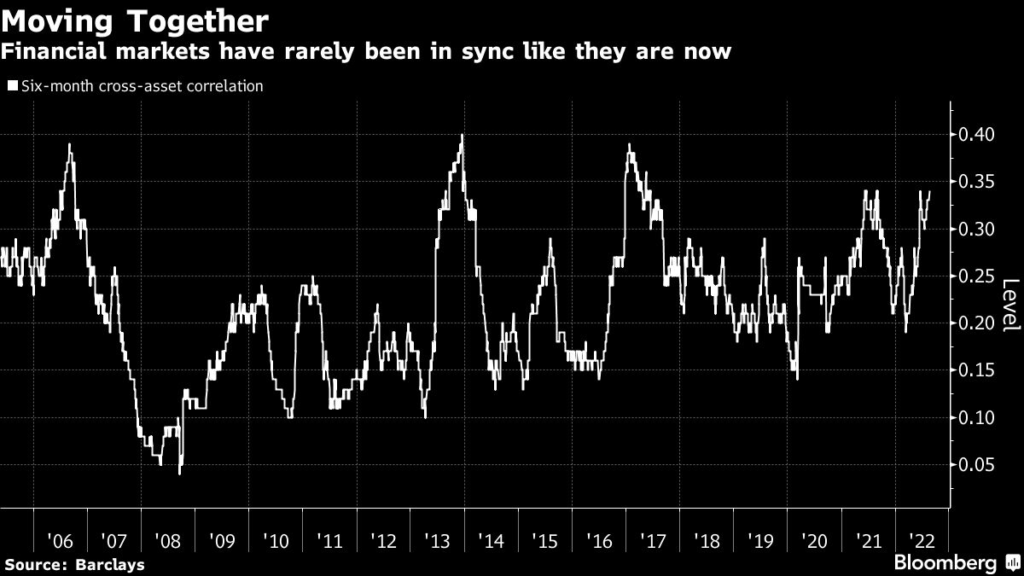
The synchronized retreat highlights a signature hazard of 2022’s markets, that everything is at risk of moving in lockstep. The obsession with economic data has contributed to spike in a measure of cross-asset correlation tracked by Barclays Plc, with recent readings ranking among the highest of the past 17 years. 

“This market is very tough, both ways,” said Michael Purves, founder of Tallbacken Capital Advisors. “Whether you were bullish the euro, Treasuries or equities, you got smoked today.”

Sweeping losses are a reversal from the previous four sessions, when investors appeared to position for a reading that showed an easing in inflationary pressure. They snapped up stocks and sold the dollar, while keeping front-end Treasury yields in check. 

The equity rout was particularly severe for hedge funds, which according to Goldman Sachs Group Inc.’s prime broker last week scooped up shares for the first time in a month, with the notional long buying reaching a one-year high. It also caused pain for options traders who had piled into bullish contracts in recent days.  

The selloff even brought pain to equity bears, a crowd that was forced to unwind wagers during the June-August bounce and again last week. A Goldman Sachs Group Inc. basket of the most-shorted stocks plunged 6.2% Tuesday, though most short sellers likely missed as they closed positions during the recent rally.  

Tuesday’s turmoil was a flashback to August, when markets endured the worst cross-asset selloff in decades. And it ended a period of brief market calm in September, a month that historically has ranked among the worst for stocks. 

The Cboe Volatility Index, a measure of equity options cost also known as VIX, climbed for a second straight session Tuesday after sliding in the previous two weeks. The ICE BofA MOVE Index, a similar gauge for Treasuries that fell in six of last eight weeks, rose the most in a week. 

The CPI “data point to a sustained aggressive tightening in Fed policy and recession risks just took a big leap forward,” said David Rosenberg, chief economist and strategist at Rosenberg Research & Associates Inc. “Cash remains king.” 

More stories like this are available on bloomberg.com

©2022 Bloomberg L.P.

Patreon Cuts 17% of Staff, Closes Offices in Dublin, Berlin

(Bloomberg) — Patreon Inc., which helps entertainers sell their work to subscribers online, is cutting about 17% of staff and closing two offices in Europe.

The cuts will affect 80 employees in operations, finance and other departments, Jack Conte, the chief executive officer, wrote in a statement on Tuesday. The offices set to close are in Dublin and Berlin, he wrote.

Conte blamed changes in the technology industry and the economy over the last nine months. The San Francisco-based company, which is privately held, must cope with a tightened venture capital market that has forced scores of startups to lay off staff. 

Companies including the fitness equipment maker Peloton Interactive Inc., meditation app developer Calm and e-commerce company Shopify cut jobs recently, while tech giants Apple Inc. and Alphabet Inc. have indicated they will slow hiring this year. Global funding for startups fell in the last two quarters compared to the preceding three-month periods, according to the research firm CB Insights. More than 600 tech companies have publicly announced staff cuts, affecting more than 78,000 employees, according to Layoffs.fyi, which tracks job cuts in the industry.

In the flurry of layoffs, communication is often a challenge. At Patreon, the CEO warned staff in a memo Tuesday morning that affected employees would see an appointment on their calendar within 10 minutes. “If you don’t receive such a calendar invitation within 10 minutes of my posting this message, your role is not impacted by today’s change,” Conte wrote. The company plans to hold meetings for remaining staffers to ask questions.

Patreon is waiving its usual one-year period for employee equity vesting for departing staffers “so that everyone has an opportunity to be a shareholder, regardless of your tenure.” About a week ago, the company dismissed a handful of employees on its security team. Conte said in the statement on Tuesday that those cuts “stemmed from a different set of reasons from the ones guiding today’s decisions.”

(Updates with context starting in the fourth paragraph.)

More stories like this are available on bloomberg.com

©2022 Bloomberg L.P.

Close Bitnami banner
Bitnami
