Bloomberg

Bitcoin Falls Most Since June Plunge; Ether Slumps Before Merge

(Bloomberg) — Bitcoin tumbled more than 10%, the biggest decline since cryptocurrencies plunged in June, as the broad-based selloff in financial markets spilled over into the digital-asset sector. 

Ether fell almost 9% to $1,571 even as its underlying Ethereum network is poised for a long-anticipated energy-saving software upgrade. Tether, the largest so-called stablecoin, is the most traded token on Tuesday as investors seek shelter from the sector’s volatility. Other stablecoins such as Binance USD and USD Coin also saw a jump in volume.

US stocks fell and Treasury yields spiked higher after hotter-than-expected inflation data fueled bets on a jumbo hike by the Federal Reserve next week.

“Today’s dump in the crypto markets is all about the US CPI,” said Teong Hng, chief executive at crypto investment firm Satori Research.

Bitcoin fell as much as 11% to $20,056, the biggest intraday decline since the largest cryptocurrency by market value fell 15% on June 18 in the wake of the collapse of crypto lender Celsius. Bitcoin is down about 56% this year. 

Ether-based investment products saw outflows of about $62 million last week, accounting for the bulk of the cash pulled from digital-asset vehicles, according to data from CoinShares.

In the derivatives market, more crypto traders are shorting Ether ahead of Ethereum’s biggest technical upgrade.

“The ETH merge has been a non-event today,” said Kevin March, founder of Floating Point Group, a crypto trading platform provider.  

More stories like this are available on bloomberg.com

©2022 Bloomberg L.P.

Paramount Considers Merging Showtime With Its Paramount+ Service

(Bloomberg) — Paramount Global is considering merging its Showtime streaming service with Paramount+, offering a combined online TV option to consumers as the industry fights for viewers.

Showtime, a premium cable TV channel that’s home to shows like the finance drama “Billions” and “Yellowjackets,” about a girls soccer team, has an online service that’s available for $11 a month. Paramount+, which includes movies and shows from channels including CBS, Comedy Central and Nickelodeon, starts at $5 a month for an ad-supported version.

The company already sells the two services as a bundle and has made it so that people who pay for both can watch Showtime within Paramount+.

“We are always exploring options to maximize the value of our content investment by giving consumers access to great Paramount content through an array of services and platforms,” the company said in a statement.

The Wall Street Journal reported earlier Tuesday that the company is considering merging the services. 

The company said that at the end of June it had more than 43 million Paramount+ subscribers and 64 million total streaming customers.

More stories like this are available on bloomberg.com

©2022 Bloomberg L.P.

US Says Russia Covertly Spent $300 Million to Sway Foreign Votes

(Bloomberg) — Russia has secretly funneled more than $300 million to foreign political parties and candidates since 2014 in an effort to influence elections in more than two dozen countries, a senior US official told reporters.

Russia transfers the funds — cash, cryptocurrency and non-monetary contributions — using intermediaries including security services, oligarchs and supposedly independent foundations or think tanks, the State Department said in a note to dozens of US embassies that was shared with reporters.

This influence effort may ramp up in the months to come as Russia seeks to blunt the effect of international sanctions over its invasion of Ukraine, according to the official, who spoke to reporters on condition of anonymity.

The US has notified more than 100 countries of its findings, and officials are offering more detailed information to countries they say were targeted by the Kremlin, which include Albania, Bosnia, Madagascar and Montenegro. The official said Washington wants to highlight the scale of the threat, gain further information from targeted countries and warn would-be recipients of illicit Russian funds that they can and will be identified.

The official said the Kremlin plans to transfer hundreds of millions of dollars more to influence elections in its favor. The official declined to assess the success of Russia’s influence efforts or discuss the risks of Russian covert financing in US elections.

The Russian embassy in Washington didn’t immediately respond to a request for comment.

More stories like this are available on bloomberg.com

©2022 Bloomberg L.P.

Twitter Whistle-Blower Testimony Spurs Calls for Tech Regulator

(Bloomberg) — Senators across the ideological spectrum vowed to pursue stricter regulation for social media in response to Tuesday’s whistle-blower testimony about what he called the “ticking bomb of security vulnerabilities” at Twitter Inc. 

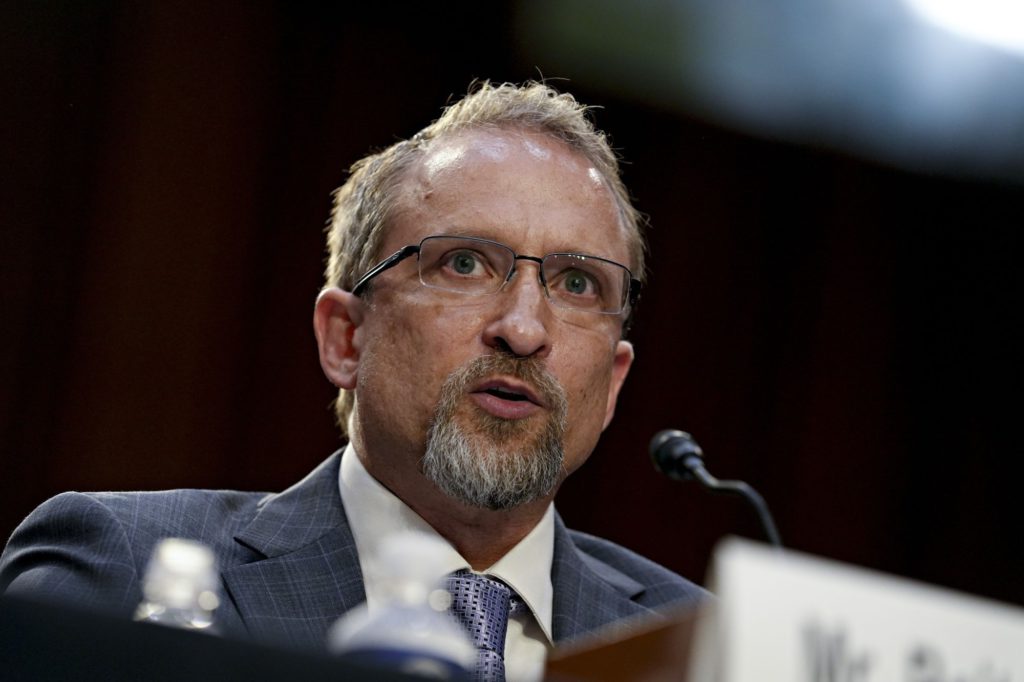
Former Twitter security chief Peiter Zatko, also known by his hacker name “Mudge,” spent more than 2 1/2 hours describing a company with outdated software, broad employee access to personal user data and a reactive security policy that had engineers running “from fire to fire.” He also spotlighted what he said was ineffective enforcement from the Federal Trade Commission that was “letting companies grade their own homework.”

The revelations had even Republicans like South Carolina’s Lindsey Graham calling for “a regulatory environment with teeth” — usually an anathema to conservatives who prefer a smaller federal government. But broad frustration with social media platforms and the risks to user privacy and national security that Zatko described are forging new alliances like Graham’s plans to introduce legislation with Elizabeth Warren, a Massachusetts Democrat and one of the Senate’s most progressive members. 

“It’s now time to look at social media platforms anew,” Graham promised Zatko in the hearing. “What you did today will not be in vain.”

The two senators are working on a bill to create a new federal regulator to oversee big tech, Graham told reporters after the hearing. He proposed licensing companies like Twitter, saying while they might not worry about paying a fine of $150 million, “they could worry about losing their license.” Graham and Warren haven’t reached agreement on the details, according to a congressional aide.

Right now, the FTC and Justice Department share oversight of the tech industry, and some advocates have argued that a regulator devoted to the internet economy would be better equipped to take on one of the world’s richest industries. 

Graham said such an agency should force companies to harden their platforms against foreign interference, be more responsible with user data and provide an appeals process for content moderation decisions. He said new rules should “create a consequence for these organizations, give them an incentive to do better.”

‘Real Risk’

Zatko said Twitter was a decade behind necessary security upgrades and gave several examples of Twitter prioritizing profit over addressing the risks on its influential platform.

“Twitter’s unsafe handling of the data of its users and its inability or unwillingness to truthfully represent issues to its board of directors and regulators have created real risk to tens of millions of Americans, the American democratic process, and America’s national security,” Zatko said in the hearing. 

He also said the company’s leadership “repeatedly covered up its security failures by duping regulators and lying to users and investors.”

Zatko, 51, was fired in January 2022 over what the company said were performance shortcomings.

Twitter, in a statement issued after the hearing, said it “only confirms that Mr. Zatko’s allegations are riddled with inconsistencies and inaccuracies.” The company defended its hiring process and said access to data is controlled by monitoring systems and background checks.

The reaction to Zatko’s testimony was mixed among current and former Twitter employees, according to people familiar with the matter and tweets from employees. Some pointed out that Zatko’s big-picture complaint — that tech companies like Twitter need better oversight on data and security issues — hit the mark. Still others questioned why he didn’t do more to fix Twitter’s problems himself, considering his high ranking position internally.

Sitting alone at a table facing the Senate Judiciary Committee, Zatko painted a picture of a company that collected vast amounts of user data but only understood how about 20% of it was used and allowed many employees a dangerous level of access to that information. Even though Twitter was under a 2011 consent decree from the FTC to address security lapses, Zatko said US regulators — and the one-time fees they use as deterrents — are ineffective compared to their foreign peers like France’s data protection agency. 

The FTC in May fined Twitter for not complying with that 2011 agreement to tighten security controls and respect user privacy. But as Hawaii Democrat Mazie Hirono put it: “A $150 million fine for a multibillion dollar company is nothing to provide any kind of incentives for them to change what they’re doing.”

Zatko’s allegations come as Twitter prepares to go to court to force Tesla Inc. CEO Elon Musk to complete a $44 billion deal to buy the company. Zatko’s whistle-blower complaint backed up Musk’s concern about the prevalence of automated accounts known as bots, which is likely to feature prominently in the Oct. 17 trial in a Delaware court, but Tuesday’s hearing focused on security shortcomings. 

Lawmakers raised concerns in particular about Mudge’s allegations that Twitter has allowed foreign agents to operate on its payroll and acquiesced to the demands of adversaries like China. Judiciary Chairman Dick Durbin, a Democrat from Illinois, compared users trusting Twitter to safeguard their data as they might trust a bank — but “at Twitter the vault is wide open,” he said. 

“Twitter is an immensely powerful platform that cannot afford gaping security vulnerabilities,” Durbin said. 

Zatko said he wasn’t surprised to find out, a week before he was fired, that the FBI had warned Twitter about an employee that was a suspected foreign asset working with the MSS, a Chinese intelligence service.

“If you’re not placing foreign agents inside Twitter — because it’s very difficult to detect them, it is very valuable to a foreign agent to be inside there,” Zatko said of intelligence agencies, “you’re most likely not doing your job.” 

Iowa Senator Chuck Grassley, the committee’s top Republican, said Mudge’s disclosures “paint a disturbing picture of a company that’s solely focused on profits at any expense.” 

Grassley said Twitter CEO Parag Agrawal was invited to Tuesday’s hearing to respond to the allegations, but declined because he claimed it could interfere with the ongoing litigation with Musk. 

Zatko pleaded with lawmakers to pass protections for whistle-blowers who want to come forward while they are still at the companies. He also said any privacy legislation should involve audits and quantifiable results that couldn’t be gamed by technology platforms. 

There is bipartisan support for new internet regulation to protect user privacy and security, but current proposals have failed to gain much traction as Congress focuses on other priorities. Even with Graham’s support, other Senate Judiciary Republicans questioned the need to give more power to regulators. 

 “I don’t think we need any more bureaucrats,” said Texas Republican John Cornyn, a member of the Senate Judiciary Committee. “We just need some rules for them to enforce, which we don’t currently have.” 

Connecticut Democrat Richard Blumenthal said he’s open to a new technology-focused regulator that could help shift the balance of power between immensely profitable companies and the agencies charged with protecting consumers. He also said he “could be persuaded” to give new authority to the FTC, rather than creating a new agency.

“To effectively address this problem, we need not only to insist on restructuring the company, but also likely restructuring, reforming and energizing our regulatory apparatus,” Bumenthal said. “Clearly what we’re doing right now is not working.”

More stories like this are available on bloomberg.com

©2022 Bloomberg L.P.

Canada Declares Holiday to Honor Queen But Banks May Stay Open

(Bloomberg) — The Canadian government is declaring Monday a federal holiday for the funeral of Queen Elizabeth II, Prime Minister Justin Trudeau said.

Federally-regulated companies including banks, life insurers, telecommunications companies and transportation firms won’t be required to close, Labor Minister Seamus O’Regan said on Twitter.  

An official with the Investment Industry Association of Canada said the organization did not have information yet on whether it would recommend closing bond and money markets. TMX Group Ltd., operator of the Toronto Stock Exchange, said it would provide an update later on whether equity trading would be shut down for the holiday. 

Details of the holiday are still being finalized and the federal government is working with provincial governments “to try and see that we’re aligned on this,” Trudeau said. The British monarch is Canada’s head of state. 

“Declaring an opportunity for Canadians to mourn on Monday is going to be important, so for our part we will be letting federal employees know that Monday will be a day of mourning where they will not work,” Trudeau said, speaking to reporters at a Liberal caucus retreat in New Brunswick.

Some provinces automatically align their holidays with federal ones, while other provinces do so on a case-by-case basis. Quebec Premier François Legault — who is in the middle of a re-election campaign in the majority French-speaking province — quickly ruled out making Monday a provincial holiday.

(Updates with new information in the second paragraph)

More stories like this are available on bloomberg.com

©2022 Bloomberg L.P.

‘We’d Rather Have Raises’: New York Times’ Lunchbox Perk Backfires Amid Work-From-Home Protest

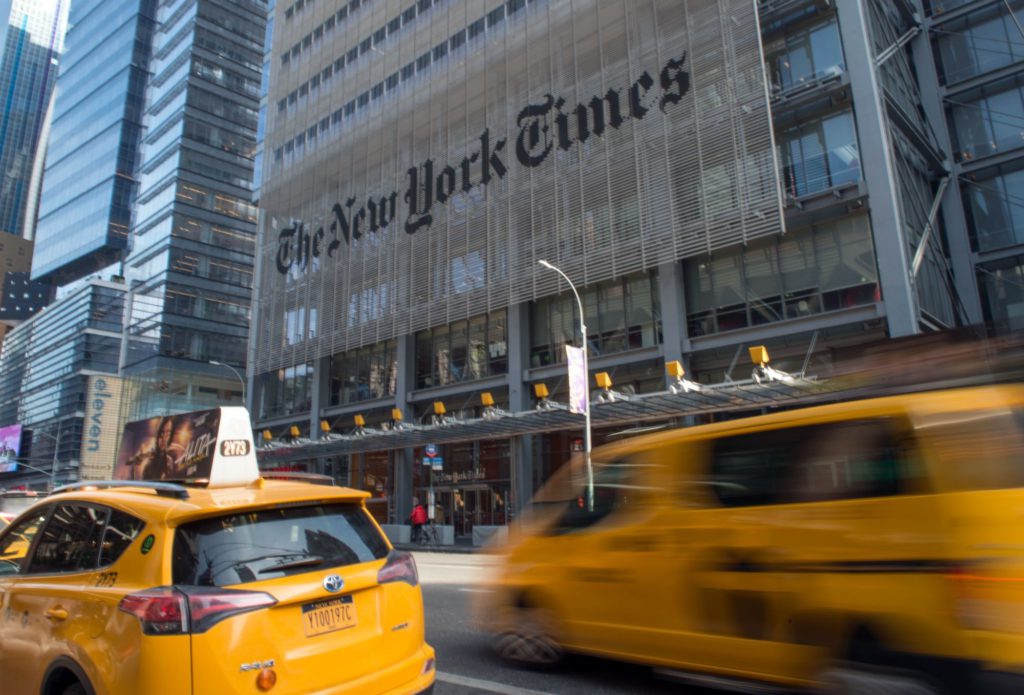
(Bloomberg) — Hundreds of New York Times Co. employees are working from home this week in defiance of the company’s renewed return-to-office push. 

More than 1,200 people, who are the majority of the journalists and tech workers represented by the NewsGuild of New York, pledged not to return to the office Monday in an effort to get the Times to negotiate over RTO plans, according to the union.

“Health and safety policies are a part of contract negotiations and they have to be bargained over,” Times software engineer Carrie Price said in an interview Monday. “Being in charge of our own personal risk assessment is important to our membership… Being asked to give up that ability to be in control of my own personal safety for myself and my loved ones, is something that we don’t want and it hasn’t been negotiated over.”

The journalists have been without a contract since March 2021 and staff haven’t gotten raises in more than two years despite decades-high inflation and rent increases. Meanwhile, they say the company has done exceptionally well in recent years and executives are making millions of dollars each year. In August, Times posted second-quarter revenue of $555 million and adjusted profit of 24 cents a share, both beating analysts’ expectations. The company has 9.2 million subscribers and is targeting 15 million by 2027.

Staffers say this week’s protest comes after months of stalled contract negotiations. In June, when Joseph Kahn became the paper’s executive editor, union organizers wrote a letter with almost 900 signatures to appeal for a new contract. Two weeks ago, after seeing no progress, more than 300 employees, many of whom are paid significantly less than some of the Times’ star reporters, wrote personal emails to senior leadership describing how they’ve been struggling to keep up with surging costs of living.

On Monday, the Times offered branded lunchboxes to welcome employees back to the office.

“I imagine that whoever decided to do a lunchbox meant it really well, but I think for us these little incentives are just not enough,” said Andrea Zagata, a senior staff editor, in an interview. “We’d rather have raises, frankly, or a contract.”

“We presented the NewsGuild with a wage proposal that would offer contractual increases of 10 percent over the remaining two and a half years of the new contract,” said Danielle Rhoades Ha, a company spokesperson. “That is significantly higher than in recent Times Guild contracts.”

The NewsGuild disputes this, saying the company’s math doesn’t add up.

This isn’t the first time the company has attempted to get its workers back to their desks. The last return to office deadline was set for June, though employees protested the move on Twitter and it was later pushed back following updated health guidance from New York City.

Public clashes with union workers are also not a new thing for the Times. In August 2021, hundreds of tech workers staged a walkout to protest unfair labor practices and alleged union-busting, later winning the election to form one of the largest tech worker unions in the US. Wirecutter journalists held a Black Friday strike last November and then reached a contract deal the following month.

The high-profile tension at the Times echoes that playing out at other offices across the country. Apple Inc., among other companies, chose Labor Day as its new line in the sand for workers to return to their desks. The tech giant had pushed back its RTO date multiple times in the face of the rising ire from employees unhappy with the policy. Meanwhile, Goldman Sachs Group Inc. and Morgan Stanley are easing some Covid policies to draw more workers back to the office.

Read More: Return-to-Office Deadline After Labor Day Sets Up Showdowns

(Updates with the union’s response to the company’s contract proposal and details about the company’s RTO delays in the second and third paragraphs.)

More stories like this are available on bloomberg.com

©2022 Bloomberg L.P.

Tech Workers Say Salaries Have Not Kept Pace With Inflation

(Bloomberg) — Most technology professionals say their pay isn’t keeping up with inflation, raising pressure on employers to meet growing demand for remote work. 

Some 82% of employees living close to their place of work and 64.5% of remote workers noted a squeeze on their salaries, even as average pay in the industry increased from last year, according to a report from Hired, a marketplace for tech jobs. In the US, salaries rose 3.2% to $159,000. 

The worst bout of inflation in the US for a generation has so far failed to derail the job market, bolstering workers’ power to demand remote or hybrid setups. Almost everyone surveyed by Hired said they’d start looking for a job immediately if they were denied an expected raise in the next six months. 

“Expectations on salary, pay raises, and work flexibility remain sky high, placing the onus on employers to execute the right strategies to attract, hire, and retain top talent,” Josh Brenner, chief executive officer of Hired, said in the report published Tuesday. 

Salaries for remote jobs are up $3,000 on average from a year earlier and are exceeding local pay in some cities — for instance, in Chicago the gap is 6.2%. London proved to be an outlier, as local workers earn 3.6% more than remote employees.

Workers fleeing high-cost areas are driving up pay outside of the nation’s biggest tech hubs. Philadelphia saw the highest average increase, at 11.9%, while Dallas was second at 11.3%. 

The country’s two centers of the industry both recovered from last year’s decline in average pay. The San Francisco Bay Area rose 3.7% to $174,063, the highest in the country, and New York gained 4.8%. 

Hired surveyed more than 2,000 tech professionals from January 2019 to June 2022. 


More stories like this are available on bloomberg.com

©2022 Bloomberg L.P.
Merge Hype Prompts Investors to Pull Cash From Ethereum ETP

(Bloomberg) — Investors are pulling cash out of exchange-traded products tied to Ether, the world’s second-most-valuable cryptocurrency, ahead of the much-anticipated upgrade of its underlying Ethereum blockchain, which is expected to take place as early as Wednesday.

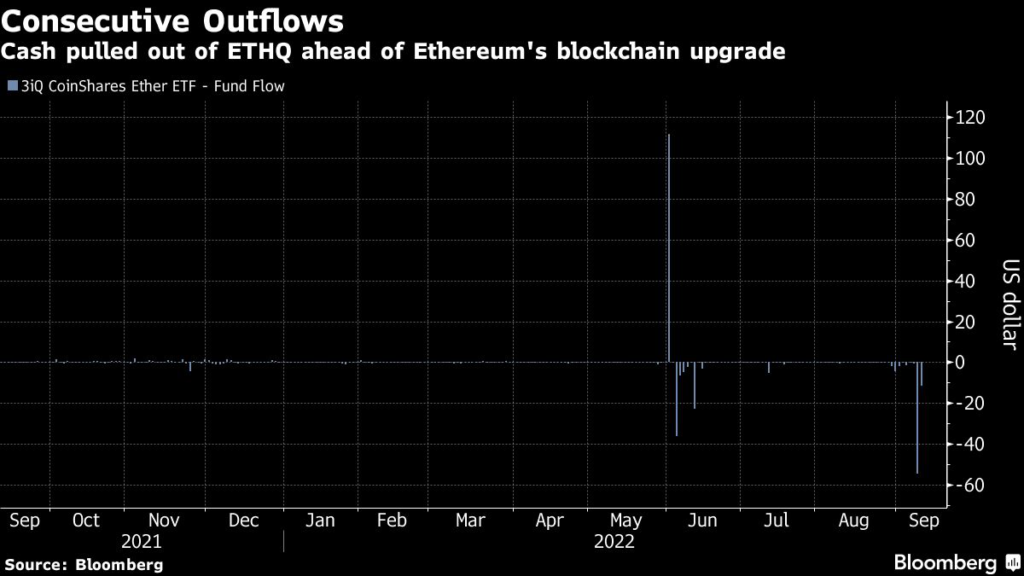
Leading up to the upgrade, dubbed the Merge, 3iQ CoinShares Ether ETF (ticker ETHQ), with nearly $20 million in assets, saw three straight days of outflows to the tune of about $66 million — the largest amount of outflows in one-week among crypto ETPs. 

“This is very likely related to the ETH merge,” said Stephane Ouellette, chief executive of FRNT Financial Inc, a crypto brokerage firm. “There are multiple benefits from holding physical ETH ahead of the merge that don’t necessarily exist when holding an ETH product or derivative.”

Funds linked to Ethereum posted outflows of around $105 million in the past month. Meanwhile, Ether is falling for the second straight day, dropping as much as 8.6% to about $1,576 on Tuesday at 12:10 p.m. New York time.

For investors, Ether post-Merge will resemble more of a traditional financial asset that pays interest, like a bond or a certificate of deposit, which could entice hedge funds, asset managers and wealthy individuals who’ve stayed on the crypto sidelines so far. 

“It is widely expected that there will be a ‘fork’ where holders of spot ETH will receive both the new POS chain and a POW ‘forked’ token,” Ouellette said, referring to the Merge taking the existing proof-of-work software and shifting it to proof-of-stake creating two different versions of Ethereum.

“With the chain moving to POS, physical holders of ETH tokens will now be able to stake their ETH — which is expected to provide an in-kind yield of about 4%-8%,” he added.

Most derivative products and ETPs are unlikely to give holders exposure to the POW fork or the staked yields post-Merge, Ouellette said. This explains why more crypto traders are shorting Ether in the derivatives market, recent data shows.

“Until we get some stability in the markets, meaning inflation directionally falling, Fed pausing, proof of continued earnings stability, the risk-off sentiment will continue and impact flows into crypto-related funds,” Sylvia Jablonski, chief executive officer and chief investment officer of Defiance ETFs, said. “They are essentially lumped into that high-growth, risk asset profile, and investors are pausing there.”

More stories like this are available on bloomberg.com

©2022 Bloomberg L.P.
Man Who Lied About Owning $305 Million in Atos Shares Fined $800

(Bloomberg) — A man who falsely claimed that he owned a 305 million-euro ($305 million) stake in IT firm Atos SE was fined just 800 euros by French regulators.

Dylan Dariah — who said last year in a filing to have more than a 5% holding in Atos when in fact he didn’t own a single share — apologized to French investigators after admitting to lying, according to the Autorite des Marches Financiers. He told them he “hadn’t measured the scope of his actions” and the fact that they could be viewed as market manipulation.

The AMF said in its settlement decision that the publication it made in May 2021 that contained the ownership claim “seemed not to have had any impact on the share price.”

The regulator added that the “very small” fine — payable in eight monthly installments — “takes into account the very low resources” of Dariah.

Frederic Peltier, a lawyer for Dariah, declined to comment on the fine. Atos declined to comment on the settlement dated April 27 decision and published on Tuesday.

Read more: Atos Files Criminal Complaint in France Over Declaration

More stories like this are available on bloomberg.com

©2022 Bloomberg L.P.

Novogratz’s Galaxy Sued by Crypto Custodian BitGo Over Deal Breach

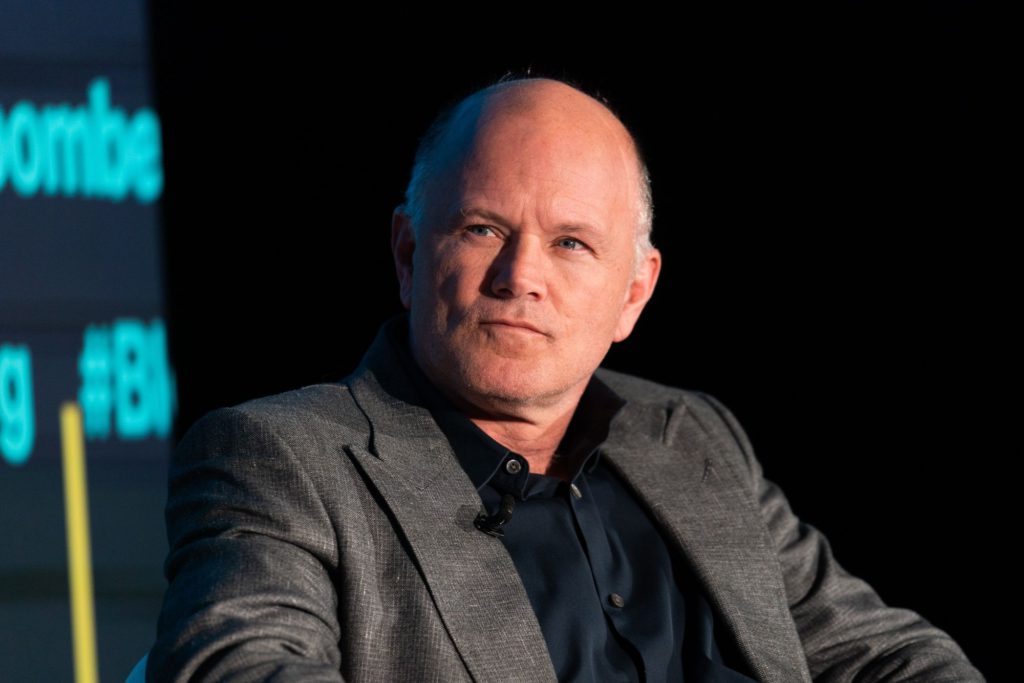
(Bloomberg) — BitGo is suing Mike Novogratz’s Galaxy Digital Holdings for more than $100 million in damages after Galaxy abandoned its planned $1.2 billion acquisition of the crypto custodian. 

The lawsuit, filed Monday in Delaware Chancery Court, cited Galaxy’s “wrongful repudiation and willful and intentional breach” of the merger agreement, according to public filings tied to the case. The complaint was filed under seal and will be made public on Thursday, in case Galaxy wishes to redact some of the allegations, according to Brian Timmons, a lawyer at Quinn Emanuel Urquhart & Sullivan, which is representing BitGo.

Last May, Galaxy announced its plan to buy BitGo in a cash and stock transaction to broaden its institutional offering and geographic reach. At the time, the deal represented one of the biggest acquisitions in the crypto industry. In August, Galaxy said it was ending the deal with no termination fee payable, citing BitGo’s failure to deliver audited 2021 financial statements by a deadline. 

BitGo has said it honored its obligations so far, including the delivery of the audited financials. A spokesperson for Galaxy reiterated Tuesday that “BitGo’s claims are without merit and we will defend ourselves vigorously.” 

Galaxy, which offers crypto financial services, posted a net comprehensive loss of $554.7 million in the second quarter. BitGo, which was founded in 2013 by Mike Belshe, offers crypto custody, trading, lending and borrowing. 

More stories like this are available on bloomberg.com

©2022 Bloomberg L.P.
Close Bitnami banner
Bitnami