Bloomberg

Warner Bros. Discovery Lays Off About 100 Employees in Ad Sales

(Bloomberg) — Warner Bros. Discovery Inc. plans to let go about 100 employees in advertising sales starting Tuesday, the latest round of cuts as the company tries to pay down debt from its $43 billion merger.

Warner Bros. plans to reduce the size of its ad sales team by about 30% through layoffs, buyouts and attrition, according to a person familiar with the plans who asked not to be identified. News of the cuts was reported Monday by Axios.

The company, formed in April through the combination of Discovery and AT&T Inc.’s WarnerMedia division, is seeking at least $3 billion in annual savings. Last month, the company fired about 70 employees who worked on programming for HBO and HBO Max. 

More stories like this are available on bloomberg.com

©2022 Bloomberg L.P.

Twitter Whistle-Blower Cites ‘Ticking Bomb’ of US Security Risks

(Bloomberg) — Twitter Inc.’s security lapses were so grave that they threatened national security and far outpaced US regulators’ ability to police them, the company’s former head of security-turned-whistle-blower told senators on Tuesday. 

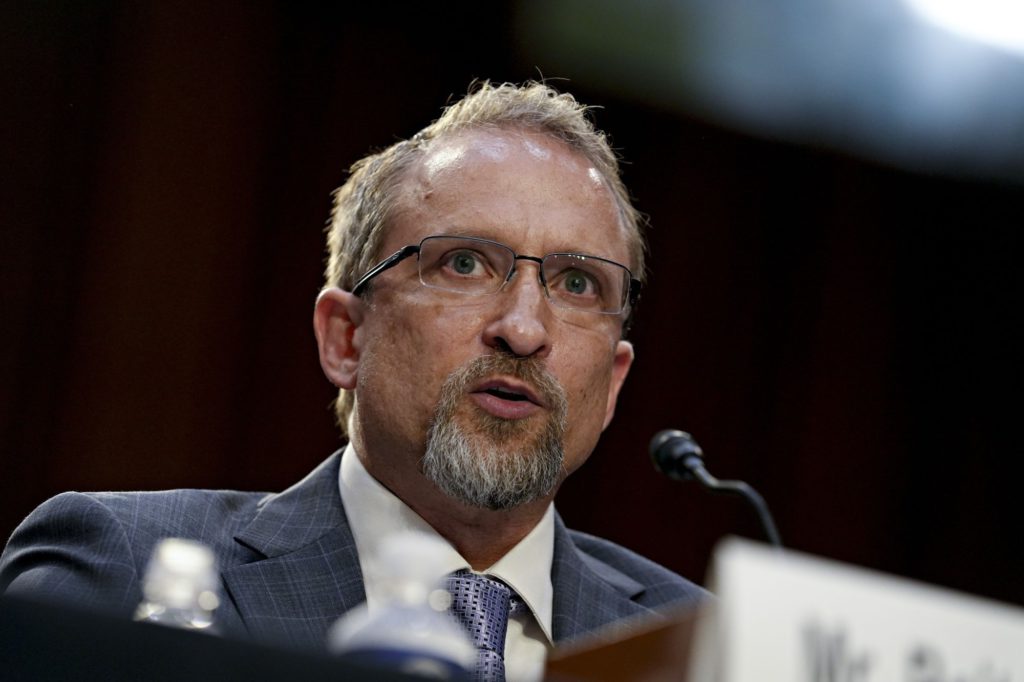
Speaking before the Senate Judiciary Committee, Peiter Zatko, also known by his hacker name “Mudge,” said Twitter was a decade behind necessary security upgrades, which he described as a “ticking bomb of security vulnerabilities.” He detailed several cases in which Twitter prioritized profit over addressing the risks on its influential platform.

“Twitter’s unsafe handling of the data of its users and its inability or unwillingness to truthfully represent issues to its board of directors and regulators have created real risk to tens of millions of Americans, the American democratic process, and America’s national security,” Zatko said in the hearing. 

He also said the company’s leadership “repeatedly covered up its security failures by duping regulators and lying to users and investors.”

Sitting alone at a table facing the dais of senators, Zatko painted a picture of a company that collected vast amounts of user data but only understood how about 20% of it was used and allowed many employees a dangerous level of access to that information. Even though Twitter was under a 2011 consent decree from the Federal Trade Commission to address security lapses, Zatko said US regulators — and the one-time fees they use as deterrents — are ineffective compared to their foreign peers like France’s data protection agency. 

“The FTC is in a little bit over their head” policing powerful companies like Google, Facebook and Twitter, Zatko said. “They’re left letting companies grade their own homework.”

Zatko, 51, first testified before Congress in 1998, warning a Senate committee about fundamental weaknesses in the internet’s infrastructure. He then went on to work at the US Defense Advanced Research Projects Agency, Alphabet Inc.’s Google and the payment service Stripe Inc. before being hired by Twitter founder and former Chief Executive Officer Jack Dorsey in 2020 to help address security concerns.

He was fired in January 2022 over what the company said were performance shortcomings.

Twitter declined to comment in advance of the testimony. But in an email to employees after Zatko filed his complaint with regulators, Twitter CEO Parag Agrawal disputed the allegations.

“We’re reviewing the redacted claims that have been published, but what we’ve seen so far is a false narrative that is riddled with inconsistencies and inaccuracies, and presented without important context,” he wrote.

Zatko’s allegations come as Twitter prepares to go to court to force Tesla Inc. CEO Elon Musk to complete a $44 billion deal to buy the company. Zatko’s whistle-blower complaint backed up Musk’s concern about the prevalence of automated accounts known as bots, which is likely to feature prominently in the Oct. 17 trial in a Delaware court, but Tuesday’s hearing has focused on security shortcomings. 

Follow the hearing on TOPLIV 

Lawmakers raised concerns in particular about Mudge’s allegations that Twitter has allowed foreign agents to operate on its payroll and acquiesced to the demands of adversaries like China. Judiciary Chairman Dick Durbin, a Democrat from Illinois, compared users trusting Twitter to safeguard their data as they might trust a bank — but “at Twitter the vault is wide open,” he said. 

“Twitter is an immensely powerful platform that cannot afford gaping security vulnerabilities,” Durbin said. 

Iowa Senator Chuck Grassley, the committee’s top Republican, said Mudge’s disclosures “paint a disturbing picture of a company that’s solely focused on profits at any expense.” 

Grassley said Twitter’s Agrawal was invited to Tuesday’s hearing to respond to the allegations, but declined because he claimed it could interfere with the ongoing litigation with Musk. 

“The business of this committee, and protecting Americans from foreign influence, is more important than Twitter’s civil litigation in Delaware,” Grassley said, adding that Agrawal should step down from Twitter if the allegations are true.

Zatko pleaded with lawmakers to pass protections for whistle-blowers who want to come forward while they are still at the companies. He also said any privacy legislation should involve audits and quantifiable results that couldn’t be gamed by technology platforms. 

There is bipartisan support for new internet regulation to protect user privacy and security, but current proposals have failed to gain much traction as Congress focuses on other priorities. 

Connecticut Democrat Richard Blumenthal called for a new technology-focused regulator that could help shift the balance of power between immensely profitable companies and the agencies charged with protecting consumers. 

“To effectively address this problem, we need not only to insist on restructuring the company but also likely restructuring, reforming and energizing our regulatory apparatus,” Bumenthal said. “Clearly what we’re doing right now is not working.”

(Updates with comments on FTC from fifth paragraph)

More stories like this are available on bloomberg.com

©2022 Bloomberg L.P.

Nintendo’s New Zelda Game, Tears of the Kingdom, Is Set to Debut May 12

(Bloomberg) — Nintendo Co. announced the title for the next highly anticipated game in one of its bestselling franchises — The Legend of Zelda: Tears of the Kingdom. It will be available May 12.

The Zelda series, originally created by Nintendo former general manager Shigeru Miyamoto, has long been iconic among gaming fans worldwide and in the US, the Japanese company’s largest market. The last title in the series, Breath of the Wild, was released in tandem with the Switch’s debut in March 2017. The game helped drive the gadget’s launch sales and so far has sold more than 27 million copies. Earlier this year Nintendo delayed the release of the next installment in the Zelda series to 2023, sending its shares tumbling.

The news was the highlight of a 45-minute video presentation to tease Nintendo’s upcoming titles this fall and into next year. Other announcements included Fire Emblem: Engage, Octopath Traveler 2 and Pikmin 4, which will be released in 2023. The Super Mario Bros. movie, starring Chris Pratt as the voice of the iconic Italian plumber, will be coming in the Spring, Miyamoto announced.

Nintendo has a strong stable of games lined up for the holiday period as it seeks to extend the life of the Switch. The recently released family-friendly online shooter game Splatoon 3 became the biggest Switch debut to date, selling 3.45 million units in Japan over its opening weekend. The shares surged 5.5% in Tokyo on Tuesday, their biggest jump since December 2020. The company is also betting on its Pokémon franchise to keep up momentum into the new year.

The slate of anticipated releases could help boost disappointing sales at Nintendo, which has been struggling with manufacturing bottlenecks that have affected Switch sales. Nintendo, whose flagship console can be used both at home and on the move, has also suffered from the reversal of stay-at-home demand during the pandemic. Still, the company has stuck to its forecast of selling 21 million units of the handheld-hybrid Switch console, down from 23 million in the previous year.

More stories like this are available on bloomberg.com

©2022 Bloomberg L.P.

Billions in Wrong-Way Bets Poured Into Biggest Tech ETF

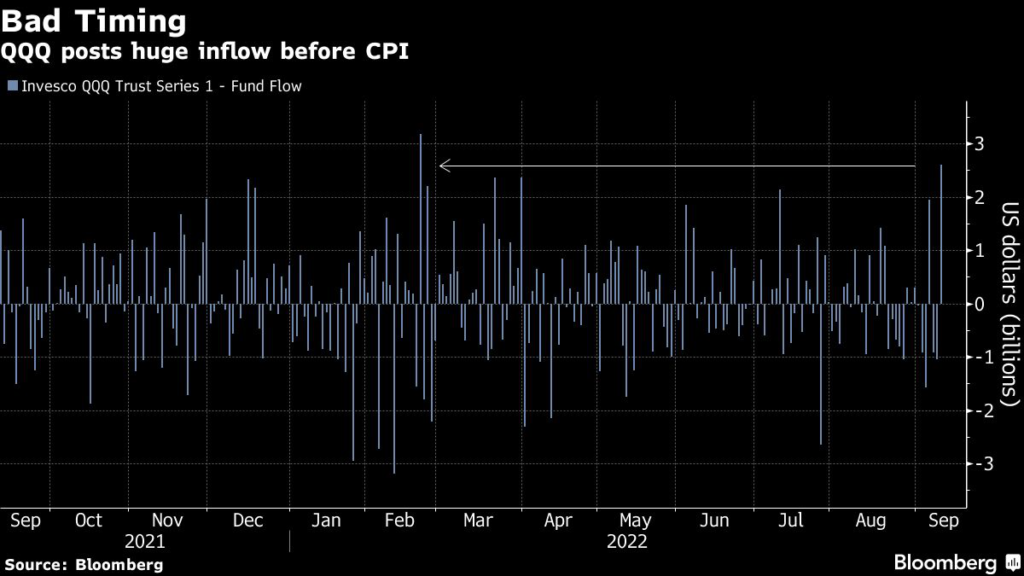
(Bloomberg) — Economists weren’t the only ones caught off-guard by Tuesday’s hotter-than-expected inflation reading: A day earlier, investors were piling into the world’s biggest tech ETF at the fastest rate since February.

The $2.6 billion poured into the Invesco QQQ Trust Series 1 ETF (ticker QQQ) on Monday is now set to take an immediate hit after data showed US consumer prices jumped 8.3% from a year earlier, coming in above forecasts. The report triggered a stock slump that looks set to end a four-day rally as traders prepare for more aggressive Federal Reserve tightening.

Read more: ‘It’s a Reality Check’: Wall Street Reacts to CPI Data

Tech shares bore the brunt of the selling, with the Nasdaq 100 Index sliding 3.3% as of 10:14 a.m. in New York. The $171 billion QQQ, which follows the gauge, was down 3.3%.

More stories like this are available on bloomberg.com

©2022 Bloomberg L.P.

Biden Seeks to Make Economy an Election Asset — If Prices Ease

(Bloomberg) — President Joe Biden’s bid to use a spate of positive economic news to turn Democrats’ biggest political liability into an election-year selling point suffered a setback with another worse-than-expected inflation report.

Falling gas prices and two major legislative victories have boosted Democrats’ once improbable bid to retain their House and Senate majorities in the November midterms. So had early signals that red-hot inflation may be easing.

But Tuesday’s price growth report will dampen Democrats’ hopes that the worst may be behind them.

Headline consumer prices increased in August by 0.1%, hotter than a forecast decline of the same figure. Core inflation, a measure that strips out volatile fuel and food costs and is closely watched by the Federal Reserve, rose by 0.6%, double the forecast. Year-over-year inflation dropped for the second month, to 8.3%, but also exceeded the forecast of 8.1%.

Biden — who argues that he and his fellow Democrats have helped steer the economy back to firmer footing — is likely to try to put a positive spin on those numbers during a White House ceremony Tuesday afternoon touting a sweeping new climate, energy and health care law dubbed the “Inflation Reduction Act.” 

“It will take more time and resolve to bring inflation down, which is why we passed the Inflation Reduction Act to lower the cost of health care, prescription drugs and energy,” Biden said in a statement Tuesday following the release of the latest data. 

“My economic plan is showing that, as we bring prices down, we are creating good-paying jobs and bringing manufacturing back to America,” he added. 

Tuesday’s event will include Cabinet secretaries and members of Congress, as well as union workers, and climate and health-care activists, according to a White House official. Biden will also emphasize that Republicans unanimously opposed the act in Congress, the official added.

Democrats have made some headway in eroding the advantage that inflation has afforded Republicans in the midterms, said Brian Stryker, a partner at Democratic polling firm Impact Research, which aided Biden’s 2020 presidential campaign and consults with gubernatorial and congressional candidates.

Yet also threatening to upend Biden’s strategy is the possibility of a rail strike that could snarl supply chains, disrupt agricultural deliveries and cost the US economy more than $2 billion a day. The Biden administration is pressuring labor unions and freight-rail operators to agree on a new contract before a Friday deadline. 

Biden on Monday issued an executive order laying out priorities for the law’s execution, including reducing greenhouse gas emissions, building US clean energy capacity and creating jobs. The order also establishes a White House office on clean energy innovation and implementation. 

The White House’s effort to shift the narrative included Biden’s visit Friday to a construction site in Ohio, where Intel Corp. is building a new plant to make computer chips. The trip gave the president an opportunity to highlight legislation signed into law last month aimed at boosting domestic semiconductor manufacturing. 

“Since I took office, our economy has created nearly 10 million new jobs, more than 668,000 manufacturing jobs — proof of point that ‘Made in Ohio’ and ‘Made in America’ is no longer just a slogan,” Biden said at the event. “It’s a reality today. And it’s just beginning.”

The president also has pivoted away somewhat from the economy in recent weeks to highlight the threat he contends Republicans pose to democracy, most notably during a Sept. 1 prime-time speech in which he said his predecessor, Donald Trump, and Republicans who back him “represent an extremism that threatens the very foundation of our republic.”

Read more: Biden Demonizes GOP in Midterm Pivot From Uncertain Economy

Republicans, for their part, plan to keep the focus on the still-high cost of groceries, housing and other day-to-day items, even as Democrats try to use their recent accomplishments to transform the state of the economy into less of a political liability. 

Democrats should aim for a repeat of 2012, when President Barack Obama was able to persuade enough voters to overlook an economic drawback — then, high unemployment — and grant him a second term, Stryker said. 

“Voters thought Obama was trying and that some of those efforts would bear fruit,” he said. “That is where Democrats need to get voters.”

Biden’s overall approval rating increased six percentage points to 44% in late August, according to Gallup — his highest level in a year. The president still earns especially low marks for his handling of the economy, but the proportion of Americans who cited inflation as their top concern headed into the midterms dropped from 37% to 30% in a Sept. 8 NPR/PBS NewsHour/Marist poll. 

Biden’s recent legislative victories “are meaningful both substantively and politically and have marginally improved his approval ratings and attitudes about the direction of the country,” Doug Sosnik, former White House political director under President Bill Clinton, wrote in a recent memo.

“Historical political gravity is on the Republicans’ side, but the Democrats head into the fall election with a stronger counter-narrative than they had in the spring,” Sosnik wrote. 

(Adds Biden comment in fourth paragraph)

More stories like this are available on bloomberg.com

©2022 Bloomberg L.P.

Biden Plan to Talk Up Economy Slams Into Inflation Reality

(Bloomberg) — President Joe Biden’s bid to use a spate of positive economic news to turn Democrats’ biggest political liability into an election-year selling point suffered a setback with another worse-than-expected inflation report.

Falling gas prices and two major legislative victories have boosted Democrats’ once improbable bid to retain their House and Senate majorities in the November midterms. So had early signals that red-hot inflation may be easing.

But Tuesday’s price growth report will dampen Democrats’ hopes that the worst may be behind them.

Headline consumer prices increased in August by 0.1%, hotter than a forecast decline of the same figure. Core inflation, a measure that strips out volatile fuel and food costs and is closely watched by the Federal Reserve, rose by 0.6%, double the forecast. Year-over-year inflation dropped for the second month, to 8.3%, but also exceeded the forecast of 8.1%.

Biden — who argues that he and his fellow Democrats have helped steer the economy back to firmer footing — is likely to try to put a positive spin on those numbers during a White House ceremony Tuesday afternoon touting a sweeping new climate, energy and health care law dubbed the “Inflation Reduction Act.” 

“It will take more time and resolve to bring inflation down, which is why we passed the Inflation Reduction Act to lower the cost of health care, prescription drugs and energy,” Biden said in a statement Tuesday following the release of the latest data. 

“My economic plan is showing that, as we bring prices down, we are creating good-paying jobs and bringing manufacturing back to America,” he added. 

Tuesday’s event will include Cabinet secretaries and members of Congress, as well as union workers, and climate and health-care activists, according to a White House official. Biden will also emphasize that Republicans unanimously opposed the act in Congress, the official added.

Democrats have made some headway in eroding the advantage that inflation has afforded Republicans in the midterms, said Brian Stryker, a partner at Democratic polling firm Impact Research, which aided Biden’s 2020 presidential campaign and consults with gubernatorial and congressional candidates.

Yet also threatening to upend Biden’s strategy is the possibility of a rail strike that could snarl supply chains, disrupt agricultural deliveries and cost the US economy more than $2 billion a day. The Biden administration is pressuring labor unions and freight-rail operators to agree on a new contract before a Friday deadline. 

Biden on Monday issued an executive order laying out priorities for the law’s execution, including reducing greenhouse gas emissions, building US clean energy capacity and creating jobs. The order also establishes a White House office on clean energy innovation and implementation. 

The White House’s effort to shift the narrative included Biden’s visit Friday to a construction site in Ohio, where Intel Corp. is building a new plant to make computer chips. The trip gave the president an opportunity to highlight legislation signed into law last month aimed at boosting domestic semiconductor manufacturing. 

“Since I took office, our economy has created nearly 10 million new jobs, more than 668,000 manufacturing jobs — proof of point that ‘Made in Ohio’ and ‘Made in America’ is no longer just a slogan,” Biden said at the event. “It’s a reality today. And it’s just beginning.”

The president also has pivoted away somewhat from the economy in recent weeks to highlight the threat he contends Republicans pose to democracy, most notably during a Sept. 1 prime-time speech in which he said his predecessor, Donald Trump, and Republicans who back him “represent an extremism that threatens the very foundation of our republic.”

Read more: Biden Demonizes GOP in Midterm Pivot From Uncertain Economy

Republicans, for their part, plan to keep the focus on the still-high cost of groceries, housing and other day-to-day items, even as Democrats try to use their recent accomplishments to transform the state of the economy into less of a political liability. 

Democrats should aim for a repeat of 2012, when President Barack Obama was able to persuade enough voters to overlook an economic drawback — then, high unemployment — and grant him a second term, Stryker said. 

“Voters thought Obama was trying and that some of those efforts would bear fruit,” he said. “That is where Democrats need to get voters.”

Biden’s overall approval rating increased six percentage points to 44% in late August, according to Gallup — his highest level in a year. The president still earns especially low marks for his handling of the economy, but the proportion of Americans who cited inflation as their top concern headed into the midterms dropped from 37% to 30% in a Sept. 8 NPR/PBS NewsHour/Marist poll. 

Biden’s recent legislative victories “are meaningful both substantively and politically and have marginally improved his approval ratings and attitudes about the direction of the country,” Doug Sosnik, former White House political director under President Bill Clinton, wrote in a recent memo.

“Historical political gravity is on the Republicans’ side, but the Democrats head into the fall election with a stronger counter-narrative than they had in the spring,” Sosnik wrote. 

(Adds Biden comment in fourth paragraph)

More stories like this are available on bloomberg.com

©2022 Bloomberg L.P.
Zara Billionaire Ortega Bets $700 Million on US Warehouses

(Bloomberg) — Zara founder Amancio Ortega has spent over $700 million in recent weeks on a series of logistics acquisitions in what’s shaping up to be one of the biggest bets yet by the Spanish textile tycoon.

Ortega’s family investment company Pontegadea bought five logistics centers in the US states of Tennessee, South Carolina, Virginia, Pennsylvania and Texas from Realty Income Corp. for about $722 million, in a deal reported by Spanish daily El Pais on Tuesday and confirmed by a Pontegadea official. 

Those acquisitions come in the wake of previously announced logistics purchases, also from Realty Income, which totaled $183 million. Taken together, the moves mark a strategic step into a new area of real estate from Pontegadea’s traditional focus on buildings such as apartments and office towers. 

The US logistics market has boomed in recent years thanks to the e-commerce push spurred in large part by Amazon.com Inc., with investors including KKR & Co. and Blackstone Inc. snapping up warehouses and industrial properties. 

Rents on industrial properties rose 21% in the second quarter from a year earlier, with leasing volume up 6%, according to a report by Jones Lang LaSalle Inc. Pontegadea’s recently purchased logistics plants have long-term lease agreements with global players including Nestle SA, Amazon, and FedEx Corp. 

Ortega has made a number of big real estate deals this year, including paying about $500 million for a 64-floor luxury apartment building in New York and agreeing to buy Toronto’s Royal Bank Plaza skyscraper for about C$1.2 billion. 

Ortega’s fortune is valued at more than $46.8 billion, making him the 24th richest person in the world, according to the Bloomberg Billionaires Index. 

Pontegadea ended 2021 with a portfolio of 15.3 billion euros ($15.5 billion) in property holdings, mainly premium commercial real estate in major cities across the world. 

The foray into logistics comes as the Spanish textile giant diversifies more broadly, with a range of deals including an investment in a Telefonica SA-owned subsea telecoms operator and moves in the energy business, in renewable power, electricity transmission and natural gas transport.

The bulk of Pontegadea’s income comes from Ortega’s stake in Zara owner Inditex SA, the world’s largest apparel retailer, which owns a range of clothing brands. 

(Updates with logistics background starting in fourth paragraph, net worth in seventh paragraph.)

More stories like this are available on bloomberg.com

©2022 Bloomberg L.P.
UK Fintech ePayments Closing After Anti-Crime Controls Probe

(Bloomberg) —

EPayments Systems Ltd., a UK electronic payments company that’s been under regulatory scrutiny for years over its anti-crime controls, is closing down.

The London-based firm, which deals in prepaid cards and electronic wallets and had almost £180 million ($211 million) in client funds at its peak, has begun the process of entering into an “orderly, solvent wind-down,” according to a statement on its website. The Financial Conduct Authority forced ePayments to freeze operations in early 2020 and the closely held firm had been working to improve its anti-crime controls since then, filings show.  

“We can no longer sustain the business to build back to what the FCA require and a ‘business as usual’ state,” according to the statement. It “will now focus entirely on providing customers with refunds” and closing accounts.

The fate of ePayments offers a window into the sometimes dicey world of UK electronic-money institutions, or EMIs, lightly regulated payments firms licensed by the FCA that move about £1.4 billion a day. The industry has come under scrutiny amid fears that weak controls and lack of oversight are enabling the movement of illicit funds. 

The company’s listed directors, Elena Arbuzova and Andrei Fetin, didn’t respond to requests for comment. Emails to a generic ePayments address weren’t immediately returned.

It’s unclear who owns ePayments. The company’s shares are held by ePayments Holdings Ltd., a firm in Jersey in the Channel Islands, but the ultimate owners are the trustees of an entity called the EXIF Trust, filings show.

ePayments has a subsidiary in Moscow, and the vast bulk of its revenue has come from outside the UK, according to filings.

Customer funds “remain in safeguarded accounts,” according to the statement. The firm had 255,000 active accounts and oversaw £110 million of client funds at the end of April 2020, according to its most recently published accounts. It’s unclear how much customer cash ePayments still oversees. 

The FCA awarded ePayments its most recent EMI license in 2018 only to discover problems with its operations during a review the following year, filings show. The regulator took action in early 2020, restricting the company from onboarding new customers or allowing existing ones to take their money out, according to filings with the UK Companies House.

“Firms need to ensure they comply with our regulatory requirements, such as having effective financial crime controls and protecting customer funds, even when they are winding-up,” said Kai Linscer, a spokesperson for the FCA, who declined to comment specifically on ePayments. “We continue to monitor firms during this process to ensure they meet our regulatory expectations.”

(Adds FCA statement in last paragraph.)

More stories like this are available on bloomberg.com

©2022 Bloomberg L.P.

Tencent, NetEase Games Approved in Sign China’s Crackdown Is Easing

(Bloomberg) — Tencent Holdings Ltd. won approval for a new game for the first time since Chinese regulators froze all licensing in 2021, as Beijing gradually lifts curbs in the world’s largest mobile entertainment market.

A health-education game created by the company was among 73 domestic titles approved Tuesday by the National Press and Publication Administration, the fifth batch of licenses granted this year. The WeChat operator missed out on previous rounds that started in April, when regulators resumed publishing regular lists of approved titles following the suspension. 

Smaller rival NetEase Inc. also made the September list. Its shares rose in US premarket trading. 

While Tencent’s name doesn’t show up on the list, its educational game “Defense of Health” was approved with a company called Nanjing Wangdian Technology as its operator. Wangdian is controlled by Tencent executives including co-founder Pony Ma, according to company registry tracker Qichacha.com. Tencent had unveiled “Defense of Health” during a 2021 event, along with other educational games that typically don’t serve as money makers.

July: Tencent Fails to Win Game Approval as China Concerns Persist

Beijing’s tech crackdown, which which ensnared sectors from e-commerce to fintech and even online education over a tumultuous year, spread to online gaming in August 2021, when regulators introduced stringent measures such as capping play time for minors and imposed other requirements aimed at curbing addiction. 

China’s media watchdog halted licensing and has since been more carefully reviewing new titles to determine whether they meet stricter criteria on content and child protection, slowing rollouts, Bloomberg News has reported.

More stories like this are available on bloomberg.com

©2022 Bloomberg L.P.
DraftKings Will Be Exclusive Odds Provider for Amazon NFL Games

(Bloomberg) — DraftKings Inc. will be the exclusive pregame and in-game odds provider for Amazon.com Inc.’s Thursday Night Football games.

The sports-betting company said Tuesday that it signed a multiyear agreement with Amazon that also includes same-game parlays that will be available on the DraftKings Sportsbook app. Content from DraftKings will be featured in all 15 of Amazon’s National Football League telecasts this season, beginning Sept. 15. Financial terms of the deal weren’t disclosed.

More stories like this are available on bloomberg.com

©2022 Bloomberg L.P.

Close Bitnami banner
Bitnami