Bloomberg

Ether Lags Bitcoin in Countdown to Revamp of Ethereum Blockchain

(Bloomberg) — The cryptocurrency market is flashing some signs of caution with just about two days to go before a critical software upgrade of the Ethereum network, the sector’s most commercially important blockchain.

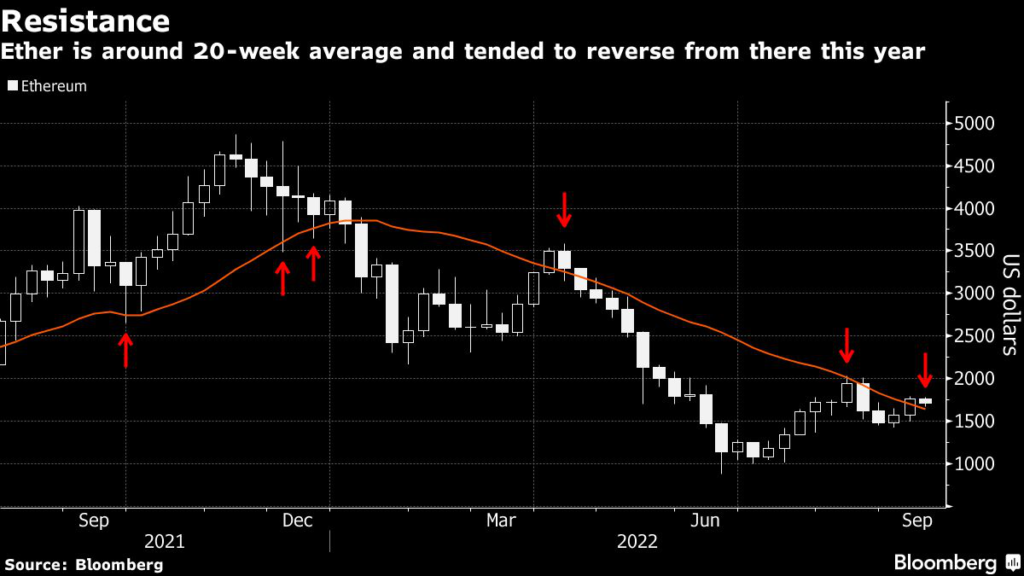
The wariness is evident in the way Ether, the network’s native token, is lagging Bitcoin of late: the second-largest digital asset is down about 13% in the past month, compared with an 9% drop in Bitcoin. The gap between a gauge of expected volatility in Ether and a similar index for Bitcoin is also elevated.

At issue is whether the blockchain’s revamp, which is designed to dramatically shrink its energy use, goes smoothly or not. There is also a risk that an Ether jump since mid-June driven partly by hype around the update — known as the Merge — will continue to fizzle once the upgrade is done and dusted.

While it seems unlikely, “we can’t rule out a buy-the-rumor sell-the-fact playing out” around the Merge, Chris Weston, head of research at Pepperstone Group Ltd., wrote in a note Tuesday.

Bitcoin fell about 2.4% to around $21,880 as of 98:35 a.m. in New York, while Ether dropped 3.% to $1,667. The MVIS CryptoCompare Digital Assets 100 Index dropped about 1.8%.

Ether-based investment products saw outflows of about $62 million last week, accounting for the bulk of the cash pulled from digital-asset vehicles, according to data from CoinShares.

This was “despite the improved certainty of the Merge and perhaps highlights a concern amongst investors that the event might not go as planned,” James Butterfill, head of research at CoinShares, wrote in a note.

In the derivatives market, more crypto traders are shorting Ether ahead of Ethereum’s biggest technical upgrade.

Before the shift from a so-called proof-of-work to proof-of-stake blockchain, expected Sept. 15, crypto and global markets have to get through the US inflation report Tuesday. The data will shape views on the likely severity of US monetary-policy tightening, which threatens to sap liquidity.

Weston from Pepperstone argued that “from a short-term trading perspective it feels like the weight of evidence is that traders are far better off watching variables such as liquidity and sentiment over the switch to ‘proof of stake.’”

More stories like this are available on bloomberg.com

©2022 Bloomberg L.P.

Flavrs Takes On TikTok With All-in-One Cooking Videos, Shopping App

(Bloomberg) — The foodie internet just got more crowded. Backed by celebrity chefs Eric Ripert and Tom Colicchio and $7 million in seed funding, Flavrs debuted on Tuesday, Sept. 13, with a deep feed of cooking videos, step-by-step recipes, meal planning tools, and the ability to instantly shop for groceries online.

“Flavrs is not for the average person who kind of cares about food. It is for the crazy people who live to eat,” says Alejandro Oropeza, co-founder and chief executive officer of the app. “If the thing you’re looking at looks delicious, and you want to do something about it, we’re going to give you the most efficient, most satisfying way to going from intention to action.”

Open the Flavrs app, you’ll see a TikTok-like interface that invites you to discover thousands of videos for foods, from kimchi fried rice to dairy-free chocolate crème brûlée.

There’s Ripert’s saffron risotto—a recipe developed for the app—an ice cream sandwich by Andrew Rea from Binging with Babish, and Jamie Milner’s shakshuka from Everything Delish, as well as gluten-free and paleo options. The content combines custom-made recipes and videos made just for Flavrs, along with repurposed hits from popular blogs and social personalities.

At the bottom right-hand corner, users can click on a recipe icon that shows both the detailed ingredients and cooking steps for a dish featured in a short video, with adjustable serving sizes. Below the recipe icon, a shopping cart takes users to an in-app version of Instacart, allowing them to buy everything the dish requires. All ingredients are automatically added to the shopping cart; users can un-tick items they prefer to skip. People who are just browsing can bookmark videos and save them in a personal folder.

“Think about this as a Spotify playlist for food, where you’re going to start to aggregate the French collection, the Mexican collection, the Thanksgiving collection,” says Oropeza. “You’re going to be able—in the future—to see what other people are bookmarking, what they’re cooking, what creators and chefs are cooking, and share these playlists with your friends.”

Since he grew up in Mexico City, Oropeza spent his life surrounded by food. From the age of 7, he helped out at Cafe Konditori opened by his grandma in 1953 and run by his family for more than 60 years until it closed. “I like to joke that before I could speak English proficiently, I could cook proficiently,” he says. 

Oropeza trained as a chef at the Ritz Hotel in Paris before leaving the kitchen to work for Procter & Gamble, Google, and YouTube in roles including product manager and global head of creator marketing. During the Covid-19 pandemic, his love for food and experience at working with internet personalities inspired him to join with co-founder François Chu to build Flavrs, at which their knowledge of technology, content creation, and e-commerce is being deployed to create a one-stop shop to serve the culinary obsessions of foodies. 

Venture capital firm Andreessen Horowitz is a lead investor for Flavrs; Bloomberg LP, which owns Bloomberg Businessweek, is an investor in Andreessen Horowitz. Others include Wellington Access Ventures, Progression Fund, Firstminute Capital LLP, and Cercano Management (formerly Vulcan Capital, the late Paul Allen’s family office).

Flavrs is currently available only on the iOS App Store; wider release may follow. Oropeza plans to bring in additional content creators and roll out social features enabling users to comment and post their cooking results to the app.

More stories like this are available on bloomberg.com

©2022 Bloomberg L.P.

Grindr Names George Arison CEO as It Prepares for Public Debut

(Bloomberg) — Grindr LLC, the dating app that specializes in connections for the LGBTQ+ community, has named George Arison its new chief executive officer, fulfilling a pledge to appoint someone who identifies with that group to lead the company as it prepares to go public.

Arison, 44, is the co-founder and former CEO of auto e-commerce marketplace Shift Technologies Inc. He will start at Grindr on Oct. 19 and shepherd the company through the process of listing on the stock market through a special purpose acquisition company later this fall. 

Grindr also named Vanna Krantz as its new chief financial officer. Krantz is the current CFO of transportation and payments company Passport Labs Inc., and she previously served in that role at Disney Streaming Services. Krantz will begin at Grindr Sept. 26. The appointments are part of a previously announced transition that will see current CEO Jeff Bonforte and CFO Gary Hsueh step down and move into advisory roles with the company.

“All of us on the small team that acquired Grindr in June 2020 understood that it had the potential to be an amazing business, wholly focused on serving the LGBTQ+ community,” Bonforte said in a statement. “Key to the plan was finding long term leadership for the business that had not only deep professional experience, but also the life experience to understand the unique and very real challenges facing the global LGBTQ+ community.”

Rivals like Match Group Inc. app Tinder and Bumble Inc. are LGBTQ+ friendly, but Grindr is the biggest and most well-known app within the community. It has more than 11 million active users, with almost 80% of them under 35. The company agreed to go public via a SPAC in May at a $2.1 billion valuation despite unfavorable market conditions among technology stocks and blank-check companies. The deal will see Grindr merge with blank-check firm Tiga Acquisition Corp. Arison also helped Shift go public via a SPAC in 2020.

Earlier this year, Arison was planning to take some rest time to rest and think about starting another company after leaving Shift. He didn’t think he would be taking another CEO job after running Shift for nine years. But he changed his mind.

“The mission at Grindr is so powerful for the sets of people I’ve been a part of and I’ve seen the power of that from the friendships I’ve built with people I’ve met” on the platform, Arison said in an interview.

Arison said his previous experience taking a private company public taught him about the importance of being clear and realistic about setting goals and financial projections. “We’ll approach that differently because from the beginning it’s going to be really crucial, and having those financial forecasting capabilities is really important,” he said. 


More stories like this are available on bloomberg.com

©2022 Bloomberg L.P.

Wall Street-Backed Crypto Exchange EDX Markets Is Set for November Debut

(Bloomberg) — US trading titans and brokerage firms are building a crypto exchange that brings investing in digital assets further into the domain of traditional finance, by mimicking the structure of how other asset classes trade.

EDX Markets will start trading a limited number of spot, crypto tokens starting with a November trial period, with the official launch in January, Chief Executive Officer Jamil Nazarali said in an interview. It is backed by Charles Schwab, Fidelity Digital Assets, Paradigm, Sequoia Capital, Citadel Securities and Virtu Financial. 

Similar to trading equities and options, EDX will allow investors to buy and sell digital assets through their existing broker dealer, rather than an outside venue or directly through a crypto-native exchange. 

“We’re taking some of the best features of traditional finance and bringing it to the digital markets to make it more efficient, and bring that cost saving to investors,” Nazarali said.

Nazarali, formerly global head of business development at Citadel Securities, is among industry veterans now at EDX. David Forman, former chief legal officer at Fidelity Brokerage Services, is EDX general counsel. And the exchange’s Chief Technology Officer Tony Acuña-Rohter was CTO at ErisX, now a part of Cboe Global Markets.

The technology is being built by MEMX, the exchange venue founded by some of the biggest players in U.S. stocks. EDX’s systems will be based at a data center in Secaucus, New Jersey, using software that ensures trades are processed in the order they are sent, Nazarali said. This type of order processing and management is different from how the majority of crypto exchanges operate, he said.

Through this partnership, MEMX’s entry into trading digital assets was done without a “complete overhaul,” CEO Jonathan Kellner said. Existing infrastructure was modified to handle the new functions trading digital assets.

Together, the firms hopes to reach an untapped pool of investors sitting on the sidelines. Even amid industry staff cuts and a plunge in prices that’s being called a “crypto winter,” many investors have been growing more comfortable with crypto in recent years, prompting interest from traditional firms. 

“Many investors are interested in cryptocurrencies but are worried about a potential hack, or other unknowns with existing crypto exchanges,” Nazarali said. “But they are familiar with broker dealers in other asset classes, and if crypto is offered, they are comfortable trading through them. By separating the responsibility for operating an exchange from those trading on it, conflicts of interest are also eliminated, he said.

Read More: Citadel Securities’ Nazarali Leaves for Joint Crypto Venture 

More stories like this are available on bloomberg.com

©2022 Bloomberg L.P.

Checkout.com Will Eliminate About 5% of Employees in Latest Cuts

(Bloomberg) — Checkout.com is eliminating 5% of its staff, the latest in a series of job cuts that’s swept technology companies this year as investors pull back on funding. 

The company confirmed that it was reducing its workforce by about 100 people in a statement in response to Bloomberg questions on Tuesday. 

“This decision did not come lightly, but will allow us to focus on the strategic priorities against our mission,” a company spokesperson said in the statement. 

A wave of layoffs is hitting technology startups that rely on funding from increasingly cautious investors. Publicly announced job cuts jumped to 37,000 in the second quarter from under 3,000 a year ago, according to Layoffs.fyi, which collects data on jobs in the tech industry. Buy-now-pay-later giant Klarna Bank AB said in May it would trim about 10% of its workforce and in July announced a “down round” that cut its valuation to $6.7 billion from $45.6 billion.  

Read More: Startups That Grew Fast Learn Shrinking Can Be Just as Tough

Checkout.com separately fired several employees earlier this year due to harassment complaints that arose from an off-site trip to Cyprus, Bloomberg News reported on Monday.

Checkout.com was last valued at $40 billion in January after raising $1 billion from investors including Tiger Global Management and the Qatar Investment Authority. At the start of the year, the company said it employed more than 1,700 people in 19 countries.

It processes payments for companies such as Pizza Hut Inc. and Farfetch Ltd., according to its website. In recent years it also made a significant push into working with cryptocurrency companies such as Coinbase Global Inc. and Binance. 

Read More: Checkout.com Fires Staff Over Harassment Claims From Cyprus Trip

Fintech and cryptocurrency transactions accounted for more than half of the company’s payments volume, its chief financial officer told the Wall Street Journal in January. Many crypto trading platforms have seen transactions drop amid a broader downturn in valuations for the digital currencies.

More stories like this are available on bloomberg.com

©2022 Bloomberg L.P.

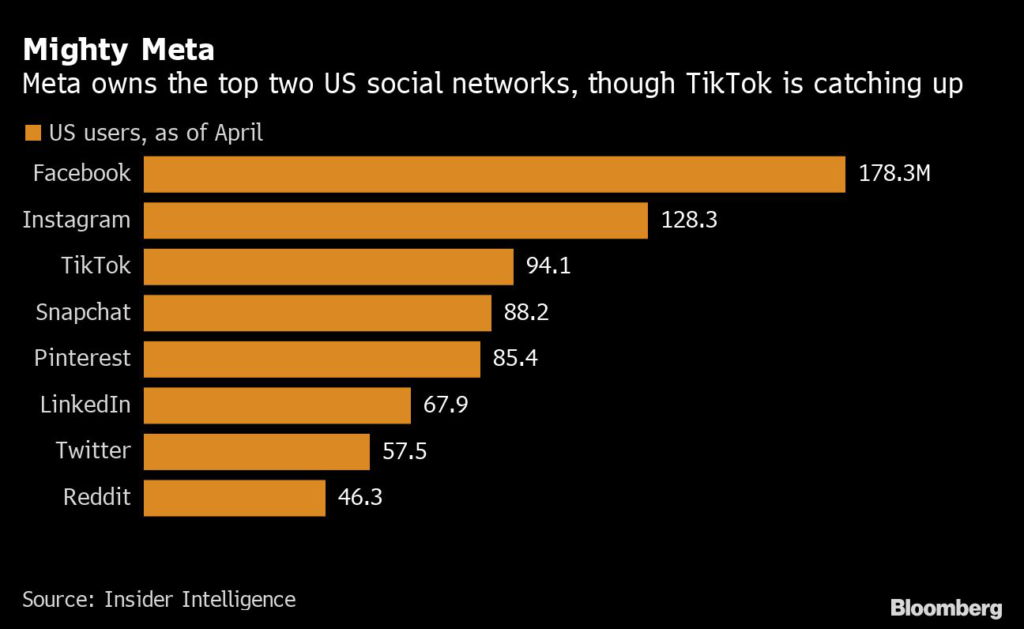
Meta Seeks Out Secrets From Over 100 Companies to Win Antitrust Suit

(Bloomberg) — To defend itself against the federal government, Meta Platforms Inc. says it needs its rivals to divulge some of their most closely held secrets.

Facebook’s parent company has so far subpoenaed 132 companies for documents, including Snap Inc., ByteDance Ltd.’s TikTok and the audio startup Clubhouse, and has warned that it may seek information from 100 more. The subpoenas have set off a cascade of legal challenges from Meta’s rivals, which accuse the company of using antitrust litigation as an excuse to dig through their confidential data.

The hunt for information was triggered by the US Federal Trade Commission’s lawsuit against Meta in 2020, alleging that the company monopolized the social networking market in part through its acquisitions of Instagram and WhatsApp. Meta contests the allegation that it has a monopoly and argues that the market is constantly evolving, with newcomers like TikTok and Clubhouse as key examples.

A trial isn’t likely until 2024 at the earliest, but both sides are marshaling evidence for the case. 

Kellie Lerner, an antitrust litigator at the law firm Robins Kaplan LLP who isn’t involved in the suit, said Meta’s requests seek “massive amounts of competitively sensitive information.” 

“You have a company accused of anticompetitive conduct who is now seeking very competitively sensitive information in discovery,” said Lerner, who has litigated many antitrust disputes. “The sheer breadth of what they are trying to get through discovery is something that, in my view, is not typical.”

Meta has asked for documents relating to some of the most important and sensitive elements of how competitors do business, according to court filings, including how they acquire users, scale up products and make money from features. It also wants materials on rivals’ marketing and sales strategies, quality metrics, contact information for their biggest advertisers, and details on their efforts to attract users from competitors, among other secrets.

Meta’s request is “overbroad and abusive,” Snap said in court filings. A California federal judge is set to decide Tuesday how much Snap — a key figure in the FTC suit and a company that Meta previously tried to acquire — must turn over to aid the defense’s case.

Meta’s request seeks “materials on every product and nearly every aspect of Snap’s business, with a time range that spans almost Snap’s entire existence,” lawyers for that company said. “Snap should not be forced to hand Meta insiders a competitive playbook.”

In court filings, Meta said it needs the information from its rivals to dispute the FTC’s contentions that it is a monopoly and doesn’t face competition.

“Meta competes vigorously with many companies to help people share, connect, communicate or simply be entertained,” Meta spokesperson Christopher Sgro said. “As a natural step in preparing our defense to the FTC’s lawsuit, we have served subpoenas on companies with which we compete or which we believe have other information relating to the FTC’s claims.”

While Snap is among the most vocal opponents of Meta’s subpoenas, it’s not the only one. TikTok complained that Meta has sought its “most confidential and highly sensitive business information.” Pinterest Inc., Microsoft Corp.’s LinkedIn and others raised concerns about Meta’s “highly invasive” requests, which they said seek their “most competitively sensitive documents.”

Other companies that Meta has subpoenaed include Tinder parent company Match Group Inc., Twitter Inc., Reddit Inc. and Oracle Corp. 

Meta’s document requests also aren’t limited to US social networking services. It has sought information from Line Corp. — a company owned by SoftBank Corp. and Naver Corp. that’s the top messaging service in Japan, Taiwan and Thailand — as well as Japanese e-commerce giant Rakuten Group Inc., which owns Viber, a messaging app popular in India, Ukraine and Russia.

Beyond the scope of the requests, Meta’s rivals say the company’s history of hoarding intelligence on competitors should be considered. In 2013, Meta — then known as Facebook — acquired a little-known Israeli startup called Onavo that gave the social giant information on ​​how often users open other apps on their phones. Facebook used Onavo’s data to find ways to quash or buy potential rivals, including WhatsApp, the FTC alleged in its complaint.

Apple Inc. banned Onavo in 2018, saying the data collection violated its App Store rules, and Facebook shut it down in 2019. That year, the social giant ​​launched a new research app called Study that would compensate users for data on what smartphone apps they download, what features they use and how much time they spend on them.

TikTok is worried that Meta’s lawyers may inadvertently disclose information that could be used by the company, given its history of copying the features and tactics of its competitors. Meta duplicated Snapchat’s Stories product and TikTok’s short-form videos on both Facebook and Instagram. And the company is currently looking at changing users’ content feeds in a way that would resemble the approach used by TikTok.

TikTok’s attorneys said they have tried for months to narrow Meta’s request and asked the court to limit the information that Meta’s in-house lawyers could view.

“They cannot unlearn any highly sensitive competitive information they receive from TikTok, and it is unclear how they can do their job as in-house antitrust lawyers without advising Meta on competitive matters,” TikTok’s lawyers said. 

Lerner, the antitrust litigator, noted that Meta also sought expansive documents from the FTC itself, asking the court to force the agency to turn over its original analysis of the 2012 Instagram and 2014 WhatsApp deals. The judge rejected Meta’s request.

“It reflects their scorched-earth defense strategy here to fight in whatever manner is available to them,” she said.

More stories like this are available on bloomberg.com

©2022 Bloomberg L.P.

Climate Change Is Making People Angrier Online

(Bloomberg) — Climate change is making us angrier online. A lot angrier.

Hateful comments spike on social media when temperatures rise above 30 degrees Celsius (86 Fahrenheit), researchers at the Potsdam Institute for Climate Impact Research have found.

“It’s an indicator of how well people can adapt to high temperatures,” said Annika Stechemesser, lead author of the study published in The Lancet Planetary Health earlier this month. “If temperatures go too hot or too cold, we found that there’s an increase in online hate speech, no matter the socioeconomic differences, religion or political beliefs.” 

Global warming of about 1.1°C on average since pre-industrial times has unleashed all sorts of extreme weather events across the world. This summer, drought and a string of heat waves hit Europe, China and the US. For humans, heat is associated with psychiatric hospitalizations, increased rates of suicide and more domestic violence, according to research. 

And aggressive behavior online has been linked to violence offline too. Incensed posts have led to more violence toward minorities, including mass shootings, lynchings and ethnic cleansing, according to the Council on Foreign Relations, a New York-based think tank.

Stechemesser and other researchers analyzed a sample of 4 billion tweets between 2014 and 2020 from users based in the US. They used artificial intelligence to identify about 75 million hate messages in English, using the United Nations’ definition of online hate, which includes racial discrimination, misogyny and homophobia. They then analyzed how the number of tweets changed when local temperatures increased or decreased. 

The researchers found that online hate speech increased as daily maximum temperatures rose above 21°C (70F) — a “feel good” point. Hate messages went up as much as 22% on hot days, compared with the average online hate during times of mild weather. Across all climate zones and socioeconomic groups in the US, online tensions intensified even more significantly when temperatures exceeded 30ºC. Researchers observed that online hate speech increased by as much as 24% — from the feel good point — when temperatures reached 42ºC to 45ºC in US regions with hot and dry climates such as parts of Texas, Arizona, New Mexico and California. Last year, a study by the same researchers focusing on Europe reached similar conclusions.

“When discussing climate change, it’s a point to remember that we feel the effects everywhere, not just in places with big disasters,” Stechemesser said. “There are places where the social consequences of heat have been not discussed very thoroughly, especially around how we can live together as a society and deal with our wellbeing in the future.” 

Researchers analyzed the tweets as a whole and did not look into specific incidents. That means there’s no way to know if the weather made online tensions worse following the murder of George Floyd in May 2020, for instance, or in the lead up to the attack on the US Capitol in January 2021. Still, some conclusions can be reached ahead of the US mid-terms on Nov. 8. 

“Our results show that if September is particularly hot, we can expect to see more hate on Twitter,” said Stechemesser. “But the research doesn’t really show what kind of hate it is or on what topics — we don’t know yet whether the hate we observe is tied to political issues.”

The direct relation between heat and online hate has also been documented in China, where researchers analyzed over 400 million tweets from a sample of 43 million users posting on the country’s largest microblog platform — Sina Weibo. They concluded that days with temperatures above 35°C, rain, higher wind speed, overcast skies and air pollution all make people grumpier online. 

“Of course people can to an extent decide consciously whether they want to be nice or not, but we still find you’ll have more hateful behavior if you find yourself a certain temperature range,” Stechemesser said. “The first thing to do is limit global warming, that’s the most obvious approach to solving this.” 

More stories like this are available on bloomberg.com

©2022 Bloomberg L.P.
BYD Is a Giant in China and Still Finding Its Footing Overseas

(Bloomberg) —

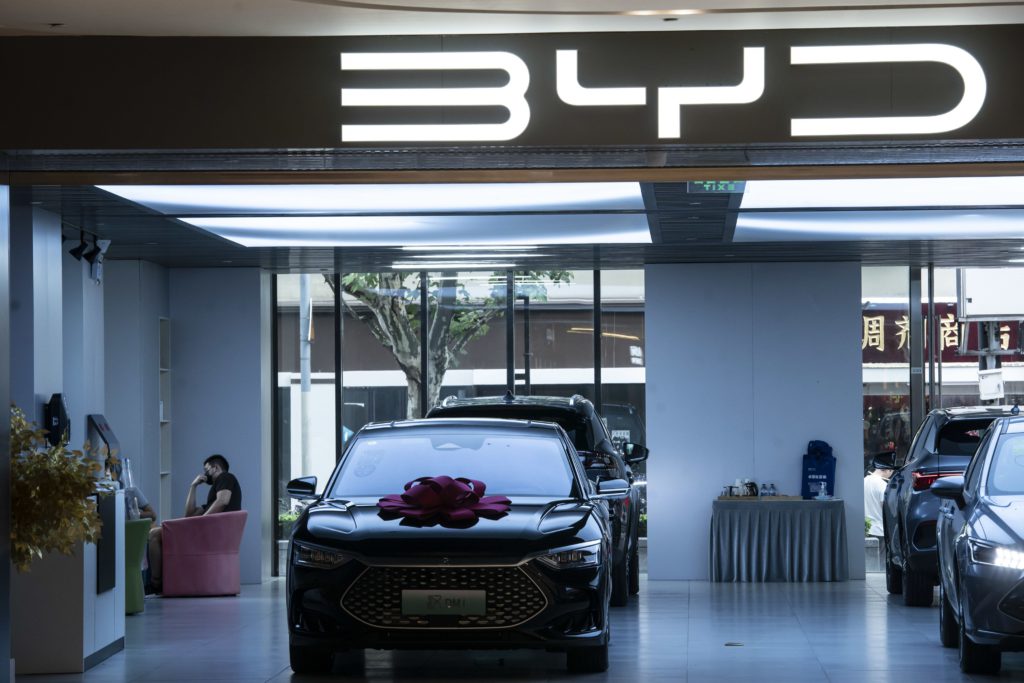
Expectant owners of BYD Co. electric cars in Australia recently discovered they won’t get the warranty they were promised, triggering an outcry and 1,660-word response from its under-fire local distributor.

The row between EV Direct, BYD’s exclusive distributor in Australia, and prospective buyers is a setback for China’s biggest electric-car maker and its efforts to become a global brand. This was already going to be a tall order for the Berkshire Hathaway Inc.-backed company, whose vehicles are little known outside China. The dissatisfaction of would-be customers in Australia has spurred  a Change.org petition that’s garnered some 1,400 signatures.

Here’s what happened: EV Direct offered customers a seven-year, unlimited-kilometer warranty for their Atto 3 crossovers, then unilaterally changed terms before customers took delivery. The warranty has been cut to six years and 150,000 kilometers, with some components covered for shorter periods.

EV Direct has tried to convince customers the warranty has changed for the better, noting it will provide “a best-in-class eight-year warranty on the most valuable part of the BYD product — the LFP blade battery.” Buyers in Hong Kong and New Zealand, however, still get a full six years on the complete car. EV Direct referred requests for further comment to BYD.

The tinkering with small print has soured the deal for several prospective buyers, including PK Saxena, who featured in a Bloomberg Businessweek story in July. He spoke back then about how keen he was to get behind the wheel of a BYD. He’s now canceled his order.

As BYD is quickly finding out, charting an expansion is one thing, and executing that plan is another — whether one chooses to go it alone or appoint a local partner. The automaker has a lot of markets where it’s going to have to make those calls, as it’s set its sights on countries from Germany to Thailand.

Other much smaller Chinese carmakers including Nio Inc. and Xpeng Inc. also are looking to make inroads abroad. Many have primarily targeted northern Europe early on, with Norway being a popular initial market.

The warranty dust-up isn’t big enough to be fatal to BYD in Australia, but it’s a cautionary tale nonetheless. It also highlights the varying expectations and cultural challenges that moving into new markets entails. Back home, BYD’s cars are known for their high-tech features. Translating that to a non-Chinese audience isn’t going to be easy, especially if the company distributing its vehicles suddenly gets cold feet about covering issues with the infotainment for as long as initially promised.

Name recognition is another issue. Take the Atto 3, for example. This model sells as the Yuan in China and is hugely popular there. Tesla Inc. hasn’t felt the need to change up what it calls its cars across different markets. BYD deciding that it needs to indicates a lack of familiarity with the nameplate overseas.

It’s still the early days of BYD building its presence abroad. Last week, the company signed a land-purchase deal in Thailand to construct its first EV plant in Southeast Asia, building on a partnership with local distributor Rever Automotive. In August, it highlighted Cambodia and Denmark as the latest nations in its global push, on top of Japan, Sweden and Israel.

While it still has a lot to prove, BYD has the resources to get traction outside China. Net income in the six months through June tripled from a year earlier as revenue jumped almost 70%. It’s reached the scale where earnings back home are plentiful enough to support big ambitions elsewhere.

More stories like this are available on bloomberg.com

©2022 Bloomberg L.P.

UK Fintech ePayments to Close After Probe of Anti-Crime Controls

(Bloomberg) —

EPayments Systems Ltd., a UK electronic payments company that’s been under regulatory scrutiny for years over its anti-crime controls, is closing down.

The London-based firm, which deals in prepaid cards and electronic wallets and had almost £180 million ($211 million) in client funds at its peak, has begun the process of entering into an “orderly, solvent wind-down,” according to a statement on its website. The Financial Conduct Authority forced ePayments to freeze operations in early 2020 and the closely held firm had been working to improve its anti-crime controls since then, filings show.  

“We can no longer sustain the business to build back to what the FCA require and a ‘business as usual’ state,” according to the statement. It “will now focus entirely on providing customers with refunds” and closing accounts.

The fate of ePayments offers a window into the sometimes dicey world of UK electronic-money institutions, or EMIs, lightly regulated payments firms licensed by the FCA that move about £1.4 billion a day. The industry has come under scrutiny amid fears that weak controls and lack of oversight are enabling the movement of illicit funds. 

The company’s listed directors, Elena Arbuzova and Andrei Fetin, didn’t respond to requests for comment. Emails to a generic ePayments address weren’t immediately returned.

It’s unclear who owns ePayments. The company’s shares are held by ePayments Holdings Ltd., a firm in Jersey in the Channel Islands, but the ultimate owners are the trustees of an entity called the EXIF Trust, filings show.

ePayments has a subsidiary in Moscow, and the vast bulk of its revenue has come from outside the UK, according to filings.

Customer funds “remain in safeguarded accounts,” according to the statement. The firm had 255,000 active accounts and oversaw £110 million of client funds at the end of April 2020, according to its most recently published accounts. It’s unclear how much customer cash ePayments still oversees. 

The FCA awarded ePayments its most recent EMI license in 2018 only to discover problems with its operations during a review the following year, filings show. The regulator took action in early 2020, restricting the company from onboarding new customers or allowing existing ones to take their money out, according to filings with the UK Companies House.  

The regulator is “aware” of ePayments’ decision to close, according to the statement. Kai Linscer, a spokesman for the FCA, didn’t immediately comment.

More stories like this are available on bloomberg.com

©2022 Bloomberg L.P.
iPhone Maker Foxconn Strikes Pact for Chip Plant in Western India

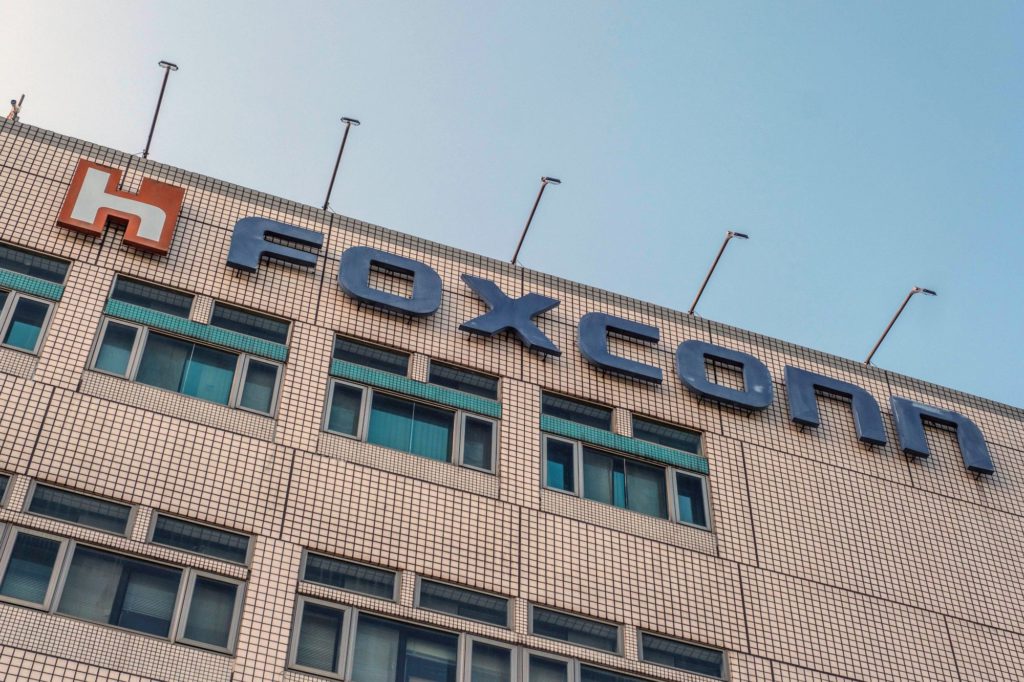
(Bloomberg) — Hon Hai Precision Industry Co., the assembler of most of the world’s iPhones, plans to build a chipmaking facility in India with a local partner to tap rising demand for semiconductors and the government’s support for such projects.

A joint venture of Taiwan’s Hon Hai, known also as Foxconn, and metals company Vedanta Ltd. will set up a factory in Gujarat, the home state of Prime Minister Narendra Modi. The total investment in the project, which includes semiconductor fabrication, assembly and testing as well as display production, is set to reach 1.54 trillion rupees ($19.4 billion), Vedanta said in a statement Tuesday.

While the partners have little experience running large chip operations, they are betting on rising demand as everything from smartphones and cars to home appliances contain an increasing number of semiconductors. Modi’s government late last year unveiled a $10 billion incentive plan, offering to cover as much as half of a project’s cost, to lure display and semiconductor fabricators to set up base in India. The country is also the world’s No. 2 smartphone maker.

The companies plan to build the chip manufacturing plant within the next two years, and the total project will employ about 100,000 people, Vedanta said. Hon Hai will own 40% of the chip venture and Vedanta the rest, and the Taiwanese company won’t be involved in the display plant. When the companies announced their intention for a joint venture in February, Hon Hai said it would invest about $118 million in its 40% stake.

The planned venture is set to make chips using mature 28-nanometer technology. India’s smartphone industry is concentrated in southern India, and the new venture could face challenges attracting skilled workers to the western state of Gujarat.

Hon Hai is the world’s largest contract manufacturer of electronics and only runs minor chip fabrication operations. Billionaire Anil Agarwal’s Vedanta produces metals including aluminum and copper.


More stories like this are available on bloomberg.com

©2022 Bloomberg L.P.
Close Bitnami banner
Bitnami