Bloomberg

FTX’s Bankman-Fried Says Dollar Rise Is Behind Crypto Decline

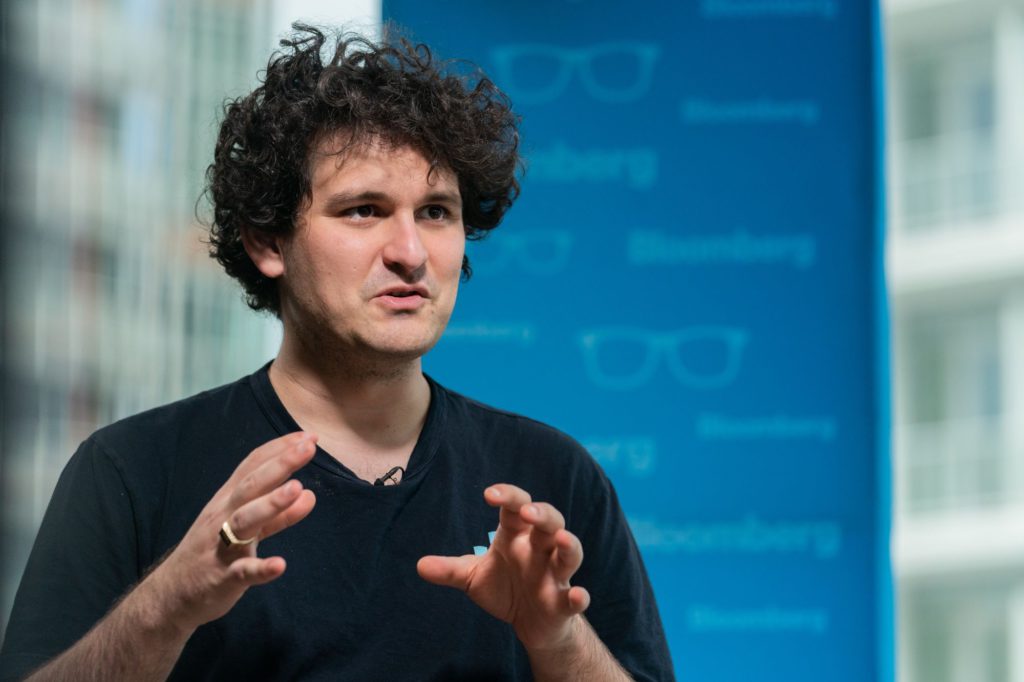
(Bloomberg) — Monetary policy and inflation have been the primary drivers behind this year’s slide in cryptocurrency prices, according to FTX’s Sam Bankman-Fried. 

“Dollars are up this year,” Bankman-Fried said during a broadcast at the SALT conference in New York on Monday. “This is the year of policy change.”

Bitcoin, the largest cryptocurrency by market value, has declined about 50% this year. The Bloomberg Dollar Spot Index has climbed about 10% during the same period as the Federal Reserve raises borrowing rates in an attempt to slow inflation. 

Bankman-Fried, who runs one of the world’s largest crypto-trading platforms, said he remains optimistic about digital assets because “more regulatory clarity is coming.” That will help to “unlock the asset class” for a number of institutions who want to get involved in the sector, he said. 

The venture capital unit of FTX announced last week that it is taking a 30% stake in Anthony Scaramucci’s SkyBridge Capital. Scaramucci interviewed Bankman-Fried via video for the conference, which is sponsored by SkyBridge.   

More stories like this are available on bloomberg.com

©2022 Bloomberg L.P.

Amazon Shares Get Back to Their Winning Ways

(Bloomberg) — Amazon.com Inc. shares are back in a familiar role of outperforming after an ugly first half of 2022, even as investors brace for a slowdown in growth at the e-commerce and cloud computing giant.

Amazon is the best-performing stock among its megacap peers since the Nasdaq 100 Index bottomed nearly three months ago, in part because it’s shown the market that it’s taking steps to curb expenses. Amazon has gained 30% since June 16, compared with a gain of 14% for the tech-heavy benchmark and a paltry 9% for Microsoft Corp. and 5% for Alphabet Inc. Only Apple Inc. comes close with a 23% advance.

It’s an about face for Amazon, whose shares were battered earlier this year amid slowing revenue growth, soaring costs and a jump in interest rates despite being one of the most loved stocks on Wall Street. The Seattle-based company’s shares are among the best performing in the past two decades with a gain of more than 16,000%.

To David Wagner, a portfolio manager with Aptus Capital Advisors, the recent rally in the stock is the result of Amazon’s focus on taming expenses, improving profitability and returning capital to shareholders through a $10 billion share-buyback plan announced in March.

“The stock does well when Amazon is harvesting and not when it’s investing, and they’re definitely in the harvesting mode right now,” said Wagner, whose firm owns Amazon shares.

The total workforce at Amazon shrank by about 100,000 in the second quarter and the company is cutting back on warehouse space as Chief Executive Officer Andy Jassy unwinds a pandemic-era expansion amid slowing growth. Fulfillment expenses rose less than analysts projected last quarter.

One area where Amazon is still willing to spend: Acquisitions. Over the past couple of months it agreed to buy software company 1Life Healthcare Inc. for $3.49 billion and iRobot Corp., maker of the Roomba vacuum, for $1.65 billion. Analysts generally have applauded the deals, seeing them as a sign that the company is seeking new avenues of growth.

Of course, owning Amazon still comes at a steep price even though the stock has gotten cheaper this year. The stock sells for 48 times earnings projected over the next 12 months. The Nasdaq 100, by contrast, has an average multiple of about half that.

With Amazon’s revenue projected to expand at the slowest pace in at least a decade this year, some investors like Kim Forrest, founder and chief investment officer at Bokeh Capital Partners, see few reasons to pay up for the stock. 

“If you buy Amazon here what you’re betting on is that it’s going to be the only place we shop in 10 years and it’s just not true.”

Despite the recent gains, Amazon shares are still down about 19% this year. Yet it remains one of the most popular stocks on Wall Street with all but two of the 60 analysts who cover the company recommending investors buy it, according to data compiled by Bloomberg. Apple, by comparison, has fewer than three-fourths of analysts recommending its shares.


Tech Chart of the Day

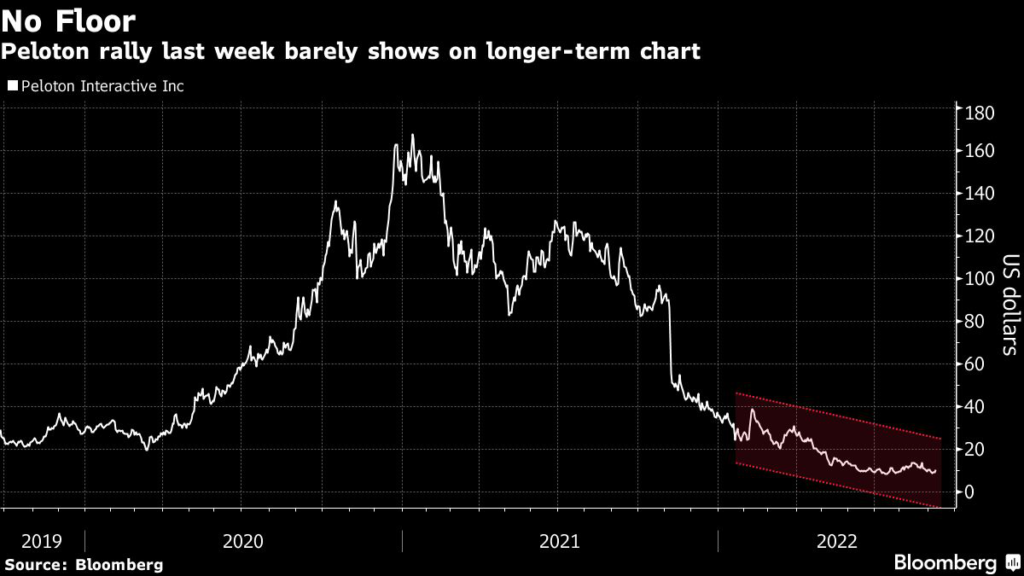
Even Peloton Interactive Inc. got a lift from last week’s rally in technology stocks, with shares of the once-popular exercise equipment maker advancing 9.2%. Still, the gain barely registers on a longer-term chart. The fitness subscription company has lost almost three quarters of its value in 2022, building on losses from 2021 that came as the so-called stay-at-home trade began to unwind. It’s hard to see what will cause a turnaround in the stock. “It’s projected to lose money for the foreseeable future, and I just don’t know how you determine a floor for that,” said Jordan Kahn, chief investment officer of ACM Funds. 

Top Tech Stories

  • The Biden administration plans to broaden curbs on US shipments of semiconductors for artificial intelligence and chipmaking tools to China, Reuters reported, citing unidentified people familiar with the matter.
  • MicroStrategy Inc., probably best known as the largest corporate buyer of Bitcoin, filed with the US Securities and Exchange Commission to sell as much as $500 million in stock. Proceeds may be used to buy more of the cryptocurrency.
  • The inventor of several key technologies used by Amazon.com Inc.’s Alexa service raised $20 million to fund a new startup in the UK. William Tunstall-Pedoe said his Cambridge- and London-based company, Unlikely AI, needed the money to start hiring developers of a new type of artificial-intelligence software. Unlikely.ai launched its first product during the Covid-19 pandemic — an app that solves and explains cryptic crossword clues.
  • Technology stocks are treading on shaky ground despite last week’s rally as chipmakers signal more trouble may be ahead in an industry notorious for its booms and busts.
  • A key Democratic senator is drafting legislation that would overhaul how the US government buys software, a move that could force Microsoft Corp., Oracle Corp. and other technology companies to remove limits on how their products interact with those made by rivals.
  • The collapse in July of Pakistani e-commerce company Airlift Technologies Pvt., less than a week after failing to complete a funding round, underscores how severely the global rout in tech valuations is affecting fragile startups in emerging markets.
  • UK payments startup Checkout.com fired several employees this year due to harassment complaints that arose from an off-site trip to Cyprus, according to people familiar with the matter.

(Updates share price moves throughout.)

More stories like this are available on bloomberg.com

©2022 Bloomberg L.P.

Twitter Drops After Saying Musk’s Attempt to End Deal Is Invalid

(Bloomberg) — Twitter Inc. said Elon Musk’s latest move to cancel his agreement to buy the social network is invalid after the billionaire said the company’s treatment of a whistle-blower gave him another reason to walk away from the $44 billion deal. 

Musk’s latest move to terminate the deal is “invalid and wrongful” and “Twitter has breached none of its representations or obligations,” the company’s lawyers said in a letter on Monday, according to a regulatory filing. 

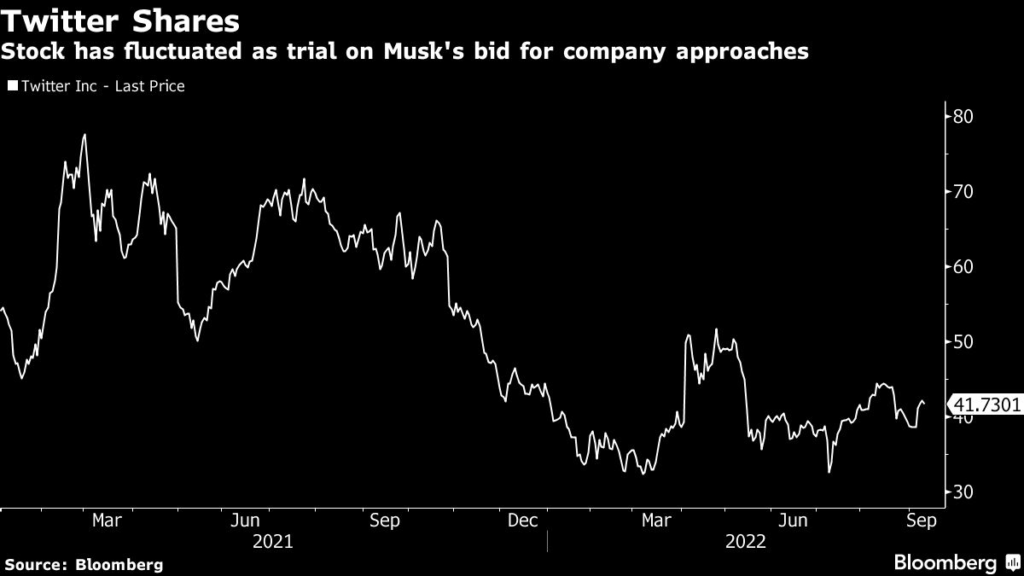
Twitter shares dropped 1% in New York trading. 

It’s Musk’s third attempt to withdraw his offer because of what he says are violations of the buyout agreement. Musk previously raised concerns about the number of “bot” accounts on the platform, and now has said that Twitter should have notified him before it spent $7.75 million in a separation agreement with Peiter Zatko, the company’s former security chief.

Read More: Musk Says Whistle-Blower Deal Lets Him Drop Twitter Purchase

Zatko is due to testify this week about his whistle-blower report, in which he raised concerns about lax security, privacy issues and the number of bots on the platform. He has been subpoenaed to testify in the Twitter lawsuit, as well.

Delaware Chancery Judge Kathaleen St. Jude McCormick has allowed Musk to add Zatko’s allegations of “egregious deficiencies” at Twitter to his legal arguments, permitting the billionaire to argue a material adverse effect on the acquisition through Twitter’s failure to disclose Zatko’s statements. 

However, McCormick has denied his bid to push back the Oct. 17 trial date. This may limit the time that Musk’s team has to explore the allegations. 

Zatko is due to testify Tuesday in front of the Senate Judiciary Committee in Washington about his allegations of security failures. Twitter shareholders are to vote the same day on whether to accept Musk’s bid. 

“The shareholder approval expected tomorrow formally sets the stage for the Game of Thrones Battle between Musk and Twitter in the Delaware Courts with the high possibility in our opinion that some form of negotiation likely takes place,” ahead of the October trial, Wedbush Securities analysts Daniel Ives and John Katsingris wrote in a note. “We continue to view the Zatko situation as a Pandora’s Box scenario for Twitter with for now the Senate hearing front and center.”

More stories like this are available on bloomberg.com

©2022 Bloomberg L.P.

Biden Needs a New Traffic Safety Chief With Road Deaths at 20-Year High

(Bloomberg) —

The US National Highway Traffic Safety Administration is operating without a Senate-confirmed leader again, leaving a void atop the agency tasked with preventing road injuries and deaths even as the number of fatalities moves sharply in the wrong direction.

Steven Cliff, who in May became the first confirmed NHTSA administrator since early 2017, bowed out to return to the California Air Resources Board starting Monday. Ann Carlson, the agency’s chief counsel, has taken over after Cliff lasted just over three months as full-time head of the regulator.

While President Joe Biden plans to nominate another permanent administrator, the process could take a while. Cliff was first put forward for the role back in December and had to be re-nominated after Senator Rick Scott, the Florida Republican, held up several of the president’s picks for Transportation Department roles for months. A White House official declined to comment on the timeline for an appointment to replace Cliff, and NHTSA didn’t respond to a request for comment.

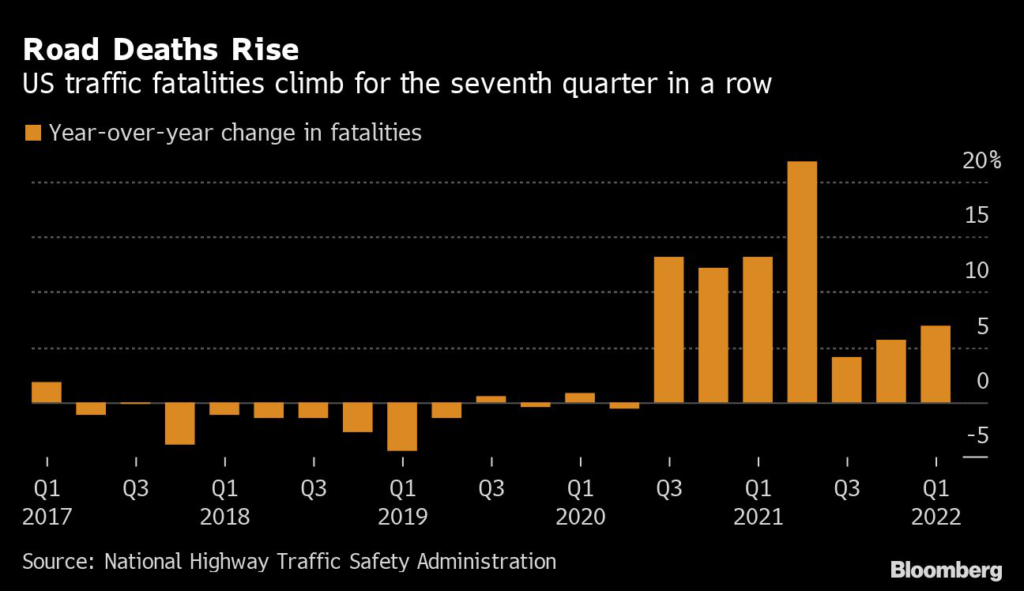
Now is not the time for NHTSA to have another long lapse in permanent leadership. Five days after announcing Cliff’s departure, the agency reported some 9,560 traffic fatalities from January through March, the worst first-quarter showing in 20 years. And this wasn’t just a blip — the number of deaths on US roads has been soaring since the tail end of Donald Trump’s presidency, rising for seven consecutive quarters.

NHTSA wasn’t standing idly by as this happened. This summer, the agency made an $8 million national media buy for a “Speeding Wrecks Lives” ad campaign. Another part of its job is enforcement activity, and last year was eventful — there were a record 1,093 vehicle and related-equipment recalls affecting roughly 34.3 million products. The ones that generated the most headlines had to do with Tesla, whose controversial driver-assistance system Autopilot is the subject of two defect investigations, one of which the agency escalated in June.

But the backgrounds of NHTSA’s leaders are in climate policy rather than fields more squarely linked to safety. Cliff has a chemistry doctorate from the University of California, San Diego, and completed a postdoc in atmospheric sciences at the University of California, Davis, before first going to work at CARB in 2008. Carlson also focused on climate change and air-pollution law before joining NHTSA early last year.

By contrast, Mark Rosekind, the last permanent administrator before Cliff, specialized in issues related to sleep and fatigue. During his tenure, NHTSA oversaw the biggest recall in history — pressuring automakers to replace airbags made by Takata, which went bankrupt — and compelled Fiat Chrysler to buy back vehicles because the agency wasn’t confident in the company’s plans to fix a fuel-tank defect.

If NHTSA decides to get similarly tough with Tesla and other manufacturers deploying advanced driver-assistance systems, it may make sense for the agency to have an administrator well-versed in automation and the safety issues surrounding human-machine interaction. The agency recently signaled its furthest-along investigation into Autopilot may be headed in this direction by asking the company several questions about its in-car cameras and the role they play in enforcing driver engagement and attentiveness.

One of Carlson’s first public appearances as acting administrator will be at the Governors Highway Safety Association’s annual meeting starting later this week in Louisville, Kentucky. The nonprofit made clear when NHTSA announced its fatality figures for the first quarter where it stands.

“We must not become desensitized to the tragedy of roadway deaths,” Jonathan Adkins, the group’s executive director, said in a statement. “GHSA and other leading national safety groups have urged President Biden to quickly nominate a qualified individual that can guide NHTSA through this turbulent time in traffic safety.”

More stories like this are available on bloomberg.com

©2022 Bloomberg L.P.

Twitter Says Musk’s Third Attempt to Cancel Deal Is Invalid

(Bloomberg) — Twitter Inc. said Elon Musk’s latest move to cancel his agreement to buy the social network is invalid after the billionaire said the company’s treatment of a whistle-blower gave him another reason to walk away from the $44 billion deal. 

Musk’s latest move to terminate the deal is “invalid and wrongful” and “Twitter has breached none of its representations or obligations,” the company’s lawyers said in a letter on Monday, according to a regulatory filing. 

Twitter shares dropped 0.7% during premarket trading in New York.

It’s Musk’s third attempt to withdraw his offer because of what he says are violations of the buyout agreement. Musk previously raised concerns about the number of “bot” accounts on the platform, and now has said that Twitter should have notified him before it spent $7.75 million in a separation agreement with Peiter Zatko, the company’s former security chief.

Read More: Musk Says Whistle-Blower Deal Lets Him Drop Twitter Purchase

Zatko is due to testify this week about his whistle-blower report, in which he raised concerns about lax security, privacy issues and the number of bots on the platform. He has been subpoenaed to testify in the Twitter lawsuit, as well.

Delaware Chancery Judge Kathaleen St. Jude McCormick has allowed Musk to add Zatko’s allegations of “egregious deficiencies” at Twitter to his legal arguments, permitting the billionaire to argue a material adverse effect on the acquisition through Twitter’s failure to disclose Zatko’s statements. 

However, McCormick has denied his bid to push back the Oct. 17 trial date. This may limit the time that Musk’s team has to explore the allegations. 

Zatko is due to testify Tuesday in front of the Senate Judiciary Committee in Washington about his allegations of security failures. Twitter shareholders are to vote the same day on whether to accept Musk’s bid. 

“The shareholder approval expected tomorrow formally sets the stage for the Game of Thrones Battle between Musk and Twitter in the Delaware Courts with the high possibility in our opinion that some form of negotiation likely takes place,” ahead of the October trial, Wedbush Securities analysts Daniel Ives and John Katsingris wrote in a note. “We continue to view the Zatko situation as a Pandora’s Box scenario for Twitter with for now the Senate hearing front and center.”

(Updates shares in third paragraph, adds background from sixth paragraph.)

More stories like this are available on bloomberg.com

©2022 Bloomberg L.P.

Online Prices in US Jumped 2.1% in August Led by Surge in Groceries

(Bloomberg) — Online prices in the US rose 2.1% in August from the previous month, driven by a jump in the cost of groceries, according to the Adobe Digital Price Index. 

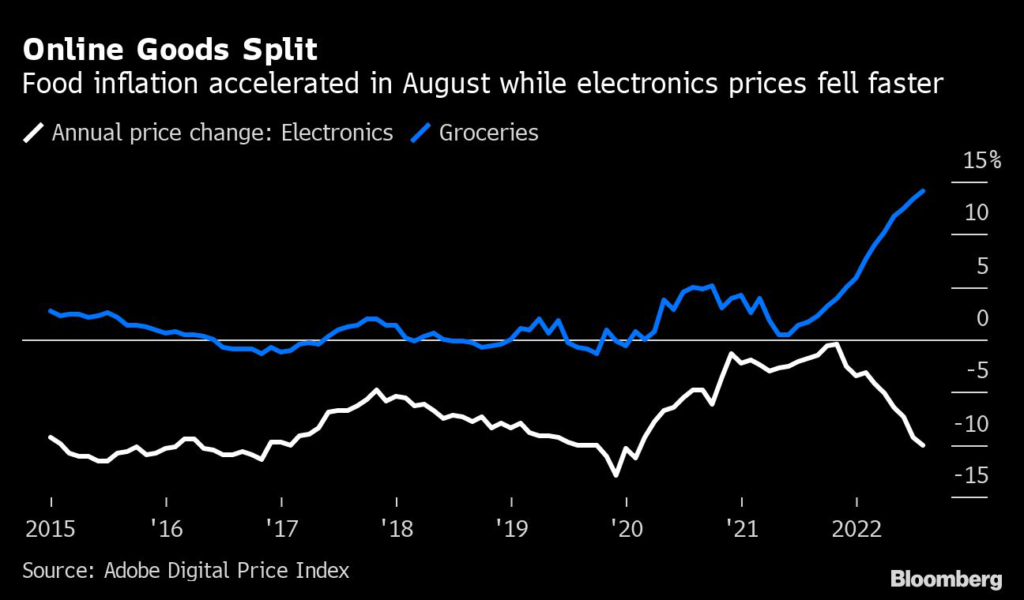
The sharp monthly increase pushed the annual rate of online inflation up to 0.4%, Adobe said. The previous month, online prices had declined from a year earlier for the first time since 2020. Before the pandemic, the price of goods bought via e-commerce had been falling steadily for several years. 

On an annual basis, food prices jumped a record 14.1% in August. The biggest declines came in the cost of computers bought online, which fell 12.6% from a year earlier — the steepest drop since the pandemic emergency began in March 2020. Electronics more broadly fell 10%. 

Covid-19 led to a surge in online purchases of consumer goods that drove prices higher, as lockdowns restricted access to services like gyms or restaurant meals, and supply chains struggled to cope with the extra demand. While that boom may be cooling, the Federal Reserve is now concerned that inflation has spread from goods into services.  

Roughly 15% of retail spending in the US is via e-commerce, a share that’s risen during the pandemic. Consumers spent $64.6 billion online last month, Adobe said.

The Adobe data is based on 1 trillion visits to retail sites and more than 100 million products across 18 categories.  

More stories like this are available on bloomberg.com

©2022 Bloomberg L.P.

Fuel-Shortage Risks Make Investors Bullish on Energy Stocks, Survey Shows

(Bloomberg) — Energy stocks and bonds are poised to get a fresh boost from investors positioning to benefit from the surging electricity prices and fuel shortages expected later this year. 

Two-thirds of respondents to an MLIV Pulse survey — which includes portfolio managers and retail investors — plan to increase exposure to the sector over the next six months. They see electricity and natural gas prices driving global inflation and expect that Russia will choke off flows of natural gas to Europe, leading to shortages of key fuels this winter.

Energy stocks are one of the rare bright spots in the world’s equity markets, with an index of energy companies in the S&P 500 rallying more than 40% so far this year as profits surged along with oil and gas prices. Yet, they remain significantly cheaper than their S&P 500 peers, based on their prices relative to the earnings they’re expected to report in the year ahead. While junk-rated energy bonds are expensive when compared with the global index, the US energy debt rated at investment grade BBB is relatively attractive, trading at a higher spread than the average of its peers by rating and duration. 

To read the breakdown of the results, click here. 

“I definitely want to remain invested in energy stocks because of massive supply constraints,” Chris Wood, global head of equity strategy at Jefferies LLC, said in a Bloomberg TV interview. “The other reason to own energy is quite simply that you need a hedge against the growing risk of escalation in Ukraine.”

Energy markets have come under further strain as Russia constricts deliveries of natural gas through its Nord Stream pipeline, causing prices to almost triple in Europe this year. European Union sanctions are set to squeeze Russian oil supplies when they take effect in December. 

Europe’s worst energy crisis in five decades is making rationing look all but inevitable this winter. The EU has already created a voluntary 15% demand-reduction target for gas, with the option of making it obligatory if needed, and warned of “further drastic reductions” if temperatures are especially low. 

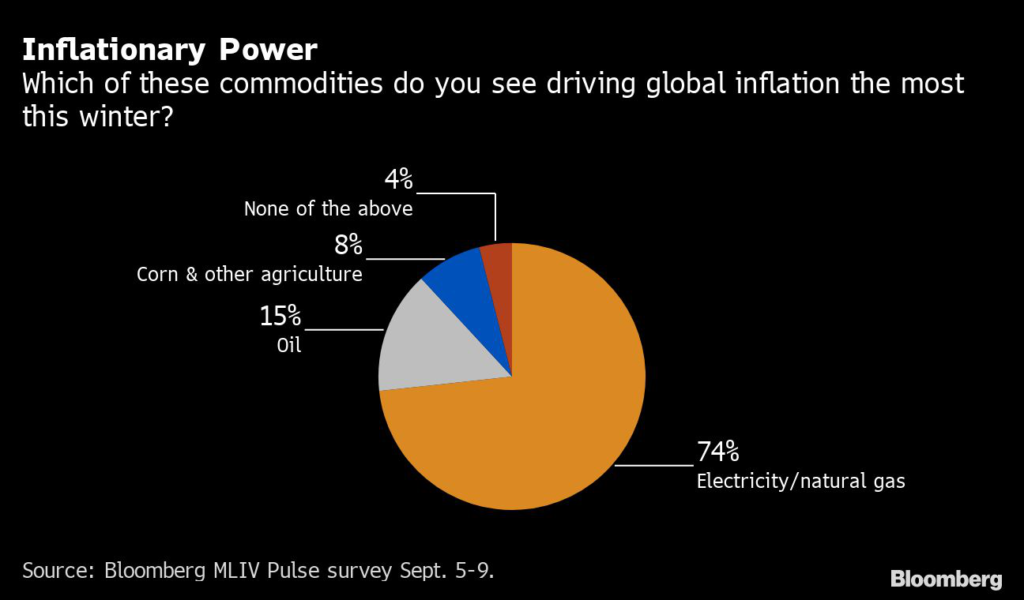
Almost three quarters of 814 respondents expect electricity and natural gas prices to drive global inflation the most this winter. A similar majority said that if there will be any shortages over the next six months, it will be of key fuels, including natural gas.

Years of under-investment during the attempt to transition away from the fossil fuels have left global supplies unable to satisfy the post-pandemic rebound in demand.“It’s ultimately the revenge of the old economy: if you don’t invest in the old economy, it comes back to haunt you,” said Jeff Currie, head of commodities research at Goldman Sachs Group Inc. “The only way you’re solving the energy problem in the long run is through investment – and oil companies are the conduit for the capex to solve the problem.”

The surge in energy prices has hit major economies with a brutal wave of inflation, which has reached record levels in the Euro-area and the hottest pace in almost four decades in the US. Goldman Sachs has warned that inflation in the UK could top 22% next year if natural-gas prices remain elevated. Economists increasingly predict a Euro-area recession in the coming quarters as the rising cost of living saps demand, undermining the pandemic rebound.

“It’s not only commodities that will drive up inflation but also government reaction to high prices of commodities,” said Anna Mikulska, a non-resident fellow in energy at Rice University’s Baker Institute for Public Policy. “The negative effect of either pumping more money into the economy will be inflation and lowering artificially energy prices will lead to higher demand and higher prices – vicious circle of sorts.”

“The European gas market is likely to remain tight throughout the 2020s,” said Katja Yafimava, a senior research fellow at Oxford Institute for Energy Studies. The “global shortage of gas, hesitancy about new investment in new gas production” and the EU’s “political decision to phase out its dependence on Russian gas altogether” are driving the tightness. 

Nonetheless, bullish investors may have their nerves tested in the months ahead as the inflationary wave batters the global economy. Demand in China, the world’s second-biggest consumer, remains overshadowed by the property crisis and virus restrictions. 

In the oil market, there are already signs of demand destruction taking place, with crude prices retreating about 24% over the past three months.

Most respondents expect oil prices to remain between $70 and this year’s peak of $139, with only 10% seeing crude surging above that level. About 46% expect energy crisis to accelerate the pace of green power generation. The global benchmark Brent futures rose more than 1% on Monday, approaching $94 a barrel as of 6:50 a.m. New York time. 

Energy price volatility is itself posing a risk to the financial system, with the rising prices forcing utilities to put up more collateral for fuel-delivery contracts purchased with loans. Norwegian energy company Equinor ASA warned that margin calls of at least $1.5 trillion are straining energy trading and pushing governments to provide greater liquidity buffers. 

Yet energy bulls are unperturbed. Even if a global economic slowdown causes oil prices to falter, they see another line of defense in the OPEC+ producers’ cartel led by Saudi Arabia. The alliance demonstrated its readiness to intervene by announcing a symbolic production cutback earlier this month.

The kingdom and its partners are likely to either hold production steady or cut rather than increase it over the next six months, according to the survey. Some 44% of respondents believe that oil prices are failing to reflect the realities of supply and demand — a disconnect recently identified by Saudi Energy Minister Prince Abdulaziz bin Salman.

“We continue to warn of significantly tighter markets at year-end,” said Amrita Sen, chief oil analyst at consultant Energy Aspects. “OPEC+ has provided a price put which should serve as a clear reminder that they will stop stockpiles from building should the world economy slump into a severe recession.”

The appetite for energy stocks appears to be sector-specific, as majority of respondents said they will keep their exposure to the S&P 500 the same over the next month. Information technology and communication services shares, which have underperformed this year, are sensitive to economic slowdowns. Meanwhile, those of financial services companies, heading for their worst year since 2018, have been taking their cues from the Federal Reserve as it steps up its monetary tightening regiment to tame inflation.Join us on Sept. 12 at 10 a.m. New York time for a discussion on the survey results. For more markets analysis, see the MLIV blog. 

(Updates with a comment, oil prices in 14th and 15 paragraphs.)

More stories like this are available on bloomberg.com

©2022 Bloomberg L.P.

Tornado Cash: What It Is and Why It’s Been Sanctioned by Treasury

  • Listen to Bloomberg Crypto on the iHeartRadio App
  • Listen to Bloomberg Crypto on Apple Podcasts
  • Listen to Bloomberg Crypto on Spotify  

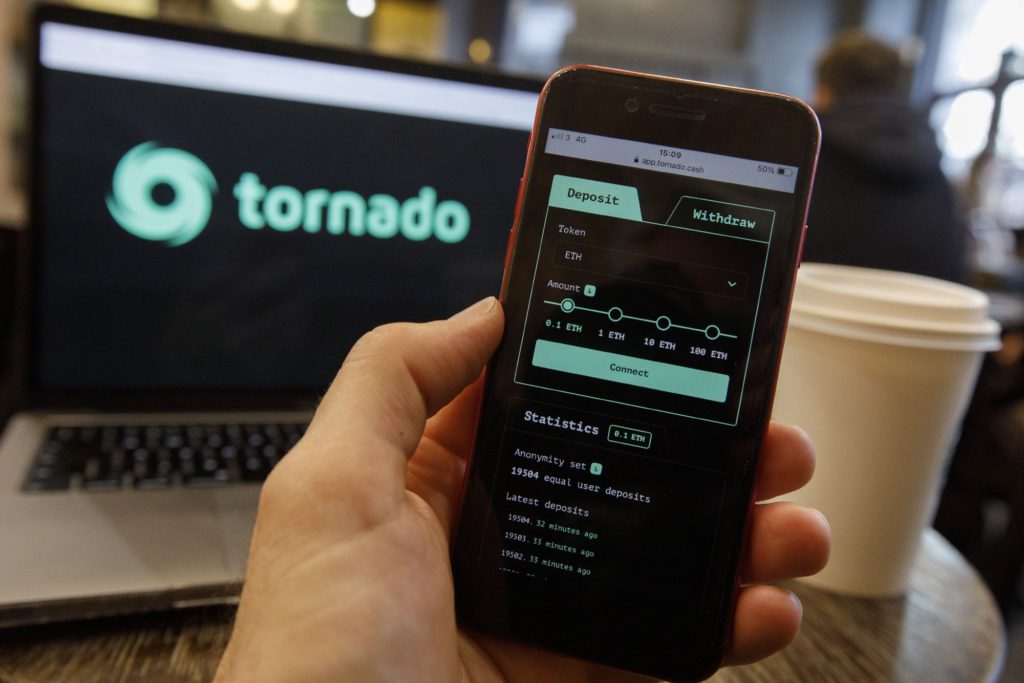
(Bloomberg) — Put a whole bunch of crypto transactions into a blender and lock them up in black box – what do you get? Something metaphorically similar to the experience of using a decentralized app called Tornado Cash. The cryptocurrency mixer allows users to move their tokens around anonymously. But federal regulators say cyber criminals have used the service launder money. Tornado Cash was recently sanctioned by the US Department of Treasury.

Privacy is a key objective of many crypto proponents. And it’s one of the features that makes the asset class attractive to some investors. If this principle can’t be guaranteed, some say crypto’s utility becomes questionable.

Emily Nicolle joins this episode to discuss whether or not a decentralized service can truly be regulated, the issue of crypto privacy and the implications of sanctions on Tornado Cash and DeFi more broadly. 


Follow us on Twitter @crypto, and subscribe to the Bloomberg Crypto Newsletter at https://bloom.bg/cryptonewsletter


More stories like this are available on bloomberg.com

©2022 Bloomberg L.P.
Biden to Boost US Biomanufacturing to Compete with China

(Bloomberg) — President Joe Biden is poised to sign an executive order on Monday to help expand US biomanufacturing and reduce reliance on China. 

The order lays out a strategy to bolster domestic manufacturing that harnesses biological systems to create a sweeping array of products and materials, from new medicines and human tissues to biofuels and food, according to people familiar with the matter, who asked not to be identified as details of the executive order aren’t yet public. 

After Biden signs the order and delivers a speech in Boston on Monday, the White House will hold a summit on Wednesday to discuss the biotechnology-focused initiative and announce investments to scale out domestic research, development and production capabilities, according to two senior administration officials. 

Bloomberg News first reported details of the executive order on Saturday. 

The US has one of the world’s most robust biotechnology industries and while it has led in research and development, it has allowed high-tech production to migrate abroad. US national security and intelligence officials are particularly concerned about reliance on China’s advanced biomanufacturing infrastructure.

Sense of Urgency

The Covid-19 pandemic created a sense of urgency around developing a clear and consistent industrial strategy, according to two of the people, who pointed to the fast development and production of messenger RNA vaccines as an example of successful domestic investment. Looking beyond health care, the US will aim to advance biomanufacturing in agriculture, energy and other industries.

The order will outline how the US should develop a trained, diverse workforce capable of using naturally occurring processes to create bio-based products and materials, the people said. The Biden administration plans to deploy resources to support scaling out biomanufacturing infrastructure, though it’s not yet clear how much funding there is to back the executive order.

The White House will suggest that improving domestic biomanufacturing will ultimately lower prices, strengthen supply-chain security and develop solutions to address climate change, according to the people.

Engineering biology could be used in manufacturing to account for more than one-third of global output, said the senior administration officials.

Two weeks ago, Biden signed an executive order to boost domestic semiconductor manufacturing that’s also part of the administration’s drive to shift the balance of US competition with China.

In May, China’s National Development and Reform Commission released a 5-year plan for bioeconomic development, which described efforts to accelerate new technologies and spur growth in health care, agriculture and fuel. As tensions mount between the the US and China, the Biden administration has looked for ways to curb investment in China’s industries.

(Updates details throughout from senior administration officials)

More stories like this are available on bloomberg.com

©2022 Bloomberg L.P.
Disney Plans Series on Epic Indian Poem ‘Mahabharata’ About a Warring Dynasty

(Bloomberg) — Walt Disney Co. is filming a series based on an ancient Indian poem about a warring dynasty, as it seeks to gain a stronger foothold in one of the world’s fastest-growing entertainment and streaming markets. 

A retelling of the “Mahabharata,” the some 2,000-year-old Sanskrit poem about two groups of cousins vying for their clan’s throne and kingdom with the aid and interference of the Gods, will be released in 2024, Gaurav Banerjee, head of content at Disney+ Hotstar — Disney’s Indian digital platform — said at the media giant’s three-day D23 extravaganza event at the Anaheim Convention Center in California. 

Disney is hoping the longest poem ever written — with 200,000 verses in its unabridged version, it’s like the South Asian version of “Game of Thrones” — will strike gold in India as streaming platforms come under increasing pressure from investors to show they can buck a downward trend in subscriber growth hitting Netflix Inc. A rerun of the 1980s production of the “Ramayana” — an ancient tale that like the “Mahabharata” is central to Hinduism — was a surprise TV hit in India during the Covid-19 pandemic.

Read more: India Uses Mythological Reruns to Keep the Vulnerable Indoors

“Mythology has always been one of the most popular genres on Indian television,” said Mihir Shah, the Mumbai-based vice president at consultancy Media Partners Asia. “The announcement of Mahabharata on Disney+ Hotstar is a move to extend this success” into the world of online streaming, he said.

Daunting Prospect

Yet the enormous scope of these stories — the “Mahabharata” is roughly 10 times the length of the “Iliad” and the “Odyssey” combined — makes it a daunting prospect for any filmmaker. The 1980s version of the Mahabharata had 94 episodes airing from 1988-1990. “Ramayana,” the shorter of the two poems, was played out over 78 episodes. 

According to media reports as many as 51 million people tuned into each episode of the Mahabharata during India’s lockdown — 77 million is the world record held by the Ramayana — which beats the 19.3 million that watched the finale of Game of Thrones.

SS Rajamouli, one India’s most successful directors who is known for his trademark action-filled epics, told Bloomberg News earlier this year that he was girding himself to eventually tackle a cinematic version of the “Mahabharata.”

Of the three main international streaming services in India, Disney is at the top, with just under 60 million subscribers. Live streaming of cricket, India’s national obsession, has been a big driver of that growth, though Disney lost the rights to digitally broadcast tournaments earlier this year to a consortium of Hollywood studio Paramount Global and Indian conglomerate Reliance Industries Ltd.

Many analysts are now skeptical that Disney can meet an ambitious target set two years ago to sign up 260 million subscribers by fiscal year 2024. Chief Financial Officer Christine McCarthy told investors last month that the company now expects between 135 million and 165 million “core” Disney+ customers, and as many as 80 million customers for Disney+ Hotstar in India by then, or a maximum of 245 million.

More stories like this are available on bloomberg.com

©2022 Bloomberg L.P.
Close Bitnami banner
Bitnami