Bloomberg

Revolut Wants to Compete With PayPal and Apple at Online Checkouts

(Bloomberg) — Revolut Ltd. is launching a one-click payment feature in a bid to rival PayPal Inc. and other tech giants at online checkouts. 

Revolut Pay has signed up retailers including Shopify Inc., Prestashop, WH Smith Plc and Funky Pigeon, and will be available within the airline industry in the coming months, according to a statement from the London-based fintech. 

Thibaut Genevrier, head of merchant acquiring, said in an interview from New York that Revolut Pay was a sign the firm has reached “critical mass,” having branched out from its original prepaid card into a range of financial services for both consumers and businesses. 

“We want to be on the top 1,000 e-commerce websites in Europe. We want to be right there in the checkout and have merchants improve their conversion rate,” he said. Businesses will be paid within 24 hours, which he said was several days quicker than some rivals. Revolut will charge retailers fees of about 1% for the service. 

The payment feature, running on Revolut’s in-house software, will enable consumers to earn cashback on purchases through mobile and desktop browsers. Shoppers who aren’t Revolut customers can use the feature with payment cards from other providers. 

Founded in 2015, Revolut has run services for businesses for the past five years. It launched a card reader in July, adding to the burgeoning payments ecosystem that has Apple Inc., Block Inc. and PayPal among its biggest players. 

Revolut is due to file its annual accounts by the end of the month. The company has denied it’s seeking to reduce costs following a report on Wednesday in the Financial Times that it had rescinded some job offers and was in the middle of a cost-cutting review.

More stories like this are available on bloomberg.com

©2022 Bloomberg L.P.

Asos Warns of Weak Sales as Inflation Hits Clothes Shopping

(Bloomberg) — British fast-fashion company Asos Plc warned that sales in August were weaker than expected as inflation crimped shoppers’ purchasing power.

Full-year profit will come in at the lower end of guidance, with sales growth of only about 2%, according to a statement Friday. The online retailer also cited a slow start to its autumn/winter ranges. 

“Asos remains cautious about the outlook for consumer spending,” the company said.

The earnings season looks likely to continue to be tough for retailers. Associated British Foods Plc, owner of budget chain Primark, warned Thursday that profit will decline next year under pressure from rising energy costs and the strengthening of the dollar. 

Asos shares fell as much as 4.2% in early trading in London and later erased their decline. Andrew Wade, an analyst at Jefferies, said the warning isn’t coming as a big surprise to the market.

Asos is having a difficult year and issued a profit warning in June as the cost-of-living crisis sapped consumers’ spending power. The company had already warned in April that its earnings goal was at risk from inflation and disruption from the war in Ukraine. The lower end of its guidance is £20 million ($23 million).

Management Changes

The company’s top management team is also changing again with Mat Dunn, who oversaw the business after Nick Beighton left last year, leaving and handing over to chief commercial officer Jose Antonio Ramos Calamonte as CEO.

Shoppers are navigating the highest inflation in four decades in the UK and there are signs that they’re cutting back on purchases of clothing and other non-essential items. Retail sales growth slowed to just 1% last month and fashion sales were sluggish, British Retail Consortium and consultancy KPMG said in a report. 

For many years Asos was a stock-market favorite, reporting increasing sales and profits. More recently the company has struggled with supply chain issues and the move away from online shopping back to stores after Covid restrictions were lifted. 

Last year Asos acquired Topshop, Topman, Miss Selfridge and HIIT brands from Philip Green’s failed Arcadia. Since then U.S. department store Nordstrom Inc. took a minority stake in the brands through a joint venture. 

The stock has lost almost three-quarters of its value this year. Some hedge funds are betting that it has further to fall. Marshall Wace, Qube Research & Technologies Ltd. and others have built short positions totaling about 6% of Asos shares, up from around 3% earlier this year. 

(Updates shares in fifth paragraph)

More stories like this are available on bloomberg.com

©2022 Bloomberg L.P.

Signs of Bottom Emerge for Rolex, Patek Prices After Secondhand Slide

(Bloomberg) — More signs are emerging that the secondhand luxury watch market is finding its footing, after prices surged and then tumbled earlier this year. 

An index for Rolex resale prices at WatchCharts, a consultancy, fell 1.84% in early September from the prior month, a slower pace of decline following a summer slump of at least twice that rate. 

Meanwhile, the Subdial50 index, which tracks prices of the 50 most-traded luxury watches, ticked up 1.2% in the 30 days prior to Sept. 7, “hinting at a bottoming out of prices in the world’s most popular luxury watch references,” the company said in a post published Wednesday. The index tracks references for watches such as the Rolex Daytona and Datejust, as well as Patek Philippe Nautilus and an Audemars Piguet Royal Oak.

Luxury timepieces have been on a wild ride this year, particularly in the closely tracked secondary market. While there is wide variation of price performance in the market, valuations for some of the most coveted models slumped in the late spring after hitting a peak sometime in March or April, depending on which models are tracked. The downturn had been linked by some to a collapse in cryptocurrency prices, though others thought different factors were in play, such as dealers trying to get rid of overstock.

Gains in other asset classes, stimulus cash and speculation fueled what some were calling a bling boom early this year, with new buyers looking for alternative investments. Demand for the most sought-after watch resales was high, sending prices soaring. In March, the WatchCharts Rolex index was up 35% over the same month the previous year.

“It was almost a sense of euphoria in the market,” said Austen Chu, founder and CEO of online watch platform Wristcheck.

Then came the fall. In the steepest month-over-month drop, the WatchCharts Rolex index fell 5.9% in June, followed by a 3.5% decline in July and 5.1% drop in August. 

“Flippers and day traders who’d been told you couldn’t lose money in watches came with little underlying passion and found themselves burnt when prices began to fall,” Subdial said in the post.

The price slide was largely attributed to dealers and individual owners trying to sell more watches, rather than fear from buyers. “Consumer demand has been resilient,” Kathryn Parker, luxury research analyst at Jefferies, said in an interview.

More stories like this are available on bloomberg.com

©2022 Bloomberg L.P.

Ikea Reveals Its Swedish House Mafia Furniture Collection

(Bloomberg) — The only ones surprised that Ikea’s entire new collection by Swedish House Mafia is black may have been the members of Swedish House Mafia. 

Despite the fact that the EDM supergroup of Axwell (Axel Christofer Hedfors), Steve Angello, and Sebastian Ingrosso have influenced everyone from Diplo to Martin Garrix and are never not dressed head-to-toe in favorite shades of noir, the trio’s first partnership with the world’s No.1 furniture retailer didn’t start out with such a dictate. 

“When you put it all together, it’s like, OK, it’s a black collection. But once you start picking these things apart, it’s very bold, brutalist—almost minimal and structural,” Angello tells me backstage during a private reveal party on Sept. 7 in Hollywood, Calif. The group was in town to launch the Ikea of Sweden AB line and play a show at Banc of California Stadium, its first return to the city in a decade. “The decision was,” he continues, “this collection is gonna be simple and bold.”

Called Obegransad, which means “unlimited” in Swedish, the SHM series will launch in the US and around the world in October, offering affordable home furnishings that aspiring musicians and DJs might use. There’s the matte black-on-black record player ($160); the black LED work lamp ($50); and black laptop stand ($14). There are also black shelving units, laptop bags, throw blankets, and even slippers in two sizes. The most expensive thing on the list is a large multi-drawer desk ($199). 

More than the obvious connection between a Swedish dance group and a Swedish corporation, the 23-item line comes from a genuine history of using Ikea products, says Axwell.

“Growing up, everybody had Ikea, and there were certain looks throughout the years—different Ikea for the ’70s, ’80s, ’90s,” he says. “For us growing up, trying to make music for a living, you don’t have unlimited funds. When you’re about to furnish your first home studio in your room—obviously, Ikea was the place. You get the starter kit.” 

Made with a sense of texture and depth (the faux fur of the rug; the matte coating of the lamps; the shape of the clock), many of these items could dress up the Lower East Side apartment of a working New York DJ. The bags, which are variously sized riffs in black on the iconic blue plastic workhorses, might be stuffed behind sound booths. They’re part of the scene, but sufficiently distinct in style for you to know which is yours when it’s time to go home—or move out of that shared flat. 

That’s kind of the idea, says Agnello: “If you take any piece of the collection and put it in a different environment, it’s gonna stand out.” 

More stories like this are available on bloomberg.com

©2022 Bloomberg L.P.

BMW Touts ‘Technology Leap’ of Longer-Range, Faster-Charging Batteries

(Bloomberg) — BMW AG plans to buy electric-vehicle batteries from six new factories to be set up and run by companies including Contemporary Amperex Technology Co. Ltd. and Eve Energy Co. as the world’s biggest luxury-car maker attempts to overhaul its supply chain.

Two plants each in Europe, China and North America will produce round lithium-ion cells that enable longer ranges and faster charging than the prismatic cells BMW currently uses, the company said Friday. At roughly half the cost, the technology is meant to bolster BMW’s planned “Neue Klasse” EV platform and follows Tesla Inc., which has been using a cylindrical shape for some time.

“We are approaching an enormous technology leap,” Frank Weber, BMW’s development chief, told reporters. He added that BMW’s suppliers have agreed to produce the cells with renewable energy only and partly use recycled cobalt, nickel and lithium to cut production-related carbon emissions by as much as 60%.

The decision is part of a BMW strategy — which differs from pushes by Tesla and Volkswagen AG — to buy cells rather than get involved in their production. With Neue Klasse, due to start in 2025, BMW aims to pick up speed in an increasingly competitive EV market. Batteries are among the major cost drivers of an electric car, and improving technology has typically delivered annual efficiency gains. That trajectory has come under strain due to the surging cost of raw materials, challenging automaker forecasts of soon selling EVs for a similar margin to combustion-engine autos.

BMW will partner with CATL and Eve Energy to source the round cells in Europe and China, with the search for partners in North America still ongoing. The two American factories will be erected in a free-trade zone in the US, Canada or Mexico, BMW said. Each facility will have an annual production capacity of as much as 20 gigawatt-hours.

BMW said it has already awarded purchasing contracts worth a double-digit-billion-euro amount to CATL and Eve Energy. Part of the batteries are coming from CATL’s planned 7.3 billion euro ($7.3 billion) facility in Hungary that’s also due to supply Mercedes-Benz AG. Eve Energy will build and operate a second plant to make round cells in Europe.

Weber said Neue Klasse’s entry-level models may also use lithium iron-phosphate batteries, which are cheaper and don’t require nickel or cobalt, but offer less energy density and are heavier than the new round cells. The line’s top EVs will have a range of as much as 800 kilometers (497 miles) and charge from 10% to 80% in less than 30 minutes, he said.

More stories like this are available on bloomberg.com

©2022 Bloomberg L.P.

Asos Warns of Weakening Sales With Cautious Outlook on Consumers

(Bloomberg) — British fast-fashion company Asos Plc warned that sales in August were weaker than expected due to the pressure of inflation on shoppers.

Profit for the year will come in at the lower end of guidance, with sales growth of only about 2%, according to a statement Friday. It also cited a slow start to shopping its autumn/winter ranges. 

“Asos remains cautious about the outlook for consumer spending,” the online retailer said.

Asos is having a difficult year and issued a surprise profit warning in June as the cost-of-living crisis sapped consumers’ spending power. The company had already warned in April that its earnings goal was at risk from inflation and disruption from the war in Ukraine. 

The company’s top management team is also changing again with Mat Dunn, who oversaw the business after Nick Beighton left last year, leaving and handing over to chief commercial officer Jose Antonio Ramos Calamonte as CEO.

More stories like this are available on bloomberg.com

©2022 Bloomberg L.P.

Singapore’s Lee Family Scions Make Crypto Push With New Funds

(Bloomberg) — Scions from two of Singapore’s most prominent families are boosting their involvement in digital assets.

Whampoa Group, a multi-family office anchored by principals from the Lee family that founded Oversea-Chinese Banking Corp. and Amy Lee, the niece of the city-state’s founding prime minister, wants to spin out its asset-management business for digital investments. It plans to raise $50 million for a crypto-related hedge fund, and is seeking to deploy $100 million for a venture-capital fund in the same space, Whampoa co-founder and Chief Executive Officer Shawn Chan said in an interview. 

Family offices tend to be less regulated than standard firms and are among the bigger players that have been looking to get into alternative investments. In Singapore, the wealthy in particular have been embracing tokens, helping propel Bitcoin trading at DBS Group Holdings Ltd.’s digital exchange that serves institutional investors and family offices. 

At the same time, however, the country’s authorities have repeatedly discouraged retail investors from betting on crypto, a space that’s been particularly volatile. Bitcoin has tanked by more than two-thirds after a years-long rally took it to a peak in November.

The Whampoa hedge fund is market-neutral in order to offset cryptocurrencies’ volatility, Chan said. It primarily trades Bitcoin and Ether, and occasionally other tokens when it identifies a favorable risk-reward setup. 

As for the VC fund, Whampoa is looking for strategic partners. It has been speaking with regional family offices and some big Chinese internet companies, Chan said.

(Updates with Bitcoin trading in fourth paragraph)

More stories like this are available on bloomberg.com

©2022 Bloomberg L.P.

Bain Weighs HR Software Firm Sale at $2 Billion Valuation, Sources Say

(Bloomberg) — Bain Capital is exploring options for Works Human Intelligence Co. including a potential sale that could value the human resources software developer at as much as $2 billion, according to people familiar with the matter.

The private equity firm is working with an adviser on the potential transaction and has started reaching out to prospective buyers, said the people, who asked not to be identified discussing private information. Bain could sell its entire or partial stake in Works Human Intelligence, the people added.

Considerations are at an early stage and Bain could still decide to retain the asset for longer, according to the people. A representative for Bain declined to comment, while a representative for Works Human Intelligence couldn’t immediately respond to requests for comment.

Founded in 1996 as Works Applications Co., the Tokyo-based company offers software for payrolls, attendance management, talent management and a human resources chatbot, according to its website. It went public in Japan in 2001 until it was taken private and delisted in a management buyout a decade later. In August 2019, Bain acquired the firm for an undisclosed amount and renamed it as Works Human Intelligence.

Bain has made 21 investments in Japan including a 49.9% stake in chipmaker Kioxia Holdings Corp. and Showa Aircraft Industry Co., its website shows. The private equity firm has more than 40 investment professionals in Japan and manages about $160 billion in assets globally. Last month, it agreed to buy Olympus Corp.’s scientific instruments business Evident for 428 billion yen ($3.1 billion). 

More stories like this are available on bloomberg.com

©2022 Bloomberg L.P.

Sea’s Retail Arm Pulls Out of Argentina in Latin America Retreat

(Bloomberg) — Sea Ltd.’s e-commerce unit is leaving Argentina and closing most of its operations in Chile, Colombia and Mexico, retreating from much of Latin America to focus on profitability over growth.

Shopee will close offices in Chile and Colombia and maintain just a small local presence in Mexico to support regional markets, according to a person with knowledge of the matter and an internal email seen by Bloomberg News. Shopee will continue to operate a cross-border e-commerce service in those markets.

The decision should affect a few hundred jobs, said the person, who asked not to be named as the matter was private. Sea however will maintain its presence in Brazil, by far the largest market in the region, though a focus also for rivals like Alibaba Group Holding Ltd. 

Shopee Chief Executive Officer Chris Feng cited “elevated macro uncertainty” for the pullout. “This means focusing our resources on our core operations,” he said in an internal email. 

Sea, which also runs fast-growing gaming firm Garena, has been scaling back its overseas footprint and peripheral businesses as rising competition curtailed its expansion abroad. Shopee pulled out of France, Spain as well as India months after launching operations in those markets. Reuters first reported Shopee’s downsizing in Latin America. 

Read more: Sea Cuts Jobs in Shopping, Food in First Major Downsizing

“Sea’s pullback from Latin America was unsurprising,” said Zennon Kapron, managing director of Singapore-based consulting firm Kapronasia. “We’re clearly in a ‘risk-off’ environment with rising interest rates and increasing uncertainty around the direction of the global economy.” 

Sea faces increasing pressure to cut costs after growth in its e-commerce business slowed from pandemic-era highs. Consumers are pulling back on spending online as rising interest rates and prices weigh on the economy.

“In line with our previously stated focus on efficiency and profitability, we will concentrate on a cross-border model for our early stage operations in Shopee Mexico, Colombia and Chile, and close our pilot operations in Argentina,” Shopee said in a statement. “These changes are to ensure that our resources are focused on key business priorities.”

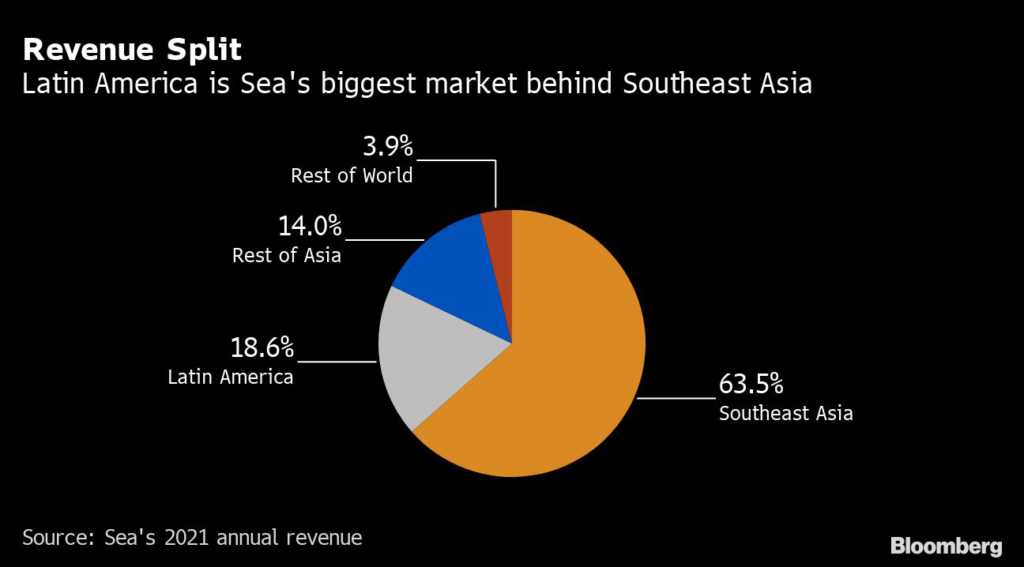
Latin America is Sea’s most important region after Southeast Asia, accounting for almost 19% of its revenue in 2021. Shopee expanded into Mexico, Chile and Colombia just a year ago — two year of going into Brazil — banking on the region’s rising population of young, mobile-savvy users.

Shopee’s second-quarter revenue in Brazil, its core market in Latin America, rose more than 270% from a year earlier. The service also ranked first by average monthly active users in the shopping category in Brazil, Sea said in its quarterly earnings report, citing analysis from data.ai.

More stories like this are available on bloomberg.com

©2022 Bloomberg L.P.

India’s Top Conglomerate in Talks to Join Club of iPhone Makers

(Bloomberg) — Tata Group is in talks with a Taiwanese supplier to Apple Inc. to establish an electronics manufacturing joint venture in India, seeking to assemble iPhones in the South Asian country.

The discussions with Wistron Corp. are aimed at making Tata a force in technology manufacturing, and the Indian salt-to-software conglomerate wants to tap the Taiwanese company’s expertise in product development, supply chain and assembly, people with knowledge of the matter said. If successful, the pact could make Tata the first Indian company to build iPhones, which are currently mainly assembled by Taiwanese manufacturing giants like Wistron and Foxconn Technology Group in China and India.

An Indian company making iPhones would be a massive boost for the country’s effort to challenge China, whose dominance in electronics manufacturing has been jeopardized by rolling Covid lockdowns and political tensions with the US. It could also persuade other global electronics brands to consider assembly in India to reduce their reliance on China at a time of increasing geopolitical risks.

The structure of the deal and details such as shareholdings are yet to be finalized, and talks are ongoing, the people said, declining to be named as the conversations are private. The plan could entail Tata buying equity in Wistron’s India operations or the companies could build a new assembly plant, one of the people said. They could also execute both those moves, the person said.

It wasn’t immediately clear if Apple was aware of the talks, which come at a time the US tech giant is looking to diversify more production away from China and deepen its supply chain in India. Apple is known to work with local companies in regions where it sets up manufacturing bases — but assembling iPhones is a complicated task that entails meeting the US company’s tight deadlines and quality controls.

A Wistron representative declined to comment. Tata and Apple didn’t respond to requests for comment.

The new venture aims to eventually increase the number of iPhones assembled by as much as five times from what Wistron currently builds in India, one of the people said. A partnership would also likely result in Mumbai-based Tata obtaining a share of Wistron’s manufacturing business beyond smartphones, the people said.

Tata Group Chairman Natarajan Chandrasekaran has said electronics and high-tech manufacturing are key focus areas for the company, India’s top conglomerate with revenue of about $128 billion. Industries such as software, steel and cars account for much of Tata’s business, but it has taken early steps in the smartphone supply chain by starting to manufacture iPhone chassis components in southern India.

For Wistron’s Indian business, struggling with losses, a pact with Tata would give it a formidable local partner with deep pockets. Tata’s reach also spans automobiles including electric vehicles, an area many of the world’s tech giants are eager to expand in.

Wistron began making iPhones in India in 2017, after years of efforts by Apple to add manufacturing capabilities in the country. The Taipei-based company currently assembles iPhones at its plant in the state of Karnataka in southern India.

The promise of India’s 1.4 billion-strong consumer market and Prime Minister Narendra Modi’s financial incentives for tech production have driven Apple’s other key contract manufacturers Foxconn and Pegatron Corp. to also expand in the country. Still, India’s workforce and factories haven’t easily adopted the highly controlled practices that Apple requires from suppliers: Since iPhone assembly began in India five years ago, workers have revolted over salaries and substandard living and working conditions in two prominent incidents.

More stories like this are available on bloomberg.com

©2022 Bloomberg L.P.

Close Bitnami banner
Bitnami