Bloomberg

Fashion Startup Pomelo Cuts 8% of Staff as Asia Layoffs Spread

(Bloomberg) — Thai e-commerce startup Pomelo Fashion Pte is cutting staff across its functions, joining other tech firms downsizing this year in a bid to withstand an economic slowdown.

The online fashion retailer cut about 55 employees, or 8% of its headcount, it said in a statement on Thursday in response to queries by Bloomberg News. The company said it streamlined its processes “to move toward more sustainable growth.”

The Bangkok-based startup is in the midst of raising external capital and has engaged banks including Morgan Stanley to help with the effort, according to people familiar with the matter. The startup in August secured about $10 million from existing investors including Jungle Ventures, regulatory filings showed, and has raised a total of at least $83 million from investors that also include JD.com Inc. and Provident Growth Fund.

Representatives for Pomelo and Morgan Stanley declined to comment on the fundraising effort.

Pomelo is joining peers in the region trying to reduce cash burn as investors become less willing to bankroll growth without profits. Launched in 2013, Pomelo sells clothing and accessories online and in its retail stores in Thailand, Singapore, Indonesia and Malaysia, according to its website.

Many of Southeast Asia’s e-commerce companies are facing slower growth as macroeconomic conditions sour and consumers pull back on spending amid rising inflation. Sea Ltd.’s commerce arm Shopee in June made its first major job cuts and is scaling back its overseas footprint. The Singapore-based giant has lost almost $170 billion of its market value since an October high on questions about its money-making prospects.

More stories like this are available on bloomberg.com

©2022 Bloomberg L.P.

Tesla Evaluating Lithium Refinery in Texas, Seeks Tax Breaks

(Bloomberg) — Tesla Inc. is plotting a potential lithium refinery on the gulf coast of Texas.

The electric-car maker has told the state it is considering constructing a “battery-grade lithium hydroxide refining facility,” in Nueces County, which it has pitched as “the first of its kind in North America,” according to a newly-public application for tax breaks filed with the Texas Comptroller’s Office.

If built, Tesla has told the state that the facility would process “raw ore material into a usable state for battery production” and that the resulting lithium hydroxide it creates would be “packaged and shipped by truck and rail to various Tesla battery manufacturing sites supporting the necessary supply chain for large-scale and electric vehicle batteries.”

Tesla also said the process it will use is “innovative and designed to consume less hazardous reagents and create usable by-products compared to the conventional process.” 

Construction could begin as soon as the fourth quarter of 2022, but wouldn’t reach commercial production until the fourth quarter of 2024. Tesla has told the state that the facility could be located “anywhere with access to the Gulf Coast shipping channel,” but that the company is evaluating a competing site in Louisiana.

Tesla didn’t immediately respond to a request for comment.

Tesla’s Chief Executive Officer Elon Musk has spent much of the last year agitating for rapid development in lithium mining in North America, comparing the opportunity to the fat margins typically made in the software industry.

“I’d like to once again urge entrepreneurs to enter the lithium refining business. The mining is relatively easy, the refining is much harder,” Musk said on Tesla’s second-quarter earnings call in July. “You can’t lose, it’s a license to print money.”

Dozens of projects are underway to add similar plants in other nations, including developments in Germany and Australia, which began production at a first refinery earlier this year. Albemarle Corp., the world’s top lithium producer, is planning to build a new processing site in the southeastern US.

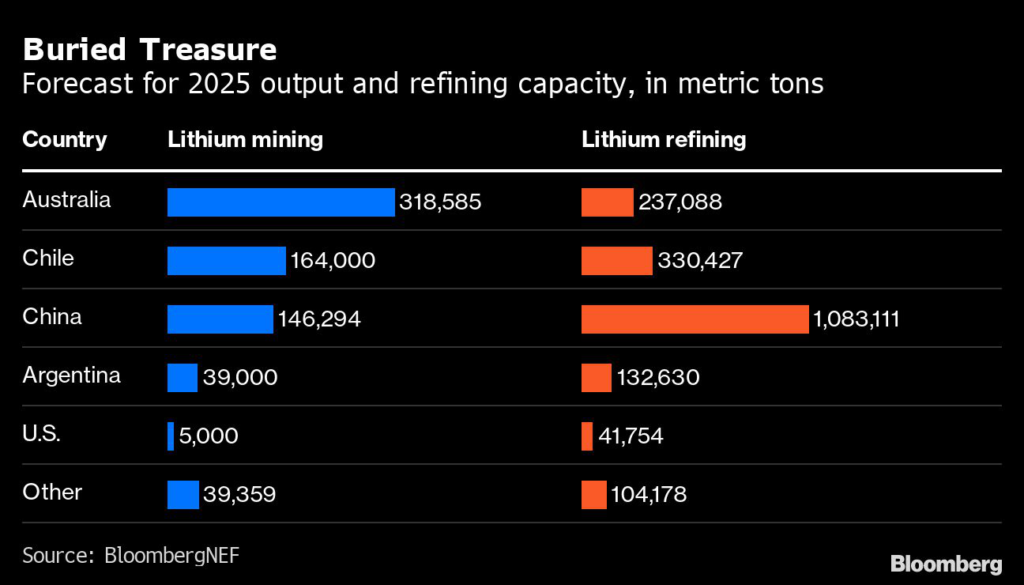
China currently dominates lithium refining and has more than half of global capacity to process raw materials harvested at mines or from salt-rich underground brines into the specialist chemicals used in EV batteries.

A lithium mining facility would be just the latest addition to Musk’s growing Texas empire. Beyond the new automotive factory in Austin that started production this year, Musk has built out a massive rocket prototyping and launch facility in Boca Chica, Texas. His tunneling outfit, The Boring Company, is also pursuing numerous projects across the state. 

Tesla has previously applied for permits to make similar battery materials adjacent to its Austin factory, though the current status of the project is unclear.

More stories like this are available on bloomberg.com

©2022 Bloomberg L.P.

How the Royal Family Used Twitter to Tell the World the Queen Had Died

(Bloomberg) — Queen’s Elizabeth II’s death after 70 years on the throne was announced first on Twitter — from the Royal Family’s own account. 

A tweet stating the long-serving monarch had “died peacefully at Balmoral” was posted by @RoyalFamily at 6.30 p.m. local time, two minutes ahead of the BBC’s own announcement on the platform.

That Twitter was chosen as the initial vector for the news shows how much the family’s approach to communication has morphed, especially in the latter years of the Queen’s reign. Known for their use of pomp and ceremony to reinforce the power of the monarchy, the Windsors have become savvy users of social media, with King Charles III and his wife Camilla, who is expected to take on the title of Queen Consort, regulars on Twitter and Facebook. The tweet came alongside a raft of more traditional protocols surrounding the monarch’s death, plans for which have been a closely guarded secret for decades. A Guardian report in 2017 said news of the Queen’s death would first be relayed to the UK prime minister via the coded message “London Bridge is down,” before an announcement made via a “newsflash to the Press Association and the rest of the world’s media simultaneously.”

Retweeted more than 650,000 times and garnering more than 2 million “likes,” the post was just the first step in a carefully choreographed 10-day mourning period that will include the suspension of parliament, a public holiday and a state funeral at Westminster Abbey. 

How the world found out Queen Elizabeth had died(All timings in UK local time)

12:32 p.m.   Statement issued by Buckingham Palace to media on concerns about health of the Queen

12:34 p.m.   Royal Family Twitter account posts statement on the Queen being put under medical supervision due to health concerns

12:37 p.m.   UK Prime Minister Liz Truss tweets that her thoughts are with the Queen and her family

12:55 – 56 p.m.   BBC News reports that members of the Queen’s family including Prince Charles and Prince William are traveling to Balmoral

4:30 p.m.   UK Prime Minister Liz Truss is informed of the Queen’s death

6:30 p.m.   Royal Family Twitter account publicly announces the Queen has “died peacefully”

6:31 p.m.   Press Association posts Buckingham Palace’s statement on Twitter

6:32 p.m.   BBC News announces on Twitter the death of the Queen

7:04 p.m.   King Charles III makes statement on his mother’s death via the Royal Family Twitter account

More stories like this are available on bloomberg.com

©2022 Bloomberg L.P.

Battery Maker CALB Wins Nod for $2 Billion Hong Kong IPO

(Bloomberg) — CALB Co., a Chinese battery supplier for electric vehicle makers, has received approval from the Hong Kong stock exchange for an initial public offering, according to people familiar with the matter.

The Jiangsu-based company received the green light following a hearing Thursday with the Hong Kong bourse’s listing committee, according to the people, who asked not to be identified because the information is private. It plans to start gauging investor demand for the offering as soon as next week, the people said. 

CALB is considering seeking as much as $2 billion including an over-allotment option, people familiar with the matter have said. It could be among the biggest in Hong Kong this year, in a group led by China Tourism Group Duty Free Corp.’s $2.1 billion listing, according to data compiled by Bloomberg.

Several expected large IPOs including private equity firm PAG and insurer FWD Group Holdings Ltd. are looking to 2023 rather than try to launch in the autumn, Bloomberg News has reported.  

Deliberations are ongoing, and details such as the fundraising amount and timing could still change, the people said. An external representative for CALB declined to comment.

Electric vehicle-related companies are drawing investor interest even amid concerns about a global recession and stringent Covid-19 containment measures in China, where EVs claim a rapidly growing share of the automotive market. Tianqi Lithium Corp., China’s biggest lithium miner, saw its first-half net income skyrocket by almost 12,000% from a year earlier to a record 10.3 billion yuan ($1.5 billion). It raised $1.7 billion in a Hong Kong listing in July.

Established in 2007, CALB makes lithium batteries for electric vehicles and other products. It operates major production bases in China, including Changzhou, Xiamen and Wuhan, according to its website. The company ranked sixth by sales in global EV battery market in July, overtaking South Korea’s Samsung SDI Co., according to data released by Seoul-based SNE Research this week.

A New Chinese EV Battery Giant Has Emerged: Anjani Trivedi

Huatai International Ltd. is the sole sponsor of CALB’s Hong Kong IPO.

(Adds global EV battery market rankings in seventh paragraph.)

More stories like this are available on bloomberg.com

©2022 Bloomberg L.P.

Chip Delivery Times Shrank in August, But Some Shortages Drag On

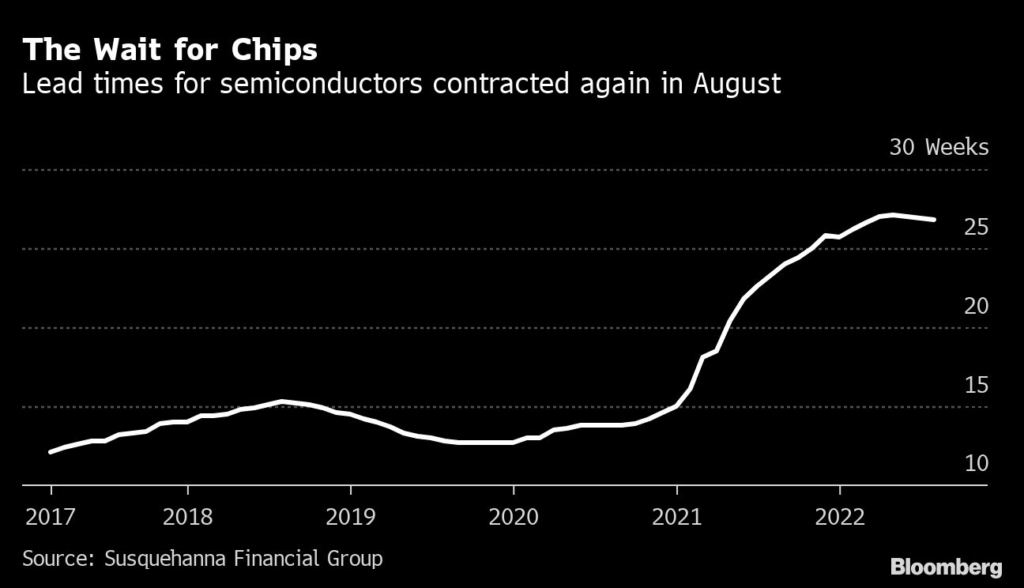
(Bloomberg) — Chip delivery times shrank again in August, a sign the global shortage is easing further, but some types of semiconductors remain hard to find.

Lead times — the gap between when a chip is ordered and when it is delivered — averaged 26.8 weeks in August, according to research by Susquehanna Financial Group. That was a day shorter than they were in the prior month. 

The shorter wait times reflect slowing demand for some kinds of technology — namely, phones and personal computers — according to Susquehanna analyst Chris Rolland. But parts of the market remain overheated, with orders coming in faster than chipmakers can fill them.

“We believe over-ordering trends and inventory builds have yet to work through the system,” he said in a research note.

In the personal computer market, the supply chain has largely returned to normal operations, Dell Technologies Inc. Chief Financial Officer Tom Sweet said Thursday. Many component costs are getting cheaper as availability has improved and demand has weakened, though Dell is working on clearing its inventories before being able to take advantage of more favorable component prices, Sweet said. 

The chip industry often struggles to match supply with demand, partly because the components take months to manufacture. Semiconductor makers also are serving a much larger swath of the economy these days, with chips going into cars, factory equipment and appliances.

In the past, investors have viewed extended lead times as a sign that the industry was building up too much inventory — a precursor to a slump. But the supply chain disruptions caused by the pandemic created unprecedented shortages. Getting back down to 10- to 14-week wait times would be “healthy,” Rolland said.

The wait for some power management, microcontroller and optoelectronic devices remains extended, Rolland said. Companies such as Microchip Technology Inc. and Infineon Technologies AG are still scrambling to fill those kinds of orders.

Other chipmakers, though, are already suffering from a drop-off in demand. That includes Nvidia Corp. and Intel Corp., which rely heavily on the PC market.

Chip investors have already been bracing for a steep downturn. The Philadelphia Stock Market Semiconductor Index has fallen 33% this year.

(Updates with Dell CFO comments in fifth paragraph)

More stories like this are available on bloomberg.com

©2022 Bloomberg L.P.

Twitter Paid Whistle-Blower $7 Million for Silence, Lawyer Says

(Bloomberg) — Twitter Inc. paid a whistle-blower who raised questions about operational problems within the social media platform $7 million to secure his silence, according to a lawyer for Elon Musk.

The payment was mentioned in passing at a Sept. 6 hearing in the lawsuit between Twitter and Musk over his attempts to cancel a $44 billion purchase of the company. “They’re paying the guy $7 million and making sure he’s quiet,” Musk attorney Alex Spiro said at the hearing. People familiar with the matter confirmed the reference was to a payment to whistle-blower Peiter Zatko.

Twitter representatives Thursday declined to comment about the payment to Zatko, the company’s former head of security. The Wall Street Journal reported the payment Thursday. The newspaper, citing unidentified people familiar with the matter, said the payment was part of a settlement related to Zatko’s lost compensation after leaving Twitter. The deal didn’t let Zatko speak publicly, but would allow him to act as a government whistle-blower about his time at the social medial company, the Journal reported, citing the people familiar.

Musk walked away from his acquisition of Twitter after claiming the platform misled him and investors about the number of spam and bot accounts among its more than 230 million users. Twitter counters that Musk’s bot concerns are a pretext to get out of a deal in which the world’s richest person allegedly developed buyer’s remorse.

Both sides are gearing up for an October trial of Twitter’s lawsuit to force Musk to consummate the deal. Delaware Chancery Judge Kathaleen St. Jude McCormick on Wednesday approved Musk’s bid to add Zatko’s allegations to his counterclaims. But she denied his bid to delay the trial.

The billionaire argues Zatko raised concerns about the number of bots embedded in Twitter’s customer base along with allegations of lax computer security and privacy issues before being fired from the social media platform. Musk contends Zatko’s claims bolster his arguments that he legitimately nixed the deal.

During their argument to McCormick, Twitter’s lawyers took aim at Zatko’s credibility, dismissing his complaints as being motivated to harm the company he was fired from and not credible.

Spiro defended Zatko by saying the whistle-blower didn’t just take his money and leave his issues with Twitter behind. Instead, he approached Congress and regulators with his complaints. Zatko is scheduled to testify before a Senate committee next week and has been subpoenaed to testify in the Twitter lawsuit, as well.

“The problem is that they paid him $7 million,” Spiro told the judge. “The problem is that if he really wanted money, then how come he’s still doing this if he doesn’t want justice also.”

The case is Twitter v. Musk, 22-0613, Delaware Chancery Court (Wilmington).

More stories like this are available on bloomberg.com

©2022 Bloomberg L.P.

Google Pays ‘Enormous’ Sums to Maintain Search-Engine Dominance, DOJ Says

(Bloomberg) — Alphabet Inc.’s Google pays billions of dollars each year to Apple Inc., Samsung Electronics Co. and other telecom giants to illegally maintain its spot as the No. 1 search engine, the US Justice Department told a federal judge Thursday.

DOJ attorney Kenneth Dintzer didn’t disclose how much Google spends to be the default search engine on most browsers and all US mobile phones, but described the payments as “enormous numbers.” 

“Google invests billions in defaults, knowing people won’t change them,” Dintzer told Judge Amit Mehta during a hearing in Washington that marked the first major face-off in the case and drew top DOJ antitrust officials and Nebraska’s attorney general among the spectators. “They are buying default exclusivity because defaults matter a lot.”

Google’s contracts form the basis of the DOJ’s landmark antitrust lawsuit, which alleges the company has sought to maintain its online search monopoly in violation of antitrust laws. State attorneys general are pursuing a parallel antitrust suit against the search giant, also pending before Mehta.

A trial isn’t expected to start formally until next year, but Thursday’s hearing was the first substantive one in the case — a daylong tutorial where each side laid out its views on Google’s business. 

The Google antitrust suit, filed in the waning days of the Trump administration, was the federal government’s first major effort to rein in the power of the tech giants, which continues under President Joe Biden. The White House Thursday hosted a roundtable with experts to explore the harm major tech platforms can wreak on the economy and children’s health. 

Google’s attorney John Schmidtlein said the DOJ and states misunderstand the market and focus too narrowly on smaller search engine rivals like Microsoft Corp.’s Bing and DuckDuckGo. Instead, Google faces competition from dozens of other companies, he said, including ByteDance Ltd.’s TikTok, Meta Platforms Inc., Amazon.com Inc., Grubhub Inc. and additional sites sites where consumers go to search for information.

“You don’t have to go to Google to shop on Amazon. You don’t have to go to Google to buy plane tickets on Expedia,” he said. “The fact that Google doesn’t face the same competition on every query doesn’t mean the company doesn’t face tough competition.”

Having fresh data on user search queries is key to a search engine’s success, lawyers for DOJ, the states and Google all agreed. Google controls the most popular browser, Chrome, and the second-most popular mobile operating system, Android. 

In his presentation, DOJ’s Dintzer focused on the mechanics of Google’s search engine and how its default contracts have hemmed in potential rivals. On mobile, Google contracts with Apple, smartphone makers like Samsung and Motorola Solutions Inc., most browsers and the three US telecom carriers — AT&T Inc., Verizon Communications Inc. and T-Mobile US Inc. — to ensure its search engine is set as the default and comes preinstalled on new phones, Dintzer said. Microsoft’s search engine, Bing, is the default on the company’s Edge browser and Amazon’s Fire tablets, he said. 

Google’s contracts make it the “gateway” by which most people find websites on the internet, which has allowed it to prevent rivals from gaining the scale that would be needed to challenge its search engine, Dintzer said.

“Default exclusivity allows Google to systemically deny rivals’ data,” he said.

Google’s Schmidtlein said the company has contracted with Apple and browsers like Mozilla since the early 2000s. DOJ and the states haven’t explained why those deals are now problems, he said. The revenue-sharing deals that Google offers to browsers are essential to companies like Mozilla Corp., he said, because they offer their products to users for free. 

“The reason they partner with Google isn’t because they had to; it’s because they want to,” Schmidtlein said. The company “had extraordinary success and was doing something incredibly valuable. Competition on the merits is not unlawful.”

The case is US v. Google, 20-cv-3010, US District Court, District of Columbia (Washington).

More stories like this are available on bloomberg.com

©2022 Bloomberg L.P.

Orbiting Space Junk Must Be Swept Up in Five Years Under US Plan

(Bloomberg) — US regulators concerned with a proliferation of orbiting space junk amid a new generation of thousands of satellites are poised to require a quicker cleanup of defunct spacecraft.

Operators will need to bring satellites down from orbit within five years of the crafts’ ending service, compared with the current requirement of 25 years, under a proposal issued Thursday by Federal Communications Commission Chairwoman Jessica Rosenworcel. The matter faces a Sept. 29 vote at the agency and is expected to pass.

“Orbital debris poses a significant risk to our nation’s space ambitions,” the FCC said in its proposed order. With more than 4,800 satellites operating, “there are many more to come.”

Defunct satellites, discarded rocket cores, and other debris now fill the space environment creating challenges for future missions, the FCC said.


More stories like this are available on bloomberg.com

©2022 Bloomberg L.P.
GameStop’s FTX Partnership Draws Wave of Retail Trader Buying

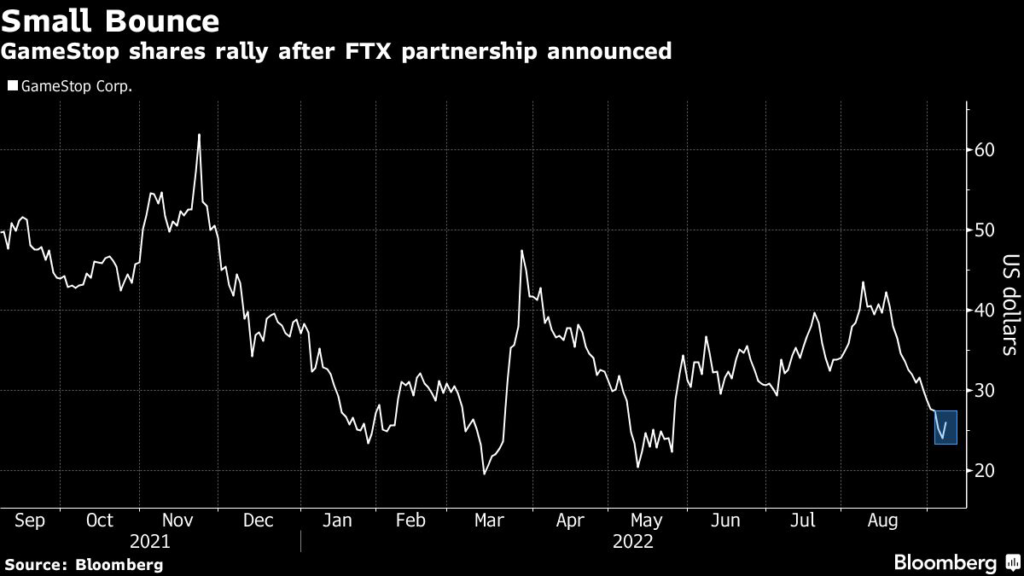
(Bloomberg) — GameStop Corp.’s partnership with Sam Bankman-Fried’s FTX US cryptocurrency exchange is fueling a flurry of buying from retail investors who are pumping their bets on popular social media.

Individual investors flocked to the video-game retailer on Thursday, making it the third-most purchased stock on Fidelity’s platform with buy orders outpacing those to sell at a more than two-to-one clip. The stock closed 7.5% higher with more than 14 million shares changing hands.

Details surrounding the partnership were relatively scarce outside of GameStop saying it wants to introduce more of its customers to FTX’s marketplaces and that it will sell FTX gift cards in some stores. The retailer reported quarterly results that mostly missed expectations, with net sales falling from the prior year and trailing analyst estimates.

The excitement for retail traders was not shared by Wall Street as analysts urged caution before piling into bets on the meme stock’s turnaround. Wedbush analysts are “skeptical that the partnership will drive meaningful revenue or profit contribution.” While Jefferies analyst Stephanie Wissink said the retailer’s unclear long-term growth prospects “remain a key source of speculation and debate.”

GameStop is among a group of so-called meme stocks that captivated individual investors armed with no-fee trading apps amid unprecedented monetary and fiscal stimulus. The mania led retail traders to bet millions on the prospects of heavily-shorted companies as they teamed up using social media platforms like Reddit’s WallStreetBets and popular chatrooms including Stocktwits to fuel massive rallies. 

GameStop’s ticker was the number-one trending company on Stocktwits while mentions on WallStreetBets made it the most mentioned over the morning as individuals discussed the FTX partnership. Even with Thursday’s rally, investors are likely sitting on big losses with GameStop shares down roughly 48% over the past year.

(Updates with closing prices.)

More stories like this are available on bloomberg.com

©2022 Bloomberg L.P.
Wells Fargo Media, Telecom Investment Bankers Leave to Join Truist

(Bloomberg) — A trio of Wells Fargo & Co. investment bankers resigned from the San Francisco-based lender to join Truist Financial Corp., according to people with knowledge of the matter.

The group includes head of media and telecom corporate and investment banking Bruce Levy as well as managing directors John Schwarz and Abhishek Kedia, said the people, all of whom requested anonymity as the move hasn’t been made public. Levy’s direct reports will now be overseen by Steven Macko, Wells Fargo’s head of technology, media and telecom corporate and investment banking, one of the people said. 

“We have a deep bench of talent in our TMT group, and we look forward to continuing to work closely with our media and telecom clients,” a Wells Fargo spokeswoman said in an emailed statement. A representative for Truist declined to comment.

Levy worked at Wells Fargo and its predecessor firms Wachovia Securities and First Union Capital Markets since 1988, according to Finra records and his LinkedIn profile. He has covered traditional media companies including television and radio broadcasters, among others. Schwarz joined Wells Fargo in 2007 after working at Lazard Ltd. and Merrill Lynch, among other firms, Finra records show. Kedia, who began his career at Wells and left for a stint at Jefferies Financial Group Inc., rejoined the firm in 2012, Finra records show. 

Truist, based in Charlotte, North Carolina, has recently made a slew of senior hires within its investment bank, led by Royal Bank of Canada alum Michael Carter. The firm’s hiring of the Levy-led team follows the exit of William Drewry, former head of internet, media and entertainment investment banking at Truist, who joined Rockefeller Capital Management. 

Read more: Truist Hires From Credit Suisse, UBS to Bolster Investment Bank

More stories like this are available on bloomberg.com

©2022 Bloomberg L.P.

Close Bitnami banner
Bitnami