

Bloomberg

Coinbase Is Helping Sue The US Treasury Over Tornado Cash Sanctions

(Bloomberg) — Coinbase Global Inc., the biggest US cryptocurrency exchange, has helped organize and is paying the costs of a lawsuit against the Treasury Department over its sanctions of coin mixer Tornado Cash.

The lawsuit, filed Thursday by six individuals including two Coinbase employees, claims Treasury overstepped its authority to block financial transactions benefiting foreign terrorists. It alleges that the department, perhaps unintentionally, ensnared law-abiding Americans conducting legitimate digital commerce through a cryptocurrency service that offers enhanced privacy and security.

“None of the plaintiffs is a terrorist or a criminal,” lawyers for the Tornado Cash customers said in the complaint, filed in federal court in Waco, Texas. “None supports terrorism or illegal activity. None launders money. Each is an American who simply wants to engage in entirely lawful activity in private.”

On Aug. 8, Treasury’s Office of Foreign Assets Control (OFAC) accused Tornado, a service that makes it harder to trace coins, of laundering more than $7 billion of cryptocurrencies since its creation in 2019. The agency sanctioned crypto wallets associated with Tornado Cash, as well as related code known as smart contracts. 

Risk to Industry

OFAC’s move is likely unprecedented and could hobble the crypto industry, which is built largely on smart contracts, said Paul Grewal, Coinbase’s chief legal officer and a former magistrate judge in the Northern District of California.

“Neutral technologies and tools are not within the sanctions law as has been written by Congress,” Grewal said in an interview. “Just because armed robbers used a highway doesn’t mean the highway should be banned. We felt compelled to act.” Coinbase is complying with the sanctions, the company said.

Neither the Treasury Department nor the Justice Department responded to requests for comment on the suit.

In his tweets and retweets, Coinbase Chief Executive Officer Brian Armstrong had indicated his opposition to the sanctions and had hinted at legal action to come. In September, he retweeted a post by Coinbase board member Katie Haun examining possible grounds on which to fight the OFAC action, such as the Fourth Amendment, which protects people against unreasonable searches and seizures. He also tweeted that his company may consider mounting a legal challenge or exiting a business if regulators continue to push for censorship. 

After the sanctions were announced, Coinbase talked to OFAC about reversing its decision, to no avail, Grewal said. It then reached out to its employees and found several who were affected by the Tornado sanctions, he said. One of them used Tornado in sending a donation to Ukraine, and now has some funds locked in the service, according to the lawsuit. 

Trapped Funds

“We have no issue with the Treasury sanctioning bad actors and we take a hard stance against unlawful behavior,” Armstrong said in a blog post. “But in this case, Treasury went much further and took the unprecedented step of sanctioning an entire technology instead of specific individuals.” He said the technology has “legitimate applications” and that “many innocent users now have their funds trapped and have lost access to a critical privacy tool.”

Coinbase believes Treasury’s action “threatens the future of decentralized finance (DeFi) and web3 specifically,” Armstrong wrote. Web3 is a version of today’s internet built largely on crypto technology in which ownership and control are more widely distributed.

Tyler Almeida, a Coinbase senior security risk analyst and the employee who used Tornado to send a donation to Ukraine, now has some funds locked in the service, according to the lawsuit. He used the anonymous service to shield his digital identity from Russian hackers who might retaliate. Shortly after his donation, he said his wallet was bombarded anyway with airdrops of possibly malicious nonfungible tokens, which can act like email spam.

The other Coinbase employee among the plaintiffs is Nate Welch, who manages customer deposits and withdrawals in the company’s crypto wallet. Welch uses other crypto privacy tools but prefers Tornado because it has “the highest volume of users and transactions, which ensures greater anonymity by making it more difficult to trace particular Ether to particular users,” according to the complaint. Ether is a digital token.

Award-Winning Coder

Coinbase rounded up other affected Tornado users — one of whom lives in Texas, where the lawsuit was filed — to join the complaint. Several, such as Alexander Fisher, are well known in the crypto sector, leaving them vulnerable to hackers and other threats.

Fisher, Ford Motor Co.’s former corporate webcasting leader, co-wrote award-winning proof-of-concept software code using Tornado’s open-source code and now manages Ethereum-focused blockchain and decentralized application infrastructure. He said he prefers transacting digitally on Tornado because bad actors have utilized public data sources and identifying information from his Twitter account to locate his crypto wallet addresses, according to the lawsuit.

The Coinbase-sponsored challenge, which also names Treasury Secretary Janet Yellen and OFAC Director Andrea Gacki, seeks a court order permanently preventing Treasury from including Tornado Cash on its sanctioned list. The plaintiffs contend Tornado can’t be sanctioned because the agency’s Specially Designated Nationals and Blocked Persons List applies only to property or to foreign countries or foreign nationals that threaten America’s national security.

Tornado’s customers also claim the sanctions violate their First Amendment right to speak freely and donate to “important and potentially controversial political and social matters.” In addition, Treasury’s move violates the plaintiffs’ Fifth Amendment due-process rights by freezing their digital assets within Tornado Cash, according to the complaint.

The case is Joseph Van Loon et al. v. Department of the Treasury, 22-cv-920, US District Court, Western District of Texas (Waco).

(Adds excerpt of Armstrong’s published blog post and paragraph on second Coinbase-employee plaintiff in third section.)

More stories like this are available on bloomberg.com

©2022 Bloomberg L.P.

Mercedes Van Deal With Rivian Opens Door to Broader Partnership

(Bloomberg) — Mercedes-Benz AG and Rivian Automotive Inc. plan to jointly build electric vans in Europe, a potential win-win that could lead to further collaboration as an established manufacturer looks to share costs and an inexperienced company struggles to scale up.

The two will invest in and operate a new assembly plant at an existing Mercedes facility in central or eastern Europe that will begin production in “a few years,” according to a statement. The companies didn’t release details of the 50-50 joint venture, including investment figures.

“We will both benefit significantly from this,” Mathias Geisen, who heads Mercedes’s vans business, told reporters, adding the move would help the partners shoulder the multibillion-euro cost of scaling up electric-van manufacturing.

Automakers are increasingly looking to share the bill of developing and producing EVs as they retool factories and overhaul model lineups to catch up with Tesla Inc. The partnership pairs Rivian, which counts Amazon.com Inc. and Ford Motor Co. among its largest shareholders, with one of the world’s most seasoned vehicle makers.

The Mercedes plant in Kecskemet, Hungary, is likely to be on the shortlist for the joint factory. The plant, opened in 2012, currently makes entry Mercedes-Benz cars such as A-Class, B-Class and C-Class models. The manufacturer plans to lower the production of such vehicles as part of its strategy of shifting to higher-end models.

Geisen, who led corporate strategy for both Mercedes and Daimler before taking over the van business at the start of this year, didn’t rule out a broader collaboration in other regions, such as the US. 

“We start setting up this factory and then we see how it goes,” he said. “I wouldn’t say that’s impossible that that happens. I’d say, ‘Let’s get it started and take it from there.’”

Rivian rose as much as 10% in New York. The shares are still down some 66% this year. Mercedes declined 1.9% in Frankfurt.

Production Challenges

After its blockbuster debut in late 2021, Rivian has struggled with production woes, high costs and economic volatility. The company briefly halted work at its Normal, Illinois, plant at the beginning of this year for fixes and process improvements aimed at helping increase output. 

Lingering supply-chain issues and elevated raw-material expenses have disrupted operations, leading Rivian recently to trim its full-year earnings expectations. It said last month that boosting production remains its primary focus, though supply-chain constraints would be the limiting factor. The startup has been looking at options for a manufacturing site in Europe since early last year, Bloomberg has reported.

For Mercedes, the search for a partner was driven in part by the unpredictable pace of electric-vehicle adoption in the European van market, which makes it more difficult to be profitable, Geisen said. 

Mercedes delivered just over 334,000 vans last year. Rivian, which makes the R1T pickup and R1S sport utility vehicle along with the vans, expects to manufacture 25,000 EVs this year.

Rivian has agreed to supply 100,000 electric delivery vans to Amazon by 2030. The tech giant also currently uses combustion-engine vans from Mercedes and other manufacturers.

Read more: How Amazon Put Rivian on the Map and Will Shape Its Future

Mercedes also said that it plans to adapt its European production network for large vans as the cost pressures from making battery vehicles undermine competitiveness. This will see an established plant from the Mercedes production network in eastern Europe — where production costs are lower — become part of van-making operations. Discussions on the plan between management and employee representatives in Germany will start shortly, according to a separate statement.

By the middle of this decade, all new Mercedes van models, including mid-size and small vans, will be electric-only, the company said.

More stories like this are available on bloomberg.com

©2022 Bloomberg L.P.
TalkTalk Opens £600 Million in Business Contracts to BT Rivals

(Bloomberg) — TalkTalk Telecom Group Ltd will invite rival networks to provide connectivity for its wholesale business contracts, marking another challenge to former state telecom monopoly BT Group Plc, which currently holds most of the work.

BT’s infrastructure arm provides almost all of the underlying network, but in an effort to inject more competition into the market, Salford, England-based internet service provider TalkTalk is asking BT’s network rivals to step in and make offers against it, according to a spokeswoman.

TalkTalk’s wholesale clients make up more than a third of its revenue, worth £600 million ($689 million). 

It’s another step up in the wider competition with BT’s infrastructure as so-called alternative networks or “alt-nets” build thousands of new fiber optic lines. The 14 regional contracts up for grabs could go to the likes of Virgin Media O2, which is owned by Liberty Global Plc and Telefonica SA. VMO2 has also held exploratory talks to acquire TalkTalk, according to people familiar with the matter.

TalkTalk said it has more than 25% market share in the UK’s high-speed ethernet market, following the acquisition of rival Virtual1 earlier in the year.

More stories like this are available on bloomberg.com

©2022 Bloomberg L.P.
BofA Says Small Caps Cheaper Than Since the Dot-Com Bubble

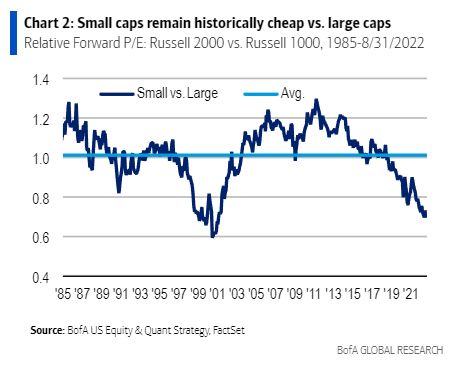
(Bloomberg) — August’s broad equity selloff has left valuations for beaten down small-cap shares at the cheapest level compared to their larger counterparts in nearly two decades, according to Bank of America Corp.

At 12 times projected earnings, the Russell 2000 Index of small-cap stocks is cheaper than even its historical averages, BofA data show. In fact, the relative forward price-to-earnings ratio for the index versus the Russell 1000 Index of large caps fell to 0.70 times from 0.71 times, more than 30% below its historic average of 1.01 times. That remains at the lowest level since the early 2000s dot-com bubble.

Read more: Huge Gains Tend to Follow Small-Cap Losing Streaks: Taking Stock

The small-cap valuations could offer evidence of a market bottom since historically, broader markets don’t bounce higher until small-cap stocks bottom. For long-term traders, current valuations for the small-cap index imply about 12% annualized returns over the next decade, compared with about 8% for the Russell 1000, BofA data show. 

The Russell 2000’s forward price-to-earnings ratio fell to 11.8 times from 12.4 times, which is more than 20% below its long-term average since 1985, according to Jill Carey Hall, equity and quantitative strategist at Bank of America. 

“Very elevated valuation dispersion within the Russell 2000 overall — which can suggest more opportunity for stock selection  — is also supportive for value near-term,” Carey Hall wrote in a note to clients.

Value stocks, which were challenged in a low-rate environment, have come back in vogue this year as growth shares have been pressured by higher borrowing costs, which drag on the present value of future cash flows. Since 1989, prior peaks in valuation dispersion have coincided with Russell 2000 Value Index outperforming Russell 2000 Growth Index over the next three months nearly 70% of the time. 

In particular, there is “lots of opportunity” for small-cap value investors, Carey Hall said. Energy, for instance, ranks among the best sectors in BofA’s small-cap sector rankings based on valuations, revisions, technicals and the bank’s analyst upgrades-downgrades. The group also remains one the most historically inexpensive sectors versus history and against its large-cap peers, she said.

More stories like this are available on bloomberg.com

©2022 Bloomberg L.P.

PC Supply Chains Are ‘Back to Normal,’ Dell CFO Says

(Bloomberg) — The supply chain for personal computers is back to normal after years of logistics disruptions, Dell Technologies Inc. Chief Financial Officer Tom Sweet said.

“There’s always going to be some issues in that chain, but in general from our perspective, it’s operating more like the historical norm,” Sweet said Thursday in an interview.

Many component costs are getting cheaper as availability has improved and demand has weakened. Dell is working on clearing its inventories before being able to take advantage of more favorable component prices, Sweet said. Many manufacturers are offering aggressive discounts to help clear inventory faster, mostly on consumer products, he said.

Supply chains issues for servers have been harder to shake due to semiconductor shortages, Sweet said. However, this tightness should begin to ease in the fourth quarter, he said.

Dell executives last month gave a gloomy outlook for computers and business infrastructure demand through at least the end of the year, predicting sales in the current quarter would decline year over year. Dell shares have dropped 21% in the two weeks since the company’s forecast, compared with about a 5% decline in the S&P 500.

In response to slowing demand, Dell paused most external hiring in June and has scaled back some expenses like travel, Sweet said. “There’s a lot of big macro things that we’re going to have to work our way through.”

More stories like this are available on bloomberg.com

©2022 Bloomberg L.P.

YouTube Tries Again to Break Into Education Market With New School Service

(Bloomberg) — YouTube will offer a stripped-down version of its site tailored for schools and colleges, an attempt to get a foothold in the market for digital education tools. 

The video giant plans to license this service, called Player for Education, to education technology companies, which can then filter YouTube’s enormous library with different restrictions. The service won’t run advertisements or serve video recommendations. Initially, YouTube is working with EDpuzzle Inc., Purdue University Global Inc. and Google Classroom, a product from YouTube’s parent, Alphabet Inc.’s Google.

Since the pandemic, Google has pushed deeper into education with its inexpensive Chromebooks and software. By one estimate, global edtech spending is set to rise to $404 billion by 2025. 

This isn’t YouTube’s first stab at the market. For many years, the platform lobbied classrooms to use its ample educational and how-to videos. But those prior pitches were met with concern over the popular video service’s targeted advertising and abundant non-educational material. 

YouTube said it will give all sales from its new service to creators whose videos play in classrooms for the first two years. Then YouTube will take a commission of sales. The company declined to share how much its new service will cost.

Along with the Player for Education, YouTube is introducing Courses, a feature that will let video creators offer online classes for a fee or free of charge.

More stories like this are available on bloomberg.com

©2022 Bloomberg L.P.

Apple CEO Credits Steve Jobs With Fostering Privacy Culture

(Bloomberg) — Apple Inc. Chief Executive Officer Tim Cook credited Steve Jobs with making privacy a top priority at the company and said he largely still runs the tech giant in the manner of its late co-founder.

Cook, speaking at a Code Conference panel Wednesday about Jobs’s legacy, said Apple has tried to ensure that privacy doesn’t get lost in a surveillance-driven world.

“I think he saw that and saw that well, and I have every reason to believe he would have put up good arguments and good fights along the way,” Cook said during the talk, alongside former Apple Chief Design Officer Jony Ive and Laurene Powell Jobs.

The discussion, led by journalist Kara Swisher, followed a major product launch event Wednesday morning, when the company unveiled new iPhones, AirPods and smartwatches. Privacy was a theme of that presentation as well, with Apple saying it would protect sensitive user information, such as women’s health data.

Apple has drawn outcry in the past year for tightening its rules about advertising in apps — a move social media companies have said has hurt their revenue. 

Cook said at the Code event Wednesday that “digital advertising is not a bad thing.”

“What is not good is vacuuming up people’s data” when it’s not on an informed basis, he said. “We try to put the user in the driver seat there to own their data.”

Powell Jobs, the founder of the Emerson Collective and Jobs’s widow, also announced the creation of a Steve Jobs archive, which serves as a repository for his emails, speeches and other communications.

Cook — who became CEO in 2011, the year Jobs died — said the company still holds his predecessor’s traditional weekly 9 a.m. Monday meeting with all of the top executives.

“The company is still run in many ways as Steve did,” said Cook, 61. 

Ive, who left Apple to start his own design firm in 2019, said Jobs’s focus was never selling more units. “I’ve never met somebody so curious and so inquisitive,” Ive said.

Powell Jobs recalled Jobs’s push to simplify Apple after his time away from the company. At the time, he reduced the number of offerings to just four main product lines.

“He was very concerned about the business,” she said. “He often talked about leaving behind a body of work, like an artist does.”

Jobs believed that you get a better answer by debating, “sometimes taking a position he didn’t even believe, just to get the discussion flowing,” Cook said. He was one in “a gazillion.”

(Update with details of Steve Jobs archive in eighth paragraph.)

More stories like this are available on bloomberg.com

©2022 Bloomberg L.P.
South Africa Plans Special Police Force to Combat Illegal Miners

(Bloomberg) — The South African Police Service will establish a specialized force to combat illegal mining that’s robbing the nation of revenue and hampering operations at mineral companies.

The new security force will be a “multi-disciplinary unit” between the SAPS and the Department of Mineral Resources and Energy, Gwede Mantashe, the energy, minerals and resource minister told lawmakers in Cape Town on Thursday. 

Illegal mining has long been a problem in South Africa. That’s now been coupled with thefts of equipment. The criminal activity affects vital infrastructure from railways to telecommunications to utilities, undermining President Cyril Ramaphosa’s efforts to revive the economy. The thefts and illegal mining have become increasingly lucrative with prices of metals such as copper surging.

The illegal miners are the “foot soldiers of organized crime,” and their widespread use of derelict and abandoned mines was a ‘’war on the South African economy,” Mantashe said.

More stories like this are available on bloomberg.com

©2022 Bloomberg L.P.

Stocks Push Higher After Powell’s Deja Vu Speech: Markets Wrap

(Bloomberg) — Stocks climbed after Jerome Powell’s remarks did little to alter bets on another super-sized rate hike during the Federal Reserve’s September gathering.

The S&P 500 wiped out a slide that approached 1% earlier in the day as the Fed’s boss reprised his hawkish views from the Jackson Hole conference in late August, saying officials are strongly committed to their fight against inflation. The yield of the policy-sensitive two-year note jumped by almost 7 basis points to 3.499%. Swap traders priced in odds of around four-in-five that officials will implement a 75-basis-point hike on Sept. 21 instead of just 50 basis points. 

Powell said the US central bank will not flinch in its efforts to curb inflation “until the job is done.” “We need to act now, forthrightly, strongly as we have been doing,” he noted Thursday in remarks at the Cato Institute’s monetary policy conference in Washington. “It is very important that inflation expectations remain anchored,” Powell said, adding that “what we hope to achieve is a period of growth below trend,” which will cause the labor market to get back into better balance.

“The Fed is keeping 75 basis points on the table for September, and the market is doubling down on the curve inversion,” said Ian Lyngen, head of US rate strategy at BMO Capital Markets. “The Fed’s rhetoric this week has raised the bar for a disappointment in the August inflation data to cement the chances of a 50 basis point hike.”

Europe’s bonds slid after the European Central Bank said it would remove a cap on how much interest government deposits can earn as it lifted rates above 0% for the first time in a decade. That reduces the incentive to shift billions of euros of public money from cash into short-term debt, driving a selloff that took the yield on two-year German bonds up much as 21 basis points to 1.31%.

Read: Bill Gross Is Long the Pound After Plunge With Dollar Overvalued

Seasoned investors, staring at a world clouded by war, inflation and economic uncertainty, are buying catastrophe insurance at a record clip. Institutional traders paid a total of $8.1 billion to initiate purchases of equity puts last week, the highest premium in at least 22 years, Options Clearing Corp. data compiled by Sundial Capital Research show. Adjusted for market capitalization, demand for hedges matches levels from the 2008 financial crisis.

US stocks could slide a further 25% if the economy tips into recession, with risks to a sustained equity rally mounting, according to Deutsche Bank AG strategists. With company profits set to drop, valuations still high and recession risks looming, the fundamental picture is challenging, strategists led by Binky Chadha wrote in a note dated Sept. 7. His base-case scenario still sees shares rising by year-end.

On the economic front, applications for US unemployment insurance fell for a fourth straight week to the lowest since May, suggesting demand for workers remains healthy despite an uncertain economic outlook. Meanwhile, Mortgage rates in the US climbed for the third week in a row, reaching the highest level since 2008 and squeezing affordability as the US housing slowdown deepens.

Among corporate highlights, GameStop Corp. jumped after the video game retailer announced a partnership with cryptocurrency exchange FTX US. Amylyx Pharmaceuticals Inc. surged as its controversial treatment for amyotrophic lateral sclerosis won the support of a panel of US regulatory advisers. Tesla Inc.’s China operations are back in full swing after an upgrade to its factory in Shanghai and a Covid-19 lockdown in the city slowed production earlier this year. 

Are you bullish on energy-related assets? This week’s MLIV Pulse survey focuses on energy and commodities. Please click here to participate anonymously.

Some of the main moves in markets:

Stocks

  • The S&P 500 rose 0.7% as of 11:06 a.m. New York time
  • The Nasdaq 100 rose 0.8%
  • The Dow Jones Industrial Average rose 0.6%
  • The Stoxx Europe 600 rose 0.6%
  • The MSCI World index rose 0.8%

Currencies

  • The Bloomberg Dollar Spot Index rose 0.2%
  • The euro fell 0.5% to $0.9960
  • The British pound fell 0.4% to $1.1489
  • The Japanese yen fell 0.2% to 144.01 per dollar

Bonds

  • The yield on 10-year Treasuries was little changed at 3.27%
  • Germany’s 10-year yield advanced 11 basis points to 1.69%
  • Britain’s 10-year yield advanced 10 basis points to 3.13%

Commodities

  • West Texas Intermediate crude rose 1.8% to $83.40 a barrel
  • Gold futures fell 0.5% to $1,719 an ounce

More stories like this are available on bloomberg.com

©2022 Bloomberg L.P.
Elizabeth Holmes Says Fraud Trial Unfair Because She Went First

(Bloomberg) — Theranos Inc. founder Elizabeth Holmes asked for a new trial on the grounds that she was unfairly disadvantaged by being tried before her ex-boyfriend and Theranos President Ramesh “Sunny” Balwani.

Facing a sentencing next month that could put her in prison for as much as a decade, Holmes has filed a flurry of long-shot motions in recent weeks to try to get a new trial. In a filing late Wednesday in federal court in San Jose, California, her lawyers claimed she would’ve been exonerated if Balwani had gone on trial first. 

Holmes, 38, was found guilty in January of defrauding investors and conspiracy for her role in the Theranos’s collapse. Balwani was convicted in July of similar counts, as well as defrauding patients.

At her own trial, Holmes’s defense team tried to cast Balwani as being behind any fraud at Theranos, the blood-testing startup that attracted big-name investors and reached a peak valuation of $9 billion before it emerged that its finger-prick tests didn’t work. She also claimed he was an abusive partner — which Balwani has denied.

Changing the trial order would’ve “fundamentally changed” the evidence jurors learned about Balwani’s role in the alleged misrepresentations to investors, her lawyers said.

“It would probably have resulted in an acquittal on the counts of conviction,” they argued.

In a Tuesday filing, Holmes’s lawyers also argued that a new trial was warranted because a key witness at the trial, former Theranos lab director Adam Rosendorff, visited her house last month and expressed misgivings about his testimony.

US District Judge Edward Davila already rejected Holmes’s first attempt to get her conviction thrown out on the grounds that there was insufficient evidence to convict her. 

Holmes’s lawyer on Wednesday also attempted to revive a long-simmering fight over a defunct Theranos database of patient information, which they say allowed prosecutors to misrepresent the accuracy of the company’s test results. Balwani raised a similar defense argument at his trial. 

According to Holmes’s lawyers, prosecutors only recently produced emails relating to the government’s role in allowing the database to go irretrievably dark in 2018. Prosecutors’ failure to turn over the emails cast earlier arguments “in a different light” and also warrant a new trial, Holmes argued.

The case is US v. Holmes, 18-cr-00258, US District Court, Northern District of California (San Jose).

More stories like this are available on bloomberg.com

©2022 Bloomberg L.P.

Close Bitnami banner
Bitnami
