

Bloomberg

Teenage Founder Raises $30 Million for Crypto Startup

(Bloomberg) — Instead of baking sourdough or hanging out on Zoom during the depths of the pandemic, Tate Berenbaum spent most of the time coding in his basement. There, the high schooler built developer tools for Arweave, a blockchain-like platform known for permanent data storage. At the time, he didn’t realize the results would be life-changing.

Now 19 years old, Berenbaum has raised $30 million for Community Labs, a software startup and venture studio dedicated to supporting crypto projects on Arweave. Berenbaum said in an interview that he moved to New York and has put his first year at the University of Virginia on hold as he builds out the company.

Asked about college, Berenbaum said, “At the moment, I don’t have plans to go back.”

Lightspeed Venture Partners led the funding round for Community Labs, which also included Arweave, Bain Capital Crypto and Blockchain Capital, among other investors. Berenbaum declined to disclose the startup’s valuation. 

Founded this year, Community Labs currently has eight staffers located around the world, including Berenbaum’s 38-year-old adviser and co-founder, Leo Lucisano. Berenbaum said the team is dedicated to bringing more versatility to Arweave.

Arweave is often the platform of choice for decentralized data storage. For example, Arweave is being used to archive digital records of the war in Ukraine, such as tweets and videos documenting the conflict. 

But in addition to expanding upon Arweave’s data storage capabilities, Berenbaum is looking at other purposes for Arweave that would allow it to function more similarly to blockchains like Ethereum and Solana. 

“It can be used for financial use cases,” Berenbaum said, noting that he has already built a service called Verto, a decentralized exchange for trading tokens, on Arweave. He said Community Labs is also interested in improving consumer-facing applications for Arweave, such as nonfungible token storage.

Arweave is well-positioned to be a “critical piece” of web3 infrastructure, according to Will Leas, an adviser at Lightspeed and deal partner at Lightspeed Faction, which is focused on blockchain-related startups. He said that the firm chose to back Berenbaum’s startup in part because the teenager is a “thought leader” in the Arweave community.

Samuel Harrison, senior adviser at Lightspeed and founder and managing partner of Lightspeed Faction, said in an interview that his team is still interested in backing projects like Community Labs despite the onset of the crypto winter.

“We really don’t try to ramp up or round down our investment activity based on the cycle,” Harrison said.

More stories like this are available on bloomberg.com

©2022 Bloomberg L.P.
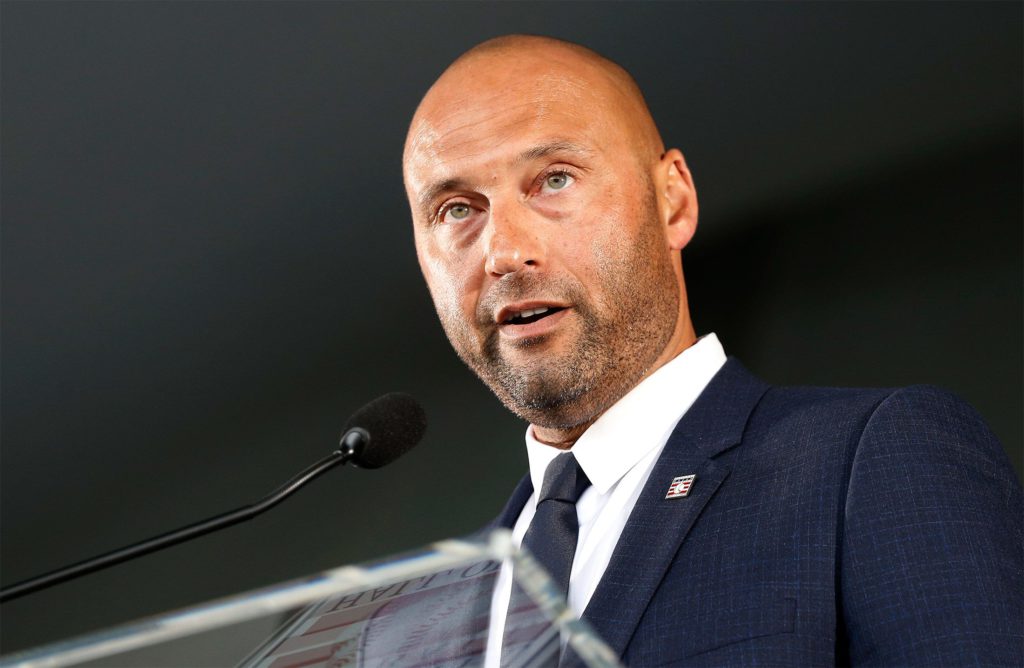
Derek Jeter to Start New Trading-Card Venture as Market Booms

(Bloomberg) — New York Yankees icon Derek Jeter has started a new trading-card platform as the boom in sports collectibles attracts new investors.

The venture, called Arena Club, will give users online showrooms for their card collections for the purpose of buying, selling and trading. Cards will be graded and kept at the company’s vault, with members given digital proof of ownership that lets them make deals quickly and without the need for shipping.

“It’s clarity, it’s speed and it’s trust,” Jeter said in an interview. “Building a community, that’s our No. 1 goal here.”

Jeter and Brian Lee, the former chief executive officer of Honest Co., began working on the project a few years ago and are launching it on Thursday. It’s backed by venture capital firms Lightspeed Venture Partners, Defy.vc and BAM Ventures, with total funding at about $9 million.

The collectibles industry has experienced immense growth in recent years and investors are pumping money into the sector. Fanatics Inc. formed a trading-card operation last year that was last valued at more than $10 billion even before it acquired rival Topps Co. in January. EBay Inc. agreed to buy marketplace TCGplayer for nearly $300 million in August. 

Startups are popping up everywhere, too, such as Amazon.com Inc.-backed platform Dibbs and Alt, which has raised funds from the venture firms of NBA star Kevin Durant and Reddit co-founder Alexis Ohanian.

Arena Club’s management sees the grading aspect of the business as vital. Card grading is dominated by firms such as Professional Sports Authenticator, Beckett Grading Services and Sportscard Guaranty Co., which assess the collectibles and assign a number grade based on quality and condition. Lee said the company wants to add speed and transparency to the system with a new process that uses computer vision and machine learning.

“When you get your card back, they don’t really provide a lot of reasons why your card gets a certain grade,” said Lee, who along with Jeter is an avid collector. “We’re going to be providing very transparent grading reports.”

Jeter has made several investments since retiring from baseball in 2014, getting involved with companies such as Blue Jean Networks video-conferencing and liquor startup Bespoken Spirits. His sports media venture, the Players’ Tribune, sold to ad-tech firm Minute Media in 2019. Last year, he joined the board of wealth manager Rockefeller Capital Management and this summer started the Greatness Wins sportswear label.

The Hall of Fame shortstop is figuring out the next steps of his career after stepping down as CEO of the Miami Marlins and selling his stake in the franchise after running the team for nearly five years. For now, he’s spending more time with his daughters at home, he said. But does he see a future in baseball?

“I don’t know. I haven’t given it much thought,” Jeter said. “I’m pretty sure I’ll do something at some point, but my focus now is elsewhere.”

More stories like this are available on bloomberg.com

©2022 Bloomberg L.P.
Shopify Hires Morgan Stanley Banker Hoffmeister as CFO

(Bloomberg) — Shopify Inc. hired Morgan Stanley investment banker Jeff Hoffmeister as its next chief financial officer, almost two months after the Canadian e-commerce giant slashed its workforce.

Hoffmeister, who spent more than two decades in Morgan Stanley’s technology investment banking group, will succeed CFO Amy Shapero when she steps down Oct. 27, the Ottawa-based company said Thursday in a statement. 

“As we position Shopify for the future, the addition of Jeff to our leadership team will continue to strengthen our ability to deliver value for our merchants, partners and investors,” Chief Executive Officer Tobi Lutke said in the statement.

Shopify also appointed Kaz Nejatian, vice president of product, to chief operating officer, effective immediately. He replaces Toby Shannan, who is retiring and plans to join Shopify’s board. The leadership changes come as Shopify grapples with slowing e-commerce growth that prompted sweeping layoffs and souring sentiment on its pummeled share price.

The “change-up is a bit of a surprise and timing raises questions on both 3Q trends and whether we see another reset in the next few quarters,” Barclays analyst Trevor Young said Thursday in a note to clients. The change was unexpected, he said, given that Shopify executives are presenting at various conferences this week and the announcement distracts investors from comments on the company’s future.

Shares of Shopify’s US listing rose as much as 1.7% in New York. 

In July, one day before it released worse-than-expected second quarter results, Shopify said that it would slash about 10% of its workforce as Lutke acknowledged the company’s decision to expand rapidly coming out of the pandemic didn’t pay off. Its share price has plunged 78% this year, prompting a series of analyst price target cuts.

(Updates with analyst commentary in fifth paragraph and shares)

More stories like this are available on bloomberg.com

©2022 Bloomberg L.P.
Legendary China Bets Unwind as Buffett, SoftBank Sell

(Bloomberg) — For early backers, they’ve been some of the most profitable Chinese stock investments of all time: Tencent Holdings Ltd., Alibaba Group Holding Ltd. and BYD Co.

But now big-name investors who’ve made billions from these shares are taking money off the table, underscoring growing angst over the prospects for China’s biggest companies as President Xi Jinping tightens the government’s grip on the private sector and the economy falters under persistent Covid lockdowns.

In the latest development, Naspers Ltd. — which invests via its Dutch unit Prosus NV — said it is continuing its plan to cut back its stake in Tencent, placing a $7.6 billion stake in Hong Kong’s clearing and settlement system, the eventual sale of which will help fund a share buyback.   

That comes a month after Japan’s SoftBank Group Corp. said it unloaded an enormous slug of Alibaba, the e-commerce pioneer that had long been China’s most valuable company. SoftBank, under pressure from botched startup bets, raised more than $17 billion through the sale of forward contracts on the stock. Warren Buffett’s Berkshire Hathaway Inc. is trimming its stake in electric-vehicle maker BYD.

The moves, taken together, represent a striking retreat from China’s private sector by investors that had been fervent champions for decades. SoftBank founder Masayoshi Son famously invested about $20 million in Jack Ma’s Alibaba in 2000 and held through the dot-com bust and the Chinese company’s IPO in 2014. Naspers invested in Tencent in 2001, while Berkshire bought shares in BYD in 2008.

“There’s a big question mark over the growth model of Chinese tech giants like Tencent and Alibaba,” said Ke Yan, analyst with Singapore-based DZT Research. “The government crackdown brought significant uncertainty.”

Son’s wager was long considered one of the best venture capital investments of all time, with his stake zooming in value to more than $200 billion. But Alibaba and its affiliate Ant Group were primary targets for the Communist Party’s crackdown, and its shares have plunged more than 70% from their peak in 2020. Son has said he will slash new investments in China because of regulatory uncertainty.

Naspers’ backing of Tencent was similarly considered a legendary startup investment. In June however, Prosus, the Naspers affiliate, unveiled an “unlimited” program to sell Tencent shares to finance buybacks of its own stock. Berkshire jettisoned total shares of 3.05 million, or 1.4% of its known 225-million-share holding in BYD.

Read more: BYD Stock Sale Is an Old-School Value-Investing Move by Buffett

“There is a great deal of de-risking from China ahead of the party congress,” Jason Hsu, chief investment officer at Rayliant Global Advisors, said referring to the Communist Party gathering that will likely give Xi a precedented-breaking third term as president. “While some are betting on China returning to an aggressive pro-growth mode, many are also betting on a structural shift toward central planning and a SOE-led economic policy focused on employment and common prosperity.”

Alibaba and Tencent have both seen their businesses deteriorate markedly in the past two years. The two companies reported their first revenue declines ever in the most recent quarter. They’ve also been compelled to put money into government causes and cut back on investments in China’s startups.

Tencent, now China’s most valuable firm, is spending more judiciously after profits fell more than 50% in the most recent quarter. Beijing authorities have been slow to approve new game titles during the crackdown, cutting off a key opportunity for growth. It has been selling off assets, including some of its investments in Chinese online retailer JD.com Inc. and Singapore’s Sea Ltd., while upping its stakes in global gaming companies like Ubisoft Entertainment SA.

Alibaba’s net income fell 50% in the latest quarter as revenue in its core China commerce division contracted for the first time. The company let go of 9,241 employees in the three months through June, according to the company’s latest filing, after cutting 4,375 in the first quarter of the year.

Layoffs by tech leaders like Alibaba, Tencent and Xiaomi Corp. have exacerbated a jobs crisis in China, pushing youth unemployment to about 20%.

In recent quarters, SoftBank’s Son has been vocal in his rising concerns about the China market. After watching the value of Alibaba plunge, he pulled back on new investments in addition to selling shares in the e-commerce giant.

“We have reduced the China dependency in our portfolio, therefore we believe we don’t have to worry too much about the situation in China,” he said during an earnings call in May.

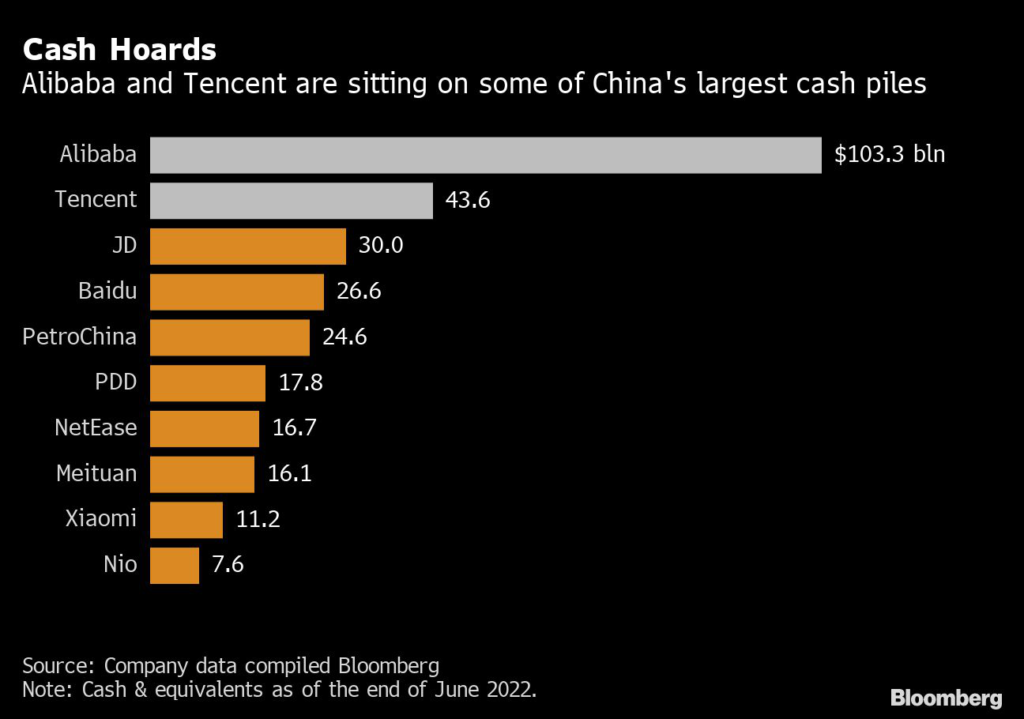
Alibaba and Tencent were long among the most active financiers for China’s startups, helping to propel innovation throughout the economy. However, both companies have had to pull back because of Beijing’s concerns they wielded too much control over their portfolio companies. That swelled their cash holdings, with Tencent holding more than $40 billion on its balance sheet while Alibaba has more than $100 billion. 

(Updated with context in paragraph 3.)

More stories like this are available on bloomberg.com

©2022 Bloomberg L.P.

Crypto Mining Is Threatening US Climate Efforts, White House Warns

(Bloomberg) — The White House says the environmental impact of producing cryptocurrencies like Bitcoin could impede US efforts to combat climate change.

The conclusion thrusts the Biden administration into the center of an already raging debate over the carbon footprint of digital assets. Critics have been ringing alarm bells for months over the amount of electricity used in crypto mining operations.

While the White House Office of Science and Technology Policy stopped short of prescribing specific regulations, the report it released on Thursday said the US must take action to mitigate pollution tied to crypto production. The federal government should collect more data on power usage and work with states and the crypto industry to set standards, the office said.

“Depending on the energy intensity of the technology used, crypto assets could hinder broader efforts to achieve net-zero carbon pollution consistent with U.S. climate commitments and goals,” the White House office said. Crypto operations in the US now use about as much energy as home computers do, according the report.

President Joe Biden ordered the study in March as part of a sweeping executive order on cryptocurrencies. In the coming weeks, other federal agencies and offices are expected to release recommendations and reports for how the US should deal with the asset class. 

The conclusions released on Thursday dovetail with the Biden administration’s focus on mitigating climate change. Since early 2021, American government agencies have launched a series of efforts related to global warming.

Creating new coins and validating transactions on the Bitcoin and Ethereum blockchains involves an energy intensive process in which multiple computers compete to solve complex math puzzles, with the winner adding new verified transactions to the blockchain in exchange for token rewards. 

Software Upgrade

The Ethereum network is set to undergo a major software upgrade this month, known as the Merge, that will transition the blockchain to a less energy-intensive approach. Bitcoin and Ether are the world’s first- and second-biggest tokens, respectively.

According to statistics cited Thursday by the White House, the US now does 38% of the world’s Bitcoin mining, compared with 3.5% in 2020. Meanwhile, blockchains that support crypto assets now use more energy than many countries, including Argentina and Australia, according to the report.

Air, noise, and water pollution from crypto mining operations can hurt the environment and “exacerbate environmental justice issues for underserved communities,” the document says. At the same time, increased electricity demand from those operations can put extra strain on already-stressed power grids.  

Developing Standards

The White House said new standards developed by federal agencies working with states and the crypto industry could reduce the impact. Those might include measures to reduce noise generation and promote clean energy usage.

Under Biden’s March executive order, agencies and offices across the government are supposed to send the president a series of reports this month. Thursday’s report was the first one to be released publicly. 

More stories like this are available on bloomberg.com

©2022 Bloomberg L.P.
Prosus Cuts Tencent Stake in Latest Pullback From Chinese Firms

(Bloomberg) — Naspers Ltd.’s Dutch unit Prosus NV continued its plan to cut back its stake in Tencent Holdings Ltd., the latest in a series of moves from early backers to unwind bets on Chinese companies.

Tencent shares worth $7.6 billion had earlier appeared in Hong Kong’s clearing and settlement system, typically a precursor to offloading stock. Prosus said later on Thursday the movement of shares, and eventual sale, will help fund its own share-buyback program.

Read More: Legendary China Bets Unwind as Buffett, SoftBank, Naspers Sell

It’s the latest in a series of sales from big-name investors who made huge profits from early bets on Chinese companies. Last month, SoftBank Group Corp. said it unloaded billions of dollars worth of shares in e-commerce pioneer Alibaba. Last week, Warren Buffett’s Berkshire Hathaway Inc. further trimmed its stake in China’s biggest electric-vehicle maker BYD Co.

The sales show increasing anxiety over the prospects for China’s biggest companies as President Xi Jinping tightens the government’s grip on the private sector and the economy falters under persistent Covid lockdowns.

Dutch e-commerce firm Prosus — via its parent company Naspers Ltd — became an early investor more than two decades ago. In late June, Prosus said it planned to reduce its stake to fund a buyback program, adding pressure to the Chinese online game company’s stock. “We will keep selling Tencent shares to buy back our own, it’s open-ended and an unlimited program,” Chief Executive Officer Bob Van Dijk said in an interview at the time. 

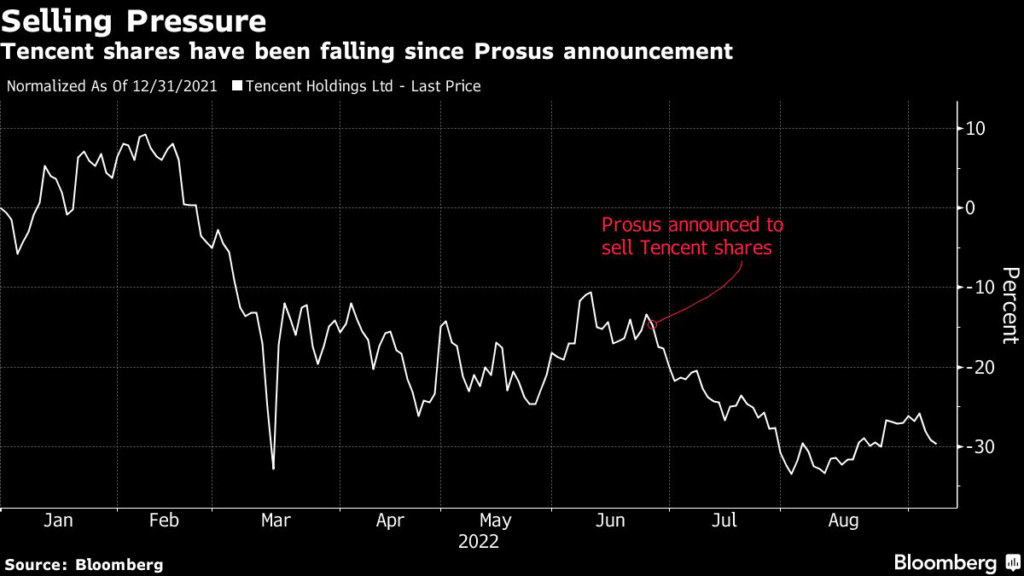
Prosus said then disposals of its stake in Tencent would be done in small chunks of about 3% to 5% of the Chinese company’s daily trading volumes. A stake sale of 2% would far exceed its stated sales policy, and the news of a possible deal has been weighing on Tencent’s share price. Shares fell 3.2% in Hong Kong on Thursday, taking their loss from a June high to 24%.

The move to start selling Tencent stock was done to narrow a discount between Prosus and its parent Naspers’ value, to that of its stake in the Chinese firm.

“People are worried that the big holder will keep selling their stake and there is no timetable when their sale will end,” said Steven Leung, executive director at Uob Kay Hian (Hong Kong) Ltd. “This kind of changes in the clearing system will always trigger worries that more selling will happen in near future.”   

Read: Tencent Backer Prosus to Cut $134 Billion Stake to Buy Stock (2) 

Headwinds

The stake reduction is likely the next setback for a company that’s seen multiple blows following Beijing’s broad regulatory crackdown and China’s slowing economic growth. Faced with declining revenue, Tencent has been looking to ease investor worry by cutting costs as well as selling off its own assets, which include online retailer JD.com Inc. and Singapore’s Sea Ltd.  

It’s also been buying back shares in the open market recently on a near daily basis, even though that’s not helped cushion broader market angst.  

“There will be an overhang for Tencent for sure but given it’s not a block sale, should not be too negative,” said Justin Tang, head of Asian research at United First Partners. “Shares dropped in the past few days partly due to more Naspers selling, but also due to macro concerns. Plus the crackdown on the tech sector of course.”  

(Update with additional context throughout.)

More stories like this are available on bloomberg.com

©2022 Bloomberg L.P.

JPMorgan Weighs Investment in Fintech Startup Yapily

(Bloomberg) — JPMorgan Chase & Co. is considering buying a stake in Yapily, a financial technology startup that’s seeking to raise fresh funds, people familiar with the matter said.

The US bank is in early-stage talks with London-based Yapily about the possibility of making an investment, the people said, asking not to be identified discussing confidential information.

Yapily is looking to bring in capital as it closes in on its acquisition of finAPI, a provider of open banking solutions in Germany, one person said. Yapily is buying finAPI from Schufa Holding AG, the German equivalent to the US FICO credit score firm. 

Deliberations are ongoing, and there’s no certainty they will result in a deal, according to the people. Representatives for JPMorgan and Yapily declined to comment.

Yapily has created an application programming interface for open banking, a tool that provides the infrastructure for software developers to build payment services and share data between different financial institutions. It works with accounting, crypto, digital banking and wealth management firms and has a presence in the UK, Lithuania and Germany, according to its website. 

For JPMorgan, any investment would continue a hot streak of fintech tie-ups for the bank. It’s been striking dozens of deals in the space as it seeks to fend off future rivals. In the last 18 months, it’s bought a stake in Greek digital banking and payments firm Viva Wallet and acquired UK digital wealth manager Nutmeg Saving & Investment.

More stories like this are available on bloomberg.com

©2022 Bloomberg L.P.

Mercedes, Rivian Partner on Electric Vans in Cost-Saving Bid

(Bloomberg) — Mercedes-Benz AG and Rivian Automotive Inc. are partnering to jointly build electric vans in Europe, a potential win-win for an established manufacturer wanting to share costs and an inexperienced company struggling to scale up.

The two will invest in and operate a new assembly plant at an existing Mercedes facility in central or eastern Europe that will begin production in “a few years,” according to a statement. The companies didn’t release details including investment figures.

“We will both benefit significantly from this joint venture,” Mathias Geisen, who heads Mercedes’s vans business, told reporters, adding the move would help the partners shoulder the multibillion-euro cost of scaling up electric-van manufacturing.

Automakers are increasingly looking to share the bill of developing and producing EVs as they retool factories and overhaul model lineups to catch up with Tesla Inc. The partnership pairs Rivian, which counts Amazon.com Inc. and Ford Motor Co. among its largest shareholders, with one of the world’s most seasoned vehicle makers.

Rivian rose as much as 9.6% in New York. The shares are still down some 65% this year. Mercedes declined 2.6% as of 3:45 p.m. in Frankfurt.

The Mercedes plant in Kecskemet, Hungary, is likely to be on the shortlist for the joint factory. The plant, opened in 2012, currently makes entry Mercedes-Benz cars such as A-Class, B-Class and C-Class models. The manufacturer plans to lower the production of such vehicles as part of its strategy of shifting to higher-end models.

Read more: Amazon Shapes Rivian’s Future and Hopes for $80 Billion IPO

After its blockbuster debut in late 2021, Rivian has struggled with production woes, high costs and economic volatility. The company briefly halted work at its Normal, Illinois, plant at the beginning of this year for fixes and process improvements aimed at helping increase output. 

Lingering supply-chain issues and elevated raw-material expenses have disrupted operations, leading Rivian recently to trim its full-year earnings expectations. It said last month that boosting production remains its primary focus, though supply-chain constraints would be the limiting factor. The startup has been looking at options for a manufacturing site in Europe since early last year, Bloomberg has reported.

Mercedes delivered just over 334,000 vans last year. Rivian, which makes the R1T pickup and R1S sport utility vehicle along with the vans, expects to manufacture 25,000 EVs this year. 

Rivian has agreed to supply 100,000 electric delivery vans to Amazon by 2030. The tech giant also currently uses combustion-engine vans from Mercedes and other manufacturers. 

Mercedes also said that it plans to adapt its European production network for large vans as the cost pressures from making battery vehicles undermine competitiveness. This will see an established plant from the Mercedes production network in eastern Europe — where production costs are lower — become part of van-making operations. Discussions on the plan between management and employee representatives in Germany will start shortly, according to a separate statement.

By the middle of this decade, all new Mercedes van models, including mid-size and small vans, will be electric-only, the company said.

(Updates with shares in fifth paragraph.)

More stories like this are available on bloomberg.com

©2022 Bloomberg L.P.
GM Bets on Electric Vehicles for the Masses With $30,000 SUV

(Bloomberg) — General Motors Co. is ready to test both the mass market’s appetite for electric vehicles and its own strategy to provide them. 

The company expects to make the electric model of its popular Chevrolet Equinox SUV available for sale in about a year with a $30,000 price tag. It may go 250 miles on a single charge and will be the first high-volume GM vehicle with its Ultium battery, the linchpin of the automaker’s $35 billion gamble to overtake Tesla Inc. in EV sales.

Chief Executive Officer Mary Barra pledged to make all of GM’s vehicles battery powered by 2035, part of her ballyhooed “Everybody In” plan to make vehicles a climate change solution by selling them en masse. By offering an electric version of the high-volume Equinox family SUV, the company will test how cheaper products perform in a market now dominated by $70,000 luxury cars, and if the Ultium battery makes those sales profitable.

“This concept of ‘Everybody In’ is very real,” said Travis Hester, a career engineer who is charged with growing GM’s EV business. “Equinox is a really practical vehicle but it has to do everything. That means not just being that second or third vehicle. That means it has to do the running around to and from your home, and it has to do the road trips.” 

GM’s shares declined less than 1% at 9:43 a.m. in New York.

Building an electric vehicle for the masses sounds like a no-brainer, but few automakers are really trying to do it. Batteries are expensive and can wipe away profits, while customers have struggled accessing charging stations at home and on the road.

The industry’s solution has been to sell electric luxury models, with the average price of today’s EVs inching toward $70,000. Even Tesla, for all its meteoric growth, sells cars that start close to $50,000 and CEO Elon Musk said that little work is being done on a low-priced model. That puts them beyond reach for most Americans.

Cut Prices

GM has tried to address those challenges before. It sells the Chevy Bolt, and recently cut prices to below $30,000. However, the car’s compact size is less appealing to most American consumers. It has also had to recall more than 140,000 Bolts after some of the batteries caught fire, a gaffe that cost the company almost $2 billion and affected its reputation.

Around the same time GM launched the Bolt in late 2016, engineers started working on Ultium. It works like a Lego set of common battery cells, produced as part of a joint venture with Korean manufacturer LG Energy Solution Ltd., that can be grouped and configured to make a small Equinox or a giant Hummer or Cadillac Escalade EV. That gives GM scale and should drive costs down. By fall 2023, Chevy will be selling the Bolt and electric versions of the Equinox, Blazer and Silverado pickup.

Equinox Chief Engineer Doug Houlihan said the vehicle has two battery packs, one for the base model and another for a longer-range version of the car. Both are shared with the larger Chevy Blazer EV. The Blazer’s larger battery also goes in the Cadillac Lyriq that went on sale this summer. Those three models, and other future EVs, will also share electric motors, torque converters and creature comforts like a 17-inch touchscreen. Mexican assembly wages could also help the vehicle make money.

Despite the industrial logic of sharing parts, the base model Equinox might lose money or just break even, said Sam Abuelsamid, an analyst with Guidehouse Insights. Houlihan said Ultium vehicles can still be profitable, especially as volume rises and battery costs fall. Further, the battery will be sourced in the US, which should allow customers to tap into at least $3,750 in federal tax credits.

“We’re not in this to break even,” Houlihan said. “We’re in this to make money.”

Helping GM is the fact the price of an Equinox is well below the average sticker on today’s internal combustion vehicles. It’s also much cheaper than rival EVs. Assuming GM hits the targets it has set out, the car will go further on a single charge than the base-model version of Hyundai’s Ioniq 5 and the Kia EV6, and it sells for at least $10,000 less than both, Abuelsamid said.

Charger Access

The company is also working to address charging problems that have bedeviled the electric vehicle market. Today’s Equinox can go about 420 miles on a tank of gasoline, potentially 170 miles further than a single charge. And customers may have problems gaining access to chargers, even at home. GM research showed Chevy Bolt owners typically wait four weeks for the permit and installation of the product. One even waited 107 days, Hester said.

Part of a $750 million budget Hester oversees will go to adding 40,000 chargers to the nation’s network of 100,000 over the next two years. The spending is focused on parking garages, malls, restaurants, office buildings and other places where apartment dwellers might go to use a DC faster charger. He’s also working to install more charging stations across US highways.

If successful, GM could set the stage for the company’s next phase of growth. And it may persuade more people to give up their gasoline-powered cars, which researchers have long said is important to fighting the impacts of climate change.

 “I guess we’ll find out very soon,” Hester said. “The demand for EVs is growing rapidly.”

(Updates with share trading in fifth paragraph)

More stories like this are available on bloomberg.com

©2022 Bloomberg L.P.

DocuSign’s Stock Collapse Sets Low Bar for Earnings

(Bloomberg) — Expectations for DocuSign Inc.’s earnings are so low after a series of blowups at the one-time pandemic winner that some investors are wondering if it can get any worse.

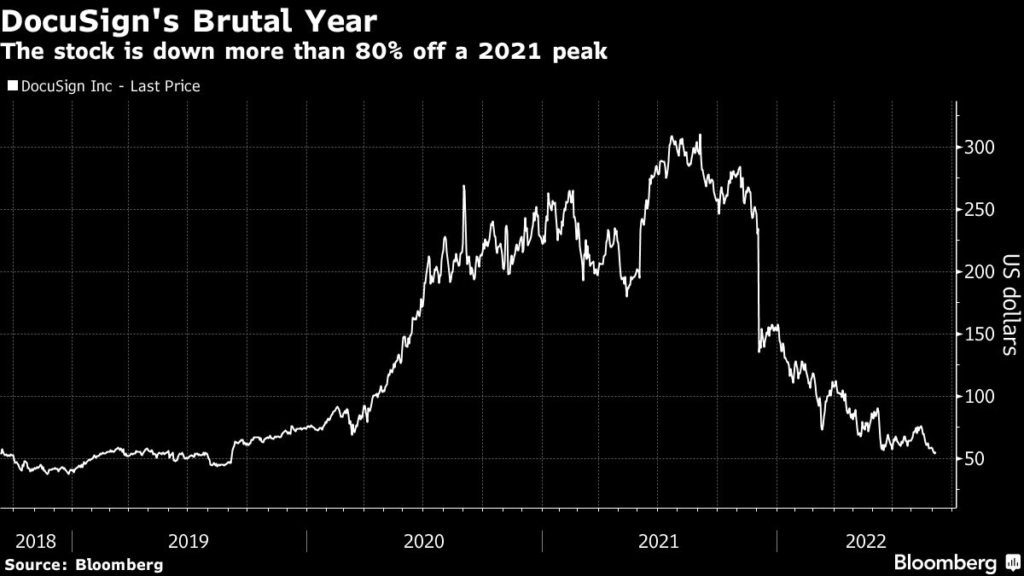
Shares of the company, which provides electronic-signature services used in real estate and other businesses, have plunged 65% this year, the second-worst performance in the Nasdaq 100 Index. As with other companies that surged in the Covid-19 era — including Netflix Inc., Zoom Video Communications Inc., and Peloton Interactive Inc. — investors have scaled back their estimation of its growth prospects in a reopened economy.

The stock fell 2.6% on Thursday.

DocuSign’s second-quarter results are due after the market close, and follow a trio of catastrophic reports, each of which resulted in stock drops between 20% and 42% in the subsequent session. Options traders expect another big post-earnings swing, with an implied one-day move of 18%. However, the shares now trade at some of their cheapest valuations on record, and the disappointments could enable DocuSign to more easily surpass low expectations. 

“Investor sentiment for DocuSign is among the most negative I’ve seen, and that means a low bar for earnings,” said Hilary Frisch, senior research analyst at ClearBridge Investments. “It’s hard to call the near-term fundamental outlook positive, but we’re optimistic about the long-term story, and the valuation is compelling on that basis. We think we can take advantage while others might be too afraid to jump in.”

After tripling in 2020, the stock fell 31% last year and the selloff picked up steam in 2022, with shares hitting a three-year low on Tuesday. Analysts forecast sales growth of 17% this year, down from 40% to 50% over the past three fiscal years. DocuSign’s struggles contributed to Chief Executive Officer Dan Springer stepping down in June.

The drop has DocuSign trading at about 31.9 times forward earnings. That’s above the 21 multiple of the Nasdaq 100, but near the all-time low for DocuSign, which went public in 2018, and below consumer-staples companies like Costco Wholesale Corp or Clorox Co.

Analysts have been paring back their estimates. The average prediction for full-year adjusted earnings per share is down by 20% from six months ago, according to data compiled by Bloomberg, while the view for revenue has fallen 7.4% over that same period. 

But in a glimmer of hope that the worst might be priced in, most of those revisions happened months ago. Brokerage predictions for earnings have stayed steady over the past month, while the consensus on sales hasn’t budged since late March. And even after the estimate cuts, analysts see double-digit revenue growth for the company over the next few years.

“Coming out of this downturn, my bet is that DocuSign is going to grow faster than these staples or the S&P 500,” Frisch said. “I don’t have a ton of names in my universe with this kind of growth, trading at a valuation that rivals traditional defensive industries.”

The big cloud hanging over DocuSign, and all growth stocks, is the economic environment. Federal Reserve Chair Jerome Powell recently indicated the US central bank was likely to keep raising interest rates, spurring a broad decline in tech. In another headwind to valuations, the yield on the 10-year US Treasury note is around 3.25%, more than double where it was at the start of the year.

For Scott Yuschak, managing director of equity strategy at Truist Advisory Services, this kind of backdrop is a key reason to keep avoiding the stock.

“The valuation isn’t ridiculous anymore, but I wouldn’t say it’s cheap, especially since it doesn’t have as much cash flow as we’d like and we don’t know what demand looks like going forward,” he said. “Given the uncertain growth outlook, it is difficult to step into a name like this.”


Tech Chart of the Day

Netflix Inc. has outperformed the Nasdaq 100 since the tech gauge’s June 16 low. Shares of the streaming giant are up nearly 30% in the period, dwarfing the index’s 9.2% rise. Analysts at Macquarie raised their recommendation on the stock this week to neutral from underperform, saying the streaming service’s ad-supported tier could generate as much as $3.6 billion in ad revenue in US and Canada by 2025.

Top Tech Stories

  • Apple Inc. unveiled a new lineup of devices Wednesday with few surprises beyond one major one: It didn’t raise its US prices during one of the worst years for inflation in decades.
    • Apple Chief Executive Officer Tim Cook credited Steve Jobs with making privacy a top priority at the company and said he largely still runs the tech giant in the manner of its late co-founder.
  • Tencent Holdings Ltd. shares worth $7.6 billion appearing in Hong Kong’s clearing and settlement system has fueled speculation that a large stakeholder may be selling its holdings.
  • China’s latest Covid lockdown has virtually paralyzed a city of 6 million that houses much of the country’s electronic information, forcing Apple Inc.’s datacenter operator to take emergency measures to shut out the pandemic.
  • Shares of Darktrace Plc tumbled as much as 33%, the biggest drop on record, after US private equity firm Thoma Bravo said it did not intend to make a takeover offer for the cybersecurity firm.
  • A judge criticized Elon Musk for not properly turning over text messages that could be evidence in Twitter Inc.’s lawsuit seeking to force the billionaire to complete his proposed $44 billion buyout of the social-media platform.

(Updates to market open.)

More stories like this are available on bloomberg.com

©2022 Bloomberg L.P.

Close Bitnami banner
Bitnami