
Bloomberg

Crypto Scammers Use Fake Websites in Latest Bid to Dupe Customers

(Bloomberg) — Scammers in recent weeks have employed up fake cryptocurrency web pages to attempt to steal money from users, the latest tactic to emerge in what’s already been a costly year for crypto-related hacks. 

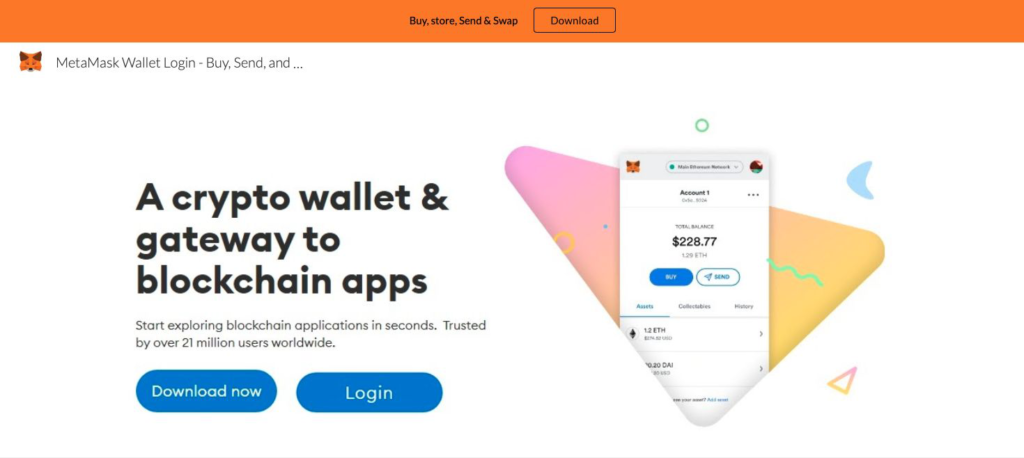
The sham websites – which masquerade as pages for popular services such as Coinbase, Gemini, Kraken and MetaMask – aim to dupe visitors into providing information that helps hackers break into their cryptocurrency wallets, according to researchers from the security firm Netskope Inc. Fraudsters deployed search-engine optimization tactics to promote the websites, which used URL addresses that closely resembled the legitimate sites and propelled the fake pages to the first page of Google’s search results, the researchers said. 

Google searches for phrases such as “kraken wallet” or “coinbase not working,” in the event the Coinbase site appears to be down,  return results with the phishing links on the first page, according to a Bloomberg analysis. A fraudulent version of the Kraken wallet appeared in a Google search in a more prominent position than Kraken’s Twitter feed and Play store app.

In another case, a Google search for the “metamask ios” app yielded results that included one website that five popular antivirus services flagged as malicious, according to the Bloomberg analysis. 

“A lot of people are making fake versions of real websites and directing users to those pages so they can take their money,” Erin Plante, senior director of investigations at the blockchain-analysis firm Chainalysis Inc., adding that such techniques have been used in other types of cyberattacks. “A lot of this is age-old hacking.”

The findings come amid a flurry of security incidents in cryptocurrency. Financial losses from cryptocurrency-related hacks totaled $1.9 billion in the first seven months of this year, according to Chainalysis. Hackers stole $1.2 billion over the same period in 2021, the company said. 

Users that clicked on the fake websites were met with messages asking them to participate in a live Q&A with a scammer who pretended to be a customer service representative from a legitimate company, Gustavo Palazolo, a security researcher at Netskope, said in an interview. During one interaction, the bogus customer service representative asked Palazolo for his phone number in an apparent attempt to locate his cryptocurrency wallet, the researcher said. 

“We detect a lot of phishing pages but when I saw the live chat function, that was something that’s more serious than the usual threat,” he said. “They got back to me within a minute after I sent a message.” 

The attackers duped Google’s search algorithm into including the scam pages on the first page of the search results by frequently posting malicious URLs in comment sections on little-read blogs throughout the web, Palazolo said. Repeatedly posting links increases the chances that Google will incorporate the URL into its results, he said, adding that the scammers also used Google Sites, a web creation tool, to create their malicious pages, giving the sites an air of credibility. 

The number of victims duped as part of the fraud effort wasn’t immediately clear. 

Coinbase urged customers to remain on alert for such scams, publishing a security bulletin in July that offered tips on how to detect such fraud efforts. In a statement, a Kraken spokesperson said the company proactively identifies counterfeit websites and apps and works to take them down. The site also has a support page meant to help crypto users avoid fraud.  

Neither Gemini nor MetaMask responded to requests for comment. 

Numerous bogus websites flagged by Netskope disappeared from search results after Bloomberg flagged the malicious sites to Google. 

“For most queries related to the mentioned topics, search results rank authoritative and reliable sources as the top results,” a Google spokesperson said in an email. “On Google Sites, we explicitly prohibit phishing and we invest heavily in detecting, deterring, and removing abuse from our platforms.”

In a separate ruse earlier this year, fraudsters impersonated journalists, crypto apps and a variety of nonfungible token projects on Twitter to steal users’ username and password credentials. 

More stories like this are available on bloomberg.com

©2022 Bloomberg L.P.

US Eases Huawei Curbs to Counter China’s Push on Tech Standards

(Bloomberg) — The US government is loosening restrictions on the sharing of technology with blacklisted firms, seeking to maintain America’s lead in setting international standards as China closes the gap.

The Commerce Department’s Bureau of Industry and Security issued a rule authorizing the release of certain technology and software when organizations deliberate and decide on standards, it said in a statement Thursday. That should address questions over whether US firms need to secure a license before sharing “low-level” technology during such processes with sanctioned parties including Huawei Technologies Co., it said.

The Trump administration in 2019 added Huawei and a number of its non-American affiliates to a blacklist that curtails the Chinese tech giant’s access to critical US suppliers. The policy, however, has led US companies to limit their participation in standards-related activities at a time when Chinese companies are ramping up efforts to increase their clout.

Washington remains concerned that China’s government and its largest companies are taking a bigger role in technical groups that determine the way technology is designed and applied globally, theoretically handing a competitive edge to corporations that the US deems national security threats. 

“US stakeholders need to be fully engaged in international standards organizations, particularly where the critical but sometimes invisible standards that they set have important national security as well as commercial implications,” Alan Estevez, the Commerce undersecretary for industry and security, said in the statement.

The new rule will help advance “US leadership in these critical bodies,” he added.

Huawei has consistently denied it poses a threat to the US.

More stories like this are available on bloomberg.com

©2022 Bloomberg L.P.
SEC Chief Renews Vow to Crack Down on Crypto Industry Rule-Breakers

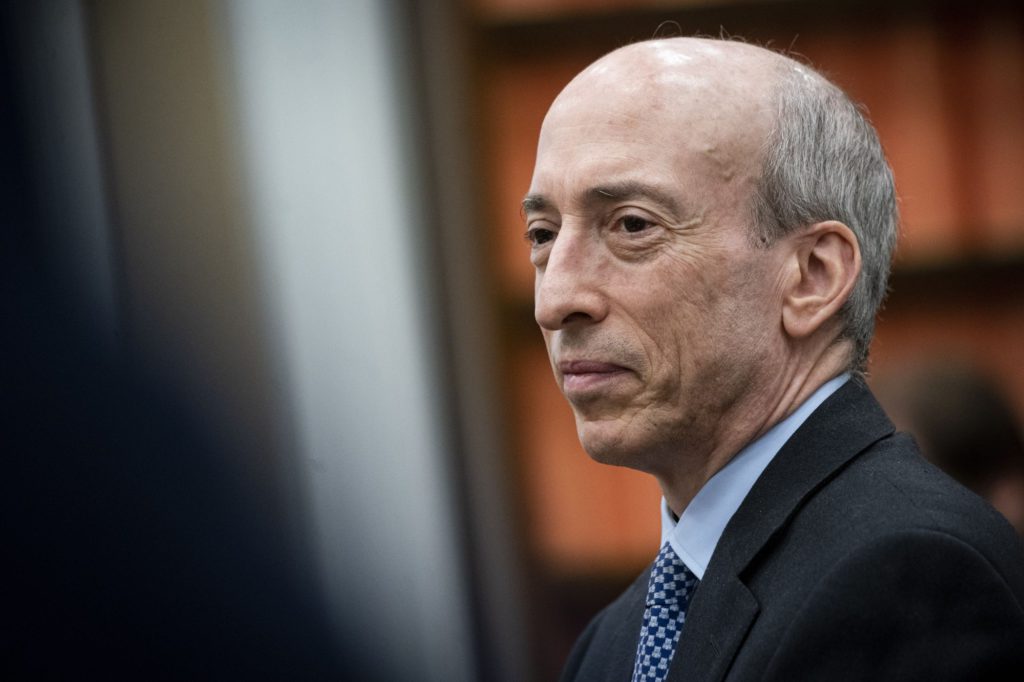
(Bloomberg) — US Securities and Exchange Commission Chair Gary Gensler is going back on the offensive against those in the crypto industry that he says are purposefully shirking regulations.

Gensler on Thursday repeated his demands that crypto exchanges, brokers and attorneys in the digital-coin industry comply with securities rules. It’s the latest salvo by the SEC chief in his push to clamp down on an asset class that he says often operates in legal gray areas.

The SEC has been at odds with much of the crypto industry over whether its regulations should apply to projects that are more decentralized than stocks or bonds since long before Gensler took over the agency in April 2021. Tensions have increased during the past year with the SEC chair repeatedly arguing that most tokens are covered by those rules.

“The public deserves the same protections from your clients that they get with other issuers of securities,” Gensler said in remarks prepared for Thursday’s Practising Law Institute’s SEC Speaks event in Washington.  “Not liking the message isn’t the same thing as not receiving it,” Gensler said. 

Crypto enthusiasts say forcing digital-asset firms to comply with traditional registration and oversight requirements could effectively kill businesses. Furthermore, some argue the “decentralized” nature of digital-asset trading also makes it difficult to obtain the types of information the SEC typically requires. 

American lawmakers are now considering multiple proposals that would significantly boost the power of the Commodity Futures Trading Commission, the US’s swaps and futures regulator, to oversee crypto assets. Some securities lawyers say that passage of those bills would diminish the SEC’s authority over the asset class. 

On Thursday, Gensler said any legislation should be done in a way that maintains the SEC’s oversight of “crypto security tokens.” He added that those assets make up the bulk of digital assets that are currently traded. 

More stories like this are available on bloomberg.com

©2022 Bloomberg L.P.

Europe Stocks Fluctuate, US Futures Slip After ECB: Markets Wrap

(Bloomberg) — European stocks fluctuated after the European Central Bank increased its key lending rate by a historic 75 basis points to combat inflation, as shares in banks advanced. US futures slipped. 

Europe’s Stoxx 600 Index swung between gains and losses as banks climbed following the ECB move, while retailers slumped. Contracts on the S&P 500 and the Nasdaq 100 fell less than 0.5% following a near-2% advance in the underlying gauges on Wednesday.  

The pound pared a decline as UK Prime Minister Liz Truss outlined a plan to provide relief on rising energy costs to British households and businesses, which she said is expected to curb inflation. There has been widespread speculation that the government’s aid proposals will require further debt sales to fund it that could drive up bond yields. 

A dollar gauge was steady as traders assessed comments from Federal Reserve officials on their commitment to fighting inflation. Treasuries gained, with the 10-year yield falling to 3.22%. Applications for US unemployment insurance fell for a fourth straight week to the lowest since May, suggesting demand for workers remains healthy despite an uncertain economic outlook.

The ECB said it expects to tighten at the next several meetings and Thursday’s unprecedented policy step underlines growing alarm as price pressures broaden beyond energy, and as the euro weakens. Traders’ focus will turn later to a speech due from Fed Chair Jerome Powell for more insights on the outlook for US interest rates.

“The ECB has hiked by 75 basis points for the first time in its history, and has delivered the message that more hikes will be needed at upcoming meetings, setting the stage for an almighty game of catch-up with the Federal Reserve,” said Chris Beauchamp, chief market analyst at IG Group. “This is a definite attempt to send a message to markets, but the accompanying downgrade of GDP estimates sends another message that says it will be a tough winter for the eurozone.”

Fed officials reiterated their determination to get inflation under control. Vice Chair Lael Brainard said interest rates will need to rise to restrictive levels, while cautioning risks would become more two-sided in the future.

Meanwhile, Goldman Sachs Group Inc. economists lifted their forecast for the pace of Fed interest rate increases, expecting the Fed to hike by 75 basis points this month and 50 basis points in November, up from previous forecasts of 50 basis points and 25 basis points respectively. They are tipping a 25 basis points move in December.

The Fed’s Beige Book report said US economic expansion prospects were weak, while adding that price growth showed signs of decelerating.

US stocks could slide a further 25% if the economy tips into a recession, with risks to a sustained equity rally mounting, according to Deutsche Bank AG strategists. With company profits set to drop, stock valuations still high and recession risk looming, the fundamental picture for stocks is challenging, the strategists said.

Elsewhere, oil trimmed a sharp slide this week sparked by demand risks from monetary tightening and China’s Covid travails — the megacity of Chengdu extended a weeklong lockdown in most downtown areas.

Gold futures wavered, while Bitcoin held above the $19,000 level.

What to watch this week:

  • Fed Chair Jerome Powell due to speak, Thursday
  • Chicago Fed President Charles Evans and his Minneapolis counterpart Neel Kashkari due to speak, Thursday
  • EU energy ministers extraordinary meeting on emergency intervention in electricity markets, Friday

Are you bullish on energy-related assets? This week’s MLIV Pulse survey focuses on energy and commodities. Please click here to participate anonymously.

Some of the main moves in markets:

Stocks

  • Futures on the S&P 500 fell 0.3% as of 8:41 a.m. New York time
  • Futures on the Nasdaq 100 fell 0.5%
  • Futures on the Dow Jones Industrial Average fell 0.1%
  • The Stoxx Europe 600 fell 0.2%
  • The MSCI World index rose 0.3%

Currencies

  • The Bloomberg Dollar Spot Index was little changed
  • The euro was little changed at $1.0002
  • The British pound fell 0.1% to $1.1520
  • The Japanese yen fell 0.1% to 143.93 per dollar

Bonds

  • The yield on 10-year Treasuries declined two basis points to 3.25%
  • Germany’s 10-year yield advanced five basis points to 1.62%
  • Britain’s 10-year yield advanced two basis points to 3.05%

Commodities

  • West Texas Intermediate crude rose 0.5% to $82.34 a barrel
  • Gold futures were little changed

More stories like this are available on bloomberg.com

©2022 Bloomberg L.P.

Swiss Running-Shoe Brand On Launches Resale Site in Sustainability Push

(Bloomberg) — The Swiss athletic brand On is launching a resale site Thursday, making it the latest company to enter the fast-growing apparel resale market. 

On Holding AG, which is backed by tennis star Roger Federer, went public last year and expects to see net sales of 1.1 billion Swiss francs ($1.1 billion) in 2022. The company has made sustainability a focus of its business. It set science-based climate targets, per its 2021 environmental impact report, aiming to cut emissions it directly generates 46% by 2030 and to reduce indirect emissions arising from the company’s supply chain and product use. On also strives to be fully circular, meaning it would someday only use recycled materials to make its products and would generate little waste in their manufacture, distribution and use. 

“It will obviously take us years to be fully circular,” said Samuel Wenger, On’s global direct-to-consumer head. The new resale site, Onward, “is a perfect in-between step,” Wenger said.  

The fashion industry has a gigantic climate and waste problem. Between 2% and 8% of global carbon emissions come from big fashion, according to the United Nations, and it’s also a major source of plastic pollution. By extending the life of products, whether through resale or rentals, customers and businesses are keeping them out of landfills for longer and staving off future emissions associated with developing new goods. 

Here’s how Onward will work: Customers can send their lightly or moderately used On shoes back to the company in return for a $35 gift card to spend on new or used items, assuming the shoes are of high enough quality to be used again and not cause injury. (Shoes that don’t meet this bar will be donated or recycled.) The returned items will then be sorted into three categories depending on quality — near-perfect, very good and good — and priced accordingly. 

Newer, in-season and better-quality products will be priced higher than lower-quality, off-season ones, and all products will be less expensive than brand-new ones. A newer product of near-perfect quality will cost roughly 75% of the original price, according to Wenger. In addition to shoes, the company plans to start selling used items of On-branded clothing on the resale site by year’s end. 

To help run the site, On is teaming up with the e-commerce technology company Trove, which manages similar sites for other big-name clothing and outdoor brands, such as Patagonia, REI and Lululemon. All of these companies see resale as an essential part of their sustainability ambitions, said Trove’s chief executive officer, Gayle Tait. So far, Trove estimates that it has helped avoid emissions of  over 2 million kilograms of carbon dioxide equivalent and kept more than 200,000 kilograms of waste out of landfills globally.

Offering products on resale is also a way to reach new customers. At least 50% of Trove’s “recommerce” customers reported being new to a brand, according to Tait. 

This is part of a larger trend of customers turning to secondhand items and marketplaces. Compared to two years ago, US consumers of all ages have reported buying second-hand at least 33% more often, according to a December 2021 report by First Insight, Inc. and the Baker Retailing Center at the University of Pennsylvania’s Wharton School.

For customers, choosing to engage in resale marketplaces is “an active choice you can make to really reduce your waste,” said Trove’s Tait. “We’ve all got closets full of stuff we wear or don’t wear, frankly, and it’s really about finding the right homes for those items and getting them to the next person.”

More stories like this are available on bloomberg.com

©2022 Bloomberg L.P.

Jeep Plans Four Electric SUVs, Including a New ‘Brother’ for the Wrangler

(Bloomberg) — Jeep, the rugged American SUV brand owned by Stellantis NV, is expanding its lineup to meet more-stringent emissions rules and catch up to rival automakers.

The brand known for the off-road Wrangler will bring four fully-electric SUVs to market by 2025, including two all-new models, the company said Thursday. The Jeep Recon, a zero-emission vehicle its top designer calls a “brother” of the popular Wrangler, will go on sale in the US in 2024. The Jeep Avenger, a compact electric SUV meant to navigate tight urban spaces, will enter the European market next year. 

The Wagoneer S, a fully-electric version of the luxury three-row SUV Jeep resuscitated in 2020, will also be available in 2024. Stellantis declined to provide the name or other details of a planned fourth new EV Jeep.

While General Motors Co. delivered the first Hummer EVs in late 2021 and Ford Motor Co. brought out the battery-powered Mustang Mach-E the same year, Stellantis has been slow to offer fully electric vehicles. But the automaker has moved more quickly to debut hybrids. The company vows to make half of the brand’s portfolio hybrid or wholly electric by 2025, and increase all-electric Jeeps to 50% of US sales by 2030. 


Even so, Jeep is being careful not to alienate die-hard fans of its gas-powered Wrangler. The Recon is meant as an electric nod to the Wrangler, not a replacement, said Christian Meunier, the global head of Jeep.

“The Wrangler stays the Wrangler, the icon of the brand, that’s very clear,” he told reporters. 

More stories like this are available on bloomberg.com

©2022 Bloomberg L.P.
Bitcoin Mining Revenue Gauge Declines to the Lowest in Two Years

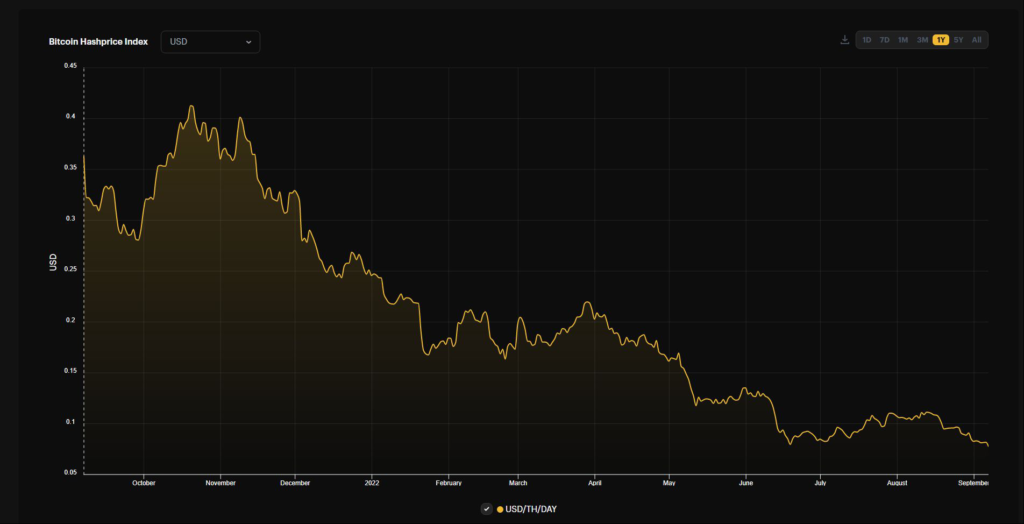
(Bloomberg) — A closely-watched measure of Bitcoin mining revenue has dropped to the lowest in about two years as competition increases while prices drop and energy costs soar. 

The hash price index, which indicates the mining revenue value per unit of computing power, dropped to around 7.7 cents for each terahash, the lowest since September 2020, according to data from crypto-mining services company Luxor Technologies. It last neared that level during the crypto market crash in June, when some miners had to sell coins held as investments to cover costs. The index uses multiple factors, such as the price of Bitcoin and transaction fees, to calculate the miners’ total revenue. 

Bitcoin miners use powerful computers to compete to be the first one that comes up with a solution to validate transactions encrypted by the Bitcoin network and win a reward in the form of newly minted tokens. However, such rewards are limited and the more competition there is on the network, the less rewards each miner will receive. 

Mining difficulty, a measure of Bitcoin miners’ computing power for the entire network, is flirting with a record high after its latest bi-weekly adjustment last week. While mining companies raised billions of dollars in building out mining infrastructure and deploying rigs during the bull run last year, the computing power only started ramping up this year. 

“With all costs taken into account, only the miners with extremely low electricity prices are running at a profit right now.” said Jarand Mellerud, mining analyst at digital asset research firm Arcane Crypto. 

This year’s extended slide in Bitcoin’s price and persistent high energy prices have also eroded the formally industry profit margins, which were once on par with luxury goods makers. The largest cryptocurrency by market value has dropped almost 60% this year to around $19,000.  

“The last time when we had this level, energy price was significantly lower across the board,” said Nick Hansen, chief executive at Luxor. “Depending on where you are at, your energy price is at at least 30% higher, in some places almost double right now.” 


Russia’s invasion of Ukraine and a record heat wave in crypto-mining hub Texas have sent energy prices soaring. Under such conditions, only the miners with their own generations or those that purchased power at a lower rate previously are best positioned to weather the high prices, Hansen said. 

Miners may be able to improve margins as temperatures cool down, said Bill Cannon, head of portfolio management at Valkyrie Investments. Public mining companies are meeting their computing power growth target by deploying more machines and they have been resistant in previous cycles, he said.

Even so, shares of mining companies have been hit hard this year. Marathon Digital Holdings Inc. is down 65%, Riot Blockchains Inc. is off 71% and Core Scientific Inc. has slumped 81%.

More stories like this are available on bloomberg.com

©2022 Bloomberg L.P.

GameStop Posts Mixed Results, Announces Partnership With FTX

(Bloomberg) — GameStop Corp. shares were up on Thursday after the video game retailer announced a partnership with cryptocurrency exchange FTX US, suggesting the company is making strides in its strategy shift to nonfungible tokens. But analysts were still skeptical about the longterm growth prospects after the company reported a decline in sales and a wider loss in the second quarter. 

GameStop said Wednesday it will collaborate with FTX US, one of the biggest cryptocurrency exchanges, on new e-commerce and online marketing initiatives, and will begin carrying FTX gift cards in select stores. The financial terms of the partnership weren’t disclosed. GameStop shares, which are down 35% this year, rose about 7% in premarket trading.

The agreement builds on GameStop’s earlier forays into NFTs, including the launch in June of a digital asset wallet to allow gamers to store, send and receive cryptocurrencies and NFTs. In July, the company rolled out an NFT marketplace to trade those assets, despite the fact that sales of such digital artworks have declined amid the crypto industry crash. 

The pivot to NFTs has yet to show up GameStop’s results. Net sales declined 4% to $1.14 billion in the fiscal second quarter, the company said in a statement, falling short of analysts’ estimates. The company’s net loss nearly doubled to $108.7 million. 

The bulk of GameStop’s business remains in a state of “extreme secular decline,” and investors shouldn’t fall for the company’s “endless series of gimmicky announcements,” analysts at Vital Knowledge wrote in a note to investors.

Chairman Ryan Cohen has been pushing GameStop into crypto in an effort to turn around the fortunes of the beleaguered gaming company, which hasn’t seen a quarterly profit since the end of 2021. Cohen, who also founded pet e-commerce site Chewy Inc., has seized on gamers as being among the NFT industry’s biggest target audience. 

The partnership with GameStop unites two companies with a shared link: Robinhood Markets Inc., the free trading app that investors used to bid up the price of GameStop shares in last year’s meme stock rally. FTX US founder and Chief Executive Officer Sam Bankman-Fried took a 7.6% stake in Robinhood earlier this year.

FTX US recently launched a stock trading service to all US users, including non-crypto investors, in a move to expand its customer base and increase assets under custody. It has also partnered with Reddit to enable crypto payments by Reddit users.

GameStop’s strategy has swerved several times in recent years as video game sales moved away from physical discs to downloads online. Much of its retail business was quashed during Covid lockdowns and results have been further hampered by supply constraints on consoles. Overall spending on gaming fell 13% in the second quarter from a year earlier, according to industry researcher NPD Group. 

While it still sells games, hardware and toys, GameStop’s leadership has struggled to make the shift into the world of crypto, with underwhelming results so far. 

GameStop fired Chief Financial Officer Mike Recupero in July and laid off several employees. While the company said at the time it was “right-sizing headcount” after a hiring spree in 2021, it has also confronted a clash about strategy among its employees, with many recent hires from e-commerce giant Amazon.com Inc., in conflict with GameStop staffers who have a background in brick-and-mortar game sales, Bloomberg has reported. Skills associated with online sales don’t translate to negotiating retail leases and operating stores. 

Part of the wave of new hires two years ago included Chief Executive Officer Matt Furlong and the now-departed CFO, who both came from Amazon with expertise in e-commerce. 

With Cohen, “you have a guy who has a lot of success in selling merchandise to people who make recurring purchases, like dog owners,” said Wedbush Securities analyst Michael Pachter before the results were announced. “He’s trying to apply that model to a consumer who does not make recurring purchases. And he’s competing with console manufacturers who deliver games electronically and consumers who prefer to download games electronically as well.”

GameStop is also changing its retail strategy with a focus on toys and collectibles at its stores. That effort seems to be paying off with sales reaching $223.2 million in the quarter, up from $177.2 million the same quarter last year.

Cohen, also an activist investor through his RC Ventures, recently faced criticism after exiting his position in another meme stock, Bed, Bath & Beyond Inc., for a $68.1 million profit mid-August. Retail investors who had flocked to him during meme-stock mania felt burned by his departure and racked up millions in losses. GameStop’s stock plunged in the aftermath.

More stories like this are available on bloomberg.com

©2022 Bloomberg L.P.
Ladbrokes Owner Sees Gambling Regulation Coming With New UK Leader

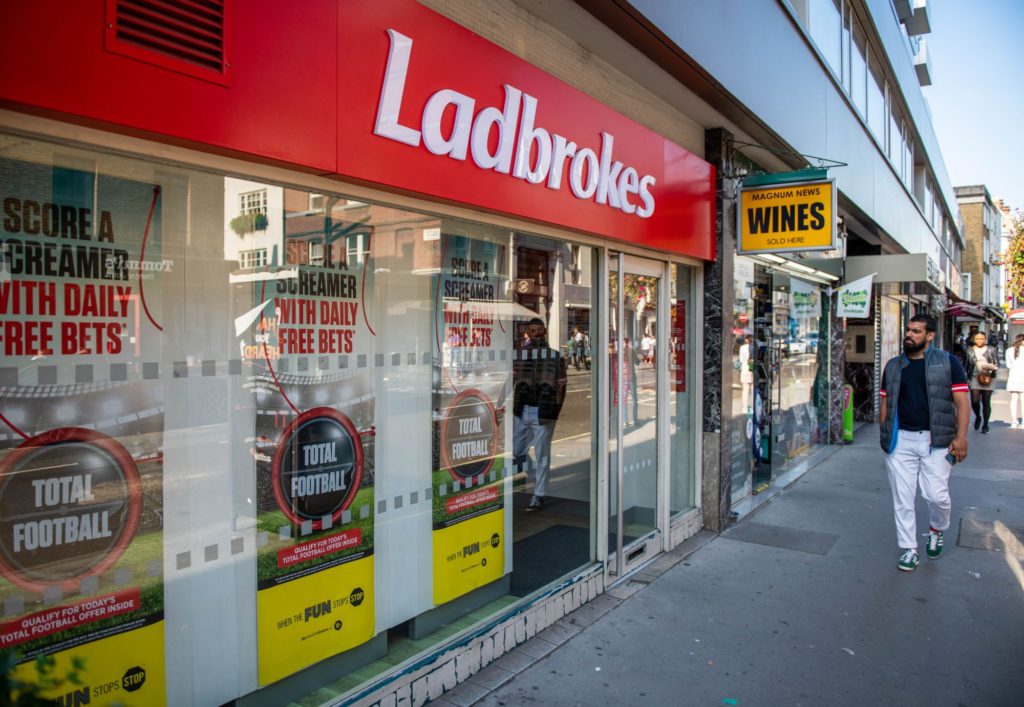
(Bloomberg) — Entain Plc Chief Executive Officer Jette Nygaard-Andersen is preparing the gambling group for long-delayed stricter rules under Britain’s new Prime Minister Liz Truss.

Nygaard-Andersen said Entain, which owns the Ladbrokes chain of betting shops as well as online betting businesses, is steeling itself for restrictions which could include limits on bets and sports-betting sponsorships.

“I do think there will be something around sponsorships,” she said in an interview with Bloomberg News, adding “clubs and football leagues would like to avoid” advertising restrictions. Entain sponsors a range of sports.

A long-expected review of Britain’s gambling laws was delayed by the July resignation of then Prime Minister Boris Johnson. The minister who had been responsible for the bill, Chris Philp, urged leadership to tackle “the ravages of gambling addiction” in his own resignation letter.

The new minister overseeing betting laws, Michelle Donelan, has herself previously shared concerns with Parliament about the impact of problem gambling.

Britain is looking to put more limits in place while revenues for its homegrown bookmakers explode in the US. Nygaard-Andersen said she expects the coming months to be “another record-breaking season” thanks to football wagering in the US. Entain owns half of online betting operator BetMGM, a joint venture with MGM Resorts International.

Entain last year defended itself against unsolicited takeover offers from MGM and later DraftKings Inc., which proposed a merger valued at $22.4 billion. MGM’s CEO recently said he’d like to own more of the JV with Entain. 

Nygaard-Andersen said she doesn’t regret spurning the offers.

“We’re not a business that’s for sale,” she said. “I’m very focused on growing this business. I see Entain as the consolidator.”

(Updates with context. Previous update corrected spelling of Ladbrokes.)

More stories like this are available on bloomberg.com

©2022 Bloomberg L.P.
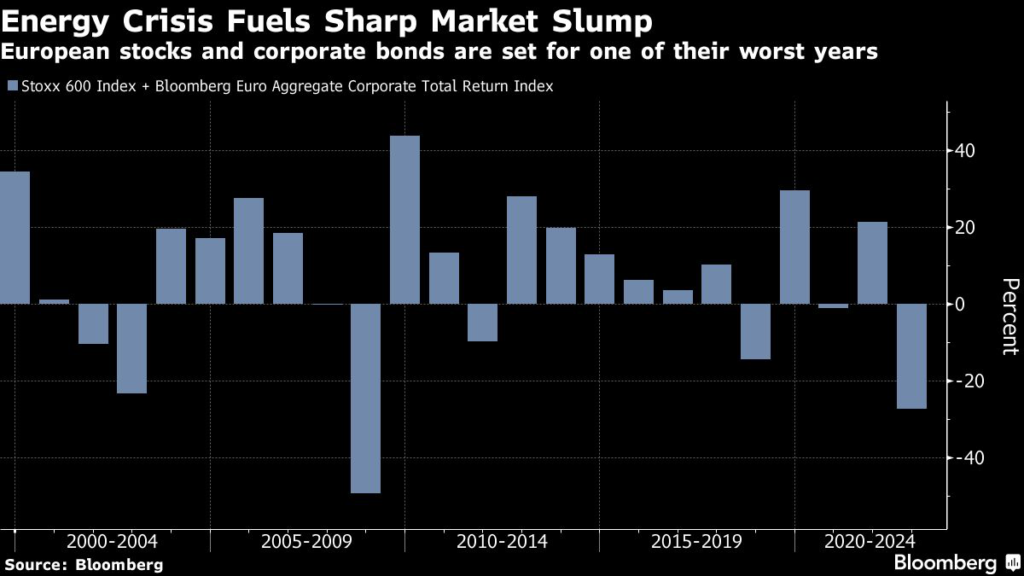
European Stocks Pare Gains With All Eyes on ECB: Markets Wrap

(Bloomberg) — European stocks pared early gains, with investors cautious before a potential jumbo interest rate hike by the region’s central bank later Thursday. 

The Stoxx 600 Index surrendered an initial 0.6% advance as retailers slumped after a profit warning from Primark-owner Associated British Foods Plc. US equity futures were little changed following a near-2% advance in the S&P 500 and Nasdaq 100 on Wednesday. 

The pound weakened after sliding to its lowest level against the greenback since 1985 on Wednesday. UK bond traders prepared to hear details of Prime Minister Liz Truss’s economic aid plan, amid widespread speculation of further debt sales to fund it that could drive up yields. 

A dollar gauge rose as traders assessed comments from Federal Reserve officials on their commitment to fighting inflation. Treasuries steadied after rallying as Australia’s central bank chief signaled a potential end to outsized policy moves. 

Central banks are walking a tightrope, moving sharply to tackle price pressures while remaining leery of sparking a damaging economic contraction in the process. The European Central Bank takes center stage later, with Bloomberg Economics predicting a 75 basis points rate increase to front-load tightening even as the region grapples with an energy crisis.


“What we are seeing in Europe is very, very concerning, what is happening there is the worst energy crisis we have seen since the oil embargo in 70s,” Ryan Lemand, Securrency capital advisor to the board, said on Bloomberg Television. “Europe will face a recession, one of the worst recessions it will have faced and I don’t think risky assets are pricing this in correctly.”

Fed officials reiterated their determination to get inflation under control. Vice Chair Lael Brainard said interest rates will need to rise to restrictive levels, while cautioning risks would become more two-sided in the future. Chair Jerome Powell is due to speak later on Thursday.

“What’s clear to us is the Fed continues to emphasize they are not done until they see inflation coming back toward that 2% target,” Nadia Lovell, UBS Global Wealth Management’s senior US equity strategist, said on Bloomberg Radio.

Goldman Sachs Group Inc. economists lifted their forecast for the pace of Fed interest rate increases, expecting the Fed to hike by 75 basis points this month and 50 basis points in November, up from previous forecasts of 50 basis points and 25 basis points respectively. They are tipping a 25 basis points move in December.

The Fed’s Beige Book report said US economic expansion prospects were weak, while adding that price growth showed signs of decelerating.

In Asia, a gauge of the region’s stocks rebounded from the lowest level since 2020. The yen slid for a fourth day after a meeting of senior Japanese officials to discuss the currency’s slide failed to generate a change in sentiment from traders.

Elsewhere, oil held a sharp slide this week sparked by demand risks from monetary tightening and China’s Covid travails — the megacity of Chengdu extended a weeklong lockdown in most downtown areas.

Gold wavered, while Bitcoin held above the $19,000 level.

What to watch this week:

  • European Central Bank rate decision, Thursday
  • Fed Chair Jerome Powell due to speak, Thursday
  • Chicago Fed President Charles Evans and his Minneapolis counterpart Neel Kashkari due to speak, Thursday
  • EU energy ministers extraordinary meeting on emergency intervention in electricity markets, Friday

Some of the main moves in markets:

Stocks

  • The Stoxx Europe 600 was little changed as of 10:29 a.m. London time
  • Futures on the S&P 500 were little changed
  • Futures on the Nasdaq 100 were little changed
  • Futures on the Dow Jones Industrial Average were little changed
  • The MSCI Asia Pacific Index rose 1%
  • The MSCI Emerging Markets Index was little changed

Currencies

  • The Bloomberg Dollar Spot Index rose 0.2%
  • The euro was little changed at $1.0000
  • The Japanese yen fell 0.2% to 144.05 per dollar
  • The offshore yuan was little changed at 6.9640 per dollar
  • The British pound fell 0.4% to $1.1484

Bonds

  • The yield on 10-year Treasuries declined two basis points to 3.25%
  • Germany’s 10-year yield was little changed at 1.59%
  • Britain’s 10-year yield was little changed at 3.04%

Commodities

  • Brent crude fell 0.4% to $87.65 a barrel
  • Spot gold rose 0.1% to $1,720.21 an ounce

More stories like this are available on bloomberg.com

©2022 Bloomberg L.P.

Close Bitnami banner
Bitnami
