
Bloomberg

Judge Slams Musk for Not Handing Over Texts in Twitter Fight

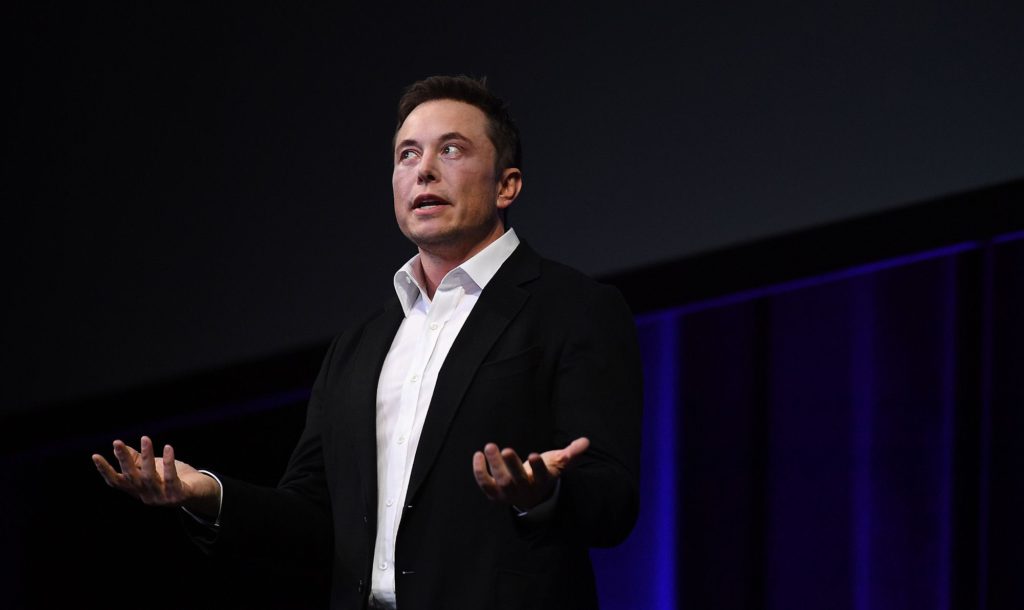
(Bloomberg) — A judge sharply criticized Elon Musk for not properly turning over text messages that could be evidence in Twitter Inc.’s lawsuit seeking to force the billionaire to complete his proposed $44 billion buyout of the social-media platform.

Delaware Chancery Judge Kathaleen St. Jude McCormick said in a Wednesday ruling there were “glaring deficiencies” in how Musk and his lawyers responded to Twitter’s request for text messages he and top aide Jared Birchall sent and received about the proposed deal and his subsequent effort to withdraw from it. She ordered the men to turn over phone records about their texts.

“Third parties produced text messages with Musk that Musk himself did not produce,” she said. Some of the exchanges he produced also had obvious gaps. Still, she noted Musk’s legal team moved to clear up many of the problems Twitter complained about in pre-trial information exchanges.

Alex Spiro, Musk’s lead lawyer, declined to comment on McCormick’s ruling about the texts. Twitter representatives didn’t immediately respond to an email seeking comment.

McCormick noted Musk produced two texts Robert Steel of Perella Weinberg sent him 18 minutes apart on June 17. Steel first asked a question and then subsequently texted, “Ok. Got it…” The second text clearly indicated that Musk replied to the first, the judge said, but the response wasn’t turned over to Twitter.

“Assuming that Musk’s response was not telepathic, one would expect some evidence of it in defendants’ document production,” McCormick wrote. “But defendants provided none by the deadline.”

The judge also said most of the burden in collecting and handing over information in the case has so far fallen on Twitter. But the company’s request for all Musk’s and Birchall’s texts — regardless of their relevance — was “too extreme to be granted.”

Earlier Wednesday, McCormick ruled Musk’s lawyers could amend counterclaims filed in the Twitter case with whistle-blower claims from an ex-company executive the billionaire claims bolster his reasons for walking away from the deal. But the judge also denied Musk’s request to push back an Oct. 17 trial in the case.

Twitter shares rose 6.3% to $41.09 in New York Wednesday.

Read more: Musk Can Use Twitter Whistle-Blower Claims in Buyout Fight

Meanwhile, Musk and Twitter are jousting over whether the company must turn over Slack messages posted by Twitter employees about Musk pulling out of the deal. Musk’s legal team accuses Twitter of reneging on promises to hand over the Slack communications.

While Twitter agreed to turn over Slack communications from officials such as CEO Parag Agrawal and Manish Chabria — the platform’s head of financial analysis and planning — it refused to turn over others, claiming the task of reviewing them is overwhelming, Musk’s lawyers complained.

McCormick heard arguments on the Slack issue at a hearing Tuesday, but has yet to rule on it.

The case is Twitter v. Musk, 22-0613, Delaware Chancery Court (Wilmington)

(Updates with details on fight over Slack messages starting in ninth paragraph.)

More stories like this are available on bloomberg.com

©2022 Bloomberg L.P.
US to Start Economic Talks With 13 Nations to Counter China

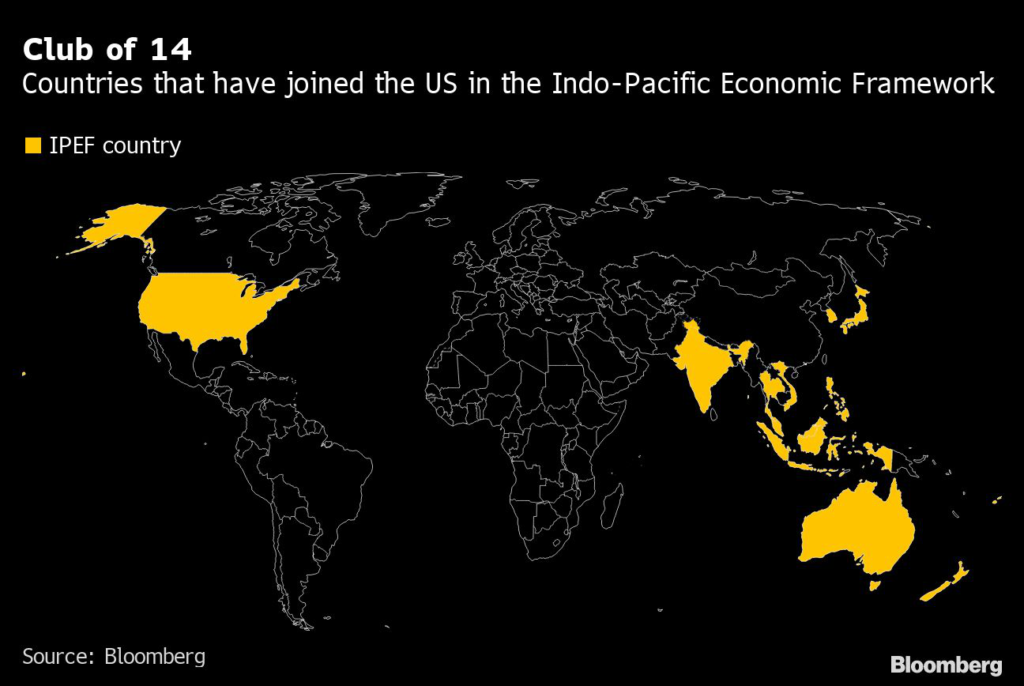
(Bloomberg) — The US is set to host the first gathering of Asian nations on an economic agreement envisioned by the White House as a counter to China’s rising influence in the region.

Thirteen countries are expected to send representatives to the two-day kickoff event starting Thursday in Los Angeles for the Indo-Pacific Economic Framework for Prosperity, or IPEF, which covers about 40% of global gross domestic product. It includes Japan, India, South Korea, Australia and Indonesia, all members of the Group of 20 largest economies.

While the framework is the most significant US economic engagement in the region since Donald Trump pulled out of the Trans-Pacific Partnership in 2017, President Joe Biden’s new effort is thin on specifics and is expected to stop short of reducing tariffs like a traditional free-trade agreement.

“At the moment you’ve got this combination of cautious optimism and continuing uncertainty,” Deborah Elms, executive director of the Asian Trade Centre, said of the framework. “The hope is that you will finish these couple days in LA with a better sense of what exactly are we talking about here. What are the parameters? What is it that I am going to have to do, and what am I going to get for doing that?”

Increasing so-called market access through lower tariffs has been a hallmark of roughly a dozen free-trade agreements that the US has negotiated since Nafta in the early 1990s. But opposition in Washington, from both Democrats and Republicans, has made such deals now politically difficult — if not impossible.

The US will seek to focus on non-tariff issues that can still deliver market access for American exporters, a Biden administration official said Wednesday, without providing specifics beyond the four so-called pillars of the framework — trade; supply chains; clean energy, decarbonization and infrastructure; and taxes and anti-corruption. 

Among those, a potential point of progress could be efforts to combat climate change, particularly after Biden and his Democratic allies in Congress recently secured $370 billion for green energy development.

‘Concrete Benefits’ 

Singapore welcomes development on renewable energy, Tan See Leng, the Southeast Asian city-state’s second minister for trade and industry, said in an interview. The IPEF can be a forum for “cross-fertilization of ideas, and then we can move things together as a bloc,” he said.

Thailand is also focused on the green economy. “This is a big deal,” said Tanee Sangrat, a Foreign Ministry spokesman. “IPEF will provide a cooperation that will help Thailand achieve this makeover for our economy.”

Specific actions on all four pillars, however, are still being worked out. 

“We need to make IPEF a framework where each country feels the concrete benefits,” Yasutoshi Nishimura, Japan’s trade minister, said this week. “We want to hold discussions so that negotiations can begin soon.”

Japan’s Nikkei reported, without providing attribution, that the IPEF group meeting in Los Angeles will also discuss creating a system for sharing semiconductors, medical devices and other vital supplies during international emergencies.

Since IPEF isn’t a traditional trade agreement, the administration likely won’t need congressional approval. Still, Biden’s efforts could face opposition within his own party. Senator Elizabeth Warren warned at a March hearing that IPEF “cannot be TPP 2.0” and must include enforceable labor and climate commitments.

Trump withdrew from the TPP shortly after taking office, fulfilling a campaign promise to exit from a deal negotiated under the Obama administration. It lives on among 11 members as the rebranded Comprehensive and Progressive Agreement for Trans-Pacific Partnership, an agreement China has sought to join. Beijing also helped spearhead a separate regional trade agreement that doesn’t include the US, which offers lower tariffs to many of the same nations in Southeast Asia.

A US official said in May that the timeline for reaching substantive commitments — both binding and non-binding — will be shorter than traditional trade negotiations that include tariff reductions. The US aims to have substantive commitments on which countries will participate in each of the four pillars in about 12 to 18 months, the official said at the time.

Since the IPEF launch in May, the administration has held consultations with groups including organized labor, the business community, and bipartisan members of Congress “on delivering tangible economic benefits to workers and businesses in the US and our IPEF partners,” the Commerce Department said in an emailed statement Wednesday.

The meeting this week also comes as relations with China have deteriorated further after House Speaker Nancy Pelosi’s visit to Taiwan last month amid threats and opposition from Beijing, which regards the self-governed island as its territory. Pelosi was the highest-ranking US politician to visit Taiwan in 25 years, prompting China to respond with unprecedented military drills around the island

Commerce Secretary Gina Raimondo, who along with US Trade Representative Katherine Tai is hosting the meeting in Los Angeles, has said that Pelosi’s trip has made geopolitics with China “particularly complicated.”

The US hasn’t invited Taiwan to join IPEF, even after more than 50 senators wrote to Biden urging him to do so, and is working on a separate framework with the government in Taipei. 

Some participants are reluctant to sign up to any agreement that doesn’t include China, the largest trading partner for many of them. Southeast Asian countries in particular had demanded the US keep the framework open to China, even though it’s highly unlikely the nation will be included anytime soon. Administration officials stressed on a call with reporters Wednesday that IPEF isn’t a choice between Washington and Beijing. 

“We hope that it could be a lot more inclusive,” said Singapore’s Tan.

(Updates with Nikkei report in 12th paragraph.)

More stories like this are available on bloomberg.com

©2022 Bloomberg L.P.

Web-Connected Devices May Have to Meet New EU Cybersecurity Rules

(Bloomberg) — Providers of internet-connected technology — from Apple iPhone software to baby monitors — will have to meet new cybersecurity requirements in the European Union or face fines and possibly have the product taken off the market, according to a draft proposal seen by Bloomberg.

New rules from the European Commission called the Cyber Resilience Act, set to become public next week, are aimed at improving the security of devices in the face of surging online attacks across the globe. Damages from software and hardware cybercrime amounted to roughly $6 trillion last year alone.

Appliances and other household devices are increasingly equipped with sensors and online connections, creating what’s known as the Internet of Things. These products can have “a low level of cybersecurity, reflected by widespread vulnerabilities and the insufficient and inconsistent provision of security updates to address them,” according to the draft, and provide users with “insufficient” information on their level of protection.

“In a connected environment, a cybersecurity incident in one product can affect an entire organization or a whole supply chain, often propagating across the borders of the internal market within a matter of minutes,” the draft said. “This can lead to severe disruptions of economic and social activities or even become life threatening.”

Under the proposed EU rules, products will have to meet various cyber standards to receive an approval marking and be sold regionally. Open-source devices wouldn’t have to meet these rules unless they are marketed commercially.

EU countries — or the EU’s cyber agency, when asked by the commission — will be able to investigate any device sold in the region for noncompliance. Even if they meet the cyber rules, they may still be found to “present a significant cybersecurity risk,” to risk people’s health and safety, or to fail to comply with fundamental rights.

The European Union Agency for Cybersecurity, known as ENISA, will also set up a vulnerability database to help assess cross-border attacks. 

If a device doesn’t meet the new standards, national regulators can have a product recalled or completely taken off the market in the EU. In exceptional circumstances, the commission can do so as well.

Fines for violating an essential part of the regulation proposal could reach 15 million euros ($15 million), or 2.5% of a company’s worldwide annual revenue, whichever is highest. Less serious violations could lead to fines of 10 million euros or 2% of global yearly sales.

If a company is found providing “incorrect, incomplete or misleading” information, it could be fined 5 million euros, or up to 1% of annual revenue.

“In an interconnected single market, we are only as strong as the weakest link,” Internal Market Commissioner Thierry Breton wrote in a 2021 post. “We must therefore improve our level of security collectively.” 

The commission predicts that the proposal will save 180 billion euros to 290 billion euros each year. However, companies and public authorities will have to spend an estimated 29 billion euros to comply with and enforce the new cyber rules.

The Financial Times first reported a draft of the proposal.

More stories like this are available on bloomberg.com

©2022 Bloomberg L.P.

Nexstar Is Looking for New Shows as It Acquires the CW Network

(Bloomberg) — Nexstar Media Group Inc. will look to buy content from various studios as it works to bolster its acquisition of the money-losing CW Network. 

“It’s going to be an open casting call,” Tom Carter, president of the Irving, Texas-based broadcaster, said at an investor conference on Wednesday. “Bring us your best ideas.”

Carter said CW Network has historically purchased shows from its owners Paramount Global and Warner Bros. Discovery Inc. Nexstar on Aug. 15 agreed to acquire a 75% interest in the network for no cash consideration. Warner Bros. and Paramount will each retain a 12.5% share, the company said in a filing.

The CW is the lowest-rated broadcast network, with programming targeted for an audience of 18-to-34-year-olds, while the average age of CW viewers is 58, Carter said on an Aug. 15 call.

Separately, Nexstar said a new prime-time news program featuring former CNN anchor Chris Cuomo as a host will debut Oct. 3 on its NewsNation cable network.

Nexstar calls itself the largest US television station owner, with 200 broadcast stations, including partner stations, in 116 markets.

More stories like this are available on bloomberg.com

©2022 Bloomberg L.P.
First North American Video Game Studio to Unionize Will Dissolve

(Bloomberg) — The first North American video game studio to unionize, Vodeo Games, announced today it was unable to secure funding for future projects. The studio will disband, according to a statement on the company’s Twitter account. 

“We’ve run out of funds and aren’t able to keep the team together — and there is simply no Vodeo without our incredible team,” the California-based company said. Its “final efforts” will go toward releasing their game Beast Breaker on Steam. 

Vodeo’s website shows the studio has 14 workers, some of whom are independent contractors. Its first and only game, Beast Breaker, was released late last year and received positive reviews. 

In December 2021, Vodeo announced it had unionized with the Communications Workers of America’s Campaign to Organize Digital Employees. Vodeo Workers United kicked off a trend, with employees at Activision Blizzard Inc.’s Raven Software and independent studio Tender Claws joining CWA this year. 

In a statement on Twitter, Vodeo Workers United said it was “in the process of collective bargaining but had not yet reached an agreement when it became clear the studio was no longer financially viable. Therefore we decided to halt bargaining.”

Vodeo, Vodeo Workers United and CWA did not immediately respond to requests for comment.

More stories like this are available on bloomberg.com

©2022 Bloomberg L.P.
Stocks Roar Back as Treasuries Halt Bearish Frenzy: Markets Wrap

(Bloomberg) — Stocks climbed the most in about a month as Treasury yields halted a surge to multiyear highs, with traders sifting through remarks from a slew of Federal Reserve speakers. Oil plunged, easing concern about price pressures that could imperil the central bank’s war against inflation.

About 95% of the companies in the S&P 500 moved higher, with every group but energy ending in the green. Only four of the Nasdaq 100’s members fell as a rally in the tech-heavy gauge topped 2%. Apple Inc. rose after unveiling a new lineup of devices with few surprises beyond one major one: It didn’t raise its US prices during one of the worst years for inflation in decades.

Read: Chart Border Is Graveyard for Shorts in Big Stock and Bond Rally

“Stocks are rebounding as the global bond market selloff takes a break,” wrote Edward Moya, senior market analyst at Oanda. “Economic momentum remains for the US economy, and that could only improve if inflation continues to soften. Investors seem poised to enter a holding pattern until the September 13th inflation report.”

Oil benchmarks took a hit as demand concerns emanating from China prompted a wave of selling as prices breached technical warning levels. West Texas Intermediate settled below $82 a barrel while Brent closed at $88. The dollar fell after a rally that rattled currencies around the globe and briefly drove gold below the “danger zone” of $1,700 per ounce.

In the final week before officials enter a blackout period ahead of the Sept. 20-21 policy meeting, Fed Vice Chair Lael Brainard said the US will have to raise interest rates to restrictive levels, while cautioning risks would become more two-sided in the future. She also sees the scope for lower retail margins to ease price pressures.

Separately, Fed Bank of Cleveland President Loretta Mester warned against declaring early victory on inflation, while her Boston counterpart Susan Collins said it’s too soon to specify what policy makers should do at this month’s gathering. Fed Vice Chair for Supervision Michael Barr said that inflation is “far too high” and central bankers are committed to restoring price stability.

High prices and a tight labor market weighed on US economic prospects over the next year, though inflation showed signs of decelerating, the Fed said in its Beige Book.

Equities have tumbled since mid-August amid a panoply of risks spanning from restrictive central banks, Europe’s energy crisis and China’s economic slowdown. The recent slide in the S&P 500 pared a bounce from June lows that a Goldman Sachs Group Inc. team led by Peter Oppenheimer described as a “bear-market rally.” The strategists “expect further weakness and bumpy markets before a decisive trough is established.”

Read: Burry of ‘Big Short’ Fame Says ‘No, We Have Not Hit Bottom Yet’

American stocks haven’t fallen enough to account for the elevated inflation pressures that will drive the Fed to keep interest rates high for a sustained period of time, said billionaire investor Thomas Peterffy.

The founder and chairman of Interactive Brokers Group Inc. told Bloomberg Television the S&P 500 won’t hit a bottom until it trades at levels between 3,300 and 3,500. After it reaches that trough, it will stay there for “a while” until the US contends with an inflation-fueled economy. The gauge closed at 3,979.87 Wednesday.

“Economies all around the world are slowing down, and that’s really not a market that says we’re on the verge of a dynamic rebound in equities,” Margaret Patel, senior portfolio manager at Allspring Global Investments, told Bloomberg Television. “Earnings are going to decelerate a lot. That says a lot of stocks could go down.”

Bank of America Corp. clients were net sellers of US equities for a third straight week. As the S&P 500 posted weekly losses of over 3%, the group sold $1.9 billion in equities, including exchange-traded funds and single stocks, strategists led by Jill Carey Hall wrote. 

The weakening economy should favor continued outperformance for cheaper, so-called value stocks over their growth equivalents, a separate Goldman note from strategists led by Cormac Conners said.

“History shows value stocks outperform around the start of recessions,” they wrote.

What to watch this week:

  • European Central Bank rate decision, Thursday
  • Fed Chair Jerome Powell due to speak, Thursday
  • Chicago Fed President Charles Evans and his Minneapolis counterpart Neel Kashkari due to speak, Thursday
  • EU energy ministers extraordinary meeting on emergency intervention in electricity markets, Friday

Are you bullish on energy-related assets? This week’s MLIV Pulse survey focuses on energy and commodities. Please click here to participate anonymously.

Some of the main moves in markets:

Stocks

  • The S&P 500 rose 1.8% as of 4 p.m. New York time
  • The Nasdaq 100 rose 2.1%
  • The Dow Jones Industrial Average rose 1.4%
  • The MSCI World index rose 1.1%

Currencies

  • The Bloomberg Dollar Spot Index fell 0.4%
  • The euro rose 1% to $1.0007
  • The British pound was little changed at $1.1528
  • The Japanese yen fell 0.7% to 143.74 per dollar

Bonds

  • The yield on 10-year Treasuries declined nine basis points to 3.26%
  • Germany’s 10-year yield declined six basis points to 1.58%
  • Britain’s 10-year yield declined seven basis points to 3.03%

Commodities

  • West Texas Intermediate crude fell 5.8% to $81.85 a barrel
  • Gold futures rose 0.9% to $1,728.60 an ounce

More stories like this are available on bloomberg.com

©2022 Bloomberg L.P.

Economic Anxiety Shows Up In Merriam-Webster’s Latest Dictionary Additions

(Bloomberg) — About once a year, Merriam-Webster adds new words to the dictionary. This September, 370 made it in.

Some are related to popular food trends like pumpkin spice, oat milk or omakase, which means chef’s choice—typically in a sushi setting. Others are acronyms frequently used across social media, such as FWIW (for what it’s worth), and ICYMI (in case you missed it.)

But among the list, one theme stands out: the number of words reflecting the economic uncertainty and post-pandemic anxieties that have recently crept into popular usage. Here are just a few as Webster defines them.

shrinkflation: the practice of reducing a product’s amount or volume per unit while continuing to offer it at the same price.

side hustle: work performed for income supplementary to one’s primary job.

supply chain: the chain of processes, businesses, etc. by which a commodity is produced and distributed; the companies, materials, and systems involved in manufacturing and delivering goods.

subvariant: one of two or more distinctive forms or types of the same variant.

Newer buzzwords in finance and tech also made the list: 

metaverse: a persistent virtual environment that allows access to and interoperability of multiple individual virtual realities.

altcoin:  any of various cryptocurrencies that are regarded as alternatives to established cryptocurrencies and especially to Bitcoin.

Others reflect climate concerns and those skirting corporate ESG responsibilities.

greenwash: to make (something, such as a product, policy, or practice) appear to be more environmentally friendly or less environmentally damaging than it really is.

atmospheric river: a concentrated band of water vapor that flows through the atmosphere.


More stories like this are available on bloomberg.com

©2022 Bloomberg L.P.
Apple’s iPhone 14 Offers Camera Upgrades, Satellite Feature

(Bloomberg) — Apple Inc. unveiled a new lineup of devices Wednesday with few surprises beyond one major one: It didn’t raise its US prices during one of the worst years for inflation in decades. 

At its biggest product-launch event of the year, dubbed Far Out, the company introduced the iPhone 14, fresh AirPods Pro earbuds and an Apple Watch upgrade that included a first-ever Ultra model. The iPhone retains the general look of the older version while getting camera enhancements, a long-anticipated satellite-messaging feature and — on the higher-end models — a new interface called the Dynamic Island. 

Apple is betting the new features, along with the lack of a big price hike, will be enough to ward off competition from Samsung Electronics Co. and other smartphone rivals. The company now accounts for roughly half of smartphone sales in the US and looks to build on those gains. 

“While many of the features announced today are incremental improvements rather than groundbreaking new innovations, we believe that Apple has done enough to drive demand by persuading consumers to upgrade and indulge in its new products,” said Neil Saunders, managing director of research firm GlobalData Plc.

Apple shares rose nearly 1% to $155.96 in New York following the presentation. They remain down 12% for the year, part of a broader pullback for tech stocks. 

The bulk of the iPhone upgrades are coming to the higher-end Pro line. Those devices will get a 48-megapixel camera and a screen that’s capable of always staying on in a low-power mode, similar to recent versions of the Apple Watch. That will let the new phones show widgets with bits of information — weather, calendar appointments and stock tickers, for instance — while the rest of the screen remains off. 

Apple has redesigned the notch at the top of the screen, essentially turning it into a new interface called the Dynamic Island. The Pro devices also will get the speedier new A16 processor, while the standard line will run a modestly souped-up version of the current A15. Apple describes the A16 as the fastest chip in a smartphone, 40% speedier than the competition.

The standard iPhone 14 models look similar to the iPhone 13 from last year, but with a twist: Apple has dropped the mini version and added a model with a larger, 6.7-inch display.

Camera improvements include a new Action mode for video that helps stabilize shots. And the device embraces the eSIM standard, which dispenses with a physical SIM card. The iPhone 14 also offers car-crash detection, similar to the latest Apple Watch. The standard iPhone 14 will cost $799 and ship on Sept. 16, with the Plus version coming in at $899 on Oct. 7.

The iPhone 14 Pro starts at $999, with the Pro Max model costing $1,099. They will be available Sept. 16, with preorders starting Friday.

Apple’s prices are largely unchanged from last year, despite a US annual inflation rate of 8.5% in July. Its carrier partners also unveiled a slew of promotions Wednesday, including offers for free phones and other discounts.

Some analysts had predicted that increases were coming, but Apple has found more subtle ways to steer customers toward higher price points. By saving its best new features for the Pro devices or other higher-end models, the company looks to upsell more customers. 

“We’re constantly challenging ourselves to raise the bar and make it better,” Chief Executive Officer Tim Cook said during the presentation.

Apple is expected to command almost 49% of the US smartphone market this year, according to Insider Intelligence, with that increasing to nearly 50% by 2024. The company has made gains on Google’s Android operating system, used by competitors such as Samsung.

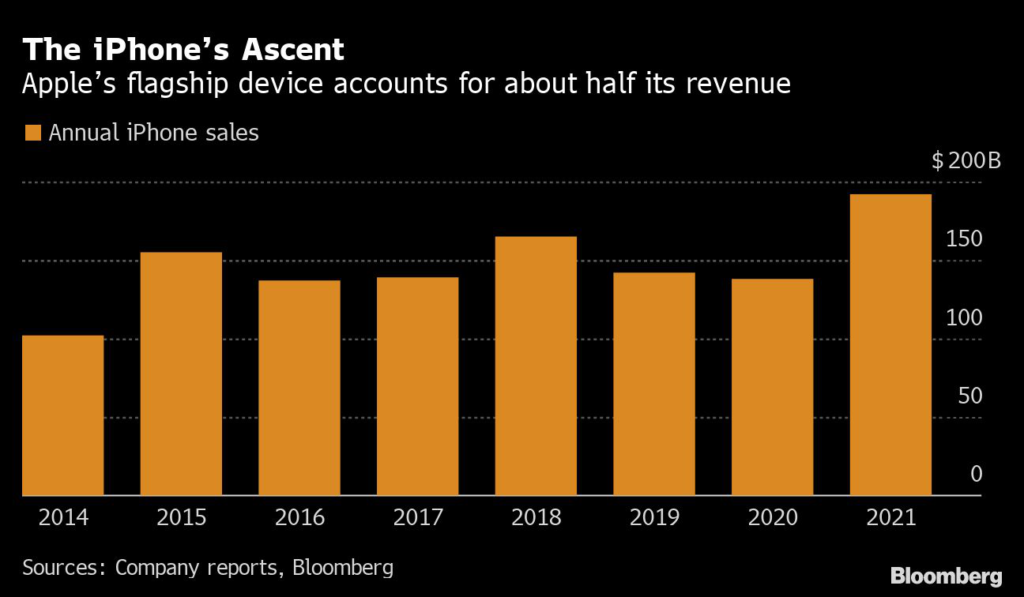
The iPhone remains Apple’s most important product by far, generating roughly 50% of the company’s sales on its own and helping fuel additional revenue from services like the App Store and Apple TV+. It also coaxes customers to buy accessories like AirPods and the Apple Watch.

In other changes announced Wednesday, the iPhone 14 Pro will get a new display with thinner bezels and more active area. The screen is also brighter, at 1,600 nits, the same level of brightness of the Pro Display XDR.

The new satellite service, meanwhile, will let users send SOS messages without a cellular connection. Bloomberg News first reported last year that the feature was coming.

Apple plans to offer it free for the first two years, starting in November. Garmin Ltd., a maker of satellite devices, sells a similar service for about $15 a month. 

Even Apple’s new Ultra smartwatch — its push into a higher-end market — was priced lower than anticipated. It will start at $799.

(Updates shares in fifth paragraph.)

More stories like this are available on bloomberg.com

©2022 Bloomberg L.P.
First Aerial Delivery Drone Granted Design Approval by FAA

(Bloomberg) — US aviation regulators approved designs for the first flying drone built specifically for shipping packages, a major step forward for the fledgling remote delivery industry.

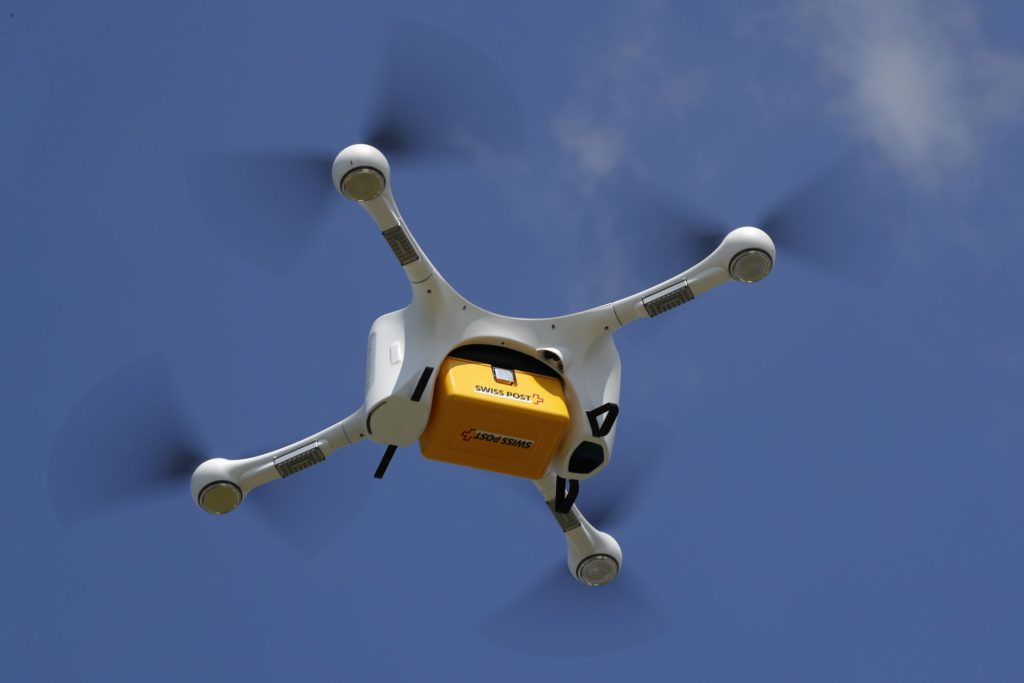
Matternet Inc.’s Model M2, a four-rotor copter capable of carrying a 4-pound (1.8-kilogram) package, is considered safe and reliable, the Federal Aviation Administration said in a statement Wednesday. Winning regulatory permission for aeronautical designs is one of the major hurdles required before the devices can operate routinely for commercial operations. 

“It is an important milestone in the FAA’s support for the development of innovative drone technology,” the FAA said in the release.

Other restrictions remain before package delivery by aerial drone becomes widespread, such as the need for a low-altitude air-traffic system and rules to allow automated flights. But FAA approval shows the technology is maturing and the agency considers this new type of rotor-powered vehicle to have the equivalent reliability of traditional aircraft. 

The FAA action, known as a type certificate, is the first granted for an unpiloted vehicle since drones began to be more widely used almost a decade ago. The agency had only given restricted approvals for drone designs in the past. 

Reviewing an aircraft’s design is one of the layers of safety the FAA has traditionally applied to the aviation industry. But it has been difficult to adapt many of the basic rules — such as how to protect people on board — and that has slowed the process for the aerial drone commercialization. The approval has broad implications for other unusual aviation technologies, such as the new class of urban air taxis for human passengers. 

Closely held Matternet, based in Mountain View, California, has worked with United Parcel Service Inc. and conducted FAA-sanctioned delivery tests. It also has operated in other countries. 

The M2 drone will have a top speed of 45 miles (72 kilometers) per hour and fly no higher than 400 feet off the ground, the FAA said. The company didn’t immediately respond to a request for comment. 

Alphabet Inc.’s Wing LLC and Amazon.com Inc.’s Prime Air, among numerous other companies, have been conducting tests and gradually gaining less expansive approvals from the FAA for what they are betting will be a technology that transforms how products are delivered to people’s homes. 

(Updates with additional details from fourth paragraph.)

More stories like this are available on bloomberg.com

©2022 Bloomberg L.P.
Amazon’s CEO Says Bid to Overturn Union Victory Will Be Protracted

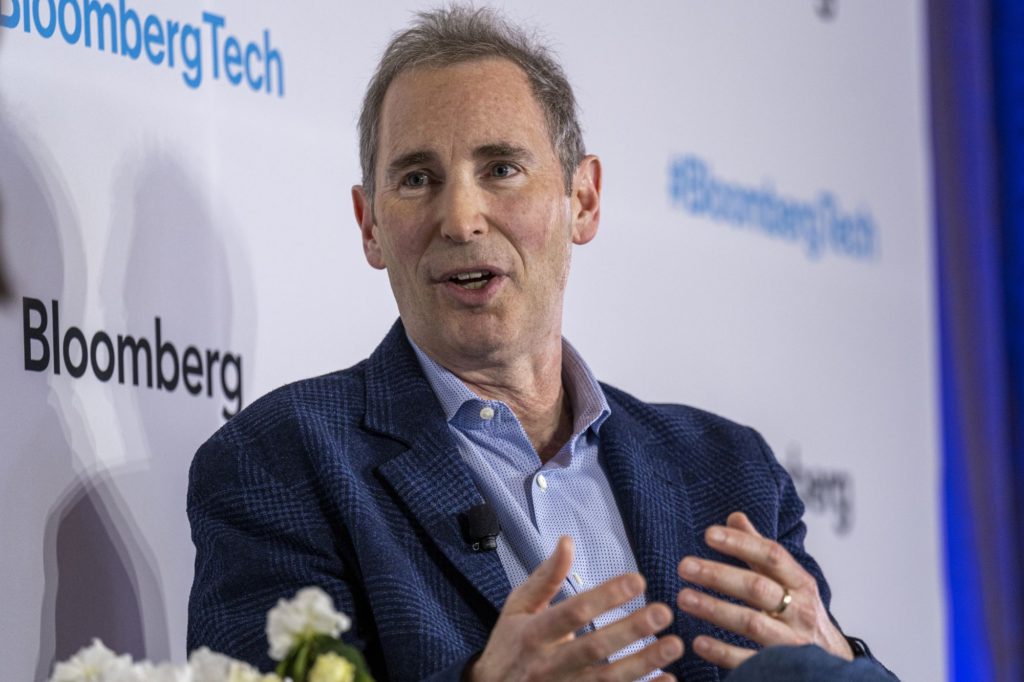
(Bloomberg) — Amazon.com Inc. Chief Executive Officer Andy Jassy said the company’s effort to overturn a union victory at a New York warehouse would take a long time to play out, an indication that the e-commerce giant plans to contest the election vigorously.  

Jassy on Wednesday said that there were “a lot of disturbing irregularities” during the vote that saw the upstart Amazon Labor Union win the right to represent more than 8,000 of the company’s workers at a warehouse on Staten Island. Amazon last week lost its initial appeal of the vote, with a US labor board official finding the company failed to prove its allegations that the election was unfair. 

Union officials urged Amazon to accept the results of the vote and begin negotiations on an employment contract, but the company said it planned to appeal. Speaking at the Code Conference in Los Angeles, Jassy indicated that the company would likely take its case beyond the National Labor Relations Board, the federal agency that conducts union elections. 

Amazon has alleged misconduct by union officials, including trespassing on company property, disrupting operations and handing out marijuana in exchange for workers’ support. The company also alleged that the NLRB had given workers the impression that the government supported the union.  

“I think that’s going to take a long time to play out, because I think it’s unlikely the NLRB will find against themselves,” Jassy said. Amazon has until next week to file objections to the NLRB hearing officer’s report, which would be reviewed by another agency official. Amazon could also challenge the NLRB’s conduct in federal court, a widely anticipated outcome.   

Though Amazon faces union drives at a handful of facilities, Jassy noted there had been just a single successful vote in the US to date. “I think it hasn’t been a huge, broad union issue,” he said. 

Employees at the company’s warehouses have to choose between “the compelling set of benefits they have today with us,” or throw in with a union, which would mean paying union dues. “And it’s unclear what benefits they’ll get. Whether they’ll be as good as what they have now or not.” 

Jassy also reiterated Amazon’s opposition to an antitrust bill sponsored by Senator Amy Klobuchar, a Minnesota Democrat, saying it was broad, overreaching and vague, and would likely degrade the Amazon Prime membership program. 

He said he wasn’t sure whether Federal Trade Commission Chair Lina Khan, who has long criticized Amazon’s market power, would seek to oppose the company’s pending $3.49 billion acquisition of primary-care company 1Life Healthcare Inc., operator of the One Medical line of doctor’s offices. “It’s a very, very large space, of which One Medical is a very, very small share,” Jassy said. 

He said Amazon remained committed to the health care market despite deciding to wind down its Amazon Care telehealth service. “If there was ever a customer experience that needs reinvention, particularly in the US, it’s health care,” he said. “That’s part of what we’re trying to solve with the One Medical acquisition.” 

More stories like this are available on bloomberg.com

©2022 Bloomberg L.P.

Close Bitnami banner
Bitnami
