Bloomberg

Fed’s Barr Says Scrutiny of Bank Mergers Will Be a Priority

(Bloomberg) — The Federal Reserve’s new top bank watchdog is pledging to take a tough approach to evaluating mergers between lenders as tie-ups between regional firms grow politically contentious in Washington. 

Michael Barr, the Fed’s vice chair for supervision, said in his first major speech since taking office in July that reviewing the central bank’s process for approving combinations was one of his priorities. While rules already prevent the biggest Wall Street giants from merging, Democrats have been arguing that more scrutiny is needed for tie-ups involving smaller firms.

“Mergers are a feature of vibrant industries, but the advantages that firms seek to gain through mergers must be weighed against the risks that mergers can pose to competition, consumers and financial stability,” Barr said in a speech Wednesday at The Brookings Institution in Washington. He added that the regulator was weighing new guidance on the issue. 

Barr, an architect of the Dodd-Frank Act of 2010, is expected to increase scrutiny of banks compared to the oversight they faced during the Trump administration. His nomination won bipartisan support earlier this year after he pledged not to let social issues drive his stance in overseeing Wall Street.

In his wide-ranging remarks, Barr also committed to putting in place new capital requirements for banks that align with the global Basel III standards. He said the Fed would work with other US regulators and seek public comment in standing up the new “Basel III endgame” standards.

“Nothing is more basic to the safety and soundness of banks and the stability of the financial system than capital,” he said. 

Digital Assets

Barr also signaled that the Fed would be focused on the fast-growing digital-asset industry. 

He said he hoped Congress would work “expeditiously” on legislation to bolster regulators’ ability to oversee stablecoins. Still, in response to a question during the event, Barr said that multiple regulators already have the authority to oversee the assets.

Meanwhile, banks’ involvement in digital currencies is also set to face more Fed scrutiny, he indicated.

“I plan to make sure that the crypto activity of banks that we supervise is subject to the necessary safeguards that protect the safety of the banking system as well as bank customers,” Barr said. “Banks engaged in crypto-related activities need to have appropriate measures in place to manage novel risks associated with those activities and to ensure compliance with all relevant laws, including those related to money laundering.”

Inflation, Climate

Barr also touched on monetary policy. He said inflation is “far too high” and US central bankers are committed to restoring price stability. The Fed official declined to say how high the benchmark rate would need to go to tame price pressures. 

On the environment, he said the Fed’s role in dealing with climate change is “narrow” and would be limited to looking at risks posed to the financial sector. He reiterated that the central bank wouldn’t tell lenders which industries should be offered financing.

(Updates with comments on inflation and climate risk in last two paragraphs.)

More stories like this are available on bloomberg.com

©2022 Bloomberg L.P.

Stocks Rally as Treasury Selloff Takes a Breather: Markets Wrap

(Bloomberg) — Stocks rallied as Treasury yields halted a surge to multiyear highs, with traders sifting through remarks from a slew of Federal Reserve speakers. Oil tumbled, easing concern about further price pressures that could imperil the central bank’s war against inflation.

The S&P 500 headed toward its best day since Aug. 10 as every group but energy moved higher. The tech-heavy Nasdaq 100 outperformed — with only two of its members in the red. Apple Inc. climbed after unveiling the latest installment of its flagship product, the iPhone 14, banking on camera upgrades and a new emergency satellite-messaging feature to ward off competition from smartphone rivals.

“Stocks are rebounding as the global bond market selloff takes a break,” wrote Edward Moya, senior market analyst at Oanda. “Economic momentum remains for the US economy, and that could only improve if inflation continues to soften. Investors seem poised to enter a holding pattern until the September 13th inflation report.”

Read: Day Traders Throwing in the Towel Send Contrarian Signal

West Texas Intermediate crude slumped below $85 a barrel for the first time since January. The dollar fell after a rally that rattled global currencies and briefly drove gold below the “danger zone” of $1,700 per ounce.

In the final week before officials enter a blackout period ahead of the Sept. 20-21 policy meeting, a hefty lineup of central bankers are offering their views. Fed Vice Chair Lael Brainard said the US will have to hike rates to restrictive levels and keep them there for “some time,” while cautioning risks would become more two-sided in the future. She also sees the scope for lower retail margins to ease price pressures.

Separately, Fed Bank of Cleveland President Loretta Mester warned against declaring early victory on inflation, while her Boston counterpart Susan Collins said it’s too soon to specify what policy makers should do at this month’s gathering. Fed Vice Chair for Supervision Michael Barr said that inflation is “far too high” and US central bankers are committed to restoring price stability.

US economic growth prospects were weak and set to slump further over the next year, while price growth showed signs of decelerating, the Fed said in its Beige Book report. Price levels “remained highly elevated,” but nine districts reported some degree of moderation in their rate of increase.

Equities have tumbled since mid-August amid a panoply of risks spanning from restrictive central banks, Europe’s energy crisis and China’s economic slowdown. The recent slide in the S&P 500 pared a bounce from June lows that a Goldman Sachs Group Inc. team led by Peter Oppenheimer described as a “bear-market rally.” The strategists “expect further weakness and bumpy markets before a decisive trough is established.”

Read: Burry of ‘Big Short’ Fame Says ‘No, We Have Not Hit Bottom Yet’

US stocks haven’t fallen enough to account for the elevated inflation pressures that will drive the Fed to keep interest rates high for a sustained period of time, said billionaire investor Thomas Peterffy.

The founder and chairman of Interactive Brokers Group Inc. told Bloomberg Television the S&P 500 won’t hit a bottom until it trades at levels between 3,300 and 3,500. After it reaches that trough, which represents a slide of as much as 16% from Tuesday’s close, it will stay there for “a while” until the US contends with an inflation-fueled economy.

“Economies all around the world are slowing down, and that’s really not a market that says we’re on the verge of a dynamic rebound in equities,” Margaret Patel, senior portfolio manager at Allspring Global Investments, told Bloomberg Television. “Earnings are going to decelerate a lot. That says a lot of stocks could go down.”

Bank of America Corp. clients were net sellers of US equities for the third straight week. As the S&P 500 posted weekly losses of over 3%, the group sold $1.9 billion in equities, including exchange-traded funds and single stocks, strategists led by Jill Carey Hall wrote. Industrials, tech and real estate bore the brunt of the selling among the clients, who were net sellers in five of the S&P 500’s 11 sectors. Meanwhile, consumer discretionary and communication services saw the largest inflows.

The weakening economy should favor continued outperformance for cheaper, so-called value stocks over their growth equivalents, a separate Goldman note from strategists led by Cormac Conners said.

“History shows value stocks outperform around the start of recessions,” they wrote. Goldman economists forecast a one in three probability of a recession in the coming year.

Traders pushed the market-implied odds of another three-quarter-point Fed rate increase in September — instead of a smaller half-point move — to the highest level since the central bank’s last meeting. The peak was reached shortly after a Wall Street Journal article suggested the larger move appeared likely. While it was only briefly sustained, the rate of the swap contract referencing this month’s meeting remains about two basis points higher on the day.

Meantime, Wednesday’s plunge in crude was exacerbated by a bearish technical picture. The US oil benchmark formed a so-called death cross for the first time since February 2020, a pattern in which the 50-day moving average falls below its 200-day marker. Such a crossover typically signals a loss of short-term momentum and further selling pressure ahead.

What to watch this week:

  • European Central Bank rate decision, Thursday
  • Fed Chair Jerome Powell due to speak, Thursday
  • Chicago Fed President Charles Evans and his Minneapolis counterpart Neel Kashkari due to speak, Thursday
  • EU energy ministers extraordinary meeting on emergency intervention in electricity markets, Friday

Are you bullish on energy-related assets? This week’s MLIV Pulse survey focuses on energy and commodities. Please click here to participate anonymously.

Some of the main moves in markets:

Stocks

  • The S&P 500 rose 1.8% as of 2:54 p.m. New York time
  • The Nasdaq 100 rose 2.1%
  • The Dow Jones Industrial Average rose 1.4%
  • The MSCI World index rose 1%

Currencies

  • The Bloomberg Dollar Spot Index fell 0.2%
  • The euro rose 0.8% to $0.9987
  • The British pound fell 0.2% to $1.1502
  • The Japanese yen fell 0.9% to 144.13 per dollar

Bonds

  • The yield on 10-year Treasuries declined eight basis points to 3.27%
  • Germany’s 10-year yield declined six basis points to 1.58%
  • Britain’s 10-year yield declined seven basis points to 3.03%

Commodities

  • West Texas Intermediate crude fell 5.7% to $81.95 a barrel
  • Gold futures rose 0.8% to $1,726.70 an ounce

More stories like this are available on bloomberg.com

©2022 Bloomberg L.P.

Apple’s New iPhone Sets Off Slew of Wireless Carrier Promotions

(Bloomberg) — The arrival of Apple Inc.’s latest iPhone kicks off another season of sales promotions from the top three US wireless carriers, including free phones, discounts and, in the case of Verizon Communications Inc., a plan that includes Apple’s music, TV and data-storage services for free.

Apple introduced several product updates on Wednesday, including the new iPhone 14 Pro for $999. Carriers are offering that model for free under certain conditions.

The promotions triggered by new iPhone releases have fueled a surge in mobile subscriber growth at AT&T Inc. and T-Mobile US Inc. over the past two years. Those gains have put pressure on Verizon, which reported far fewer new customers than analysts expected in the second quarter. The discounting threatens to crimp industry profit margins as the battle for market share continues.

Here are the offers:

  • AT&T said new and existing customers can get a free iPhone 14 Pro. The company is also offering customers who trade in old phones as much as $1,000 toward other new iPhones. The deal requires the customer to sign on to a select unlimited plan. AT&T is also cutting in half the price for the older iPhone 12 mini.
  • T-Mobile is giving away a free iPhone 14 Pro to new and existing customers with an eligible trade-in and the selection of its top tier Magenta Max unlimited plan. The company is also offering a twofer: buy one iPhone 14 and get a second one free, if the customer is adding a new line.
  • Verizon, in an exclusive deal with Apple, is introducing the One Unlimited for iPhone plan. It includes the Apple One bundle (Apple Music, Apple TV+, Apple Arcade video games and iCloud storage) starting at $90 a month. This offer is similar to, yet separate from, one that includes a bundle of Walt Disney Co.’s streaming TV services.

More stories like this are available on bloomberg.com

©2022 Bloomberg L.P.

DeFi Projects Look to Replenish Treasuries After Crypto Collapse

(Bloomberg) — Some of the largest projects left standing in decentralized finance, created as a parallel universe to traditional lending but minus intermediaries such as brokerages and banks, appear to be still feeling the pinch of the springtime collapse of the sector. 

Aave Companies, the main developer behind the biggest DeFi lending project, is seeking $16.28 million from the so-called decentralized autonomous organization that governs the protocol. It is the first time the development team ever asked for money from the Aave DAO, according to a proposal. A vote on the plan, which will close on Sept. 8, has already received the quorum needed for approval.

“As the Aave protocol has grown into what it is today, costs associated with development have risen substantially,” the proposal said. “Building an innovative, secure and battle-tested version of a protocol such as Aave V3 requires experienced builders across a variety of skill sets that are fairly compensated for their work.”

  • Read more: The Sleuths Who Protect Crypto From Hackers Are Raking in Money

Aave’s developers aren’t alone in seeking to weather DeFi’s ongoing liquidity crunch. Lido DAO, which manages Lido Finance, one of the biggest projects as measured by the total value of crypto locked on the platform, recently approved a proposal to sell 10 million of Lido’s native token to the venture capital firm Dragonfly Capital. The sale followed the rejection of several proposals put before its community on how to manage its assets in order to cover two years worth of expenses. 

“Candidly, we moved too slowly,” said Jacob Blish, head of business development at Lido Finance, acknowledging the project’s failure to anticipate the consequences of the crisis earlier. He added that Lido had focused on everything else but managing its money in the middle of the bull market. 

At its height earlier this year, money woes seemed like the last problem DeFi would have. The sector attracted billions of dollars in investment and saw activity surge, generating million of dollars in revenue. The value of the treasuries of top DeFi projects have come down significantly in tandem with token prices during the current bear market, according to blockchain data provider Nansen.      

Aave DAO’s liquid assets stand at $378 million, compared with over $800 million in April. Lido DAO saw its liquid assets’ value drop to around $344 million from about $800 million. Uniswap, one of the most popular decentralized exchanges, also saw the value of its DAO treasury drop to about $1.7 billion, from $2.5 billion five months ago. The three are among the wealthiest DeFi projects based on the value of their treasuries.

“We really started understanding how serious this was going to get once we entered into mid, late May, as Terra and the CeFi protocols started getting worse with inflation running away, the war overseas, whatever else is going on,” Lido’s Blish said.

Unlike the typical tech startup, the treasuries of DeFi projects are usually comprised of their native tokens as well as other cryptocurrencies. Aave’s proposal is mostly for stablecoins.   

“We’ve seen protocols being just too bullish on crypto and having all their treasury in Ethereum” or Bitcoin, said Diogo Mónica, co-founder and president of crypto platform Anchorage Digital “Whenever crypto goes down, their treasuries also go down, which materially changes their ability to run their protocols, businesses, treasuries and foundations.”

In hindsight, some industry observers said it isn’t surprising that some of the biggest DeFi projects are struggling with money. Then there is the examples of the likes of Kyber Network, a decentralized trading platform, which disclosed previously that it had “a small portion” of Treasury exposed to the failed hedge fund Three Arrows Capital. 

“A lot of them are more technical founders who are extremely book smart,” said Jake Dwyer, managing director at crypto financial services firm GSR. “When it comes to finance, they are not experienced asset managers.”  

More stories like this are available on bloomberg.com

©2022 Bloomberg L.P.

Apple Unveils Bigger, Rugged Watch Aimed at Outdoor Athletes

(Bloomberg) — Apple Inc. unveiled a new line of smartwatches that includes a bigger, more rugged model called Ultra, aiming to attract hikers, long-distance runners and other serious athletes. 

The $799 device has a larger screen and a new button that gives users “quick physical control” for a range of functions, the company said Wednesday during a presentation dubbed Far Out, an event that will include iPhone and AirPods announcements. The Ultra also has a bigger battery that can keep it running for up to 60 hours in low-power mode.

The Apple Watch Ultra is part of a next-generation line of devices that will add body-temperature tracking, crash detection and the new lower-power mode. The standard model in the line, known as Series 8, will starts at $399, with a cellular version costing $499. The temperature-tracking feature will help women monitor their ovulation and other health issues, Apple said. 

The company also is rolling out a redesigned version of its lower-end SE model. It starts at $249, with the cellular model coming in $349. 

The Apple Watch has become an increasingly more important part of the tech giant’s business, accounting for a large portion of its Wearables, Home and Accessories segment, which generated about $8 billion last quarter. The Apple Watch is tied to the iPhone, meaning the product helps push users to buy newer smartphone models and benefits Apple beyond just the price of the smartwatch’s hardware.

(Updates with more details on the Ultra starting in second paragraph.)

More stories like this are available on bloomberg.com

©2022 Bloomberg L.P.

Crypto Lender Celsius Misled Investors, Vermont Regulator Says

(Bloomberg) — Celsius Network Ltd., the bankrupt cryptocurrency lender, may have hidden its financial trouble from its investors and “engaged in the improper manipulation of the price” of the platform’s tokens to boost the company’s balance sheet and financials, according to a new court filing. 

The Vermont Department of Financial Regulation submitted the filing on Wednesday in support of the United States Trustee’s motion to appoint an independent examiner. The trustee handling Celsius’s bankruptcy case previously said that it is seeking an examiner to help get additional information and clear up “confusion and anxiety.”

The latest filing shows that, based on a preliminary analysis of financial records, Celsius posted “massive losses” in the first seven months of 2021 and experienced “two material adverse events” in June and July of that year. And that the company had kept its losses from investors, despite state and federal securities laws requirements to disclose its financial statements.

Moreover, the filing also alleged that Celsius may have manipulated the price of its CEL token. The move may have “artificially” inflated the company’s CEL holdings on its balance sheet.

The company “never earned enough revenue to support the yields being paid to investors,” the filing said.

“During the course of the multistate investigation, it has become clear that Celsius, through its CEO Alex Mashinsky and otherwise, made false and misleading claims to investors about, inter alia, the company’s financial health and its compliance with securities laws,” the filing said. “Both of which likely induced retail investors to invest in Celsius or to leave their investments in Celsius despite concerns about the volatility of the cryptocurrency market.”

The Vermont and other state regulators are “especially concerned” about losses suffered by Celsius’s retail investors, including those who have invested their college funds or retirement accounts with Celsius.

“The appointment of an examiner is critical to ensure the interests of these investors are protected,” the filing said.

Bloomberg reported that the lender asked for a US bankruptcy judge’s permission to release about $50 million worth of cryptocurrencies stuck in so-called custody accounts on Celsius so it can give coins back to users who are locked out. But it was just a fraction of the more than $200 million trapped in custody accounts on the platform.

More stories like this are available on bloomberg.com

©2022 Bloomberg L.P.

The EU Is Getting Ready for a Prolonged Crisis: Energy Update

(Bloomberg) — The European Union is set to intervene in energy markets to take the pressure off companies that are being squeezed by a liquidity crunch. It will also propose a clawback on excess profits by power and oil companies as it seeks to protect citizens from soaring costs.

EU officials are set to meet in Brussels on Friday to consider next steps. All eyes are on the calendar as the cold season approaches — but this winter may be just the beginning of a prolonged crisis, according to some observers. 

The bloc is also considering capping the prices paid to Russia for imported gas, Commission President Ursula von der Leyen said earlier, raising the stakes in a standoff with Moscow. President Vladimir Putin has said Russia won’t supply oil or gas to any nations that introduce price caps.

Key Developments:

  • Europe Faces Even Tougher Winters Ahead From Putin’s Gas Squeeze
  • EU Set to Intervene to Ease Liquidity Strains in Energy Markets
  • Citi Says High Europe Gas Prices to Stay Until Later in Decade
  • Europe Aluminum Cuts Get Deeper by the Day
  • Scholz Accuses Russia of ‘Blackmail’ Over Gas Pipeline Shutdown

Why Europe Wants to Change the Way Power Gets Priced: QuickTake

(All timestamps London.)

Gas Closes Lower for a Second Day (5:30 p.m.) 

European gas prices settled 11% lower, dropping for a second day as traders weighed interventions being proposed by the European Commission to intervene in markets in an attempt to lower costs for consumers. 

Dutch Support for Russia Gas Price Cap (4:27 p.m.)

The Netherlands would support a price cap on Russian gas, according to a person with direct knowledge of the matter. The Dutch government also backs making a 15% voluntary reduction of gas demand in the EU mandatory, the person said on condition of anonymity. Reuters was first to report the Dutch government’s support for the two proposals.

The Dutch Minister for Climate and Energy Policy Rob Jetten told Bloomberg last week that price caps will be the most difficult part of the discussion as the EU’s energy ministers are due to decide how to respond to the crisis at an emergency meeting on Friday.

Sugar Seeks to Get Ahead of Crisis (3:15 p.m.)

European sugar companies are processing crops a few weeks earlier than usual this year to try to avoid the worst of a winter energy crunch. Starting sooner should bring forward the end of the campaign, which typically wraps up during the coldest months — when energy supply is expected to be especially tight.

Germany’s Nordzucker AG has began processing, while Suedzucker AG and French producers Cristal Union and Tereos also plan earlier starts. But there’s a risk that doing so will mean beets — which have already been hit by drought — miss out on much-needed rain, potentially curbing production.

Switzerland Takes More Steps (2:45 p.m.)

The Swiss government plans a hydropower reserve to strengthen energy supplies and help avoid bottlenecks near the end of the winter. The reserve can only be tapped to bridge critical supply shortages that the market can’t regulate itself, the government said in a statement on Wednesday. It’s one of several measures being taken. On Friday, Switzerland bought eight mobile gas turbines — which can run on gas, oil or hydrogen — from GE Gas Power.

Asia LNG Demand Still to Come (2:30 p.m.)

Asia has been later than usual in buying liquefied natural gas to fill storage facilities to prepare for the winter, as high prices have scared buyers away, according to Michael Sabel, chief executive officer at Venture Global LNG.

“In Asia, demand will still come out,” he said in an interview at the Gastech conference in Milan. “No one is talking about China this year, but it’ll come out. Asia is very short of physical LNG.”

Europe Faces Tougher Winters Ahead (2:25 p.m.)

The loss of Russian natural-gas supplies will cause reserves to be depleted faster when temperatures drop in the coming months and make the process of preparing for following heating seasons even more difficult, according to energy executives, who predicted the strain will last until at least 2025.

“Europe could have an even bigger problem next winter,” Niek Den Hollander, chief commercial officer at German energy giant Uniper SE, said in an interview at the Gastech conference in Milan this week.

The main issue is the lack of viable alternatives to gas piped from Russia, as new LNG export capacity takes some three years to build. That means Europe faces a painful reset with consumers and businesses forced to rein in energy consumption.

EU, Regulators to Discuss Easing Collateral Crunch (2:17 p.m.)

The EU is set to act to ease the crunch in energy markets caused by surging collateral requirements, according to a document published by the Commission. It wants to “engage with the relevant securities and banking regulators to explore ways to enable market participants to find the collateral to meet margin calls,” according to the document. 

Citi’s Morse: Years Before Prices Recede (1:35 p.m.)

Citigroup Inc.’s Ed Morse says gas prices will be elevated for a while yet. “It’ll be somewhere between 2025 and 2027 that we’ll see the prices in Europe coming back to where they were at the beginning of 2021,” Morse, the firm’s global head of commodities research, said in an interview with Bloomberg TV. 

“You can only produce as much LNG as you have liquefaction capacity, and it doesn’t grow overnight. That’s the reason why Europe is going to have to wait to mid- or later in the decade” to have ample supplies to replace Russian gas. He added: “We also have to remember that the Russian game plan isn’t completely over.” 

Naturgy Calls for End of Dutch Benchmark (1:30 p.m.)

The Dutch gas benchmark — known as the Title Transfer Facility, or TTF — should be replaced, according to Francisco Reynes, chief executive of Spain’s Naturgy Energy Group SA.

It would be “reasonable” for energy markets to stop relying on the benchmark, Reynes said at an event in Madrid Wednesday. TTF pricing is currently harmful for industrial competitiveness and domestic prices, and is hurting the income of families, he said. Naturgy is one of Europe’s largest buyers of LNG and also imports natural gas via an undersea pipeline from Algeria.

Execs Pour Cold Water on Gas Price Caps (1:20 p.m.)

Executives at exporting and trading companies at the Gastech conference in in Milan have questioned the viability of gas price caps, including LNG. Europe needs to attract available supply from global markets and such measures won’t contribute to any additional supply for Europe, they have said.

“It doesn’t create any solution to the problem,” Helge Haugane, senior vice president for gas and power at Equinor ASA, said in an interview earlier this week. “Suppliers need price signals to send gas to where it is needed most. Gas is a global commodity and there is not that much supply, so there is not much we can do.” 

LNG Output Must Jump to Solve EU Problem: API (1:10 p.m.)

Europe can’t solve its energy crisis just via LNG cargoes being redirected to the region, according to Dustin Meyer, vice president of natural gas markets at the American Petroleum Institute. Replacing Russian gas is challenging and can only be achieved if the global LNG export capacity increases quickly, he said.

“That is a problem that must be solved only through investments in new capacity, new supply,” said Meyer in an interview in Milan. “The diversion of cargoes has been very helpful in the short term, but in the long term, we need investment in export capacity.”

Oil Majors So Far Unfazed by EU Pitch (12:47 p.m.)

Shares of European oil majors were little changed on news of the EU’s proposal, with BP Plc and Shell Plc down less than 1%. Von der Leyen said Europe plans to impose a “solidarity contribution” on fossil fuel companies, but it’s not yet clear how much of an impact that will have on the record profits of big oil companies.

“It’s easy to say these things, but it will depend on who and how,” said Henry Tarr, analyst at Berenberg. “The devil’s in the details.”

Truss Opposes UK Windfall Tax (12:05 p.m.)

UK Prime Minister Liz Truss said a windfall tax on energy companies would hinder investment in the economy. “It’s the wrong thing putting companies off investing in the UK just as we need to be growing the economy,” she said in her first Prime Minister’s Questions. The premier will announce her energy plan to help households and business with soaring bills in the House of Commons on Thursday. 

Also see: Truss Plans £40 Billion Energy-Aid Package for UK Businesses 

Von der Leyen Pitches Emergency Plan (12:03 p.m.)

The European Union will pursue radical measures to reduce electricity consumption and cap power prices in an emergency intervention to curb soaring energy costs that are sending shockwaves through the region’s economy.

The EU’s executive arm plans to propose that the bloc’s 27 member states limit excessive revenues of companies producing power from sources other than gas and use the profits to support consumers, Commission President Ursula von der Leyen said. That would be done through imposing a price cap on electricity generated from technologies such as renewables, lignite or nuclear energy.

The unprecedented plan to step into energy markets also includes a levy on fossil-fuel producers, a price cap on Russian gas imports, measures to increase liquidity for energy companies if needed and a mandatory target reduction of electricity use.

EU Targets Excess Profit of Non-Gas Power Producers (11:30 a.m.)

The European Union aims to recapture excess profit from power producers that don’t rely on expensive gas to help consumers as soaring energy prices bite.

EU proposals for a price cap of 200 euros per megawatt hour applies to revenues obtained by production of electricity from wind, solar and geothermal energy, hydropower, biomass, landfill gas, sewage treatment plan gas, biogas, nuclear, lignite and crude oilshale oil, according to a draft regulation seen by Bloomberg News. 

China’s Gas Storage Review Risks Order to Buy LNG (11:25 a.m.)

China is checking if there is enough natural gas in storage before winter, sparking concern that importers may be asked to buy more LNG, exacerbating the global shortage.

Because of the slack demand at home due to virus restrictions, China’s LNG importers have been diverting shipments to more profitable markets overseas, like Europe. However, an order by the Chinese government to boost storage for winter could halt that and intensify competition for LNG, risking to drive up gas prices around the world.

EU Price Cap Would Shift Costs of Supply Risks (11:20 a.m.)

The European Union’s proposed price cap on electricity not generated by gas of EU200/MWh would reallocate the costs of supply risks in power and gas markets from consumers to generators, according to Jefferies. 

However, it could theoretically lead to higher demand, which would exacerbate scarcity and supply issues. In that context, the EU needs to put greater emphasis on policies that reduce electricity consumption, Jefferies said.

Swedish Utilities Want Fixed-Rate Contracts Scrapped (11:10 a.m.)

Some power companies in Sweden want to cancel multi-year fixed-rate contracts with consumers as a result of the “force majeure” clause, state broadcaster Swedish Radio reported, citing people familiar with the matter.

The companies, which were not identified in the article, fear an extended period of high power prices as a result of Russia’s invasion of Ukraine.

Europe’s Newest Reactor Ramps Up (10:55 a.m.)

Power output at Europe’s newest reactor is set to hit a landmark 1,000 megawatts overnight as it ramps up toward full production, bringing some relief to the region’s strained market.

Finland’s Olkiluoto-3 nuclear unit will provide much-needed supplies to the Nordic nation’s taut power system when it reaches full capacity later this autumn, after imports from Russia were cut completely in May. 

EU Seeks Power-Demand Cut of 10% (10:25 a.m.)

The European Commission is seeking a deal to reduce power demand across the bloc by 10%, according to people familiar with the situation.

There’s also a proposal to cut demand during peak hours by 5%, while the commission is proposing a price cap on electricity not generated by gas of EU200/MWh, people familiar with situation said.

Soaring Energy Threatens German Companies (10:15 a.m.)

More than 90% of German companies view the rising energy prices as a serious or even existential threat to their businesses, according to a survey of the influential business lobby group BDI. 

About 40% of companies are planning to postpone investments into ecological or digital transformation because of rising energy prices.

Pakistan Sees Gas Becoming Unaffordable (10:05 a.m.)

Gas will become unaffordable for developing countries, Iqbal Z Ahmed, chairman of Pakistan GasPort Consortium Limister, said on a panel at Gastech in Milan.

“There should be some focus on making volumes available to emerging markets,” and the industry, gas producers and developed nations should find a solution, he said.

LNG Import Capacity Offers Europe Leverage (9:55 a.m.)

If Europe doubled its import capacity for liquefied natural gas, it would give the region more negotiating leverage with Russia, said Michael Sabel, chief executive officer of Venture Global LNG.

The company is supporting LNG regasification projects in Europe, which typically cost $500 million to $2 billion, he said.

Gas Storage May Run Empty, Industry Warns (9:45 a.m.)

Europe’s gas storage could run empty this winter if demand cuts are not rolled out urgently, industry group Eurelectric warned.

“Energy prices are soaring, amid throttled gas flows and increased scarcity in the market, pointing towards supply shortages this coming heating season,” the lobby group said in a report. Record wholesale electricity prices are exerting pressure on the retail market with prices up 84% since January 2021, it said.

Putin Says Give Us Turbines for Gas (9:25 a.m.)

“Give us turbines and we’ll turn on Nord Stream tomorrow, but they won’t give us anything,” President Vladimir Putin said at the Eastern Economic Forum in Vladivostok.

Accusations that Russia is using gas as an energy weapon are “nonsense,” said Putin, adding that a potential price cap on Russian oil and gas is “another stupidity.”

Greece Moves to Cut Energy Use (9:15 a.m.)

Greece announced measures and penalties Wednesday that aim to cut the use of energy in the public sector by 10% in the near future and by 30% by 2030. 

Measures include changes to street lighting and ensuring that lighting and air conditioning units are turned off when offices are not in use. Measures and incentives to encourage a reduction in energy consumption in the private sector and households will be announced in the coming days, the government said.

Scholz Accuses Russia of Blackmail (9:05 a.m.)

Chancellor Olaf Scholz accused Russia of seeking to blackmail Germany and its European partners by shutting off gas deliveries and dismissed an apparent leak in a key pipeline as “pretense.”

“Russia could deliver if it wanted to,” Scholz said Wednesday, according to the text of a speech to the lower house of parliament in Berlin. He said Gazprom PJSC simply needs to request a turbine for the Nord Stream 1 link that is in western Germany and ready for use after repairs.

Deutsche Bank CEO Sees Recession in Germany (9:00 a.m.)

Europe’s largest economy is set for contraction on the back of soaring inflation, energy supply bottlenecks and the disruption to global supply chains, Deutsche Bank AG Chief Executive Officer Christian Sewing warned.

“We will no longer be able to avert a recession in Germany,” Sewing said during a speech in Frankfurt on Wednesday. “We believe that our economy is resilient enough to cope well with this recession — provided the central banks act quickly and decisively now.” 

German Aluminum Smelter Halves Output on Energy Costs (8:41 a.m.)

Aluminum producer Speira GmbH will cut output at its smelter in Germany by 50% in response to soaring energy costs.

The curtailment adds to the extreme toll that the energy crisis is having on Europe’s metals industry, which is one of the biggest industrial consumers of power and gas. The region’s aluminum and zinc production capacity has fallen by about 50% within the past year, and industry groups have warned of further closures over the winter months.

Gas, Power Futures Fall Again, Giving Up Gains (8:41 a.m.)

European gas futures erased earlier gains, with traders awaiting details from the region’s policymakers on measures to stem the effects of the energy crisis. Benchmark front-month gas contracts traded in Amsterdam dropped as much as 6.2%, while German next-year power declined 3%.

“The market is currently torn between conflicting feelings: fears on Russian supply, optimism on LNG supply and stock levels, all while waiting for the reforms on energy markets that EU is about to adopt,” according to EnergyScan, the market analysis platform of Engie SA.

Europe’s Energy Costs Surge by 1 Trillion Euros (8:11 a.m.)

Europe’s energy costs will exceed pre-pandemic levels by more than 1 trillion euros, according to estimates by S&P Global Ratings. The impending redesign of EU gas and power markets will be “complex and bear many risks” Emmanuel Dubois-Pelerin, lead analyst for EMEA utilities said. 

“Given massive collateral postings in volatile power markets, we believe European governments are increasingly willing to support liquidity on energy exchanges and at European utilities against massive hedge collateral posting movements,” he said.

Netherlands Reaches EU Gas Storage Target Early (7:44 a.m.)

The Dutch government confirmed on Wednesday that the country’s gas storage facilities are on average 80% full, nearly two months before the EU deadline. The cabinet had previously allocated an addition 10 million euros ($9.9 million) to fill the large Bergermeer gas storage facility as much as possible over the previous 68% target. Levels are expected to reach around 90%. Facilities at Grijpskerk and Alkmaar will be filled to full capacity and the Norg storage facility has now been filled to about 85%.

“We will continue to fill the gas storage facilities in the Netherlands in the coming period so that we have a buffer for the uncertain times that Europe is facing,” said Climate and Energy Minister Rob Jetten.

Gas Prices Move Higher After Recent Wild Ride (7:33 a.m.)

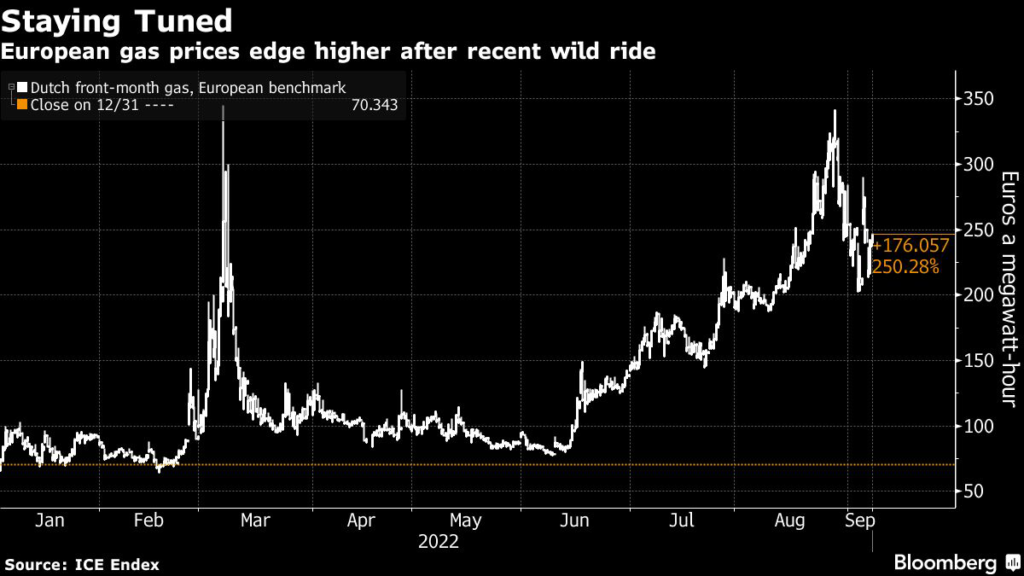
Gas futures in Europe edged higher early Wednesday after wild moves in the previous two days. Dutch front-month contract, the European benchmark, added 2.7%, with traders weighing risks to Russian supplies against moves drafted by politicians to fix the crisis ahead of winter. Gas supplies from Norway are also curbed due to seasonal maintenance, with volumes bottoming out at the lowest since mid-July on Wednesday. Works will wrap up next month.

Germany Seen Sliding Into Recession (7:33 a.m.)

For Germany’s industrial backbone, small and medium-sized enterprises, higher energy prices look like a “ticking time bomb”, according to according to ING Groep NV. With ongoing pressure on consumers’ disposable incomes, companies’ pricing power is fading, Carsten Brzeski, chief macro-economist said.

“Judging from the first macro data for the third quarter, the German economy has not fallen off a cliff at the start of the third quarter but is rather sliding into recession,” he said.

Australia Moves to Allay Japan’s Gas Cut Fears (7:33 a.m.)

Australia says it’s doing what it can to ensure supplies of liquefied natural gas to Asian customers will remain reliable, in response to concerns producers could be forced to redirect to relieve domestic shortfalls.

The nation, which vies with Qatar for the title of top LNG exporter, has the power to force producers in the east to redirect uncontracted cargoes tipped for international markets for domestic consumption, but has so far declined to use it. Even if Canberra decides to tighten the rules when the current agreement expires on Jan. 1, the impacted volumes are likely to be relatively minor — about 4% of Australia’s exports, according to BloombergNEF.

Crisis May Extend Beyond Next Winter (7 am)

Europe could face an even bigger problem next winter with no end in sight for the energy crisis, Niek Den Hollander, Uniper’s Chief Commercial Officer, said in an interview in Milan.

If Russian gas flows remain curtailed, it’s possible that nations won’t be able to fill up storage sites effectively next summer, he said. 

“We could see low inventories in the end of this winter, and that would make it very difficult to procure gas and fill up storage again for security of supply next winter,” Den Hollander said. “It all depends on how much LNG Europe will be able to attract and will also depend very much on the weather.”

More stories like this are available on bloomberg.com

©2022 Bloomberg L.P.

Musk Can Use Twitter Whistle-Blower Claims in Buyout Fight

(Bloomberg) — Elon Musk can add a Twitter Inc. whistle-blower’s allegations about spam and bots on the social media platform to his legal arsenal as the company fights to make him complete his $44 billion buyout, a judge ruled.

Delaware Chancery Judge Kathaleen St. J. McCormick on Wednesday allowed the billionaire to add former Twitter security chief Peiter Zatko’s accusations of “egregious deficiencies” in Twitter’s operations to his case for walking away from the $54.20-per-share deal. 

But she rebuffed his bid to push back the Oct. 17 trial date, and Twitter’s shares jumped on the news. They were up 5.4% at $40.74 at 12:42 p.m. in New York.

McCormick, who put the case on a fast track in July, also said Musk’s legal team would be permitted only an “incremental” pursuit of information related to Zatko’s claims.

Harm to Twitter

“I am convinced that even four weeks’ delay would risk further harm to Twitter too great to justify,” she wrote.

The brisk schedule bodes well for Twitter, Bloomberg Intelligence analyst Matthew Schettenhelm wrote in a note on the rulings.

“Zatko’s allegations still require Musk to prove either an exceptional material adverse effect” on the acquisition “or that he relied on an intentional Twitter lie,” Schettenhelm wrote. “That remains difficult.”

Read More: Musk-Twitter M&A Ruling Signals Whistle-Blower Not Game-Changer

Musk backed away from his planned purchase of Twitter earlier this year, claiming the company hadn’t leveled with him about the number of spam and bot accounts among its more than 230 million users. Twitter says the concerns are a pretext to get out of a deal over which the world’s richest person began to experience buyer’s remorse.

Musk’s legal team hailed McCormick’s permission to amend its counterclaims to argue a material adverse effect on the acquisition, through Twitter’s failure to disclose Zatko’s allegations that the company had lax computer security and brushed off his warnings. 

“We are hopeful that winning the motion to amend takes us one step closer to the truth coming out in the courtroom,” said Alex Spiro, Musk’s lead lawyer. 

Agreed Price and Terms

A Twitter spokesperson said in a statement that “we look forward to presenting our case in court beginning on October 17th and intend to close the transaction on the price and terms agreed upon with Mr. Musk.” 

In Tuesday’s hearing, Twitter’s lawyers for the first time specifically disputed Zatko’s assertions that he raised questions about the quality and security of Twitter’s user base while at the company. They said addressing the bots issue wasn’t part of his “portfolio.” 

Read More: Twitter Whistle-Blower Raised No Spam Concerns, Company Says 

Bill Savitt, Twitter’s lead lawyer, told McCormick on Tuesday that Zatko, whom the company says it fired over his performance, has a “huge ax to grind with Twitter.” In her ruling, the judge said she wasn’t commenting on the legitimacy of Zatko’s claims at this stage.

“I am reticent to say more concerning the merits of the counterclaims at this posture before they have been fully litigated,” McCormick wrote. “The world will have to wait for the post-trial decision.”

The case is Twitter v. Musk, 22-0613, Delaware Chancery Court (Wilmington).

(Updates with details, context and comment starting in second paragraph. An earlier version of this story incorrectly stated that the judge will let only parts of the whistle-blower complaint into the case.)

More stories like this are available on bloomberg.com

©2022 Bloomberg L.P.
‘Worst Kept Secret’ Apple Event Still Gets Attention: Tech Watch

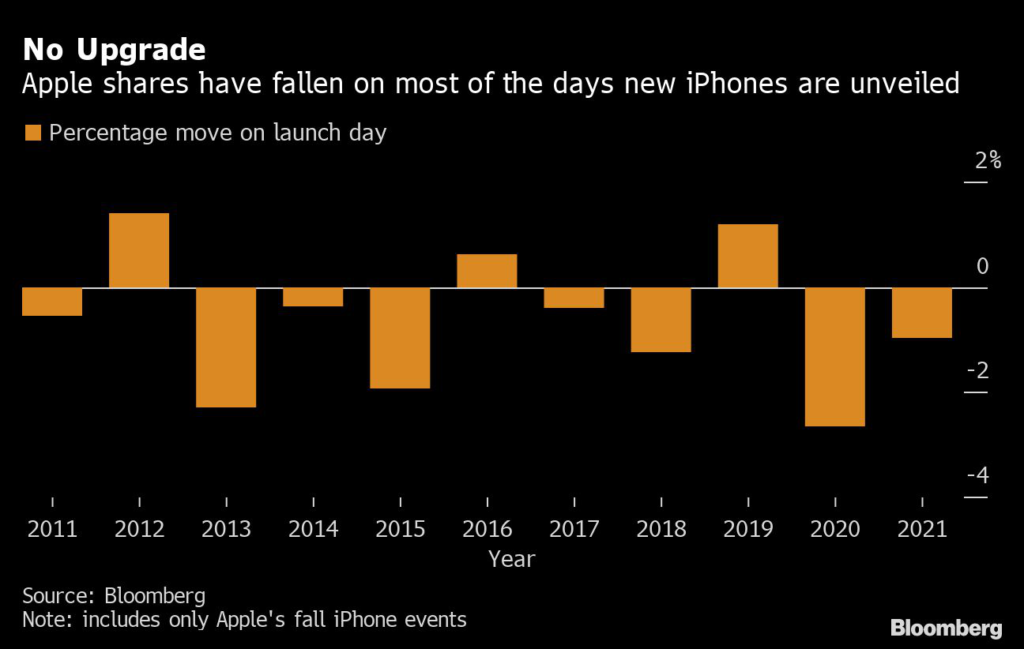
(Bloomberg) — Investors hoping that the introduction of a new line of iPhones will help Apple Inc. shares rebound to their January record may be in for a disappointment if history is any guide.

The stock has fallen seven times on the day the company has launched a model in the past decade. When it announces the new iPhone Wednesday, Apple is likely to take shareholder-friendly steps such as higher prices to cushion its margins from inflationary pressures, analysts say. Such moves, though, come during a weakening economy that may make buyers reluctant to pay more for a handset. 

“Apple’s fall iPhone launch event has always been the ‘worst kept secret,’ with investors aware of most of the product lineup to be announced heading into the event,” Samik Chatterjee, an analyst at JPMorgan Chase & Co., wrote in a note.  “Investors will be keenly watching iPhone prices in the backdrop of an increasingly challenging macro with concerns around consumer spending.” 

Historically, the shares tend to rebound a couple months after the event, as early sales figures trickle in. However, even that respite has evaded the stock after the last two iPhone announcements. Apple’s shares are down 13% this year, heading for their first annual decline since 2018.

Some analysts predict Apple will raise prices on its higher-end Pro models that cater to a more affluent customer base while lowering older phones to lure budget-conscious buyers. 

Wamsi Mohan, an analyst at Bank of America Corp., expects to see a 20-cent bump in earnings per share if Apple hikes prices of its Pro models by $50.  

Price increases are important because Wall Street is counting on Apple’s growth in earnings per share to outpace the increase in revenue. Analysts project that earnings will increase by 9% in 2022 and by 6% next year, compared to projections for annual sales increases of 7% this year and 5% next, according to data compiled by Bloomberg.

Apple is the top performing mega-cap technology stock this year because investors have faith in its ability to tap into its more than 1 billion customers to earn more on its services including apps, video, fitness and gaming subscriptions.

The next catalyst for the stock will be earnings for the September quarter, to be reported in late October, said Gene Munster, managing partner of Loup Ventures. 

“At that time I expect Apple will reassure investors that while Apple is not immune to a slowdown, their products remain in demand and sales will grow year over year in the December quarter,” he said.


Tech Chart of the Day

Its been a rough year for technology stocks and that’s reflected in the 26% slump in the Nasdaq 100 Index. While the gauge is on course for its worst performance since 2008, it’s still outperforming another favorite of speculators, Bitcoin. The cryptocurrency, which is down almost 60% for the year, was trading slightly lower to around $18,888 as it inches closer to its 2022 low.

Top Tech Stories

  • Sundar Pichai, chief executive officer of Google parent Alphabet Inc., defended the internet-search giant against claims that it is anticompetitive, citing established rivals in the digital advertising market and upstart mobile app TikTok as examples of robust competition in technology.
  • Xi Jinping renewed calls for China to step up the development of technology critical to national security, issuing a forceful reminder just as escalating US sanctions threaten Beijing’s efforts to become self-reliant in semiconductors.
  • Tencent Holdings Ltd. is set to more than double its stake in Ubisoft Entertainment SA, forging its latest major overseas deal and giving the founding Guillemot brothers capital to get the video-game company back on track.
    • Ubisoft shares slumped as much as 17% because the investment means a full takeover of the company is unlikely.
    • Ubisoft will announce several new games in the Assassin’s Creed franchise Saturday, including one set in feudal Japan, according to media reports and people familiar with the company’s plans.
  • Twitter Inc.’s lawyers are using Elon Musk’s text messages to try to convince a Delaware judge that the billionaire wants to abandon his $44 billion deal to acquire the company because of buyer’s remorse, rather than concern about the social network’s spam or bot accounts.
  • An “incredible onslaught of money” against a landmark bill meant to rein in the power of the biggest US technology companies has been an obstacle to passing the legislation, according to Senator Amy Klobuchar, the primary sponsor of the bill.
  • Six Gulf Arab states have told streaming service company Netflix Inc. to stop broadcasting material that they said violates the region’s Islamic values, and threatened legal action if it didn’t act.
  • South Korea’s Samsung Electronics Co. is warning that the semiconductor industry could be in for a rocky close to 2022. A senior executive at the world’s largest maker of memory chips said the outlook for the second half is gloomy, and Samsung is not yet seeing momentum for a recovery next year.

(Adds moves in last paragraph.)

More stories like this are available on bloomberg.com

©2022 Bloomberg L.P.
Twitter Wants Its Users to Fight Misinformation With Expanded Birdwatch Feature 

(Bloomberg) — Twitter Inc. is expanding efforts to fact-check the service with the help of regular users through a program called Birdwatch.

The feature allows some users to write a “note” that can be attached to another person’s tweet to add additional context. A pilot version of Birdwatch has operated since early 2021, but most people still don’t see any of these notes attached to the tweets that appear in their feed. That will soon change — roughly half of Twitter’s US user base will start seeing such notes in the coming weeks.

Twitter also hopes to expand the group of users who contribute to Birdwatch. Currently it has about 15,000 people in the program, said Keith Coleman, a product vice president at the company, and Twitter hopes to start adding roughly 1,000 new users to Birdwatch every week.

Twitter fact checks some tweets that fall into specific categories, like Covid or election information. But the company doesn’t have as robust of a fact checking operation as Facebook parent Meta Platforms Inc. and has instead focused on labeling only the tweets with the most reach and impact.

The point of the Birdwatch program is to extend those fact checking efforts, and also to add context to tweets that might not technically be a violation of Twitter’s existing rules, but might still be misleading. 

“One of the superpowers of Birdwatch is it can cover anything,” Coleman said. “It can cover any tweet that the people think would benefit from context. That space is huge.”

More stories like this are available on bloomberg.com

©2022 Bloomberg L.P.

Close Bitnami banner
Bitnami