
Bloomberg

Stocks Climb as US Yields Halt Surge; Oil Tumbles: Markets Wrap

(Bloomberg) — Stocks climbed as Treasury yields halted a surge that drove them to multiyear highs, while an oil selloff eased concern about further price pressures that could imperil the Federal Reserve’s war against inflation.

The S&P 500 rebounded from its lowest since mid-July, with every group but energy moving higher. At a presentation dubbed “Far Out,” Apple Inc. is set to unveil the iPhone 14 line, a fresh slate of smartwatches and new AirPods. West Texas Intermediate crude slumped below $85 a barrel. A dollar gauge was little changed after a rally that rattled currencies around the globe and briefly drove gold below the “danger zone” of $1,700 per ounce.

The pound slid to its weakest level in close to four decades, weighed down by a dire economic outlook. The Japanese yen dropped to a fresh 24-year low versus the greenback and speculation is swirling about the prospects for direct intervention. South Korea’s won weakened to levels not seen since 2009 and China’s yuan was within a whisker of cracking the psychological 7 barrier. 

In the final week before officials enter a blackout period ahead of the Fed’s Sept. 20-21 policy meeting, a hefty lineup of central bankers will offer their views. Fed Bank of Cleveland President Loretta Mester warned against declaring early victory on inflation, saying she would like to see several months of declines in month-over-month readings before concluding that prices have peaked. The Beige Book due at 2 p.m. Washington time will be dissected for signs of moderating economic momentum.

“Is there a light at the end of the rate hike tunnel?” said Alex Christensen, portfolio manager at Columbia Threadneedle. “That’s what many investors are wondering on the heels of last month’s Fed symposium in Jackson Hole. And the answer to that question will depend on if the Fed believes it has done enough to bring down inflation.”

Traders pushed the market-implied odds of another three-quarter-point Fed rate increase in September — instead of a smaller half-point move — to the highest level since the central bank’s last meeting. The peak was reached shortly after a Wall Street Journal article suggested the larger move appeared likely. While it was only briefly sustained, the rate of the swap contract referencing this month’s meeting remains about two basis points higher on the day.

Equities have tumbled since mid-August amid a panoply of risks spanning from restrictive central banks, Europe’s energy crisis and China’s economic slowdown. The recent slide in the S&P 500 pared a bounce from June lows that a Goldman Sachs Group Inc. team led by Peter Oppenheimer described as a “bear-market rally.” The strategists “expect further weakness and bumpy markets before a decisive trough is established.” 

Read: Burry of ‘Big Short’ Fame Says ‘No, We Have Not Hit Bottom Yet’

“Economies all around the world are slowing down, and that’s really not a market that says we’re on the verge of a dynamic rebound in equities,” Margaret Patel, senior portfolio manager at Allspring Global Investments, told Bloomberg Television. “Earnings are going to decelerate a lot. That says a lot of stocks could go down.”

The weakening economy should favor continued outperformance for cheaper, so-called value stocks over their growth equivalents, a separate Goldman note from strategists led by Cormac Conners said.

“History shows value stocks outperform around the start of recessions,” they wrote. Goldman economists forecast a one in three probability of a recession in the coming year.

Meantime, Wednesday’s plunge in oil was exacerbated by a bearish technical picture. The US oil benchmark formed a so-called death cross for the first time since February 2020, a pattern in which the 50-day moving average falls below its 200-day marker. Such a crossover typically signals a loss of short-term momentum and further selling pressure ahead, with prices remaining below their 50-day, 100-day and 200-day moving averages.

Elsewhere, wheat futures climbed almost 7% after Russian President Vladimir Putin criticized a recent grain deal with Ukraine, heightening attention on the sales outlook from the Black Sea region. 

What to watch this week:

  • European Central Bank rate decision, Thursday
  • Fed Chair Jerome Powell due to speak, Thursday
  • Chicago Fed President Charles Evans and his Minneapolis counterpart Neel Kashkari due to speak, Thursday
  • EU energy ministers extraordinary meeting on emergency intervention in electricity markets, Friday

Are you bullish on energy-related assets? This week’s MLIV Pulse survey focuses on energy and commodities. Please click here to participate anonymously.

Some of the main moves in markets:

Stocks

  • The S&P 500 rose 0.9% as of 11:31 a.m. New York time
  • The Nasdaq 100 rose 1%
  • The Dow Jones Industrial Average rose 0.8%
  • The Stoxx Europe 600 fell 0.4%
  • The MSCI World index rose 0.3%

Currencies

  • The Bloomberg Dollar Spot Index was little changed
  • The euro rose 0.4% to $0.9948
  • The British pound fell 0.4% to $1.1472
  • The Japanese yen fell 1.2% to 144.45 per dollar

Bonds

  • The yield on 10-year Treasuries declined six basis points to 3.29%
  • Germany’s 10-year yield declined six basis points to 1.57%
  • Britain’s 10-year yield declined seven basis points to 3.03%

Commodities

  • West Texas Intermediate crude fell 3.7% to $83.69 a barrel
  • Gold futures rose 0.5% to $1,721.40 an ounce

More stories like this are available on bloomberg.com

©2022 Bloomberg L.P.
BofA Names Burkhardt Investment Banking Chief Strategy Officer

(Bloomberg) — Bank of America Corp. named JuliAnn Burkhardt chief strategy officer for global investment banking, succeeding Dave Fishman.

Burkhardt, who is based in New York, first joined BofA in 2007, leaving in 2015 for a stint at Deutsche Bank AG, according to Financial Industry Regulatory Authority records. She rejoined Charlotte, North Carolina-based BofA in 2017, and was most recently a managing director within consumer and retail investment banking. Burkhardt will continue to work with key clients in that sector while serving in her new position, a rotational leadership role that was established in 2020, according to an internal memo.

“In this role, JuliAnn will be responsible for partnering with our global group heads to lead strategic initiatives that drive the investment banking business across our sectors, products and regions,” Thomas Sheehan, head of global investment banking, wrote in the memo. Burkhardt will report to Sheehan and work closely with the group’s chief operating officer, Kathy Bolner, he said. 

Fishman, also based in New York, will rejoin the global mergers and acquisitions team as co-head of technology, media and telecommunications M&A, alongside David King and Shawn Liu, according to a separate memo. He will also serve as co-head of private sales and divestitures, alongside Andrew Martin. 

A BofA spokesman confirmed the contents of the memos and declined to comment further. 

More stories like this are available on bloomberg.com

©2022 Bloomberg L.P.

‘Movie Business Is Not Over,’ Super Agent Ari Emanuel Says

(Bloomberg) — Things certainly look rough for movie theaters these days, with ticket sales still well off their pre-pandemic highs and one of the largest chains filing for bankruptcy.

But Ari Emanuel, co-founder of one of the world’s largest talent agencies, strongly disagrees with folks who think cinemas will disappear.

“Anybody that says to you, and I won’t name names, that the movie business is over are fools,” Emanuel said in a recent appearance on “The David Rubenstein Show: Peer-to-Peer Conversations” on Bloomberg TV. “The movie business is not over,” he said. “It is just an expanding world.”

Emanuel, the 61-year-old chief executive officer of Endeavor Group Holdings, has diversified his company over the years, taking it from its roots representing Hollywood actors, writers and directors, and adding sports stars, ownership of live events and more recently, a sports-betting technology company. Endeavor is projecting operating profit of at least $1.13 billion on sales of $5.24 billion this year.

Read more: Regal parent files for bankruptcy

Emanuel said he’s been guided for years by George Gilder’s 1990 book “Life After Television,” which argued that the computer age would expand the ways in which people consume and interact with content. Cinemas have survived challenges from broadcast TV, cable and DVDs, Emanuel said. Now streaming video is the perceived threat.

“The theatrical business is as important as it’s ever been,” he said. “Is it gonna be a $9.3 billion business? No, maybe it’ll be an $8 billion business. I’m not sure. But it’s not going away.”

Comscore Inc., which collects data on cinema ticket sales, projects the domestic movie theater industry will end this year with revenue of $7.5 billion, still down 37% from 2018’s record of $11.9 billion.

A fitness buff who gets up before dawn for workouts, an ice bath and meditation, Emanuel said he’s also come to terms with the super-aggressive character, Ari Gold, which was modeled after him in the HBO series “Entourage.”

“I didn’t like it at the beginning,” he said. “There were some things that were for sure not true and then there were some things that I hated seeing that were true.” 

Now, however, he’s realized the benefits of the exposure. “It’s for sure opened a lot of doors.”

(Updates with Cineworld bankruptcy filing in first paragraph.)

More stories like this are available on bloomberg.com

©2022 Bloomberg L.P.
JPMorgan Product Reveals Wall Street’s Shifting Views on ESG

(Bloomberg) — A new ESG product that JPMorgan Chase & Co. is about to start offering clients shows how rapidly perceptions are changing about the investment strategy.

JPMorgan, the biggest US bank, has teamed up with software firm Datamaran to develop a data-analysis tool for clients to gauge not just the environmental, social and governance risks facing portfolio companies, but also the ESG risks that such assets pose to the world around them. While the concept — known as double materiality — is already built into EU ESG regulations, it has yet to make inroads in the US. 

Double materiality is “the only way to think about ESG in a way that is both forward-looking and comprehensive,” said Jean Xavier Hecker, the Paris-based co-head of EMEA ESG research at JPMorgan and the architect behind the new tool called ESG Discovery. 

“If you limit your views to things that are currently financially material, by definition you are going to miss the ones that are soon going to become financially material,” he said in an interview. “You also risk losing sight of sustainability.” 

How widely double materiality should be applied remains the subject of intense debate. In the US, prominent members of the Republican Party have argued that ESG already goes too far in bringing progressive politics into investing decisions, and have started penalizing banks and asset managers that embrace ESG. At the other end of the debate, ESG has been criticized for not doing enough to cut greenhouse gas emissions or fight inequality.

Read More: GOP Fury Over ESG Triggers Backlash With US Pensions at Risk 

But with key members of the financial industry such as JPMorgan building double materiality into their palette of ESG products, the concept appears to be expanding its foothold. And the Global Reporting Initiative, which is working closely with the International Sustainability Standards Board on its upcoming rules on ESG risk disclosure, says businesses and investors across jurisdictions should expect to have to adapt to a world in which double materiality will count.

“Looking at financial materiality alone would produce incomplete ESG information that doesn’t reflect the risk/reward of the potential investment over the long-term,” Hecker said. 

The tool now available to JPMorgan clients will use artificial intelligence to compile data from corporate disclosures, regulations and online media. It won’t provide an ESG rating or score, and will instead focus on unpacking individual ESG drivers. The idea is to centralize Datamaran’s AI tools and the ESG analysis of JPMorgan’s researchers in one place.

Sophie Warrick, co-head of global ESG research at JPMorgan, said the goal is to let clients see the underlying data.

“There are huge numbers of AI ESG platforms. In theory they often look great, but when you go under the hood and see what’s driving the key-word analysis and so on, it’s often not as sophisticated as you hoped,” she said in an interview. “Investors have concerns about amalgamating a broad set of considerations into a single ESG outcome. ESG is much more complex than that.”

The finance industry is ramping up its output of ESG analysis products, as investors struggle to navigate their way through the seemingly endless data points. On Wednesday, Morningstar Inc. released a tool, Investable World, that it says will help users cut through the noise. The product, among other things, is intended to help clarify the gaps between ESG and sustainable investing.

“Some companies that have their revenue strongly aligned with positive societal impact metrics may face a lot of outward-in ESG risk,” said Adam Fleck, director of equity ESG research at Morningstar.

Read More: An ABC on ESG and Sustainable Investing’s Flavors: QuickTake

The spread of double materiality within the ESG universe, meanwhile, may pose a challenge to a cornerstone of the industry, namely ESG ratings providers. Many of these still only measure the financial risks that ESG factors pose to the issuers they rank, and not their impact on the environment. 

“Being ‘backward looking’ is a common criticism of ESG ratings,” Hecker said. “A focus on double materiality is a business necessity for investors.”

Some ESG score providers within the ratings industry have started responding to investor demand for a broader assessment of ESG. For example, Sustainable Fitch just launched a leveraged finance ESG scoring system that offers an independent view of an issuer’s overall ESG impact.

Read More: ESG Investing Is Mostly About Sustaining Corporations 

Expanding the definition of ESG in the current political climate isn’t without risks. Wall Street has this year come under direct attack from the GOP, with prominent members of the party accusing firms such as BlackRock Inc. of peddling “woke” investment strategies.

For JPMorgan’s Hecker, ESG is no more political than other forms of financial analysis. A focus on double materiality, meanwhile, can help prove its real-world impact to doubters.

“Every type of investment strategy has political considerations,” he said. “The history of accounting is rooted in politics.” 

(Adds additional comments from JPMorgan’s Hecker throughout)

More stories like this are available on bloomberg.com

©2022 Bloomberg L.P.

Musk Can Use Twitter Whistle-Blower Complaint in Buyout Fight

(Bloomberg) — Elon Musk can bring a Twitter Inc. whistle-blower’s complaint about spam and bots on the social media platform into his defense against the company’s lawsuit to make him complete his $44 billion buyout, a judge ruled.

Musk’s legal team is permitted “incremental discovery relevant to the new allegations” raised by the whistle-blower, Delaware Chancery Judge Kathaleen St. J. McCormick said in a five-page ruling on Wednesday.

But McCormick denied Musk’s request to delay a trial of the case set for next month.

“I am convinced that even four weeks’ delay would risk further harm to Twitter too great to justify,” she wrote, maintaining the Oct. 17 date.

The rulings came a day after McCormick heard arguments on the matters from both sides.

Twitter Whistle-Blower Raised No Spam Concerns, Company Says 

“We are hopeful that winning the motion to amend takes us one step closer to the truth coming out in the courtroom,” said Alex Spiro, Musk’s lead lawyer.

A Twitter representative didn’t immediately return an email seeking comment on the rulings.

The Tesla Inc. chief executive officer backed away from his planned purchase of Twitter, claiming the company hadn’t leveled with him about the number of spam and bot accounts among its more than 230 million users. The whistle-blower, former Twitter security head Peiter Zatko, said company officials brushed off his worries about such accounts and misled investors about the problem. 

Lawyers for the billionaire cast Zatko’s accusations of shoddy operations as further violations of the buyout agreement.

In Tuesday’s hearing, Twitter’s attorneys for the first time specifically disputed Zatko’s assertions that he raised such questions while at the company. They said addressing the bots issue wasn’t part of his “portfolio.” 

The case is Twitter v. Musk, 22-0613, Delaware Chancery Court (Wilmington).

(Adds ruling on trial date and further details and context starting in third paragraph. An earlier version of this story incorrectly said the judge allowed only parts of the whistle-blower complaint.)

More stories like this are available on bloomberg.com

©2022 Bloomberg L.P.
Apple Phone Event, ‘Worst Kept Secret,’ Is Priced In: Tech Watch

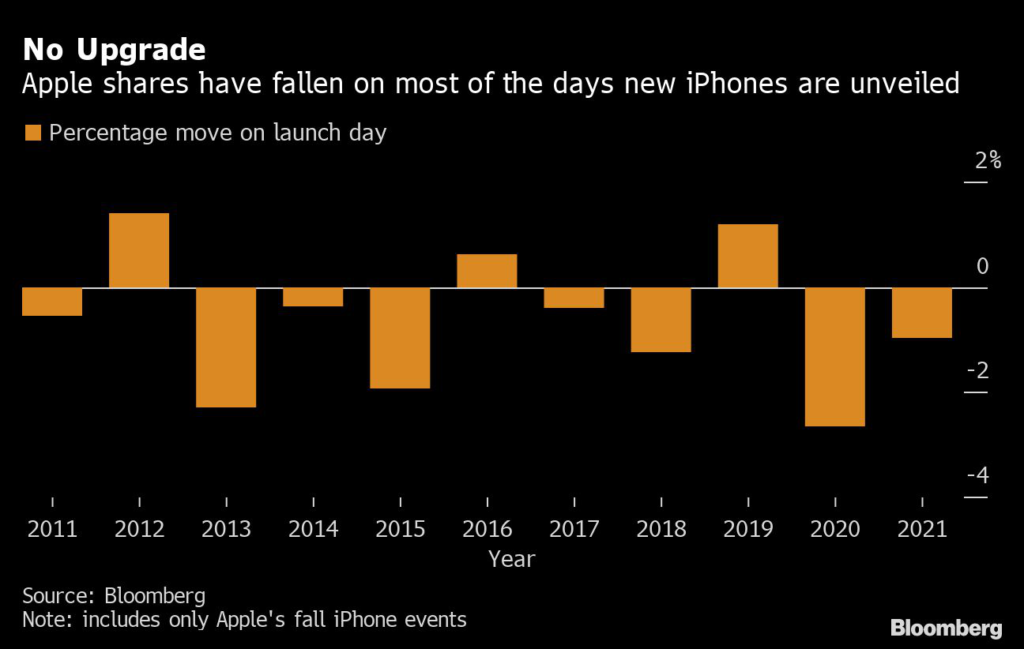
(Bloomberg) — Investors hoping that the introduction of a new line of iPhones will help Apple Inc. shares rebound to their January record may be in for a disappointment if history is any guide.

The stock has fallen seven times on the day the company has launched a model in the past decade. When it announces the new iPhone Wednesday, Apple is likely to take shareholder-friendly steps such as higher prices to cushion its margins from inflationary pressures, analysts say. Such moves, though, come during a weakening economy that may make buyers reluctant to pay more for a handset. 

“Apple’s fall iPhone launch event has always been the ‘worst kept secret,’ with investors aware of most of the product lineup to be announced heading into the event,” Samik Chatterjee, an analyst at JPMorgan Chase & Co., wrote in a note.  “Investors will be keenly watching iPhone prices in the backdrop of an increasingly challenging macro with concerns around consumer spending.” 

Historically, the shares tend to rebound a couple months after the event, as early sales figures trickle in. However, even that respite has evaded the stock after the last two iPhone announcements. Apple’s shares are down 13% this year, heading for their first annual decline since 2018.

Some analysts predict Apple will raise prices on its higher-end Pro models that cater to a more affluent customer base while lowering older phones to lure budget-conscious buyers. 

Wamsi Mohan, an analyst at Bank of America Corp., expects to see a 20-cent bump in earnings per share if Apple hikes prices of its Pro models by $50.  

Price increases are important because Wall Street is counting on Apple’s growth in earnings per share to outpace the increase in revenue. Analysts project that earnings will increase by 9% in 2022 and by 6% next year, compared to projections for annual sales increases of 7% this year and 5% next, according to data compiled by Bloomberg.

Apple is the top performing mega-cap technology stock this year because investors have faith in its ability to tap into its more than 1 billion customers to earn more on its services including apps, video, fitness and gaming subscriptions.

The next catalyst for the stock will be earnings for the September quarter, to be reported in late October, said Gene Munster, managing partner of Loup Ventures. 

“At that time I expect Apple will reassure investors that while Apple is not immune to a slowdown, their products remain in demand and sales will grow year over year in the December quarter,” he said.


Tech Chart of the Day

Its been a rough year for technology stocks and that’s reflected in the 26% slump in the Nasdaq 100 Index. While the gauge is on course for its worst performance since 2008, it’s still outperforming another favorite of speculators, Bitcoin. The cryptocurrency, which is down almost 60% for the year, was trading slightly lower to around $18,885 as it inches closer to its 2022 low.

Top Tech Stories

  • Sundar Pichai, chief executive officer of Google parent Alphabet Inc., defended the internet-search giant against claims that it is anticompetitive, citing established rivals in the digital advertising market and upstart mobile app TikTok as examples of robust competition in technology.
  • Xi Jinping renewed calls for China to step up the development of technology critical to national security, issuing a forceful reminder just as escalating US sanctions threaten Beijing’s efforts to become self-reliant in semiconductors.
  • Tencent Holdings Ltd. is set to more than double its stake in Ubisoft Entertainment SA, forging its latest major overseas deal and giving the founding Guillemot brothers capital to get the video-game company back on track.
    • Ubisoft shares slumped as much as 17% because the investment means a full takeover of the company is unlikely.
    • Ubisoft will announce several new games in the Assassin’s Creed franchise Saturday, including one set in feudal Japan, according to media reports and people familiar with the company’s plans.
  • Twitter Inc.’s lawyers are using Elon Musk’s text messages to try to convince a Delaware judge that the billionaire wants to abandon his $44 billion deal to acquire the company because of buyer’s remorse, rather than concern about the social network’s spam or bot accounts.
  • An “incredible onslaught of money” against a landmark bill meant to rein in the power of the biggest US technology companies has been an obstacle to passing the legislation, according to Senator Amy Klobuchar, the primary sponsor of the bill.
  • Six Gulf Arab states have told streaming service company Netflix Inc. to stop broadcasting material that they said violates the region’s Islamic values, and threatened legal action if it didn’t act.
  • South Korea’s Samsung Electronics Co. is warning that the semiconductor industry could be in for a rocky close to 2022. A senior executive at the world’s largest maker of memory chips said the outlook for the second half is gloomy, and Samsung is not yet seeing momentum for a recovery next year.

(Adds moves in last paragraph.)

More stories like this are available on bloomberg.com

©2022 Bloomberg L.P.
Instacart Buys Online Local Grocery Startup in Deal Spree

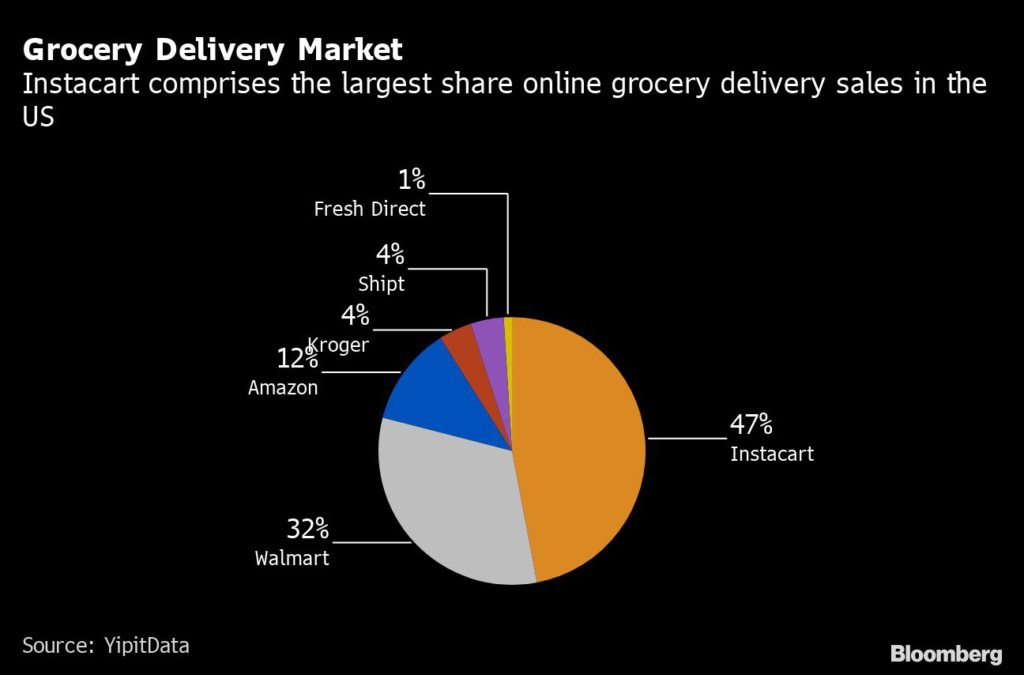
(Bloomberg) — Instacart Inc. is acquiring Rosie Applications Inc., an online grocery startup focused on local retailers and wholesalers, as it moves to consolidate and expand its share of the online grocery delivery market ahead of an anticipated initial public offering this year. 

Rosie is Instacart’s second acquisition this month, following its purchase of pricing and promotions platform Eversight Inc. Terms of the transactions weren’t disclosed. Last year Instacart bought smart-cart startup Caper AI for $350 million.

Ithaca, New York-based Rosie has an app that connects customers to local, independent supermarkets and also offers a white-label e-commerce product to its grocers. The company was valued at $40 million in 2021 and had raised a total of $12 million in funding, according to PitchBook. 

Rosie will add its roster of almost 300 grocers across 40 states to Instacart’s platform, helping it expand its e-commerce offerings and deepen its connection to smaller stores. As of June, San Francisco-based Instacart comprised 47% of sales in the US, according to market research firm YipitData. 

More stories like this are available on bloomberg.com

©2022 Bloomberg L.P.

US Trade Gap in Goods, Services Narrows for a Fourth Month

(Bloomberg) — The US trade deficit shrank for a fourth straight month in July, reflecting a decline in the value of imports and a slight pickup in exports that are seen helping provide a lift to third-quarter economic growth.

The gap narrowed by 12.6% from a month earlier to $70.65 billion, the smallest since October, Commerce Department data showed Wednesday. The median estimate in a Bloomberg survey of economists called for the deficit to narrow to $70.2 billion. The figures aren’t adjusted for inflation.

The value of goods and services exports increased 0.2% to a record $259.3 billion while imports declined 2.9% to a five-month low of nearly $330 billion.

Inbound shipments of consumer goods plummeted 9.8%, the most in data back to 1992. US retailers are likely dialing back orders with overseas suppliers as they focus on getting inventories more in line with sales. 

Rapidly rising prices are weighing on domestic demand, limiting Americans’ wherewithal to spend. The leftover income is increasingly being spent on services and experiences in the wake of a pandemic-fueled boom in outlays on merchandise. 

On an inflation-adjusted basis, the July merchandise trade deficit shrank to $103.4 billion, the smallest since October.

The decline in the value of imports of consumer goods, unadjusted for inflation, was driven by decreases in pharmaceutical preparations and toys, games and sporting goods. Industrial materials and foods imports also fell. Inbound shipments of motor vehicles and capital goods increased.

US exports of capital equipment, including industrial machinery, computer accessories and telecommunications gear, helped boost total exports.

Digging Deeper

  • The nominal merchandise-trade deficit shrank 8.2% to $91.09 billion
  • Travel exports — or spending by visitors to the US — rose 5.2% to a more than two-year high of $11.59 billion
  • Travel imports, a measure of Americans traveling abroad, fell 3.1% to $9.23 billion
  • The US merchandise-trade deficit with China narrowed 6.9% to about $34.4 billion

(Adds graphic)

More stories like this are available on bloomberg.com

©2022 Bloomberg L.P.

Bankrupt Crypto Lender Voyager Digital Heads to Auction Block

(Bloomberg) — Insolvent crypto lender Voyager Digital Ltd. has drawn enough interest from potential buyers to necessitate an auction.

The auction will be held at 10 a.m. on Sept. 13 in the New York offices of Voyager’s investment bank Moelis & Co., according to a notice filed in bankruptcy court Tuesday. A court hearing to approve the results is scheduled for Sept. 29.

The need for an auction means Voyager received more than one acceptable bid for its assets and no bid was clearly the best. That could be good news for Voyager customers still locked out of their accounts: a higher final price tag for Voyager may result in better recoveries for customers. 

Sam Bankman-Fried’s FTX and Alameda publicly disclosed a joint bid for Voyager in July, but Voyager called it a “low-ball” offer.  

The bankruptcy is Voyager Digital Holdings Inc., 22-10943, U.S. Bankruptcy Court for the Southern District of New York (Manhattan).

More stories like this are available on bloomberg.com

©2022 Bloomberg L.P.

Truist Hires From Credit Suisse, UBS to Bolster Investment Bank

(Bloomberg) — Truist Financial Corp. hired Hayes Smith, a veteran of Credit Suisse Group AG, to help oversee its investment-banking arm’s coverage of private equity firms, according to people with knowledge of the matter.

Smith is set to join Truist after a period of gardening leave, said one of the people, all of whom asked not to be identified because the hiring hasn’t been announced. He has worked with firms including Carlyle Group Inc., Warburg Pincus, Veritas Capital, Cerberus Capital Management and Kelso & Co. 

Truist also hired Chris Cormier, a UBS Group AG managing director who led US technology, media and telecommunications equity capital markets at the Swiss bank, to head its TMT ECM efforts, according to people with knowledge of the matter. He, too, will join after a period of gardening leave. 

Representatives for Truist, Credit Suisse, UBS all declined to comment. Smith and Cormier didn’t immediately respond to requests for comment.

Smith joined Credit Suisse in 2001 and most recently was a managing director based in New York, Financial Industry Regulatory Authority records show. He was co-head of East Coast financial sponsors, according to his LinkedIn profile, which shows he joined a Credit Suisse predecessor, DLJ, in 2000. His exit from the Swiss lender comes as the firm doles out retention payments to senior dealmakers and amid a comprehensive strategic review.

Truist’s head of financial sponsors, Douglas Speegle, retired at the end of August, a person with knowledge of the matter said. Speegle didn’t immediately respond to a request for comment.

Cormier joined UBS in 2018 after roles at Merrill Lynch, Deutsche Bank AG, Bear Stearns and Credit Suisse, according to Finra records. 

Truist, based in Charlotte, North Carolina, has been making senior hires to bolster its investment bank, led by Royal Bank of Canada alum Michael Carter.

More stories like this are available on bloomberg.com

©2022 Bloomberg L.P.

Close Bitnami banner
Bitnami
