Bloomberg

Two SPAC ETFs Close in One Month, Suggesting End to Wall Street Boom

(Bloomberg) — Little noticed in the annual August market slowdown were two fund closures that may signal an end to one of Wall Street’s hottest manias of the past few years: SPACs. 

The Defiance Next Gen SPAC Derived ETF and the Morgan Creek – Exos SPAC Originated ETF shuttered last month, after struggling to maintain traction as the Federal Reserve’s monetary tightening weighs on risk assets and drains liquidity from a market once free-flowing with capital searching for a home.

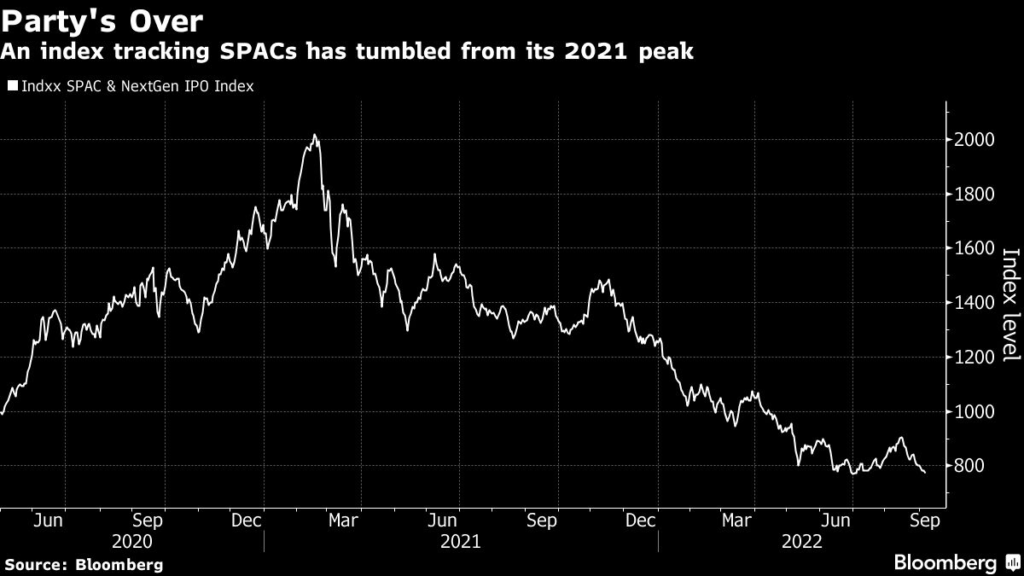
Defiance’s fund, which traded under the ticker SPAK, was worth around $112 million at its peak, but liquidated with only $16 million in holdings. The index of special purpose acquisition companies and blank check merged firms it tracked is currently down 37% year-to-date. Morgan Creek’s ETF (ticker SPXZ) boasted a market capitalization of $47 million at its peak, but also struggled to maintain investor interest as everything from blue-chip stocks to speculative bets sold off this year.

Along with meme stocks and cryptocurrencies, SPACs were a hallmark of the stimulus-fueled pandemic market that has sputtered out in 2022 as the Federal Reserve rapidly tightens monetary policy to cool off soaring inflation. Increasing scrutiny from US regulators has also deflated the blank-check mania. 

“While they raised assets initially in a ‘risk on’ environment, the market for SPACs has collapsed, with very little new issuance and many entities failing to identify targets and/or complete transactions,” said Jane Edmonson, founder of EQM Capital. 

Defiance ETFs declined to comment on the filing beyond the details in its August press release announcing the closure. Morgan Creek could not be reached for comment beyond its press release.

Meantime, the SPAC rout is providing a windfall for a fund that bets against the space. The $23 million AXS Short De-SPAC Daily ETF (SOGU), which provides daily inverse exposure to companies that recently went public via a SPAC merger, is one of the best performing US active equity ETFs year-to-date, according to data compiled by Bloomberg. 

The latest ETF closures underscore how SPAC-mania seems to be melting away just as quickly as it came about. SPAK was among the first funds of its kind to hit the US market, but is shuttering after just 22 months. SPXZ was also less than 2 years old. The pattern mirrors the broader trend across the industry: according to Bloomberg data, roughly 45% of the exchange-traded funds that have closed this year launched in either 2020 or 2021.  

More stories like this are available on bloomberg.com

©2022 Bloomberg L.P.

US Stock Futures Dip; Dollar Strength Sets Records: Markets Wrap

(Bloomberg) — US equity futures edged lower as investors assessed prospects for aggressive Federal Reserve monetary tightening, while a dollar gauge climbed to a record for a third day.

Contracts on the S&P 500 and Nasdaq 100 slipped less than 0.4% before the market hears from a slew of Fed speakers. Europe’s Stoxx 600 Index fell, with retailers leading the declines as JPMorgan Chase & Co. analysts said the cost of living crisis facing consumers “has only just begun.”

Oil erased a decline after Russian President Vladimir Putin underlined that his country won’t supply oil and fuel if price caps on the country’s exports are introduced.

Bets on another 75 basis points Fed interest-rate hike to tackle high inflation have spurred a selloff in Treasuries, while traders are bracing for a European Central Bank rates decision due on Thursday, with the potential for a similar-size move.


Aside from tightening monetary settings and an apparently unstoppable dollar, markets are also contending with a debilitating energy crisis in Europe and Covid lockdowns in China. Concerns are growing about the outlook for company earnings and a rebound seen in equity markets since mid-June is fading. 

“At this point, we see no positive triggers to keep the rally going, while there are rising risks moving into autumn amid a gloomier economic backdrop,” Amundi SA Chief Investment Officer Vincent Mortier and his deputy, Matteo Germano, wrote in a note. “To cope with this environment, we believe investors should adjust their asset allocation stances.”

European policymakers are pulling together proposals to bring to a meeting of energy ministers in Brussels on Friday where emergency interventions will be hammered out to address the region’s energy crisis. European natural gas prices dropped.

In the UK, borrowing costs are set to tumble by the most since the 2016 Brexit referendum after Bank of England officials said the government’s proposed energy-price cap may curb soaring inflation, potentially reducing the urgency of interest-rate hikes. Two-year yields slid to a one-week low, while the pound dropped close to the lowest level since 1985.

With global stocks on pace for their worst run since the European debt crisis a decade ago, Goldman Sachs Group Inc. strategists are among those warning that more selling is possible. The MSCI All Country World Index is in its longest losing stretch since 2011 and rapidly erasing the latest bounce that a Goldman team led by Peter Oppenheimer described as a “bear market rally.” 

“We expect further weakness and bumpy markets before a decisive trough is established,” the strategists wrote.

Bitcoin flirted with a test of lows for the year and gold futures steadied.

What to watch this week:

  • Apple event due to feature new iPhones, watches, Wednesday
  • Bank of England Governor Andrew Bailey at Treasury Committee, Wednesday
  • Fed’s Beige Book of regional economic activity, Wednesday
  • Cleveland Fed President Loretta Mester due to speak, Wednesday
  • European Central Bank rate decision, Thursday
  • Fed Chair Jerome Powell due to speak, Thursday
  • Chicago Fed President Charles Evans and his Minneapolis counterpart Neel Kashkari due to speak, Thursday
  • EU energy ministers extraordinary meeting on emergency intervention in electricity markets, Friday

Are you bullish on energy-related assets? This week’s MLIV Pulse survey focuses on energy and commodities. Please click here to participate anonymously.

Some of the main moves in markets:

Stocks

  • Futures on the S&P 500 fell 0.4% as of 8:29 a.m. New York time
  • Futures on the Nasdaq 100 fell 0.3%
  • Futures on the Dow Jones Industrial Average fell 0.3%
  • The Stoxx Europe 600 fell 1.1%
  • The MSCI World index fell 0.5%

Currencies

  • The Bloomberg Dollar Spot Index rose 0.4%
  • The euro fell 0.1% to $0.9894
  • The British pound fell 0.7% to $1.1434
  • The Japanese yen fell 1.3% to 144.72 per dollar

Bonds

  • The yield on 10-year Treasuries declined four basis points to 3.31%
  • Germany’s 10-year yield declined seven basis points to 1.56%
  • Britain’s 10-year yield declined 10 basis points to 3.00%

Commodities

  • West Texas Intermediate crude fell 0.7% to $86.24 a barrel
  • Gold futures were little changed

More stories like this are available on bloomberg.com

©2022 Bloomberg L.P.

Investor Who Made 1,700% on Mt. Gox Circles Crypto Again

(Bloomberg) — In 2017, Thomas Braziel didn’t have much of an interest in Bitcoin. But as an investor in obscure distressed assets, his sport, as he called it, was bankruptcies — and there was nothing quite as enticing as the collapse of crypto exchange Mt. Gox.  

“The first instance was: boy, wouldn’t it be cool to buy a Japanese cryptocurrency bankruptcy claim?” said the founder of 507 Capital, a two-man shop named after a section of the U.S. bankruptcy code. 

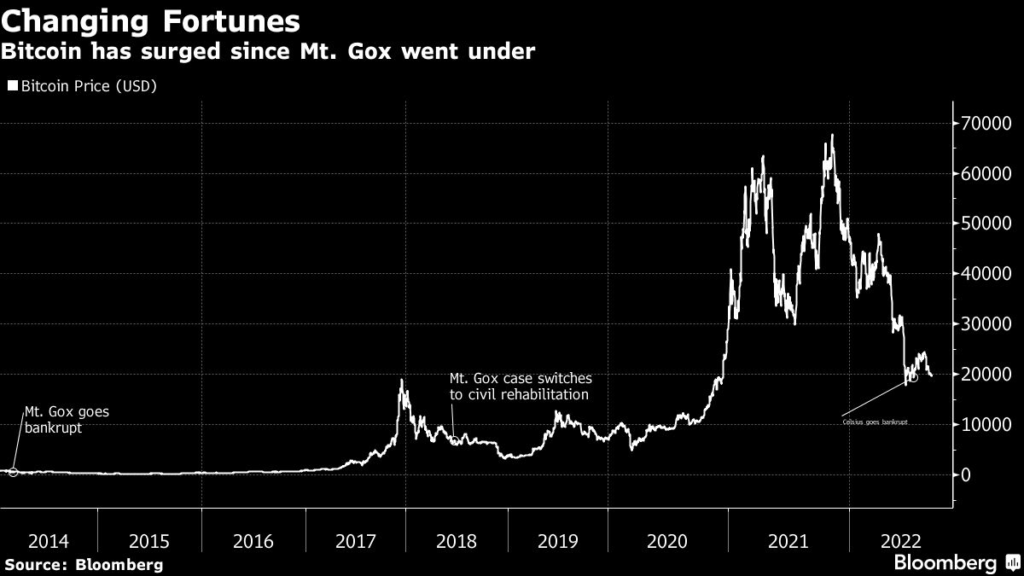
Braziel, the son of two insolvency lawyers, bought nearly 4,000 Bitcoins worth of claims from Mt. Gox customers, using $1 million raised from a family office. Former users of the exchange were waiting to get their money back after a hack of about 850,000 Bitcoins drove the Tokyo-based exchange into bankruptcy in 2014. 

With payouts expected to finally begin, Braziel’s investment is set to return nearly 18 times, thanks to Bitcoin’s surge since he bought the claims. Now, after a $2 trillion rout in digital assets brought down some of crypto’s most prominent players, Braziel is again on the prowl for deals.

Crypto is about as niche as it gets in the world of distressed assets, but some of the investment opportunities and thorny questions raised by Mt. Gox’s collapse have started resurfacing as bankruptcies from Celsius Network to Voyager Digital Ltd. hit US courts for the first time. One of the biggest conundrums for judges: Should customers get their money back in fixed dollar values or in tokens? 

“Nothing in the bankruptcy code talks about crypto assets,” said Elie Worenklein, a restructuring lawyer at Debevoise & Plimpton. “So the parties and bankruptcy courts will likely be analogizing various novel crypto issues to existing legal principles.”

‘I’ll Just be Let Down’

Crypto remains a novelty in US courts. When a regulated brokerage fails, customer assets are segregated and insured. But under the terms of Celsius’s high-yield Earn account, which held about $4.2 billion as of early July, customers were effectively turning their tokens over to the firm and giving it full control to lend them out. That means those depositors could now be unsecured creditors jostling for a share of a firm with a $1.19 billion hole in its balance sheet. 

Bankrupt Celsius Seeks to Return $50 Million of Locked Crypto

They include Katie, a 27-year-old speech pathologist in Sydney who asked for her surname to be withheld as she hasn’t told her friends and family about losing money when Celsius failed. She was counting on the $138,000 she and her husband put on Celsius to help buy a house and start a family. 

“I don’t want to put in my head that we’re going to get any back because then I’ll just be let down once again,” she said. 

Like many other users, Katie would like her Bitcoin and Ether, rather than dollars, back. After Celsius officially filed for bankruptcy, Bitcoin initially rebounded as much as 30% and is now roughly flat. Ether is 50% higher. 

More Like Commodities?

Whether she will pocket any of those gains remains unsettled, though the firm has said it intends to see customers capture any upside. Normally, if the assets are determined to be Celsius’s, such claim amounts are fixed in dollar terms. Customers can, however, argue that cryptocurrencies are more like commodities or securities, which are valued at the time they are sold, said Vincent Indelicato, a partner at Proskauer Rose LLP who specializes in restructurings. 

Fear of missing out on a crypto recovery is driving some users to sell their claims. Oliver, an IT professional in his 40s who lives near Nantes in France, said he’s looking for a buyer for his $1 million Earn account for as little as 30% of the nominal value so he can free up cash to buy more crypto — and store it in his own wallet this time.

“Say in five years the crypto market goes up 10x, even if I get back 100% of the value as of July 13, I’m still losing a lot,” he said, referring to the date of Celsius’s bankruptcy.  

The same debate loomed over the Mt. Gox case after Bitcoin started rallying in 2016, which meant the tokens that remained after the hack were enough to pay out the initial yen-denominated claims. The value of Mt. Gox’s estate also rose further when a free Bitcoin Cash — a token now worth $112 apiece — was given to every Bitcoin holder in 2017. 

Braziel’s Windfall

The rest of the windfall could then have flowed into the pockets of equity owners including convicted founder Mark Karpeles. To avoid that, the case was shifted in 2018 from bankruptcy proceedings to a civil procedure that let users re-value their claims and get their money back in a combination of fiat and digital coins. 

That payout is now going to mean hefty profits for those who started snapping up the claims at sharp discounts, like Braziel and his clients. He bought his first claim for $106,333 at 38% of the face value. It’s now worth more than $2 million. Fortress Investment Group LLC, an asset manager owned by Softbank, also bought Mt. Gox claims. 

With the rehabilitation trustee making final administrative preparations based on a plan passed last year, Braziel said he expects the disbursement to begin in early 2023. 

Still, that case won’t have much bearing on this new wave of insolvencies in US courts, and some potential investors are holding off from making any moves for now. At distressed investing firm Argo Partners, which owns claims on Mt. Gox and collapsed Canadian crypto exchange Quadriga, Jonathan Maruri says the current cases are still early in the process. The head of trading has spoken to a few Celsius users but hasn’t bought anything yet. 

“These are some of the first interactions the crypto space has with the bankruptcy space,” he said. 

Braziel said he’s talking to the holders of a few multimillion-dollar claims, but hasn’t struck any deals so far. Compared to Mt. Gox, whose users tended to be early crypto enthusiasts with cash to spare, he said he’s now hearing more from customers who have lost their life savings after being lured by the high yields Celsius and other crypto lenders marketed. 

“For us, it’s exciting to see stuff,” Braziel said. “But at the same time you feel bad.”  

(Updates price moves in fourth paragraph under first sub-heading and fourth paragraph under second sub-heading.)

More stories like this are available on bloomberg.com

©2022 Bloomberg L.P.

China Builder Sunac Gets Wind-Up Petition as Pressure Mounts

(Bloomberg) — Sunac China Holdings Ltd. said it will take “every measure” to defend itself against a winding-up petition in Hong Kong, highlighting the turmoil at the property developer as it crafts a debt-resolution plan.

A court hearing is scheduled for Nov. 16, according to a filing, with parties involved including the company and Chen Huaijun. 

The petition is an “aggressive” move by an individual creditor whose holdings account for an “extremely small” share of the company’s debt, Sunac said in a statement, adding that the case won’t have any material impact on the firm’s operation or debt restructuring work.

The company expects to publish its debt restructuring plan within this year, according to the statement.

Creditors of embattled Chinese property firms are increasingly seeking court help on debt repayments. A wind-up petition was filed in June against Sunac peer China Evergrande Group, a case that’s been adjourned until November as the company continues work on a restructuring plan that it aims to deliver as soon as possible.

The two firms are among more than a dozen developers to have defaulted on dollar bonds in the past year, fueling a record amount of delinquencies by Chinese issuers. Sunac founder Sun Hongbin, dubbed the “white knight” in China for bailing out fellow billionaires and their empires, has been unable to rescue his own from the property crisis that’s engulfing the world’s second-biggest economy.

The filing against Sunac could add pressure on the firm to speed up its restructuring process. After defaulting in May, the company said previously it would seek a holistic solution and has appointed financial and legal advisers to explore liquidity solutions. 

Sunac, which was once the country’s fourth-largest builder by sales, has fallen to ninth, according to China Real Estate Information Corp. data. Most of the developer’s dollar bonds have been trading below 20 cents on the dollar for much of the past six months, according to Bloomberg-compiled data.

The case number for Sunac’s winding-up petition is HCCW 319 / 2022.

(Updates with Sunac’s statement throughout)

More stories like this are available on bloomberg.com

©2022 Bloomberg L.P.

‘The Movie Business Is Not Over,’ Super Agent Ari Emanuel Says

(Bloomberg) — Things certainly look rough for movie theaters these days, with ticket sales still well off their pre-pandemic highs and one of the largest chains contemplating a bankruptcy filing.

But Ari Emanuel, co-founder of one of the world’s largest talent agencies, strongly disagrees with folks who think cinemas will disappear.

“Anybody that says to you, and I won’t name names, that the movie business is over are fools,” Emanuel said in a recent appearance on “The David Rubenstein Show: Peer-to-Peer Conversations” on Bloomberg TV. “The movie business is not over,” he said. “It is just an expanding world.”

Emanuel, the 61-year-old chief executive officer of Endeavor Group Holdings, has diversified his company over the years, taking it from its roots representing Hollywood actors, writers and directors, and adding sports stars, ownership of live events and more recently, a sports-betting technology company. Endeavor is projecting operating profits of at least $1.13 billion on sales of $5.24 billion this year.

Emanuel said he’s been guided for years by George Gilder’s 1990 book “Life After Television,” which argued that the computer age would expand the ways in which people consume and interact with content. Cinemas have survived challenges from broadcast TV, cable and DVDs, Emanuel said. Now streaming video is the perceived threat.

“The theatrical business is as important as it’s ever been,” he said. “Is it gonna be a $9.3 billion business? No, maybe it’ll be an $8 billion business. I’m not sure. But it’s not going away.”

Comscore Inc., which collects data on cinema ticket sales, projects the domestic movie theater industry will end this year with revenue of $7.5 billion, still down 37% from 2018’s record of $11.9 billion.

A fitness buff who gets up before dawn for workouts, an ice bath and meditation, Emanuel said he’s also come to terms with the super-aggressive character, Ari Gold, which was modeled after him in the HBO series “Entourage.”

“I didn’t like it at the beginning,” he said. “There were some things that were for sure not true and then there were some things that I hated seeing that were true.” 

Now, however, he’s realized the benefits of the exposure. “It’s for sure opened a lot of doors.”

More stories like this are available on bloomberg.com

©2022 Bloomberg L.P.

EU Pitches Radical Steps to Curb Costs and Demand: Energy Update

(Bloomberg) — The European Union will pursue radical steps including price caps and a clawback on power and oil companies’ excess profits as it tries to stop its energy crisis from becoming an economic catastrophe.   

It also will propose capping the prices paid to Russia for imported gas, Commission President Ursula von der Leyen said, raising the stakes in a standoff with Moscow. President Vladimir Putin said earlier Russia won’t supply oil or gas to any nations that introduce price caps.

All eyes are on the calendar as the cold season approaches. EU policymakers are set to meet in Brussels on Friday to consider next steps. Russia last week indefinitely halted gas supplies on the Nord Stream pipeline to Germany.

Key Developments:

  • EU to Consider Emergency Power-Use Cuts, Price Caps, Profit Grab
  • European Utilities Surge on EU Power Price Cap Proposal
  • Scholz Accuses Russia of ‘Blackmail’ Over Gas Pipeline Shutdown
  • Europe Aluminum Cuts Get Deeper by the Day
  • Putin Says Nord Stream Can Reopen if Turbines Available
  • Australia Moves to Allay Japan’s Fear It Will Cut Gas Supply

Oil Majors So Far Unfazed by EU Pitch (12:47 p.m.)

Shares of European oil majors were little changed on news of the EU’s proposal, with BP Plc and Shell Plc down less than 1%. Von der Leyen said Europe plans to impose a “solidarity contribution” on fossil fuel companies, but it’s not yet clear how much of an impact that will have on the record profits of big oil companies.

“It’s easy to say these things, but it will depend on who and how,” said Henry Tarr, analyst at Berenberg. “The devil’s in the details.”

Truss Opposes UK Windfall Tax (12:05 p.m.)

UK Prime Minister Liz Truss said a windfall tax on energy companies would hinder investment in the economy. “It’s the wrong thing putting companies off investing in the UK just as we need to be growing the economy,” she said in her first Prime Minister’s Questions. The premier will announce her energy plan to help households and business with soaring bills in the House of Commons on Thursday. 

Also see: Truss Plans £40 Billion Energy-Aid Package for UK Businesses 

Von der Leyen Pitches Emergency Plan (12:03 p.m.)

The European Union will pursue radical measures to reduce electricity consumption and cap power prices in an emergency intervention to curb soaring energy costs that are sending shockwaves through the region’s economy.

The EU’s executive arm plans to propose that the bloc’s 27 member states limit excessive revenues of companies producing power from sources other than gas and use the profits to support consumers, Commission President Ursula von der Leyen said. That would be done through imposing a price cap on electricity generated from technologies such as renewables, lignite or nuclear energy.

The unprecedented plan to step into energy markets also includes a levy on fossil-fuel producers, a price cap on Russian gas imports, measures to increase liquidity for energy companies if needed and a mandatory target reduction of electricity use.

EU Targets Excess Profit of Non-Gas Power Producers (11:30 a.m.)

The European Union aims to recapture excess profit from power producers that don’t rely on expensive gas to help consumers as soaring energy prices bite.

EU proposals for a price cap of 200 euros per megawatt hour applies to revenues obtained by production of electricity from wind, solar and geothermal energy, hydropower, biomass, landfill gas, sewage treatment plan gas, biogas, nuclear, lignite and crude oilshale oil, according to a draft regulation seen by Bloomberg News. 

China’s Gas Storage Review Risks Order to Buy LNG (11:25 a.m.)

China is checking if there is enough natural gas in storage before winter, sparking concern that importers may be asked to buy more LNG, exacerbating the global shortage.

Because of the slack demand at home due to virus restrictions, China’s LNG importers have been diverting shipments to more profitable markets overseas, like Europe. However, an order by the Chinese government to boost storage for winter could halt that and intensify competition for LNG, risking to drive up gas prices around the world.

EU Price Cap Would Shift Costs of Supply Risks (11:20 a.m.)

The European Union’s proposed price cap on electricity not generated by gas of EU200/MWh would reallocate the costs of supply risks in power and gas markets from consumers to generators, according to Jefferies. 

However, it could theoretically lead to higher demand, which would exacerbate scarcity and supply issues. In that context, the EU needs to put greater emphasis on policies that reduce electricity consumption, Jefferies said.

Swedish Utilities Want Fixed-Rate Contracts Scrapped (11:10 a.m.)

Some power companies in Sweden want to cancel multi-year fixed-rate contracts with consumers as a result of the “force majeure” clause, state broadcaster Swedish Radio reported, citing people familiar with the matter.

The companies, which were not identified in the article, fear an extended period of high power prices as a result of Russia’s invasion of Ukraine.

Europe’s Newest Reactor Ramps Up (10:55 a.m.)

Power output at Europe’s newest reactor is set to hit a landmark 1,000 megawatts overnight as it ramps up toward full production, bringing some relief to the region’s strained market.

Finland’s Olkiluoto-3 nuclear unit will provide much-needed supplies to the Nordic nation’s taut power system when it reaches full capacity later this autumn, after imports from Russia were cut completely in May. 

EU Seeks Power-Demand Cut of 10% (10:25 a.m.)

The European Commission is seeking a deal to reduce power demand across the bloc by 10%, according to people familiar with the situation.

There’s also a proposal to cut demand during peak hours by 5%, while the commission is proposing a price cap on electricity not generated by gas of EU200/MWh, people familiar with situation said.

Soaring Energy Threatens German Companies (10:15 a.m.)

More than 90% of German companies view the rising energy prices as a serious or even existential threat to their businesses, according to a survey of the influential business lobby group BDI. 

About 40% of companies are planning to postpone investments into ecological or digital transformation because of rising energy prices.

Pakistan Sees Gas Becoming Unaffordable (10:05 a.m.)

Gas will become unaffordable for developing countries, Iqbal Z Ahmed, chairman of Pakistan GasPort Consortium Limister, said on a panel at Gastech in Milan.

“There should be some focus on making volumes available to emerging markets,” and the industry, gas producers and developed nations should find a solution, he said.

LNG Import Capacity Offers Europe Leverage (9:55 a.m.)

If Europe doubled its import capacity for liquefied natural gas, it would give the region more negotiating leverage with Russia, said Michael Sabel, chief executive officer of Venture Global LNG.

The company is supporting LNG regasification projects in Europe, which typically cost $500 million to $2 billion, he said.

Gas Storage May Run Empty, Industry Warns (9:45 a.m.)

Europe’s gas storage could run empty this winter if demand cuts are not rolled out urgently, industry group Eurelectric warned.

“Energy prices are soaring, amid throttled gas flows and increased scarcity in the market, pointing towards supply shortages this coming heating season,” the lobby group said in a report. Record wholesale electricity prices are exerting pressure on the retail market with prices up 84% since January 2021, it said.

Putin Says Give Us Turbines for Gas (9:25 a.m.)

“Give us turbines and we’ll turn on Nord Stream tomorrow, but they won’t give us anything,” President Vladimir Putin said at the Eastern Economic Forum in Vladivostok.

Accusations that Russia is using gas as an energy weapon are “nonsense,” said Putin, adding that a potential price cap on Russian oil and gas is “another stupidity.”

Greece Moves to Cut Energy Use (9:15 a.m.)

Greece announced measures and penalties Wednesday that aim to cut the use of energy in the public sector by 10% in the near future and by 30% by 2030. 

Measures include changes to street lighting and ensuring that lighting and air conditioning units are turned off when offices are not in use. Measures and incentives to encourage a reduction in energy consumption in the private sector and households will be announced in the coming days, the government said.

Scholz Accuses Russia of Blackmail (9:05 a.m.)

Chancellor Olaf Scholz accused Russia of seeking to blackmail Germany and its European partners by shutting off gas deliveries and dismissed an apparent leak in a key pipeline as “pretense.”

“Russia could deliver if it wanted to,” Scholz said Wednesday, according to the text of a speech to the lower house of parliament in Berlin. He said Gazprom PJSC simply needs to request a turbine for the Nord Stream 1 link that is in western Germany and ready for use after repairs.

Deutsche Bank CEO Sees Recession in Germany (9:00 a.m.)

Europe’s largest economy is set for contraction on the back of soaring inflation, energy supply bottlenecks and the disruption to global supply chains, Deutsche Bank AG Chief Executive Officer Christian Sewing warned.

“We will no longer be able to avert a recession in Germany,” Sewing said during a speech in Frankfurt on Wednesday. “We believe that our economy is resilient enough to cope well with this recession — provided the central banks act quickly and decisively now.” 

German Aluminum Smelter Halves Output on Energy Costs (8:41 a.m.)

Aluminum producer Speira GmbH will cut output at its smelter in Germany by 50% in response to soaring energy costs.

The curtailment adds to the extreme toll that the energy crisis is having on Europe’s metals industry, which is one of the biggest industrial consumers of power and gas. The region’s aluminum and zinc production capacity has fallen by about 50% within the past year, and industry groups have warned of further closures over the winter months.

Gas, Power Futures Fall Again, Giving Up Gains (8:41 a.m.)

European gas futures erased earlier gains, with traders awaiting details from the region’s policymakers on measures to stem the effects of the energy crisis. Benchmark front-month gas contracts traded in Amsterdam dropped as much as 6.2%, while German next-year power declined 3%.

“The market is currently torn between conflicting feelings: fears on Russian supply, optimism on LNG supply and stock levels, all while waiting for the reforms on energy markets that EU is about to adopt,” according to EnergyScan, the market analysis platform of Engie SA.

Europe’s Energy Costs Surge by 1 Trillion Euros (8:11 a.m.)

Europe’s energy costs will exceed pre-pandemic levels by more than 1 trillion euros, according to estimates by S&P Global Ratings. The impending redesign of EU gas and power markets will be “complex and bear many risks” Emmanuel Dubois-Pelerin, lead analyst for EMEA utilities said. 

“Given massive collateral postings in volatile power markets, we believe European governments are increasingly willing to support liquidity on energy exchanges and at European utilities against massive hedge collateral posting movements,” he said.

Netherlands Reaches EU Gas Storage Target Early (7:44 a.m.)

The Dutch government confirmed on Wednesday that the country’s gas storage facilities are on average 80% full, nearly two months before the EU deadline. The cabinet had previously allocated an addition 10 million euros ($9.9 million) to fill the large Bergermeer gas storage facility as much as possible over the previous 68% target. Levels are expected to reach around 90%. Facilities at Grijpskerk and Alkmaar will be filled to full capacity and the Norg storage facility has now been filled to about 85%.

“We will continue to fill the gas storage facilities in the Netherlands in the coming period so that we have a buffer for the uncertain times that Europe is facing,” said Climate and Energy Minister Rob Jetten.

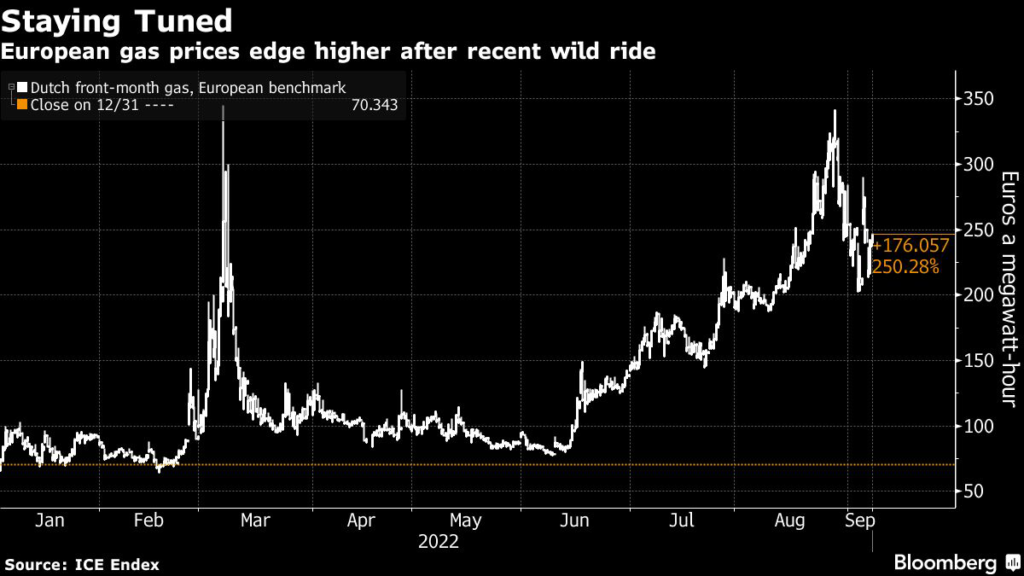
Gas Prices Move Higher After Recent Wild Ride (7:33 a.m.)

Gas futures in Europe edged higher early Wednesday after wild moves in the previous two days. Dutch front-month contract, the European benchmark, added 2.7%, with traders weighing risks to Russian supplies against moves drafted by politicians to fix the crisis ahead of winter. Gas supplies from Norway are also curbed due to seasonal maintenance, with volumes bottoming out at the lowest since mid-July on Wednesday. Works will wrap up next month.

Germany Seen Sliding Into Recession (7:33 a.m.)

For Germany’s industrial backbone, small and medium-sized enterprises, higher energy prices look like a “ticking time bomb”, according to according to ING Groep NV. With ongoing pressure on consumers’ disposable incomes, companies’ pricing power is fading, Carsten Brzeski, chief macro-economist said.

“Judging from the first macro data for the third quarter, the German economy has not fallen off a cliff at the start of the third quarter but is rather sliding into recession,” he said.

Australia Moves to Allay Japan’s Gas Cut Fears (7:33 a.m.)

Australia says it’s doing what it can to ensure supplies of liquefied natural gas to Asian customers will remain reliable, in response to concerns producers could be forced to redirect to relieve domestic shortfalls.

The nation, which vies with Qatar for the title of top LNG exporter, has the power to force producers in the east to redirect uncontracted cargoes tipped for international markets for domestic consumption, but has so far declined to use it. Even if Canberra decides to tighten the rules when the current agreement expires on Jan. 1, the impacted volumes are likely to be relatively minor — about 4% of Australia’s exports, according to BloombergNEF.

Crisis May Extend Beyond Next Winter (7 am)

Europe could face an even bigger problem next winter with no end in sight for the energy crisis, Niek Den Hollander, Uniper’s Chief Commercial Officer, said in an interview in Milan.

If Russian gas flows remain curtailed, it’s possible that nations won’t be able to fill up storage sites effectively next summer, he said. 

“We could see low inventories in the end of this winter, and that would make it very difficult to procure gas and fill up storage again for security of supply next winter,” Den Hollander said. “It all depends on how much LNG Europe will be able to attract and will also depend very much on the weather.”

More stories like this are available on bloomberg.com

©2022 Bloomberg L.P.

Crypto Market Drops Below $1 Trillion, Bitcoin Nears 2022 Low

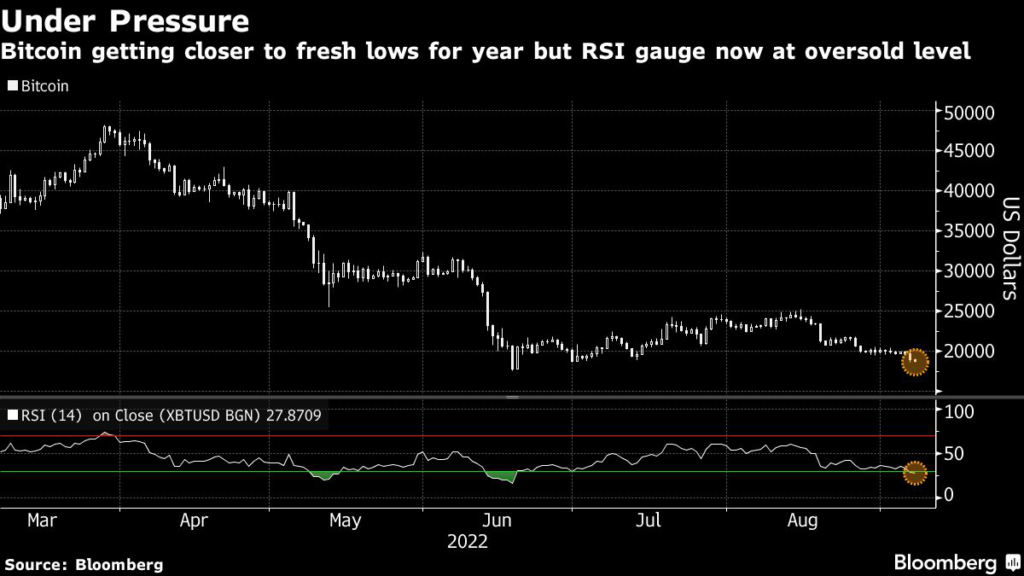
(Bloomberg) — Bitcoin is flirting with a test of this year’s lows following a cryptocurrency selloff that again pushed the sector’s overall market value below $1 trillion.

The largest digital token has shed more than 6% so far this week and was trading at about $18,750 as of 7:02 a.m. in New York. Crypto market capitalization has fallen by a similar proportion in the past 24 hours, according to CoinGecko. Ether erased Tuesday’s gains, dropping about 4.4%.

Surging real interest rates — seen as the true cost of borrowing — are heaping pressure on a range of risk assets and crypto is no exception. The retreat in Bitcoin is taking it closer to a nadir of about $17,600 that was hit in June in the wake of blowups at crypto lenders and hedge funds.

“The macro narrative is very hard to be able to let go and will drive risk assets,” Kevin Loo, head of investment insights at IDEG Asset Management Ltd., said on Bloomberg Television. “Bitcoin is below $20,000. We have been here before and it’s likely that we could actually go slightly lower.”

At the same time, there remains residual optimism from the upcoming upgrade of the Ethereum network, which some analysts hope will draw investment flows into Ether and other digital assets.

“Bitcoin was at $3,000 in the first crypto winter and if you measure trough to trough, the trend is we are heading higher in the longer term,” Loo said.

The MVIS CryptoCompare Digital Assets 100 index of the largest tokens is down about 60% this year. Bitcoin has tumbled from a pandemic-era peak of almost $69,000 in November last year.

More stories like this are available on bloomberg.com

©2022 Bloomberg L.P.
China’s Electric Car Startups Put a Dent in Legacy Automaker Market Share

(Bloomberg) —

For many years, China’s electric vehicle market was primarily driven by policy. The combination of fuel economy regulations, a new-energy vehicle quota system, government fleet mandates and direct purchase subsidies all added regulatory pressure and incentives for both automakers and consumers to go electric.

The policies still matter, but recent BloombergNEF analysis shows EV adoption is now running well ahead of what’s required purely from national regulations and policy targets. City-level policies are still playing an important role because they make it difficult to get a new license plate for internal combustion vehicles in China’s major cities, but even that isn’t enough to explain why adoption is rising so quickly.

There are many factors at play when a consumer technology starts to take off. Technology maturity, cost competitiveness and word of mouth all play a role. In China’s EV market, there’s another factor at play, namely that homegrown EV startups have helped transform perceptions of the vehicles there.

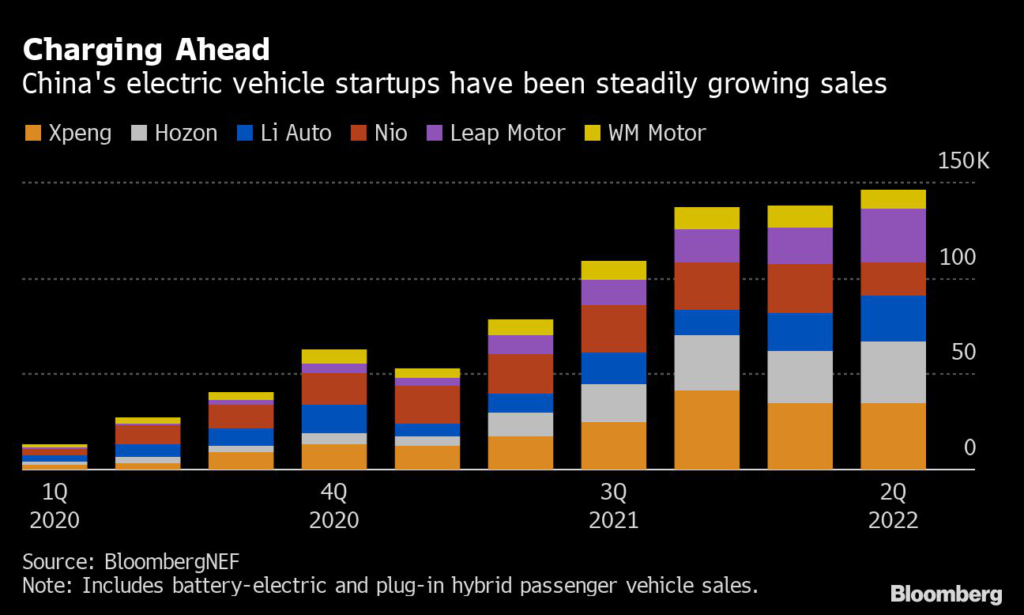
There was talk a few years ago about how many of these startups risked being wiped out by stricter technology standards. Lo and behold, some not only survived but are growing sales quite quickly. Xpeng, Hozon New Energy Automobile, Li Auto, Nio, Leap Motor and WM Motor are now selling almost 150,000 EVs a quarter, about 7% of the global total and up more than 10-fold from the beginning of 2020.

These startups are less likely to be designing vehicles strictly to comply with regulations, as some Western, Japanese and Chinese automakers with legacy businesses have done. They have no legacy business to protect, know subsidies won’t last forever and that their products need to stand on their own feet quickly.

China’s EV startups also have made a combined push on digital services, in-car connectivity and customer-service experience concurrently with their electrification efforts, which has helped shift the perception of EVs from one of compliance and regulation to one where you access the coolest tech, and get treated well in the process.

They’re not alone, of course. Other dynamic auto companies are pursuing a similar strategy, and the startups’ share of sales is still relatively small compared to the likes of Tesla and BYD, which sold 255,000 and 354,000 plug-in vehicles globally last quarter, respectively. But the startup numbers are still significant. They’re ramping up quickly and will probably top 250,000 a quarter next year.

The group getting squeezed by all this is established global automakers, many of which deliberately slow-rolled their EV programs and are now scrambling to catch up with respect to their model lineups and battery supply. As recently as 2020, international automakers had 61% of the total auto market in China. That’s declined to 49% so far in 2022. Setbacks on software and disputes with local partners are not helping, and with China’s EV sales rising fast, it’s getting harder to see this market share trend reversing.

While Western automakers are seeing their share of the Chinese market shrink, China’s EV startups are quickly expanding in Europe. MG Motor, owned by SAIC, sold 40,000 EVs in Europe last year, while groups like Nio, Xpeng, BYD and others have been testing the waters with smaller numbers in countries such as Norway.

All of China’s startup automakers plan to significantly increase their international presence in the next few years and some of them are launching very cost-competitive EV models to further that goal. There’s a window open for them in Europe right now, because the region’s vehicle CO2 regulations don’t tighten again until 2025. Many established automakers have slowed down their EV rollout accordingly. With Tesla, BYD and these EV startups all at the gate, this may not be a wise strategy.

There are probably still some bumps in the road ahead. Making cars is still difficult. But it’s remarkable how fast perceptions of what’s possible can shift. In 2019, China proposed what was then widely viewed as a stretch target of having new-energy vehicles represent 25% of passenger vehicle sales by 2025. That number now looks like it will be achieved this year, a full three years ahead of schedule. China’s EV startups have played an important role in making that happen.

More stories like this are available on bloomberg.com

©2022 Bloomberg L.P.
Asia Stocks Tumble to Lowest Since May 2020 on Strong Dollar Pain

(Bloomberg) — A fresh sell-off hit Asian equities on Wednesday as concerns over a stronger dollar and rising global interest rates added to pressure on capital flows. 

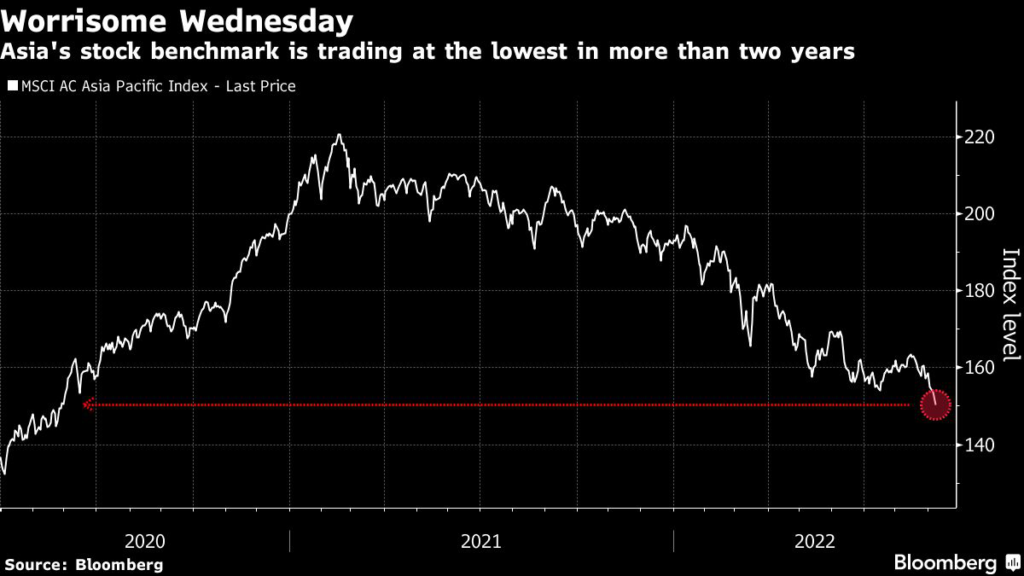
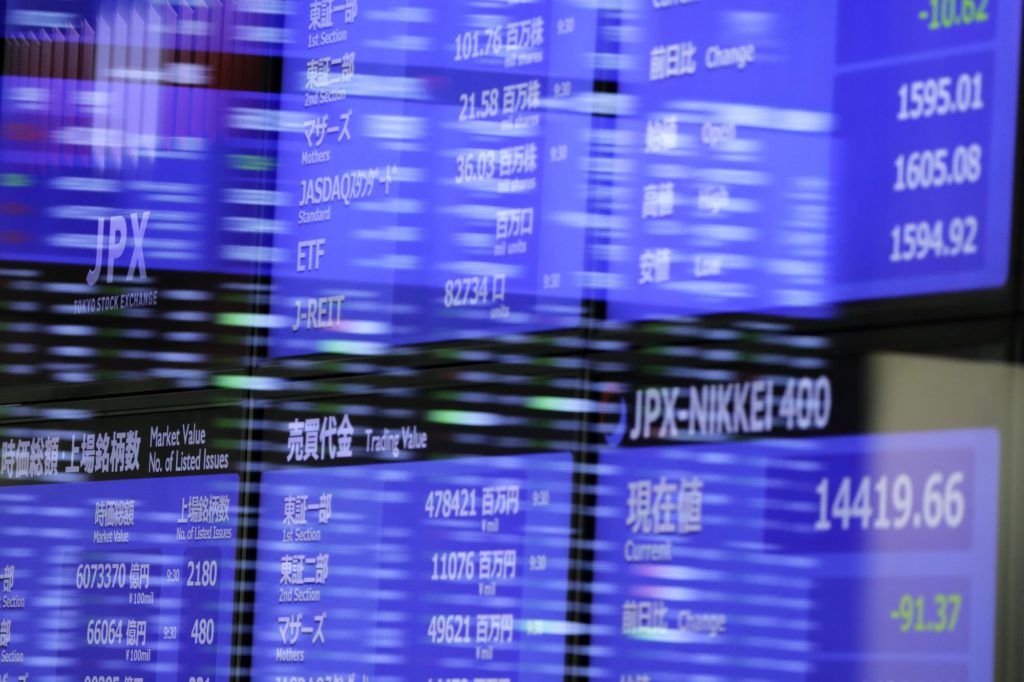
The MSCI Asia Pacific Index dropped as much as 1.8% to its lowest since May 2020 as most sectors were in the red. Tech shares led declines, given the sector’s sensitivity to higher borrowing costs and the global economy. Benchmarks in Taiwan, the Philippines, and Vietnam fell the most, with the latter two sliding more than 2% each.

The “strong dollar is never good news for Asian markets,” Sanford C. Bernstein strategists including Rupal Agarwal wrote in a note late Tuesday. “It tends to increase the cost of foreign debt, results in higher capital outflows and puts pressure on central banks to maintain the attractiveness of their exports and the yield spreads.” 

Regional currencies were under pressure, with the Korean won at its lowest in more than 13 years, the Philippine peso dropping past 57 per dollar for the first time and the Malaysian ringgit falling to a 24-year low. Such rapid depreciation can further damp appetite for Asian assets. 

By contrast, Chinese equities held up relatively well. The CSI 300 Index was little changed as chipmakers advanced after President Xi Jinping called for a stronger effort to advance key technologies. Still, the nation’s Covid-19 lockdowns continue to expand, keeping a cap on equity gains. 

A risk-off mood is taking hold ahead of Federal Reserve Chairman Jerome Powell’s speech on Thursday, as well as a line-up of other Fed speakers at various events this week. Investors expect Powell to signal a continued aggressive tightening cycle after the August ISM services index unexpectedly rose to a four-month high. Bond yields soared across tenors and a dollar gauge climbed for a third session to a fresh high. 

Global funds have net sold about $1.1 billion worth of emerging Asia excluding China shares this week, adding to the $2.4 billion in outflows seen last week, according to latest data compiled by Bloomberg. Taiwan has accounted for a majority of the outflows, with geopolitical tensions and worries about the semiconductor cycle causing net redemptions of $41 billion in 2022.

Valuations for MSCI’s Asia gauge continue to crawl toward a pandemic low. The measure is trading at about 12 times forward earnings — inching closer to the 10.6 multiple seen in March 2020.

Asia “is a difficult story” right now, said Steen Jakobsen, chief investment officer at Saxo Bank. “We see relatively weak growth on the consumer side in China, and relatively weak stories across” the region except for certain sectors such as energy, commodities and defense, he added.

SECTORS TO WATCH

  • Chip stocks are in focus after a senior executive at Samsung Electronics warned that the semiconductor industry could be in for a rocky close to 2022
  • Shares of China aluminum producers including Shandong Nanshan rallied after a report that President Xi Jinping has vowed to strengthen key technologies. Producers of the metal elsewhere in Asia fell as stockpiles jumped
  • Asia’s energy-related shares including Santos slid after oil retreated on concern a global slowdown will cut demand in Europe and the US just as China’s Covid Zero strategy hurts consumption
  • PLDT led declines among Philippine telecommunication stocks as Maybank Securities downgraded the sector to neutral, citing rising competition and slower growth expectation in broadband fiber
  • Nippon Yusen and other Japanese shipping stocks fell after a key official flagged concerns over an economic downturn
  • Shree Cement led a rally in Indian makers of the key construction material as analysts expect the companies to hike prices as demand improves, while a recent decline in some commodity prices benefits the sector

MARKETS AT A GLANCE

  • MSCI Asia Pacific Index down 1.3%
  • Japan’s Topix index down 0.6%; Nikkei 225 down 0.7%
  • Hong Kong’s Hang Seng Index down 0.8%; Hang Seng China Enterprises down 0.6%; Shanghai Composite up 0.1%; CSI 300 up 0.1%
  • Taiwan’s Taiex index down 1.8%
  • South Korea’s Kospi index down 1.4%; Kospi 200 down 1.5%
  • Australia’s S&P/ASX 200 down 1.4%; New Zealand’s S&P/NZX 50 down 0.4%
  • India’s S&P BSE Sensex Index down 0.2%; NSE Nifty 50 down 0.1%
  • Singapore’s Straits Times Index down 0.4%; Malaysia’s KLCI up 0.2%; Philippine Stock Exchange Index down 2.3%; Jakarta Composite Index down 0.6%; Thailand’s SET Index up 0.4%; Vietnam’s VN Index down 2.7%

ADVANCERS

  • Soho China jumped 11% in Hong Kong, the biggest gain since August 2021, after the property company said its Chairman Pan Shiyi has resigned to focus on supporting the arts and philanthropic pursuits
  • Shidax rose 5.6% after Colowide said it made a proposal for its food service business

DECLINERS

  • PHC Holdings fell 9.9% after it was cut to neutral from outperform at SMBC Nikko
  • Posco declined 2.6% after the steelmaker said its entire production is down at Pohang steel mill with a typhoon flooding South Korea’s largest steel plant

Are you bullish on energy-related stocks and bonds? This week’s MLIV Pulse survey focuses on energy and commodities. Please click here to participate anonymously.

More stories like this are available on bloomberg.com

©2022 Bloomberg L.P.
CEOs Ride Tractors to Work as Rains Engulf India Tech Hub

(Bloomberg) — Weather officials are predicting further bouts of severe weather in Bangalore as torrential rains pounded the city, submerged access to office parks and hit back-office operations that are the nerve center of the global financial and technology industries.  

Known as India’s Silicon Valley, Bangalore has faced consecutive nights of relentless monsoon rains that have crippled transport and business operations on the city’s key Outer Ring Road (ORR), an area where big name international firms such as Microsoft Corp, Intel Corp, Goldman Sachs Group Inc. and Morgan Stanley have offices. It’s also caused tens of millions in productivity losses locally, according to an industry group. 

A cluster of chrome-and-glass towers on the ORR, as well as office parks nearby have become home to about a million software coders and support workers. They handle such vital operations as risk management, customer support and financial compliance. The companies that employ them had returned to a semblance of workplace normalcy after prolonged Covid-19 restrictions, but have been forced to send workers back to working from home yet again.

The chief executive officer of prominent edtech startup UpGrad said he had to reach his office riding on a tractor as his home faced a power cut. “I had to walk 7 km, take a tractor to cross waist deep water and hitch rides from passing bikers to reach office,” said Arjun Mohan, chief executive officer of edtech unicorn UpGrad on LinkedIn. “Quite an adventurous day” he said, adding that he went to work at his office as the city had cut off power and drinking water supply to his neighborhood.

The downpour of the past days, described by local media as some of the wettest on record for Bangalore, highlighted the dilapidated public facilities in one of India’s most global cities and irked the global businesses that have made it their base. The city has already reported two deaths due to the rains and India’s Meteorological Department has issued a yellow alert for Bangalore, indicating further bad weather.

Poor infrastructure in the city’s technology corridor is “bringing down the efficiency and productivity of the companies and putting employees’ safety and wellbeing at risk,” members of the Outer Ring Road Companies’ Association, which includes Wall Street banks and global tech behemoths, complained in a strongly-worded letter to the chief minister of Karnataka state, of which Bangalore is capital. Flooding led to a five-hour traffic jam where workers were stuck leading to a loss of about $30 million, the group said in the letter.

Companies had to trigger emergency business continuity plans, allow work from home or pass on critical work to locations outside of Bangalore, causing reputational damage and economic losses, the group said.  

The ORR stretch generates about $22 billion in annual revenues, a third of the city’s technology revenues, but “the lack of focus on the development of infrastructure in this corridor is appalling,” said the association whose members also include Wells Fargo & Co, Dell Technologies Inc and Capgemini SE besides a host of Wall Street banks and Silicon Valley corporations.

Bangalore, home to over 10 million people, serves as a base for major outsourcing companies, dozens of prominent startups, and the India ecommerce operations of Amazon and Walmart. It also houses the global technology units of hundreds of companies from consultancy KPMG, software tools maker Adobe Inc and travel software provider Amadeus IT Group.  It’s becoming a popular hub for expatriates drawn to its moderate weather and cosmopolitan lifestyle.

Yet, this week, photos of the submerged entrance to the headquarters of one of India’s largest IT services companies, Wipro Ltd, circulated on messaging groups. 

“The scale of disruption is unbelievable,” said Pradeep Kar, chairman of Microland Ltd. a technology provider which specializes in managing digital infrastructure such as cloud networks and data centers for clients like Microsoft Corp. and the London borough of Ealing.  “Our customers expect us to provide 24×7 uninterrupted services; thankfully we were equipped for work-from-home because of the pandemic and could continue to manage our clients’ infrastructure,” said Kar, a pioneering tech entrepreneur. Microland has three facilities on ORR stretch that house about 5,000 employees.  

Weddings and school lessons went back online, citizens complained on social media of miles-long traffic jams because of water-logging, residents of upscale communities were marooned inside their homes, international flights were diverted and drinking water supply and power cut off in several neighborhoods. Local TV channels streamed videos of fire brigades deploying boats to rescue stranded people. 


Many have blamed the events on the rampant and chaotic development in the city where lakes and storm water drains have been filled to make way for glitzy buildings and posh homes. Traffic jams have only worsened in the last decade. But this week’s flooding took the pain to another level for many residents who waded through waist-deep water to get out of their flooded homes. On WhatsApp groups, photos appeared of rescues by delivery people and of stalled vehicles getting pushed through the water by helpful security guards.


More stories like this are available on bloomberg.com

©2022 Bloomberg L.P.

Close Bitnami banner
Bitnami