

Bloomberg

Japan LDP Policy Chief Meets Taiwan’s Tsai Amid China Strain

(Bloomberg) — Taiwan received its first visit from a top member of Japan’s ruling party in 19 years, a trip that comes as Tokyo prepares a hefty boost in military spending to counter threats from countries like China.

Koichi Hagiuda, policy chief of Japan’s Liberal Democratic Party, met with President Tsai Ing-wen on Saturday. Tsai told Hagiuda Taiwan will continue to deepen partnerships with Japan and work together to facilitate openness and stability in the Indo Pacific region.

She urged Japan to support Taiwan’s membership in the Comprehensive and Progressive Agreement for Trans-Pacific Partnership. Hagiuda told Tsai that Taiwan is an important partner that shares common values, including freedom, democracy and rule of law, with Japan.

The senior LDP member told a forum in Taipei on Sunday that he supports Taiwan’s participation in CPTPP and that Tokyo doesn’t want the status quo altered by the use of force.

Hagiuda, whose role allows him to steer the LDP’s course, said he hoped to have “frank discussions” with Tsai on security issues as China steps up pressure on the self-governed island, the Nikkei newspaper reported earlier. 

The visit is significant because it comes just days after Japanese Prime Minister Fumio Kishida ordered a sharp hike in defense spending. The money is set to be used for items such as stockpiling missiles capable of striking military targets in China, Russia and North Korea.

Japan’s Rising Defense Budget Is Now Nearly on Par With Russia

Hagiuda will “likely communicate Japan’s intentions with its additional defense budgets pertaining to Taiwan,” said Wen-ti Sung, a specialist on Taiwanese politics and cross-strait relations at Australian National University.

It was also “likely intended to normalize frequent exchanges at this level going forward and to touch base with presumptive presidential candidates.”

The Japanese politician also took time off in Taiwan to visit the headquarters of Taiwan Semiconductor Manufacturing Co., the world’s biggest maker of made-to-order chips, and met with its managers, the Nikkei reported.

His visit to TSMC comes with ongoing supply-chain problems in the chip industry and growing US efforts to restrict Beijing’s access to high-end technology. Japan and Taiwan will further enhance their partnership on chips, Hagiuda was cited by the Nikkei as saying. 

He told reporters following the meeting that he wants to establish a supply-chain system that would prevent chip shortages under any circumstances, with cooperation between TSMC and Japanese companies, the newspaper reported on Sunday. 

Why Taiwan’s Status Risks Igniting a US-China Clash: QuickTake

The LDP frequently sends lawmakers to Taiwan to push back at efforts by China to isolate it. Kishida has warned that Taiwan is at the frontline of the standoff between China and the US, and a problem in the Taiwan Strait would have enormous consequences for Japan.

Beijing claims the island as part of its territory to be taken by force if necessary, though Tsai insists it is already a de facto nation deserving broader recognition.

Hagiuda’s visit comes at a challenging time for the Taiwan leader, whose Democratic Progressive Party last month suffered its worst loss in local elections since its founding in 1986. That defeat sets up a more contentious presidential race focused on rising tensions with China in 2024, when Tsai leaves office due to term limits.

–With assistance from Debby Wu and Yoshiaki Nohara.

(Updates with report of visit to chip company from ninth paragraph.)

More stories like this are available on bloomberg.com

©2022 Bloomberg L.P.
Elon Musk Steps Up Attacks on Twitter’s Former Safety Head

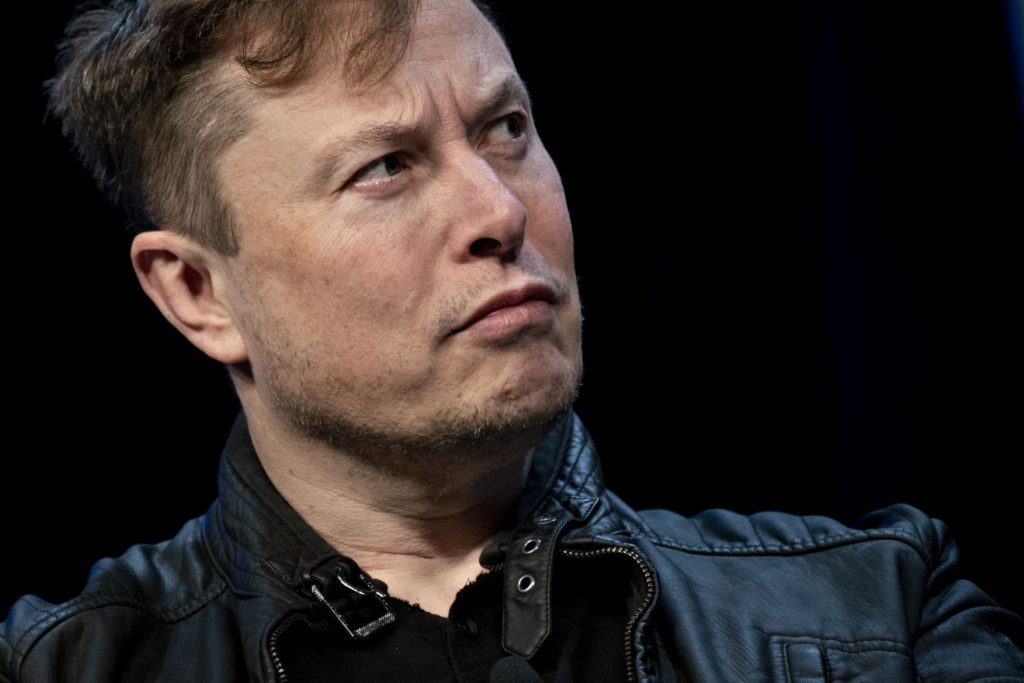
(Bloomberg) — Elon Musk posted tweets including an excerpt of Yoel Roth’s doctoral dissertation Saturday that suggested the former Twitter executive is an advocate for child sexualization — a baseless trope that leaves Roth susceptible to online abuse.  

Musk bought Twitter in late October for $44 billion and has singled out Roth, the former head of Twitter’s Trust & Safety division, and ex-legal head Vijaya Gadde for left-wing bias as he made swift changes. Both have long been the target of right-wing attacks over Twitter’s decision to ban former President Donald Trump from the platform after the violent insurrection at the US Capitol on Jan. 6, 2021. 

Roth declined to comment Saturday. 

Musk participated in a Twitter Spaces Friday night about childhood exploitation, and responded to one of the participants on Saturday after she linked to an old tweet of Roth’s. 

“Looks like Yoel is arguing in favor of children being able to access adult Internet services in his PhD thesis,” tweeted Musk, with an excerpt from the 300-page dissertation. “Gay Data,” the title of Roth’s 2016 dissertation at the University of Pennsylvania, is about Grindr, the geosocial networking service popular with the LGBTQ+ community.

Far-right and extremist voices have long pushed a false claim that LGBTQ+ people are sexual predators who are “grooming” children to abuse them. In September, the Anti-Defamation League’s Center for Extremism said that “the result of this widespread hateful rhetoric has been a spike in harassment, threats and violence targeting the LGBTQ+ community.”

Musk in 2018 called a British caver who was involved in the rescue of a trapped Thai youth soccer team a “pedo guy.” One of his aides paid $50,000 to hire a private investigator in a futile attempt to back up the assertion. In 2019, Musk beat back a defamation claim from the cave expert in a Los Angeles court in 2019. 

Musk Hired Detective to Probe Man Who Sued Over Tweet (2)

When Musk first purchased Twitter in late October, he expressed support for Roth before the executive resigned in November. 

In recent days, Musk has said that Twitter interfered in elections, pointing to the release of emails from executives including Roth that discussed a controversial decision to restrict access to a 2020 article involving Hunter Biden. 

Musk’s line of attack has already received some push back. When Musk tweeted that Twitter “refused to take action on child exploitation for years,” former Chief Executive Officer Jack Dorsey, who is friendly with Musk, tweeted “this is false.”

More stories like this are available on bloomberg.com

©2022 Bloomberg L.P.
Telstra Says Database Issue, Not Hacking Led to Privacy Breach

(Bloomberg) — Australian communications company Telstra Corp. said a “misalignment of databases” caused the details of some customers to be released publicly.

The names, phone numbers and addresses of some customers who had requested to be unlisted became available online and via directory assistance, the Melbourne-based company said in a blog post. About 130,000 customers were affected, the Age reported without saying where it got the information 

“We recently discovered there had been a misalignment of the databases used to provide these services, which resulted in some customers’ names, numbers and addresses being listed when they should not have been,” Chief Financial Officer Michael Ackland said in the blog post. “This was a result of a misalignment of databases — no cyber activity was involved.”

Last month, Telstra called for a review of laws governing data retention after scams targeting customers reached new highs and a leak of years of information about its employees. In October, its main rival Optus, which is owned by Singapore Telecommunications Ltd., revealed a vast hack of the records of almost 10 million current and former customers.

Ackland apologized and said Telstra has started work to remove the details, as well as to contact every affected customer to let them know. An internal investigation will be conducted.

“Protecting our customers’ privacy is absolutely paramount, and for the customers impacted we understand this is an unacceptable breach of your trust,” he said. “We’re sorry it occurred, and we know we have let you down.”

More stories like this are available on bloomberg.com

©2022 Bloomberg L.P.

Twitter Relaunches Twitter Blue Monday With Two-Tiered Pricing

(Bloomberg) — Twitter will relaunch its Twitter Blue subscription service Monday for $8 per month on the web, the company said.

Users will also get access on iOS for $11 per month to subscriber-only features, including the blue checkmark, the company said in a series of tweets Saturday.


To view the source of this information click here

More stories like this are available on bloomberg.com

©2022 Bloomberg L.P.
World’s Top Money Managers See Global Stocks Recovering in 2023

(Bloomberg) — Some of the world’s biggest investors predict that stocks will see low double-digit gains next year, yet the path to a rebound won’t be a straight line.

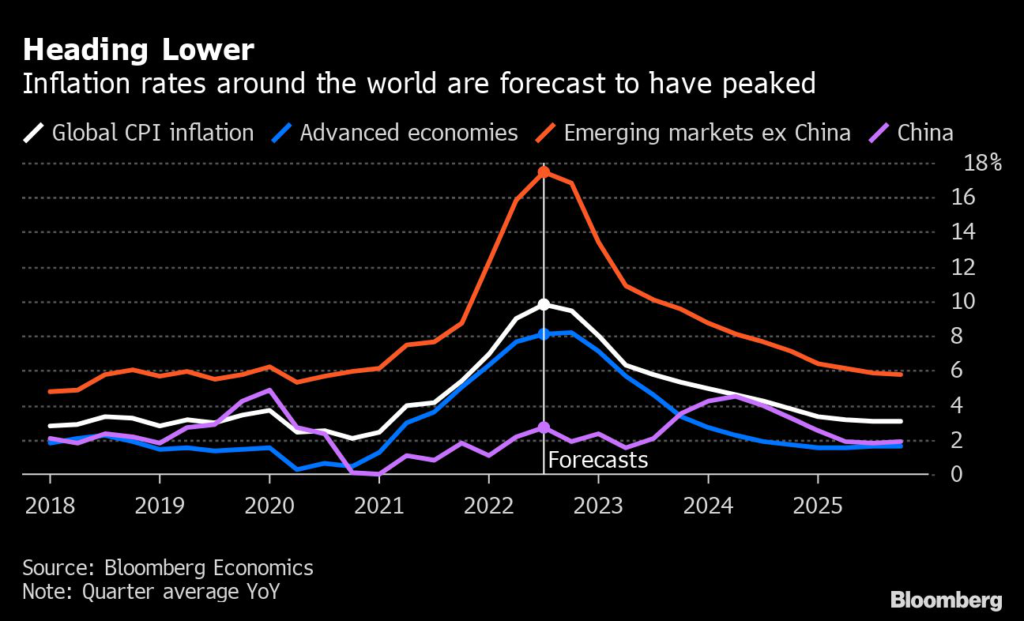
Amid recent optimism that inflation has peaked — and that the Federal Reserve could soon start to change its tone — 71% of respondents in a Bloomberg News survey expect equities to rise, versus 19% forecasting declines. 

The informal survey of 134 fund managers incorporates the views of major investors including BlackRock Inc., Goldman Sachs Asset Management and Amundi SA and was conducted between Nov. 29 and Dec. 7. It provides an insight into the big themes and hurdles they expect to be grappling with in 2023 after inflation, the war in Ukraine and hawkish central banks battered equity returns this year.

Last year, a similar survey predicted that aggressive policy tightening by central banks would be the biggest threat to stocks in 2022.

Here are the main points of the survey in six charts. For more on the full details of the survey, click here.

Modest Gain

Those who expect global shares to rise see an average 10% gain for 2023. That is in line with the average historical return of the MSCI All-Country World Index, yet looks modest given previous rebounds such as 2009 or 2019 where equities gained more than 30% and 20% respectively.

Investors remain cautious for the start of the year and predict that stock market gains will be skewed to the second half of 2023. When it comes to specific sectors, respondents generally favored companies that can defend earnings through an economic downturn. Dividend payers and insurance, health care and low volatility stocks were among their picks.

Biggest Risks

The biggest threats to a potential recovery are somewhat interlinked, with stubbornly high inflation or a deep recession ranking high on investors’ watch list, cited by 48% and 45% of participants, respectively. 

Clues about the path forward might came as early as next week where a frenzy of headline risks are awaiting investors, including US consumer-price data for November as well as rate decisions and commentary from both the Federal Reserve and the European Central Bank. 

Read more: Stress Creeps In Again on Stock Market as Fed, CPI Data Loom

Tech Rebound

After being hammered this year as interest rates climbed, US technology stocks may also come back in favor, according to the survey. More than half of respondents said they’d buy the sector.

Those in favor note valuations are relatively cheap despite the recent rally and bond yields are expected to fall next year. Yet sentiment is shifting away from a broad “buy growth” approach as many participants suggest being very selective when going back into the segment, putting money only on those companies that have established business models and resilient financials even in an economic downturn.

China Opportunity

Some 60% of the investors are bullish on China, particularly as it moves away from Covid zero. A slump earlier this year has put valuations well below their 20-year average, making them more attractive compared with US or European peers.

Political and regulatory risks are too big for those advising to stay away from the region. And similarly to big tech, the bulls suggest being very selective, when it comes to picking stocks. 

The Fuel

For fund managers, better news on inflation and growth could be catalysts for a stronger performance. Almost 70% of respondents said they were the main potential positive factors. They also cited a full China reopening and a ceasefire in Ukraine as upside triggers.

The emphasis on inflation and growth as the make-or-break elements is in line with the findings of Bank of America Corp.’s latest fund manager survey. It showed recession expectations were at the highest since April 2020, while a “stagflation” scenario of low growth and high inflation was “overwhelmingly” the consensus view.

Contrarian View

The constructive view of money managers is at odds with what Wall Street is predicting. In separate Bloomberg surveys of strategists, gains of less than 2% for Europe and a meager 1% for the US stock market are forecast.

Central banks’ aggressive monetary policy, leading to a weakening of global growth momentum in the first half of 2023, is one of the main arguments cited by strategists for anticipating an essentially flat stock market next year. However, they foresee the impact on equities will be partly offset by a decline in real bond yields.

Read more: Burned Stock Pundits Ditch Two Decades of Unbroken Bullishness

More stories like this are available on bloomberg.com

©2022 Bloomberg L.P.
Investors Call Time on FAANG Stock Dominance After Nasdaq’s Rout

(Bloomberg) — For some investors, this year’s rout in high-flying technology stocks is more than a bear market: It’s the end of an era for a handful of giant companies such as Facebook parent Meta Platforms Inc. and Amazon.com Inc.

Those companies — known along with Apple Inc., Netflix Inc. and Google parent Alphabet Inc. as the FAANGs — led the move to a digital world and helped power a 13-year bull run. 

But history shows that market leaders of one era almost never dominate the next one. There are early signs that a shift is already under way: Growth has slowed or evaporated for Netflix and Meta, while the sheer size of Amazon, Apple and Alphabet means they’re unlikely to provide the huge returns in the future that they did in the past.  

“We think it is unlikely the FAANG will lead the next tech bull cycle,” Richard Clode, a portfolio manager at Janus Henderson Investors, said by phone, adding that he has reduced his holdings of those stocks “very materially.” “We are at our lowest exposure to FAANG that we’ve been since the acronym was created.”

If it is indeed the end of the cycle for these companies, what an ending it’s been. 

The outbreak of the coronavirus pandemic in early 2020 rocked the whole stock market, but after a blink-and-you-missed-it plunge, indexes came roaring back. Large-capitalization technology stocks including the FAANGs led the way as locked-down consumers ordered goods from Amazon, subscribed to Netflix to watch “Tiger King,” and spent hours scrolling through Facebook and searching on Google using iPhones.

But investors are reassessing their longer-term potential now that societies have reopened and higher interest rates around the world have damped risk appetites.

One of the biggest draws for investors has been the super-charged growth rates that technology companies offered. Now the growth looks more pedestrian. 

“Superior” sales growth, the characteristic most associated with large-cap tech stocks, has vanished, at least for this year, Goldman Sachs strategists wrote in November. The bank’s strategists predict sales growth of 8% for megacap tech stocks in 2022, below the 13% growth expected for the broader S&P 500 Index.

While Goldman does expect tech companies to deliver faster sales growth than the benchmark next year and in 2024, the gap is much smaller than the average of the past decade, the firm said.

“It’s very hard to grow those mega-revenues at very, very high growth rates the way that they did historically,”said Michael Nell, senior investment analyst and portfolio manager at UBS Asset Management. “While the megacap stocks have held up well, going forward it’s hard to see that they are necessarily going to drive performance from here.”

Meta shares shed a quarter of their value in one day in October after the Facebook owner’s sales forecast for the fourth quarter came in at the low end of analysts’ expectations amid a slowdown in the advertising market. Amazon.com slumped 7% a day later after projecting the slowest holiday-quarter growth in the firm’s history. 

The example of past stock-market stars is sobering. Cisco Systems Inc. and Intel Corp., leaders in the dot-com boom of the late 1990s, have never climbed back to the highs they reached in 2000, while it took the Nasdaq 100 Index 15 years to surpass its 2000 peak.

Apple, the world’s largest company with a $2.3 trillion market value, has held up the best in this year’s bear market, falling 20%. The stock has been bolstered by the company’s cash pile of about $170 billion, marketable securities and demand for its latest iPhones.

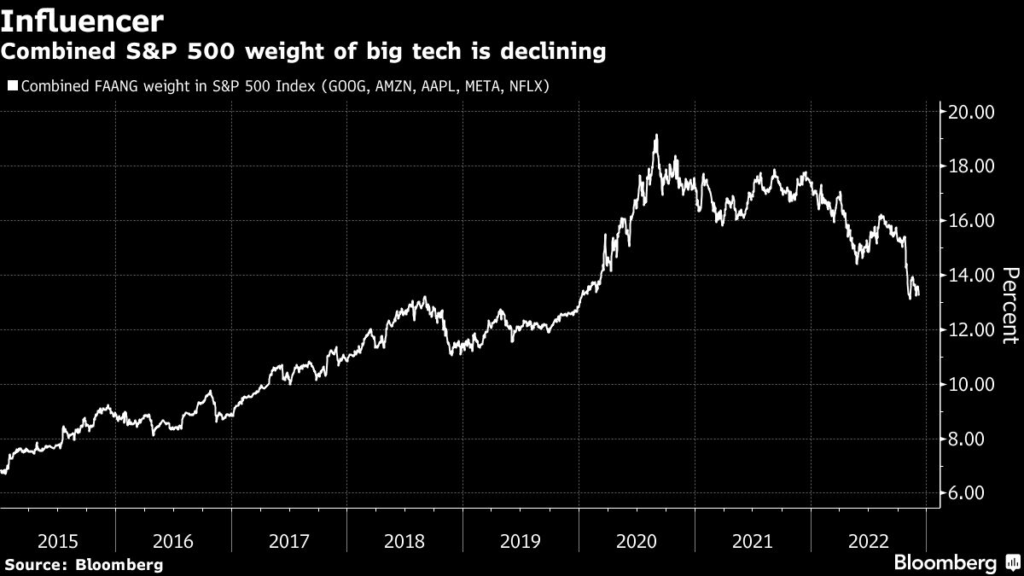
The other stocks in the FAANG group have fallen more, ranging from Alphabet’s 36% drop to the 66% plunge of Meta. Even with the declines, the group still accounts for more than 10% of the S&P 500 weighting, so subpar performance in coming years will be a big drag on the market. 

And the pain in technology stocks looks set to continue next year. Analysts see profits for the industry contracting by 1.8% next year, compared with expected growth of 2.7% for the broader US market, according to data compiled by Bloomberg Intelligence. 

Faced with a higher cost of borrowing and rising inflation, investors are becoming more exacting in terms of which companies they are willing to back. Big capital projects on unproven technologies, such as Meta’s bet on the metaverse, haven’t gone down well. A basket of money-losing tech stocks compiled by Goldman has plunged nearly 60% this year.

“The market’s telling them we want some near-term profitability and we can’t afford to fund all of your negative free cash flow. Get a bit more realistic: grow a little bit slower, but do it profitably,” said Neil Robson, head of global equities at Columbia Threadneedle Investments.

Robson is still overweight technology in his portfolios, though by a smaller amount than in the past. He still owns Amazon and Alphabet, though he’s also investing in companies that improve energy efficiency. UBS Asset Management’s Nell is finding opportunities in the software-as-a-service space and semiconductor stocks, while Janus Henderson’s Clode is looking toward energy, cybersecurity and artificial intelligence, and at areas that could prove resilient in a recession, such as software firms that could help with productivity.

“Two years ago we could have thrown a dart at a FAANG dart board and we would’ve pretty much come up a winner, right?” said Dan Morgan, a senior portfolio manager at Synovus Trust Co. “Do we just blindly throw money into an ETF which just buys nothing but FAANG? That’s probably not going to work anymore.”

–With assistance from Jeran Wittenstein, Subrat Patnaik, Ryan Vlastelica, Michael Msika, Jan-Patrick Barnert and Geoffrey Morgan.

More stories like this are available on bloomberg.com

©2022 Bloomberg L.P.
Caroline Ellison Hires SEC’s Former Top Crypto Cop for FTX probe

(Bloomberg) — Ex-Alameda Research CEO Caroline Ellison has hired a former SEC official who oversaw many of the regulator’s biggest crypto cases as her lawyer in the federal probe into cryptocurrency exchange FTX’s calamitous collapse. 

Stephanie Avakian, former enforcement division chief at the Securities and Exchange Commission, is representing Ellison along with other lawyers at her firm, WilmerHale, according to people familiar with the matter.  

A spokesperson for the law firm declined to comment. 

Alameda was the Hong Kong-based sister trading company of FTX, and FTX’s bankruptcy team, Congress, regulators and Manhattan prosecutors are probing allegations billions of dollars in customer funds deposited at the exchange wound up traded by Alameda.

Sam Bankman-Fried, FTX’s founder and former chief executive officer, has cast blame on Alameda in several media interviews. In contrast, Ellison has so far remained silent, fueling speculation that she may be seeking a cooperation deal with authorities. 

Avakian was SEC enforcement director for four years — and deputy director for two — before she joined WilmerHale in 2020. She shared the role of director with Steve Peikin, who is now representing FTX in its bankruptcy proceedings. During their tenure, the regulator ramped up enforcement in the cryptocurrency sector. 

Among the cases Avakian oversaw was one against blockchain company Ripple Labs, whose founders were accused of illegally raising $1.3 billion in an offering of an unregistered digital asset securities. The 2020 SEC suit has sparked an ongoing debate over whether crypto assets are securities.

Outside the crypto space, Avakian also oversaw enforcement actions against Robinhood Markets, General Electric and Tesla Inc chief executive officer Elon Musk.

WilmerHale partner Anjan Sahni, a former federal prosecutor who was in the running to be President Joe Biden’s US attorney for the Southern District of New York before Damian Williams was selected for the role last year, is also working on Ellison’s case, people with knowledge of the matter said. 

The Southern District is leading the criminal investigation into FTX. Sahni previously worked in the office for a decade and oversaw the investigation into Bernie Madoff’s accomplices and facilitators, as well as dozens of insider trading probes. He led the Southern District’s securities-fraud unit before he left in 2015. 

Sahni and Avakian have both visited the Southern District prosecutors’ office in Lower Manhattan in the past week, but it’s unclear whether their visits were related to Ellison. 

There has been rife speculation surrounding her whereabouts since an unconfirmed photo of the 28-year-old at a Soho cafe surfaced on Twitter on Dec. 4.

Read more: FTX Bankruptcy Team Met With US Prosecutors Probing Collapse

More stories like this are available on bloomberg.com

©2022 Bloomberg L.P.
The $115 Billion Thematic ETF Boom Lives On Even as Losses Mount

(Bloomberg) — Thematic investing can be traced as far back as 1948 when a mutual fund named the Television Fund was launched. And if it’s lasted this long, it can survive the ravages of an inflation-lashed year — at least as far as proponents like Kenneth Lamont are concerned.

Aggressive rate hikes by central banks as they battle surging prices have been brutal for thematic ETFs, a cohort of funds that target investments based on trends like robotics or electric cars. Rising borrowing costs have been hammering these riskier, speculative bets.

Yet Lamont, a nine-year veteran at Morningstar UK Ltd., sees reason for optimism. Even with an average drawdown of 30% for US thematic ETFs in 2022 — almost double the losses of the S&P 500 — outflows are less than 1% of the $115 billion in assets under management, data compiled by Bloomberg Intelligence show. It displays continuing faith in one of the hottest areas of investing that has helped power record-setting launches and growth for the $6 trillion ETF industry.

“It’s almost incredible how little the net outflow has been,” Lamont, Morningstar’s senior manager research analyst, said by phone. “If these were really being used trendily, we would’ve expected to see a sort of stampede for the door.”

Year-to-date, 53% of thematic funds are underwater since their inception. Launches in 2022 have slowed to 38 from the 77 seen in the previous year, while closures have picked up to 20 from five, data compiled by Bloomberg Intelligence show.

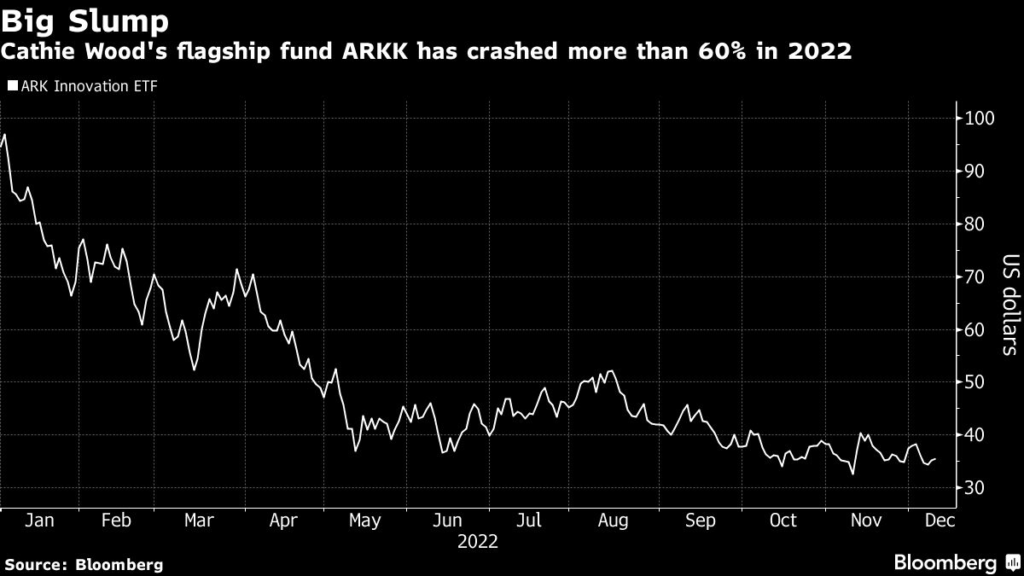
All the while, investors have stuck around. Most famously, Cathie Wood’s bellwether ARK Innovation ETF has added cash even as its price crashed 63% this year.

“From the demand side for these funds, the genie is out of the bottle,” said Lamont. “Thematic investing is captivating. We are narrative creatures and each fund and investment styles come with an inbuilt narrative.”

More broadly, as of Dec. 7, firms have launched 422 new ETFs this year, five more than the number seen over the same period in 2021. That total puts 2022 on track to surpass last year’s record for debuts, even amid recent market turmoil across asset classes. 

Among thematic funds, innovation and emerging markets technology were the top themes driving inflows year-to-date to the tune of $2.2 billion and $1.8 billion respectively. Tech and communications saw the most outflows with $3.2 billion leaving such funds, followed by cloud computing at $1.2 billion and robotics and artificial intelligence at $941 million.

The flight of money may not come as a big surprise as the tech sector faced multiple headwinds this year. Companies including Twitter Inc., Meta Platforms Inc. and Amazon.com Inc. have slashed their workforces by the thousands while other firms have been trimming staff and slowing hiring as they grapple with higher interest rates and a pullback in consumer spending.

The backdrop for equities remains challenged for the year ahead as concerns about the impact of Fed policy on growth and corporate earnings run rampant. To Athanasios Psarofagis, a Bloomberg Intelligence ETF analyst, that suggests tougher times ahead in the thematic space.

“There’s likely going to be a purge,” he said by phone. “The market is going to be more difficult going forward, there’s just no way it will be able to support these.”

Issuers are unlikely to give up without a fight. Thematic ETFs charge a higher expense ratio by roughly 50 basis points compared to the average ETF, according to data by Bloomberg Intelligence — a compelling reason to keep them trading and even to launch more.

Still, Sylvia Jablonski, chief investment officer at Defiance ETFs, is bullish on the space. Investor conviction will be enough to support these funds, she said, most of which revolve around innovation, digitalization, artificial intelligence and advances in computing.

“As markets evolve and new themes become investable, investors are more comfortable with the diversification of innovation in a basket, versus banking on one name,” she said. “There have been so many advances in classic sectors like energy, tech, communication, pharma, alternative energy and that has opened the doors for issuers with great ideas.”

–With assistance from Sam Potter.

More stories like this are available on bloomberg.com

©2022 Bloomberg L.P.
Musk Signals Long-Form Tweets Are ‘Almost Ready’

(Bloomberg) — The days of being constrained to just 280 characters in a tweet may soon be over after Twitter Inc. owner Elon Musk signaled that the long-form post is “almost ready” for deployment.

Musk has been actively engaging with users’ suggestions for how to improve the social media platform since his $44 billion takeover.

The billionaire has been issuing a flurry of pronouncements on the site. On Friday, Musk said in a tweet the company would start telling users if their posts have been suppressed while giving them an avenue to appeal. 

More stories like this are available on bloomberg.com

©2022 Bloomberg L.P.

China Suspends Alcohol Imports From Taiwan as Tensions Mount

(Bloomberg) — China suspended the import of alcoholic beverages from certain Taiwanese companies, the latest to get hit amid elevated political tensions.

Taiwan has asked Chinese authorities for reasons behind the decision, the island’s finance ministry said in a statement. Producers affected include the state-owned Taiwan Tobacco & Liquor Corp., Legend Brewery, Yunshan Distillery and Taihu Brewing, according to Taiwan’s official Central News Agency. China also halted imports of some other beverages, including Uni-President Enterprises Corp. products, according to Taiwan’s Next Apple News website.

Beijing has scaled back purchases of Taiwanese products as it seeks to punish the island’s democratically elected government for increasing ties with the US and its allies. While food made up a tiny fraction of Taiwan’s more than $328 billion of two-way trade with China last year, it’s one area where Beijing can find alternative sources, in contrast to semiconductors from Taiwan’s technologically advanced manufacturers.

In the wake of US House Speaker Nancy Pelosi’s visit to Taipei in August, China said it would suspend imports of some fish and fruit from the island.

–With assistance from Debby Wu.

(Updates with statement from finance ministry in second paragraph)

More stories like this are available on bloomberg.com

©2022 Bloomberg L.P.

Close Bitnami banner
Bitnami
