
Bloomberg

Biden, Truss to Speak Tuesday With ‘Special Relationship’ at Stake

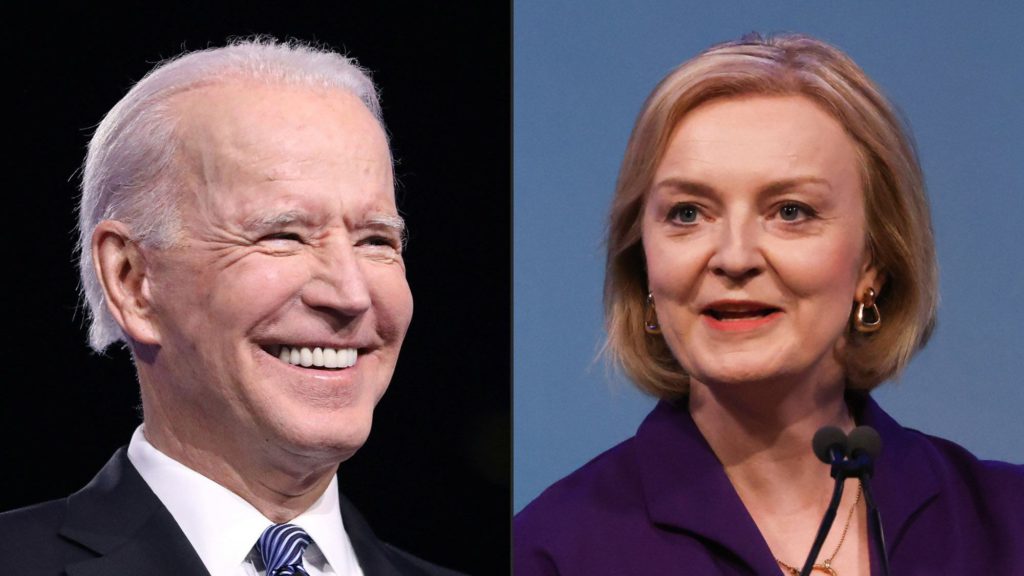
(Bloomberg) — With Liz Truss as the new UK prime minister, the “special relationship” with the US is on course for redefinition with a conservative leader that is much more of a hard-liner than her predecessor.

President Joe Biden will speak to his counterpart on Tuesday at 3:30 p.m. Washington time, a conversation that will set the tone for the future working relationship of two allies that have been historically close but do not always see eye to eye. 

His spokeswoman nodded to potential friction between Biden, a Democrat, and Truss, a Conservative who underwent a political transformation and went from being anti-Brexit to one of its most dedicated cheerleaders.

“He has been clear about his continued interest in Northern Ireland,” White House Press Secretary Karine Jean-Pierre said Tuesday. “Our priority remains protecting the gains of the Belfast Agreement and preserving peace, stability and prosperity for the people of Northern Ireland.” 

Biden was critical of the UK departing the European Union and given his roots felt particular concern about how a UK government could undermine the 1998 Good Friday Agreement, which drew a line under three decades of violence in the region.

The worry is whether Truss would tear up key parts of the Brexit deal that keeps Northern Ireland in the bloc’s single market for goods to avoid imposing a hard border on the island of Ireland.

The intervention comes at another tricky juncture for UK-EU relations as the deadline approaches for Truss’s government to respond to reactive legal proceedings launched by Brussels accusing the UK of four infringements to the Northern Ireland treaty. The deadline for the response is Sept. 15.

Truss is seeking to meet Biden when she makes her international debut at the United Nations General Assembly later in September, according to a person familiar with her thinking. Even so, her domestic in-tray is laden with an announcement on energy this week and tax plans next, leaving her less bandwidth for pursuing trade deals with a reluctant Biden. The US declined comment.

Most pointedly, Truss is less keen on the “special relationship,” a term fetishized by the Tory press to describe the personal affinity between Ronald Reagan and Margaret Thatcher in the 1980s.

Last year, on the fringes of the annual Tory party conference, she said she sees the relationship with the US as “special but not exclusive,” comparing the jostling of nations positioning to be close to the US as a “beauty contest.” 

The UK, she told the audience, shouldn’t be “worried like some teenage girl at a party if we’re not considered to be good enough. I don’t I just don’t see it like that.”

(Update in paragraph 7 on plans to attend UN General Assembly)

More stories like this are available on bloomberg.com

©2022 Bloomberg L.P.

Bitcoin Mining Firm Poolin Halts Withdrawals in Liquidity Crunch

(Bloomberg) — Poolin, one of the largest providers of Bitcoin mining-pool services, has suspended all withdrawals, flash trades and internal transfers within the Beijing-based firm’s system, citing the need to preserve liquidity.

Bitcoin mining pools are essentially the software that aggregates computing power from miners to increase the probability of winning the token rewards by securing the Bitcoin network. They charge miners a fee for providing the services. The mining process involves millions of powerful computers that compete to be the first to come up with a solution to validate transaction data encrypted by the blockchain and win the Bitcoin rewards for solving the equation. 

Mining pool companies have become an integral part of the Bitcoin mining industry. The vast majority of miners, including Marathon Digital Holdings Inc. and Riot Blockchain Inc., use the services since a single miner has a very slim chance of winning the Bitcoin rewards. The miners would rather combine their power and receive a share of the rewards if their pool wins. They can withdraw Bitcoin rewards through a wallet owned by the pool. 

“This imperative serves our goal of preserving assets, stabilizing liquidity, and operations in the midst of the dull crypto market, meanwhile, we continue to explore strategic alternatives with various parties,” PoolinWallet said in a Sept. 5 statement. 

In general, miners tend to withdraw Bitcoin rewards from the pools’ wallets every 24 hours. However, some mining pool companies incentivize clients to leave the rewards in their wallets for a longer time with lending products, said Ethan Vera, chief operating officer at mining services firm Luxor Technologies, which also has a Bitcoin mining pool. 

It is also possible for certain mining pools to lend out their clients’ holdings before they withdraw to maximize profits, Vera said. 

Poolin is the sixth-largest Bitcoin mining pool by computing power, according to data from btc.com. The firm also provides services to mine other coins such as Ethereum Classic. Poolin also mines Bitcoin itself. The Chinese firm has seen a significant drop in computing power in its mining pool over the last three days. 

The liquidity crunch comes at a time when Poolin is completing the costly process of moving its mining operations to Texas since China banned crypto mining last May. 

More stories like this are available on bloomberg.com

©2022 Bloomberg L.P.
Unfettered Fintech, Crypto Taking Banks’ Turf, Ex-Comptroller Says

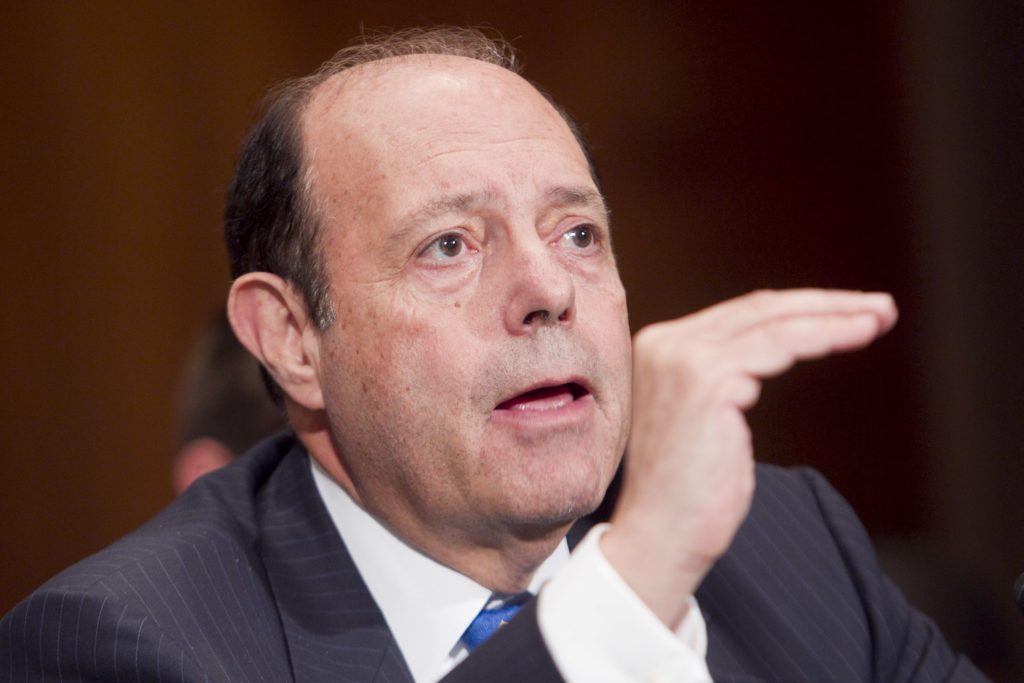
(Bloomberg) — Fintech and cryptocurrency firms competing with banks but subject to fewer regulations are “getting away with murder,” said Eugene Ludwig, a former Comptroller under the Bill Clinton administration. 

These new types of companies that take deposits and provide lending without proper oversight could be the reason for the next recession, Ludwig said during a Tuesday panel at the Clearing House and Bank Policy Institute’s annual conference in New York. 

Furthermore, if the Federal Reserve gets into crypto by endorsing a central bank digital currency, that will take the deposit experience away from banking and into the government, which will present “all kinds of problems,” he added.  

Banks should “retake the turf rather than let the turf devolve away” and be allowed to “play more aggressively in the crypto markets,” Ludwig said, though the tendency now is to do the opposite.  

Ludwig, who served as comptroller of the Currency from 1993 to 1998, is now managing partner at Canapi Ventures, which invests in fintech companies. In 2018, he applauded a decision from the Office of the Comptroller of the Currency to let fintech companies apply for a bank-like charter. 

But in the past year, the regulator has made it more difficult for crypto companies to secure this kind of license. It also heightened supervision requirements in November for banks looking to engage in crypto activities. 

Ryan Nash, an analyst at Goldman Sachs Group who covers financial companies, said at the same panel that investors have been able to get comfortable with deposits in crypto, but are still uncertain about the lending side. 

More stories like this are available on bloomberg.com

©2022 Bloomberg L.P.

Big Tech’s $95 Million Spending Spree Leaves Antitrust Bill on Brink of Defeat

(Bloomberg) — A high-profile push by Congress to rein in the nation’s biggest internet companies is at risk of failing with time running out to pass major legislation ahead of midterm elections.

Alphabet Inc.’s Google, Apple Inc., Amazon.com Inc. and Meta Platforms Inc. and their trade groups have poured almost $95 million into lobbying since 2021 as they seek to derail the American Innovation and Choice Online Act, which has advanced further than any US legislative effort to address the market power of some of the world’s richest companies.

After a nearly two-year battle, the bill is now at a critical juncture as the Senate returns this week for a final stretch before the November midterms. Backers of the measure swear they have the necessary votes, yet it’s unclear if they do, and the Senate will be busy with other must-pass spending legislation.

The view that momentum for the bill is slowing is based on conversations with nearly two dozen of its supporters and critics — including policy experts, lobbyists, congressional aides and advocates. One Hill staffer summed it up as a do-or-die moment.

“If supporters of this bill had enough votes, it wouldn’t be a bill, it would be a law,” said Matt Schruers, president of the Computer & Communications Industry Association, which represents the major tech companies.

Failure would be a setback for politicians, activists and regulators who argue Silicon Valley has too much control over people’s lives. It would mark a huge win for Big Tech, which has argued that the measure would weaken privacy, threaten national security and degrade products that consumers enjoy. 

Even if this bill falls short, advocates say the attention on this measure has helped build the antitrust movement into something bigger than any one piece of legislation. Sarah Miller, head of the American Economic Liberties Project, an anti-monopoly nonprofit, said she supports the bill and wants to see it pass, but she said this is “not a one-time fight.”

“Now is a pretty good moment to move it through,” Miller said of the measure. “Is it the end of the road for bills dealing with big tech monopoly power? No.”

Although clipping the wings of tech giants through antitrust reform had support from both Republicans and Democrats during this Congress, a likely GOP majority in the House next year is expected to focus on allegations that internet platforms squelch conservative viewpoints.  

That’s why tech lobbyists have been trying to run out the clock. Leading Republicans like California’s Kevin McCarthy, who is on track to become Speaker under a GOP majority, have publicly opposed the antitrust push.


The legislation’s sponsors can see the window narrowing. Antitrust advocates were expecting a vote before Congress adjourned for four weeks in August. But Schumer told donors in July that it didn’t have enough votes to pass. 

Minnesota Democrat Amy Klobuchar, who introduced the bill along with Iowa Republican Chuck Grassley, expressed confidence that Majority Leader Chuck Schumer will put the proposal to the ultimate test by asking senators to vote on it now. 

“Once this bill comes to the floor for a vote, we are confident it will pass,” Klobuchar told Bloomberg News. 

The bill has 13 co-sponsors in the Senate, where it would need 60 votes to pass and be sent to the House. Supporters like Yelp Inc.’s head of public policy Luther Lowe, a longtime Google critic, argue that enough undecided lawmakers would vote for the measure if it came to the floor. 

A Schumer spokesperson said he’s working with the bill’s sponsors to find the necessary votes and he still plans to bring it to the floor.

The bill was approved by both the House and Senate Judiciary Committees on strong bipartisan votes. Several amendments have addressed concerns about privacy and security issues. What hasn’t killed the bill “has made it stronger,” said Yelp’s Lowe.

The measure seeks to restrict the companies from favoring their own products, so that competitors who depend on these platforms to reach consumers wouldn’t be at a disadvantage. That could impact the design of Google Maps, the display of Apple Music on an iPhone or the prominence of Amazon Basics on the company’s e-commerce site.

Klobuchar’s staff members are working with several Democratic senators who shared concerns about the bill’s impact on content moderation, according to people familiar with the conversations. Hawaii Democrat Brian Schatz and Oregon Democrat Ron Wyden have pledged to support the bill if changes are made. 

Still, its path to becoming law isn’t going to get any easier. Congress has to fund the government in September before the next fiscal year begins Oct. 1. And the Senate is planning to be in session for just two weeks in October before midterm elections.

“I don’t see it going to the floor,” said Michael Petricone, senior vice president of government affairs at the Consumer Technology Association, a trade group that counts Amazon, Google and Facebook among its members. “With an election coming up, I expect senators to come back and focus on issues that are popular with voters. Tech regulation is not one of those issues.”

(Updates with quote from anti-monopoly advocate from seventh paragraph)

More stories like this are available on bloomberg.com

©2022 Bloomberg L.P.

US Lays Out $50 Billion Chips Plan and May Issue Funds in the Spring

(Bloomberg) — The Biden administration published its strategy for subsidizing US output of semiconductors, with the first phase of funding potentially being rolled out next spring, Commerce Secretary Gina Raimondo said. 

Smaller, simpler projects involving expansion of existing facilities will be the first to receive funds, followed by more complex projects for so-called leading-edge chips, which the US currently doesn’t produce but consumes more than 25% of global supply, Raimondo told reporters in Washington Tuesday. 

The plan — known as Chips for America — allocates $28 billion for domestic production of leading-edge logic and memory chips, about $10 billion for new capacity to build current-generation chips and semiconductors, and $11 billion for a new National Semiconductor Technology Center, manufacturing institutes, and other development programs, the Department of Commerce said in a statement accompanying the strategy’s release. 

“We’re going to be pushing companies to go bigger and be bolder,” Raimondo said in Washington. “So if a company already has funding now for $10 billion project, we want them to think bigger and and convince us how they can go from $10 billion to $50 billion with use of the taxpayer financing.”  

President Joe Biden signed the $52 billion Chips and Science Act legislation into law Aug. 9. It’s the centerpiece of his administration’s effort to reduce dependence on Asian suppliers like Taiwan and South Korea, whose local companies are leading the global market, and to address supply-chain disruptions and resulting price hikes for certain goods containing semiconductors.

Commerce will release funding documents that will provide specific application guidance for the program by early February, it said. 

“Awards and loans will be made on a rolling basis as soon as applications can be responsibly processed, evaluated and negotiated,” it said.

There are clear guardrails on the money, in that companies can’t use the funds for stock buybacks, Raimondo said. The department will ensure those who receive chips funds can’t compromise national security by investing in China. 

The department also will have the ability to claw back money if a recipient company fails to start or complete a project on time, Raimondo said. 

(Updates with comment from Raimondo in first paragraph.)

More stories like this are available on bloomberg.com

©2022 Bloomberg L.P.

Ether Gains as Long-Awaited Network Upgrade Begins

(Bloomberg) — Ether is outperforming the broader crypto market as the latest software update to the the Ethereum network kicks off one of the last legs of the long-anticipated transition of the blockchain to a more energy-efficient process. 

The second-largest cryptocurrency by market value after Bitcoin rose as much as 5.5% to $1,643. Bitcoin was little changed, as were so-called altcoins such as Cardano and Solana. Ethereum Classic, a throwback offshoot of Ether, jumped as much as 13% for a second consecutive day. 

The latest upgrade to the Ethereum network, known as Bellatrix, was activated at around 7:35 a.m. in New York Time. It officially kicks off the blockchain’s transition, known as the Merge, from proof of work to proof of stake. The proof-of-work mechanism requires powerful computers, called the miners, to secure the network and earn rewards in Ether. 

The new system will replace the miners to perform the same tasks with validators, who are essentially Ether holders staking their coins. The transition is expected to reduce Ethereum’s carbon footprint by 99% and pave the way for future upgrades that make the network more scalable and efficient. 

The Merge will eliminate the multi-billion Ether mining industry. Some crypto-mining companies plan to use their equipment to mine other proof-of-work tokens such as Ethereum Classic and Ravecoin. Prices of such tokens have been on the rise as more investors anticipate the Merge will happen. A group of miners are also plotting a new token EthereumPOW, which will remain on the the old version of Ethereum after the Merge. 


The next step after Bellarix will be the Paris upgrade, which boots off the miners to finalize the Merge. That upgrade is set to happen next week. The Ethereum core developers have been running the Beacon Chain, a proof-of-stake parallel to the current Ethereum proof-of-work network. The transition will be carried out through the merge of these two chains. 

The Merge has been on Ethereum’s roadmap since the blockchain’s inception in 2015. Despite multiple delays in the past several years, crypto investors are betting on the Merge finally happening this year based on developers’ updates and a few successful test runs earlier this year. 

More stories like this are available on bloomberg.com

©2022 Bloomberg L.P.

Stocks See Technical Bounce as Treasuries Sell Off: Markets Wrap

(Bloomberg) — Stocks rose, following three straight weeks of losses in Wall Street that sent the market near oversold levels.

The S&P 500 rebounded from a slide that reached 1% earlier in the day. Treasuries slid across the curve, taking the 10-year yield above 3.3%. The Bloomberg Dollar Spot Index climbed to another record, while the Japanese yen tumbled to a fresh 24-year low against the greenback.

US shares gave up about half of a rally from their June lows after the Federal Reserve signaled it will stay hawkish as it confronts the hottest inflation in four decades. Data showing the US service sector expanded at the fastest pace in four months just reinforced those Fed bets.

While economic uncertainties should still keep the equity market in “choppy waters,”, several indicators suggest the selling is getting overdone, according to Keith Lerner at Truist Advisory Services.

“Markets do not typically move in a straight line,” said Lerner. “Of course, oversold markets can get more oversold. Still, after advocating for trimming equities on strength, we would be less apt to do so now — at least over the short term.”

To Matt Maley at Miller Tabak + Co., any stock gains at this point should be seen as a short-term relief rally. He says traders should use those bounces as an opportunity to get more defensive.

“We should get an incredibly great opportunity to ‘buy on weakness’ in the coming months,” he added. “We just don’t think this past June was that great opportunity.”

Meantime, one of Wall Street’s biggest bears is turning even more pessimistic on the outlook for profits.

Morgan Stanley’s Mike Wilson cut his expectations for earnings-per-share growth, saying that a slowing economy is now likely to be a bigger concern for stocks. In 2023, he expects profits to fall 3% even in the absence of a recession.

Investors are unwinding their equity positions as if a deep recession is already here. So say strategists at Deutsche Bank AG, who found that a historically strong link between discretionary investors’ equity exposure and the ISM manufacturing index is unwinding. 

Their current stock exposure stands at the bottom-10th percentile of historical observations after a sharp drop last week. Historically, that’s been consistent with an ISM print of 47, below the level of 50 that signals recession.

Global equity funds had outflows of $9.4 billion in the week to Aug. 31, the fourth-largest redemptions this year, according to EPFR Global data cited by Bank of America Corp. US equities had the biggest exodus in 10 weeks, while $4.2 billion left global bond funds.

Fed Chair Jerome Powell leads a hefty lineup of central bankers offering their views in the final week before officials enter a blackout period ahead of the Sept. 20-21 policy meeting. The remarks will be weighed carefully for evidence of a tilt toward another 75 basis-point rate increase, or if there’s scope for the hiking pace to be dialed back.

What to watch this week:

  • Apple event due to feature new iPhones, watches, Wednesday
  • Bank of England Governor Andrew Bailey at Treasury Committee, Wednesday
  • Fed’s Beige Book of regional economic activity, Wednesday
  • Cleveland Fed President Loretta Mester due to speak, Wednesday
  • European Central Bank rate decision, Thursday
  • Fed Chair Jerome Powell due to speak, Thursday
  • Chicago Fed President Charles Evans and his Minneapolis counterpart Neel Kashkari due to speak, Thursday
  • EU energy ministers extraordinary meeting on emergency intervention in electricity markets, Friday

Are you bullish on energy-related assets? This week’s MLIV Pulse survey focuses on energy and commodities. Please click here to participate anonymously.

Some of the main moves in markets:

Stocks

  • The S&P 500 rose 0.4% as of 11:58 a.m. New York time
  • The Nasdaq 100 rose 0.2%
  • The Dow Jones Industrial Average rose 0.2%
  • The Stoxx Europe 600 rose 0.2%
  • The MSCI World index was little changed

Currencies

  • The Bloomberg Dollar Spot Index rose 0.4%
  • The euro fell 0.2% to $0.9911
  • The British pound rose 0.3% to $1.1547
  • The Japanese yen fell 1.7% to 142.93 per dollar

Bonds

  • The yield on 10-year Treasuries advanced 15 basis points to 3.34%
  • Germany’s 10-year yield advanced seven basis points to 1.63%
  • Britain’s 10-year yield advanced 15 basis points to 3.09%

Commodities

  • West Texas Intermediate crude rose 1% to $87.72 a barrel
  • Gold futures fell 0.5% to $1,714.30 an ounce

More stories like this are available on bloomberg.com

©2022 Bloomberg L.P.
SoftBank Nears $2 Billion Sale of Fortress to Mubadala

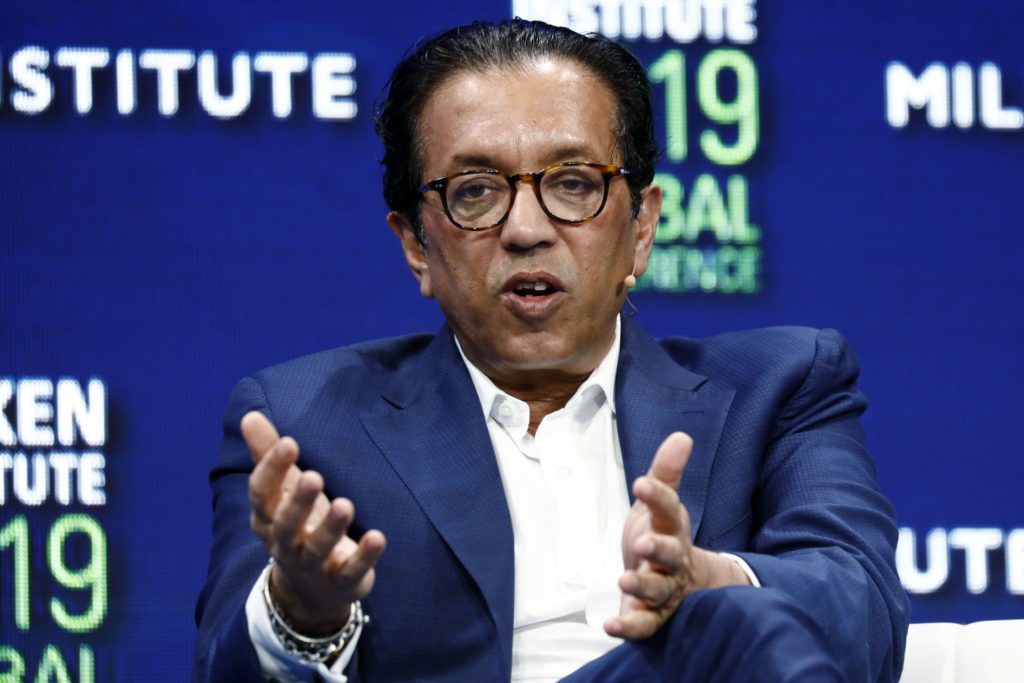
(Bloomberg) — Mubadala Investment Co. is nearing a deal to buy Fortress Investment Group from SoftBank Group Corp. in a purchase that could value the US asset manager at more than $2 billion, people with knowledge of the matter said.

The Abu Dhabi sovereign fund could announce an agreement in the coming weeks, the people said, asking not to be identified because the information is private. Rajeev Misra, a key lieutenant to SoftBank founder Masayoshi Son with close ties to the Gulf emirate, is playing a key role in brokering the deal, the people said.

Misra was a partner at Fortress before joining SoftBank, and his knowledge of the business was instrumental in helping Mubadala proceed in the negotiations, one of the people said. Bloomberg News first reported the parties were in talks in July. 

No final decisions have been made, and talks could still fall apart. Spokespeople for SoftBank, Mubadala and Fortress declined to comment, while representatives for Misra weren’t immediately available for comment.

Mubadala has long been a SoftBank counterpart. In 2017, the fund emerged as one of the anchor investors in the firm’s debut Vision Fund, which Misra was instrumental in helping set up.  

Misra, who joined SoftBank in 2014, has recently been stepping back from his main roles at the conglomerate and has secured more than $6 billion to launch his own fund. Entities based in Abu Dhabi have committed money to this new venture, Bloomberg has reported. 

SoftBank acquired Fortress in 2017, intending to use the New York-based firm’s expertise to help manage its behemoth Vision Fund. The firm, led by co-Chief Executive Officers Pete Briger and Wesley Edens, managed $53.3 billion as of Dec. 31.

More stories like this are available on bloomberg.com

©2022 Bloomberg L.P.

Lead Edge Hires Catalyst Investors’ Susan Bihler as a Partner

(Bloomberg) — Lead Edge Capital Management, a technology-focused investment firm, has appointed Susie Bihler as partner focused on growth-equity investments.

New York-based Bihler, most recently a partner at Catalyst Investors, will focus on making minority investments in software and tech-enabled services businesses. She said she first crossed paths with her new firm, led by founding partner Mitchell Green, over a decade ago when Lead Edge and Catalyst were invested in Mindbody.

“I saw first-hand how they approached investing,” she said in an interview. “Some firms are conventional, but Lead Edge has always been very creative with structure, the timing of how they put capital out, and how they partner with teams.”

Lead Edge’s growth-equity business typically writes equity checks that range from $25 million to $250 million. The firm’s broad network, which portfolio companies have access to, positions it to thrive despite the recent rout affecting once-robust markets and valuations, Bihler said.

Lead Edge’s flexible mandate includes acquiring limited-partner stakes in funds to gain exposure to companies held by those entities, Green said. But Lead Edge is bearish on convertible notes, which Green says can create misaligned incentives and hugely dilute employees and early investors.

“For most of these, the juice isn’t worth the squeeze,” he said, referencing the average return of 8% to 12%. 

While some investment partners are often lured by startups that have already raised institutional capital, Bihler has a track record of finding companies off the beaten path, Green said. She’s backed companies including LinkSquares, which makes technology used by legal teams; Datavail, a startup focused on cloud migration and data analytics; and Envoy Global, which makes software used for immigration services. 

More stories like this are available on bloomberg.com

©2022 Bloomberg L.P.

Ransomware Hackers Hit Los Angeles School District

(Bloomberg) — The Los Angeles Unified School District was the victim of a data breach over the weekend, but schools were scheduled to open on Tuesday.

The nation’s second-largest school district identified unusual activity in its information technology systems over the weekend and later confirmed that it was targeted by a ransomware attack, according to a statement. Some business operations may be delayed, but school officials said they didn’t expect major issues with providing instruction, transportation or food. Officials didn’t disclose if there was an extortion demand from the hackers responsible. 

The hack was described as “likely criminal in nature.” It wasn’t yet clear who was behind the incident, which took the district’s website offline, eliminated access to email and reportedly affected systems that teachers use to post lessons and take attendance, according to the Los Angeles Times. Classes started on Aug. 15.

It was the 50th cyberattack against US-based education-sector entities so far this year, including 26 colleges and universities and 24 districts, said Brett Callow, threat analyst at the cybersecurity firm Emsisoft, in a tweet. He added that there is a predictable increase in ransomware attacks involving schools in the third quarter of the year. 

Federal officials are helping the district respond to the incident, according to the statement. 

More stories like this are available on bloomberg.com

©2022 Bloomberg L.P.

Close Bitnami banner
Bitnami
