
Bloomberg

Trump-Tied SPAC Drops on Report It Can’t Get Deadline Push

(Bloomberg) — Investors dumped shares of Digital World Acquisition Corp., the blank-check firm set to merge with Donald Trump’s social media company, after a report said it failed to get enough support for an extension to complete the deal.

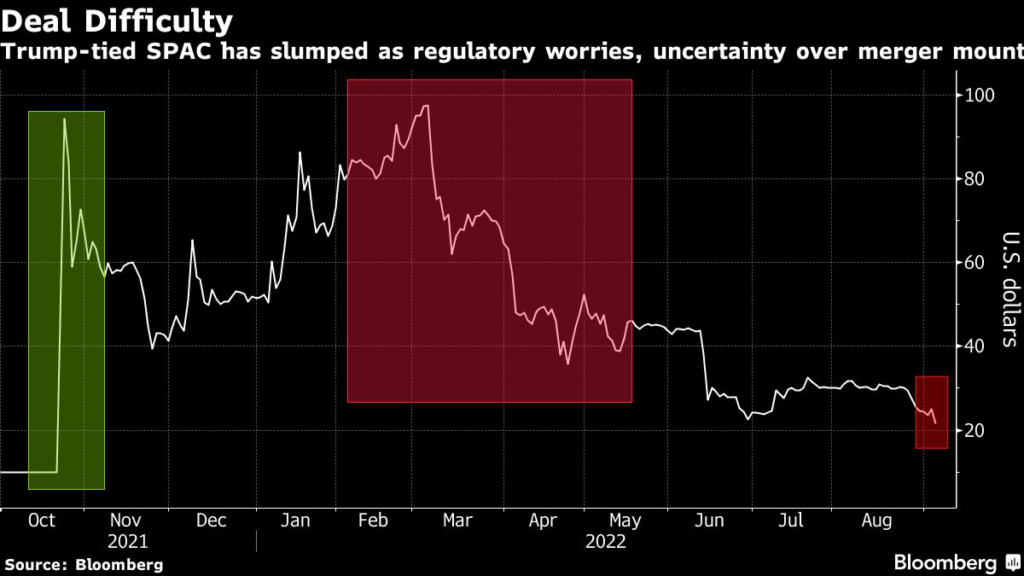
Executives at the special purpose acquisition company don’t expect to get enough shareholder support for a one-year extension to complete a deal with Trump Media & Technology Group, Reuters reported, citing people familiar with the matter. The shares fell as much as 21% to $19.70 on Tuesday, the lowest since the deal was announced in October, while warrants tied to the SPAC sank 17%.

The company — which needs 65% of shareholders to support the extension — is now weighing delaying the vote deadline among other options, Reuters said. The shareholder meeting is scheduled for noon in New York on Tuesday and the company has been active in recent weeks, courting retail traders to vote — a group that historically misses out on similar events.

Digital World shares soared to $175 after the merger with the former President’s company was announced in October, becoming a favorite among retail traders. The launch of Trump’s social media site, Truth Social, in February, provided another boost, before disappointing downloads for the platform and regulatory issues facing Digital World weighed on the shares.

The SPAC gave itself a one-year deadline to get a deal done when it debuted last September before risking the need to return the millions it raised to investors. The sponsor’s terms do give it an option to extend its deadline to up to six months, however, that would cost the team millions of dollars as it would push cash into its trust account.

“I’m not touching it,” said Matthew Tuttle, chief executive officer at Tuttle Capital Management. The risk is too great and even if the SPAC extends its deadline by six months, “that may just kick the can down the road.”

Retail traders were actively discussing Digital World’s stock Monday, however, they didn’t appear to be actively buying the dip. The company’s ticker was trending on popular chatroom, Stocktwits, but wasn’t among the 30 most traded assets on Fidelity’s platform as of 9:45 a.m. in New York.

The blank-check firm said in July that a federal grand jury is seeking information from Trump Media & Technology Group about the planned deal, while the Securities and Exchange Commission issued a subpoena for similar information the same week. Digital World said at the time that the grand jury is also seeking information from certain current and former TMTG personnel.

CF Acquisition Corp. VI, a SPAC taking video platform Rumble Inc. public, rose 3.3% ahead of a deadline for its shareholder vote next week. Rumble has a technology and cloud services pact with Trump Media.

(Updates with share movement, additional detail throughout.)

More stories like this are available on bloomberg.com

©2022 Bloomberg L.P.
CVS to Buy Signify Health in Deal Pushing Beyond Retail

(Bloomberg) — CVS Health Corp. reached a deal to buy home-health and technology services provider Signify Health Inc. for about $8 billion, as the drugstore chain continues to expand beyond its retail origins.

CVS is acquiring Signify for $30.50 a share in an all-cash deal, according to a statement Monday. The company emerged as the winning bidder over potential suitors that, Bloomberg News previously reported, had included UnitedHealth Group Inc., Amazon.com Inc. and Option Care Health Inc. 

Through its software and services, Signify aims to help clients — payers like health plans, government programs and employers — shift to value-based payment plans. It’s backed by New Mountain Capital, which formed the company in 2017, according to the private equity firm’s website.

Signify’s network has more than 10,000 clinicians in all 50 states in the US.

“Signify Health will play a critical role in advancing our health-care services strategy and gives us a platform to accelerate our growth in value-based care,” CVS Health Chief Executive Officer Karen S. Lynch said in the statement. “This acquisition will enhance our connection to consumers in the home and enables providers to better address patient needs as we execute our vision to redefine the health-care experience.”

The acquisition ranks among the biggest for CVS as it has broadened its health-care footprint. Its largest was its purchase of insurer Aetna Inc. in a deal valued at $68 billion including debt. That transaction, completed in 2018, followed its 2007 acquisition of Caremark RX Inc. for about $27 billion.

CVS and Signify said they expect their transaction to close in the first half of 2023.

Signify shares were little-changed at $28.78 at 9:46 a.m. Tuesday in New York, while CVS fell less than 1%.

(Updates with share trading in final paragraph)

More stories like this are available on bloomberg.com

©2022 Bloomberg L.P.

Apollo-Backed ADT Sells Stake to State Farm for $1.2 Billion

(Bloomberg) — State Farm Mutual Automobile Insurance Co., the largest US home insurer, agreed to make a $1.2 billion equity investment in ADT Inc., giving it a 15% stake in the security-services provider.

State Farm will acquire 133.3 million shares of ADT’s common stock at $9 per share, or 25% higher than Friday’s closing price, according to a statement Tuesday.

ADT will commence a self-tender offer for an equal number of its outstanding common and Class B stock at the same price, eliminating any dilution from State Farm’s investment, according to the statement. Funds managed by affiliates of Apollo Global Management Inc., ADT’s majority owner, are ensuring the offering is fully subscribed. Shares of ADT surged 11% to $8.02 at 9:41 a.m. in New York trading.

The partnership is the latest example of insurers pairing up with technology and security firms to get more granular insight into home security. Travelers Cos. announced a partnership with Amazon.com Inc. to offer customers discounts on security cameras, water sensors and motion detectors, and insurance-technology firm Hippo Holdings Inc. has sought to position itself as a one-stop shop for homeowners looking to protect and maintain their homes.

ADT, based in Boca Raton, Florida, and State Farm also will work with Alphabet Inc.’s Google on next-generation security, smart-home technology and risk-mitigation capabilities to detect and prevent homeownership risks, the companies said in the statement. State Farm will commit as much as $300 million for innovation and marketing, and Google, which already has a relationship with ADT, agreed to an additional $150 million in funding, boosting its total commitment to $300 million.

“We’ve always recognized our responsibility to go beyond insurance and find ways to build stronger and safer communities for our customers and the neighborhoods we serve,” State Farm Chief Operating Officer Paul Smith said in the statement. “This partnership gives State Farm the opportunity to provide smart-home technology that takes us from our ‘repair and replace’ model to a ‘predict and prevent’ mindset.”

With its equity investment, Bloomington, Illinois-based State Farm will gain a seat on ADT’s board, and intends to designate Smith to the position. The investment is scheduled for completion early in the fourth quarter.

(Updates with details on industry practices starting in fourth paragraph.)

More stories like this are available on bloomberg.com

©2022 Bloomberg L.P.
Sony’s PlayStation Architect to Retire After Decades at SIE

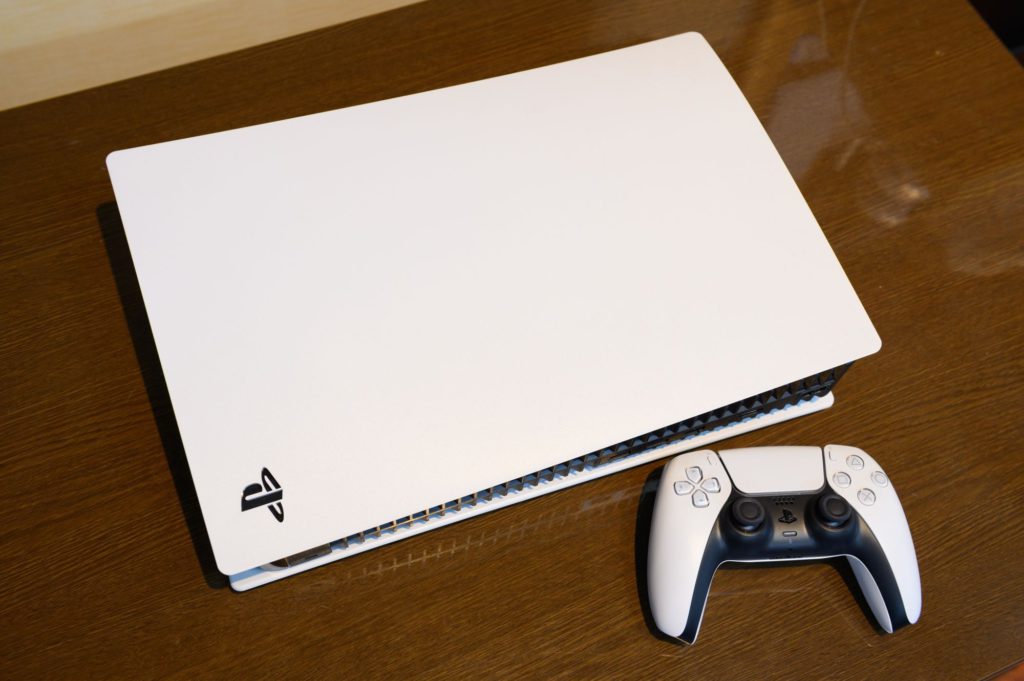
(Bloomberg) — Sony Group Corp.’s PlayStation unit is set to lose its longtime hardware architect Masayasu Ito, who will retire at the end of this month.

The 60-year-old executive vice president of Sony Interactive Entertainment, the arm responsible for PlayStation and Sony’s other gaming initiatives, will depart the company on Oct. 1, Sony told Bloomberg News Tuesday. He will have a mobility related assignment at Sony Group from October and also continue to support SIE’s Platform Experience Group in an executive adviser until March 2023.

Ito is retiring after a career spanning five decades at Sony, having joined the Tokyo-based company in 1986 and worked on in-car audio equipment before moving on to the console division in 2000. During his tenure at the PlayStation group, Ito led engineering for the PlayStation 4, which has sold over 117 million units, and the latest-generation PlayStation 5. In between, he also helped bring to market the upgraded PS4 Pro model, adding improved graphics and compatibility without making the generational leap of an entirely new console platform.

The PS5 has been plagued by supply chain and logistics snarls since its debut in November 2020. Before the launch, Ito wrote on the PlayStation Blog about the challenges of developing the console through the pandemic. Part of the initial difficulty in assembling sufficient units had to do with Sony’s ambitious custom design for the console and its components, which led to production yield challenges for chip supplier Advanced Micro Devices Inc.

“Our team values a well thought out, beautifully designed architecture,” Ito wrote about Sony’s engineering philosophy in the blog post. “Inside the console is an internal structure looking neat and tidy.”

(Updates with additional information from SIE in second paragraph)

More stories like this are available on bloomberg.com

©2022 Bloomberg L.P.

Binance Will Convert Users’ USDC Into Its Own Stablecoin

(Bloomberg) — Binance, the largest crypto exchange by volume, will start converting any existing user balances and new deposits of USD Coin (USDC), Pax Dollar (USDP) and True USD (TUSD) into the company’s own stablecoin, according to a statement published on Monday. The conversion is scheduled to begin Sept. 29. 

USDC, issued by Circle Internet Financial, is the second-ranked stablecoin after Tether’s USDT, with a market value of nearly $52 billion, according to data from CoinGecko. Binance’s stablecoin, BUSD, is a distant third at around $19.3 billion. 

Read more: Circle’s USD Coin Reaps the Benefits of Tether Circulation Drop

The exchange said the move is intended “to enhance liquidity and capital-efficiency for users.” Binance will also remove and stop any trading on spot pairs that involve USDC, USDP or TUSD, the exchange said in the statement. 

Binance’s move may heat up competition among the three largest stablecoins, which are digital tokens designed to maintain a peg to the US dollar. Because stablecoins are an integral part of the crypto ecosystem and are often used an intermediary for switching between cryptocurrencies and cash, bolstering BUSD may support Binance’s push to cement its status as the top marketplace for digital assets.

The decision “is quite bold and unprecedented,” said Hagen Rooke, a partner at law firm Reed Smith LLP in Singapore. “Commercially it is a smart move for Binance because its service offering will now increasingly converge around its house-own BUSD product.”

Tether Not Included

He added that users likely won’t be left “materially out of pocket” since the stablecoins involved are all intended to be pegged to the dollar. However, the conversion may ire users wishing to use their third-party stablecoins like USDC on applications which specifically support them, like for yield generation on a decentralized protocol, Rooke said.

Binance doesn’t anticipate any regulatory implications from the change, which it had agreed on with Circle and other involved third parties in advance, a spokesperson for the company said by email. 

Binance didn’t say why the changes don’t involve Tether’s USDT, which currently has a circulation of around $67 billion. “The consolidation of stablecoins on one of the world’s most active exchanges foreshadows future competition among stable assets,” a representative for Tether said in an emailed comment. 

Coinbase unified its order books for the US dollar and USDC in July, a move which it said would create more liquidity between trading pairs. The offering differs depending on which part of Coinbase a user is accessing, though: On Coinbase Exchange, deposits in USDC are automatically credited with US dollars, while on Coinbase’s Prime service, users can hold USDC directly. 

Current Binance-offered USDC products affected include crypto loans, which will be closed and liquidated as of Sept. 23; USDC-denominated savings accounts; DeFi staking; and the USDC/USDT liquidity pool. 

Read more: How Stablecoins Became a Powerful Force in Crypto

(Updates with comment from Tether in eighth paragraph.)

More stories like this are available on bloomberg.com

©2022 Bloomberg L.P.
Verizon Still Attracts Investors During a Miserable 2022

(Bloomberg) — Verizon Communications Inc. has cut its forecasts twice this year and the stock has tumbled, adding to its decade-long underperformance against the broader market. Plenty of contrarians are betting the worst is past for the mobile-phone giant.

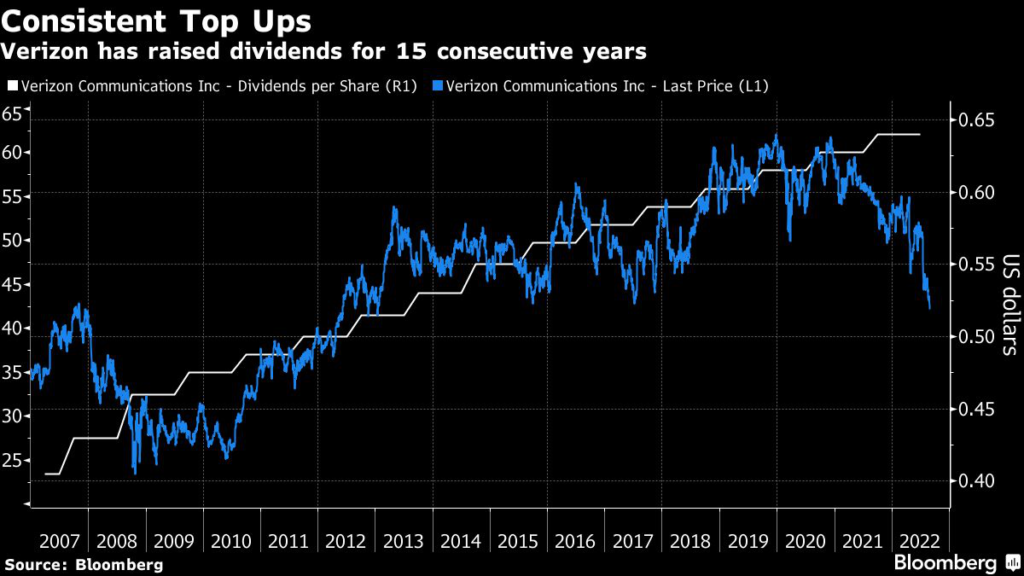
The big appeal: Verizon’s juicy dividend yield and history of raising the payout. That cash return looks especially appealing with tech and telecom stocks broadly slumping and the economy teetering on the brink of recession.  

Funds run by Capital Group, Federated Hermes Inc., Invesco Ltd., GQG Partners and other firms snapped up millions of Verizon shares in the three months ended June 30, regulatory filings show. Those bets proved to be premature, since the company in July lowered its forecast for the second straight quarter, sending the stock plunging.

But those value- or dividend-oriented investors are betting Verizon will manage to revive subscriber growth even in the face of aggressive phone discounts and decades-high inflation. 

Verizon has plenty to prove. The stock has fallen 21% this year, closing Friday at its lowest since June 2012. Rival T-Mobile US Inc. has been a surprise winner, up 22%, and AT&T Inc. has declined only 7.4%.

What sets the company apart from its rivals is its consistent dividend, and investors got more proof of that on Tuesday as the company raised its payout for the 16th straight year. The stock yields 6.3%. While that’s less than AT&T’s 6.5%, the latter has slashed its dividend by nearly half this year. T-Mobile doesn’t pay a dividend. 

“T-Mobile is not a dividend payer and Verizon is a very consistent 5% dividend payer,” said David Bahnsen, chief investment officer at the Bahnsen Group, a wealth management firm with $3.7 billion in assets. Verizon’s “dividend is sustainable and will continue to grow,” said the investor, who owns a Verizon stake. 

Verizon, the largest US wireless carrier, is taking steps to keep up with rivals on subscriber growth amid heavy phone discounts and decades-high inflation. It has launched phone plans to cater to budget-conscious customers and is working on ramping up its so-called fixed wireless business, a relatively new segment of broadband service where signals are beamed directly to a home WiFi router. 

Contrarian investors can take comfort in the fact that Wall Street is nearing maximum bearishness on the stock. Fewer than 25% of the analysts covering Verizon have a buy rating on the stock.

“Verizon is well-positioned to benefit from ongoing 5G wireless subscription growth along with its leading position in prepaid wireless and new growth opportunities in fiber and fixed broadband connectivity,” said one of the bulls, Ivan Feinseth of Tigress Financial Partners.

The telecom industry is capital intensive and Feinseth says that “Verizon’s strong balance sheet and cash flow enable ongoing investment in spectrum expansion and growth opportunities.”

Verizon trades at 7.9 times estimated earnings, its cheapest in two decades, making a bargain for stock pickers looking for a healthy dividend yield. Skeptics say they’re not convinced the company is ripe for a turnaround.

“Certainly they’re cheap. But while the valuations are not demanding, we worry that they’re value traps, and that they will only get cheaper,” said Matt Peron, director of research at Janus Henderson. “Just because something has a high dividend yield doesn’t mean its a good stock.”

Tech Chart of the Day

Big Tech stocks have split in two groups since the Nasdaq 100’s June low. Apple Inc. and Amazon.com Inc. have proved resilient, leading the rally and faring better in the subsequent selloff since mid-August. Microsoft Corp. and Alphabet Inc., though, have underperformed, with their stocks pressured as the software giant attempts to combat a stronger dollar and the Google owner tries to navigate a cooling advertising market.  

Top Tech Stories

  • Amazon.com Inc., which is struggling to quell workplace movements from the US to Europe, faces a growing union effort in Asia’s second-largest economy.
  • CVS Health Corp. has reached a deal to buy home-health and technology services provider Signify Health Inc. for about $8 billion, as the drugstore chain expands further beyond its retail origins.
  • Sony Group Corp. is set to lose its longtime PlayStation hardware architect Masayasu Ito, who will retire at the end of this month.
  • HappyFresh’s board hired turnaround firm Alvarez & Marsal Holdings LLC and is conducting a review of the online grocer’s financial situation, according to people familiar with the matter.
  • Binance, the largest crypto exchange by volume, will start converting any existing user balances and new deposits of USD Coin, Pax Dollar and True USD into the company’s own stablecoin, according to a statement published on Monday. The conversion is scheduled to begin Sept. 29.
  • Contemporary Amperex Technology Co. Ltd. has taken full control of a Chinese lithium carbonate project as the battery giant seeks to shore up supply of the ingredients used in electric car cells.

(Updates with Verizon’s dividend raise in paragraph six.)

More stories like this are available on bloomberg.com

©2022 Bloomberg L.P.
Trump-Inspired Game’s Success Galvanizes Africa’s Developers

(Bloomberg) — By the time Evans Kiragu arrived in South Africa for a four-month training camp for promising games developers, the Kenyan had already created more than 80 mobile titles. But what happened next was beyond his wildest ambition: a game that shot to number one in the U.S. download charts.

‘The President’, loosely based on a fictionalized Donald Trump, was inspired by the former US leader’s ever-present role in public discourse, Kiragu said in an interview.

“We decided to zone in on the humor — it is about being a powerful president but making very silly, hilarious decisions as you go,” he said. “It worked like magic.”

Kiragu and his team at Nairobi-based Mekan Games designed the game at the 2021 training course in Cape Town, which was co-hosted by South African publishing startup Carry1st and CrazyLabs — a global leader with more than 4 billion downloads. It topped the US charts for a few days in July this year, and will make Mekan about $1 million, enough to keep it afloat for three years.

Mekan’s success has born out of an African gaming industry that’s accounting for a small yet significant amount of investment amid the continent’s startup boom, which has been triggered by a youthful population and greater internet connectivity through smartphones. 

There are about 200 million gamers on the continent generating more than $1 billion in revenue, according to Cordel Robbin-Coker, the co-founder and chief executive officer of Carry1st. That’s triple the numbers from 2015 and the growth is only expected to accelerate. 

“It is really tough to make a commercially successful game and it is amazing that in our first cohort, we had a team from Kenya that had one,” he said. “The US is the biggest, most competitive market.” 

Carry1st raised $20 million earlier this year from U.S. private equity firm Andressen Horowitz, Alphabet Inc.’s Google, Avenir Growth Capital and superstar rapper Nas to grow its content portfolio and user base.

The startup has since doubled its team and increased annual revenue fivefold, Robbin-Coker said, and is looking to raise more funds. 

Latent Demand

The success of The President “shows what kind of latent talent is here but isn’t being tapped,” he said. As for the continent’s gamers, the prevalence of mobile phones helped expand the appeal to lower-income earners and to women, he said. 

Still, Africa accounts for just 1% of the $100 billion global industry, so Mekan will continue to focus on more developed markets such as the US, Kiragu said. That’s partly because of the untapped demand, said Dawit Abraham, founder of Ethiopia’s Qene Games and the spokesman for the Pan-African Gamers Group. 

“It is there for the taking. The continent is the market easiest for us to dominate in a very short time,” he said. The “current social awakening toward global content,” as seen in the global popularity of Afro Beat or Korean music, can translate to games too, he said. 

More stories like this are available on bloomberg.com

©2022 Bloomberg L.P.
US Lays Out $50 Billion Chips Plan and Will Issue Funds Guide in 2023

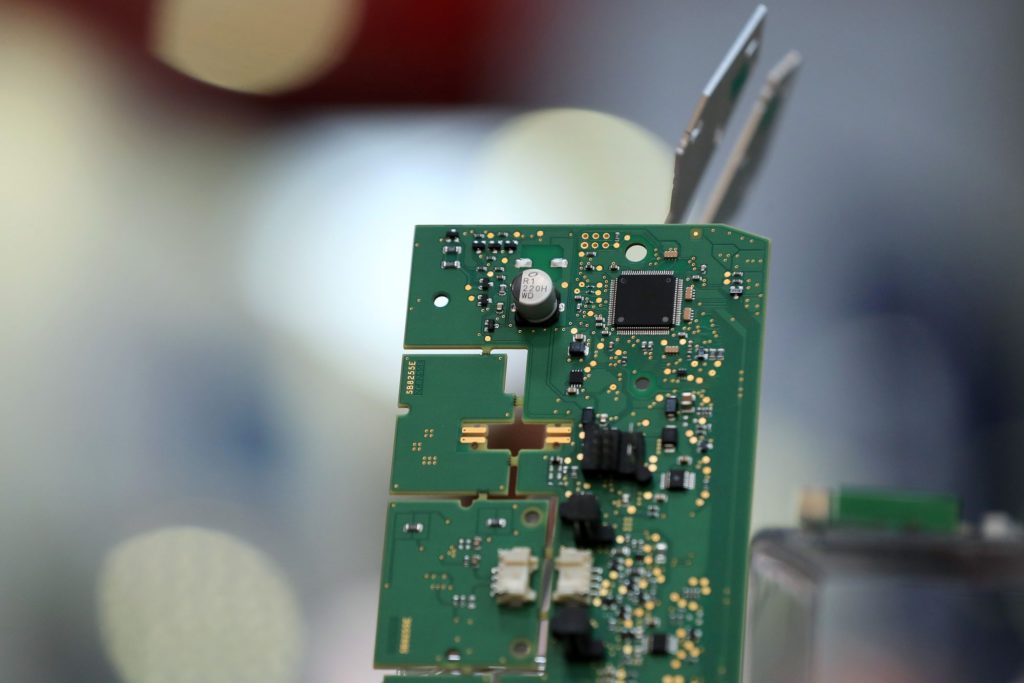
(Bloomberg) — The Biden administration published its strategy for subsidizing US output of semiconductors, saying it will give guidance on how companies can apply for funds from the $52 billion Chips and Science Act by February. 

The plan — known as Chips for America — allocates $28 billion for domestic production of leading-edge logic and memory chips, about $10 billion for new capacity to build current-generation chips and semiconductors, and $11 billion for a new National Semiconductor Technology Center, manufacturing institutes, and other development programs, the Department of Commerce said in a statement accompanying the strategy’s release Monday.

Commerce will release funding documents that will provide specific application guidance for the program by early February, it said. 

“Awards and loans will be made on a rolling basis as soon as applications can be responsibly processed, evaluated and negotiated,” it said.

President Joe Biden signed the chips legislation into law Aug. 9. It’s the centerpiece of his administration’s effort to reduce dependence on Asian suppliers like Taiwan and South Korea, whose local companies are leading the global market, and to address supply-chain disruptions and resulting price hikes for certain goods containing semiconductors.


More stories like this are available on bloomberg.com

©2022 Bloomberg L.P.

Amazon’s ‘Rings of Power’ Divides Audience Reviews

(Bloomberg) — Amazon said its “Lord of the Rings: The Rings of Power” series drew more than 25 million viewers worldwide on its first day. Critics have praised the show. The average score on Rotten Tomatoes is 84% while on Metacritic it is a 71.

The average viewer ratings on those sites is substantially lower however. On Rotten Tomatoes the audience score is 39% and on Metacritic the user score is 2.5 out of 10. On IMDB.com, the user rating is a 6.8 out of 10 with over 100k ratings.

On the Amazon page for the show, there are no user reviews as of 8:39am ET on Tuesday, Sept. 6. According to the Hollywood Reporter, a company source said Amazon is suspending reviews for 72 hours to help stop online trolls and ensure only legitimate reviews. THR’s source added that Prime Video started the policy this summer for all of its shows.

One famous Twitter user complained about the show. Elon Musk said that author Tolkien was “turning in his grave.”

Meanwhile, Musk’s competitor in the space realm was excited about his own company’s success in the fantasy realm.


More stories like this are available on bloomberg.com

©2022 Bloomberg L.P.

China’s Xi Vows to Strengthen System That Develops New Tech

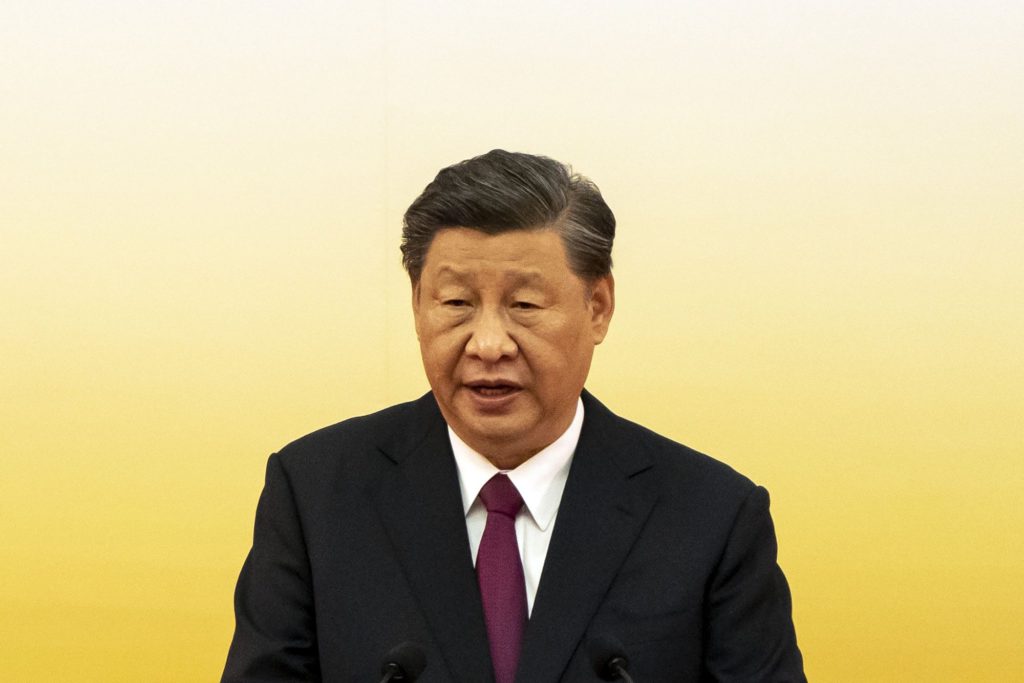
(Bloomberg) — China’s President Xi Jinping called for a stronger effort to pool nationwide resources to advance key technologies, as rising tensions with the US add urgency to the need to develop industries such as semiconductors.

The so-called “whole nation system” should improve its strategy and focus on areas critical to China’s industrial, economic and national security, state broadcaster Central China Television reported, citing a meeting on Tuesday of a high-level Communist Party committee chaired by Xi.

“Competitive advantages should be achieved in certain sectors to win strategic initiative opportunities,” Xi was quoted as saying, urging the country to make use of its ability to “pool resources to get major undertakings done.”

Research of technologies that have first-mover advantage or can guide future development should be prioritized, CCTV reported.

READ: China Searches for Chipmaking Advance That Can Change the Game


More stories like this are available on bloomberg.com

©2022 Bloomberg L.P.

Close Bitnami banner
Bitnami