

Bloomberg

Indian Anti-Money Laundering Agency Searches Paytm, Razorpay

(Bloomberg) — India’s anti-money laundering agency searched the premises of online payment companies including Razorpay Pvt Ltd, Cashfree Payments and Paytm Payment Services Ltd. as part of a probe into a Chinese loan app.

The Enforcement Directorate conducted the search operations in the tech hub Bengaluru on Friday amid allegations of extortion and harassment of customers involving the Chinese app, according to an e-mailed statement from the investigation agency on Saturday.

“During inquiries, it has emerged that these entities are controlled/operated by Chinese persons,” it said. They forged documents of Indians, making them “dummy directors” of the companies that were generating proceeds of crime through merchant accounts held with payment gateways and banks, the investigating agency said, adding it has seized 170 million rupees ($2.1 million).

Razorpay said some of its merchants were investigated by law enforcement about a year and a half ago.

“As part of the ongoing investigation, the authorities requested additional information to help with the investigation,” the company said, adding that it fully cooperated. “The authorities were satisfied by our due diligence process.”

A Paytm spokesperson said they are cooperating with authorities, who are investigating a specific set of merchants. “The authorities reached out to us with directions to provide certain information about these merchants under scrutiny, to which we promptly responded.”

The entities are “independent” and do not belong to Paytm, the company said in a filing to India’s National Stock Exchange, while confirming it’s providing payment processing solutions to them. It added that the funds seized by the agency do not belong to Paytm or any of its group companies.

Cashfree in a statement on Sunday said it had cooperated with the agency’s investigation, providing them the necessary information. “Our operations and on-boarding processes adhere to the PMLA and KYC directions, and we will continue to do so,” it said, referring to the Prevention of Money Laundering Act.

Late last month, the agency also raided premises of a16z-backed crypto exchange CoinSwitch Kuber, probing its directors and CEO after accusing them of forex laws violations. The exchange is under suspicion of acquiring shares of over 20 billion rupees in contravention of forex laws.

(Updates with Cashfree response and agency’s previous raid in ninth and tenth paragraphs)

More stories like this are available on bloomberg.com

©2022 Bloomberg L.P.
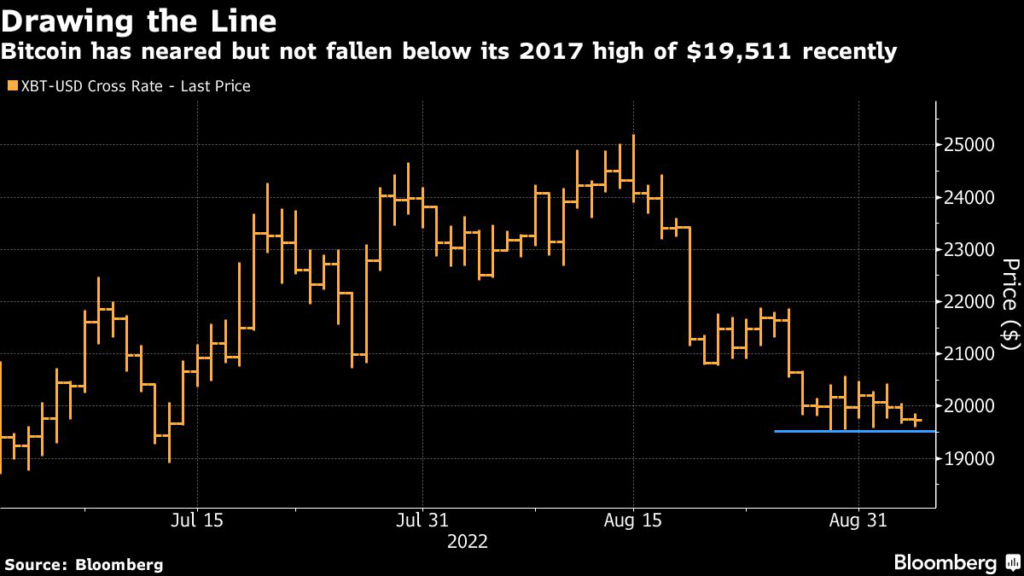
Bitcoin Loses Momentum on Weekend With Support Around 2017 High

(Bloomberg) — Bitcoin trended downward through the weekend after a solid unemployment report offered mixed implications for the Federal Reserve as it contemplates its path on interest rates.

The largest cryptocurrency spent time below $20,000 for a ninth consecutive day on Sunday, a session in which it failed to crack above that round-number level at all. On several of the days, it’s fallen into the $19,500 range but not below $19,511, its then-record peak from December 2017.

Bitcoin dropped as much as 0.8% to $19,591 on Sunday and was little changed as of 7:50 a.m. in New York.

“The Fed is busy ‘burning’ money as well (a.k.a. quantitative tightening) to restore the credibility of the US dollar,” a report sent Sunday from Gavekal Research said. “That presents a significant headwind for all cryptocurrencies.”

Bitcoin has traded largely in the same direction as other risk assets like the Nasdaq 100 as the Fed boosts interest rates amid stubborn inflation. Meltdowns like those of the Terra/Luna ecosystem and hedge fund Three Arrows Capital have depressed sentiment as well, and numerous crypto firms have declared bankruptcy or are struggling to survive. 

More stories like this are available on bloomberg.com

©2022 Bloomberg L.P.

Nigeria, Binance in Talks for Digital City to Develop Blockchain

(Bloomberg) —

Nigerian authorities and cryptocurrencies platform Binance Holdings Ltd. are in talks to establish a digital economic zone that will help entrepreneurs fast track blockchain technology in the West African nation.

The partnership aims to build a digital hub, “similar to the Dubai virtual free zone,” according to statement by the Nigeria Export Processing Zones Authority.  

Nigeria, Africa’s most populous nation, is targeting digital technology as a means to help diversify the economy away from crude oil, taking advantage of an increasingly connected and youthful population. Fintech startups such as Interswitch Ltd. and Flutterwave Inc. has emerged in the space and achieved billion-dollar plus valuations. 

The government this year enacted regulations for trade in digital assets while Nigeria Exchange Ltd. plans to start a blockchain-enabled platform next year to deepen trade at the bourse.

Read: Africa’s Technology Hub Rises in a Congested Lagos Neighborhood

Nigeria’s citizens showed more interest in cryptocurrencies than any other country since the digital assets began to decline in April, according to a study by price tracker CoinGecko.


More stories like this are available on bloomberg.com

©2022 Bloomberg L.P.

Saudi Central Bank Hires Crypto Chief to Boost Digital Ambitions

(Bloomberg) —

Saudi Arabia’s banking regulator recently appointed Mohsen AlZahrani to lead its virtual assets and central bank digital currency program in a sign of the Gulf state’s potential crypto ambitions. 

Saudi Arabia has until now taken a more cautious approach on virtual assets, with officials raising concerns about their speculative nature. Yet the emergence of the neighboring United Arab Emirates as a global crypto hub has created some urgency in Riyadh to draft more formal rules for the asset class, people familiar with the matter said. 

AlZahrani, a former managing director at consultancy Accenture, reports to Ziad Al Yousef, the Central Bank’s deputy governor for development and technology, the people said, asking not to be identified because the matter is private. They’re part of a team in Riyadh that’s engaging with some of the world’s biggest crypto firms on future regulations, they said.

Representatives for SAMA didn’t respond to requests for comment.

Saudi Arabia has been pushing firms to increase their presence in Riyadh as part of Crown Prince Mohammed bin Salman’s plans to turn the capital city into a global hub. That’s posed a direct challenge to the Gulf’s business hub, Dubai. 

The kingdom is the largest economy in the Middle East, with a relatively affluent population, making it a key market for any firm operating in the region. Some of the industry’s biggest players, including Binance Holdings Ltd., have staffed up their Saudi teams, identifying the kingdom as a large untapped market if the current restrictions get loosened.  

In 2018, Riyadh banned banks from processing transactions involving cryptocurrencies, though workarounds exist to trade. In recent months, local financial firms reiterated the restrictions in correspondence with customers, people familiar with the matter said. 

Meantime, the Saudi government has been collaborating for several years with the UAE on a potential joint digital currency. 

More stories like this are available on bloomberg.com

©2022 Bloomberg L.P.
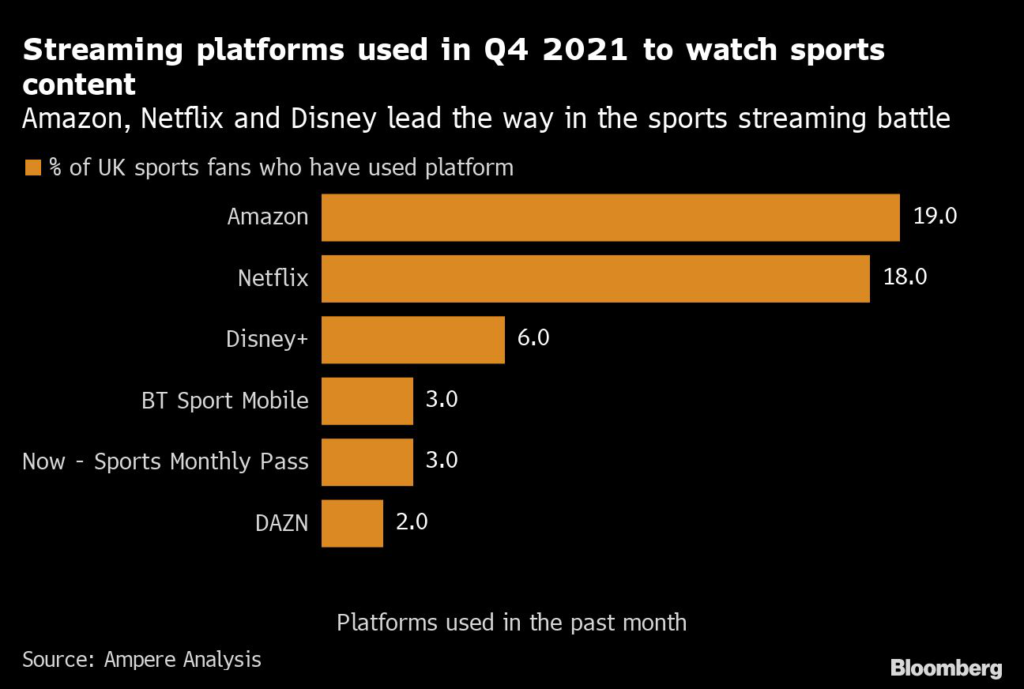
Cost of Watching Premier League Up By a Third After Amazon Entry

(Bloomberg) —

The cost for streaming every available game for the current Premier League season matches will cost UK users more than £800 by the end of 2022, an increase of about 30% since Amazon.com Inc. first started streaming matches in 2019. 

Amazon joined Sky and BT Group Plc at the end of 2019 in broadcasting UK Premier League games, adding one of the world’s largest companies into an already highly competitive auction process.  

Prior to Amazon’s entry, the cost to stream all live Premier League football matches for a season was just under £540 — using the best available deals without signing up to extra services. By the end of 2022 that price will be more than £800 a year, according to a Bloomberg calculation of membership fees.

An Amazon subscription — which comes with its Prime delivery service — will set consumers back £95 a year from September, up from £79 in 2019, while the cost to stream Sky Sports on Now TV is £33.99 a month, up 78% from the cheapest deal three years ago. The lowest cost to stream BT Sports is still £25 a month. 

“This is the first time Amazon has changed the price of Prime in the UK since 2014, and we will keep working to ensure Prime offers exceptional value for members,” an Amazon spokersperon said in an emailed statement. 

Pivotal Research Group Chief Executive Officer Jeffrey Wlodarczak said the increase in competition is driving up costs for the consumer and broadcasters alike. “It’s difficult to compete with the money and model that Amazon has,” he said.

Amazon has agreed to spend £30 million a year on Premier League rights from 2019 through at least 2025, according to the Ben McMurray, an analyst at Ampere Analysis. As a percent of the population, the UK is No. 2 in Europe for customers who have at least one streaming sports subscription, after Italy, McMurray said. 

The streaming companies have big budgets. Amazon has invested more than £1 billion in TV, movies and live sports since 2018. 

However, subscribers are facing rising costs of living. The UK could see an exodus of subscribers after autumn gas bills come in, according to Minal Modha from Ampere. Netflix has already been losing customers after increased competition combined with users facing less disposable income. Last quarter, it shed 1.3 million customers in the US and Canada, its biggest region.

Some streaming services will begin selling advertising to offset the cost and keep subscribers, according to Deloitte’s Digital Consumer Trends report, published in December. Charging customers a premium for ad-free viewing hasn’t appealed to Netflix or Disney+ in the past, which have both thrived offering products without commercial interruptions. 

But Deloitte’s study showed that about two thirds of streaming users would agree to watch as much as 10 minutes of ads per hour. Disney+ and Netflix are also developing ad-supported plans. 

DAZN is incorporating gambling to supplement subscriptions. The service launched DAZN Bet in August with the aim of “creating a more recreational, sociable, and relevant experience for today’s sports fan,” it said in a statement.

OneFootball, a Germany-based football media company, announced in August this year that UK customers will be able to watch one free live game of Italian football league, Serie A, every match day of the season through its app. Traditional broadcasters are promising similar as a bid to win loyalty. Free-to-air channel, ITV Plc has said it will broadcast 10 La Liga games throughout the season. 

Streaming companies are also creating other sports content to build exclusive libraries and entice viewers. Amazon has its “All or Nothing” documentary series about NFL teams, and took on Bath Rugby Club player Beno Obano to produce a behind-the-scenes documentary on Harlequins Rugby Club. 

Netflix’s Formula 1 “Drive to Survive” series has been a ratings hit in its own right, something Disney executives are hoping to replicate with “Welcome to Wrexham,” a series following Wrexham Football Club and its celebrity owners, Rob McElhenney and Ryan Reynolds.

More stories like this are available on bloomberg.com

©2022 Bloomberg L.P.

UK Broadband Prices May Jump More Than 25% if Inflation Persists

(Bloomberg) —

The UK’s biggest mobile and broadband providers are set to increase charges above the soaring rate of inflation early next year, while government officials urge them to consider the effect on the cost-of-living crisis.

Following their most recent earnings, in which 2022 price rises boosted revenues, executives at EE-owner BT Group Plc and Vodafone Group Plc indicated they’ll press ahead with contracts that add 3.9% on top of the Consumer Prices Index. Virgin Media O2, jointly owned by Liberty Global Plc and Telefonica SA, annually raises fees the same 3.9% plus the Retail Prices Index, which was two percentage points above CPI in July.

That means charges could jump more than 26% in 2023 if analysts at Goldman Sachs prove right in their Tuesday forecast that the UK’s headline inflation gage could top 22% in the case of gas prices remaining high. The Bank of England’s latest forecast was that UK inflation would peak at 13.3% in the fourth quarter.

In June telecom executives were called in to meet Culture Secretary Nadine Dorries and committed to do more to help customers cope with rising costs. Officials are still watching closely.

“We continue to urge broadband and mobile companies to carefully consider the impact their annual price rises may have on households struggling with the global rise in the cost of living,” a spokesman for the Department for Digital, Culture, Media and Sport said in a statement.

With regulator Ofcom, officials are monitoring how many customers are signing up for low-priced “social tariffs” available to some people on state benefits, which are priced between £10 and £25 per month. 

Social Tariffs

An Ofcom spokesman encouraged people to shop around, and said millions would be able to cut bills today by switching to social tariffs or by finding a new deal if they’re at the end of a contract. As of February 55,000 homes had signed up for social tariffs, just 1.2% of those eligible, though numbers have risen. 

“While Ofcom doesn’t set retail prices, we’re concerned about their impact on households who can least afford them,” he said.

A Virgin Media O2 spokesman didn’t disclose how many customers take a social tariff but said the number had increased 80% since March, while BT said the number had doubled in the last two quarters. Three UK doesn’t offer a social tariff.

However, most prices are on track to jump significantly as carriers say they need to recoup investments amid rising costs.

“With the input prices going up for everybody in the country, we have to unfortunately pass those costs onto our customers,” BT Chief Executive Officer Philip Jansen told reporters after the company’s first quarter results in July. “We’re going to stick the course on that.”

Vodafone Chief Executive Officer Nick Read indicated the same kind of approach, and this week rolled out a similar model in Spain.

“We built them into the contracts of customers moving forward, and therefore I expect the industry to continue to do that,” he said about the UK price rises during a results call with media in July. “We don’t make our cost of capital in the UK, and therefore we need to improve our financial position, so obviously this is a contributor.”

A Vodafone spokeswoman said “we know no one wants to see price rises” but pointed to rising costs including energy, staffing, logistics and investment in networks as people use more data. A BT spokesman encouraged customers eligible for social tariffs to get in touch and switch, adding “we are committed to supporting customers who are worried about their finances and who need extra help.”

Three UK, owned by Hong Kong conglomerate CK Hutchison Holdings Ltd, has a different policy which imposes a flat 4.5% increase every year. In an early August interview, Chief Financial Officer Darren Purkis stopped short of an ironclad commitment to that model.

Asked if Three UK would alter pricing in response to inflation, he said “there are no plans to at this point” but “if we did change anything, it would only be for people that have joined after that point in time” — not retroactively applying a change to users already signed up.

A representative for Virgin Media O2 declined to comment and a Three spokesman referred to CFO Purkis’s comments.

More stories like this are available on bloomberg.com

©2022 Bloomberg L.P.

Cloudflare Blocks Site Linked to Hate After Weeks of Pressure

(Bloomberg) — Cloudflare Inc. blocked Kiwi Farms on Saturday, days after hinting it will continue working with the controversial discussion forum despite weeks of pressure.  

The company has blocked Kiwi Farms content from being accessed through its infrastructure after an escalation in rhetoric and “specific, targeted threats” over the past 48 hours, Chief Executive Officer Matthew Prince said in a blog post.  

“This is an extraordinary decision for us to make and, given Cloudflare’s role as an internet infrastructure provider, a dangerous one that we are not comfortable with,” Prince said. While we believe “it would have been appropriate as an infrastructure provider for us to wait for legal process, in this case the imminent and emergency threat to human life which continues to escalate causes us to take this action.” 

Previously, Cloudflare offered security services to Kiwi Farms. Visitors to Kiwi Farms sites that use any of its services will now see a Cloudflare block page and a link to Prince’s post.

Cloudflare came under pressure to drop Kiwi Farms as a customer after the online forum known for harassment and hate campaigns recently forced a well-known transgender Twitch streamer into hiding. 

Kiwi Farms founder Joshua Moon didn’t immediately respond to a request for comment. He told Bloomberg News earlier this week that “the forum does not condone behavior besides on-site discussion.”

Users of the site have become even more aggressive following the internet campaign to pressure service providers to block it, Prince said, adding that over the past two weeks, Cloudflare contacted law enforcement in several jurisdictions over “potential criminal acts and imminent threats to human life that were posted to the site.”

Read more about Cloudflare and Kiwi Farms 

Over the last decade, Kiwi Farms has been tied to multiple doxxing attacks, in which a person’s private, personal information is published online, or “swatting,” where anonymous attackers use that private information to send police or SWAT teams to a targeted person’s home. 

At least two people who died by suicide have been targeted by Kiwi Farms users, according to messages from the victims themselves or friends cited in news reports. Kiwi Farms has also hosted posts that include manifestos from extremist mass shooters. 

In a statement Saturday, Clara Sorrenti, who has been leading the charge to force Cloudflare to terminate services for Kiwi Farms, said the move “deals a big blow to Kiwi Farms and their community.” If the site ever becomes active again, the campaign must “continue fighting” and pressure other companies that provide services to it, she said.

Cloudflare, which as recently as Wednesday suggested it won’t cede to pressure to terminate Kiwi Farms as a customer, defended its earlier policy, saying that the “legal process is still the correct way to deal with revolting and potentially illegal content online.” 

Still, in the absence of a mechanism for providers like Cloudflare to work with legal authorities over threats to human life, the company was forced to take “this uncomfortable emergency decision alone,” Prince said Saturday.  

He warned it’s likely Kiwi Farms will find other infrastructure providers and that Cloudflare’s decision to block the site may heighten the emergency. The company will continue to work with law enforcement authorities to help with their investigations into Kiwi Farms and the users who may have posted illegal content.

More stories like this are available on bloomberg.com

©2022 Bloomberg L.P.
Amazon’s ‘Lord of the Rings’ Series Draws 25 Million on Debut

(Bloomberg) — Amazon.com Inc. said its “Lord of the Rings: The Rings of Power” series drew more than 25 million viewers worldwide on its first day. 

The series, based on the universe created by J.R.R. Tolkein and set a few thousand years before the events of “The Hobbit,” was the biggest-ever debut on the tech giant’s Prime Video service, Amazon said in a statement Saturday. 

Amazon does not release viewership data for most of its shows. But streaming services are starting to disclose more information to tout their success and signal their scale to advertisers. Amazon will work with Nielsen to release data for its upcoming production of “Thursday Night Football.” 

Amazon has invested an estimated $1 billion on the project, including $250 million for the rights to the franchise, in an effort to compete against streaming giants like Netflix Inc. and Walt Disney Co.’s Disney+. The series was launched in more than 240 countries and territories worldwide this month, and new episodes will be released weekly through Oct. 14.    

Read more: With ‘Rings of Power,’ Amazon Bets a Billion on Blockbuster TV

Streaming services are increasingly turning to blockbuster shows to draw viewers as competition heats up. Netflix credited the new season of “Stranger Things” released earlier this year for reducing subscriber losses, while Warner Bros Discovery Co. last month launched “House of the Dragon,” the prequel to its hit “Game of Thrones” series. 

More stories like this are available on bloomberg.com

©2022 Bloomberg L.P.

Surge in Real Rates Hits Every Asset on Wall Street and Beyond

(Bloomberg) — A big pandemic-era distortion in the world of finance is well and truly over — and the new normal is helping fuel the worst cross-asset selloff in decades. 

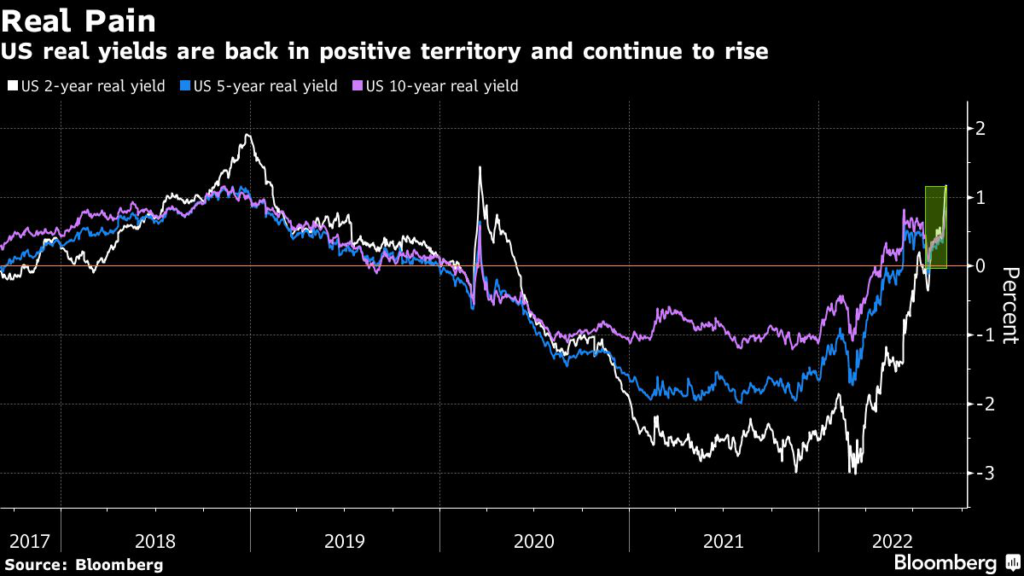
After being trapped in negative territory during the lockdown days, inflation-adjusted Treasury yields are again breaking out, with five- and 10-year measures back near multiyear highs. 

In another sign that the free-money era is no more, short-dated real rates suddenly jumped this week to the highest since March 2020 after finally turning positive in early August.

All this is bad for news for money managers across the board, with rate-sensitive allocations harder to justify from tech stocks to long-maturity corporate bonds. Rising real yields — seen as the true cost of money for borrowers — are rippling through the economy as mortgage rates soar while Corporate America adjusts to the higher cost of doing business.

It could get a whole lot worse. The thinking among Wall Street traders is that a hawkish-at-all-costs Federal Reserve is increasingly determined to engineer tighter financial conditions — via lower stock prices and higher bond yields still — in order to combat raging inflation.

That suggests investors in just about every asset class risk fresh market chaos, as Goldman Sachs Group Inc. projects 10-year real yields are moving closer to levels that would materially restrict economic activity.

“The next few months for equities will be bumpy and there is a risk of further drawdowns if this dynamic of rising real yields with decelerating growth continues,” said Christian Mueller-Glissmann, managing director of portfolio strategy and asset allocation at Goldman Sachs. 

The latest yield surge with echoes of the June tumult began when Powell surprised investors at the Jackson Hole symposium with a somber message that borrowing costs will need to go higher and stay in potentially growth-restricting territory to get inflation down. Since then, 10- and five-year real rates in the US have advanced some 30 and 38 basis points while technology-heavy Nasdaq 100 Index has plunged 8%.

“It is likely that any push to new multiyear highs in real yields would likely correspond with a new leg down in stocks,” said Charlie McElligott, a cross-asset strategist at Nomura Holdings Inc. 

Rising inflation-adjusted yields are putting pressure on the likes of tech shares because the latter’s long-term earnings prospects now have to be discounted at higher rates. At the same time assets bereft of income streams like gold and cryptocurrencies look less appealing given the greater opportunity costs to hold them compared to a Treasury bond that pays out a real return. 

“There’s clear competition from higher real bond yields for any type of store value, especially more speculative, long duration ones,” said Mueller-Glissmann.

All this is a world away from the post-financial crisis era when central bankers sought to reflate the economy via historically low interest rates that sent money managers into riskier and riskier assets in order to eke out gains.

These days, the thinking goes that monetary officials are effectively seeking to anchor real rates higher to help moderate the excesses of the inflation-addled business cycle.

In an interview with Bloomberg’s Odd Lots podcast after Jackson Hole, Minneapolis Fed President Neel Kashkari noted that real rates are a driver of economic growth. He also didn’t rule out a scenario whereby inflation fails to reach the central bank’s target anytime soon, requiring higher borrowing costs.

Yet policy makers must tread carefully. The yield on 10-year inflation-protected securities is now less than 30 basis points away from the 1% tipping point that would start seriously hurting economic growth, according to Goldman Sachs analysis. And while the latest jobs report may give ammo to those who reckon the Fed can secure a soft landing, skeptics clearly outnumber optimists right now.

“A lot of the economic data is looking really uncertain so that usual offset to higher real rates — the economic optimism — just isn’t there,” said Morgan Stanley’s chief cross-asset strategist, Andrew Sheets, in an interview with Bloomberg TV. “That puts the market still in a tough position.”

More stories like this are available on bloomberg.com

©2022 Bloomberg L.P.

Sweden Offers Liquidity Guarantees to Utilities, Leader Says

(Bloomberg) — Sweden’s government will provide liquidity guarantees to Nordic and Baltic utilities to protect financial stability amid a surge in energy prices.

A halt in Russian gas export could threaten stability, Prime Minister Magdalena Andersson, who is facing an election next Sunday, told journalists in Stockholm. The guarantees — designed to help companies struggling to meet the surging collateral requirements needed to trade electricity — will amount to “hundreds of billions” of Swedish kronor, she said, without specifying.

“We expect this to be in place before stock markets close on Monday, and during the first two weeks, the guarantees will include all Nordic and Baltic actors,” Andersson said. “This provides breathing space for neighboring countries to get their own measures in place.”

Andersson spoke at a joint news conference with Riksbank Governor Stefan Ingves, Finance Minister Mikael Damberg and financial watchdog head Erik Thedeen after Russia’s Gazprom PJSC reversed its plan to resume flows through its key gas pipeline indefinitely, a move decried by European politicians as an attempt to use energy as a weapon. 

Read More: Europe’s Energy Crisis Deepens After Russia Keeps Pipeline Shut

Skyrocketing prices in Europe make it more expensive for utilities to buy and sell electricity because of the additional collateral required to guarantee trades on power markets facing unprecedented turbulence. Fortum Oyj of neighboring Finland said earlier this week its collateral needed to trade on Nordic power markets rose by 1 billion euros ($1 billion) in a week to 5 billion euros, excluding the collateral posted by its German subsidiary Uniper SE.

Finland is advanced in similar preparations, its finance minister, Annika Saarikko, said on Twitter.

The European Energy Exchange AG this week asked for more government support to traders to guarantee their buying and selling as billions of euros put up as collateral for trades are sapping liquidity and making prices even more volatile.

The Swedish parliament will be called in on Monday to process the proposals, the legislature said in a separate statement.

Andersson’s Social Democratic minority cabinet and its constellation with supporting parties may be unseated by the right-wing opposition as the rival blocs are neck-and-neck ahead of the Sept. 11 vote.

Energy policy has become a flash point in Sweden’s political debate, with the opposition announcing their own policies in last weeks aimed at alleviating the pain of households and blaming the government for a power shortage in the south after some nuclear reactors were shuttered a few years ago. 

(Updates with details from second paragraph.)

More stories like this are available on bloomberg.com

©2022 Bloomberg L.P.

Close Bitnami banner
Bitnami