Bloomberg

Sweden Offers Liquidity Support to Region’s Energy Producers

(Bloomberg) — Sweden’s government will provide liquidity guarantees to Nordic and Baltic utilities as Prime Minister Magdalena Andersson warned that Russia’s decision to halt gas exports put the region’s financial stability at risk.

The guarantees — designed to help companies struggling to meet the surging collateral requirements needed to trade electricity — will amount to “hundreds of billions” of kronor and be in place before stock markets close on Monday, Andersson told journalists on Saturday in Stockholm.

“During the first two weeks, the guarantees will include all Nordic and Baltic actors,” said Andersson, who faces an election next Sunday. “This provides breathing space for neighboring countries to get their own measures in place.”

Andersson spoke at a joint news conference with Riksbank Governor Stefan Ingves, Finance Minister Mikael Damberg and financial watchdog head Erik Thedeen after Russia’s Gazprom PJSC reversed its plan to resume flows through its key gas pipeline indefinitely, a move decried by European politicians as an attempt to use energy as a weapon. 

Read More: Europe’s Energy Crisis Deepens After Russia Keeps Pipeline Shut

Skyrocketing prices in Europe make it more expensive for utilities to buy and sell electricity because of the additional collateral required to guarantee trades on power markets facing unprecedented turbulence. Fortum Oyj of neighboring Finland said earlier this week its collateral needed to trade on Nordic power markets rose by 1 billion euros ($1 billion) in a week to 5 billion euros, excluding the collateral posted by its German subsidiary Uniper SE.

Finland is advanced in similar preparations, its finance minister, Annika Saarikko, said on Twitter.

The European Energy Exchange AG this week asked for more government support to traders to guarantee their buying and selling as billions of euros put up as collateral for trades are sapping liquidity and making prices even more volatile.

The Swedish parliament will be called in on Monday to process the proposals, the legislature said in a separate statement.

Andersson’s Social Democratic minority cabinet and its constellation with supporting parties may be unseated by the right-wing opposition as the rival blocs are neck-and-neck ahead of the Sept. 11 vote.

Energy policy has become a flash point in Sweden’s political debate, with the opposition announcing their own policies in last weeks aimed at alleviating the pain of households and blaming the government for a power shortage in the south after some nuclear reactors were shuttered a few years ago. 

(Updates with details from second paragraph.)

More stories like this are available on bloomberg.com

©2022 Bloomberg L.P.

El Salvador Had a Bitcoin Revolution. Hardly Anybody Showed Up

(Bloomberg) — El Salvador President Nayib Bukele took the stage last year to fireworks and AC/DC’s “You Shook Me All night Long,” announcing to a cheering crowd of crypto enthusiasts at a beachside confab that Bitcoin would revolutionize his country. It was November, the digital token had just notched new all-time highs and El Salvador was at the very beginning of its experiment as the world’s first nation to use the cryptocurrency as legal tender. 

Now, a year into the journey, there are far fewer fireworks. Adoption has moved slowly, and steep declines in Bitcoin’s price from those lofty levels last fall have dampened the early euphoria that swept across the nation. Bitcoin hasn’t replaced El Salvador’s hard currency, the U.S. dollar — it’s not even close — but it also hasn’t brought the financial ruin that some warned of either. Or not yet anyway.

“No one really talks about Bitcoin here anymore. It’s kind of been forgotten,” said former El Salvador central bank  chief Carlos Acevedo. “I don’t know if you’d call that a failure, but it certainly hasn’t been a success.” 

Bukele captivated the world last year when he made Bitcoin an official currency alongside the dollar, stirring a craze in the cryptocurrency community while also drawing criticism from skeptics, including bond traders and the International Monetary Fund. Bitcoin’s Sept. 7 debut was beset with technical glitches, making for an inauspicious beginning. Undaunted, Bukele — sporting “laser eyes” on his Twitter profile picture — barked back at detractors while welcoming Bitcoin backers and crypto executives to his presidential office, where he continues to host them to this day. 

Read More: Bitcoin Sparks Wave of Speculation in El Salvador

As part of the rollout, Salvadorans were offered government-issued digital wallets preloaded with $30 worth of Bitcoin to help kick things off. Under the law, taxes can be paid in Bitcoin and businesses should accept it as a form of payment, unless they are technologically unable to do so. But the coin’s volatility has spooked users, and cryptocurrency has seen broader acceptance in countries with poor payment networks or strict currency controls, such as Argentina, Venezuela and Cuba, Acevedo said. “In El Salvador we have a good payments network, so why transfer money with cryptocurrency?” he said.

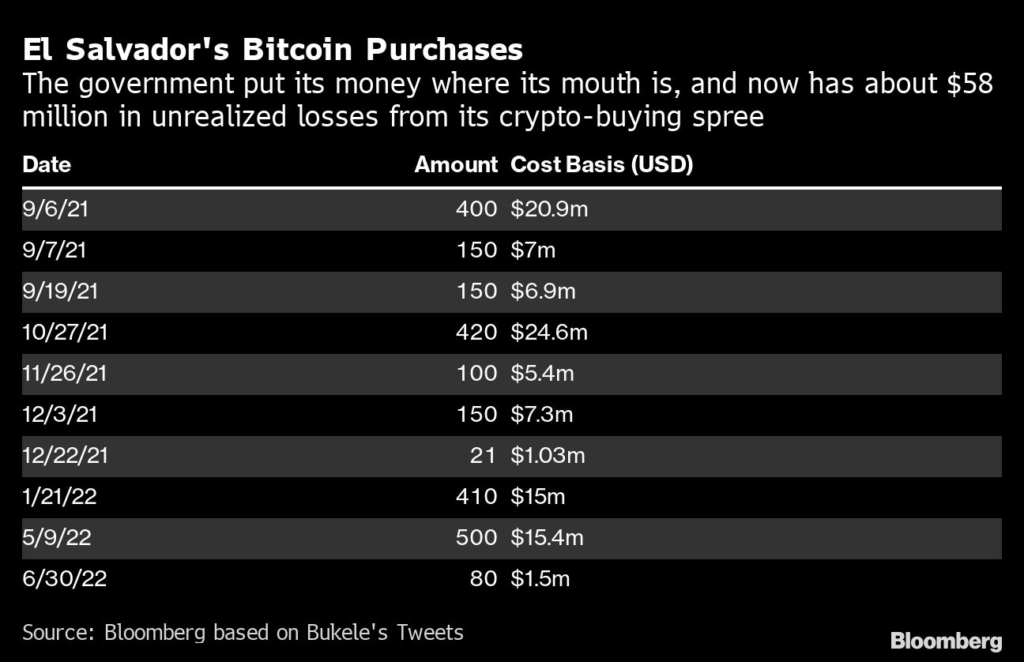
Most Salvadorans haven’t poured large amounts of money into Bitcoin, saving many from the recent bear market, Acevedo said.  The same can’t be said of the government itself, which started purchasing the token last year in the run-up to its launch as legal tender and has continued to add to its stockpile, conspicuously “buying the dip” during periods when Bitcoin declined. The result? It’s sitting on losses.

A series of recent surveys found that only a relatively small minority of respondents continue to use digital wallets and few businesses have registered transactions in Bitcoin. And the central bank says only 2% of remittances have been sent via cryptocurrency wallets. 

The government is still claiming victory, however. Bitcoin has attracted foreign investment and tourism and increased financial access to a largely unbanked population, according to Finance Minister Alejandro Zelaya. The government says its digital wallet, Chivo, has more than 4 million users. Tourism is on pace to surpass pre-pandemic levels this year and the central bank says 59 cryptocurrency and blockchain companies have registered offices in El Salvador. 

Read More: Bitcoin Bet is Paying Off, El Salvador Says

Zelaya says the administration still plans to issue a Bitcoin-backed bond, dubbed the “volcano token,” using blockchain technology, though admits recent price declines have hurt sentiment. Advocates say El Salvador is in a position to woo companies in a promising industry and become a hub for financial services in the future, creating high-tech jobs. 

“Assuming cars were a failure because after the very first year Ford started production in 1896 no more than 2% of the population had a car would’ve been quite myopic,” said Paolo Ardoino, chief technology officer at Bitfinex. “The government has a long-term vision. The crypto industry is highly technological and that is the type of industry that everyone should want in its country.” 

Bitfinex will serve as a trading platform for the volcano bond and will apply for a license to operate in El Salvador once the government passes a digital securities law to underpin the issuance. Canada-based crypto lending and savings company Ledn saw a 678% increase in users in El Salvador over the past year, according to co-founder Mauricio Di Bartolomeo. New-York based AlphaPoint was hired to fix bugs in the Chivo wallet and a series of other companies have also worked on the country’s rollout. 

“I don’t see adoption as low. I see a country where everybody has a Bitcoin wallet and everybody knows what Bitcoin is,” Simon Dixon, founder of crypto financial startup Bank to the Future, said during an August visit to El Salvador in which he met Bukele. Bank to the Future is currently hiring people in El Salvador and planning to open an office there, he said. “This is the first time I’ve ever met a government that has a president who has assembled a team that really operates with the urgency and impact of a fast growing company.”

But Bukele’s desire to win over Bitcoiners has come with a downside. The IMF has held off on approving a $1.3 billion program for the country citing risks from Bitcoin. The government’s 2,381 Bitcoin bought with public funds are worth $47.2 million at current prices, less than half what the administration paid for them. Moody’s estimates the government has spent $375 million in total on the rollout, including a $150 million fund to back Bitcoin-dollar conversions and the money for the $30 sign-up bonus given to Chivo users.  

“The Bitcoin experiment promoted by the Bukele administration has significantly raised the market’s risk perception of the country,” said Fabiano Borsato, Chief Operating Officer of Torino Capital LLC. “It’s being implemented in a context of fragile public finances, high and persistent fiscal deficits and doubts about the rule of law in the country. This, in our opinion, will prevent El Salvador from accessing financing in the international markets under favorable conditions in the short and medium term.” 

Overall, Bukele remains enormously popular among Salvadorans, largely because of his crackdown on gangs, investments in infrastructure and efforts to boost tourism, even as many remain wary of Bitcoin.

A May poll by El Salvador’s Universidad Centroamericana Jose Simieon Canas found that 71.1% respondents said the Bitcoin law did nothing to improve their family finances. Those polled ranked Bitcoin as Bukele’s second-biggest policy failure over the past year behind accelerating inflation. 

“If you go to any market in El Salvador, you’re more likely to receive an insult than be able to purchase something in Bitcoin,” said Laura Andrade, director of the university’s public opinion institute, which conducted the poll. “It’s not a part of people’s daily routine.” 

More stories like this are available on bloomberg.com

©2022 Bloomberg L.P.

India August Trade Gap Narrows on Easing Commodity Prices

(Bloomberg) — India’s trade deficit narrowed from a record high as easing global commodity prices lowered import costs, aiding the government’s efforts to reduce inflows through curbs on gold purchases.

The gap between exports and imports stood at $28.6 billion last month, from a record high of $30 billion in July, Trade Secretary BVR Subrahmanyam said at a press conference Saturday. 

Imports jumped 37% in August from a year ago to $61.68 billion, while exports were $33 billion, down 1.15%.

Inbound shipments of petroleum products during the month are up 86% to $17.6 billion, and gold imports declined 47% at $3.5 billion. Coal imports stood at $4.5 billion, while petroleum exports rose 5% for last month standing at $4.9 billion.

Global commodity prices have fallen from their peak seen earlier this year as hawkish central banks stir up market fears over rising rates, with slowdown talks threatening to stifle raw materials demand. Meanwhile, the federal government’s decision to raise import duty on gold in June and impose a levy on fuel exports also impacted the trade gap. 

Though below record, a wider trade deficit is also putting pressure on current account gap — the broadest measure of the country’s external finances. Subrahmanyam said the current account deficit will be about 3% in fiscal 2023, lower than Bloomberg Survey of 3.2%.

More stories like this are available on bloomberg.com

©2022 Bloomberg L.P.

Five Things to Know Ahead of NASA’s Second Moon Launch Try

(Bloomberg) — For the second time this week, NASA is attempting to send into space a new rocket to kick off its ambitious Artemis moon program, with the aim of returning people to the lunar surface by as early as 2025. Anticipation is high for Saturday’s launch following an initial attempt on Monday.

NASA has been troubleshooting a recurring hydrogen leak Saturday morning, this time in the engine cavity. NASA is still counting down to launch, but hydrogen has been slow to load as flight controllers work through the issue.  

Here’s what else you need to know ahead of launch:

The Artemis Mission

Artemis I is set for launch at 2:17 p.m. Eastern time when a massive rocket is scheduled to carry aloft an an uncrewed capsule in a test flight critical for advancing NASA’s goals of establishing a sustainable presence on the lunar surface and eventually sending people to Mars.

The Artemis I flight will be the first major test of the Artemis program. If all goes well, NASA’s massive rocket, called the Space Launch System, built by Boeing Co., will carry future astronauts, riding inside the Orion capsule, made by Lockheed-Martin Corp., to the vicinity of the moon. From there, they will transfer to SpaceX’s yet-to-fly Starship for the ride down to the lunar surface. A crewed mission could go forward as early as 2025.

After reaching Earth orbit, the spacecraft will set out on a 37-day mission to orbit the Moon and travel into deep space before returning home. The Orion capsule is slated to splash down in the Pacific Ocean off the coast of San Diego on Oct 11. 

Both the SLS and Orion are years behind schedule and billions of dollars over their original projected budgets.

Monday’s Scrub

NASA tried Monday to get Artemis I off the ground, but flight controllers called off the attempt at 8:34 a.m. Eastern time, one minute after the scheduled two-hour launch window began. NASA was first forced to delay filling the rocket with propellant, due to storms near the launch site. Later a suspected hydrogen leak also paused propellant loading. Finally, an issue chilling down an engine ahead of launch and an issue with a vent valve inside one of the rocket tanks convinced NASA to call off the launch. 

A few days after the scrub, NASA identified a faulty sensor as possibly giving an incorrect temperature reading for one of the engines, based on other data the flight team was getting. “The way the sensor is behaving, it doesn’t line up with the physics of the situation,” John Honeycutt, NASA’s SLS program manager, said during a press conference.

NASA officials said they plan to start the engine chill down process earlier during their next attempt. The team might also choose to ignore the faulty sensor if they believe it’s still providing incorrect readings. “We do not need this sensor for flight,” John Blevins, SLS chief engineer, said during a press conference.

Saturday Launch

The afternoon time for the new two-hour launch window is a requirement of the Earth and moon’s orbital mechanics, as well as other parameters. Flight controllers will aim to launch at the beginning of that window, but can give the green light anytime up until 4:17 p.m. Florida time.

The SLS is set to take off from launchpad LC-39B out of NASA’s Kennedy Space Center in Cape Canaveral, Florida. It’s the same launchpad that was used for numerous flights of NASA’s Space Shuttle, as well as the agency’s Skylab missions in the 1970s.

The Destination

If all goes well, the SLS will be sending Orion into deep space, where the capsule will insert itself into an elongated lunar orbit before returning to Earth. At one point, the capsule will come within just 60 miles of the lunar surface. And on its journey back to Earth, Orion will travel deeper into space than any previous craft intended to transport astronauts.

Though there are no people on board, Orion will be carrying myriad sensors and payloads to track the journey. They include mannequins and a special box called Callisto that is carrying an Amazon Alexa and a touchscreen loaded with Cisco’s Webex, to test out communication tools that future astronauts may use.

Contingency Plans

The SLS, though it relies on proven Space Shuttle engines and other hardware, is otherwise a brand-new rocket. That means the odds are high for more kinks and delays.

If the SLS doesn’t get off the ground on Saturday, there are plenty of options to fly again. If bad weather is to blame, NASA says it could launch again as early as Monday. If a delay is brought on by a technical issue, a quick turnaround is less likely.

If the launch slips beyond Sept. 6, the next window opens on Sept. 19 and runs through Oct. 4. And if NASA would need to do extensive work on the rocket beyond those dates, the next opening would begin on Oct. 17 and run through Oct. 31.

(Updates with news of pre-launch hydrogen leak in 2nd paragraph)

More stories like this are available on bloomberg.com

©2022 Bloomberg L.P.
Jobs Report Shows Supply Returning Even as Fed Focuses on Demand

(Bloomberg) — The August US jobs report contained hints of a long-awaited increase in labor supply. The big question for the central bank is whether that can continue even as it attempts to engineer an economic slowdown.

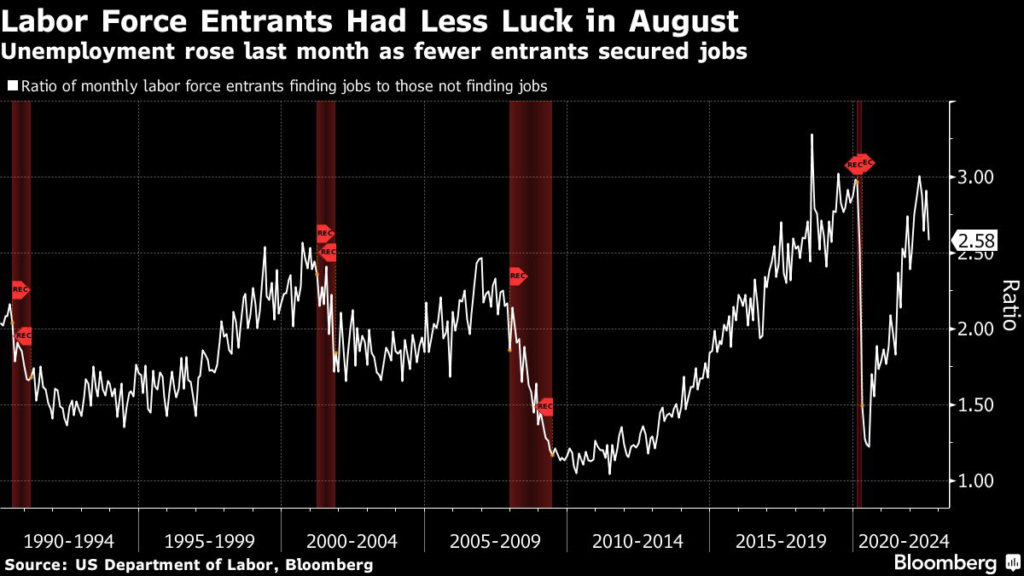
The labor force participation rate jumped to 62.4% last month, pushing the unemployment rate up to 3.7% as the share of those entering the job market who managed to find work declined. But the influx of Americans looking for work still came in the context of continued strong job creation, which historically has been a necessary ingredient for enticing people into the job hunt.

That presents a new wrinkle for the Federal Reserve as it confronts the highest inflation in almost four decades. It has largely given up this year on waiting for increases in the supply of goods, services and labor — all of which have been curbed by the pandemic — to put downward pressure on consumer prices and worker pay. Instead, it has turned its focus to bringing down demand via rapid interest-rate increases.

If participation continues to rise, it could bolster the case at the Fed for a less-aggressive tightening path and raise the chances of a “soft landing” for the US economy. But with only one month of data in hand, that’s still a big “if.”

“What we learned in the report today is that it’s not crazy to think we can be in an environment where we still see this expansion on the labor supply side, and that allows us to ‘land the plane,’ so to speak,” said Julian Richers, an economist at Morgan Stanley in New York. “This definitely contributes to the optimism that they can manage a soft landing.”

After the publication of the monthly Labor Department report on Friday, investors dialed back expectations for the size of the rate hike Fed officials will opt for at their Sept. 20-21 policy meeting, erasing all of the extra tightening they priced in following Chair Jerome Powell’s hawkish Aug. 26 speech in Jackson Hole.

Powell had said “there is clearly a job to do in moderating demand to better align with supply,” adding that the process “would bring some pain to households and businesses,” which investors interpreted as auguring for another three-quarter percentage point increase in the central bank’s benchmark rate, following hikes of the same size at each of its last two meetings.

What Bloomberg Economics Says…

“One data point does not make a trend, and we’re still skeptical that labor supply will continue to expand at such a robust pace. Even before the pandemic, the aging US population was putting downward pressure on the trend rate of labor-force participation.”

—  Anna Wong, Yelena Shulyatyeva and Andrew Husby, economists

— To read more click here

Now, it’s looking more like a toss-up between that and a half-point increase, according to federal funds futures contracts. Another Labor Department report on consumer prices for the month of August, due out Sept. 13, will probably be decisive.

The question for the remainder of the year is whether or not the increase in participation in August was a one-off effect related to a receding pandemic, and whether it can be sustained even in the face of slowing job growth, which many forecasters expect to see as higher interest rates start to weigh on the economy.

“Can you erode demand and boost supply at the same time? Maybe at the margin you can, if people are ready to go back to work, and it’s more of a behavioral change or a psychological change — that it’s a new school year, and it’s time to end this pandemic sabbatical and get back in the labor market,” said Nela Richardson, the chief economist at Automatic Data Processing in Roseland, New Jersey.

“The problem here is if companies start to pause, or be more conservative, in their hiring as a bunch more people come in,” Richardson said. “There’s been a timing mismatch this whole time: First, firms were ready and workers weren’t. Now, workers may be ready and firms may be pausing.”

Labor force participation for Americans between the ages of 25 and 54 jumped to 82.8% last month from 82.4% in July, bringing it just shy of the Feb. 2020 level of 83%. Participation for younger Americans — those between the ages of 16 and 24 — rose too, but at 55.7% is still some way from the pre-pandemic rate of 57%. For Americans of the ages 55 and older, participation actually fell, to 38.6% — well below the Feb. 2020 level of 40.3%.

More labor supply may also have helped put downward pressure on wages: Average hourly earnings rose just 0.3% in August, marking the slowest pace of increase since February. A separate Labor Department report published earlier in the week showed the percentage of Americans who quit their private-sector jobs in July sank to the lowest level in over a year, which may be helping curb wage pressures too.

Some of the details in the participation data, though, were less optimistic. Friday’s report showed participation for White Americans rose by two-tenths of a percentage point in August, while that for Black Americans fell by the same amount. It marked the third straight month of declines in the Black participation rate.

For William Spriggs, the Howard University economics professor and AFL-CIO chief economist, that’s a harbinger of things to come.

“Black people are the canary in the coal mine,” Spriggs said. “When you see Black labor force participation drop like that, that means that Blacks are finding it too hard, and more of them are just saying, forget it.”

More stories like this are available on bloomberg.com

©2022 Bloomberg L.P.
India’s Anti-Money Laundering Agency Searches Paytm, Razorpay

(Bloomberg) — India’s anti-money laundering agency said it was searching the premises of online payment companies including Razorpay Pvt Ltd, Cashfree Payments and Paytm Payment Services Ltd.

The search operations, conducted in the tech hub Bengaluru yesterday, were a part of a probe involving a Chinese loan app case where there were allegations of extortion and harassment of customers, according to an e-mailed statement from the investigation agency. “During inquiries, it has emerged that these entities are controlled/operated by Chinese persons,” it said. 

They forged documents of Indians, making them “dummy directors” of the companies that were generating proceeds of crime through merchant accounts held with payment gateways and banks, the investigating agency said, adding it has seized INR17 crore ($2.1 million).

The latest move underlines heightened scrutiny of Chinese companies, following a Himalayan border clash between the two nuclear-armed neighbors in 2020 that left 20 Indian and four Chinese soldiers dead.

Razorpay said some of its merchants were investigated by law enforcement about a year and a half ago.

“As part of the ongoing investigation, the authorities requested additional information to help with the investigation,” the company said. “We have fully cooperated and shared KYC and other details. The authorities were satisfied by our due diligence process.”

Paytm declined to comment.


More stories like this are available on bloomberg.com

©2022 Bloomberg L.P.
UBS Abandons $1.4 Billion Deal for Robo-Adviser Wealthfront

(Bloomberg) —

UBS Group AG has abandoned its plan to acquire US robo-adviser Wealthfront, unwinding what would have been the Swiss bank’s first major acquisition under Chief Executive Officer Ralph Hamers. 

The companies together decided to terminate their January merger agreement, valued at $1.4 billion, according to statements from both of them on Friday that didn’t specify a reason. UBS will purchase a $69.7 million note convertible into Wealthfront shares.

The planned deal marked Hamers’ effort to put a definite stamp on UBS after former Chairman Axel Weber recruited him in 2020 from Dutch lender ING thanks to his perceived digital skills.

At the time, Hamers trumpeted the Wealthfront acquisition as a cornerstone of his plan to grow UBS’s US operations and widen the lender’s client base by finding a cost-efficient way to also cater to less-rich people, as opposed to the ultra rich who tend to be UBS’s core clientele. 

UBS is “expanding into new segments to reach a much broader set of clients,” Hamers said in the lender’s annual report, published shortly after the announcement. The Wealthfront deal “will help us deliver a digital wealth management offering to Millennial and Gen Z affluent investors in the US, allow us to expand our wallet share, lower the cost to serve and drive long-term growth.”

But UBS reached the deal when financial technology startups were commanding higher valuations. In the months since, US markets, and tech stocks in particular, have tumbled and set off a wave of investor markdowns for privately-held companies. That downturn could even erode Americans’ readiness to invest their savings in the months and years ahead.

The aborted transaction is the latest in a string of failed digital projects that Hamers has led. As ING CEO, he bought the payments provider Payvision, but ING subsequently closed the unit’s adult industry portfolio and phased it out altogether after Hamers had left. ING also announced last year it’s closing its UK retail app Yolt for consumers. It was introduced in 2016 under Hamers. 

Founded in 2008, Wealthfront was an early robo-adviser, using algorithms to help users manage money. Zurich-based UBS was looking to add more than $27 billion in assets under management and over 470,000 clients in the US through the purchase.

“I am incredibly excited about Wealthfront’s path forward as an independent company,” the venture’s CEO, David Fortunato, said in its statement on Friday. He predicted the firm will be cash-flow positive and profitable before interest, taxes, depreciation and amortization “in the next few months.”

(Updates with details on strategy from third paragraph)

More stories like this are available on bloomberg.com

©2022 Bloomberg L.P.
Charting the Global Economy: Unemployment Rate in US Climbs

(Bloomberg) — Sign up for the New Economy Daily newsletter, follow us @economics and subscribe to our podcast.

The US jobless rate rose for the first time since the start of the year, inflation in Europe hit a fresh record high and China’s retail activity showed signs of stagnating because of the government’s Covid Zero policy. 

Meantime, one research group indicated surging energy bills risk leading to a double-digit slump in UK inflation-adjusted disposable incomes and pushing millions into poverty.

Here are some of the charts that appeared on Bloomberg this week on the latest developments in the global economy:

US

Employers added a healthy number of jobs in August and a steady stream of people entering the job market pushed the unemployment rate higher, suggesting a tight labor market is easing and offering mixed implications for the Federal Reserve.

The number of container ships headed for the California ports of Los Angeles and Long Beach — a traffic jam that once symbolized American consumer vigor during the pandemic — declined to the lowest level since the bottleneck started to build two years ago. An all-time low eight vessels were in the official queue as of late Monday.

Europe

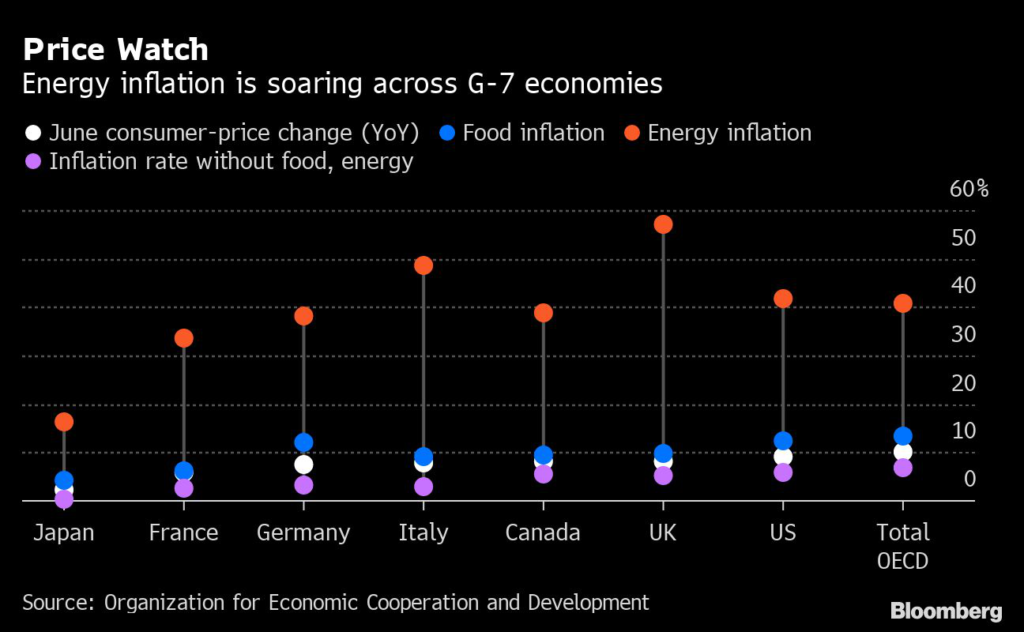
Euro-area inflation accelerated to another all-time high, strengthening the case for the European Central Bank to consider a jumbo interest-rate hike when it meets next week. Consumer prices in the 19-nation currency bloc jumped 9.1% in August from a year ago, led by energy and food. 

Britons are set for the biggest squeeze on living standards in a century unless the next prime minister delivers tens of billions pounds of additional support, according to new analysis. The Resolution Foundation warned of a 10% fall in real disposable incomes over two years as soaring energy bills drive inflation well into double digits. 

Euro-area economic confidence dropped to its lowest level in 1 1/2 years as inflation breaks record after record and limited energy supplies push the region closer to a recession. Sentiment declined in industry and services as energy shortages jeopardize output and soaring prices curb demand.

Asia

China’s economic growth slowdown has triggered a stark contrast in fortunes for its trading partners across Asia, with northern neighbors suffering while economies in the southeast are broadly holding up. The world’s No. 2 economy is still dealing with a slump in consumption and output brought on by lockdowns, compounding the hit to demand from a global semiconductor slowdown.

China’s retail activity flatlined in August with e-commerce demand especially weak, according to satellite data, suggesting that consumer caution due to the ongoing Covid Zero policy and elevated unemployment remain major drags on the world’s second-largest economy.

World

Global inflation is finally coming off the boil, even if it’s set to remain far too hot for the liking of the world’s central bankers. That doesn’t mean an early return to the subdued inflation that much of the world enjoyed before the twin shocks of Covid-19 and the war in Ukraine — or the end of monetary tightening anytime soon.

Central bankers in Hungary raised the benchmark interest rate by a full percentage point to 11.75%, the highest key rate in the European Union. Gambia also lifted its rate by 100 basis points. Guatemala opted for a 50-basis-point hike, while policy makers in the Dominican Republic went for 25.

Emerging Markets

Turkey’s economy lurched forward at a faster rate than expected, as the highest inflation in 24 years prompted consumers to bring forward purchases in anticipation of steeper prices ahead.

About this time last year, Chileans were feeling flush and the local economy was hotter than perhaps any other on Earth. What’s shocking now to many in a country that’s long prided itself on having the most stable economy in all of Latin America is the sudden nature of the turn toward stagflation. It’s happening far more quickly and violently here than across the rest of the globe.

More stories like this are available on bloomberg.com

©2022 Bloomberg L.P.
Google’s Plan to Stare Down Fake News on Ukrainian Refugees

(Bloomberg) — Alphabet Inc.’s Google is hoping an ad campaign can help prevent misinformation percolating about Ukrainian refugees who fled Russian President Vladimir Putin’s invasion from shaping public opinion.

Google is premiering a series of 90-second videos in Poland, Slovakia and the Czech Republic that will seek to educate viewers about how to avoid being manipulated, according to Beth Goldberg, the head of research at its anti-propaganda unit Jigsaw. 

The spread of misinformation has become a major political issue in the European Union, with watchdogs warning that Russian-affiliated sites and social media accounts are promoting false pro-Kremlin narratives six months into the war. An effective response remains elusive, despite an EU ban of Russian state media like RT and new rules ordering internet giants like Google and Facebook parent Meta Platforms Inc. to police their platforms more strictly for hate speech and fake news. 

More than 5.6 million refugees from Ukraine have flooded Europe since the war began, according to the United Nations High Commissioner for Refugees. Many have been welcomed in their host nations, but resentment against them is growing, fueled by surging inflation and economic concerns as Russia cuts energy supplies.

“We’ve seen from past waves of migration there are certain tactics which get used, like scapegoating and fear-mongering,” Goldberg said in an interview. Google’s program will help researchers understand how effective the shorts are at “inoculating” viewers against propaganda, she said.

Russia relies on state-run media, anonymous websites and accounts on digital platforms like YouTube and TikTok to put out a constant drumbeat of conspiracy theories, ranging from a NATO plot to establish a base in Ukraine to the sale of vast tracts of Ukrainian farmland to US agricultural companies, according to NewsGuard, a startup that tracks news credibility. 

Critics say the Kremlin wants to chip away at European unity against the invasion, which has led to unprecedented EU sanctions that have helped hobble Russia’s economy and made it more difficult for Russians to travel to the bloc. 

Russia’s efforts are designed to “undermine the EU’s global standing, reduce the European public’s support for Ukraine, and cause political disruption within the EU,” said Joseph Bodnar, an analyst focusing on Russian disinformation at the Alliance for Securing Democracy. 

‘Pre-Bunking’

Jigsaw will use what it calls “pre-bunking,” or an attempt to build resistance to propaganda by explaining how it works, in countries where narratives demonizing Ukrainian refugees are already spreading, according to Goldberg. 

The strategy was developed by Jigsaw in partnership with researchers at Cambridge University and Bristol University who published a report last week showing it is more difficult to debunk misinformation after it has gained a foothold.

The study, which involved 30,000 participants, concluded that people from a range of ideological backgrounds were better able to identify falsehoods after watching short, sometimes humorous videos that explain common propaganda tools such as drawing false dichotomies.

Attempts to identify and counter fake news have burgeoned since the invasion. In May, Slovak Facebook feeds were flooded with posts that claimed Ukrainians support fascism and the government in Kyiv was secretly developing biological weapons. Meta at the time said it removed some of the content and was working with third-party fact checkers to expose misinformation. 

The Czech Elves, a network of volunteers monitoring online disinformation, said in a May report that Ukrainian refugees were being falsely portrayed as causing prices to rise in the country.

Google’s experience could have implications beyond Europe. Social media companies are bracing for a fresh onslaught of misinformation ahead of the 2022 midterm elections in the US. Facebook and TikTok have announced strategies to fact-check posts and highlight misinformation. 

However, watchdogs have warned that the volume of content posted on these platforms is difficult to sift through. 

More stories like this are available on bloomberg.com

©2022 Bloomberg L.P.
Megawide Plans Bus Terminals, Data Centers From Sale of Airport

(Bloomberg) — Philippine construction company Megawide Construction Corp. will use proceeds from the sale of its stake in Mactan Cebu International Airport to build 10 land transport terminals and enter new ventures including data centers, according to Chief Executive Officer Edgar Saavedra.

Megawide will focus on building “pandemic resilient” infrastructure assets in the next three to five years, including re-development of public markets in towns and cities, Saavedra said at a briefing Friday. The builder can “always go back” to airports when travel returns to normal, he said. Gross proceeds from the disposal of the company’s interest in the Cebu facility amount to 15 billion pesos ($264 million).

“We now have a war chest to fund projects and pursue new opportunities,” Saadvedra said. “We have many projects in the pipeline.” 

Megawide’s venture that runs the Mactan Cebu International Airport was forced to restructure debt because of the effects of the pandemic on its business. The company and its partner, India’s GMR Infrastructure Ltd., agreed to sell the airport venture for 25 billion pesos, with the Philippine company getting 60% of the proceeds.

GMR, Megawide Sell Mactan Cebu Airport Venture to Aboitiz

The sale will cut Megawide’s consolidated debt load, according to Jez dela Cruz, head of corporate finance. The venture’s liabilities include the 25 billion pesos it borrowed to construct the airport. Megawide originally invested 4.4 billion pesos for its 60% stake in the unit, which started in 2014.

Megawide plans to build the land transport terminals across the country over the next three years, adding to the integrated bus hub it runs in capital Manila, Chief Financial Officer Ramon Diaz said in an interview with Bloomberg. Each terminal could cost a billion pesos, he said, adding that the sites have already been identified and contracts for three hubs are underway.

Megawide’s non-affiliation with the nation’s telecommunications companies is an advantage for its data centers since many potential locators are “telecoms neutral,” said Jaime Raphael Feliciano, chief business development officer.

More stories like this are available on bloomberg.com

©2022 Bloomberg L.P.
Close Bitnami banner
Bitnami