

Bloomberg

Chip Exports to China at Risk on New US Rules, Sparking Selloff

(Bloomberg) — The latest US effort to restrict chip exports to China from Nvidia Corp. and Advanced Micro Devices Inc. sparked concern that escalating government actions could cut off some of the semiconductor industry’s biggest companies from the largest market for their products.

Nvidia’s stock tumbled as much as 12% on Thursday after warning that new rules on the export of some artificial-intelligence chips to China may affect hundreds of millions of dollars in revenue. The Philadelphia Stock Exchange Semiconductor Index shed as much as 2.5%, adding to losses that have wiped out a third of its valuation this year. 

US companies are under increasing government scrutiny over what they sell to China, whose electronics factories and consumers make it the biggest buyer of chips. Washington has been tightening restrictions on sales to the country, arguing that it represents a security risk. China has been trying to build its own domestic capabilities to become less dependent on the US, which still dominates design and manufacturing technology needed to make the vital electronic components.

Washington’s actions against China have been concentrated on individual companies that it has accused of being bad actors, such as Huawei Technologies Co. But it’s now shifting slowly toward broader initiatives such as restricting the supply of certain types of advanced chipmaking equipment. Halting the provision of entire classes of chips to China would mark a greater escalation that would hurt the Asian country’s economy and potentially crater sales for some US companies. 

Nvidia’s stock dropped to an intraday low of $132.70 following the disclosure Wednesday that Nvidia’s A100 and forthcoming H100 products will require approval from the US government before they can be sold to Chinese customers. It was the biggest intraday decline since March 2020.

In a separate filing on Thursday, Nvidia said the US government has authorized it to “perform exports needed to provide support for US customers of A100 through March 1, 2023.” Nvidia has also been granted permission to transfer necessary technology to China for the development of its upcoming H100 products. These exports are authorized to be conducted through the US chipmaker’s Hong Kong facility through Sept. 1, 2023, according to the filing. 

That statement did little to assuage investors, who fear a big chunk of Nvidia’s sales are at risk. The company warned in its initial statement that the restrictions may cost it $400 million in revenue this quarter. The time limitations laid out in Thursday’s filing — as well as the fact there was no mention of any license for Chinese customers — suggested the US government is determined to clamp down on access to technology it deems could be misused for military purposes. 

Nvidia relies on the Asian country for about a quarter of its revenue, and the temporary easing likely doesn’t allow it to sell the chips to some of the biggest buyers of that type of technology — Chinese hyperscalers, companies that operate giant data centers full of server chips. 

What the authorization does do, crucially, is allow Nvidia to use Chinese engineers and operations to complete development of its H100 chip, its latest piece of technology for the market.  

“If Nvidia is unable to complete H100 development, the knock-on effects would likely be much larger than the direct revenue exposure in the current quarter,” Matt Ramsay, an analyst at Cowen & Co., wrote in a report. 

Read more: Nvidia gives weak forecast, adding to concerns of chip slump

“We are working with our customers in China to satisfy their planned or future purchases with alternative products and may seek licenses where replacements aren’t sufficient,” the company said on Wednesday. “The only current products that the new licensing requirement applies to are A100, H100 and systems such as DGX that include them.”

AMD said Wednesday that it received a similar notice from the government, though it doesn’t expect a significant impact. “At this time, we do not believe that shipments of MI100 integrated circuits are impacted by the new requirements,” the company said in a separate statement.

According to Nvidia’s Wednesday filing, the government’s new rules specify chips with certain performance capabilities.

The rules apply to both China and Russia, though Nvidia and AMD no longer sell to Russia.

Separately, Intel Corp., the US’s biggest chipmaker, which is bringing to market a competitive product to those highlighted by the latest action by Washington, said it hasn’t been impacted by the new rules.

“While we understand the US Government is continuing to look at new restrictions, no new export control rules have been published and there are currently no changes to our business,” Intel said in a statement. “We are closely monitoring the process.”

More stories like this are available on bloomberg.com

©2022 Bloomberg L.P.
Tencent Targets About $14.5 Billion in Divestments, FT Says

(Bloomberg) — Tencent Holdings Ltd. has set a soft target of divesting about 100 billion yuan ($14.5 billion) of its $88 billion listed equity portfolio this year as it shifts strategy, the Financial Times reported, citing two unidentified people familiar with the matter.

Food-delivery service Meituan is among the assets that are in the pipeline for divestment, the paper reported. A reduction in the stake could ease pressure from anti-monopoly regulators.

A spokesperson for Tencent disputed the report in an emailed statement. “We don’t have any target amounts for divestments,” the spokesperson wrote. “We have always invested with the goal of generating strong returns for our company and shareholders, not according to any arbitrary timeline or target. Nor have we received any external pressure regarding our investment portfolio.”

Beijing since late 2020 has worked to curb the influence of tech industry leaders from Tencent to Alibaba Group Holding Ltd. The two companies exert enormous sway over the Chinese internet economy through part-ownership of hundreds of startups and publicly traded firms. 

The WeChat operator last year began disclosing plans to sell shares in investees such as e-commerce giant JD.com Inc. and Southeast Asia’s Sea Ltd. That in turn spurred speculation it would soon consider paring stakes in other firms such as Meituan and Pinduoduo Inc. Earlier this month, Tencent executives said a report that the company planned to sell all or most of its $24 billion stake in Meituan was not correct.

The Shenzhen-based company’s biggest investments include Sea Ltd., Kuaishou Technology and Bilibili Inc.

The American depositary receipts of Pinduoduo dropped as much as 1.8% in extended trading in New York, while Sea slipped as much as 1.3%. 

The disinvestment drive has begun though there are still discussions on which stakes in non-core businesses would be pared, and the price, the FT reported. Sales would depend on market conditions and internal targets. 

(Updates with Tencent comment in the third paragraph.)

More stories like this are available on bloomberg.com

©2022 Bloomberg L.P.

Stocks Pare Losses as Traders Digest Robust Data: Markets Wrap

(Bloomberg) — US stocks fell for a fifth day and a measure of the dollar surged to a record after recent data showed the American economy remained robust last month even as the Federal Reserve stepped up its inflation battle.

The policy-sensitive two-year Treasury yield topped 3.5% and the dollar rallied on speculation the latest data will force the Fed to raise rates by three-quarters of a percentage point at its meeting later this month. The S&P 500, which dropped as much as 1.3%, pared losses later in the session as some investors turned opportunistic. 

US manufacturing growth steadied in August, while jobless claims came in lower than estimated, adding to a flurry of data this week that show the American economy can likely withstand additional harsh central bank tightening. Investors on Friday will receive the last reading on unemployment before the Fed’s next meeting. August inflation data is due Sept. 13.

“Any upbeat data that we’ve had this week has actually since stock markets lower, just because the market’s in turn is interpreting it as paving the way for a more aggressive Fed,” said Fiona Cincotta, senior financial markets analyst at City Index. “So I think we are just also seeing this real realization that the economy is going to slow. The Fed is going to hike rates firmly and keep them elevated.”

But some investors may be positioning themselves to taking advantage of recent dislocations in the market.

“We’re taking a more opportunistic tone when it comes to markets,” Ashish Shah at Goldman Sachs Asset Management said on Bloomberg TV. “There’s going to be a lot of back and forth through the data and you want to set yourself up to be investing because sitting in cash is really expensive right now.”

Stocks are also entering a month that is often poor for returns, following losses in August. The S&P 500 has averaged declines of 0.6% and 0.7% for August and September, respectively, over the past 25 years.

“Right now you have to be patient,” said Megan Horneman, chief investment officer at Verdence Capital Advisors. “I wouldn’t try and get in the middle of this kind of reset and re-pricing we’ve seen. The markets can move pretty violently.”


Risk assets had been under pressure after China put the megacity of Chengdu under lockdown, delivering a blow to economic growth. Chengdu’s lockdown continues to ripple through the economy. Factory slowdowns in Europe and Asia also reflect dwindling demand.

Investors are also assessing political risks as Russia’s invasion of Ukraine continues and tensions in Taiwan mount, with the latter shooting down a civilian drone after weeks of complaints about incursions by unmanned aerial vehicles from China.

Russia is considering a plan to buy as much as $70 billion in yuan and other “friendly” currencies this year to slow the ruble’s surge, before shifting to a longer-term strategy of selling its holdings of the Chinese currency to fund investment. 

“The Fed effect is now melding with other global factors such as China’s growth slowdown and Europe’s stagflation to create a more fraught global macro environment with higher rates and lower growth,” said Alvin Tan, strategist at RBC Capital Markets in Singapore. “It is this combination of hawkish central banks led by the Fed, China’s slowdown and Europe’s stagflation that is now driving volatility across global markets.”

Here are some key events to watch this week:

  • ECB Governing Council members due to speak at event Tuesday through Sept. 2
  • US nonfarm payrolls, Friday
  • UK leadership ballot closes Friday. Winner announced Sept. 5

Will Chinese sovereign bonds outperform Treasuries? China is the theme of this week’s MLIV Pulse survey. Click here to participate anonymously.

Some of the main moves in markets:

Stocks

  • The S&P 500 fell 0.3% as of 2:56 p.m. New York time
  • The Nasdaq 100 fell 0.7%
  • The Dow Jones Industrial Average was little changed
  • The MSCI World index fell 0.6%

Currencies

  • The Bloomberg Dollar Spot Index rose 0.7%
  • The euro fell 1% to $0.9949
  • The British pound fell 0.7% to $1.1541
  • The Japanese yen fell 0.9% to 140.18 per dollar

Bonds

  • The yield on 10-year Treasuries advanced seven basis points to 3.26%
  • Germany’s 10-year yield advanced two basis points to 1.56%
  • Britain’s 10-year yield advanced eight basis points to 2.88%

Commodities

  • West Texas Intermediate crude fell 3.5% to $86.44 a barrel
  • Gold futures fell 1.1% to $1,706.60 an ounce

More stories like this are available on bloomberg.com

©2022 Bloomberg L.P.

YouTube to Label US Election-Related Videos and Searches With Context

(Bloomberg) — YouTube said that it will add contextual information underneath election-related videos and in search results for the US midterms in the coming weeks, an initiative aimed at curbing the spread of falsehoods on the Google-owned video platform.

YouTube will roll out information panels in two languages, English and Spanish, when users search for information about the election, Leslie Miller, YouTube’s vice-president of government affairs and public policy, said Thursday in a blog post. The video site will also promote authoritative content from national and local news sources, and work to quickly remove videos that violate its community guidelines, including ones that mislead voters on how to vote, encourage interference in the democratic process, incite violence, or promote other types of election misinformation. YouTube said that it had already pulled a handful of videos that contained false claims of widespread fraud, errors and glitches in the US presidential election, though it did not specify how many.

“Over the years we’ve built policies, systems and teams that raise authoritative content and limit the spread of harmful misinformation,” Miller said in the blog post. “Whether it’s learning about when and where to vote, or finding information about political candidates, we take seriously our commitment to connecting viewers with trusted resources.” Starting on Election Day, the company said, people will see information about election results underneath videos and in search results related to the midterms, and will be able to track results live. But YouTube did not say whether its information panels would address false election-related rumors in real-time.

Misinformation on major social media platforms has proliferated in recent years, surfacing around especially newsworthy periods like elections as candidates fight for votes, and political pundits and social media influencers fight for attention and ad dollars. YouTube has historically lagged behind other platforms in cracking down on different types of misinformation, often announcing stricter policies weeks or months after platforms like Facebook and Twitter. YouTube’s announcement on Thursday detailing an expansion of its election misinformation policies follows similar pronouncements from Facebook, Twitter and TikTok last month. Its parent company, Alphabet Inc.’s Google, published a blog post in March reiterating the video platform’s longstanding policy to prohibit false claims about widespread fraud in the outcome of past US presidential elections.

When YouTube does take a strong stance on misinformation, research has shown that it makes a difference in terms of what ends up going viral across other social media. Last October, researchers at the Center for Social Media and Politics at New York University published a study describing how after Dec. 8, 2020, the day YouTube announced that it would remove videos promoting unfounded theories about election fraud and errors, it was followed immediately by sharp drops in the prevalence of false and misleading videos on Facebook and Twitter.

More stories like this are available on bloomberg.com

©2022 Bloomberg L.P.
Comcast Looks to Cut Up to $1 Billion From Budgets at Its TV Networks

(Bloomberg) — Comcast Corp. is looking to cut as much as $1 billion from the budget of the TV networks in its entertainment division, NBCUniversal, money it can use to boost other parts of the business, according to people familiar with the company’s plans.

NBCUniversal Chief Executive Officer Jeff Shell has asked his top deputies to find savings at its legacy cable and broadcast TV networks, said the people, who asked not to be identified because the plans haven’t been finalized. Executives have explored many ways of cutting costs — including layoffs, trimming budgets for the development of new programs and changing the mix of programs on TV to produce more low-cost shows.

Comcast is in the middle of setting its budget for next year, and Shell has yet to make final decisions about how many cuts he will make or where they will occur. Those decisions are expected in the next couple weeks. Reallocating money from profitable but slow-growing TV networks could allow Comcast to invest more resources into its streaming service, Peacock, as well as its theme parks. 

Bankers, analysts and executives have been speculating about what Comcast will do to boost its media business. NBCUniversal is one of the largest entertainment companies in the world — the owner of the NBC broadcast network, along with Universal’s movie studio and theme parks. It has a suite of cable channels, such as Bravo and E!, but has been one of the slowest of the major media companies to build up its streaming operations. 

Peacock, at 13 million subscribers, showed no growth in the most recent quarter. It lost close to $500 million. To make matters worse, Comcast, the largest US cable TV provider, also reported no new customers for its internet access business.

Comcast explored a merger with video-game maker Electronic Arts Inc., and has discussed other potential targets. 

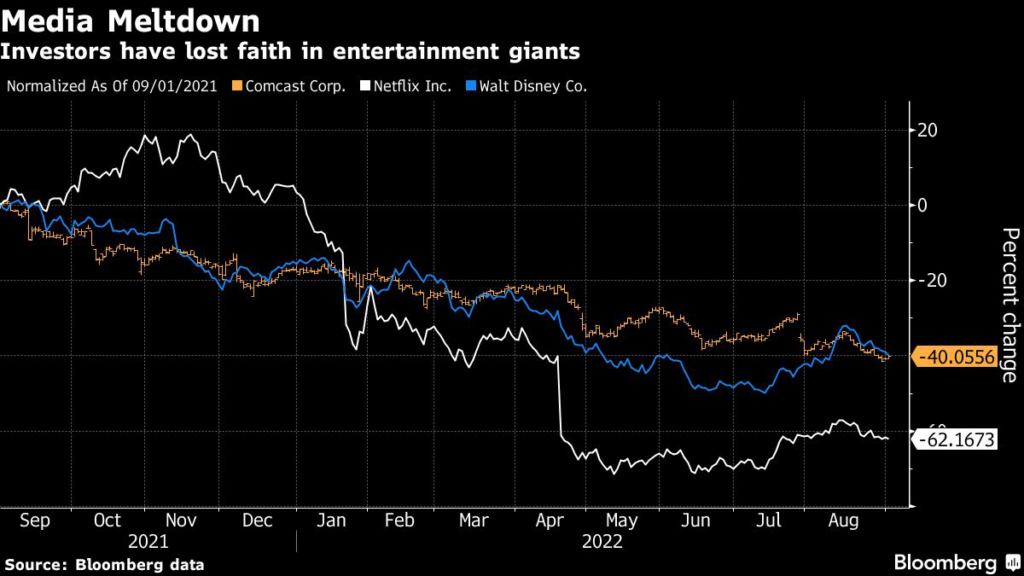
Every major media company is looking to cut costs due to pressure from Wall Street. Warner Bros. Discovery Inc. is in the process of firing thousands of workers and has said it will find $3 billion in cost cuts after its big merger, while Netflix Inc. has slowed the growth of its investment in original programming.

Investors once rewarded media companies for spending billions of dollars on unprofitable but growing streaming services. The recent struggles of Netflix, exacerbated by fears of a looming recession, have prompted investors to be more focused on profit than growth.

The companies can’t cut from streaming, their fastest-growing segment and one widely viewed as the future of the entertainment industry. They now need to find ways to cut budgets at their traditional TV networks without making them unappealing to viewers. Comcast’s TV networks still generate billions of dollars in profit a year.

NBCUniversal has already shut down or sold a couple of smaller sports cable networks and has shifted sports content such as the English Premiere League and Nascar to more popular channels such as USA. The company has discussed eliminating an hour of prime-time programming a night at the NBC broadcast network, the Wall Street Journal reported last week. The company is exploring ways to put more resources and top shows on Peacock, which unlike many streaming rivals hasn’t produced many hit original series.

Shell has been encouraging the company to prioritize Peacock, as evidenced by its higher spending and losses. But he’s still working to better integrate his different teams and divisions so that his direct reports are invested in Peacock’s success. The head of Peacock, Kelly Campbell, reports to direct-to-consumer chief Matt Strauss. Both Strauss and Susan Rovner, who oversees entertainment programming for NBCUniversal’s TV networks and streaming service, report into Mark Lazarus, the overall head of TV and streaming. The executives who run NBCUniversal’s movie studio, TV studio and news division all report to Shell.

(Updates with reporting structure in final paragraph.)

More stories like this are available on bloomberg.com

©2022 Bloomberg L.P.

Draghi Discussed Eni, GSE Hacks With Senior Officials Thursday

(Bloomberg) — Italian Premier Mario Draghi discussed hacker attacks on oil giant Eni SpA and other Italian energy companies with senior officials at a high-level security meeting Thursday, according to people familiar with the matter.

Draghi and his undersecretary for security, Franco Gabrielli, held discussions at a meeting of the so-called Interministerial Committee for Cybersecurity, said the people who declined to be named as the discussions were not public. A spokesman for the Italian government declined to comment. 

Eni said Wednesday its internal protection systems had detected unauthorized access to its networks, though the consequences so far appeared to be minor. Earlier in the week, Italy’s energy agency GSE said that it suffered a breach on Sunday night and Monday morning. 

Read more: Hackers Hit Italian Oil Giant Eni’s Computer Network (1)

More stories like this are available on bloomberg.com

©2022 Bloomberg L.P.

X-Shore CEO Says Its $99,000 E-Boat Could Herald a ‘Tesla Moment’

(Bloomberg) — X Shore AB is planning to sell a new electric boat at a similar price to traditional vessels, a move that could significantly broaden sales beyond the wealthy, the startup’s chief executive said. 

The X Shore 1 starts at $99,000 before tax, a fraction of the price of other electric boats, including X Shore’s Eelex 8000, which starts at $329,000, Stockholm-based CEO and founder Jenny Keisu said in an interview.

“We could easily continue to sell 40 boats per year to very wealthy individuals,” Keisu said. “But if you want to see real impact, you need to replace traditional boats, and for that to happen the electric boats must become cheaper.”

X Shore is one of several companies pushing the boat industry to start replacing combustion-engine leisure boats with battery-powered vessels. Keisu likened the launch of the X Shore 1 to a possible “Tesla moment” for electric boats. 

“When Tesla launched its Model 3, and brought down the price of an electric car on par with that of a regular one, it pivoted the entire industry,” she said. 

Keisu, who previously worked for private equity firm Nordic Capital and founded Summa Equity, one of Europe’s largest impact funds, said she aims to produce a net-zero emissions boat by 2030. The comparatively long lifespan of a boat means it will take longer to replace the existing combustion-engine fleet than it will for cars.

“If you show competitors that something is possible, they have no alternative,” she said.

To quickly ramp up production of the new model, X Shore will need to raise additional capital, Keisu said. The last round of fundraising in April added $50 million from investors including Peter Carlsson, founder and CEO of Swedish battery developer Northvolt AB.

X Shore also needs to make significant investments to secure access to components amid the global supply-chain problems. 

Keisu said it’s likely that X Shore will need to raise more capital within one year. She added that should “the board come to the conclusion that we should go public, and the market is open for it, we could move very quickly.”

More stories like this are available on bloomberg.com

©2022 Bloomberg L.P.

Microsoft Combat Goggles Win First US Army Approval for Delivery

(Bloomberg) — The US Army is taking delivery of a first batch of high-tech combat goggles made by Microsoft Corp., citing encouraging results from testing in the field.

Assistant Secretary for Acquisition Douglas Bush has “cleared the Army to begin accepting” some of the 5,000 sets of goggles, spokesman Jamal Beck said in a statement. Their delivery had been placed on hold over concern about the device’s performance until more rigorous testing took place.

Based on the test results so far the service “is adjusting its fielding plan to allow for time to correct deficiencies and also field to units that are focused on training activities,” Beck said.

Microsoft’s Integrated Visual Augmentation System, or IVAS, is expected to provide a “heads-up display” for U.S. ground forces, similar to those for fighter pilots. The system — a customized version of Microsoft’s HoloLens goggles — would let commanders project information onto a visor in front of a soldier’s face and would include features such as night vision.

The Army projects spending as much as $21.9 billion over a decade on Microsoft’s combat goggles, spare parts and support services if all options are exercised. 


Bush’s directive to accept delivery, issued last month but not previously disclosed, marks a show of faith in the Microsoft product. A final test report, which isn’t expected until next month, is being drafted by the Pentagon’s director of operational test and evaluation. “We did a good test and will learn from it,”  Bush said in an earlier statement informed by the emerging results. “The Army remains confident that the program will succeed.” Microsoft declined to comment.

The Army placed its initial order for the 5,000 goggles valued at $373 million in March 2021. The order was to be the first of a potential 121,000 over a decade but was placed on hold later last year when the service delayed deployment of the device “to continue to enhance the technology platform.”

The test report will help Congress decide whether to approve the $424.2 million the Army proposed to spend on the program for the fiscal year starting October. The House and Senate appropriations panels proposed deep cuts to the Army’s request pending the test results.

More stories like this are available on bloomberg.com

©2022 Bloomberg L.P.
WestCap, Backer of Splashy Startups, Marks Down Funds by a Fifth In Tech Rout

(Bloomberg) — Laurence Tosi’s WestCap Management wrote down the combined value of its main investment funds by almost a fifth in the second quarter as prospects dim for Silicon Valley startups to swiftly generate windfalls.

Tosi, the former chief financial officer at Blackstone Inc. and Airbnb Inc., founded WestCap in 2019 and won over customers with its focus on marketplace-oriented startups and a pitch that they could lean on its team of business specialists. WestCap has helped fund a variety of buzzy ventures including mental-health-care provider Cerebral Inc., crypto lender Celsius Network and Klarna, the e-commerce payments company with the motto “Shop now. Pay later.” 

Such wagers haven’t fared well in this year’s tech rout. WestCap cut the value of its first fund by some $750 million to about $2.5 billion in the quarter, according to people familiar with the matter, who asked not to be named because they weren’t authorized to speak publicly. WestCap also reduced the valuation of a newer fund by about 5%.

The downturn is testing WestCap’s proposition: It can not only spot which maturing startups have the power to transform into industry leaders, it can spur them along with its expertise. WestCap executives have told investors and others that the firm is now focused on helping a number of portfolio companies respond to the market turmoil or deal with other problems, people close to the company said.

The first fund, launched in 2019, was still valued at 2.6 times its invested capital as of June. And using one measure of returns, it’s delivering an 83% net internal rate of return as of June. 

“Our unique operating platform consistently drives best-in-class returns,” the firm said in a statement to Bloomberg. “While we accurately reflect current market conditions in a quarter, we manage 10+ year funds and have the time and skill and experience to further create value with our companies and for our investors.”

Earlier this year, the firm gave investors in its first fund the option to cash out by selling stakes to new investors.

Unicorn Era

Signs of fatigue are showing after a heady era in which savvy investment firms poured money into Silicon Valley unicorns with unpredictable profits and later minted billions as the ventures sought public listings. Federal Reserve efforts to fight inflation are cooling the stock market, sending the tech-heavy Nasdaq Composite Index down more than 25% this year and prodding private investors to reassess their valuations of promising private enterprises. Some venture capitalists are sitting out funding rounds that once helped fuel startups’ growth, further undermining their prospects.

The rout has hit once highflying buyers of private stakes such as Tiger Global Management. Growth-oriented funds from firms such as Blackstone and TPG Inc. have also taken some writedowns. It’s a reminder that the industry, despite its goal of uncorrelated returns, isn’t immune to steep market swoons.

When marketing WestCap, Tosi, who goes by the nickname LT, touted his credentials at Merrill Lynch, Blackstone and Airbnb, and his employees’ experience at Ipreo, a fast-growing data provider that once counted Blackstone as an investor. 

He signed up wealthy investors and institutions, such as South Carolina’s state pension-fund manager. By the end of last year, WestCap reported more than $7.6 billion under management. 

Like other growth-equity firms, WestCap participates in funding rounds and doesn’t take majority stakes or seek to exert the same influence as buyout firms. But over the years, it has made staff available to companies to support them in marketing, cash management and other functions. A top executive at one portfolio company said WestCap’s team also serves as a sounding board for ideas.

In recent weeks, WestCap has privately updated investors on the state of its holdings. 

It slashed a valuation for Cerebral by half in the quarter ended June. That pegged the SoftBank-backed startup at roughly three times WestCap’s original investment, down from about six. Cerebral told employees this year it would stop writing new prescriptions for controlled substances that treat attention deficit/hyperactivity disorder. The US government is scrutinizing how such businesses dispense stimulants, and in May Cerebral said it’s cooperating with an investigation into whether it violated the Controlled Substances Act. It hasn’t been charged with wrongdoing.

Read more: Cerebral receives grand jury subpoena from U.S. attorney

WestCap also cut the valuation of Klarna below its original investment. The firm had previously valued it at 1.4 times invested capital. A fundraising round this year valued Klarna at $6.7 billion, a fraction of the $45.6 billion it commanded last year as the lender became Europe’s most valuable startup.

WestCap marked down its stake in checkout business Bolt by about half from March valuations, and it also cut a valuation for Sonder Holdings Inc. even further below the level at which it invested. The rental company went public by merging with a special purpose acquisition company and is down more than 80% this year.

Some investments such as travel site Hopper Inc. and wealth-management platform Addepar Inc. are helping to bolster returns. 

In a March regulatory filing, WestCap said the fund behind those deals is “substantially through its investment period, and, subject to relatively modest follow-on investments, is substantially fully invested.” It is deploying some of the fund’s remaining spare cash to support companies, people familiar with the matter said. WestCap could consider injecting more cash using money from its second fund, something it’s done before, the people said. 

The firm raised some $2.25 billion for a new fund by last year, Bloomberg reported at the time, and it’s continuing to seek money from institutions and high-net-worth individuals.

Many investments in the newer fund are still valued at cost. WestCap wrote down one company, Celsius Network, to some 15 cents of every dollar invested. The embattled crypto lender filed for bankruptcy in mid-July.

More stories like this are available on bloomberg.com

©2022 Bloomberg L.P.

Cash-Strapped Bed Bath & Beyond Is Taking a Lesson From Best Buy

(Bloomberg) — Bed Bath & Beyond Inc., short on cash and time, is trying to have its Best Buy moment.

While many US retailers’ attempts at a turnaround have failed in recent years, Best Buy Cos.’s is one of the few that’s succeeded. The electronics chain overcame relentless online competition and management missteps to regain its stature during the past decade. It stands out as an example for Bed Bath & Beyond, where executives are betting on a plan that includes more debt financing, issuing shares, cutting costs and revamping merchandise.

The home-goods retailer announced Thursday it had secured more than $500 million of new financing. The company is pledging to increase its sales and recapture market share, much as Best Buy did. 

Best Buy is “the one poster child for a retail turnaround,” said Cristina Fernandez, a Telsey Advisory Group analyst. Among big-box stores that operate with tight profit margins, Best Buy was able to win back customers, strengthen frayed relationships with vendors and improve e-commerce, Fernandez said. “Today, they are considered a strong and high-quality retailer.”

See also: Matt Levine writes that Bed Bath & Beyond missed the memes

Best Buy achieved that by becoming a go-to store for consumers to test competitively priced electronics products. Expert advice from staff — a service unavailable from competitor Amazon.com Inc. — was key to winning back sales. 

Fernandez and other analysts aren’t optimistic Bed Bath & Beyond can forge a similar path, however. “They don’t have all the time in the world to execute this turnaround,” she said. 

While Best Buy focused on preserving cash to shore up its finances and improve operations, Bed Bath & Beyond has returned a lot of cash to shareholders in recent years. While that helped to boost the stock in the short term, it’s limiting the company’s flexibility today. The recent financing agreements alleviate some pressure, at least for now. 

Still, S&P Global Ratings on Thursday reduced Bed Bath & Beyond’s credit rating to CCC- from CCC, citing “very weak” prospects as well as “ongoing cash burn, unfavorable macroeconomic conditions and our view that vendor relationships could be strained.” That’s nine levels below investment grade, with entities at that level classified as vulnerable to nonpayment and dependent on favorable conditions to meet its commitments. 

Bed Bath & Beyond shares fell 7.1% to $8.86 at 1:48 p.m. on Thursday in New York trading, bringing its year-to-date decline to almost 40%. 

See also: Bed Bath & Beyond pushes fragile market with plan to sell shares

The company “is arguably in this vicious cycle of challenged market share and inability to really invest in market-share stabilizing initiatives,” Fitch Ratings analyst David Silverman said. “These vicious cycles are pretty difficult to get out of.”

The new financing “only kicks the can down the road,” Raymond James analyst Bobby Griffin said in a research note, adding the current business trends “remain abysmal.” 

In a reversal of its strategy over the past couple of years, Bed Bath & Beyond is looking to decrease the amount of private-label products it sells. Former Chief Executive Officer Mark Tritton had boosted the company’s own brands from around 10% of sales to an estimated 25% at the end of last year. While private labels are typically more profitable for retailers, at Bed Bath & Beyond many products failed to resonate with shoppers who had come to the chain for name-brand goods. 

“The private-label strategy they tried to implement clearly failed,” Wedbush analyst Seth Basham said. Tritton exited this summer. Now, Basham says, executives are “reverting back to what they tried before” — but with a slight twist. They’ve said they will increase their offering of well-known national brands while also aiming to bring in more innovative products that shoppers might have a hard time finding elsewhere at the same price — a la Best Buy.

The problem, Basham said, is it might be too late. Comparable sales fell by about 25% in the first quarter from a year earlier and executives warned they are likely to fall again by about the same amount in the current one.

“They have lost the interest of so many customers already,” Basham said, “I think it’s going to be tough to win them back.”

(Updates to add S&P downgrade in eighth paragraph and share trading in ninth paragraph.)

More stories like this are available on bloomberg.com

©2022 Bloomberg L.P.

Close Bitnami banner
Bitnami
